
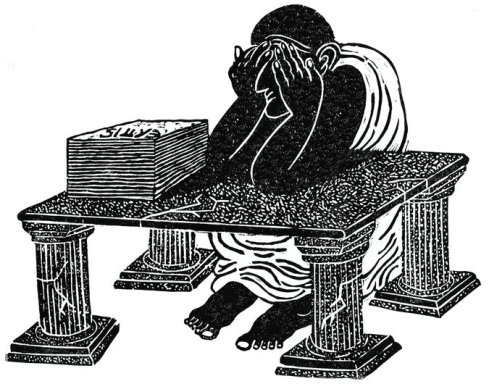
 WHEN I moved my Beginning Greek course, last year, from the spring to fall semester, I did not reckon with the impact on my psyche of diminishing daylight. As the days grew shorter, my thoughts about the course grew darker. When the semester concluded, just before the winter solstice, those thoughts had also reached a nadir, giving way to the fear that I had failed, once again, in my 30-year quest to turn bright and eager undergraduates into readers, and lovers, of ancient Greek.
Sisyphus would sympathize with my condition. Every year I begin rolling my stone up a four-month-long hill, my hopes high. Every year I end up far closer to the bottom than the top. Some of my students still, after 120 hours of instruction, take the first noun in a sentence as its subject, no matter what form it’s in. Their habits of 15 years of reading English will not give way to the methodology that an ancient language demands.
Reading Greek (or Latin) depends, first and foremost, on recognition of case endings. A student must develop an instinct for seeing the word “anthrōpou” as “of a man,” “anthrōpois” as “for men,” and similarly with eight other forms of the same word. To look for meaning rather than case, to see only “man” in either word, is what readers of English are programmed to do. My task, as a teacher, is to defeat this impulse. The experience of reading without reference to word order, once students “get it,” can be exhilarating, like being freed from a kind of gravity.
But for reasons I don’t understand, some take far longer than others to “get it,” and a few never will. Lack of intelligence isn’t the problem; it’s more about adaptability, acceptance of change. How long should such students go on in the language, hoping for an epiphany? Should I encourage them to continue? And if I do, is it only to assuage my own sense of failure?
Paradoxically, the mood in my classroom brightened as the days grew darker. I counterweighted my own internal gloom with saturnalian energy and verve. Anecdotes and digressions proliferated, sometimes drawing boisterous laughter. But the levity masked a sense of unease, a fear that standards were not being met. The number of sentences that couldn’t be cracked, or even attempted, had grown; whole pages of the workbook stood blank. The day of reckoning loomed — the final exam.
It’s at such times that Professor de Breeze swims into my thoughts. He’s one of the useless, blinkered obsessives who populate the nihilistic landscape of Dr. Seuss’s darkest exploration of human folly, “Did I Ever Tell You How Lucky You Are?” The anapests that describe him run through my mind on a daily, sometimes hourly, basis:
How fortunate you’re not Professor de Breeze
Who has spent the past thirty-two years, if you please,
Trying to teach Irish ducks how to read Jivanese.
Am I Professor de Breeze? The span of my teaching career is rapidly approaching his. Of the scores of students to whom I have taught Beginning Greek, only a small minority learned to read it with real comprehension, and of those, only a handful still do. What did I contribute to the others, except the most laborious eight credits they ever earned?
Oblivious to my struggles, the textbook tries, every year, to crown my students’ achievements by offering them long passages from Sophocles, Homer and Plato. I assigned, for last term’s final exam, a reading from “Antigone” that contains one of my favorite Sophoclean lines: “You have a warm heart for cold things,” says the cautious Ismene to her sister Antigone, to dissuade her from defying state decrees and burying their brother. I contemplated the satisfaction my class would get from translating this verse, which seemed to offer little difficulty, apart from the separation of “heart” from its modifier “warm.”
As I graded the exams, however, I found Professor de Breeze once again looking over my shoulder. “You have a warm heart because of the cold,” read one version; “you have a warm heart in addition to a cold one,” ran another (several variants on this theme). One ingenious student came close with “You have a warm heart for cold men” — a possible meaning, though it makes Antigone’s care for her brother’s corpse sound like necrophilia. Two out of my 10 students had understood the line. Wearily I uncapped my red pen, my sins lying heavy upon me.
It’s been said that, for nonstellar teachers at least, the hardest things to teach are the things one loves most. When I tried, years ago, to read “King Lear” with a group of indifferent freshmen, I made a complete botch of things; my investment in their seeing the play as I did was too great. The same feeling afflicts me on a daily basis when teaching Greek, though I have learned better how to suppress it. “I will be the pattern of all patience,” said Lear when his daughters disappointed him, and I have long wanted to emblazon that line over the door of my classroom. No one in that room, I must remind myself, will “hear” the Antigone passage as I want them to, at least not without lots of help. I must have a cold heart for warm things.
“Oimoi katauda,” Antigone screams — “Shout it to the skies!” — when Ismene urges her to keep her plan secret. That “oimoi,” a cry of pain both mocking and sincere, gives vivid insight into Antigone’s state of mind; lines like this are the best argument one can find for learning Greek. It’s untranslatable, yet translate we must. Our textbook offers either “Alas” or “woe is me,” and there’s little to choose between the two. The sarcasm of “katauda” — “shout it out” — is lost without a better sense of “oimoi,” and I could tell from the exam papers that few of my students had gotten its point. Most, at least, had recognized it as an imperative form.
With that cry of pain, the exam, and the semester, had ended. Antigone was doomed to die, but at least had managed to spread a little dust on her brother’s corpse. In Beginning Greek, too, one settles for small victories and accepts huge shortfalls. But giving up is not an option.
As I finished grading, word arrived of the results of spring registration. Eight of my 10 students had chosen to go on to next semester’s Greek course. The news, I was surprised to find, made me unreservedly happy.
The solstice had passed, and the days were already brightening.
James Romm is a classics professor at Bard College.
***********************************************************
As a former language teacher, even if just English, I thought some of the comments were right on too.
John
Palo Alto 21 hours ago
Learning Greek was one of the great academic challenges of my life — I was a classics major who concentrated mostly on Latin, but still took four years of Greek. I can still remember my brain overheating as I translated, trying to keep all those moving parts straight. I can also still remember the joy when a passage finally came together.
I didn’t graduate all that long ago, but my Greek is hopelessly rusty now. That said, it wasn’t a waste, even though my work has nothing to do with Sophocles or Xenophon: Greek and Latin taught me how to think systematically and did wonders for my English writing. They also allowed me four years of small classes and tons of attention from professors who loved teaching and sharing their passion for the ancient world. I don’t think everyone should have to learn Greek & Latin, but if you’re fortunate enough to be pursuing a liberal arts education, older niche fields like classics are hidden gems, and a lot more fun than an over enrolled Econ or English department.
Longue Carabine
Spokane 21 hours ago
The problem with language learning is always grammar. You really never understand English grammar until you encounter foreign languages; in your own language it has become intuitive– to speak another you have to learn it. Then, you understand the grammar of your own language for the first time. The sentence diagrams of 8th grade finally come to make sense…
“If I had been there then, I would have done that”….learn it in a foreign language, and you’ll finally understand the complexity of what you take for granted in English.
Cases are hard. French for me was so much easier than German; no comparison.
creepingdoubt
New York, NY US 21 hours ago
A delightful piece. To those who feel that Professor Romm is hopelessly leading his students backward into a language — a cavern — growing darker and more remote with each passing decade, I’d say, “Hold up.” Let’s attend and try to hear his cri de coeur.
I think he doesn’t so much want his students to wend and twist their way back into classical Greek simply for its own sake as much as he wants them to hear the cries of the ancients unfiltered by today’s tropes, the “thinking” that we can all “relate” to. I imagine that by insisting on correct grammatical order he’s trying to help his students hear, and feel, the words as the Greeks might have heard, felt and acted upon them. He believes that one can make one’s way via grammar and syntax into the minds and hearts of the Greeks. Then, having “gotten” it the Greeks’ way, we can return to our syntax, our certainties, and be in even more secure possession of our world.
Antigone’s cry is ancient but it surely isn’t dead. She was crying out for justice. Do we really want to forgo any possible path to better understanding that vital concept?
See rest of comments — genuinely interesting, some: “Beginning Greek, Again and Again.“
 Jadde: from Bosnia to Bengal
Leave a comment