Tag Archives: Croats

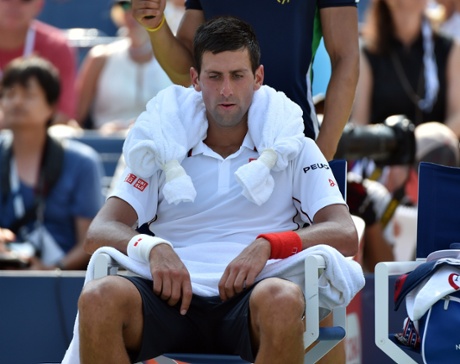
Djoković at his worst…

6 Sep

368d4e2a-509b-40a6-af0b-56c9241a6773-460x364Photograph: Stan Honda/AFP/Getty Images

Moody, distracted, irritable, unable to come back from even the tiniest initial set-back, seemingly pissed off that it’s hot — like it’s a personal conspiracy against him — pissed off that #11 seed can be winning against him; till he decides he’s just too exhausted to even try and throws it in like a little child who doesn’t want to play anymore.

I don’t know why so much tennis is played in the most vicious heat imaginable either — July in London, New York in September, Melbourne in January — but deal with it.  It’s not like the gods have set up an invisible parasol for your opponent.  And, he’s not that much younger than you.

Then you got the announcers: “Having to be away from pregnant wife Jelena must be taking its toll on Novak too…”  Spare me the heterosentimentality, please.  (Or maybe they’re right: cherchez la femme…she’ll drain you dry every time…)  I adore this dude, but when he just gives up, he just gives up and it’s a real let-down for fans.  You’re getting too old for this sh*t Nole; the pissy defeatism is unacceptable; it’s not cute anymore.

Now I’m in a position where I have to root for a Croat…

The Guardian — like I’ve said before, best coverage of anyone — hasn’t posted yet, but see their Twitter in the meantime.

Woops… here they go.

P.S. Decent, polite and humble at press conference after, though…

Comment: nikobakos@gmail.com

The first two of my cents on Ukraine and Russia…

31 Aug

01UKRAINE1-master675

Alexander Demianchuk/Reuters (click)

See this story from the Times: Putin Urges Talks on Greater Autonomy for Eastern Ukraine,” which I’m pretty sure was his objective to begin with: force a crisis to get so bad and then negotiate for autonomy.  What repercussions that will have for Ukraine’s future or what patterns it’ll set for other areas (like the Baltic countries — Putin’s most vociferous critics — or Central Asia) of the former Soviet/Russian sphere that contain large Russian minorities has to be seen.

Belgravia Dispatch had an excellent and frighteningly prescient opinion piece on the escalating Ukrainian crisis back in March:  What To Do–And Not Do–About Ukraine — which, unfortunately, the whole world ignored and whose worse case scenarios have now come true, including the annexation of Crimea and what I think it is now safe to call a full-scale invasion of Ukraine by Russian forces and not just a rebel movement of local Russian separatists.

One important point from me, first and up front: the West can rush to get tough on Russia if it wants to; I can guarantee you that Russians are tougher.  This is a point that Gregory Djerejian on Belgravia makes and one that has certainly manifested itself in exactly the way he predicted.  We need to remember that this generation of Russians that has come of age since the momentous changes of the nineties are the first generation in that people’s history, perhaps, to not have been dragged to hell and back at least once in their lifetime.  They’re proud — rightfully, I feel — of their capacity for survival.  This isn’t an expression of support on my part for Putin’s cheap machismo: my loathing for him and his posturing, his whole persona and everything he represents — including the craven adulation of him that is Russians at their most infantile — is something I’ve written on endlessly.  It’s just stating a fact that the West should be aware of: they’re not going to be pushed around.  Think hard before you put them in a position where they have to prove that to you…because they will.  So treating Russia like a pariah will only play into Putin’s hand.  That’s, in fact, what has happened; the whole country has fallen in line behind him and anything like the РОССИЯ БЕЗ ПУТИНА — “Russia without Putin” — protests of two years ago would be considered, in a spontaneous act of socially unanimous censoring, pure treason these days with no one even daring to publicly air such opinions in the current heady climate of nationalist excitement.

The other point is one that Belgravia makes right off the top of his post with the following quotes:

Yet, Kievan Russia, like the golden days of childhood, was never dimmed in the memory of the Russian nation. In the pure fountain of her literary works anyone who wills can quench his religious thirst; in her venerable authors he can find his guide through the complexities of the modern world. Kievan Christianity has the same value for the Russian religious mind as Pushkin for the artistic sense: that of a standard, a golden measure, a royal way.”

–Georgy Fedotov

“The problem of the origin of the first Russian state, that of Kiev, is exceedingly complex and controversial.”

–Nicholas Riasanovksy

“Without Ukraine, Russia can remain an empire, but it cannot remain Russia.”

–Title of a recent article in Russkoye Obozreniye, a Russian periodical.

It’s like Scotland.

This was one of the first things you would’ve realized if you were on the ground in Russia this July and August like I was (but despite my suggestions to several industry friends and acquaintances, no Western journalists seemed to think that the “story” was not just in Donetsk or Luhansk, but in living rooms and at kitchen tables in Moscow and Petersburg and countless other places): that is that Russians simply don’t consider Ukraine a foreign country or foreign culture.  I’m not making a judgement call on whether that’s right or wrong or imperialist on their part or not; judging such sentiments “ethically” or putting them through the political-correctness grinder is pointless and counter-productive.  It’s just that their historical experiences have led Russians — and arguably, till a certain point, had led most of the people who now call themselves Ukrainians — to think that way: that they were both intimately and inseparably related, and there’s as much point in calling those feelings “wrong” as there would be in your therapist telling you that your neuroses are “wrong.”  And so Russians were/are, in fact, in shock that the rest of the world thinks it has no role to play in Ukraine or no vital interests in political developments there.  The reason that this doesn’t seem to register in Western consciousness is a result of the fact that the West is so immersed in thinking along an ethnicity-based nation-state model of discrete national units with clear, essentialized, historical trajectories, that it is incapable of seeing nationalism as a construct: flexible, malleable, unclear, even “made-up-as-you-go-along” if you will — so that Russians, and the new Ukrainian nationalists, can have radically opposing views on what their relationship is, without either of them being “wrong.”  As brilliant a historian as Timothy Snyder, author of the devastating Bloodlands: Europe between Hitler and Stalin is capable of writing in The New Republic this past May, in an article called: The Battle in Ukraine Means Everything  the following:

“Ukraine does of course have a history. The territory of today’s Ukraine can very easily be placed within every major epoch of the European past. Kiev’s history of east Slavic statehood begins in Kiev a millennium ago. Its encounter with Moscow came after centuries of rule from places like Vilnius and Warsaw, and the incorporation of Ukrainian lands into the Soviet Union came only after military and political struggles convinced the Bolsheviks themselves that Ukraine had to be treated as a distinct political unit. After Kiev was occupied a dozen times, the Red Army was victorious, and a Soviet Ukraine was established as part of the new Soviet Union in 1922.”

Snyder’s history — “of course” — with its suggestion of a straight, uninterrupted historical lineage of “Ukrainian-ness” from Kievan Rus’ to modern Ukraine is just patent bullsh*t, and is one that simply chooses, in the glossing-over-of-breaks-and-ruptures fashion and in the fabricating of false unities that nationalist narratives always engage in, to ignore several fundamental, historical realities: one, the fact that the Russian principalities that rose up in the northern forests of what we now consider the Russian heartland after Kiev’s demise at the hands of the Mongol-Tatars — Vladimir, Pskov, Novgorod and later Moscow and its unifying power — were more highly conscious of their political descent from early mediaeval Kiev and were, in fundamental ways, far more its true political and cultural and spiritual heirs than any “Ukrainian” polity could even try to claim to be until the twentieth century; two, that most of what is now Ukraine had already been part of Russia for more than two centuries before the Bolshevik revolution; and that, three, before that, the western quarter of it, maybe, was Polish and then Austrian, while much of the rest — through “every major epoch of the European past…” — was just a frontier no-man’s-land, a coming-and-going corridor for nomadic peoples either conquering or fleeing someone else.  (You can find a place for each and every corner of the world in “every major epoch of the European past” if you want to; that doesn’t mean it was central or even remotely important to that past.)  Also, thence, a crucial point: that Ukraine wasn’t so much conquered, but settled by Russia, while Snyder’s quote taken on its own makes it sound like an eternal Ukraine, populated by a people who had always thought of themselves as solidly and eternally Ukrainian, was just subjugated by the Soviet Union in the twenties.*  So it ignores all the ways that “Ukrainian-ness,” a term that did not even come into common usage until the late nineteenth and early twentieth centuries, was the product of a complex negotiation and mixture of different sub-identities converging from different directions in those fertile flatlands and has always, in that sense, been bound up in a million intricate ways with the history of its larger kin-nation to the north.  But we’re making the same mistake I believe we made in Yugoslavia: seeing the “nation” as something essential and essentialized, first and foremost; and secondly, assuming that the nationalism of the powerful player — in this case Russia, in the Yugoslav case, the Serbs — is pathological, inherently oppressive and dangerous, while ignoring the fact that the nationalism of the “little” — in these cases, Ukraine, and in Yugoslavia, that poor, powerless victim, Croatia — can not only be just as venomous and illiberal and murderous, but is often more so because it has a point to prove or a chip on its shoulder.  But the West is so in love with what by now should be the completely discredited Wilsonian idea of “self-determination” (while simultaneously supporting the “inviolability” of national borders**) that it fails to see that dark truth.  I’ll probably need to get into greater historical detail in another post in order to clarify a bit better.

(And now I’m ready for the barrage of accusations that all I ever do is knee-jerk defend my Orthodox brethren, but that’s cool — just par for the course.)

History, climate, geography have always conspired to isolate Russia.  And, in a sense, the pathos that drives Russian history and is the force behind her brilliant civilizational achievements (and, yes, her imperialism too), is  that of a constant, heroic struggle to break out of that isolation and find her place in the larger world.  Yacking on, like Snyder, about how Ukraine is somehow “essential” and central to the very idea of Europe, when, ironically, the very name Ukraine means “the edge” (from the same Indo-European cognate as the Greek “άκρη”…height or edge as in acropolis, or as Serbian “Krajina”).  The edge of what? of Russia/Poland…the EDGE of Europe…what an elevation of status Snyder grants to a proverbial Podunk, while treating Russia as dispensable or as a dangerous threat that needs to be hemmed around and contained — isolated again — is criminally unfair to Russians (if not to Putin and his cronies) and will end up backfiring on the West in ways it hasn’t even begun to anticipate.  Russia is not dispensable.  Nor is she to be ignored or patronized.  We think of her in those terms and the results will just get uglier and messier.

bloodlandsweb

**************************************************************************************************************************************************************************************************************

* There’s even a subtle subtext to the narrative of the Revolution and subsequent Civil War that Snyder gives us, which suggests some kind of identity between Ukrainian-ness and White Russian resistance to the Bolsheviks, when, in fact, I think that if the White Russian movement can be said to have had an ethnic or regional “base,” it was among the Russians of eastern Ukraine (the grandfathers of these very separatists of today? I wouldn’t know…) and the neighboring parts of southeastern Russia that stretch to the Caucasus.  The independent “frontiersman” mentality of the Russians of these areas, a sort of Russian Texas  — among its ethnic Cossack peoples especially — should not be underestimated and should not be disregarded as a possible element in the current conflict.  (See: And Quiet Flows the Don at Amazon and at Wiki.)

** The contradiction between the ideas of self-determination for peoples and the inviolability of borders — a contradiction that can’t be avoided if we keep thinking in terms of the EBNS (ethnicity-based nation-state) — has plagued do-gooder Western policies in all parts of the non-Western world from Wilson and Paris till Helsinki and still does.  And this despite the fact that its randomness and practical inapplicablity have been made so obviously clear on so many occasions: if Croatia can secede from Yugoslavia, why can’t Krajina Serbs secede from Croatia?  If Ukraine deserves — has an inalienable right — to be a country independent of Russia, then why doesn’t its overwhelmingly Russian eastern parts have an inalienable right to be independent of Ukraine?  Obviously it just comes down a particular bias of the West at a particular time

As for where it all started, Crimea, I hate to report to outraged Western observers that of all parts of Ukraine, Crimea was always the area with a practically non-existent Ukrainian element in its population.  Not that the March “referendum” was not a total farce.  But if any people have a right to Crimea and to feeling displaced and dispossessed it’s Crimean Tatars — not Ukrainians.  Hell, just to play Devil’s advocate…the millenia of Greek presence on the northern shores of the Black Sea, and the numerous Greek mercantile communities that existed in Crimea and around the Sea of Azov until the twentieth century (Chekhov attended a Greek elementary school in Taganrog), give even us a technically greater ethnic claim to Crimea than it does to Ukrainians.

In any event, I knew as far back as the early nineties, that sooner or later Russia would find a way to take Crimea back (Crimea was part of the Russian Soviet Republic until 1955) and am actually surprised it took so long.  The drang nach süden impulse that drove Russian imperial policy for hundreds of years — the equivalent of American “Manifest Destiny” — south into Ukraine and on to the Black Sea, with the ultimate objective of a re-Orthodoxed Constantinople and Russia as a Mediterranean and world super-power with access to India and the East, was not a desire for the rich soils of the Dnieper valley.  It was a need for access to warm weather ports.  Crimea thus became a crucial site for the base and deployment of Russian and then Soviet naval power and there was no way that it was just going to be handed over so casually.  Ask the United States to just hand over Camp Pendleton and Twenty-Nine Palms, the naval bases at Coronado and Loma Catalina, along with the whole San Diego metropolitan area, to Mexico.  Or just grant Hawaii its independence.  Or give it to Japan.  Or try, even, just to get the U.S. to close its base in Okinawa!  It’s the same thing.  Is this an apology for imperialism?  No.  It’s just a statement of a historical and political reality that can’t be ignored.  Or one that it’s necessarily the West’s business to “fix.”

Note: The Ukrainian national case or argument may have one key point that is rarely discussed and is surprising to me in that sense.  I’m not certain of it, but it may be that eastern Ukraine acquired its overwhelming Russian ethnic character because it was the region hardest hit and left most depopulated by Lenin and Stalin’s murderous collectivization disaster, and that many Russians were settled there afterwards when the region was turned into one of the industrial heartlands of the Soviet Union.  This is seriously guessing on my part and someone with greater knowledge should be sought out for a definitive answer.

A corollary to that is the hypocrisy of western Ukrainians, the most fanatical nationalists and quasi-Catholics, and perhaps the most extreme element on the Ukrainian political stage today (whom Putin uses, of course, to paint all Ukrainian nationalists as fascists and Nazi collaborators), who did not suffer any of the horrors of collectivization and famine because they were under Polish rule at the time — not always so benign either — and only became part of the Soviet Union in 1945.  Yet, they use those events as some of the main tools in their anti-Russian arsenal.  Furthermore, just as many Russians suffered during those violent socioeconomic processes and it’s a slightly cheap appropriation to call them a purely Ukrainian set of humanitarian disasters.

Comment: nikobakos@gmail.com

Rebecca West was never wrong: ‘a nation of lawyers’?

29 Aug

“History has made lawyers of the Croats, soldiers and poets of the Serbs.  It is an unhappy divergence,” she once wrote famously.

Then I stumble on this as I look for the Croatian-font worksheet I lost last week when my Mac’s drive crashed:

Croatian legal documents


And…  Are you proud of this?  “More than any other Slav nation.”  

Comment: nikobakos@gmail.com

“History has made lawyers of the Croats…”

10 Dec

…Rebecca West famously wrote, “soldiers and poets of the Serbs. It is an unhappy divergence.”

And she is proven, once again, to be among the sharpest ever of Western observers of the Balkans.  From today’s New York TimesBob Dylan’s Discordant Notes:

“Last month, France presented Bob Dylan with its highest civilian prize, the Legion of Honor. At the ceremony, the French culture minister gushed about how Mr. Dylan had inspired a whole generation to push for peace and civil rights, about how he was inspired by Verlaine and Rimbaud in his fight for justice and freedom.

“It turns out that just days before the award was pinned on Mr. Dylan’s lapel, a Parisian prosecutor had filed preliminary charges against Mr. Dylan for violating a law that restricts free speech. The French authorities are investigating Mr. Dylan for “public injury” and “incitement to hatred.” The timing was strange since the inquiry involves comments made more than a year ago to Rolling Stone magazine. Also, the full transcript of his remarks makes it clear he was decrying racism rather than trying to incite racial hatred.”

It turns out the lawsuit was filed by the Representative Council of the Croatian Community and Institutions in France.  What they objected to was the following from Dylan:

“It’s a distraction,” the singer-provocateur said in the September 2012 interview. “People at each other’s throats just because they are of a different color. It’s the height of insanity, and it will hold any nation back — or any neighborhood back. Or any anything back. Blacks know that some whites didn’t want to give up slavery — that if they had their way, they would still be under the yoke, and they can’t pretend they don’t know that. If you got a slave master or Klan in your blood, blacks can sense that. That stuff lingers to this day. Just like Jews can sense Nazi blood and the Serbs can sense Croatian blood.”

It’s hard to take the simplistic comments of someone I’ve always thought was a posturing creep like Bob Dylan seriously, but the Croats are infuriated that they can end up in the same sentence as the Ku Klux Klan and Nazis and, of course, are filing charges.  Who even knows how much Dylan knows about the Balkans or the former Yugoslavia or Serbs or Croats.  I just found it gratifying for someone to state so publicly that Serbs might have historical reasons to fear others, since Croatian WWII crimes are among the least talked about in post-war Europe, and Croatian war crimes during the Yugoslav Wars among the least publicized, and that for once Serbs weren’t made the default villains in that relationship.

hrlarge

For those who weren’t aware, Croatia officially joined the European Union just this past July.  Thus, the most dangerous Euroligourides (“Euro-salivators” in Zouraris‘ wonderful term) and frangoplektoi (“Frank-ridden” — though I guess technically they are Frangoi) of Balkan peoples see their dreams realized and join their Teutonic buddies.  Alles Gute, then, herzlichen Glückwunsch und auf Wiedersehen!

comment: nikobakos@gmail.com

“Screamers:” Genocide: what is it and why do we need the term?

7 Nov

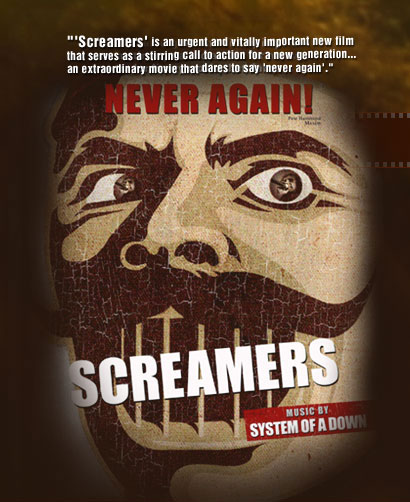
Screamers

I watched “Screamers”* the other night, a 2006 documentary by Carla Garapedian about an Armenian-American synthpunk group based in California, who go around, among other things, “screaming” about the Armenian massacres of the early twentieth century and issues of genocide recognition generally.  They’re shown on tour, comparing Armenian experiences to those of Rwandans, Cambodians — Jews conspicuously less so — soliciting the support of U.S. congressmen, interviewing British aristocrats, Harvard professors and their own great-aunts and grandfathers telling their own story of the events they describe as the Armenian Genocide, all in an effort of course to get the Turkish government to acknowledge the “Genocide” as such.  And it left me with the usual thoughts I have on this issue: that this word – “genocide” – which is supposed to name an evil particular to our time and by naming it hopefully eradicate it, has come to be so overused as to be meaningless, was vague from its beginnings and has come to obscure more than it reveals about the phenomenon, if there is such.

Raphael Lemkin, the Polish Jewish Holocaust survivor who originated the term, described it as such:

By ‘genocide’ we mean the destruction of an ethnic group . . . . Generally speaking, genocide does not necessarily mean the immediate destruction of a nation, except when accomplished by mass killings of all members of a nation. It is intended rather to signify a coordinated plan of different actions aiming at the destruction of essential foundations of the life of national groups, with the aim of annihilating the groups themselves. The objectives of such a plan would be disintegration of the political and social institutions, of culture, language, national feelings, religion, and the economic existence of national groups, and the destruction of the personal security, liberty, health, dignity, and even the lives of the individuals belonging to such groups . . ..

T. Marcus Funk in Victims’ Rights and Advocacy at the International Criminal Court says genocide is “the deliberate and systematic destruction, in whole or in part of an ethnic, racial, caste or religious, or national group.” 

“…in whole or in part…” is controversially vague enough.  Then, how “deliberate and systematic” does it have to be to qualify?  And if its victims are members of any “ethnic, racial, caste, or religious, or national group,” is that not so all-encompassing as to include most of humanity?  What sets genocide apart then from any mass killing?  That it’s done to a socially or ethnically identifiable group?  Mass killing – apart from shootings in American shopping malls or movie theaters – is usually committed on such a group.  And by emphasizing that a “group,” usually an ethnic or minority group, is the object, it creates the unspoken assumption of irrationality, though most of the events we call genocides have and had a very rational end and, to be effective, must have used fairly rational means.  And thus I wonder if the word mystifies and, more importantly, decontextualizes to a point that ultimately may do more harm than good.

Obviously, our region gives us a variety of useful examples to look at.  Now, I often get emails here — most simply rants that I don’t bother publishing — in which I’m told that I am defeating the stated purpose of this blog by favoring one group over another or being so obviously preferential in some of my affections or animosities.  I’m told that I’m panderingly philosemitic; I don’t know about the “pandering” part, but otherwise, yes.  I’m accused of being both pro-Israeli and anti-Israeli, and anti-Palestinian and possessed of a blind good faith in Palestinian intentions and an enabler of their “tactics,” whatever that means; I guess if I can be all those things at once I may be doing something right.  I’m accused of being anti-Croatian: let’s leave that one to the side for a moment.  But mostly I’m accused of two things: that I’m pro-Turkish — this usually by angry Greeks — and that I’m a shameless apologist for Serbian criminality.

And here there is some truth: the two peoples may not much appreciate being linked in my heart, but one of the many reasons that I may have a special affection for Turks, or at least find myself defending them so often, is also one of the many reasons I have a special affection for Serbs: I think the two have historically been the most unfairly maligned groups in the region.  And that brings us back to the larger genocide discussion obviously.

It has always irritated me that critics of Serbia, both in the nineties and to this day, dutifully rehearse the main highlights of the “Serbian myth”: traumatic defeat at Kosovo; continued resistance to the Ottomans; among first to struggle for independence in the Balkans; a sincere if often faulty and undemocratic attempt to actually go through with the noble experiment of South Slav unity, only to have those attempts undermined from the get-go by a Croatia that was always a member of that union in bad faith; always supporters of Western causes only to be stabbed in the back after; further traumatic WWII memories – and then just blow them off as if none are legitimate, that they’re just the “mythical” or fictional building blocks of a national pathology that explains Serbs’ vicious behavior during the breakdown of Yugoslavia.

Nobody is denying the unscrupulous manipulation of the Serbian group ‘psyche,’ starting in the late eighties, by some of the most criminally opportunistic, thuggish politicians to emerge out of post-Cold War Europe.  Nobody denies the horrible war crimes of Serbs and Serbian paramilitaries, especially in the great victims of the Yugoslav wars, Bosnia and Kosovo.  But the simple fact is: Serbs had absolutely no reason to feel secure about their future in the states that emerged from the break up of Yugoslavia, especially not in Croatia, the West’s darling.  During WWII, the NDH, the Independent State of Croatia, the Ustaša, had a greater percentage of its population—Serbs, Jews and Gypsies — slated for elimination than any other of the Nazi’s puppet states in Eastern Europe.  The plan for the Serbs specifically was the famous “thirds” plan: kill one third, expel one third, convert the other third to Catholicism (the Ustaša was also fanatically Catholic and its support by the Vatican is one of the Catholic Church’s ugliest twentieth century moral “lapses”).  The numbers are uncertain, as always in these cases, but several hundred thousand Serbs were killed by the Croatian regime and – unfortunately – its Bosnian collaborators during the war.  Ustaša Croatia was the only one of the Nazi puppet states whose tactics even the Germans found excessive, and had to be told by Berlin to “tone it down” a little, because their viciousness was giving undue impetus to a Serbian resistance movement that was becoming increasingly difficult for the Germans to keep under control.  The reasons that post-Yugoslav Serbs might have felt insecure in independent Croatia or even an independent Bosnia are not simple “myths,” pathological obsessions with historical wrongs – especially when Tudjman’s Croatia started making all kinds of fascist noises again as soon as it gained recognition from its German buddies.

Turkey.  It’s maddening that what happened in early twentieth-century Turkey is never put into the broader historical context of the previous two centuries by groups like the Screamers or others who are bent on forcing Turkey to acknowledge the events as genocide.  You can talk and talk and argue and explain and then you come across a passage somewhere that condenses and puts it all into perspective.  The following is from Karen Barkey’s Empire of Difference: The Ottomans in Comparative Perspective.  Towards the end of a chapter where she’s discussing the deterioration of interethnic relations in the nineteenth-century empire, the penetration of European economic influence and the benefits that that created for Ottoman Christians and from which Muslims were excluded, she writes:

“If major misgivings regarding ethnic and religious difference and disparity were already well-rooted in the empire, competition and communal strife only got worse as Muslim refugees from the Balkans, the Caucasus, and the Crimea were settled in Anatolia.  Between 5 and 7 million refugees, mostly Muslims, were settled by the Ottoman government throughout the nineteenth century, mostly in Anatolia.  Kemal Karpat argues that between 1856 and 1876 at least 500,000 Crimean Tatars and 2.5 million Muslim immigrants from the Caucasus were settled in Anatolia, the Balkans, northern Syria and Iraq.  Not long after, in 1877-1878, the Caucasian population that had been settled in the Balkans was resettled in Anatolia together with a million others, mostly Muslims from the Balkans.  Another 2 million took refuge in Anatolia until 1914.  By the time of World War I, the immigrant [refugee] population of Anatolia represented nearly 40% of the total population. Such immigration, originating in the nationalist movements and independence politics of the Balkans, the Russian Wars, and the Ottoman defeats, brought in another element of Muslim discontent that not only altered the demographic balance of the empire, but also exacerbated social and economic tensions.”  [emphases mine]

Do we understand that?  Charles Simic has written: “Nationalists everywhere are unmoved by the suffering of people they hurt.”  But are the above figures enough to penetrate the armor-plated narcissism of the nationalist or even dent it?  Might some clubbing over the head be in order?  Let’s repeat them and see: in 1914, the year we’re supposed to think that Turks suddenly had a collective psychotic episode and just started massacring millions of people for no reason, 40% — forty percent – of the population of Anatolia, roughly the territory of contemporary Turkey, consisted of Muslims who had escaped from the various parts of the shrinking empire, usually under conditions that could be clearly labeled “genocidal” or definitely characterized as “ethnic cleansing” though for some reason they are not, and often, as Barkey alludes to, after having been brutally displaced twice in one or two generations: like the Bosnians who had settled in Salonica after 1878 and again in 1908, in such numbers that they gave their name to a neighborhood in that city, only to have to move once more to Anatolia in 1913; or the millions of Circassians, driven en masse out of their Black Sea homeland by Russia in the 1860’s and settled in the Balkans only to have to move on to Anatolia after Bulgarian independence.  Forty percent!  That is almost twice the percentage of incoming refugee population that Greece staggered under in the 1920s after the Population Exchange, and in an Empire that had dragged itself into a World War it was woefully unprepared to fight.

And here’s where we get to the question that every ethically honest Greek or Armenian has to ask himself: what did we expect Turks to do at that point?  Give up even what they had left?  Pack it up?  Go back to the Red Apple Tree?**  To expect that at some point Ottoman Muslims/Turks were not going to fight back in order to hold on to something, a state and territory of their own, is delusional in ways that only as totalizing an ideological structure as nationalism can produce.
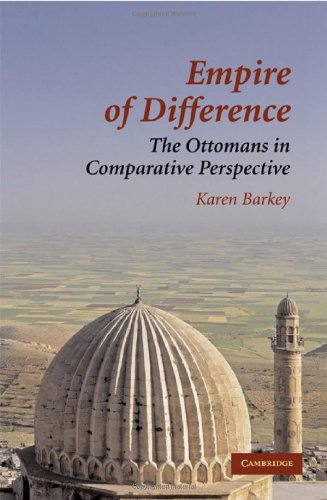
51kGIPmTZdL

(what was a really fascinating, eye-opening book for me — highly recommended…)

At no point during the long blood-soaked mess of the past two centuries have Serbs or Turks been guilty of anything that everybody else wasn’t also doing.  Thus, one of my primary objections to the use of “genocide” as a term is that it becomes part of a tool in a chronology of preference, a political expedient for stigmatizing the bad guy of the moment.  In the late nineteenth and early twentieth centuries, when European powers were obsessing with how they were going to divide the crumbling Ottoman Empire among them, there were only Muslim perpetrators of massacre in the region, never Christian ones, only the “unspeakable Turk.”  Only a tiny group of more objective observers at the time of Gladstone’s hysterical campaign asked themselves how “speakably” the Bulgarians and their Russian supporters behaved toward the Muslim population of Bulgaria in the 1870s; only Trotsky had the intelligence and conscience to report the truth about the degree and intensity of Russian/Bulgarian atrocities against the Muslim population of those lands in the 1870’s and nearly resigned from his assignment as a reporter of a Kiev newspaper as a result — he could no longer stand to physically be around the sickening violence (See Bulgarian historian Maria Todorova‘s excellent: “War and Memory: Trotsky’s War Correspondence from the Balkan Wars”  for an excellent account of Trotsky’s reporting and, through it, his brilliant and morally courageous mind; how that mind and its obvious compassion became so twistedly cruel when he turned it on his own people and country a few decades later is one of the mysteries of Bolshevik perversity.)

Later in the century, after the Cold War gave Turkey a kind of favored nation status in the Muslim eastern Mediterranean, Turkey could and still essentially can do no wrong, even if it does conduct, like in Cyprus, campaigns of what elsewhere would be called ethnic cleansing or violates the human rights of its minorities and majorities on a systematic basis.

At the beginning of the twentieth century, Serbia was “gallant little Serbia” standing up to the Austrians, beating back two massive assaults by Austria-Hungary, almost crossing the Danube into Austrian territory itself; only when Germany came to its aid was Serbia successfully defeated, and even then while putting up some of the most suicidal and vicious resistance in military history.  Serbia was a staunch supporter of the Allies in both World Wars – essentially the liberators of the Balkans in the First World War especially.  But by the end of the same century, when Serbs refused to play along with the West’s plan for what the New Balkans would look like, they were turned into pathological savages, and locked into a pariah status from which they have still not been allowed to fully emerge.

(To switch regions and periods for a moment, and examine the selective use of terminology, we never speak of the “genocide” of urban Germans or Japanese, do we, though they were a civilian population subjected to barbaric, mass, incendiary murder on a staggering scale and of questionable strategic uses and motivations other than punitive ones.)

But perhaps my most important objection to the word “genocide” should have become obvious from the above: mass murder and expulsion is what happens during nation-state formation and labeling this kind of mass murder and expulsion with some rare-orchid terminology obscures that fact.  As long as the legitimizing principle of the modern state is ethnic/tribal identity there will be groups who by their very cultural and/or religious character cannot uphold that legitimacy and will be oppressed by it.  And the time will come when they will have to be dealt with in some way or other, either through acculturation or removal, especially if their status leads them to separatist desires.  There is no such thing ultimately as genocide.  To observe the former Ottoman sphere, which is as good as any for our purposes, the rules are: form a state by grabbing as much land as you can and keep it by eliminating those who would be opposed to being part of your state.  It’s painful to say, because Bosnians got semi-trapped and stumbled into declaring independence by their two ravenous neighbors and suffered more than any in the Yugoslav conflict: but there was no Bosnian genocide, no attempt to eliminate the cultural/ethnic group that Bosnian Muslims were from the face of the earth.  There was the brutal, systematic, cruel ethnic cleansing of Muslims from parts of Bosnia that Serbia — and, of course, Croatia — wanted to hold on to because those Bosnians wanted to be part of a separate state of their own.  There was no genocide of Anatolian or Pontic Greeks, as many Greeks have lately started referring to the events of the nineteen tens and twenties.  There were decades of chronic, inter-communal violence, a war by an invading state, and the elimination of those that supported that invasion, and mostly not even through violence or by force, but by mandatory fiat agreed upon by the leaders of the countries in question.***  It’s painful to say – they’re a familiar people, one I admire, like, am close to — but as extensive as it was, as systematic and vicious in ways that set a terrible precedent for the rest of the century, it’s hard for me to call what happened to Armenians in the early twentieth century genocide. The CUP — the Young Turks — have always seemed to me to have been a bunch of loose cannons: a nefarious, often eccentric, make-it-up-as-you-go-along group of giant egos who seemed to be talking past each other most of the time and did their best in essentially ending the Ottoman Empire in the messiest way possible; and the Armenians were their single greatest victims.  But the fact remains: a people (Armenians), in a state (the Ottoman Empire) that was being torn in a million different directions, tried to form an ethnically separate state of their own (though they constituted a majority in no single region of the territory in question), and yes, often did so through violence, armed means and with outside military help.  And they were stopped.  That it was horrifying and its dimensions staggering would be obscene to deny.  That it’s some “special” form of violence — qualitatively and not just quantitatively different — and not just an extreme example of what fundamentally happens during nation-state formation is simply unsustainable as a theory for me.  I had an Armenian-American friend, and we obviously didn’t see eye to eye on these issues.  I remember him once being incensed by what he called the “macho” insensitivity of a Turkish guy who had been arguing with him and who had said: “If we hadn’t done it to you, you would have done it to us.”  Well, it’s sad, but that’s probably the truth.

No one in Screamers, not the experts or the humanitarians, not the musicians themselves, link what they want to call ‘genocide’ to the dominant political state formation of our time.  No one sees it as inevitable that if an “ethnic, racial, caste or religious, or national group” serves as the principle legitimizing force of state organization, that then some other “group” will have to be removed.  And the Helsinki Agreement’s contradictory support of both “minority rights” and “the right to self-determination” has, needless to say, been of no help in sorting out issues of this kind; Yugoslavia was the best proof of the amateurish, do-gooder thinking behind such ideas.

In fact one wonders if it was a Jew who invented the term because he and his were really the only one victims of the irrational beast we want to call genocide and are now using rather indiscriminately all over the place.  Because I can think of only one case in history where a people were not engaged in war with another country, nor in armed or any other kind of civil conflict with the surrounding population, who did not have a separatist agenda within the states they lived in or irredentist designs on parts of neighboring states, who did not constitute any kind of threat – at least real threat – to the society around them (were, quite the opposite, in fact, among those societies’ most productive and talented members), and yet became the object of a villainizing myth of incomprehensible irrationality  that marked them for complete extermination anywhere in the world they were to be found — and that is the case of the Jews.  And since we have “Holocaust” or “Shoah” for that singular episode of human horror, do we need  “genocide” at all?

I hope I haven’t insulted — worse — hurt anyone.  I hope this is the beginning of a bigger discussion.

************************************************************************************************************************************************************************************************

* Check out the film’s Wiki site; one slightly unethical thing it does is to link the great Hrant Dink’s assassination in 2007 with the the fact that he appeared in the film the year before.  There’s also some slight misrepresentation in a scene where they show Turkish nationalists trashing a fifty-year commemorative exhibit here in Istanbul of the anti-Greek pogrom of 1955 and call it an “Armenian and Greek exhibit.”

** I have no idea of the origin of this myth, or whether it developed in late Byzantine or Ottoman times, but in Greek folklore the homeland of the Turks is a place in some distant indeterminate East called the Red Apple Tree, He Kokkine Melia, and in traditional messianic thought, when the City and Romania (what the Byzantines called their polity) were brought back under Christian rule, the Turks would go back to “the Red Apple Tree.”  Ironically, Constantinople itself was known to Muslims as the Red Apple, the prize conquest, in the centuries before the fall.  I have no idea if the two myths grew out of each other or are some kind of bizarre mirror images that paradoxically developed in opposition to each other.

*** And let us all here be disabused at once of the idea that the Population Exchange agreed to at Lausanne was something that Venizelos and his government reluctantly agreed to because circumstances had made any other solution impossible.  Lefterake, our Cretan levente, was enamoured of population exchanges and similar plans far before Lausanne or even 1919.  He thought that the section of the Aegean coast that the Allies gave Greece at Paris in 1919 was eventually going to be Hellenized through exactly such a voluntary departure of its majority Muslim population, thus giving a kind of tacit approval to the atrocities committed during those years by the occupying Greek army, and, always the careerist and opportunist, one of his earlier strategies at the Paris Peace Conference had been to promise Bulgaria eastern Macedonia (Kavalla, Drama), and move its Greek population into western Macedonia where they would offset the Slavic majority of those regions, in order to coax the allies into giving him Ionia — he was a twentieth-century nationalist social engineer of the crudest kind from the beginning.  For the definitive placing of responsibility for the disastrous Asia Minor campaign on Venizelos’ shoulders, plus an extremely competent analysis of the destructive consequences of his egotistical, polarizing political style on twentieth-century Greek political life, see Michael Llewellyn Smith’s Ionian Vision: Greece in Asia Minor, 1919-1922 — an excellent account of the entire period and a great place to start if, like me, you have embarked on a minor ideological mission to dismantle the entire Venizelos myth.

Comment: nikobakos@gmail.com
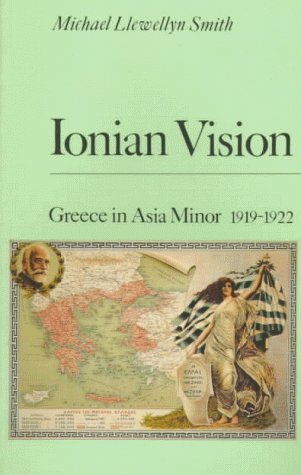
Ionian Vision

Where’s Charlemagne When We Need Him?

1 Jul

Huh?

Not the most brilliant thing I’ve read lately but one important, though really flawed, point:

“BY 1900, only two genuine multinational empires remained. One was the Ottoman, which was by then in the process of abandoning its traditional religious toleration for Turkish nationalism and even racism. [A completely, unfair, simplistic and un-historical assessment]  The other was Austria-Hungary, home to 11 major national groups: a paradise in comparison with what it was to become. Its army had 11 official languages, and officers were obliged to address the men in up to four of them.

It wasn’t terribly efficient, but it secured an astonishing degree of loyalty. It also brought rapid economic and cultural progress to an area extending from the Swiss border to what is today western Ukraine. During World War I, Austria-Hungary fielded eight million soldiers commanded by, among others, some 25,000 Jewish reserve officers. Thirty years later, the nation-states that succeeded the empire sent most of the surviving Jewish officers to the gas chambers.”

Unfortunately, the poison of the ethnic-based nation-state ideal had gotten too far by then.  Even the portrait of Austria-Hungary he gives us is completely idealized and existed in the form he describes for less than a century.

(Click above)

How sweet though, to have lived in a world that interesting instead of the stupefying monotony of the modern nation-state.  But that idea is so powerful — no, not because it’s natural and inborn, but because the modern, bureaucratic state was the first with the technical apparatus to impose it on its population(s) — that it deletes all historical files dealing with plurality.  Not a single European tourist who comes to New York fails to make the same comment: “Amazing…all these peoples living together…” and I want to explain that that’s how humanity lived for most of its civilized existence — or just pull my hair out — but I usually don’t bother.

But that reminds me: I do live in a world that “sweet” and “interesting:”

Mr. Deak (Hungarian?) is also wrong on an even more crucial point.  The Ottoman and Austro-Hungarian empires were not the world’s last multi-ethnic states.  There’s still China.  Most of southeast Asia.  And Russia.  And most ex-Soviet republics.  And certain Latin American countries.  And almost all of Africa.  And Syria and Lebanon and Iraq and Iran and Afghanistan and Pakistan and the world’s great wonder, India.  Even Turkey.  (And wherever ethnic nationalism is a problem in those countries it’s based on the Western intellectual model.)  In fact, most of the world still lives in “plural” situations.  Only Europe (and even in Europe there’s Spain and the U.K.), has an issue with this concept, but it seems to be fading even there.  Its last bastion will probably be the growing number of viciously homogenized, ugly little states of Eastern Europe and the Balkans.  Which brings us back to Michael Ignatieff:

“The misery of the Balkans stems in part from a pathetic longing to be good Europeans — that is, to import the West’s murderous ideological fashions.  These fashions proved fatal in the Balkans because national unification could be realized only by ripping apart the plural fabric of Balkan village life in the name of the violent dream of ethnic purity.”

From Blood and Belonging: Journeys into the New Nationalism, Michael Ignatieff


Euro: Make Example of Croatia, Says Anti-Racism Group

17 Jun
By REUTERS Published: June 17, 2012 at 10:44 AM ET

WARSAW (Reuters) – UEFA must make an example of Croatia by punishing them heavily for the racism charges leveled at their fans during Euro 2012, the head of Football Against Racism in Europe (FARE) said on Sunday.

European soccer’s governing body has charged Croatia’s Football Federation (HNS) for racist chants and symbols displayed by the national team’s fans during the Group C match against Italy in Poznan on Thursday.

FARE, an independent anti-discrimination and social inclusion network which works closely with UEFA to identify instances of racism at matches, said hundreds of Croatian fans had racially abused Italy striker Mario Balotelli.

UEFA is also investigating reports that a banana was thrown on to the pitch in the same game, and is looking into racist chanting during two other matches.


Comment: nikobakos@gmail.com

“In the Land of Blood and Honey”

20 May

A lot of us probably had our doubts about this one – in retrospect, unfair doubts and probably (not a little bit) sexist ones.  La Jolie has made a film about us Balkanians…  How could she possibly understand our mystery, our inscrutable savagery, the complexity of our past?  A Hollywood vanity project, for sure.

It turns out this is a great film.  It’s beautiful as a film: beautifully written, shot, acted (some tragic editing errors or omissions though).  And it’s beautiful and intelligent as ethnography and history as well.  She’s modest about her descriptions of her work, but whatever corner of the collective unconscious belongs to our fucked up little part of the world, she was channeling it.

The film recently “premiered” in Belgrade.  A few dozen people showed up and half of those left after the first few scenes, which tells you how much progress we’re making on the Serbian front.  But it struck me really hard that Jolie didn’t attend either.  I thought it was cowardly and, after the love and intelligence she’s obviously put into the project, just plain stupid on her part. Granted, some of the actors, all Bosnian, meaning Serb and Muslim, have been threatened, had their car windows smashed but, you know, all great art has always provoked…

No really, why was she not there?  I clearly, for whatever historical or cultural or mostly emotional reasons, have a special love for Serbs.  I understand they often come across as — or are even – unruly, contrarian, inat-driven, loose cannons (this word, “inat,” deserves an entry of its own and can’t be wrapped up in a footnote).  But I know that more than anything they want to hear and be heard; they crave a healthy confrontation.  That the nineties continue to be simplistically narrated as the story of their villainy rightly pisses them off to no end and they want the chance, at least, to present another narrative; if they pretend that they don’t give a shit what the world thinks it’s just hurt pride or they’ve just given up trying.  Without wanting to add to the reams of crap written about what macho lunatics they are, Serbs are guys – by which I mean the women too – and if Jolie had gone it would’ve gained her instant balls and street cred’ in their eyes and led to all kinds of productive discussion and exchange; I’m not kidding one bit.  If she had truly wanted to say something about the Balkans or the Yugoslav wars and not just about women, she undid more than half the good she could’ve done.

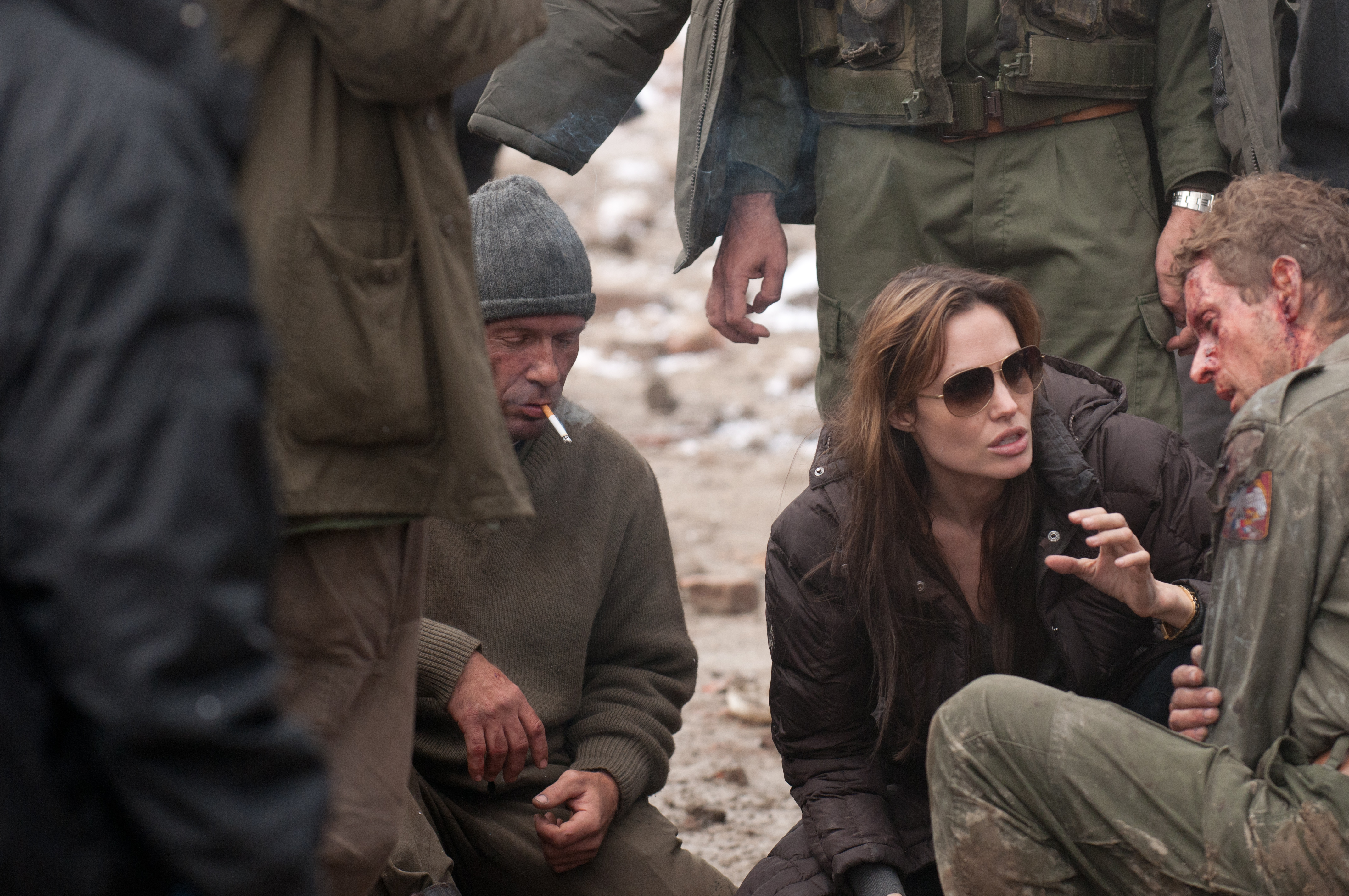
Jolie with extras

One thing that makes you furious about the isolation that was the result of that pointless separating into dumb little countries is that we don’t otherwise know these actors; we got a near fatal dose of Kusturica while Bosnia was on our screens and then it disappeared.  (See below for some extra photos of all.)  Their performances are flawless and their technical competence is proven, if by nothing else, than by the fact that they pulled off the amazing feat of shooting the entire film in both languages.  Not dubbing or anything.  They shot the entire film twice: once in SerboCroatoBosnoHerzegovinoMontenegrin (to be scrupulously correct but which I’ll just call Serbian from here on) and once in English.  Jolie and her team had something to do with how well this came off too.  They let the actors speak the English they speak, which is literally perfect but has the tiny idiosyncrasies that a non-native speaker’s naturally has.  This is the opposite of what Hollywood usually does, which is write a role for, say, Penelope Cruz, in an absolutely impeccable American English which someone with her incomprehensible accent couldn’t possibly speak and which makes her even more incomprehensible and cripples what might otherwise be a decent performance.  But beyond that, they’re all great.  If this one Sarajevo can produce all these actors it makes you want to live there just to go to the theatre or wait for someone to make their next film.

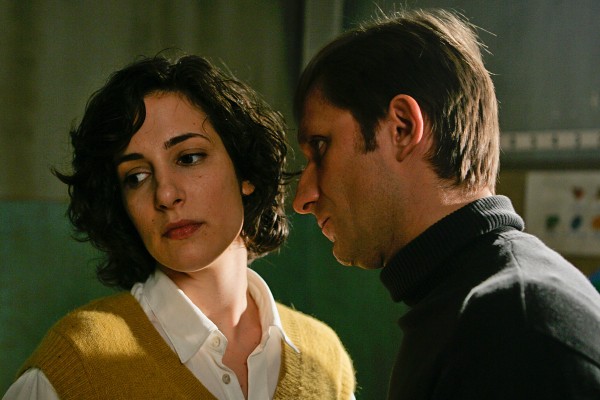
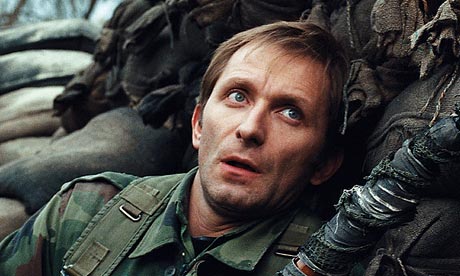
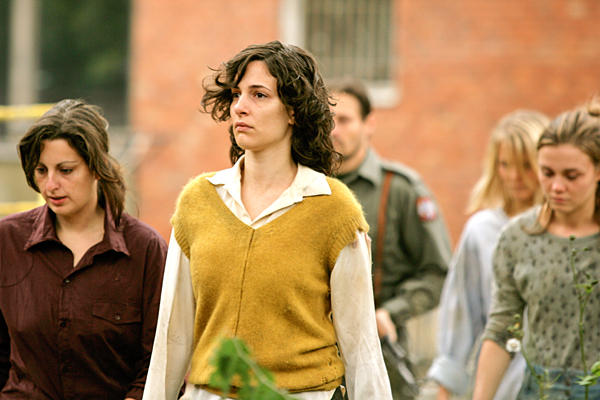
Of course the two you can’t take your eyes off and can’t get out of your head afterwards are the two leads: the painfully sexy Goran Kostić as Danijel, the Serbian cop thrust into the role of Bosnian Serb army captain, and Žana Marjanović as the inscrutable Ajla, the Muslim woman he falls for, one of those close to six-foot Dinaric beauties that make you hate all ex-Yugos; she goes out in one of the opening sequences in heels, a blue dress and a traditional silverwork belt and makes you want to cry, for all kinds of reasons.  I say inscrutable partly because a South American friend who saw the film described her as “parca,” which means dry or stiff or cold — the same root as “parched” maybe – and I had to explain that that attitude implies nobility in our parts, a posture that Ajla doesn’t slip from even for one moment, despite the hell she’s put through; in fact she clings to it even more desperately throughout, her dignity the only thing she has left, her only weapon against male power.  (“Archontia” is another word I need to give a full entry to at some point.)

Goran Kostić (Danijel) and Žana Marjanović (Ajla)

They meet, fall in love just before the war — he in a spellbound way that would be unbelievable if Kostić’s performance didn’t make it so naively magical that you buy it — and then, under circumstances which also strain belief a tiny bit but which you forgive, she ends up in his “custody” as a female POW, for lack of a better word.  Jolie says some trite stuff in the “Making of…” about a “love story that could’ve ended up in happiness, in marriage and children and what war does to that” but, whether she knows it or not, she’s made a film about something so much more complex and true.  Ajla (Marjanović) is both terrified and in the grips of the acute, aching desires of Stockholm Syndrome, but though Danijel is constantly groping around blindly in her heart, he never knows whether she’s there because she “wants” to be with him or not.  Kostić plays the perfect good soldier and officer — the way perfect good soldiers have always been perfect: he’s brave, tough, loves his men, is completely scared to death the whole time and never finds the slightest relief from the tormenting doubts of what he’s doing.

This is a film about anything but a love story — or it’s about a real love story, since these two are in love not in spite of, but because of, war.  It’s a story about the fear that women feel in the presence of potential male violence, something that no man will ever, ever understand in his gut, and Marjanović, like the painter her character Ajla is, gives you a hundred different shades of that fear; it’s about how men will never stop feeling the temptations of that violence; it’s about how sex and love are always about fear and violence.  It’s about how your tribal affiliations are not the product of the Western media but will burst out of you under the slightest pressure in what you had thought was a forgotten and buried language of hatred; it inverts the traditional Muslim-Christian power structure of the region’s sexual captivity narratives; it confronts your loyalties and asks what they’re worth to you; it throws your capacity for betrayal in your face and challenges you to deny it.  Serbian viewers might have been slightly flattered by the discursive lip service given to the Serbian position in the conflict.  But if the film has any real compassion for that position it’s in how the two lovers end up, a subtle and powerful metaphor for the two societies.*  Ajla is battered to no end — and a horrible one; it leaves you feeling crushed in ways that I am unable to describe and, as a man, wouldn’t try to.  But she achieves a kind of heroic closure ultimately that Danijel never can.  He’s the film’s true tragic figure, driven by a child’s insatiable thirst to be loved that’s impossible to quench and that ultimately destroys him in ways that she’s spared.

(* The absent Croats in this metaphor are that species of bad driver who never gets into any accidents himself but causes them all around him — just a calculating version.)

Get the Blu-Ray if you can.  It gives you a choice between the English or Serbian.  On either DVD or Blu-Ray, watch the “Making of…” segment and definitely see the “Deleted Scenes” because I don’t know what they were thinking when they cut these segments out of the final film.  If it was to fit Hollywood commercial length expectations it was particularly dumb because that audience is just not going to see this film anyway.  There are several segments in there that help you understand the sado-masochistic intensity of Danijel and Ajla’s relationship and how they get to that point.  And there’s one scene of priceless beauty where Ermin Bravo (Mehmet), sings what I think is a “sevdalinka,” a Bosnian love song, to his beloved, Vanesa Glodjo (Lejla) — see both below – a scene that breaks your heart with the realization that even another’s most exquisite tenderness will only relieve the agony of a tragic loss for a brief moment.  Every soul is on its own.

Some of the rest of cast:

Vanesa Glodjo (Lejla)

Ermin Bravo (Mehmet)

Boris Ler (Tarik)

And with Jolie

Ler and Bravo in a great shot (from another, unknown stage production) — again, this city must have great theatre… (photo: Irfan Redzović)

Comment: nikobakos@gmail.com


“…lessons on patriotism, but not in a patriotic way…” Djokovic on Kosovo, Croats, etc.

22 Apr


Something we should all strive for — one more reason to love this kid.

I just knew it, though.  I knew he was southern, or from an Old Serbia/Kosovo family.  What is it exactly?  Can I dare say it’s because he looks so Albanian?  Nobody will get angry, right?  I’ve established my Serbophile credentials, haven’t I?


Comment: nikobakos@gmail.com