

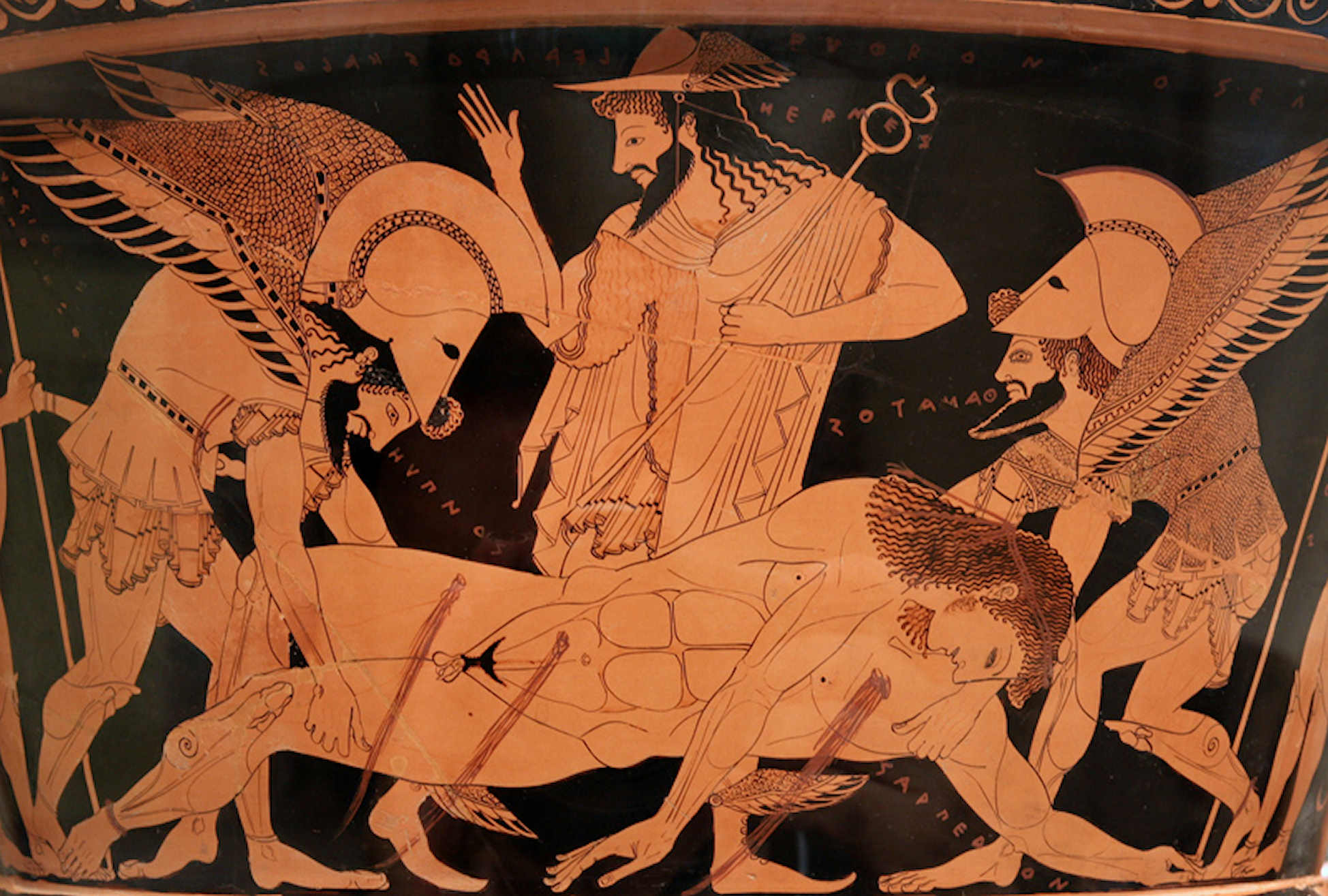
In a description of the Sarpedon vase, “The Death of Sarpedon: Who does art “belong” to?,” that used to be at New York’s Metropolitan Museum, I commented on an interesting political correcting of the Iliad that I came across on a slightly unexpected website:
“A final note. A classic piece of regressive ideological projection from the NYU site: “Euphronios’s depiction of Sarpedon’s death is an early portrait of the barbarity of war and the needless death that is its legacy.”
Really? Is that what you think the Iliad is about? That’s pretty funny…”
Here’s a relevant section from Bernard Knox’ introduction to Robert Fagles moving 1990 translation, in which Knox quotes a Simone Weil essay — yes, quite a line-up. It sets out from a Book XVI episode where Patroclus spears a Trojan charioteer, Thestor, through the jaw and lifts him out up of his chariot in a way that makes Homer think of a hooked, gasping fish.
“…clearly Homer is walking the borderline of credibility here. He does it for a reason: that simile. It emphasizes the grotesque appearance of violent death by a comparison with a familiar fact of every day life: Thestor is gaping like a fish on the hook. The spearthrust destroys his dignity as a human being even before it takes his life. But the simile does something more: it shows us the action from the point of view of the killer – the excitement of the hunter dispatching his prey, the joy of the fisherman hauling in his catch. The lines combine two contrary emotions: man’s instinctive revulsion from bloodshed and his susceptibility to the excitement of violence. And they are typical of the poem as a whole. Everywhere in the saga of the rage of Achilles and the battles before Troy we are made conscious at one and the same time of war’s ugly brutality and what Yeats called its “terrible beauty.” The Iliad accepts violence as a permanent factor in human life and accepts it without sentimentality, for it is just as sentimental to pretend that war does not have its monstrous ugliness as it is to deny that it has its own strange and fatal beauty, a power, which can call out in men resources of endurance, courage and self-sacrifice that peacetime, to our loss and sorrow and loss, can rarely command. Three thousand years have not changed the human condition in this respect: we are still lovers and victims of the will to violence, and so long as we are, Homer will be read as its truest interpreter.”
This was recognized by Simone Weil in an essay written long before she left her native France for wartime London, where she filled her brilliant notebooks with reflections on Greek literature and philosophy in the short time left to her to live. This classic (and prophetic) statement – L’Iliade ou le Poeme de la Force – presented her image of Homer’s poem as an image of the modern world.
“The true hero, the true subject, the center of the Iliad, is force. Force as man’s instrument, force as man’s master, force before which human flesh shrinks back. The human soul, in this poem, is shown always in its relation to force: swept away, blinded by the force it thinks it can direct, bent under the pressure of the force to which it is subjected. Those who had dreamed that force, thanks to progress, now belonged to the past, have seen the poem as a historic document; those who can see that force, today as in the past, is at the center of all human history, find in the Iliad its most beautiful, its purest mirror”.
She goes on to define what she means by force: “force is what makes the person subjected to it a thing.” She wrote these words in 1939: the article was scheduled for publication in the Nouvelle Revue Francaise, but before it could be printed Paris was in the hands of the Nazis and her compatriots, like all Europe, were subjected to force and turned into things – corpses or slaves.
“Its most beautiful, its purest mirror…” The most marvelous lines in the Iliad owe their unearthly, poignant beauty to the presence of violence, held momentarily in reserve but brooding over the landscape. These are the lines that end Book 8 and describe the Trojans camped on the plain, awaiting the next dawn, which will launch them on their attack on the Greek fortification:
“And so their spirits soared
as they took positions down the passageways of battle
all night long, and the watchfires blazed among them.
Hundreds strong, as stars in the night sky glittering
round the moon’s brilliance blaze in all their glory
when the air falls to a sudden, windless calm…
all the lookout peaks stand out and the jutting cliffs
and the steep ravines and down from the high heavens bursts
the boundless bright air and all the stars shine clear
and the shepherd’s heart exults – so many fired burned
between the ships and Xanthus’ whirling rapids
set by the men of Troy, bright against their walls.
(8.638 – 49)
“These are surely the clearest hills, the most brilliant stars and the brightest fires in all poetry, and everyone who has waited to go into battle knows how true the lines are, how clear and memorable and lovely is every detail of the landscape the soldier fears he may be seeing for the last time.”
And that’s what the Iliad is all about Charlie Brown…
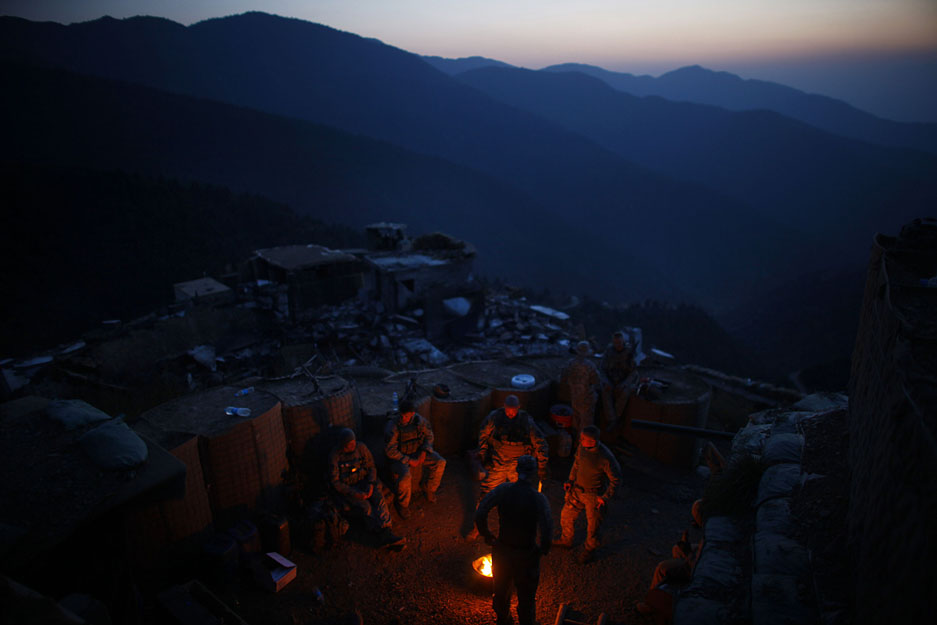
Soldiers with Alpha Company 2-327 (TF No Slack) 1BCT of the 101st Airborne Division make a small fire to keep warm high up in the mountains on border of Afghanistan and Pakistan. (David Gilkey, NPR) (Click)
Comment: nikobakos@gmail.com



 Jadde: from Bosnia to Bengal