Tag Archives: European Union

What I managed to put away in a day-and-a-half in Paris and some thoughts on the “crise;” or, “…the brevity of time and the immediacy of pleasure.”

1 Nov

…not all in one sitting of course.

A ‘tarte tatin’ au boudin — a take on the traditional tatin upside-down fruit torte, with the boudin (spiced and coagulated pig’s blood) over the flakiest, probably lard-based, crisp puff pastry underneath, and a thin layer of apple and some of the most expertly caramelized onions — almost honeyed, that’s what’s seen dripping almost like syrup under the boudin — in between:

tarte tatin au boudin

(click)

A pig’s foot, braised, then breaded and fried, for the first time served with a bearnaise sauce (essentially tarragon-flavored egg yolks and butter), which was almost a bit too much even for me:

Pied de cochon pané

(click)

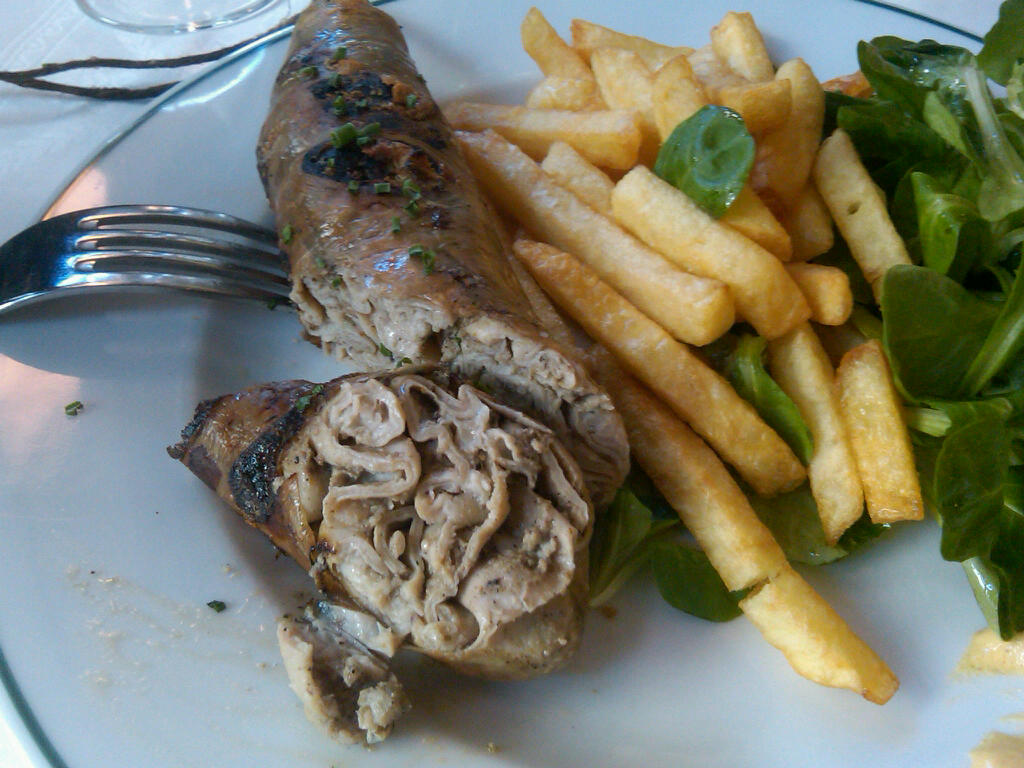
And andouillette, large pig intestine (colon) stuffed with small pig intestine and grilled, kind of like a chit’lin-loaf or mageiritsa sausage, usually served with a mustard sauce or mustard of some kind because it needs something to balance the heady fecal aroma (like the dill in mageiritsa) and really bring out its subtlety:

andouilletebalzar

(click)

And now everyone who keeps telling me that people only ate this stuff because they were so poor they had no choice must cease and desist in this absurd and ignorant argument. (See last year’s post: Chitterlings…and mageiritsa: “Then I have to listen to the anthropology tes poutsas about how people only used to eat that stuff because they were poor and they had to eat everything available, like eating intestines were the equivalent of the dirt-eating that tragically occurs in third world countries under famine conditions.”)  No.  They eat this shit ’cause it’s good.  Proof were the happy groups of Parisians all around me — even young, skinny ones — digging into the same stuff I was, who apparently hadn’t gotten the “evolution” memo from Brussels yet that now that they live in one of history’s most prosperous societies they can stop eating pig guts.

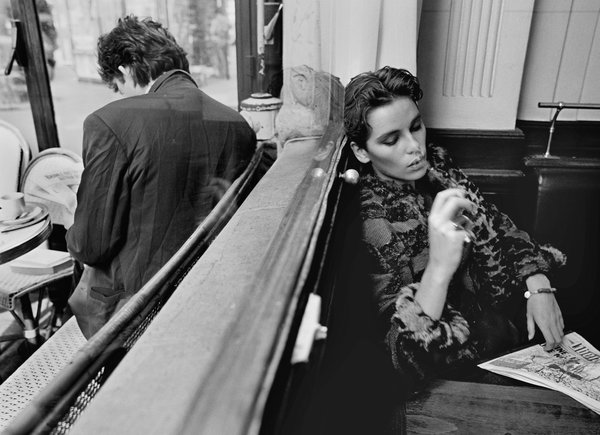
And speaking of prosperity…  Everyone I know in Paris talks incessantly of the “crise” but eventually ends up admitting things are ok for the most part, which makes me wonder that the French crisis is not an outsiders’ invention, or just a fruit of the fact that the French like to think about things and talk about them — imagine….  Ever since Adam Gopnik heroically defended French civilization (“the most beautiful daily culture ever created…lemons on trays and windows like doors everywhere you looked…”) in his Paris to the Moon, ever since the eighties Thatcher/Reagan years actually, there has been a constant schadenfreud-ish gloat-fest in what the French love to call the “Anglo-Saxon” world about how France is over: politically irrelevant, its cultural traditions either fading or ossifying, and how its economic model is simply unsustainable.  This “end of France” commentary in the English-speaking press has practically become a genre of its own; Maureen Dowd gave a classic example of this type of screed in the Times this summer, “Goodbye Old World, Bonjour Tristesse” about how depressed the French now are that France has seemingly lost in place in the world (great photo though):

07DOWD-articleLarge

Ferdinando Scianna/Magnum Photos (Paris, 1989)

and then just these past few months, Steven Erlanger produced these two models of the genre “A Proud Nation Ponders How to Halt Its Slow Decline” and “Reflections on a Paris Left Behind”, sad reflections on how… boring and sterile Paris has become, and repeating the tiringly repeated observation on how London has taken its place; London a city I still find to be trying a little too hard to make up for centuries of un-coolness, vis-a-vis Paris mostly.

Yet, they’re doing something right.  The London Review of Books had a fascinating and comprehensive review of the European Union crisis in its August 29th issue by Susan Watkins: “Vanity and Venality” where she comments on France’s seeming disappearance from the European political landscape (which it seems to be trying to make-up for by flexing military muscle elsewhere) but how it seems to be functioning fairly well internally:

“There is something anomalous about the neutralisation of France as an actor on the European stage and the brittle character of German hegemony must stem in part from it. The conventional explanation is that the French economy is too weighed down by its statist legacies for the Elysée’s word to carry much authority, but the figures don’t bear this out. France has now overtaken the UK, after a swifter recovery from the crisis .  [Could that be because it didn’t opt for Nasredin’s Donkey austerity economics as much as Britain did?]  Its public debt, including bank rescues, is lower than Britain’s and its manufacturing sector is in better shape. Unemployment is worse, but average household income is higher, inequality lower and infrastructure and healthcare in another league.”

(Also read the Watkins article for some dismal analyses of a Greek economy that has shrunk by twenty-percent and the scandalous closing of ERT, Greek Radio Television by PM Samaras)

So France and the French, it seems, keep soldiering on, and well and socially securely at that.  And it seems that some Protestant sourpuss will always be incensed that they seem to be doing it so pleasurably on top of it all, adapting to the new state of things and still enjoying themselves.  Let them bitch and judge.  I know the small part of Paris I see when I’m there is only an equally small part of French society, but if for some reason I were banished from New York tomorrow, it’d still be my first choice to seek refuge in.

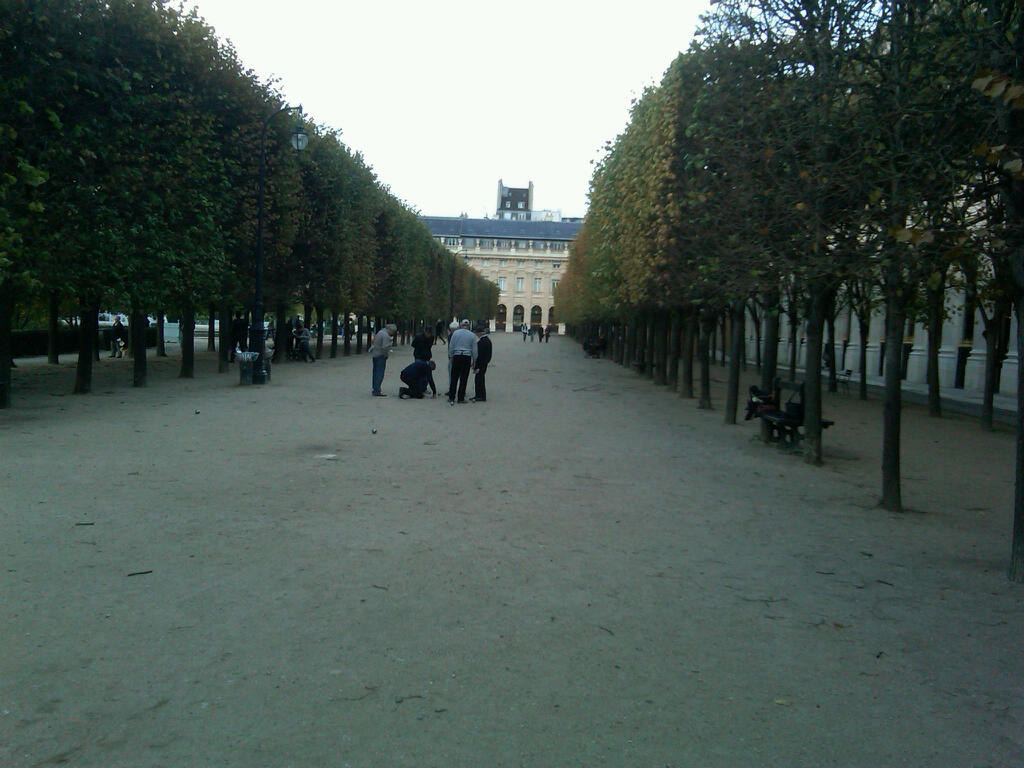
PalaisRoyal

One of those single, condensing phrases that teach you so much about a thing, in this case me about the French: the writer Michèle Fitoussi hits the nail on the head when she said that her compatriots “have a keen sense of the brevity of time and the immediacy of pleasure.”

Comments: nikobakos@gmail.com

Also see the full post: Chitterlings…and mageiritsa for my general food musings, campaigns, philosophies and tirades

“It’s Turkey’s Time” — NYT

28 Jun

May 23, 2012, 8:49 am 14 Comments

By ANDREW FINKEL
(Murad Sezer/Associated Press)

ISTANBUL — If patience is a virtue, then Turkey’s place among the angels is secure. The country’s efforts to become a member of the European Union has been dragging on for some 50 years, and while Ankara has not always been free from blame, since 2005 — when negotiations began in earnest — it has been trying hard to climb over the wall of Europe’s prejudices.

Yet now there is hope at last that the process may accelerate. Voter disenchantment in the euro zone recently claimed the head of President Nicolas Sarkozy of France, the leader of the die-hard Turko-skeptics. France had been refusing to even discuss with Turkey important provisions of the accession document known as the acquis communautaire, including those about budgetary affairs and agriculture. Along with his ally German Chancellor Angela Merkel — who has also been answering to constituencies that regard Turkey as not European enough to join the European club — Sarkozy favored granting Turkey a form of association that would stop well short of full membership.

News from the latest NATO summit in Chicago is that Sarkozy’s successor, François Hollande, is trying to turn the page. German attitudes may also be changing. Last week Merkel’s foreign minister, Guido Westerwelle, a member of the Liberal Democrats — partners of Merkel’s Christian Democratic Union in the governing coalition — delivered to Ankara a message very different from hers. “What is important is to seize the opportunity that emerged after the latest elections in Europe and restart E.U.-Turkey ties,” he said.

Turkey itself must seize the moment. Making the E.U. a priority again would quiet growing criticism that the government of Recep Tayyip Erdogan is becoming more autocratic as its traditional opponents (including the military) become weaker. But doing so will not be an easy matter. If Europeans may be said to suffer from enlargement fatigue, in the case of the Turks, it’s more like narcolepsy. The Turkish government is understandably tired of banging its head against a wall.

Turkey first approached Brussels in 1959. In 1963 it signed the Ankara Agreement, which set out a path for its joining what was then the European Communities. As Europe’s economic integration became political, too, sharing sovereignty with Turkey started to look like a more elaborate project. Still, in 2004, after an intense period of reform, Turkey was declared a full candidate for E.U. membership. Enthusiasm for joining Europe among Turks shot up, with 73 percent of respondents to a survey by the German Marshall Fund saying they thought accession would be a good thing.

But then Europe’s leaders slowed down negotiations, and the Turkish public started to look on the E.U. as a club that did not want them as members. By 2010, support for E.U. membership among Turks had dropped to 38 percent.

Europe wasn’t the only guilty party. My own jaundiced take is that Ankara was more interested in becoming a full candidate for E.U. membership than in becoming a full member of the E.U. Candidacy was an advertisement that Turkey was on a stable course, and it was instrumental in attracting much-needed foreign direct investment. Actual progress toward membership, on the other hand, would have meant implementing more reforms — environmental policies, greater transparency for government tenders — all at a steep economic and political cost. Turkey also refused to recognize the E.U. member Cyprus, or even open its ports to Cypriot vessels.

Turkish attitudes may change again, though. Over the past few years, Turks had begun to flirt with the notion that the Middle East was Ankara’s natural backyard. But they’ve started to realize that the Arab Spring has brought some stormy weather. Turkey’s relations with Iraq, Iran and Syria are at a low, and its export opportunities in Libya and Egypt have taken a hit. Despite the economic crisis in Europe, Turkey still carries out about 43 percent of its trade with the E.U.

Now is just the time when Turkey should want to join the union. With Europe more skeptical about itself these days, it may be less skeptical about admitting Turkey. While Europe staggers under austerity measures, Turkey is experiencing a boom. In the last two years its G.D.P. grew by 9.2 percent and 8.5 percent. The figure for this year will likely be lower, but Turkey can present itself as an engine of Europe’s recovery; it already is the E.U.’s fifth-largest export market. And though incorporating such a big country is still a major challenge, the task may seem less daunting if a “two-tier” Europe — with political integration occurring at different rates for different countries — emerges from the current crisis.

Turkey should spin Europe’s economic problems to its advantage and revive talks for E.U. membership. To its credit, the government has begun to speak about a “new era” and a “clean page.” At a time when Turkey is trying to adopt a more liberal constitution and better enforce the civil rights of the minorities like the Kurds, progress toward E.U. membership would strengthen democracy here. That would be good for Turkey, Europe and for Turkey’s neighborhood.


Andrew Finkel has been a foreign correspondent in Istanbul for over 20 years, as well as a columnist for Turkish-language newspapers. He is the author of the book “Turkey: What Everyone Needs to Know.”


Comment: nikobakos@gmail.com

What happens next in Greece?

15 May

The Greek Parliament in Athens (with its beautiful interior chamber at bottom), originally the Royal Palace (1843), one of the buildings in the Bavarian Neo-Classical style, often much-maligned, that were part of that beautiful city that our first, touchingly sincere and totally daft Teutonic dynasty built for us, till we levelled it all — as thoroughly as a carpet bombing and entirely on our own — between about 1960 and the early eighties.

Pessimistic and disconcerting, if semi-intelligent analysis below by Brady Kiesling (except for the actually offensive labour-camp island references — sorry, white boy, I don’t remember granting you the right to joke about that stuff, I don’t care how long you’ve lived there — and the nonsense scenarios of resurgent dictatorships).  It’s just still…well…still not totally convincing.  It just has the same general assumptions of all right-wing positions: if we challenge the giant financial actors here: Europe, banks, even what’s left of Greece’s shipping industry, they will abandon us.  But when the unpaying indebted reach a critical mass, what do the creditors do?  I still don’t understand why it’s an all or nothing question.  Hardliners outside Greece (which means Merkel mostly) have just had their positions significantly weakened; the pigs are squealing louder than ever, she just lost the Netherlands, France and even some hefty political points in her own country.  And it’ll cost them to let Greece go or kick it out, no matter what a mess it is.  I haven’t even heard Tsipras speak, honestly, other than in Al Jazeera voice-overs, so I don’t know how much of an old-school seventies populist he really is, but what if he’s just holding out for slightly more lenient terms?  Then, if they get in, no, they obviously won’t be able to give Greeks back their antideluvian frappe-paradise (and who wants to…?), but so what?  What politician comes through on his electoral positions?  Sorry if these are “communist sunday school” questions.  (Kiesling’s references to Tsipras’ KNE-te past are not smart either, just cheap.)

“Dear friends,
This pessimistic piece I just posted on Facebook, is what logic says will happen in the coming months. Logic is a slender reed, and I seriously underestimated the depth of anger at PASOK and ND when I predicted election results. Evangelos Venizelos is finding the other party leaders a tough sell, but their alternative scenarios depend heavily on magic and/or divine intervention. My prediction tracks with what the financial markets are saying, another reason to doubt it.
Feel free to share … though there’s nothing really surprising.

What happens next in Greece
Publication of an opinion poll showing SYRIZA/Alexis Tsipras as leading party has essentially destroyed the possibility of an “ecumenical” government and thus made it impossible for Greece to stay in the Euro-Zone.

Not wishing to commit electoral suicide like Karatzaferis of LAOS, Fotis Kouvelis of DIMAR refuses to join a government that does not include Tsipras. But Tsipras has been handed the opportunity to fulfill the Left’s dream of taking power democratically. Thus he prefers to force a new election.

Take a solid core of Greeks who loathe the “bourgeois” parties. Add voters who still believe in client-patron politics and want to back the winner. Add romantics who will vote for any leader who loves them enough to tell them beautiful lies, and you achieve critical mass. Though SYRIZA will probably fall short of an independent majority, the 50-seat bonus will give Tsipras the maneuvering room he needs to form a government.
Why is this bad? Papandreou, after all, made equally beautiful, terrifying promises to get elected in 1981. The 52% of the electorate that did not vote for him was sure he would turn Greece into Cuba or Libya. But in fact, Papandreou forgot his promises to take Greece out of the EU and NATO. He left the U.S. bases intact, let private education continue, and nationalized companies that mismanagement had left on the verge of bankruptcy anyway. A new set of clients got their first taste of government jobs and pensions. The Greek economy took on massive new debt, but did not instantly collapse. So electing Tsipras, who at least insists he wants Greece in the Euro, ought to be simply business as usual.
But this time it won’t work. It remains easy to break promises about foreign policy, because ordinary Greeks don’t care whether Greece is a member of NATO or not. On the economic front, Papandreou promised to give Greeks things they never had. Tsipras has made a much more dangerous promise, to restore things they recently had and still remember, their old jobs, wages, and pensions.

In 1981, Greek state books had recently almost balanced, and the debt load was manageable, with effort. The current situation is much worse. Tsipras, a non-practicing civil engineer whose knowledge of economics apparently comes from KNE (Communist Youth) Sunday school, perhaps genuinely does not understand that no lender, not even the EU, will ever agree to lend Greece (or anyone else) money for public sector wages and pensions. When he keeps insisting, they will throw him out on his ear. At that point, in order to pay for promises Tsipras dares not break, Greece will stop paying its foreign debt.

Wages and pensions, now paid in drachmes, will theoretically match their old euro levels. But without basic budget equilibrium, inflation/devaluation is inevitable. The Tsipras government, which will need every euro and dollar in the country to pay energy and other vital imports, will discover that the shipowners have fled to avoid being taxed, and the illicit savings of the wealthy are out of reach in foreign banks. People need to be fed. Farmers, however, will need strong encouragement to sell their produce for drachmes. Tsipras will be sorely tempted to make the parallel euro market and euro pricing illegal.

Technology, the technocrat’s cure for waste, fraud, and mismanagement, cannot be counted on in a society where a billion-euro industry in fraudulent pharmaceutical prescriptions simply hires a few hackers to bring down the state’s computerized prescription system.
 It is not impossible that a culture of endemic corruption will transform itself, inspired by a self-assured young socialist, into a virtuous collectivist paradise like Cuba or Venezuela. But if not, what is a humane, progressive leader to do? Greek prisons are already overflowing. SYRIZA is full of genuine human rights advocates, so the historic islands of Makronisos and Gyaros are off-limits. But about the time they find a less politically loaded location for the reeducation centers likely to be required, I fear a Greek Pinochet will install them there instead, to the applause of many of the same people now applauding the defeat of PASOK and ND. When that happens, I and my wife, though penniless by then, will follow the shipowners… Stay tuned…”

Brady Kiesling
May 11, 2012 ·

Alexis Tsipras, leader of popular and gaining left-wing Syriza party, currently the young gilded bete noire of Eurocrats across the Continent.


Comment: nikobakos@gmail.com

“…a craven and cringingly embarrassing pandering to the West’s classical image of what Greeks are supposed to be…”

27 Apr

The above is a quote from my April 22nd post: “Turkey in Europe”

Just to get a minor point out of the way first.  The sheer arrogance of this “Hellas” and “Hellene” campaign — that speakers of other languages should change a word in their vocabulary to suit our bloated fantasies — enrages me.  “Griego,” for example, is not a Greek word that you can change; it’s a Spanish word that Spanish-speakers use to refer to Greeks.  Are you going to make them change it, Katinaki?  You don’t hear Hungarians running around insisting the world call them Magyars, or Finns launching a campaign to have us all call them — do you even know? — Suomalaiset.  (Unfortunately, there are some annoying Turks who are trying to get everyone to say “Turkiye” instead of “Turkey,” with the lip-pursed umlaut on the ‘u’ and the the extra syllable at the end.)

The occasion for this post is this ridiculous personage below: Katerina Moutsatsou, who hasn’t just posted one video but is all over the web and is apparently a Greek actress, though she sounds and acts Greek-American to me:

Grrrrrrrr……  You didn’t invent the West, yavrum; the West invented you — ki akoma na to pareis habari — and in deep, profound ways your refusal to see that is fundamental to the current crisis.  Because once the West invented you, motivated by cultural and ideological desires of its own that had nothing to do with you, once it got you to internalize its image of you so that two hundred years later you’re still trying to squeeze cultural capital out of that internalized colonial identity — because this stupid “Hellene” campaign is just an expression of that pathology — the West proceeded to ignore you and still does.  But keep preaching that gospel and see how far you get.

Happily, she’s not being taken seriously by most.  Here’s a great riposte to Moutsatsou’s video, which in contrast to her inflated silliness, is the best of what a Greek can be: ironic, angry, smart, aware and funny.  This guy Spyros originally had a little cut of Moutsatsou in the beginning so viewers could get the reference, but the young miss made him remove it for — not kidding — copyright reasons, and he had to re-edit and repost it.  He says in Greek in his comments: “I reposted without the part where Mouts’ [Moutsatsou] is talking…” — “mouts” being suspiciously close to gay Greek slang for “annoying chick” — probably unintentional but you never know.  “Malakas,” for those who aren’t Mexican or haven’t otherwise worked in a New York diner kitchen, is a multi-toned word.  Originally meaning “masturbator” I guess, it now means “asshole” or “jerk” but among young men (and increasingly young women) it can be a totally innocuous interjection like “mate” or “buddy” or “dude.”  Spyros absolutely means it in the harder-core “asshole” sense.  I was especially moved by: “I don’t blame globalization; I blame immigrants.” (see my April 14th post: “Ain’t that America”)

And then there’s Manos, a talk show host who just goes on an all-out firebombing of Moutsatsou’ pretensions.  The one Greek phrase he uses and that I feel obligated to translate is when he says, “if I owe any money…it’s because “Hoi hwraioi echoun chree” (“Hot guys have debts…”) which is the refrain of a Greek pop song — a piece of crap as music but the refreshing heights of Greek impudence given the current situation — whose lyrics go: “Hot guys have debts…and they pay them with kisses…so tell me what I owe and we’ll settle accounts in my arms.”  Dedicated to Angela Merkel.

Any issue like this becomes an instant riot-fest of satire in Greece, something maybe we did invent, because give them a good story and it suddenly turns into a country of ten million very sharp-witted, merciless, gossipy housewives.  God help you if they find even the tiniest crack in your position or your posturing.  Miss Moutsatsou is going to get run out of the country soon; once Greeks are on to you, you’re finished.  As Cavafy wrote: “…κ’ οι Aλεξανδρινοί τον πάρουν στο ψιλό, ως είναι το συνήθειο τους, οι απαίσιοι.”


Comment: nikobakos@gmail.com

Turkey in Europe

22 Apr

According to Stephen Kinzer, New York Times correspondent and the paper’s bureau chief in Istanbul for a good part of the nineties, the appeal of EU membership to those countries waiting for it is (or was) political, social, and economic.  “For Turkey it is also psychological,” he writes in his 2001 Crescent and Star:

“The central question facing Turks today is whether their country is ready for full democracy, but behind that question lies a more diffuse and puzzling one: who are we?  The Ottomans knew they were the servants of God and lords of a vast and uniquely diverse empire.  The true heart of their empire, however, was not Anatolia but the Balkans…  But by caprice of history the founders of the Turkish republic found themselves bereft of the Balkans and masters instead of Anatolia.  To make matters worse, through a series of twentieth-century tragedies Anatolia lost most of the Armenians, Greeks and Jews who had given it some of the same richness that made the Balkans so uniquely appealing.”

There’s a lot there I’m not sure of, like the Ottomans’ heart having been in the Balkans and their backs turned on Anatolia.  I also don’t know if “who are we?” isn’t too categorical a way to phrase the dilemma Kinzer is talking about.  Unlike Greeks, Turks know who they are; their growing willingness to accept, not only the former existence of their neighbors among them, but the plurality of their own ethnic make-up would indicate that: Albanian fraternal associations, Tatar and Circassian language classes, seem to be coming out of the woodwork of the Republic’s forced homogenization, and even the lay-low-and-keep-your-head-down Alevis have found a new courage in asserting themselves.  (Poor Republic: no sooner does it harass one minority out of its existence, another one pops up to take its place.)  That’s a process that requires confidence, whereas we remain isolated in our ignorant dream of purity — and banging our feet to prove it to the rest of the world on top of it — a ringing sign of insecurity.  As mangled as Turks’ knowledge of themselves may have become by their own nationalism, I think phenomena like nostalgia for the multiethnic or the Neo-Ottomanism that has pervaded cultural life and even motivated political life and foreign policy in Turkey recently (and I don’t think that’s a bad thing or necessarily a “threat” to anyone; we, Greeks, might want to take advantage of it actually) is an attempt to right that disfigurement, not a deep existential reorientation.  Proof might be that since Kinzer wrote his book in 2001, Turkish membership in the European Union has pretty much become a dead-in-the-water issue.  And that may be partly because, in almost head-on contrast to Kinzer’s interpretation, Turkey was looking for political and economic benefits and not for Europe to validate its psychological needs, as the Neo-Greek statelet always has since its beginnings, a craven and cringingly embarrassing pandering to the West’s classical image of what Greeks are supposed to be being the foundation of Neo-Greek identity.  However the Ottomans may have felt about the Balkans or wherever modern Turks end up with their renewed embracing of the Ottoman past, they seem to be increasingly feeling — even the old, staunchly Kemalist bourgeoisie, or at least their children — that they don’t need European validation to prove they’re part of a civilization that they’re not.  And good for them.  I wonder when we’ll get the message.

On a lighter note, it’s not often one hears the Balkans described as “so uniquely appealing.”  It’s a line I’ll have to remember.  Often when people find out I’m Greek, they launch into delirious and happy memories of the Aegean and little white houses and sparkling blue waters and then I have to watch their faces drop as I tell them: “Well, the part of Greece my family is from is really more the Balkans than the Mediterranean…  And it rains all the time.”

Landscape approaching my mother’s village, in its usual mood. (click)

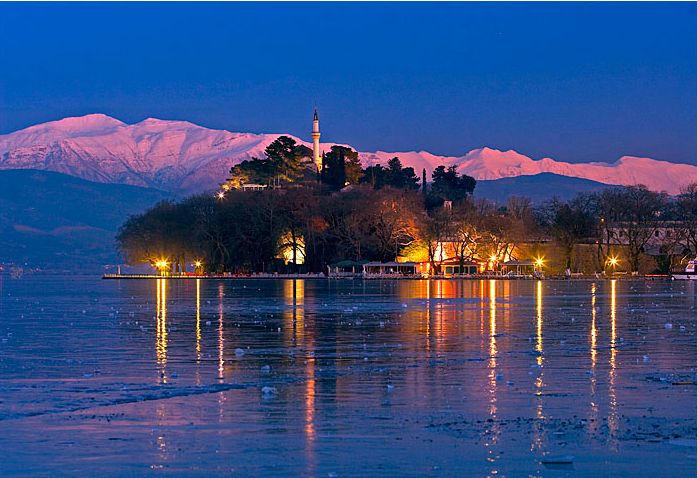
But then it is often “so uniquely appealling,” to get back to the Turks and the Balkans.  The main city of the region (Epiros) is Jiannena/Yanya, a beautiful little city by a lake that always had an air of luxuriant civility about it, proof of which may be that the Greek population didn’t rush to pull down the minarets or demolish all the mosques of the city as soon as the last Turks left in the twenties.*  It’s one of those Balkan cities the Turks loved.  Here’s a winter photo of Yanya’s main cami, the Aslan Pasha Mosque, overlooking the icy lake, below. (click)

Jiannena deserves a post of its own.  I gotta dig up some 2010 notes I have.

* On the other hand, the city government and developers have done all they can since WWII, including harassment and straight-out vandalism, to expropriate the city’s large and very romantic Jewish cemetery, which unfortunately for the city’s 40 surviving Jews, sits on some prime real estate.  Last I heard they had taken the issue to the EU, which makes me very happy.  Maybe the economic slump will give them a reprieve.  More on Jiannena’s Jews in the future.


Comment: nikobakos@gmail.com

Chitterlings…and mageiritsa

12 Apr

What are chitterlings, or chitterlins, or chit’lins?  They’re pig intestines, which people eat all over the world wherever they eat pigs.  (Where they don’t, they eat lamb intestines.)  Unfortunately, in the United States, the only people with the sensory refinement to appreciate them are African-Americans.  (And yes, girlfriend, the casing on that $25 a pound artisanal Calabrian soppressata you get at Whole Foods…pig gut.)

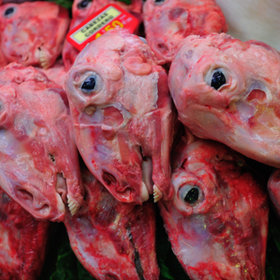
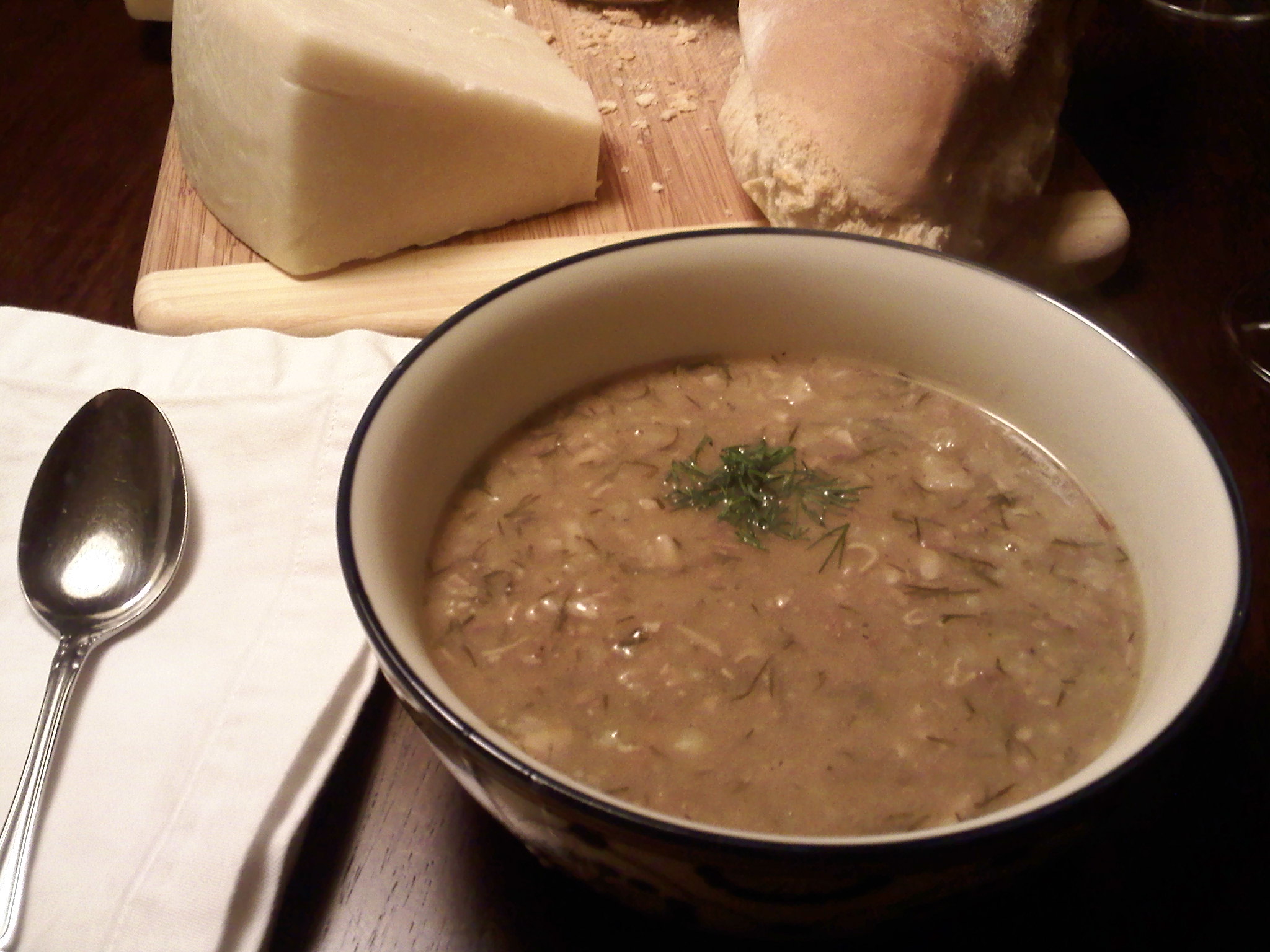
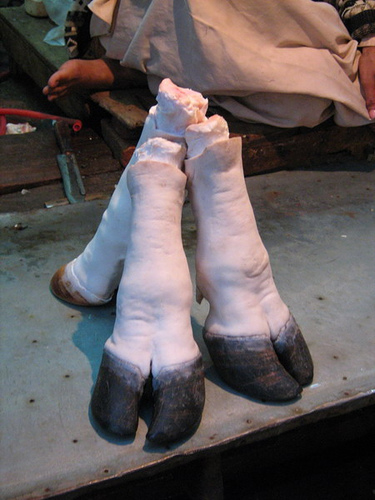
“Mageiritsa” is a Greek soup made of lamb offal that is made at – and only at – Easter.  It’s an incredibly time-consuming and labor- intensive production, which is probably why.  First comes the all-day or over-night simmering of the lamb’s heads and feet, to get the appropriately kelle paça type broth necessary.  (Kaleh pacheh seems to be a Friday after-prayer tradition in Afghanistan, so starting Thursday morning in front of all the butcher shops in Kabul, usually collected on one street, and by shacks along roads leading out of the city that seem to open just for that purpose, one sees giant piles of recently severed, bloody heads next to piles of bloody feet, both still in their fur, swarming with flies.  It’s a beautiful sight and one that, like so many other things in Afghanistan, I didn’t get a photo of while there because I thought I would embarrass people by taking pictures of things that I was afraid they would think I thought backwards.)  Then comes the cleaning out of faeces from about a football field’s length of lamb intestines (below), which is not that bad because they come from young animals that only eat grass anyway so it’s kind of the texture of baby poop.  (The European Union Daddy-State tried to ban the sale of intestines a few years ago and the Greeks to their credit, which I don’t grant them often, got into an uproar and Brussels backed down.  I actually have a theory that the intestine issue was the behind-the-scenes deal-breaker between the EU and Turkey, and rightly so; make me bend over backwards about how I run my country, make me reorganize my economy to enrich you and impoverish myself, treat me like an unwanted guest because I’m Muslim, but I’ll be damned if you take away my kokoreç.*)  Then you braise the intestines, and the sweetbreads (thymus glands) and hearts and kidneys in the broth (some people use liver or spleen and testicles too, but I don’t ‘cause the liver and spleen can get bitter and the testicles retain an unpleasant spongy texture when boiled which they don’t when grilled, or when sautéed with oil and a ton of garlic like they do with the bull’s balls in Spain after a bullfight — talk about sympathetic magic – and are quite yummy — see bottom.)  Then they’re all minced up, browned in a healthy amount of butter, added to the broth with lots of scallions and dill, some rice, and, just before serving, terbiye-d** with eggs and lemon.
Intestines

It’s generally acknowledged that I make the best mageiritsa in the world.  You can get pretty good mageiritsa lots of places, but mine is the best…in the world.  When I serve it at Easter, some people can’t get enough of it and some people politely decline.  Others, unfortunately – and tellingly, it’s usually younger Greek-American family – have always felt they have license to grimace and make faces of disgust and revulsion.

Mageiritsa — the finished product (click)

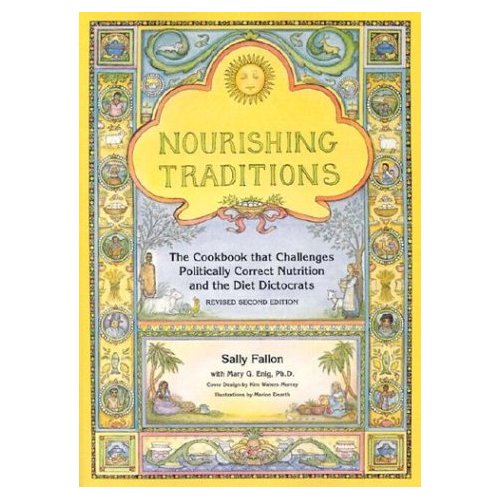
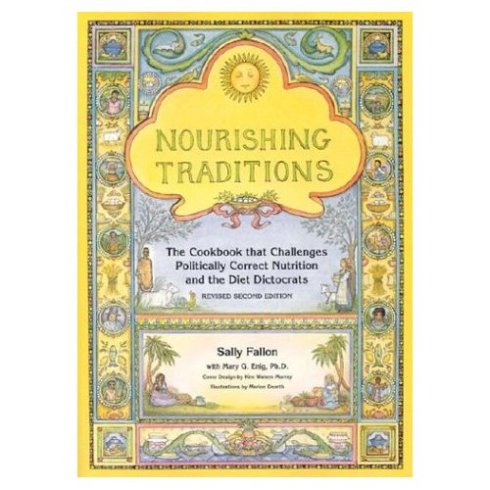
It’s bad enough that so much art and time and work on my part should be met with that kid of rudeness.  Then I have to listen to the anthropology tes poutsas about how people only used to eat that stuff because they were poor and they had to eat everything available, like eating intestines were the equivalent of the dirt-eating that tragically occurs in third world countries under famine conditions.  No they didn’t; they ate those things because they taste good.  Organ meats perform more complex biochemical functions in our and other animals’ bodies than muscle does; joints: feet and hocks, are complexly interconnected with tendons and cartilage of various kinds.  They therefore have more varied textures, mineral content and other elements, which gives them a richer and more varied taste than regular flesh has.  As mentioned in this brilliant book Nourshing Traditions: The Cookbook that Challenges Politically Correct Nutrition and the Diet Dictocrats by Sally Fallon, when a carnivorous animal (which we are, by the way; ignore false, scientifically faulty Vegan and Buddhist propaganda) kills another animal in the wild, the first thing it goes for are the guts because it instinctively knows they’re the most nutritious part.  Instead of teaching their kids the value and variety of our traditions or pointing out the beautiful economy with which our ancestors made use of every part of the animal, or their respect for and intimate knowledge of the world, the plants, and the animals which fed them, as opposed to our obscene wastefulness and complete alienation from any food which actually looks like food or reminds us of where it comes from, these people stupidly and condescendingly put it down to their poverty.
I never, ever heard anyone in older generations reminisce about the breast of any chicken or the dry, grey boti meat of a traditionally over-cooked Greek leg of lamb.  My mother used to wax nostalgic about an aunt’s Sunday pacha or the street kokoretsi they sold down by the lake in Jiannena next to the Karagöz puppet box (you’d get slices of it on wax paper, that or a cone of pumpkin seeds or a stick-full of pişmaniye and sit and watch Karagöz and Hacivat’s brilliant antics; I can’t be grateful enough that all these survived until I myself was a child.)  If a whole animal were roasted, the kids would fight over the head and its brains, tongue and the delicious, gelatinous cheek flesh.  And pig feet and andouillete are enjoyed in the best Parisian bistros, not just in supposedly impoverished Balkan or South American villages.

It’s a growing ecological disaster – a cultural one – and that’s what depresses me most.  We’re tangling ourselves (like most things modern, it starts in America but is spreading throughout the world) in such a neurotic, kosher-like web of food anxieties and hysteria that we’ll have soon lost access to half the things humanity used to enjoy at the table if we haven’t already.  I truly believe that it’s a phenomenon connected to the disappearance of other forms of diversity:

“All these seemingly disconnected events are the symptoms, you could say, of a global epidemic of sameness. It has no precise parameters, but wherever its shadow falls, it leaves the landscape monochromatic, monocultural, and homogeneous. Even before we’ve been able to take stock of the enormous diversity that today exists — from undescribed microbes to undocumented tongues — this epidemic carries away an entire human language every two weeks, destroys a domesticated food-crop variety every six hours, and kills off an entire species every few minutes. The fallout isn’t merely an assault to our aesthetic or even ethical values: As cultures and languages vanish, along with them go vast and ancient storehouses of accumulated knowledge. And as species disappear, along with them go not just valuable genetic resources, but critical links in complex ecological webs.”  — “In Defense of Differerence.”

“Oh, this is so salty.  Oh, this is so fatty.  Oh, this is so oily.  Oh, this must have so much cholesterol; I can feel my arteries clogging.  Eeew, this has liver in it.  It’s what?! Made with blooood?!”  (You can’t imagine how many people I’ve known who had heard of blood sausage but thought it was a metaphor.)  “Ugh, this is so sweet – I can’t take a second bite.”  We think we’re so sophisticated but are pretty much as incapable of thinking comparatively or relatively as an Amazonian tribe shooting arrows at airplanes.  It never occurs to us that fattiness, or cloying sweetness, or fishiness or gumminess were and are qualities that people enjoy.  One of the most interesting pieces of etymology that I’ve ever learned is that the word “funky” – one of the few African words to have passed into American English usage – actually means “stinky” in whatever West African language it comes from.  But it’s telling that it’s come to mean what it means for us: weirdly, pleasantly off-beat.  Cool — in a way you can’t put your finger on — ‘cause it’s off.  Get it?  Like certain French cheeses when they’re good and ripe and smell like your boyfriend’s unwashed underwear, or the obviously slimy texture and smell – the obviously slimy look even, with all its erotic overtones — of oysters or other raw seafood.  Funky.  Yum.

Even in foodie paradise New York — where curious Brooklyn Heights ladies are taking butchery classes and where you’ve started seeing more and more of the kind of tastes and smells I’m talking about on restaurant menus: tripe and boudin and fatback (and if that’s a good thing to you because you love good food, you’re indebted more than you know for that to one man: one of my best beloved heroes, Anthony Bourdain***, who wrote in his first best-seller, Kitchen Confidential: “My body is not a temple; it’s a playground.”) – try going out to dinner with a group of friends.  It’ll take several hours of conference calling before everybody’s food concerns and quirks are taken into consideration and then, if the night’s not over, you’ve ended up at a least common denominator restaurant where one of your group is still bound to torment a busy waiter with a barrage of anxious questions, requests for substitutions, no peanut oil, “light on the butter” or the resounding, echoing sound of “sauce on the side.”  This is most often a white girl who doesn’t cook (“sauce” is usually a fundamental component of a dish produced by the entire, holistic process of preparing it; you can’t put it on the “side;” it’s not the jarred tomato sauce you grew up eating, babe; you can’t make a blanquette de veau with the sauce on the ‘side,’ or a mole poblano with the mole on the side!) or it’s someone who has never worked in that business and has no idea what a tightly organized military operation a good New York restaurant is and what chaos that behavior throws both the floor and kitchen staff into, not to mention the offense to the chef himself and his line, who might not just be doing their jobs, but might actually be proud of the carefully conceived and prepared dishes they’re trying to put out.

I understand people have different tastes and that they even have different biochemical make-ups that might make certain tastes seriously unpleasant to them.  I mean, even Tom Colicchio doesn’t like okra, which I love, but I don’t hold it against him.  (I just know that he hasn’t eaten them properly prepared).  But the preparation and sharing of food is such a fundamental part of most human socializing and it’s become almost impossible to conduct in any civilized form through this thicket of prohibitions and fears. Which brings me to my final point: the social aspect, which includes issues of hospitality, personal pride, and what Greeks call philotimo, all heavily weighted and codified issues in ‘our parts.’

But my intestines need cleaning, so I’ll have to tackle the rest of this issue in another post.

*Kokoreç (shown below) is basically the same ingredients as mageiritsa but spitted and roasted.  The organ meats are spitted and the whole thing is wrapped around with the intestines like a giant andouillette.  In Greece, they cut it in slices and serve it like that, which I prefer.  In Turkey they usually mince it all up with red pepper after roasting and put it in a sandwich, which is delicious but doesn’t allow the texture of each constituent organ meat to be appreciated as much.

** Terbiye, what Greeks call augolemono, is supposed to be an egg-lemon liaison sauce used in many dishes or to thicken soups and is the greatest culinary hoax ever perpetrated on the peoples of the Near East.  Very simply, the recipe, as usually given, does not work, and does not produce a thickened sauce but a watery, sour mess.  When you make a béarnaise or a hollandaise you use minimal acid (vinegar or lemon respectively) only the egg yolks and pure butter, ideally clarified.  It’s impossible to scramble some whole eggs with lemon, pour some watery liquid out of a pot of cabbage sarma into it and expect that it will produce something comparable.  If you’ve ever seen a truly smooth, thick terbiye, some kind of extra binder (corn or regular flour) was added to it, and if the cook tells you otherwise she’s lying.  Never underestimate the tactics a Turkish or Greek woman (especially one from Istanbul) will resort to in order to protect her recipes and ensure no one else’s version is as good; lying is the least of it.

***Anthony Bourdain

My man Bourdain — get all his books here.
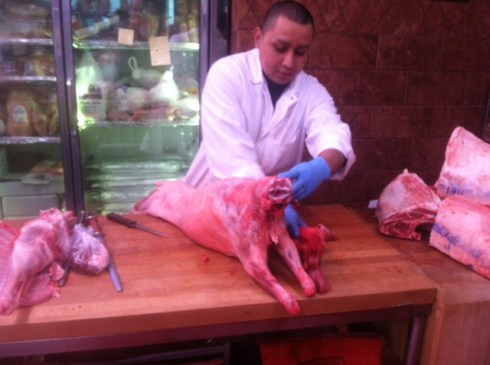
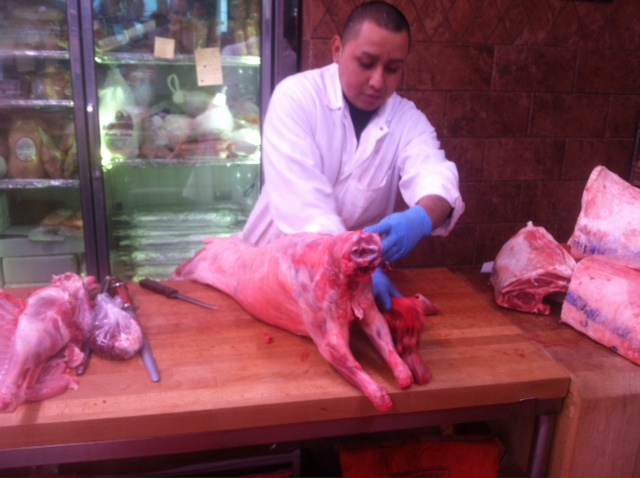
International Meats in Astoria, staffed almost entirely by Mexicans, who speak perfect Greek and know every detail of innards terminology in not only Greek, but Serbian and some Roumanian.  A Queens insituton.

Bull balls at International, with liver to the left, kidneys on the right, spleen on bottom left, hearts on bottom right.

Comment: nikobakos@gmail.com