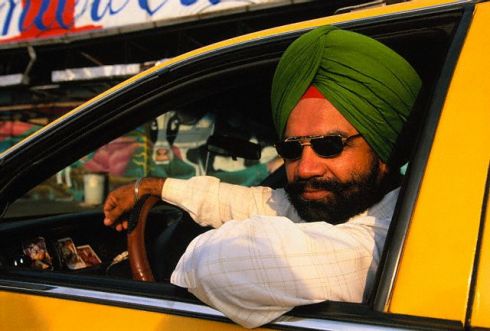
The description in this Times article of the exploitative nineteenth-century style racket these guys are subject to makes you think again about how much they can piss you off sometimes: the pressures they work under, why they can be so nasty, why they drive the way they do; the frustration must be unbearable; you almost want to compare their plight to early twentieth-century textile workers. What a third-world city this remains on so many levels; and I don’t mean immigrants; I mean how it uses and abuses them:
A few families have owned thousands of cabs since the Great Depression, or shortly thereafter. Each taxi must have a medallion affixed to its hood. There are fewer than 14,000 medallions, and the price for each has increased to $1 million from $275,000 in 2002.
A vastly profitable corporation, Medallion Financial, owned by the grandson of one of those original cab owners, provides financing for the medallions. It borrows at less than 1 percent and lends at 6 percent.
If a poor schlemiel falls behind? The city plays repo man and takes back the medallion.
It is a can’t-miss business plan.
Years ago, drivers didn’t have to rent their cabs, and they didn’t pay for gas. They split their daily proceeds with garage owners. Slow nights hurt both.
Now drivers are “independent contractors,” which is a winsome way of saying owners transferred risk onto their backs.
If it is a slow night in August, and a driver limps home after 12 hours with $30, too bad.
Just make that lease payment.
“It’s sharecropping economics, and it only works for the plantation owner,” [my emphasis] said Edward Rogoff, a professor at Baruch College, and himself a former cabby.
Tags: Bloomberg, Indians, New York, Pakistanis, Sikhs, South Asians, taxis






 A woman places earthen lamps, or diyas, on the threshold of her home on the eve of Diwali in Hyderabad, India Photograph: Noah Seelam/AFP/Getty Images
 A devotee lights oil lamps at a religious ceremony in Colombo, Sri Lanka Photograph: Dinuka Liyanawatte/Reuters


 Jadde: from Bosnia to Bengal