

According to Stephen Kinzer, New York Times correspondent and the paper’s bureau chief in Istanbul for a good part of the nineties, the appeal of EU membership to those countries waiting for it is (or was) political, social, and economic. “For Turkey it is also psychological,” he writes in his 2001 Crescent and Star:
“The central question facing Turks today is whether their country is ready for full democracy, but behind that question lies a more diffuse and puzzling one: who are we? The Ottomans knew they were the servants of God and lords of a vast and uniquely diverse empire. The true heart of their empire, however, was not Anatolia but the Balkans… But by caprice of history the founders of the Turkish republic found themselves bereft of the Balkans and masters instead of Anatolia. To make matters worse, through a series of twentieth-century tragedies Anatolia lost most of the Armenians, Greeks and Jews who had given it some of the same richness that made the Balkans so uniquely appealing.”
There’s a lot there I’m not sure of, like the Ottomans’ heart having been in the Balkans and their backs turned on Anatolia. I also don’t know if “who are we?” isn’t too categorical a way to phrase the dilemma Kinzer is talking about. Unlike Greeks, Turks know who they are; their growing willingness to accept, not only the former existence of their neighbors among them, but the plurality of their own ethnic make-up would indicate that: Albanian fraternal associations, Tatar and Circassian language classes, seem to be coming out of the woodwork of the Republic’s forced homogenization, and even the lay-low-and-keep-your-head-down Alevis have found a new courage in asserting themselves. (Poor Republic: no sooner does it harass one minority out of its existence, another one pops up to take its place.) That’s a process that requires confidence, whereas we remain isolated in our ignorant dream of purity — and banging our feet to prove it to the rest of the world on top of it — a ringing sign of insecurity. As mangled as Turks’ knowledge of themselves may have become by their own nationalism, I think phenomena like nostalgia for the multiethnic or the Neo-Ottomanism that has pervaded cultural life and even motivated political life and foreign policy in Turkey recently (and I don’t think that’s a bad thing or necessarily a “threat” to anyone; we, Greeks, might want to take advantage of it actually) is an attempt to right that disfigurement, not a deep existential reorientation. Proof might be that since Kinzer wrote his book in 2001, Turkish membership in the European Union has pretty much become a dead-in-the-water issue. And that may be partly because, in almost head-on contrast to Kinzer’s interpretation, Turkey was looking for political and economic benefits and not for Europe to validate its psychological needs, as the Neo-Greek statelet always has since its beginnings, a craven and cringingly embarrassing pandering to the West’s classical image of what Greeks are supposed to be being the foundation of Neo-Greek identity. However the Ottomans may have felt about the Balkans or wherever modern Turks end up with their renewed embracing of the Ottoman past, they seem to be increasingly feeling — even the old, staunchly Kemalist bourgeoisie, or at least their children — that they don’t need European validation to prove they’re part of a civilization that they’re not. And good for them. I wonder when we’ll get the message.
On a lighter note, it’s not often one hears the Balkans described as “so uniquely appealing.” It’s a line I’ll have to remember. Often when people find out I’m Greek, they launch into delirious and happy memories of the Aegean and little white houses and sparkling blue waters and then I have to watch their faces drop as I tell them: “Well, the part of Greece my family is from is really more the Balkans than the Mediterranean… And it rains all the time.”

Landscape approaching my mother’s village, in its usual mood. (click)
But then it is often “so uniquely appealling,” to get back to the Turks and the Balkans. The main city of the region (Epiros) is Jiannena/Yanya, a beautiful little city by a lake that always had an air of luxuriant civility about it, proof of which may be that the Greek population didn’t rush to pull down the minarets or demolish all the mosques of the city as soon as the last Turks left in the twenties.* It’s one of those Balkan cities the Turks loved. Here’s a winter photo of Yanya’s main cami, the Aslan Pasha Mosque, overlooking the icy lake, below. (click)
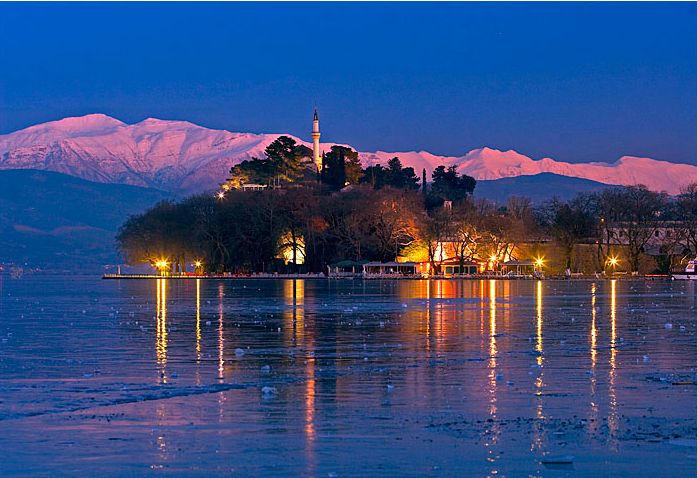
Jiannena deserves a post of its own. I gotta dig up some 2010 notes I have.
* On the other hand, the city government and developers have done all they can since WWII, including harassment and straight-out vandalism, to expropriate the city’s large and very romantic Jewish cemetery, which unfortunately for the city’s 40 surviving Jews, sits on some prime real estate. Last I heard they had taken the issue to the EU, which makes me very happy. Maybe the economic slump will give them a reprieve. More on Jiannena’s Jews in the future.
Comment: nikobakos@gmail.com

 Jadde: from Bosnia to Bengal