Balkans, Anatolia, Caucasus, Levant and other Middle East, Iran, Afghanistan, South Asia, occasional forays into southern Italy, Spain or eastern Europe, minorities, the nation-state and nationalism — and whatever other quirks or obsessions lurk inside my head.
I think the Romans in Passion story films have always colored our vision of that people: tough, competent blokes who get things done, an image promoted by some first-class marketing of course. Especially if you’re Orthodox, and have spent a good part of several hours over your lifetime in the gilded dark of the evening of Holy Thursday or “Twelve Gospels” (technically the Matins for Good Friday), listening to the several point-of-view and repeated takes on the same narrative, the Romans almost steal the story. I was rejolted by that realization last night, by the “Seventh Gospel”s display of Latin sticklerism for fairness, and respect for juridical procedure. This is the Gospel where Jesus is taken out three times by Pilate to display to the crowds, repeating each time his ruling of the Nazarene’s innocence and pleading for his life. This is also the only Roman female voice in the Gospels too: Pilates’ wife, who warns her husband that she has dreamt terrible things about this man and that Pilate should release him.
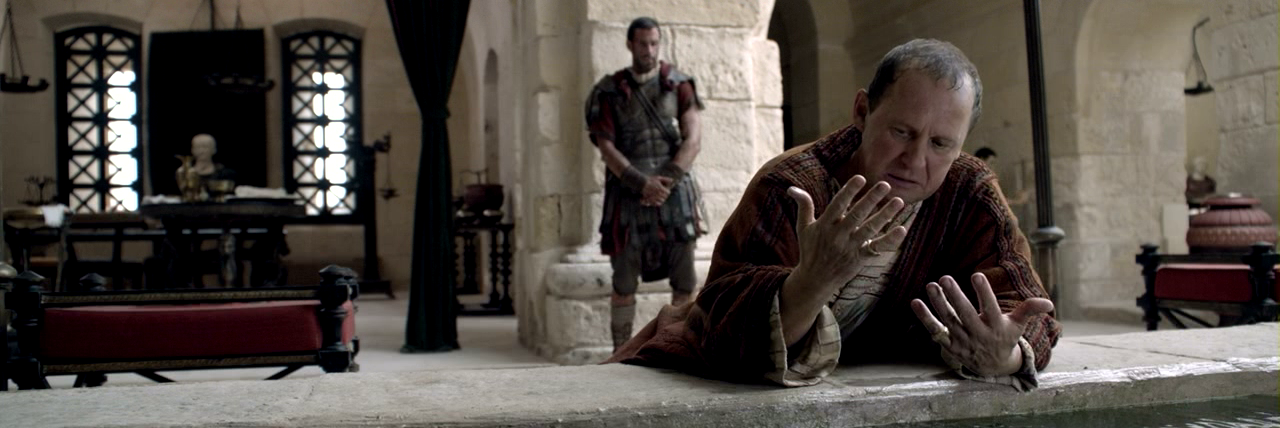
Into this historical-narrative of what Marguerite Yourcenar correctly post-prophesied would become a bloody circling tale and horrid “series of frenzies and misconceptions…” comes Risen (2016) by Kevin Reynolds, a film that until well in the later half is wholly focused on the Romans and their practical and existential vexations. Pilate (Peter Firth) is the one we all know: coming to the end of his service, annoyed by his contentious Judeaen ward of bearded clerics, and by the constant combo of legal fraction and violent rebellion he has to navigate and keep in place, all especially with his boss Caesar’s upcoming arrival for a tour of the province.
Unknown until now comes Clavius (Joseph Fiennes), looking every bit the Roman tribune: appropriate attitude, soldierly, fit and tan. He’s also dreaming of serving Rome, then finishing his military duty and duly retiring to some lovely Horatian farm idyll in Italy, with olives, vineyards, oxen and a wife. Clavius is a by-the-book man too, but he’s got a slightly different edge about him than the others. He’s relatively kinder and permissive with his men. He’s got an immediately sharper eye for what pushes the “natives” buttons — not to be confused for compassion – and senses that there’s something different and even off with the Nazarene.
This is where the emotional perspicacity of the film kind of goes off its tracks and as Clavius starts to become more and more of Christ’s followers, the late parts of the film become filled with Hallmark images of sunrises in the Galilean countryside.
I can control my reaction because the material has its emotional valence for me. Other times it’s just pissed me off. But it’s a shame, because it’s a good film with a truly innovative conceit, but as Fiennes’ strong, προβληματισμένο, complicated character starts looking more and more like he’s drinking the Kool Aid – or as one film critic, who I can’t find now, wrote: “…the colonies of bats start sailing around…” the whole thing falls into tatters. Watch the first two thirds. Don’t bother with it at all if this stuff is not your style.
Last night I figured I’d just buck up, get over with it, and start watching the Netflix docudrama — got through first two episodes — and it’s actually pretty good. Some key notes: The Turkish perspective is not insufferably jingoistic or Islamically triumphalist, like it was in that trashy 1453 film that came out a few years ago, which I also put off watching for a while because I thought it would be disturbing, but I ended up turning off after 20 minutes, not because I was disturbed or offended but because the script and acting were so horrendous and the production values so cheap — it looked like the set was composed of stuff bought wholesale from a Moroccan antique shop in the East Village or Çukurcuma– that it was simply unwatchable.
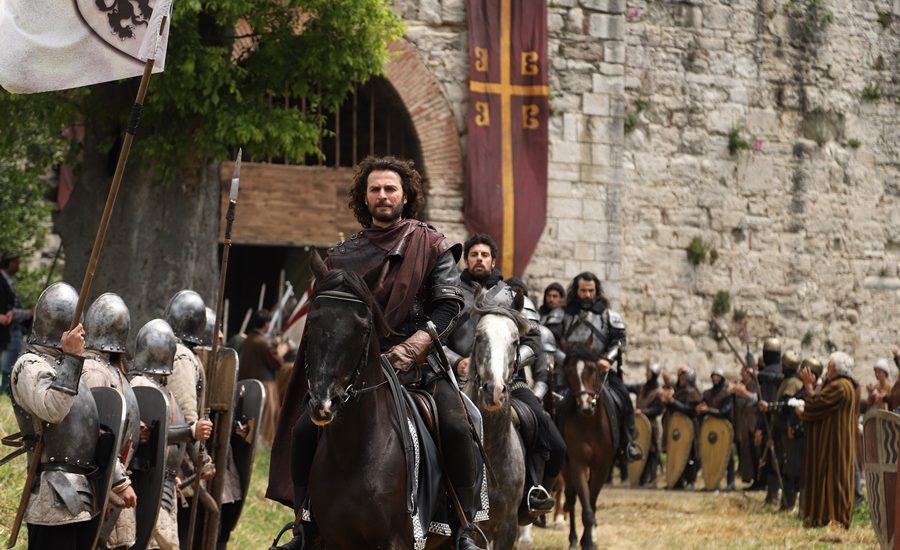
* We’re not portrayed as craven cowards or decadent dinosaurs à la Gibbon, whose destiny it was to float off into extinction. Both Constantine and Mehmet are portrayed as equal opponents, Hector-Achilles style: it’s probably no accident; both were, I’m sure, as acquainted with the Iliad as the other. Constantine’s heroic and complex combination of resistance and resignation are portrayed as thoroughly as possible: he did everything he could until there was nothing to be done anymore; Mehmet’s impressive intellect, cosmopolitanism and warrior skills are highlighted without going overboard. And both are pretty sexy, as is Giustiniani, as is even Notaras père (costumes and sets are beautiful too). I do dread the thought of how they’re going to treat the fate of the Notarades, though. It’s much too scintillating to just leave out of the whole narrative, yet to show it to us they’d have to admit that their revered Fatih Mehmet was what we would today call bisexual, and that he was also a cruel sadist, and I don’t know how that would have sat with the Turkish side of the production.
* Unexpectedly, I thought, we’re called “Romans” from the beginning of the series, in the fictional segments (and I think some of the Italians, Giustiniani even, calls us “Greeks” at one point); there’s more “Byzantine” used in the doc segments obviously. Either way, it’s hard to say whether they wanted to take a calculated risk in doing that, because using “Romans” probably leaves all non-Greek viewers baffled, or because “baffling” and confusing were the desired result for what’s always been the Turkish state’s policy: that is, separating us from the Byzantines/Romans and not giving us our due rights to claim descent for ourselves there, by calling us something different, the same reason Turkey calls Istanbul’s 3,000* remaining Greeks “Rum” to this day, while the rest of us are “Yunan”. It’s satisfying to hear, in any event.
* Whether advertently or not, it punctures some pretty giant holes in the Turkish mythology of heroic feat. One, by admitting the fact that we were outnumbered by the tens of thousands, so that the speed with which, for example, Rumelihisarı was built doesn’t seem quite so miraculous, plus there were already foundations on the site from an older Roman fortress. Two, by showing the glaring technological disparities between the two sides, meaning, that the Siege and Fall of Constantinople was the last great military event between mediaeval fortifications and early modern cannons and artillery, so that instead of being an incredible military achievement, it was more like the Spanish conquest of Tenochtitlán, with as dogged and determined a defense. And enough already with the “genius” of dragging the ships over from what, I would guess, would be somewhere near Kabataş, over the ridge, down Dolapdere into the Horn. It must have taken an enormous amount of manpower — too bad Erdoğan’s tunnel wasn’t there yet — yet not everything that’s just super-hard is necessarily “genius”.
* And stop comparing it to fucking Game of Thrones. GOT was Tolkien with sex and was the most maddening piece of trash to enthrall the masses in a long time. Ottoman is about a series of deeply traumatic events in the history of a real people that still exists, and who have been persecuted and are still threatened and harassed by Mehmet’s descendants to this day: US.
All in all it’s good; watch it. I mean, wtf, whatever. Maybe the inevitable escalation of violence, especially against civilians after the entry of the Turks into the City (The Religion of Peace gave an army three days’ right to loot, murder, rape and enslave if a city resisted and didn’t capitulate on it own) will make later episodes more disturbing. And the long arm of Erdoğanism is always felt throughout the whole thing. If Netflix were to produce a series portraying the destruction of the Second Temple and the horrendous brutality with which the Romans massacred and expelled most Jews from Judaea that made the Romans look even slightly heroic for even a second — “due to be released next Tisha B’av” — there’s not even a question of whether it would face a howling riot of protest or not; it would simply never have been produced. That’s not a “Jews control Hollywood” argument. It’s the truth. Just too many people would be offended. But even as Turkey sinks deeper into self-isolating dictatorship, it does wonders projecting a certain image to the rest of us and the rest of the Ummah.
But, at best it’s an exercise in what Helequin above calls “understand-[ing] an oppenents [sic] mythology”. You don’t have to be a trained Jungian to understand (or at least try) that “myth” is the only “reality”. That means understanding the other’s myth/s is crucial to the development of empathy, the one form of intelligence that homo sapiens [?] are still tragically deficient in.
It’s certainly the only thing in Palestine, or between Hindu and Muslim in India, and in the continuing bad divorce that is Greek-Turkish relations that will inevitably make a difference. Put yourself in a Turk’s position. Think about the massive baggage of tradition around the idea of taking Constantinople that animated them. And then [smerk]… put yourself in our position: if everybody wanted it so badly for 1,200 years, it must have been one puta madre of a city we had built there.
And in the 19th and 20th centuries, we built them another real city — “over there” — the likes of which they also had never known, and they threw us out of there too.
What are you gonna do? After a certain point, anger is too tiring. And they pay and are paying the price for their political culture anyway.
************************************************************************* The number of Greeks today in Istanbul is somewhere in the 2,000 to 3,000 range, there’s an issue of whether deaths and marriages and births will keep things in the range of critical mass… Near 300,000 in a city of around a million in the 1920s, three-thousand — in a city of 15 million today.
Balkans, Anatolia, Caucasus, Levant and rest of ME, Iran, South Asia
Me, I'm Nicholas Bakos, a.k.a. "NikoBako." I'm Greek (Roman really, but when I say that in English some five people in the world today understand what I'm talking about, so I use "Greek" for shorthand). I'm from New York. I live all over the place these days. The rest should become obvious from the blog.






 Jadde: from Bosnia to Bengal