Tag Archives: Judaism

Pentecost

8 Jun

(reposted from 2012)

Today is Pentecost, the day that commemorates the descent of the Holy Spirit and the divine enlightenment of the gathered Apostles, when they were suddenly given the wisdom to speak all languages and that marks the institutional beginning of their mission and the Church generally.  What the New Testament doesn’t say is that the Apostles were gathered to celebrate Shavuos (lit. “weeks”), “Shvuyes” in deep Yiddish pronunciation, the day God gave the Torah to the people of Israel.   The Christian feast of a gift of divine wisdom was based on the existing Jewish feast of a gift of divine wisdom, and Shavuos comes seven weeks after the first day of Passover, like Pentecost comes seven weeks after Easter – it means “fiftieth” – a name Greek-speaking Hellenistic Jews were already using for the holiday long before the Christian era.

I always loved the reading for Pentecost from the Book of Acts (below in English, the original Greek and the Vulgate Latin).  In its endless list of peoples I always felt a kind of Pax Romana yearning for unity that still moves me, especially when it’s properly recited.  It’s a bit of a sad holiday too because it marks the official end of the Easter cycle (like it does the end of the Counting of the Omer in Judaism).  Significantly, the day before is one of the several “soul Saturdays” on which the Orthodox Church commemorates the dead; old folk beliefs held that the dead dwell among us from the Resurrection until the eve of Pentecost and then depart again.  And tonight at vespers, people kneel for the first time since Holy Week; the joy of the Easter season prohibits any kneeling or prostrations during the seven weeks it lasts.  It’s the return to Real from Divine time.  And from the period of renewal where death has been defeated to real existence again where it still holds full sway.  Until the promise of the next Resurrection.

I couldn’t find a recitation of the actual second chapter.  But here’s a beautiful Arabic recitation of the first chapter of Acts — which uses the same phrasing as a Greek reading would — where Christ preps the Apostles on what’s in store for them and, like a good rabbi, tells them not to ask too many questions:


And here’s Giotto’s depiction of the event from the Scrovegni Chapel in Padua, which probably contains more spectacular art than any other equivalent square footage of space in the world:

And El Greco’s more violent, Cretan-Spanish imagining (it became a tradition to include the Virgin in the scene, especially in the West, though Acts doesn’t mention her):

2 And when the day of Pentecost was fully come, they were all with one accord in one place.

And suddenly there came a sound from heaven as of a rushing mighty wind, and it filled all the house where they were sitting.

And there appeared unto them cloven tongues like as of fire, and it sat upon each of them.

And they were all filled with the Holy Ghost, and began to speak with other tongues, as the Spirit gave them utterance.

And there were dwelling at Jerusalem Jews, devout men, out of every nation under heaven.

Now when this was noised abroad, the multitude came together, and were confounded, because that every man heard them speak in his own language.

And they were all amazed and marvelled, saying one to another, Behold, are not all these which speak Galilaeans?

And how hear we every man in our own tongue, wherein we were born?

Parthians, and Medes, and Elamites, and the dwellers in Mesopotamia, and in Judaea, and Cappadocia, in Pontus, and Asia,

10 Phrygia, and Pamphylia, in Egypt, and in the parts of Libya about Cyrene, and strangers of Rome, Jews and proselytes,

11 Cretes and Arabians, we do hear them speak in our tongues the wonderful works of God.

12 And they were all amazed, and were in doubt, saying one to another, What meaneth this?


2 Καὶ ἐν τῷ συμπληροῦσθαι τὴν ἡμέραν τῆς πεντηκοστῆς ἦσαν πάντες ὁμοῦ ἐπὶ τὸ αὐτό, καὶ ἐγένετο ἄφνω ἐκ τοῦ οὐρανοῦ ἦχος ὥσπερ φερομένης πνοῆς βιαίας καὶ ἐπλήρωσεν ὅλον τὸν οἶκον οὗ ἦσαν καθήμενοι, καὶ ὤφθησαν αὐτοῖς διαμεριζόμεναι γλῶσσαι ὡσεὶ πυρός, καὶ ἐκάθισεν ἐφ’ ἕνα ἕκαστον αὐτῶν, καὶ ἐπλήσθησαν πάντες πνεύματος ἁγίου, καὶ ἤρξαντο λαλεῖν ἑτέραις γλώσσαις καθὼς τὸ πνεῦμα ἐδίδου ἀποφθέγγεσθαι αὐτοῖς.

Ἦσαν δὲ ἐν Ἰερουσαλὴμ κατοικοῦντες Ἰουδαῖοι, ἄνδρες εὐλαβεῖς ἀπὸ παντὸς ἔθνους τῶν ὑπὸ τὸν οὐρανόν· γενομένης δὲ τῆς φωνῆς ταύτης συνῆλθε τὸ πλῆθος καὶ συνεχύθη, ὅτι [ἤκουον εἷς ἕκαστος τῇ ἰδίᾳ διαλέκτῳ λαλούντων αὐτῶν· ἐξίσταντο δὲ καὶ ἐθαύμαζον λέγοντες· Οὐχ ἰδοὺ πάντες οὗτοί εἰσιν οἱ λαλοῦντες Γαλιλαῖοι; καὶ πῶς ἡμεῖς ἀκούομεν ἕκαστος τῇ ἰδίᾳ διαλέκτῳ ἡμῶν ἐν ᾗ ἐγεννήθημεν; Πάρθοι καὶ Μῆδοι καὶ Ἐλαμῖται, καὶ οἱ κατοικοῦντες τὴν Μεσοποταμίαν, Ἰουδαίαν τε καὶ Καππαδοκίαν, Πόντον καὶ τὴν Ἀσίαν, 10 Φρυγίαν τε καὶ Παμφυλίαν, Αἴγυπτον καὶ τὰ μέρη τῆς Λιβύης τῆς κατὰ Κυρήνην, καὶ οἱ ἐπιδημοῦντες Ῥωμαῖοι, 11 Ἰουδαῖοί τε καὶ προσήλυτοι, Κρῆτες καὶ Ἄραβες, ἀκούομεν λαλούντων αὐτῶν ταῖς ἡμετέραις γλώσσαις τὰ μεγαλεῖα τοῦ θεοῦ. 12 ἐξίσταντο δὲ πάντες καὶ διηπόρουν, ἄλλος πρὸς ἄλλον λέγοντες· Τί θέλει τοῦτο εἶναι;


2 et cum conplerentur dies pentecostes erant omnes pariter in eodem loco

et factus est repente de caelo sonus tamquam advenientis spiritus vehementis et replevit totam domum ubi erant sedentes

et apparuerunt illis dispertitae linguae tamquam ignis seditque supra singulos eorum

et repleti sunt omnes Spiritu Sancto et coeperunt loqui aliis linguis prout Spiritus Sanctus dabat eloqui illis

erant autem in Hierusalem habitantes Iudaei viri religiosi ex omni natione quae sub caelo sunt

facta autem hac voce convenit multitudo et mente confusa est quoniam audiebat unusquisque lingua sua illos loquentes

stupebant autem omnes et mirabantur dicentes nonne omnes ecce isti qui loquuntur Galilaei sunt

et quomodo nos audivimus unusquisque lingua nostra in qua nati sumus

Parthi et Medi et Elamitae et qui habitant Mesopotamiam et Iudaeam et Cappadociam Pontum et Asiam

10 Frygiam et Pamphiliam Aegyptum et partes Lybiae quae est circa Cyrenen et advenae romani

11 Iudaei quoque et proselyti Cretes et Arabes audivimus loquentes eos nostris linguis magnalia Dei

12 stupebant autem omnes et mirabantur ad invicem dicentes quidnam hoc vult esse.

* See next post


Comment: nikobakos@gmail.com

Yom Kippur, Kol Nidre, Moishe Oysher and the First Roumanian (a little late…sorry)

10 Oct

Yom Kippur (pronounced “Yum Kip-per” or “Yun Kip-peh” and not “Yom Kip-pur”) is the holiest day of the Jewish year; just thought I should explain, I don’t want to under or overestimate my readers’ knowledge.  It’s the Day of Atonement, which closes the ten beautifully named Days of Awe that begin with the Jewish New Year (“Happy New Year to Everyone“), when Jews fast and atone for their – “sins” is too Catholic – for their moral failures, let’s say.

Kol Nidre, the first few words of which are heard sung by Moishe Oysher in the clip from “Overture to Glory,” (see Kol Nidre) is sung on the eve of Yom Kippur.  “All Vows” in Aramaic, the prayer, which in many ways has become the center of the day’s observance, asks God for release from any promise or oath that one will make in the coming year.  Controversial even among Jews at certain periods in Jewish history, in the Gentile world the prayer has generated volumes of anti-Semitic garbage, along the lines that one can imagine: sneaky Jews starting their year off with a legal loophole, etc.  What Kol Nidre asks of God is understanding for the many ethical obligations that an honest man knows he will not be able to completely live up to in the coming year; it’s not a request for a moral pass or a license to lie.  It’s an expression of terrible honesty, in fact.

Moishe Oysher (click)

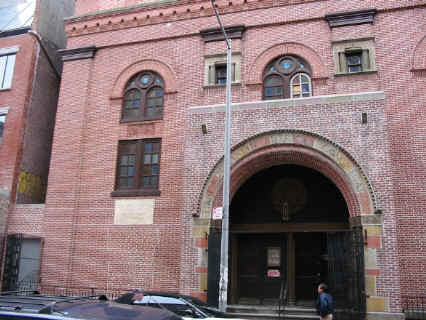
Moishe Oysher was a Moldavian-born star of Yiddish theater and cinema, first in Europe, then mostly in the Americas, who almost accidentally stumbled into the real-life role of cantor at the First Roumanian Shul* on Rivington Street on the Lower East Side.  His powerful voice, entertaining and dramatic style (disliked by many purists), and movie star looks made him, and the First Roumanian, a sensation in the 1930s and 40s when he sang there, apparently increasing the congregation’s size to overflowing.  “Ooooh yeaaaah….” the ancient caretaker who showed me and a friend the decrepit interior the one time I was in there in the early 90s, “Moishe Oysher…they say he really packed in the gallery [where the women sat] in those days, he he…”

Unfortunately Oysher died young, at 51, and unfortunately the First Roumanian Shul (see below) was torn down or — like used to happen to “landmark” buildings in Greece — allowed to collapse in 2006.  It wasn’t any stunner of a building, but it was a historic center of Jewish New York and it had some of the best acoustics of any interior space in the city.  Its congregation was tiny at that point and only used the basement, even on Yom Kippur, but it could have easily been used as a concert hall or musical venue of sorts like so many houses of worship in the city whose demographic environment has changed.  In fact, it was in the process of being designated a landmark when, under shady New York real estate circumstances that may have involved the leaders of the congregation itself, city money for repairs was delayed for so long that the roof collapsed, the building was declared irreparable and the shul was demolished a few months later.

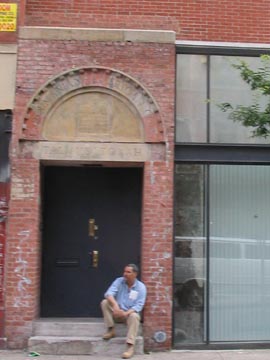
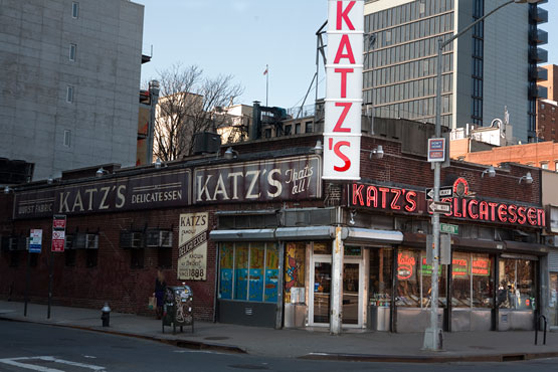
Like so much of the neighborhood, once the site of terrible poverty and the greatest population density of any equivalent set of square miles of urban space in history, but the wellspring of so much of New York’s historical and cultural and political life, the shul’s space is now occupied by a condo, with the old yeshiva side-door set into the glass façade in one of those contrived architectural pastiches that only add insult to injury for me, and Rivington Street no longer echoes to the booming voices of cantors on the High Holy Days but the screeching of drunk white girls pouring out of its series of identical bars at closing time.  At least Katz’s can still make a living.**

**********************************************************************************************************************************************************************************

*Shul: “school” literally, in Yiddish, is the traditional Ashkenazi term for “synagogue,” a Greek word which means roughly the same thing: a place to come together and pray and study (“train,” if you like, for those that recognize the second half of the word from “pedagogue” — or the movie 300…  Venetian Jews called their synagogues “scuole.”  Oddly enough, I don’t know what Sephardim call theirs.)  I don’t know where American Reform and Conservative Jews got the, frankly, sacrilegious idea of calling a “synagogue” a “Temple.”  There was only One Temple to the One God in the One City; you can’t rebuild one in Great Neck or Forest Hills.  I cringe whenever I hear it.

**Katz’s is a delicatessen on the corner of Ludlow and Houston, literally around the block from where the First Roumanian used to be.  Like most Jewish businesses on the Lower East Side by the 1980s, it was sliding downhill and hanging on by a thread, when the sudden explosion of the neighborhood (starting with, and especially, Ludlow Street) into the center of under 35 nightlife in the city gave it a new lease on life.  It’s now on every New York tourist’s itinerary and is open twenty-four hours a day, packed when the bars close after 4:00 a.m.  It has decent undistinguished pastrami, but nothing there is especially good.  A better post-bar munchies choice is Bereket, down the street on the corner of Orchard, the Turkish place that has a variety of meat-kebab-doner choices and zeytinyagli-ladera-vegetable dishes, but you have to deal with vegans there.

There’s still excellent pastrami to be had in New York around the clock, but I’m not telling where.


Comment: nikobakos@gmail.com


Jewish New York gets scary, ctd.

20 Jun

I’ve written about the Israeli colonization of the Diaspora mind (in and not in connection with similar process among Greeks) here and here, so I was really intrigued by reading some of the comments on The Forward‘s* original post, which put a really interesting twist on things:

“They couldn’t even write it in Yiddish?” [asks one poster]

[reply]  “The billboard isn’t sanctioned by any official Orthodox organization but rather the work of a lone wolf accentric [sic]. The use of Hebrew rather than Yiddish or English suggests this to be the work of an Israeli trying to import Mea Shearim standards to Brooklyn,  [see: Haredi Judaism**]  The overwhelming majority of Orthodox Brooklynites (including Hassidic and yeshivish) view public spiritual policing as distasteful and bordering on incitefull [sic]. Also, the use of a billboard for this message is an oxymoron, since a spiritually sensitive person that tries to watch his eyes avoids looking at billboards altogether.”

*The Jewish Daily Forward (“Forverts”), a New York institution, central to progressive causes in the city and the country since its founding: The Forward.

**Haredi Judaism: these guys are the ones that made front pages last year for terrorizing a little girl in a short skirt in Israel, and have generally worked their way into a place where they hold much of Israeli politics hostage, though they don’t serve in the Israeli army on grounds that they don’t recognize Israel, but do accept massive amounts of public assistance from the Israeli state because their birthrate is so high and much of them, having only religious education, are unemployable (just so many yeshiva bochers an economy can absorb).  “The vast majority of Haredi Jews rejected Zionism for a number of reasons. Chief among these was the claim that Jewish political independence could only be obtained through Divine intervention, with the coming of the Messiah.”