
(click)
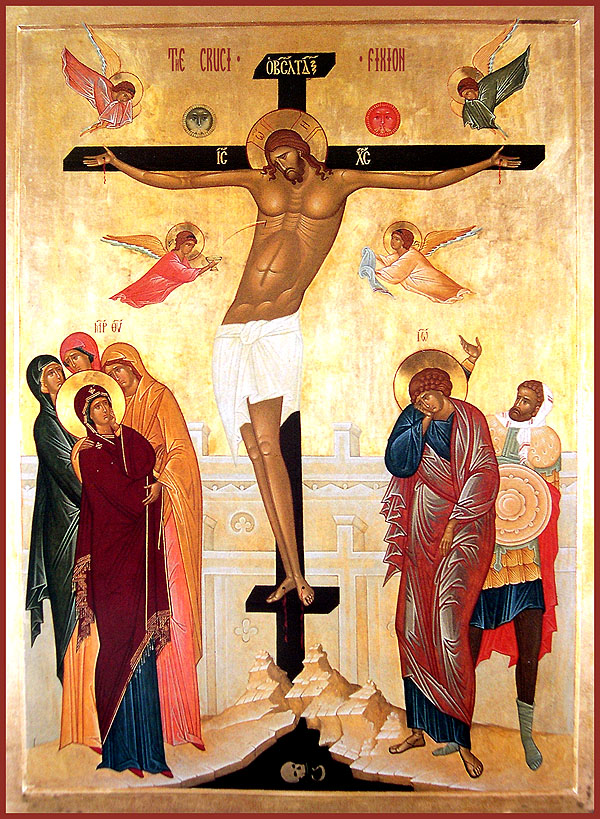
“Today hangs suspended from a piece of wood, the One who suspended the earth amidst the waters…” begins the main hymn of tonight’s service in the Orthodox Church. It’s matins for Good Friday, sung the night before; it corresponds to the Oficio de Tinieblas in the Catholic Church, or the Via Crucis, or Stations of the Cross. Except it’s not the forty-five minutes Cliff notes version. It’s a four — with Russians, five plus — hour, perfectly paced and structured, oratorio that uses twelve gospel selections (it’s colloquially known as the “Twelve Gospels” among both Greeks and Russians and I imagine other Orthodox peoples), and a surfeit of beautiful and psychologically astute poetry and music to tell the story of the Last Supper, and Christ’s arrest, judgement, crucifixion, death and burial. It’s my favorite Holy Week service. Because it’s a masterpiece. It doesn’t draw any of its power from made-up, sadistic Mel Gibson details that aren’t even in the gospels: like how many times Christ fell, or where they whipped Him, or where and when they spat on Him, or where He scraped his knees, or any of the bloody kitsch and sensationalism and fabricated detail so physical that it’s disrespectful and that the Catholic Church allows and encourages; one speaks of the body of Christ with a certain laconic awe I would think, no matter what it was put through. Its power comes from the perfection of its theater and its theology and — if anything — from the spareness of the story it tells.
Background to this post… For years, whenever I heard that relatives or friends from Greece, especially under a certain age and especially from Athens, were coming to New York to visit for Easter, my guts would get twisted up in knots of anxiety in anticipation because I just could not endure having them around at that time of year. Anticipation of what? Well, there came a time, for me a crucial turning point in post-1974 Neo-Greek culture — it was around the early-eighties — when Greeks started asking each other: “Where are you going for Easter?” And I couldn’t imagine what I would answer if asked. Where am I going for Easter? I dunno… I’m going to be home. I’m going to my village. It’s Easter. Where should I be going? This is because there came a point, when, for the demographic I’m talking about, Holy Week and Easter had become the equivalent of Spring Break, some free days to go off on a vacation somewhere.
So I could anticipate their attitude. I knew they wouldn’t appreciate the subtle shift in the pace of life that occurs in a Greek neighborhood like Astoria when Palm Sunday dawns. The sobriety mixed with the rush of preparation and excitement. I would anticipate instead the surprise, at best, but mostly the grinning condescension, with which they’d react to how seriously diaspora Greeks still took this time of the year, how backwards and un-hip and un-Euro it was of us. I’d know they’d want to go out to a cool baraki on Good Friday night. I’d know they’d ask to be taken shopping on Holy Saturday, in the middle of the cooking and cleaning: there were some shoes they had seen on sale at Macy’s. I had two Turkish roommates for a while once: totally secular, modern Istanbullu girls; they just didn’t eat pork. And out of respect, or just to prevent possible squeamishness on their part — they had never even said anything to me — I would keep salami and pancetta and other pork products in the basement refrigerator that they never used. On the other hand, I once had to have a screeching match with a Athenian guest about not having meat in the house on Good Friday — I ended up feeling like a friggin’ Talib — because she needed her protein and fasting reminded her of how oppressive her mother was during her childhood. Just a couple of years ago, a cousin saw me go off to the first Nymphio on Palm Sunday evening and said to me: “You mean…like…you’re going to go be going to church…like…every night this week? In Greece nobody goes. That’s something left over in the diaspora…” she had the archidia to say to me. It was never something they had lost; it was always something “left over” among us. I said nothing. But, as you can imagine — as opposed to the sentiment of “Next year in Jerusalem” — the idea of being stuck in Greece for Easter had always been my nightmare. I only came this year because it was going to be one of the rare years professionally when I could go to my father’s village in Albania for what I knew would be a traditional Easter that wouldn’t infuriate me.
And instead I’ve been amazingly and pleasantly surprised. I don’t know what Greece it is that this cousin of mine lives in where nobody goes to church, but all through Lent and especially this week, every church I’ve been in has been packed. Tonight was the most moving “Twelve Gospels” I’ve ever attended. The massive (as massive as a pre-Tanzimat church could be) eighteenth-century, stone cathedral of Jiannena was filled to the rafters — literally; it has a two-floor gallery where the women used to traditionally stand and even both of them were full. The cantors were perfect. The procession of the Cross immaculately pulled off. I felt like Vladimir’s envoys in Hagia Sophia.
But what most moved me most was the breadth of age and sex of the crowd. If anything, there were even more young people than there would be in New York — young guys, parea — following the text from the little black book carefully, people with that relaxed reverence that the best Greek — knowing how to be respectful, but comfortable in his father’s house — displays when in church. Almost everyone stayed to the very end. I really felt in my heart and gut what Yosef Eliya felt in his Purim poem when he writes: “Tonight the synagogues open their arms wide to the faithful children of my ancient people…”
Tomorrow it’s off to Albania.
Kale Anastase and Happy Easter…my ancient people.
–
Comment: nikobakos@gmail.com
–

 Jadde: from Bosnia to Bengal