

By NATHAN THRALL

(West Bank: Second Intifada)
Jerusalem
EARLIER this month, at a private meeting with the Israeli prime minister, Benjamin Netanyahu, and his security advisers, a group of Middle East experts and former intelligence officers warned that a third Palestinian intifada was imminent. The immediate catalyst, they said, could be another mosque vandalized by Jewish settlers, like the one burned on Tuesday, or the construction of new settlement housing. Whatever the fuse, the underlying source of ferment in the West Bank is a consensus that the Palestinian Authority president, Mahmoud Abbas, has reached a dead end.
Mr. Abbas’s political strategy was premised on the notion that security cooperation between the Palestinian Authority and the Israeli government would make Israel feel safer and remove its primary justification for continuing to occupy the West Bank, thereby clearing the way for a Palestinian state. Ironically, owing to the success of his efforts, many Israelis have had the luxury of forgetting that there is an occupation at all.
Thanks to the American- and European-financed peace that Mr. Abbas’s government has been keeping in the West Bank, Israelis have come to believe they can eat their cake and have it, too. A majority of citizens polled earlier this year said their state could remain Jewish and democratic without relinquishing any of the West Bank. Years of peace and quiet in Tel Aviv allowed hundreds of thousands of Israelis to take to the streets last summer to protest the high price of cottage cheese, rent and day care without uttering a word about Palestinians in the West Bank. The issue has ceased to be one of Israel’s primary security concerns. Mr. Netanyahu would have to be either politically suicidal or exceptionally forward-thinking to abandon a status quo with which a vast majority appears satisfied.
By contrast, Palestinians today see their leadership banging its head against a wall, hoping against reason that a bit more good behavior will bring about an independent state. As a result, longstanding debates over how to achieve national liberation — by comforting Israel or confronting it — have now been resolved. Palestinians of all political stripes are no longer arguing about whether to make Israel’s occupation more costly, but how.
During the 1990s, Mr. Abbas was one of the key architects of the Oslo peace process, which envisioned a phased Israeli withdrawal from the West Bank leading to a permanent peace agreement (though not necessarily to a Palestinian state). Today, he is perhaps its last remaining believer. He has been forced to pay lip service to the demands of those who advocate confrontation by issuing repeated pledges to confront Israel — by dismantling the Palestinian Authority or refusing to negotiate unless Israel freezes settlement construction — only to renege on each one.
As the gap between the Palestinian president’s words and actions has grown, so has the distance of his policies from public sentiment, leading to his government’s turn to greater repression: torturing political opponents, blocking Web sites and arresting journalists and bloggers critical of Mr. Abbas. Even Mr. Abbas’s close advisers confide that he is at risk of becoming another Antoine Lahad, the leader of Israel’s proxy force during its occupation of southern Lebanon. The chief steward of Mr. Abbas’s policies, the unelected prime minister, Salam Fayyad, has acknowledged, “I think we are losing the argument, if we have not already lost.” And Mr. Abbas himself has admitted that the peace process is “jammed” and that his government had merely helped create “a good situation” for Israel, which, enjoying years of unprecedented cooperation with Palestinian forces in the West Bank, lacks incentives to agree to any change.
But these days, Palestinian security forces have little reason to believe their efforts are advancing national goals, and Israel can’t assume that the Palestinian Authority will provide security indefinitely. Last month, as gunfire returned to the streets of Jenin, and 1,600 Palestinian prisoners entered the fourth week of a hunger strike, Mr. Abbas said: “I cannot control the situation. I am afraid, God forbid, that the security system here will collapse.” That sentiment echoed remarks by Yuval Diskin, the recently retired head of Israel’s internal security agency: “When the concentration of gas fumes in the air is so high,” he said, “the question is only when the spark will come to light it.”
The root cause of this instability is that Palestinians have lost all hope that Israel will grant them a state. Each attempt to exert what little leverage Palestinians possess has been thwarted or has proved ineffective. Boycotts of settlement jobs and products haven’t gained mass support, and would not stop settlement growth even if they did. The Palestinians could have pushed for a vote last September in the United Nations General Assembly — a move that frightened Israel and America because of its implications for Palestinian accession to the International Criminal Court. Mr. Abbas abandoned that effort in favor of a petition for statehood at the Security Council, which was always guaranteed to fail, and then deftly sold his capitulation as defiance.
These failures have left Palestinians who hope to make present conditions untenable for Israel with only two options: popular protest and armed resistance. The first option faces enormous obstacles because of political divisions between Hamas in Gaza and Mr. Abbas’s Fatah in the West Bank. Each faction regards mass mobilization as a potential first step to its overthrow, as well as a means of empowering a new generation of leaders at the expense of existing ones.
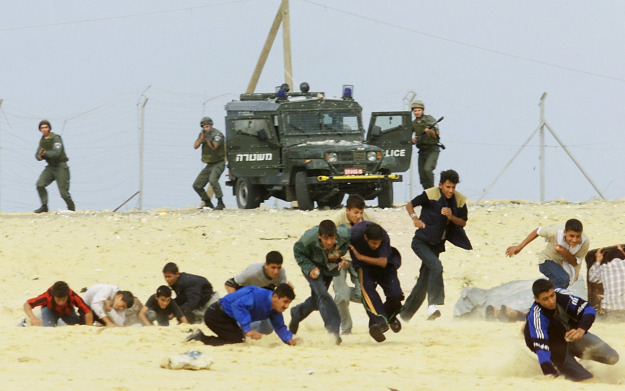
If mass demonstrations erupted in the West Bank, Israel would ask Palestinian security forces to stop any protests near soldiers or settlers, forcing them to choose between potentially firing on Palestinian demonstrators or ending security cooperation with Israel, which Mr. Abbas refuses to do. As he knows and fears, mass protests could quickly become militarized by either side. For that reason, his government has offered little more than rhetorical support for the small weekly protests so beloved by foreign activists and the Western press, and has actively prevented demonstrators from approaching any Jewish settlements.
The second option is armed confrontation. Although there is widespread apathy among Palestinians, and hundreds of thousands are financially dependent on the Palestinian Authority’s continued existence, a substantial number would welcome the prospect of an escalation, especially many supporters of Hamas, who argue that violence has been the most effective tactic in forcing Israel and the international community to act.
THEY believe that rocks, Molotov cocktails and mass protests pushed Israel to sign the Oslo Accords in 1993; that deadly strikes against Israeli troops in Lebanon led Israel to withdraw in 2000; that the bloodshed of the second intifada pressured George W. Bush to declare his support for Palestinian statehood and prodded the international community to produce the Arab Peace Initiative, the Geneva Initiative, and the Road Map for Middle East Peace. They are also convinced that arms pressured Ariel Sharon, then Israel’s prime minister, to evacuate settlers and troops from Gaza in 2005. That pullout also had the effect of freezing the peace process, supplying “the amount of formaldehyde that is necessary,” as a Sharon adviser put it, “so there will not be a political process with the Palestinians.”
For more militant Palestinian leaders, who never believed in the peace process, the lesson was clear: “Not an inch of Palestinian land will be liberated,” Mousa Abu Marzook, deputy head of Hamas’s political bureau, told me, “while Israelis feel that controlling it exacts few costs.” Matti Steinberg, a former senior adviser to Israeli security chiefs, described Mr. Abbas as the most obliging, nonviolent Palestinian leader Israel has encountered and warned of taking him for granted. “The Israeli center is caught in a vicious cycle,” he said. “It argues that it cannot make peace while there is violence, and when there is no violence it sees little reason to make peace.”
History may credit Mr. Abbas with reigning over the more virtuous phase of this cycle, but he has likely laid the groundwork for the uglier one. Hamas, meanwhile, has already moved on. “Israelis had a golden opportunity to sign an agreement with Abbas,” Hamas’s health minister, Basem Naim, told me in Gaza last November. “But the chance has already passed. They will not get it again.”
Nathan Thrall is a Middle East analyst at the International Crisis Group.

Nablus (2005)
Comment: nikobakos@gmail.com

 Jadde: from Bosnia to Bengal