Tag Archives: Turks

Something beautiful from Greece: “Minore tes Auges” — rebetiko

17 Jun

This goes out to my best friend in the world.  We’re different — maybe it’s the complementarity that has sustained the friendship since I was eighteen — and we like to rag on each other a lot.  I call him a technocrat who can’t understand anything unless it can be put on a spreadsheet; he calls me a poetry-addled flake from another planet; both contain a large dose of truth.  At the same time he has the largest heart and the most profoundly musical soul of any person I have ever met.  He remembers how when he first heard this song at eight years old, he fell into a crying fit that kept him awake all night; it wasn’t the lyrics, it was the melody that “turned him into rags” as we say in Greek, “my mother at my bedside asking me ‘what’s wrong, my son?,’ me sobbing uncontrollably…”

I can’t post the original 1947 video he sent me because some copyright b.s. makes it unviewable in the U.S., so I found a beautiful rendition (along with odd but interesting video) by the great Swteria Mpellou, one of the great cultural icons of modern Greece; read about her fascinating, heroic life; like with many flamenco or blues singers, it wasn’t the classical beauty or timbre of her voice that made her great; it was her voice’s indefinable character, its soul.

The lyrics:

Ξύπνα, μικρό μου, κι άκουσε
κάποιο μινόρε της αυγής,
για σένανε είναι γραμμένο
από το κλάμα κάποιας ψυχής.

Το παραθύρι σου άνοιξε
ρίξε μου μια γλυκιά ματιά
Κι ας σβήσω πια τότε, μικρό μου,
μπροστά στο σπίτι σου σε μια γωνιά.

Wake up my little one,

and hear a dawn minore,

written for you by the weeping

of some soul.

Open your window

and throw me just one sweet glance,

and then let me be extinguished, my little one

in some corner, outside your house.

Swteria Mpellou

“A Dawn Minore” is a rebetiko — though a late-style, more commercial example of that genre — music which has its origins among the Greek proletariat of Anatolian cities — more so Smyrna than Constantinople (I imagine that in C-town the classical tradition was too strong and the other alternatives were more a la Franca, though whatever more popular genres contemporary “arabesque” comes from must have been present).  It took its definitive form, however, among the largely refugee proletariat of Athens, Piraeus, and Salonica, after the Population Exchange of the 1920’s.  Because of its association with Turkey, the poor, crime, drugs, the underworld, but mostly because its “orientalness” didn’t sit well with the Westernizing agenda of the Neo-Greek bourgeoisie, it was subject to much discrimination, marginalization and even official bans of varying efficacy.  Eventually, however, and with the recognition of geniuses like Hatzidakis, it became the basis of modern Greek music, especially that of its Golden Age between the fifties and the seventies, when Greece produced popular music that, for the quality of its compositions and high poetic standard of its lyrics, may be unmatched in any modern commercial genre, and which, along with Cavafy, I consider the great cultural achievement of twentieth-century Greek culture.  Under unknown circumstances, this musical florescence suddenly expired in the early eighties at some point (Pasok and its lethal, lefty didacticism?).  A craze for old rebetika (pl.) which suddenly exploded in Greece at the same time, probably represented a need to fill the gap: nostalgia is usually a symptom of creative sterility.

Irony: Tsitsanes, lionized as the greatest rebetiko composer and bouzouki player, but who I never thought was all that, published a series of virulent, racist rants against the Hindi-film influenced genre of popular music that developed in Greece in the fifties, decrying its “corrupt, oriental cheapness,” that could have been written, with the same vocabulary, by a Greek bourgeois ranting against rebetiko itself two decades earlier.

Irony: Many of the young Neo-Greeks that have fetishized rebetiko since the eighties (the little Athenian snots who will only listen to authentic rebetiko first renditons off of 78’s — that, or Miles) till the point where the aural environment of Greece became so saturated with it that it could drive you nuts, will also still express the same Orientalist, petit bourgeois anti-“easterness” towards other music that previous generations did toward rebetiko.  “I can’t tolerate any form of Eastern music” a thirty-something Athenian recently told me (with the crucial condescending stress difference between “anato-li-tike” and “anatoli-ke) which for the sociological type in question almost always means any microtonal, highly chromatic music, which, freed from polyphony — except for the simple drones of Hindustani classical music or of certain Balkan folk music — and the structural complexities of Western harmonies, can throw all its craft into the highly embroidered monophonic melodic line — which essentially means all music from Greece eastwards.  This was announced to me with great disgust while I was listening to a sublime Shajarian rendition of a Fereydoon Moshiri poem, disparaged as “amanedes”* (if she only knew the caliber of artists she was talking about…)  “Eastern music?”  I replied.  “So, you mean our entire musical tradition before “Barba Yianne me tis Stamnes?”**  She didn’t have an answer to that.

Heresy: Most rebetika contain neither the intriguing depth of Western harmony nor the possessing melodic intricacy of Arab or Persian classical music, or even Greek ecclesiastic music, which is why I often find them a bit tedious and am not part of the general fan club, and I consider its popular offspring of later decades (the Golden Age, a masterful combination of rebetiko, various folk genres, western forms and the best poetry of the period — prepare for a “Golden Age” series of posts) to be the by far superior music on every level.

Positive: Rebetiko, in a strangely poetic voyage back across the Aegean, became wildly popular in Turkey in the nineties, with Turks forming their own groups and everything (I’ll find an example) and has since become a happy space where much musical collaboration and explicit mutual affection is expressed.

Final YouTube comment from a Greek on another video: “Πέθανε αυτή η Ελλάδα. Ας το καταλάβουμε μπας και γλυτώσουμε από τα ΑΚΟΜΑ χειρότερα…”  “That Greece is dead.  If we get it through our heads maybe we’ll be spared EVEN worse.”

*”Amanedes” are a light classical Turco-Greek genre that flourished in early twentieth-century Smyrna.  I don’t think it ever called itself that; the mostly negative term comes from the frequent repetition of “aman,” mercy in Turkish, in its lyrics.  It’s mostly disparaging, like when used by the person above, to deprecate some kind of music as “Turkish” “Eastern” “oriental wailing” etc…

**”Barba Yianne me tis Stamnes” is an exemplary piece of an extremely silly barber-shop quartet genre that became popular in early twentieth-century Greece, based on the Italianate “cantada” tradition of the Ionian islands, which is like bad Neapolitan music without the passion, wit, complexity or subversiveness.  I can’t find a recording of it.  The thought that if it hadn’t been for the refugee influx of the twenties, that could have become the future of Greek music sends chills down my spine.  (Here you go– from a Turkish website — go figure.)

Comment: nikobakos@gmail.com
Crimean Tatars

7 Jun

from Al Zazeera:

“On May 18, 1944, Joseph Stalin deported 218,000 Crimean Tatars to Central Asia.

Using personal testimonies, this film tells the story of the Tatars’ expulsion from their homeland and their long struggle to return.

It was only in 1989, with the opening up of the Soviet Union, that they were able to come back in large numbers. Most, finding Russians living in their former homes, built shacks in which to live.

Today, 300,000 Tatars live in Crimea – 5,000 of them still in shacks.

Even those with houses suffer because they only have minority status.

Despite this, 150,000 more are still hoping to return home.”


Comment: nikobakos@gmail.com

Fethih 1453

2 Jun

Wow! This looks cool.

Anybody seen it?  I won’t even look on-line for comments ’cause I don’t expect to find anything but the usual crap.

Or maybe I will…


Comment: nikobakos@gmail.com

“Kurbet — yes, the Turks have a word for it too…”

1 Jun

A film about Turkish immigrants in Germany and a homecoming trip they go on that looks delightful.  What a creative voice German Turks have become.

The little boy is terrified of the crucifix because the other boy earlier in the trailer tells him that in Germany they eat swine-flesh and people: “They eat people?  Yeah, and on Sunday they get together and eat them and drink their blood!,” which is sure throwing the anti-Jewish blood libel in Christianity’s face; it’s that slight chill that always makes a good laugh funnier.

The other, more poignant scene — scenes of which I have an infinite file of from my own childhood — is of the mother trying as hard as possible to give her kids a real German Christmas: “Nooooo!” they yell at her, “you’re supposed to wrap them!”  And the sad little tree…

I don’t know all this because the Holy Spirit suddenly blessed me with the ability to understand German but because I caught a discussion with the filmmakers on — where else — Al Jazeera.  I couldn’t find a trailer with English subtitles, though you can put it on your Netlix “saved” list already.

Does there always have to be a white-girl girlfriend in these movies?  You can so predict what the jokes and problems are gonna be…


Comment: nikobakos@gmail.com

“…the innocent boy of seventeen…”

12 May

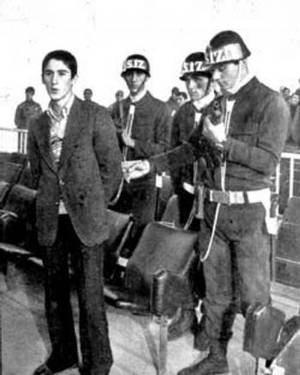
Though it was only incidental to the previous post, the image of Erdal Eren has haunted me for the rest of the night; perhaps it’s the photo of him and its painful youth and innocence; obviously the terrifying quote: that he looked forward to his execution in order to avoid thinking of the torture he had witnessed; maybe it’s that hanging has always struck me as a particularly obscene form of capital punishment’s obscenity (the setting looks prison-like, like he’s actually entering the gallows chamber there…)

Then the eerie reminder of the Cavafy poem: “27 June 1906, 2 p.m.”

27 Iουνίου 1906, 2 μ.μ.

Σαν το ’φεραν οι Xριστιανοί να το κρεμάσουν
το δεκαεφτά χρονώ αθώο παιδί,
η μάνα του που στην κρεμάλα εκεί κοντά
σέρνονταν και χτυπιούνταν μες στα χώματα
κάτω απ’ τον μεσημεριανό, τον άγριον ήλιο,
πότε ούρλιαζε, και κραύγαζε σα λύκος, σα θηρίο
και πότε εξαντλημένη η μάρτυσσα μοιρολογούσε
«Δεκαφτά χρόνια μοναχά με τα ’ζησες, παιδί μου».
Κι όταν το ανέβασαν την σκάλα της κρεμάλας
κι επέρασάν το το σκοινί και το ’πνιξαν
το δεκαεφτά χρονώ αθώο παιδί,
κ’ ελεεινά κρεμνιούνταν στο κενόν
με τους σπασμούς της μαύρης του αγωνίας
το εφηβικόν ωραία καμωμένο σώμα,
η μάνα η μάρτυσσα κυλιούντανε στα χώματα
και δεν μοιρολογούσε πια για χρόνια τώρα·
«Δεκαφτά μέρες μοναχά», μοιρολογούσε,
«δεκαφτά μέρες μοναχά σε χάρηκα, παιδί μου».

“27 June 1906, 2 p.m.”

When the Christians brought him out to be hanged
the innocent boy of seventeen
his mother there near the scaffold
was dragging and beating herself in the dust,
under the sun, the savage noon-day sun,
and now would screech, and now would howl like a wolf, like a beast,
and then exhausted the martyred woman would keen
“You only lived these seventeen years my child.”
And when they raised the boy up on the scaffold,
and passed the rope around his neck,
the innocent boy of seventeen,
and his body swung hideously in the void
wracked by the spasms of his black agony
the beautifully made youthful body,
the martyred mother rolling in the dirt
was no longer keening of years,
“Seventeen days only” she keened,
“Seventeen days only did I enjoy you, my child.”

(my translation)

Erdal Eren

Cavafy wrote the poem in remembrance of the 1906 Denshawi affair, one of Britain’s unfinest hours.  Apparently some British military personnel were returning from Cairo to Alexandria and, near the village of Denshawi, shot some pigeons that belonged to the locals.  A scuffle ensued; a rock was thrown that hit a British soldier on the head and, though he died of what was later proven to be sunstroke, like a delicate E.M. Forster memsahib, five of the residents of Denshawi, including the seventeen-year old of the poem, were imprisoned.  Fortunately, there was such a public outcry after the execution of the young man that the other four men were released, though not till two years later in 1908.  The episode still remains disgusting and Cavafy’s poem one of his most chilling, a register he usually didn’t work in.

At the same time it’s a beautiful reminder of his humanity on several levels.  One is his life-long opposition to capital punishment: “Whenever I have the opportunity I declare this,” he wrote in 1902.  The other, without re-outfitting him as a post-colonialist before his time, is his affection for and lack of alienation and estrangement towards Egypt itself.  He could have had the cloistered emotional outlook of an erudite fag in the European cocoon of Alexandria, yet the otherness that life imposed on him taught his heart the right lessons.  The above poem (even his use of “the Christians,” which in the context can mean nothing less than “the kafirs,”* is a jarring statement of identification) is only his most poignant expression of his love for the country, not just the historical Egypt of so much of his poetry, but the actual Arab Egypt he lived in; “To glyky mas Misiri,” as he calls it in one poem: “Our sweet Misiri” — our sweet Egypt.**

I wonder what he would have thought of the current state of Greek politics – not that he ever cared much for either the Neo-Greek statelet or its inhabitants.  What would a man that lived and wrote on the cusp of every possible human margin and in every plural space conceivable, who would have died before he let his Hellenism be trapped by geography, nationalism or its idiocy, have thought of Greece having the most potentially powerful Nazi (I’m tired of dignifying them with the prefix neo-) party on the European continent?  And that granted to them by a significant youth vote.  A thirty-something Athenian, and a left-leaning one at that, recounting to me the multiple incidents of petty anti-immigrant animosity that she had been witness to in Athens even before the current crisis, recently said to me, in glib defensiveness: “Well, we’re not used to strangers in our country.”  This from us, malaka, the inventors of migration and its pain, who since the beginning of our historical presence have been strangers in every stranger’s land on the planet, except those corners ventured into only by more intrepid or desperate Jews or Gypsies.  It’s beyond even remotely doubting for me that it’s partly the loss of a diaspora consciousness on Neo-Greeks’ part, and the wider sense of world it gives you, that has made us such closed, parochial idiots, just as Israel — sorry to say — has had the same effect on Jews.  And the comparison doesn’t end there; in both cases the diaspora is not just forgotten and ignored, but a source of embarrassment and shame, and each state and its official and/or fabricated culture has the hubris to think itself the metropolitan standard that those left outside should aspire to, when neither state in question contained a serious metropolitan center of either Hellenism or Jewishness until the twentieth century (…with Israel causing a progressive closing of the Jewish mind everywhere — a disaster for all of us).  Now maybe that some young Greeks have had to start emigrating again some of that attitude will get a real reality check.  The economic crisis in Greece is a source of genuine consternation for me and I’m guardedly on the anti-EU/Troika side; at the same time some humility may be exactly what that society needed.  Maybe…though voting for Nazis doesn’t exactly indicate humility but childish rage.


*Qafr, kafir: infidel

**Masr is Egypt in Arabic.  Cavafy uses “Misiri” because in Modern Greek words can only end in certain consonants.  This is something  — tzatziki, kazani, kadaifi, kokoretsi, duvari — that makes Turks giggle and strikes them as particularly funny when they hear it in Greek and the kick they get out of it has always struck me as particularly sweet in return.  I think Cavafy intended it to have this effect.


Comment: nikobakos@gmail.com

Pious Turks Push for Labor Justice

11 May

http://www.nytimes.com/2012/05/10/world/middleeast/pious-turks-push-for-labor-justice.html?pagewanted=1&ref=world

Turkish kids think new Turkish capitalists (and the AKP) aren’t morally Muslim enough.

Turkish demonstrators at a May Day rally at Taksim Square in central Istanbul, Turkey, on May 1, 2012. (European Pressphoto Agency)

“Now that there are many rich Muslims, they have begun to regard themselves as a separate class,” Mr. Icoz said. “They live in their new suburbs, far away from the poor, to comply with the admonition of the Prophet against ‘sleeping sated while one’s neighbor goes hungry.’ That’s how low they have dragged Islam.

“They think it is enough to perform the rituals of Islam, like praying, fasting, the Hajj,” he added. “They exploit the workers and then go to prayers. They give no thought to the spiritual, moral side of Islam.”

If even twenty years ago you had told me that any prosperous Turkish middle class would be described in these terms I wouldn’t have known what country you were talking about.  Praying…fasting…the Hajj…huh?  Who?

Nor would I have imagined much of the below.  Whatever their government and political factions, their military or the wild wolves of the Altai mountains might be up to, average Turks continue to exceed my expectations at an almost dizzying rate:

In their march, the youths brandished placards demanding an end to nuclear energy, a right to conscientious objection, a lifting of the head scarf ban and more rights for Kurds and Armenians.

“All Property Belongs to God,” proclaimed one sign; “All Oppressed Are Equal,” said another. A large banner read “Freedom From Slavery” in Kurdish, Armenian and Arabic as well as in Turkish. Some of the female marchers wore head scarves, while others went bareheaded. An impromptu manifesto read out at the rally included quotations from the Bible and the Torah as well as the Koran.

“They are very open and inclusive,” Ihsan Eliacik, a theologian whose writings have influenced the students, said in a telephone interview last week.

“They are also very courageous,” he added, alluding to the fate of former Turkish youth activists such as the iconic Deniz Gezmis, who was hanged at the age of 25 exactly 40 years ago this week, or Erdal Eren, executed at age 16 along with other young activists after the 1980 coup.

Deniz Gezmis: http://en.wikipedia.org/wiki/Deniz_Gezmi%C5%9F

http://en.wikipedia.org/wiki/1980_Turkish_coup_d%27%C3%A9tat

http://tr.wikipedia.org/wiki/Erdal_Eren  “One notable victim of the hangings was a 17-year-old Erdal Eren, who said he looked forward to it in order to avoid thinking of the torture he had witnessed.”


Comment: nikobakos@gmail.com

Domes

10 May

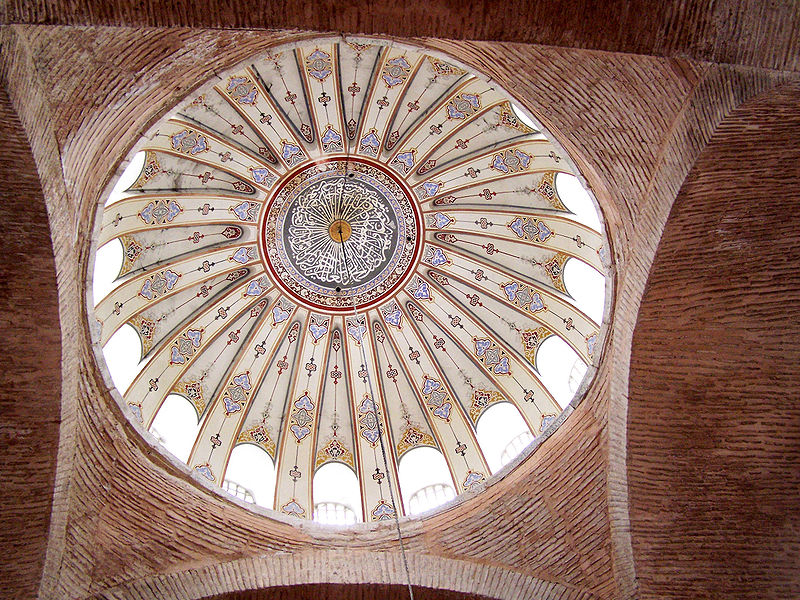
I love the remnant decoration against the bare brick of certain churches/mosques in Istanbul.

Ho Akataleptos or He Theotokos Kyriotissa/Kalenderhane Camii

He Pammakaristos/Fethiye Camii

Ho Hagios Swstes tes Choras/Kariye Camii

or just bare entirely, He Mone tou Libos or He Mone tou Prodromou/Fenari Isa Camii (top and bottom)


Comment: nikobakos@gmail.com

Turkey and religious freedom: Wooing Christians — “We are ready to face the past, to make amends.”

23 Apr

From the Economist:

“IT IS well known that Kurdish tribes took part in the mass slaughter by the Ottomans of around 1m Armenians in 1915. “Collaborating Kurdish clerics pledged that anyone who killed an infidel would be rewarded in heaven with 700 mansions containing 700 rooms, and that in each of these rooms there would be 700 houris to give them pleasure,” says Mala Hadi, an Islamic sheikh in Diyarbakir.

The sheikh is among a handful of local leaders seeking reconciliation with the Kurdish region’s once thriving Christians. “We are ready to face the past, to make amends,” promises Abdullah Demirbas, mayor of Diyarbakir’s ancient Sur district. To atone, Mr Demirbas has been providing money and materials to restore Christian monuments in Sur. These include the sprawling Surp Giragos Armenian Orthodox church where, until recently, drug dealers plied their trade amid piles of rubbish. It is now squeaky clean and even boasts a new roof.”

Here’s a website with some beautiful pictures of the church: http://www.futurereligiousheritage.eu/february-2012-restoration-of-dyarbakir-surp-giragos-armenian-church-dr-f-meral-halifeoglu/ 

This is a story that made me cry — I wish I could say I don’t cry easily.

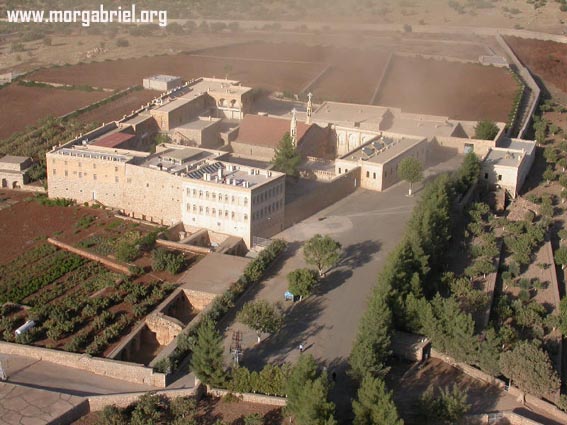
Read the whole story from the Economist here: http://www.economist.com/node/17632939  The story then goes on to talk about relations with the Syrian Christian community in southeastern Turkey, especially the conflict surrounding the Syrian monastery of Mor Gabriel, since the Armenian community that the Kurdish sheikh would like to make amends to has been practically non-existent outside Istanbul for a good century now.  Some photos of Mor Gabriel:

I keep looking for a story — because there’s definitely one there — about Syrian Christians among the refugees flowing into Turkey from Syria.  But there may not be that many, since for the most part they’ve been pretty passive in the whole conflict, nervously afraid of change as all minorities are, and maybe passively siding with the Alawite regime for fear the Sunni resistance will turn religious in ways uncomfortable for them.  And yet Homs and Hama, two of the Assad regime’s most brutalized targets, are among the largest and most ancient Christian communities in the country.  In William Dalrymple’s From the Holy Mountain: A Journey Among the Christians of the Middle East: http://www.amazon.com/From-Holy-Mountain-Journey-Christians/dp/0805061770/ref=sr_1_1?ie=UTF8&qid=1335220105&sr=8-1 he describes the Christians of Syria as the most happy, confident, open, and optimistic about their future of any of the Christian communities of the region, even those that constitute a larger percentage of their country’s population, like those of Lebanon or Egypt (on Lebanon, he has a kind of sensationalist chapter on Maronite “savagery,” which reminds me of a lot of Western journalism about Serbs, or older travel accounts of Albania, and pretty much tows the standard line that if they, Maronites, are on their way out demographically and politically, it’s their own fault.)  That optimism on Syrian Christians’ part must certainly have changed.  And if they were going to flee, it would be to their pretty numerous co-religionists in Turkey, wouldn’t it?

I always wanted to know what percentage of Arabs in southeastern Turkey were Christian and could never find any definitive information on it.  But if there were that many, they probably wouldn’t have to be fighting such an outnumbered battle to protect the property of one of their main religious centers.

Anyway, kudos to the sheikh, Demirbas, and I guess guarded kudos to AK leaders too; I think their concern for issues like this might actually be genuine; I mean Hillary talked about the Chalke seminary when she was in Turkey last and they didn’t freak out.

I have a few acquaintances who would roll their eyes at this post, irritated, along the lines of: “So many people being killed and you’re only concerned about Christians…”  No, I’m not just concerned about Christians.  But — shout out to the MESA thought police — I’m not going to waste any more time arguing my basic non-sectarian ethics either.

As a final note: the great villain here is not Assad, but his prime backer, Vladimir Putin, the last twentieth-century totalitarian dictator of the twenty-first century and a Chekist murderer and Stalinist criminal on all levels.  Be afraid of him — very afraid.  Recent NYRB article about him: http://www.nybooks.com/articles/archives/2012/apr/26/vladimirs-tale/


Comment: nikobakos@gmail.com
Turkey in Europe

22 Apr

According to Stephen Kinzer, New York Times correspondent and the paper’s bureau chief in Istanbul for a good part of the nineties, the appeal of EU membership to those countries waiting for it is (or was) political, social, and economic.  “For Turkey it is also psychological,” he writes in his 2001 Crescent and Star:

“The central question facing Turks today is whether their country is ready for full democracy, but behind that question lies a more diffuse and puzzling one: who are we?  The Ottomans knew they were the servants of God and lords of a vast and uniquely diverse empire.  The true heart of their empire, however, was not Anatolia but the Balkans…  But by caprice of history the founders of the Turkish republic found themselves bereft of the Balkans and masters instead of Anatolia.  To make matters worse, through a series of twentieth-century tragedies Anatolia lost most of the Armenians, Greeks and Jews who had given it some of the same richness that made the Balkans so uniquely appealing.”

There’s a lot there I’m not sure of, like the Ottomans’ heart having been in the Balkans and their backs turned on Anatolia.  I also don’t know if “who are we?” isn’t too categorical a way to phrase the dilemma Kinzer is talking about.  Unlike Greeks, Turks know who they are; their growing willingness to accept, not only the former existence of their neighbors among them, but the plurality of their own ethnic make-up would indicate that: Albanian fraternal associations, Tatar and Circassian language classes, seem to be coming out of the woodwork of the Republic’s forced homogenization, and even the lay-low-and-keep-your-head-down Alevis have found a new courage in asserting themselves.  (Poor Republic: no sooner does it harass one minority out of its existence, another one pops up to take its place.)  That’s a process that requires confidence, whereas we remain isolated in our ignorant dream of purity — and banging our feet to prove it to the rest of the world on top of it — a ringing sign of insecurity.  As mangled as Turks’ knowledge of themselves may have become by their own nationalism, I think phenomena like nostalgia for the multiethnic or the Neo-Ottomanism that has pervaded cultural life and even motivated political life and foreign policy in Turkey recently (and I don’t think that’s a bad thing or necessarily a “threat” to anyone; we, Greeks, might want to take advantage of it actually) is an attempt to right that disfigurement, not a deep existential reorientation.  Proof might be that since Kinzer wrote his book in 2001, Turkish membership in the European Union has pretty much become a dead-in-the-water issue.  And that may be partly because, in almost head-on contrast to Kinzer’s interpretation, Turkey was looking for political and economic benefits and not for Europe to validate its psychological needs, as the Neo-Greek statelet always has since its beginnings, a craven and cringingly embarrassing pandering to the West’s classical image of what Greeks are supposed to be being the foundation of Neo-Greek identity.  However the Ottomans may have felt about the Balkans or wherever modern Turks end up with their renewed embracing of the Ottoman past, they seem to be increasingly feeling — even the old, staunchly Kemalist bourgeoisie, or at least their children — that they don’t need European validation to prove they’re part of a civilization that they’re not.  And good for them.  I wonder when we’ll get the message.

On a lighter note, it’s not often one hears the Balkans described as “so uniquely appealing.”  It’s a line I’ll have to remember.  Often when people find out I’m Greek, they launch into delirious and happy memories of the Aegean and little white houses and sparkling blue waters and then I have to watch their faces drop as I tell them: “Well, the part of Greece my family is from is really more the Balkans than the Mediterranean…  And it rains all the time.”

Landscape approaching my mother’s village, in its usual mood. (click)

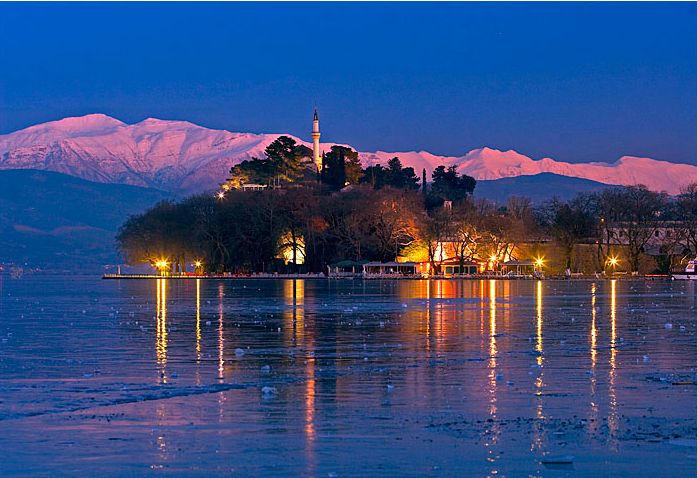
But then it is often “so uniquely appealling,” to get back to the Turks and the Balkans.  The main city of the region (Epiros) is Jiannena/Yanya, a beautiful little city by a lake that always had an air of luxuriant civility about it, proof of which may be that the Greek population didn’t rush to pull down the minarets or demolish all the mosques of the city as soon as the last Turks left in the twenties.*  It’s one of those Balkan cities the Turks loved.  Here’s a winter photo of Yanya’s main cami, the Aslan Pasha Mosque, overlooking the icy lake, below. (click)

Jiannena deserves a post of its own.  I gotta dig up some 2010 notes I have.

* On the other hand, the city government and developers have done all they can since WWII, including harassment and straight-out vandalism, to expropriate the city’s large and very romantic Jewish cemetery, which unfortunately for the city’s 40 surviving Jews, sits on some prime real estate.  Last I heard they had taken the issue to the EU, which makes me very happy.  Maybe the economic slump will give them a reprieve.  More on Jiannena’s Jews in the future.


Comment: nikobakos@gmail.com

Chitterlings…and mageiritsa

12 Apr

What are chitterlings, or chitterlins, or chit’lins?  They’re pig intestines, which people eat all over the world wherever they eat pigs.  (Where they don’t, they eat lamb intestines.)  Unfortunately, in the United States, the only people with the sensory refinement to appreciate them are African-Americans.  (And yes, girlfriend, the casing on that $25 a pound artisanal Calabrian soppressata you get at Whole Foods…pig gut.)

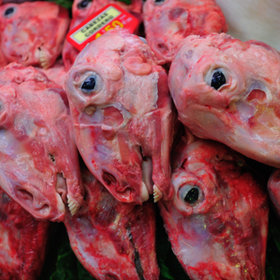
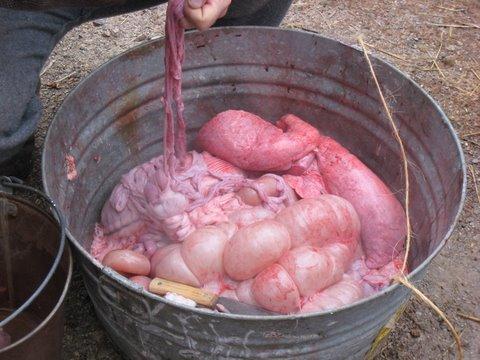
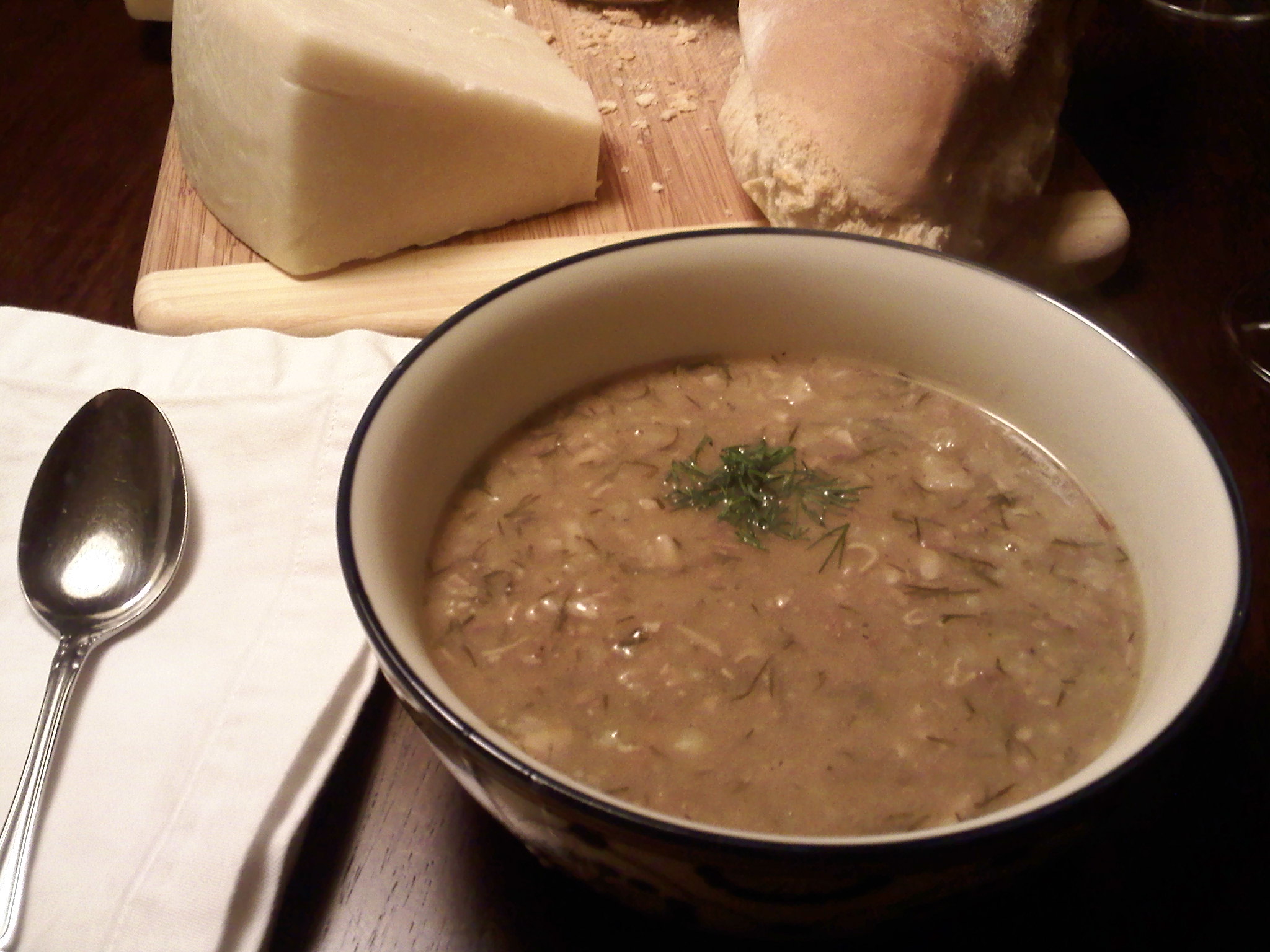
“Mageiritsa” is a Greek soup made of lamb offal that is made at – and only at – Easter.  It’s an incredibly time-consuming and labor- intensive production, which is probably why.  First comes the all-day or over-night simmering of the lamb’s heads and feet, to get the appropriately kelle paça type broth necessary.  (Kaleh pacheh seems to be a Friday after-prayer tradition in Afghanistan, so starting Thursday morning in front of all the butcher shops in Kabul, usually collected on one street, and by shacks along roads leading out of the city that seem to open just for that purpose, one sees giant piles of recently severed, bloody heads next to piles of bloody feet, both still in their fur, swarming with flies.  It’s a beautiful sight and one that, like so many other things in Afghanistan, I didn’t get a photo of while there because I thought I would embarrass people by taking pictures of things that I was afraid they would think I thought backwards.)  Then comes the cleaning out of faeces from about a football field’s length of lamb intestines (below), which is not that bad because they come from young animals that only eat grass anyway so it’s kind of the texture of baby poop.  (The European Union Daddy-State tried to ban the sale of intestines a few years ago and the Greeks to their credit, which I don’t grant them often, got into an uproar and Brussels backed down.  I actually have a theory that the intestine issue was the behind-the-scenes deal-breaker between the EU and Turkey, and rightly so; make me bend over backwards about how I run my country, make me reorganize my economy to enrich you and impoverish myself, treat me like an unwanted guest because I’m Muslim, but I’ll be damned if you take away my kokoreç.*)  Then you braise the intestines, and the sweetbreads (thymus glands) and hearts and kidneys in the broth (some people use liver or spleen and testicles too, but I don’t ‘cause the liver and spleen can get bitter and the testicles retain an unpleasant spongy texture when boiled which they don’t when grilled, or when sautéed with oil and a ton of garlic like they do with the bull’s balls in Spain after a bullfight — talk about sympathetic magic – and are quite yummy — see bottom.)  Then they’re all minced up, browned in a healthy amount of butter, added to the broth with lots of scallions and dill, some rice, and, just before serving, terbiye-d** with eggs and lemon.

Intestines

It’s generally acknowledged that I make the best mageiritsa in the world.  You can get pretty good mageiritsa lots of places, but mine is the best…in the world.  When I serve it at Easter, some people can’t get enough of it and some people politely decline.  Others, unfortunately – and tellingly, it’s usually younger Greek-American family – have always felt they have license to grimace and make faces of disgust and revulsion.

Mageiritsa — the finished product (click)

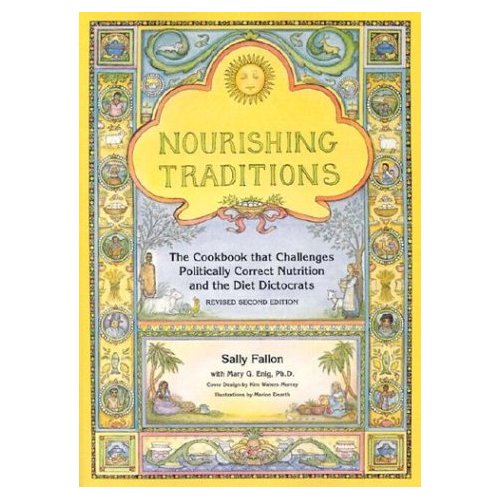
It’s bad enough that so much art and time and work on my part should be met with that kid of rudeness.  Then I have to listen to the anthropology tes poutsas about how people only used to eat that stuff because they were poor and they had to eat everything available, like eating intestines were the equivalent of the dirt-eating that tragically occurs in third world countries under famine conditions.  No they didn’t; they ate those things because they taste good.  Organ meats perform more complex biochemical functions in our and other animals’ bodies than muscle does; joints: feet and hocks, are complexly interconnected with tendons and cartilage of various kinds.  They therefore have more varied textures, mineral content and other elements, which gives them a richer and more varied taste than regular flesh has.  As mentioned in this brilliant book Nourshing Traditions: The Cookbook that Challenges Politically Correct Nutrition and the Diet Dictocrats by Sally Fallon, when a carnivorous animal (which we are, by the way; ignore false, scientifically faulty Vegan and Buddhist propaganda) kills another animal in the wild, the first thing it goes for are the guts because it instinctively knows they’re the most nutritious part.  Instead of teaching their kids the value and variety of our traditions or pointing out the beautiful economy with which our ancestors made use of every part of the animal, or their respect for and intimate knowledge of the world, the plants, and the animals which fed them, as opposed to our obscene wastefulness and complete alienation from any food which actually looks like food or reminds us of where it comes from, these people stupidly and condescendingly put it down to their poverty.

I never, ever heard anyone in older generations reminisce about the breast of any chicken or the dry, grey boti meat of a traditionally over-cooked Greek leg of lamb.  My mother used to wax nostalgic about an aunt’s Sunday pacha or the street kokoretsi they sold down by the lake in Jiannena next to the Karagöz puppet box (you’d get slices of it on wax paper, that or a cone of pumpkin seeds or a stick-full of pişmaniye and sit and watch Karagöz and Hacivat’s brilliant antics; I can’t be grateful enough that all these survived until I myself was a child.)  If a whole animal were roasted, the kids would fight over the head and its brains, tongue and the delicious, gelatinous cheek flesh.  And pig feet and andouillete are enjoyed in the best Parisian bistros, not just in supposedly impoverished Balkan or South American villages.

It’s a growing ecological disaster – a cultural one – and that’s what depresses me most.  We’re tangling ourselves (like most things modern, it starts in America but is spreading throughout the world) in such a neurotic, kosher-like web of food anxieties and hysteria that we’ll have soon lost access to half the things humanity used to enjoy at the table if we haven’t already.  I truly believe that it’s a phenomenon connected to the disappearance of other forms of diversity:

“All these seemingly disconnected events are the symptoms, you could say, of a global epidemic of sameness. It has no precise parameters, but wherever its shadow falls, it leaves the landscape monochromatic, monocultural, and homogeneous. Even before we’ve been able to take stock of the enormous diversity that today exists — from undescribed microbes to undocumented tongues — this epidemic carries away an entire human language every two weeks, destroys a domesticated food-crop variety every six hours, and kills off an entire species every few minutes. The fallout isn’t merely an assault to our aesthetic or even ethical values: As cultures and languages vanish, along with them go vast and ancient storehouses of accumulated knowledge. And as species disappear, along with them go not just valuable genetic resources, but critical links in complex ecological webs.”  — “In Defense of Differerence.”

“Oh, this is so salty.  Oh, this is so fatty.  Oh, this is so oily.  Oh, this must have so much cholesterol; I can feel my arteries clogging.  Eeew, this has liver in it.  It’s what?! Made with blooood?!”  (You can’t imagine how many people I’ve known who had heard of blood sausage but thought it was a metaphor.)  “Ugh, this is so sweet – I can’t take a second bite.”  We think we’re so sophisticated but are pretty much as incapable of thinking comparatively or relatively as an Amazonian tribe shooting arrows at airplanes.  It never occurs to us that fattiness, or cloying sweetness, or fishiness or gumminess were and are qualities that people enjoy.  One of the most interesting pieces of etymology that I’ve ever learned is that the word “funky” – one of the few African words to have passed into American English usage – actually means “stinky” in whatever West African language it comes from.  But it’s telling that it’s come to mean what it means for us: weirdly, pleasantly off-beat.  Cool — in a way you can’t put your finger on — ‘cause it’s off.  Get it?  Like certain French cheeses when they’re good and ripe and smell like your boyfriend’s unwashed underwear, or the obviously slimy texture and smell – the obviously slimy look even, with all its erotic overtones — of oysters or other raw seafood.  Funky.  Yum.

Even in foodie paradise New York — where curious Brooklyn Heights ladies are taking butchery classes and where you’ve started seeing more and more of the kind of tastes and smells I’m talking about on restaurant menus: tripe and boudin and fatback (and if that’s a good thing to you because you love good food, you’re indebted more than you know for that to one man: one of my best beloved heroes, Anthony Bourdain***, who wrote in his first best-seller, Kitchen Confidential: “My body is not a temple; it’s a playground.”) – try going out to dinner with a group of friends.  It’ll take several hours of conference calling before everybody’s food concerns and quirks are taken into consideration and then, if the night’s not over, you’ve ended up at a least common denominator restaurant where one of your group is still bound to torment a busy waiter with a barrage of anxious questions, requests for substitutions, no peanut oil, “light on the butter” or the resounding, echoing sound of “sauce on the side.”  This is most often a white girl who doesn’t cook (“sauce” is usually a fundamental component of a dish produced by the entire, holistic process of preparing it; you can’t put it on the “side;” it’s not the jarred tomato sauce you grew up eating, babe; you can’t make a blanquette de veau with the sauce on the ‘side,’ or a mole poblano with the mole on the side!) or it’s someone who has never worked in that business and has no idea what a tightly organized military operation a good New York restaurant is and what chaos that behavior throws both the floor and kitchen staff into, not to mention the offense to the chef himself and his line, who might not just be doing their jobs, but might actually be proud of the carefully conceived and prepared dishes they’re trying to put out.

I understand people have different tastes and that they even have different biochemical make-ups that might make certain tastes seriously unpleasant to them.  I mean, even Tom Colicchio doesn’t like okra, which I love, but I don’t hold it against him.  (I just know that he hasn’t eaten them properly prepared).  But the preparation and sharing of food is such a fundamental part of most human socializing and it’s become almost impossible to conduct in any civilized form through this thicket of prohibitions and fears. Which brings me to my final point: the social aspect, which includes issues of hospitality, personal pride, and what Greeks call philotimo, all heavily weighted and codified issues in ‘our parts.’

But my intestines need cleaning, so I’ll have to tackle the rest of this issue in another post.

*Kokoreç (shown below) is basically the same ingredients as mageiritsa but spitted and roasted.  The organ meats are spitted and the whole thing is wrapped around with the intestines like a giant andouillette.  In Greece, they cut it in slices and serve it like that, which I prefer.  In Turkey they usually mince it all up with red pepper after roasting and put it in a sandwich, which is delicious but doesn’t allow the texture of each constituent organ meat to be appreciated as much.

** Terbiye, what Greeks call augolemono, is supposed to be an egg-lemon liaison sauce used in many dishes or to thicken soups and is the greatest culinary hoax ever perpetrated on the peoples of the Near East.  Very simply, the recipe, as usually given, does not work, and does not produce a thickened sauce but a watery, sour mess.  When you make a béarnaise or a hollandaise you use minimal acid (vinegar or lemon respectively) only the egg yolks and pure butter, ideally clarified.  It’s impossible to scramble some whole eggs with lemon, pour some watery liquid out of a pot of cabbage sarma into it and expect that it will produce something comparable.  If you’ve ever seen a truly smooth, thick terbiye, some kind of extra binder (corn or regular flour) was added to it, and if the cook tells you otherwise she’s lying.  Never underestimate the tactics a Turkish or Greek woman (especially one from Istanbul) will resort to in order to protect her recipes and ensure no one else’s version is as good; lying is the least of it.

***Anthony Bourdain

My man Bourdain — get all his books here.

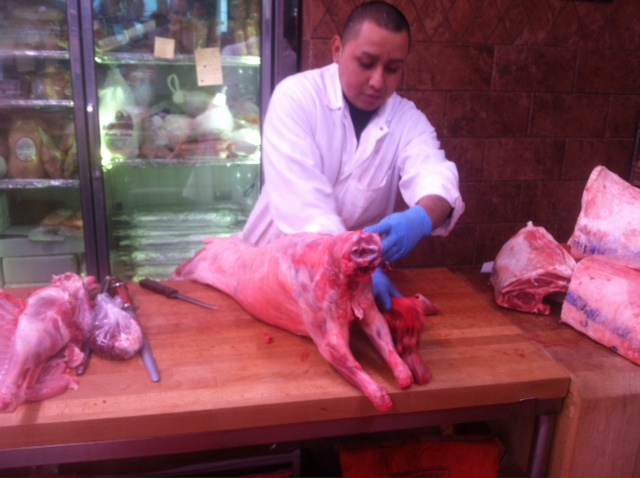
International Meats in Astoria, staffed almost entirely by Mexicans, who speak perfect Greek and know every detail of innards terminology in not only Greek, but Serbian and some Roumanian.  A Queens insituton.

Bull balls at International, with liver to the left, kidneys on the right, spleen on bottom left, hearts on bottom right.

Comment: nikobakos@gmail.com