Tag Archives: Twelve Gospels

Joseph Fiennes in “Risen”

1 May

I think the Romans in Passion story films have always colored our vision of that people: tough, competent blokes who get things done, an image promoted by some first-class marketing of course.  Especially if you’re Orthodox, and have spent a good part of several hours over your lifetime in the gilded dark of the evening of Holy Thursday or “Twelve Gospels” (technically the Matins for Good Friday), listening to the several point-of-view and repeated takes on the same narrative, the Romans almost steal the story.  I was rejolted by that realization last night, by the “Seventh Gospel”s display of Latin sticklerism for fairness, and respect for juridical procedure.  This is the Gospel where Jesus is taken out three times by Pilate to display to the crowds, repeating each time his ruling of the Nazarene’s innocence and pleading for his life.  This is also the only Roman female voice in the Gospels too: Pilates’ wife, who warns her husband that she has dreamt terrible things about this man and that Pilate should release him.

Into this historical-narrative of what Marguerite Yourcenar correctly post-prophesied would become a bloody circling tale and horrid “series of frenzies and misconceptions…” comes Risen (2016) by Kevin Reynolds, a film that until well in the later half is wholly focused on the Romans and their practical and existential vexations.  Pilate (Peter Firth) is the one we all know: coming to the end of his service, annoyed by his contentious Judeaen ward of bearded clerics, and by the constant combo of legal fraction and violent rebellion he has to navigate and keep in place, all especially with his boss Caesar’s upcoming arrival for a tour of the province.
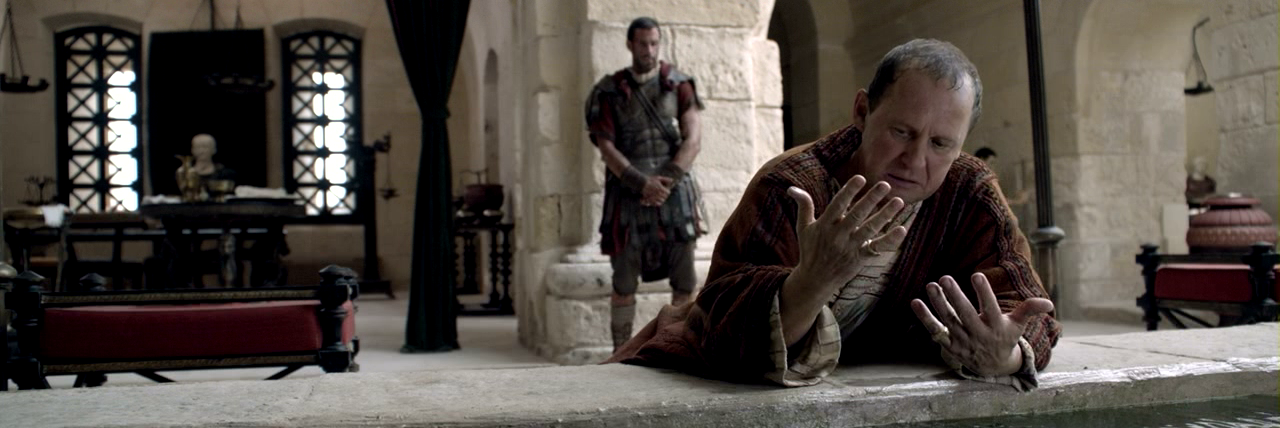
Unknown until now comes Clavius (Joseph Fiennes), looking every bit the Roman tribune: appropriate attitude, soldierly, fit and tan. He’s also dreaming of serving Rome, then finishing his military duty and duly retiring to some lovely Horatian farm idyll in Italy, with olives, vineyards, oxen and a wife.  Clavius is a by-the-book man too, but he’s got a slightly different edge about him than the others.  He’s relatively kinder and permissive with his men.  He’s got an immediately sharper eye for what pushes the “natives” buttons — not to be confused for compassion – and senses that there’s something different and even off with the Nazarene.

This is where the emotional perspicacity of the film kind of goes off its tracks and as Clavius starts to become more and more of Christ’s followers, the late parts of the film become filled with Hallmark images of sunrises in the Galilean countryside.

I can control my reaction because the material has its emotional valence for me.  Other times it’s just pissed me off.  But it’s a shame, because it’s a good film with a truly innovative conceit, but as Fiennes’ strong, προβληματισμένο, complicated character starts looking more and more like he’s drinking the Kool Aid – or as one film critic, who I can’t find now, wrote: “…the colonies of bats start sailing around…” the whole thing falls into tatters.  Watch the first two thirds.  Don’t bother with it at all if this stuff is not your style.

Or just enjoy Fiennes’ leather-banded forearms.

********************************************************************************************************

Write us: with comments or observations, or to be put on our mailing list or to be taken off our mailing list, contact us at nikobakos@gmail.com.
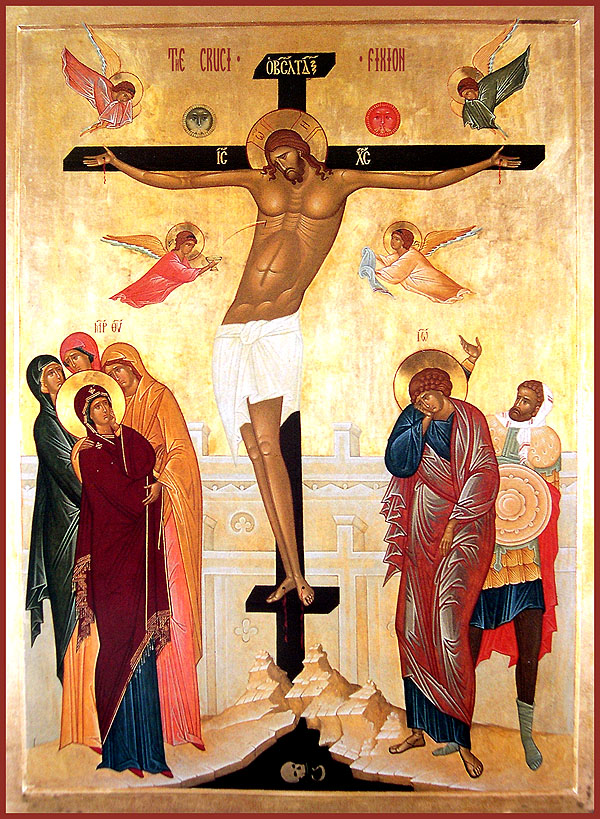
Σήμερον κρεμάται επί ξύλου…

17 Apr

crucifixion2

(click)

“Today hangs suspended from a piece of wood, the One who suspended the earth amidst the waters…” begins the main hymn of tonight’s service in the Orthodox Church.  It’s matins for Good Friday, sung the night before; it corresponds to the Oficio de Tinieblas in the Catholic Church, or the Via Crucis, or Stations of the Cross.  Except it’s not the forty-five minutes Cliff notes version.  It’s a four — with Russians, five plus — hour, perfectly paced and structured, oratorio that uses twelve gospel selections (it’s colloquially known as the “Twelve Gospels” among both Greeks and Russians and I imagine other Orthodox peoples), and a surfeit of beautiful and psychologically astute poetry and music to tell the story of the Last Supper, and Christ’s arrest, judgement, crucifixion, death and burial.  It’s my favorite Holy Week service.  Because it’s a masterpiece.  It doesn’t draw any of its power from made-up, sadistic Mel Gibson details that aren’t even in the gospels: like how many times Christ fell, or where they whipped Him, or where and when they spat on Him, or where He scraped his knees, or any of the bloody kitsch and sensationalism and fabricated detail so physical that it’s disrespectful and that the Catholic Church allows and encourages; one speaks of the body of Christ with a certain laconic awe I would think, no matter what it was put through.  Its power comes from the perfection of its theater and its theology and — if anything — from the spareness of the story it tells.

Background to this post…  For years, whenever I heard that relatives or friends from Greece, especially under a certain age and especially from Athens, were coming to New York to visit for Easter, my guts would get twisted up in knots of anxiety in anticipation because I just could not endure having them around at that time of year.  Anticipation of what?  Well, there came a time, for me a crucial turning point in post-1974 Neo-Greek culture — it was around the early-eighties — when Greeks started asking each other: “Where are you going for Easter?”  And I couldn’t imagine what I would answer if asked.  Where am I going for Easter?  I dunno…  I’m going to be home.  I’m going to my village.  It’s Easter.  Where should I be going?  This is because there came a point, when, for the demographic I’m talking about, Holy Week and Easter had become the equivalent of Spring Break, some free days to go off on a vacation somewhere.

So I could anticipate their attitude.  I knew they wouldn’t appreciate the subtle shift in the pace of life that occurs in a Greek neighborhood like Astoria when Palm Sunday dawns.  The sobriety mixed with the rush of preparation and excitement.  I would anticipate instead the surprise, at best, but mostly the grinning condescension, with which they’d react to how seriously diaspora Greeks still took this time of the year, how backwards and un-hip and un-Euro it was of us.  I’d know they’d want to go out to a cool baraki on Good Friday night.  I’d know they’d ask to be taken shopping on Holy Saturday, in the middle of the cooking and cleaning: there were some shoes they had seen on sale at Macy’s.  I had two Turkish roommates for a while once: totally secular, modern Istanbullu girls; they just didn’t eat pork.  And out of respect, or just to prevent possible squeamishness on their part — they had never even said anything to me — I would keep salami and pancetta and other pork products in the basement refrigerator that they never used.  On the other hand, I once had to have a screeching match with a Athenian guest about not having meat in the house on Good Friday — I ended up feeling like a friggin’ Talib — because she needed her protein and fasting reminded her of how oppressive her mother was during her childhood.  Just a couple of years ago, a cousin saw me go off to the first Nymphio on Palm Sunday evening and said to me: “You mean…like…you’re going to go be going to church…like…every night this week?  In Greece nobody goes.  That’s something left over in the diaspora…” she had the archidia to say to me.  It was never something they had lost; it was always something “left over” among us.  I said nothing.  But, as you can imagine — as opposed to the sentiment of “Next year in Jerusalem” — the idea of being stuck in Greece for Easter had always been my nightmare.  I only came this year because it was going to be one of the rare years professionally when I could go to my father’s village in Albania for what I knew would be a traditional Easter that wouldn’t infuriate me.

And instead I’ve been amazingly and pleasantly surprised.  I don’t know what Greece it is that this cousin of mine lives in where nobody goes to church, but all through Lent and especially this week, every church I’ve been in has been packed.  Tonight was the most moving “Twelve Gospels” I’ve ever attended.  The massive (as massive as a pre-Tanzimat church could be) eighteenth-century, stone cathedral of Jiannena was filled to the rafters — literally; it has a two-floor gallery where the women used to traditionally stand and even both of them were full.  The cantors were perfect.  The procession of the Cross immaculately pulled off.  I felt like Vladimir’s envoys in Hagia Sophia.

But what most moved me most was the breadth of age and sex of the crowd.  If anything, there were even more young people than there would be in New York — young guys, parea — following the text from the little black book carefully, people with that relaxed reverence that the best Greek — knowing how to be respectful, but comfortable in his father’s house — displays when in church.  Almost everyone stayed to the very end.  I really felt in my heart and gut what Yosef Eliya felt in his Purim poem when he writes: “Tonight the synagogues open their arms wide to the faithful children of my ancient people…”

Tomorrow it’s off to Albania.

Kale Anastase and Happy Easter…my ancient people.

Comment: nikobakos@gmail.com