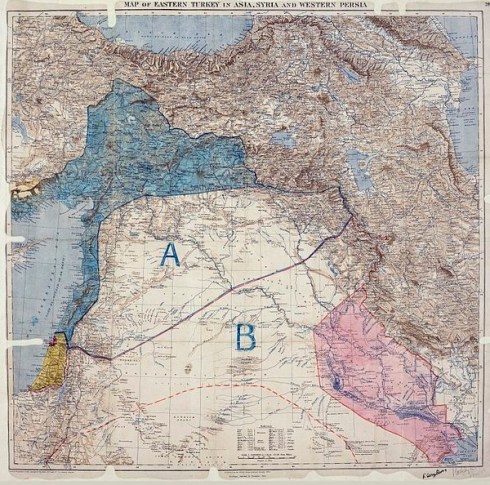
He got enough flak for the post (read through all the ctd.’s too — very interesting) and I feel kind of bad giving him more after so many months, but it’s been in the back of my mind since the fall and the argument is so irritating that I had to put in my own two cents.
It seems that every Sullivan-type pundit rushed out in 2001, or more probably 2003 when they were making their Iraq predictions, and bought some book about the Paris Peace Conference: “Paris 1919” “The Peace to End All Peace” — it’s an entire genre in itself. And there they found out about some magic secret, like in a Dan Brown novel, called the Sykes Picot line, that supposedly explains everything about the Middle East’s dysfunction, and like a little kid who realizes he’s said something that the adults have found smart or funny, they go around repeating it ad nauseum: “Sykes-Picot Line”…”Sykes Picot Line” … “this guy Sykes and this guy Picot”…”The Sykes Picot Line…” Listen to Sullivan’s own pedantic tone:
“Syria as we now know it was created by one Brit, Mark Sykes, and one Frenchman, Francois Georges-Picot in 1920. Originally, it included a chunk of Iraq (another non-country), but when oil was discovered there (in Mosul), the Brits wanted and got it. With that detail alone, you can see how valid the idea is of a Syrian “nation” is.”
The whole point is that most of the nations of the present Middle East are artificial, colonial creations — arbitrary lines drawn on a map –and that explains everything. First, these lines are not arbitrary. Whatever you might want to say about Sykes or Picot, or Churchill or Lloyd George or Clemenceau — that they were gross imperialists (which is not even redundant really but simply a tautology: “The King is a gross monarchist…”) or anything else, they weren’t ignorant or anistoretoi.* The units they put together corresponded, as so many of Sullivan’s readers point out to him, with regions with long, historically recognized identities. Where you look at a map of the Middle East and do see straight artificially drawn lines, they were drawn through places where nobody lives. Otherwise, within every one of those lines, there has always existed a shifting, changing, re- or de-centralizing identity, but one with clear continuities nonetheless.
(*Anistoretoi – ανιστόρητοι – is a Greek word that I like very much, because it literally means “un-historied” — historically ignorant, obviously, but there’s something about “un-historied” that just seems to me like a sharper condemnation of inexcusable lack of knowledge — no? — so you’ll see it on this blog here and there.)
Thankfully, no one says this about Egypt, because it so obviously has a longer continuous history of unified consciousness than even China. But what Sullivan, so damn pompous — or just so gay and so Magdalen — dismisses as the “non-country” of Iraq, the flatlands of the Tigris and the Euphrates basin, even when semi-splintered into northern, central, and southern parts, as Iraq seems to be doing now, was always seen as a unit: certainly geographically but even culturally. The two regions the Greeks called Libya and Cyrene may correspond to a west-east division that is still apparent in modern Libya (Tripoli and Benghazi), but their union is not necessarily artificial or inherently problematic. The headland to the west of Libya we call Tunisia was the first region called Africa by the Romans, where their ancient enemy Carthage had once stood. And the region where the northwestern section of the Fertile Crescent bends over and meets the Mediterranean has been called Syria since the Greeks and was probably seen as a recognized cultural entity far before them. The mountainous Mediterranean littoral of this Syria — what’s now Palestine and Lebanon and maybe a new Alawite state waiting to be born — was always a space slightly apart and more heterogeneous, but Syria nonetheless. (The arid plateau across the Jordan, inhabited by the Moabites and Edomites and Nabataeans and all those other peoples the Israelites are always defeating in the Old Testament because God loves them more, was also a region of a recognized coherence of sorts not just made up by the Brits when they decided to call it Trans-Jordan.) Syria was the birthplace of Christianity as an organized religion. Syria was the Romans-Byzantines’ richest and most sophisticated eastern province. Syria was the prize catch for the Crusaders; the real studs among them who could, got themselves a piece of booty there, not the “Holy Land.” When Zainab bears her lament to the people of Shaam (Syria or the Levant) in Agha Shahid Ali’s beautiful poem she cries out: “Hear me Syria…” addressing the people of the seat of Umayyad power in Damascus — the one in Syria — that had massacred her sacred family. Sykes and Picot didn’t make this stuff up.
What Sullivan wants to say, and what’s truly problematic about his assertion, is that Syria is not a country because it’s not ethnically or confessionally homogeneous, and dismissing it as a state for those reasons is a far more eurocentric, and anistoreto, an idea than he may know. Because if those are our standards for nation-hood, there are very few countries in the world. By those standards, if Syria is not a country, then England and France aren’t countries either. Because a polity called the Kingdom of England, or the Kingdom of France — both of which one could argue were “artificially” created by the powers that be of the time — had existed for far longer than Englishmen and Frenchmen have. And the process by which a unified national consciousness was created to match these pre-existing political units — England or France — was a long and complex one and one that followed the particular course it did only in Western Europe and trying to force it onto the peoples of states in other parts of the world is impossible and extremely dangerous. Forget what Sullivan thinks is the Machiavelian divide-and-rule politics of the colonizers that pitted ethnic groups in Syria and Iraq against each other; these colonizers were probably never as devilishly smart as we like to imagine them. What Sullivan finds inconceivable is that one can be a Latakian Alawite or a Sunni from Homs or an Aleppo Christian or a northeastern Kurd and still function as a citizen of a legitimate country called Syria; that these groups have always had boundaries that fluctuated or were permeable; and, that though relations between them historically were better at some moments than others, they were brought together in this place called Syria by organic historic processes and not corraled together there by outsiders. And by believing that it’s inconceivable they can all function as citizens of this place, he’s actually participating in the creation of a discourse that pits these groups against each other in a manner far more fatal than the supposed manipulations of the British or French. He’s creating a poetics of sectarianism, pure and simple. One only has to look at how reinforcing ethnic differences, often with the naive supposition that satisfying each group’s demands will lead to peace, only exacerbated the tragedy — the tragedies — of Yugoslavia in the 90s to see where thinking like Sullivan’s leads.
To his credit, Sullivan gives the Ottomans credit for maintaining a semblance of peace and stability in the region for several centuries. But the Ottomans had molded, over the centuries, a complex and flexible system of negotiated corporatism and autonomy that recognized the different groups of their empire and yet that held them together in one unit successfully until modern nationalism started making that impossible. What Sullivan is doing with blowhard statements like the above is just continuing that process: making it impossible for the peoples of the region that have to live together to do so peacefully and productively.
Finally, as a somewhat tangential but important aside, I’d really be interested in finding out why Sullivan doesn’t think that India is “not a country.”
And, folks, what is going on in Syria? I’ve been in France for a month and my French isn’t good enough to follow the news and the American stuff on-line seems to have less and less coverage. Has some sort of stalemate been reached? Is some kind of compromise being forged? Are people just tired? Anyone want to enlighten me?
–
Tags: Agha Shahid Ali, Alawites, Aleppo, Andrew Sullivan, Byzantines, Churchill, Clemenceau, Damascus, Egypt, Greeks, Iraq, Jordan, Kurds, Lebanon, Libya, Lloyd George, Ottomans, Palestine, Paris Peace Conference, Romans, Shaam, Syria, Syrian Christians, the Sykes-Picot Line, Tunisia, Yugoslavia, Zainab

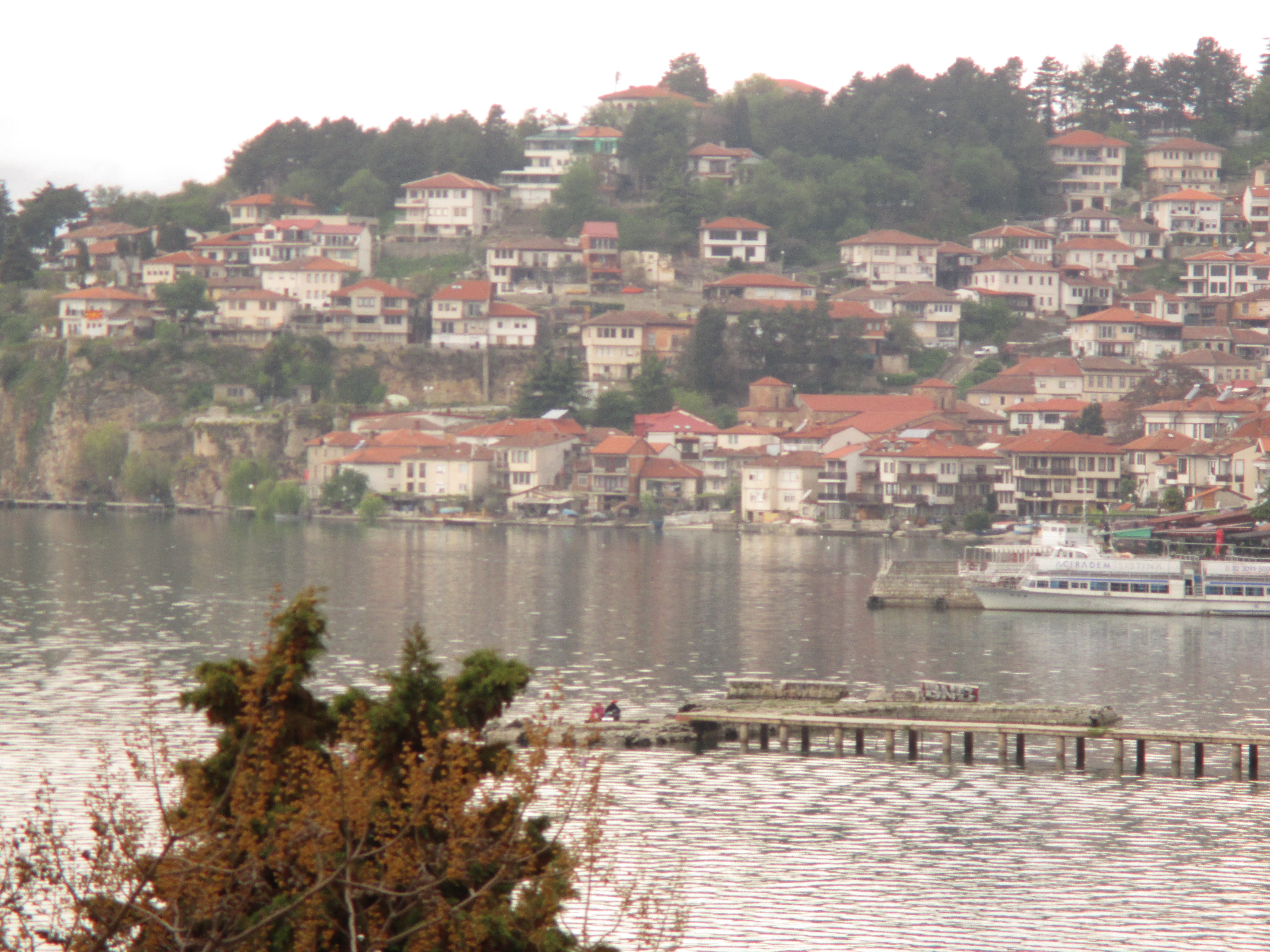
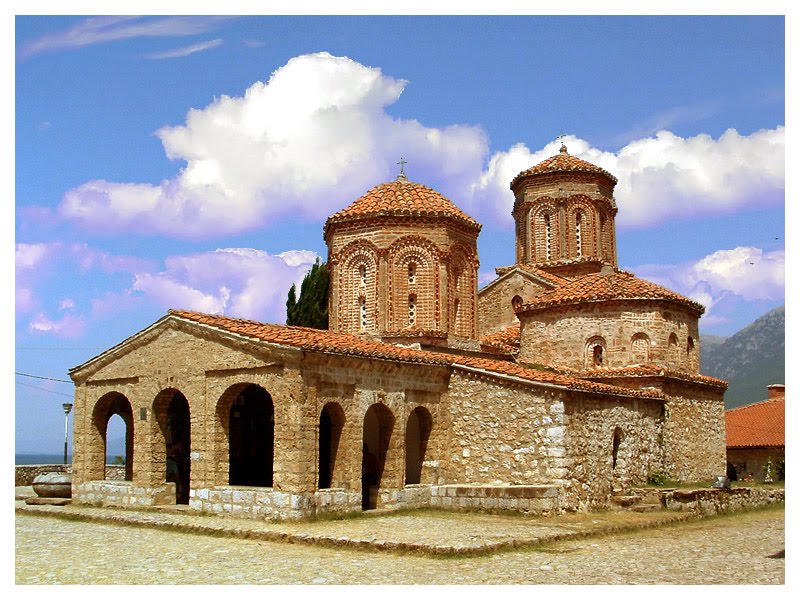 Sveti Naum, Ochrid (click)
 (click)

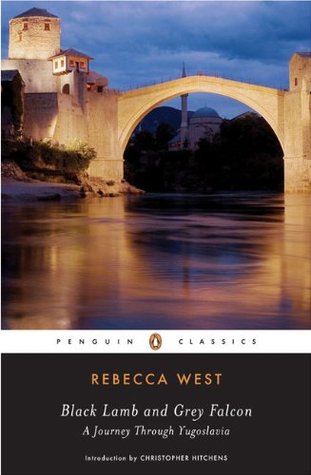
 Jadde: from Bosnia to Bengal