Archive | Uncategorized RSS feed for this section

Turkey continues to (sort of…) unravel?

13 Mar

From The New York Times:

Across Turkey, New Unrest as Teenage Boy Is Buried

By SEBNEM ARSUMARCH 12, 2014

 turkey1-master675
Riot police used tear gas to disperse protesters on Wednesday. Credit Ozan Kose/Agence France-Presse — Getty Images

ISTANBUL — An enormous outpouring of grief and antigovernment rage during the funeral procession for a teenage boy felled by a police tear-gas canister turned into another mass confrontation with the Turkish authorities on Wednesday as mourners clashed with antiriot squads in Istanbul, Ankara and Izmir. At least one person was killed.

The new unrest came a day after protesters battled with police officers in at least 15 cities over news that the boy, Berkin Elvan, 15, had died. He had been comatose with head trauma since June, when Turkey was first engulfed with antigovernment protests against the decade-old tenure of Prime Minister Recep Tayyip Erdogan, who is seen as increasingly authoritarian.

The boy, who was struck by a tear-gas canister while buying bread, has become the newest symbol of simmering anger at Mr. Erdogan and his Justice and Development Party, known as AKP, and over the tough police repression of political dissent and a recent corruption scandal that has entangled the top echelons of the ruling party.

Djokovic Fells the Big Croat at Paribas…

13 Mar

He and Nadal cruise into quarter-finals — pairing always nice to see:

By REUTERSMARCH 13, 2014, 4:29 A.M. E.D.T.

Novak+Djokovic+-+Getty


(Reuters) – Roger Federer and Novak Djokovic cruised into the quarter-finals of the BNP Paribas Open at Indian Wells on Wednesday after Wimbledon champion Andy Murray and Australian Open winner Stanislas Wawrinka both fell in the fourth round.

In a tournament full of surprises, Federer and Djokovic struck a blow for the old world order with Federer beating Germany’s Tommy Haas 6-4 6-4 and Djokovic coming back to down Croatia’s Marin Cilic 1-6 6-2 6-3.

Federer and Djokovic are the only players ranked in the world’s top 10 to reach the quarter-finals after Wawrinka and Murray joined the big-name casualties when they both crashed to lower-ranked opponents on another day of upsets in the Californian desert.

Wawrinka suffered his first loss this year when his 13-match winning streak came to a shuddering halt as he was beaten 7-6(1) 4-6 6-1 by South African Kevin Anderson.

“It wasn’t really on my mind that he had won Australia,” said Anderson, whose next opponent is Federer.

“It feels great to beat somebody who obviously has just won a grand slam.”

Murray was blown away by Canada’s Milos Raonic, one of the biggest servers in men’s tennis.

——————————————————————————————————————————

MEANS A LOT

Djokovic had won each of his previous seven encounters with Cilic but his perfect record was in danger after he lost the opening set to the towering Croatian, winning just three points on return.

But the Serbian quickly got his act together, and broke Cilic twice in the second set then once in the deciding third to safely advance to the last eight.”

[Listen to my man Nole, the soldier at his best: polite, respectful, ready-to-come-from-behind fighting spirit:]

“I was composed and mentally calm, regardless of the score line,” Djokovic said. “I just accepted the fact that he came out of the blocks better than I did.

“He was very aggressive, not missing at all, serving incredibly fast and accurate. I couldn’t do much really. I was forced to back up.

“I believed that I could come back. The second set was a whole new story. I reset myself and told myself it was the start of the match.

“I forgot about the first set and the second and third went really well. It was the intensity I want to have and I hope to keep it up.”

see whole piece: Federer, Djokovic Advance as Murray, Wawrinka Fall”   

Comment: nikobakos@gmail.com

Kale Sarakoste to everyone: Alexander Schmemann and “the bright sadness of Lent”

2 Mar

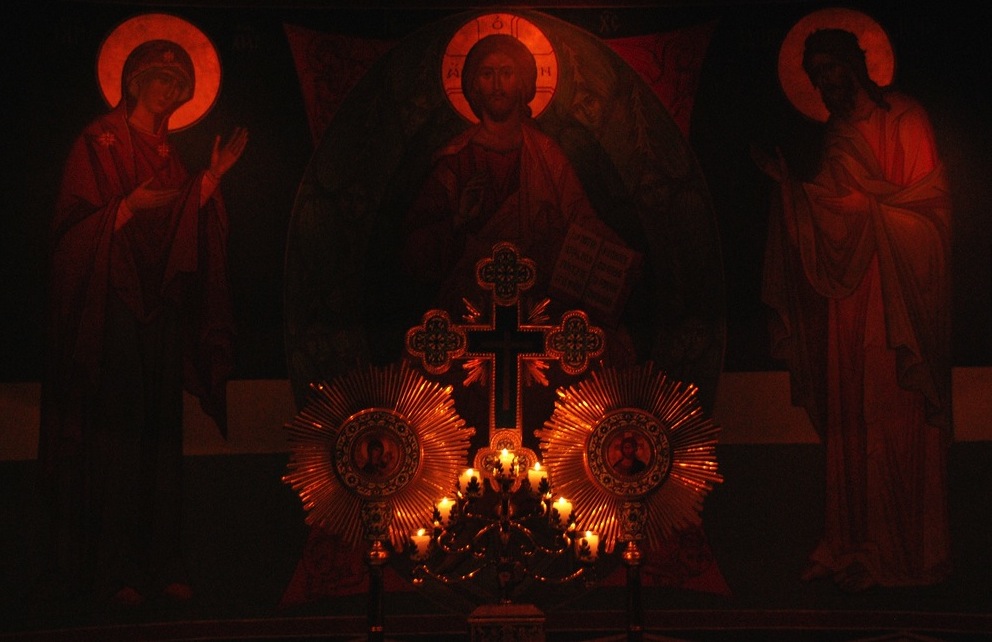
orthodox-worship

“The general impression, I said, is that of “bright sadness.” Even a man having only a limited knowledge of worship who enters a church during a Lenten service would understand almost immediately, I am sure, what is meant by this somewhat contradictory expression. On the one hand, a certain quiet sadness permeates the service: vestments are dark, the services are longer than usual and more monotonous, there is almost no movement. Readings and chants alternate yet nothing seems to “happen.” At regular intervals the priest comes out of the sanctuary and reads always the same short prayer, and the whole congregation punctuates every petition of that prayer with prostrations. Thus, for a long time we stand in this monotony — in this quiet sadness.

“But then we begin to realize that this very length and monotony are needed if we are to experience the secret and at first unnoticeable “action” of the service in us. Little by little we begin to understand, or rather to feel, that this sadness is indeed “bright,” that a mysterious transformation is about to take place in us. It is as if we were reaching a place to which the noises and the fuss of life, of the street, of all that which usually fills our days and even nights, have no access — a place where they have no power.

“All that which seemed so tremendously important to us as to fill our mind, that state of anxiety which has virtually become our second nature, disappear somewhere and we begin to feel free, light and happy. It is not the noisy and superficial happiness which comes and goes twenty times a day and is so fragile and fugitive; it is a deep happiness which comes not from a single and particular reason but from our soul having, in the words of Dostoevsky, touched “another world.” And that which it has touched is made up of light and peace and joy, of an inexpressible trust. We understand then why the services had to be long and seemingly monotonous. We understand that it is simply impossible to pass from our normal state of mind made up almost entirely of fuss, rush, and care, into this new one without first “quieting down,” without restoring in ourselves a measure of inner stability.”

Read the rest here: The Bright Sadness Of Lent

Comment: nikobakos@gmail.com

Leaving…

2 Mar

Window

It gets harder to leave Paris every time.  That my departure falls exactly on the eve of Lent today makes it a bit more melancholy but a bit easier to take as well.  “Here,” I think, “I’ll lose this for now; maybe again soon I’ll have it back.”  Like any Lenten action, you might have to have it taken away to keep the edge of your love for it sharp and even.  I dunno.

I don’t need to tell readers that I’m totally unembarrassed by my sheer, sappy sentimentality and ready-to-die-for loyalty to this city.  You can keep the unkempt disorder of dank, mouldy London and its claustrophobic spaces and the nightly threat of getting the shit beaten out of you at 11:00 when the pubs close (I’ve never in a lifetime in New York City, even as a teen during the Dark Ages of the seventies and eighties, felt that kind of menace on that kind of regular basis) and whatever it is that everybody suddenly decided is so cool about it since the nineties.  You can keep sehr-hip Berlin with everyone in their funky Libeskind glasses and with that constant annoying earnest look, or the architectural wonders of Oslo and the new cosmopolitanism of the Rotterdam waterfront or the New Pittsburgh — or friggin’ B-a-r-c-e-l-o-n-a — or any of the other newly minted urban centers that found some way to remake their grimness over as cutting-edge in the post-industrial world and that supposedly left Paris behind in the dust.  I’ll take her over any of them at any time.

Something here, if you’re susceptible to it, makes you sick forever.  Forever.  It’s a promise of perfection, of a possible and absolute Attic kind.  Of perfect image, of perfect moment.  Of what Hadrian felt for Athens, having just seen a stage production of Yourcenar’s book here.  In Athens, a young man bending over to lace up his sandal.  Here, a girl wrapping her scarf; the posture and composure of the kid refilling your glass — that twist of the wrist that slays; the highly conscious, almost Japanese rituals of courtesy exchanged with even everyday shopkeepers.  Some fleeting view of what the civilized ideal looks like, rushing past you in a furtive but powerful array of images all day and all night.  And all marked by the supremely intelligent understanding that it all starts on the surface — that that’s what counts — and that it works its way down from there.

New York holds out a radical promise too, but of a very different sort, and New York makes it clear that you’ll have to suffer so much to obtain it that you’ll be too exhausted to actually live it in the end. And I’m from there anyway and don’t have that outsider’s magic belief that some kind of fulfillment is waiting for me there “if only just…”  Just nothing; it’s just my hometown; superior to all the rest — obviously — for the simple reason that it contains the whole world, but really just home.  Queens.  Here it’s not about something you’re expected to achieve necessarily; it’s about being part of a life as it should be lived.  There’s no being more specific than that; it’s just the way things should be.  The myth is so overpowering and myth is our only reality anyway and when, of course, it falls short, as everything in a fallen world does, that doesn’t heal the sickness.  It just makes it worse because the temptation to keep wishing the moment frozen grows as any real possibility of that recedes.  And I guess that means ultimately that the secret of what makes leaving Paris each time that much harder is just age.

I discovered a cousin I had never known before who lives here, an experience like finding a beautiful old photograph of someone you don’t know in a shoebox in the back of a closet.  “…you’re never through with the city…” she wrote me, after we had had coffee one morning.

Insha’allah.

platform

“The Nasty Bits”

28 Feb

I guess I’ve already missed the end of pre-Lenten meat-eating by a week, but I thought, as my last day in Paris coincides with the last day of Apokries, I’d take the opportunity to volley a few more visual missiles at my Vegan-Anti-Offal enemies’ positions.

These are from my new favorite place in the city.  One very cool development in France lately has been the proliferation of almost Spanish-style tapas bars, where you can try lots of different dishes instead of having to sit through the traditional three-piece suite.  I hope that will always be available in all its ritualized confidence, but this meze phenomenon is a welcome break.  And except for the absence of ankle-deep garbage on the floor, this place is as chaotic as any place in Spain and makes me mindful of the French’s own anarchic impulses.  You only get half the things you ask for; you have to scream for them over a counter that’s packed three-people deep; the check is always wrong; people are eating out of your plates and vice-versa, but the flavors there are nothing short of miraculous.

My favorites:

kidneys

The kidneys in a quick onion and vinegar sautee

Boudin

Their boudin, (coagulated pig’s blood — just a reminder…) which they don’t put into a casing but make into a loaf, kind of like a Penn-Dutch scrapple if the analogy isn’t too weird, served with a very hot green pepper and roasted apples

IMG00408-20140227-1657

A soft-fried egg dish swimming in butter and buttery croutons that’s made with some mushroom that has all the foot-like smell of truffle but none of its subtlety; they wouldn’t tell me what it’s called: “Il n’y en a pas là-bas…”  (I think) “You don’t have them over there…” was all I managed to get from them, irrespective of where “over there” was.

Pig's ears

The pig’s ears, slimy and gummy on the outside with the cartilage-crunch core, sauteed in a Basque-like red pepper combo

butter

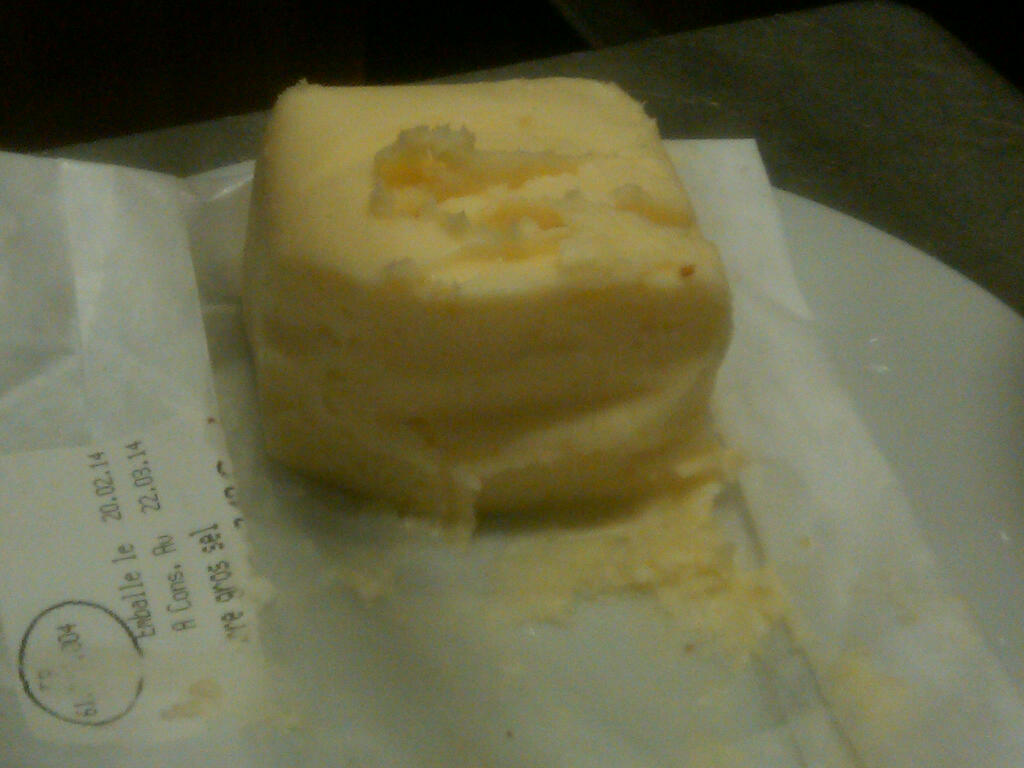
The most delicious cheesey, slightly sour butter on earth, always sitting on the counter sweating, with bits of other people’s food always stuck in it (“eeeeewww…” a definite “C” rating from Bloomberg) and served with bread that’s leagues beyond the Poilaine stuff that’s everywhere and is so not great that I’m beginning to think is a gigantic hoax.

Finally, the pig cheeks — yep, hog maw — (see: “Hog maw, cornbread and chitterlin” ) braised in lentils:

pig cheeks

…which really reminded me of how much great food, especially great French food is based on the slow, laborious breaking down of animal collagens, something I tried to capture in this second pic a little better (forgive the quality — yes, yes, I’ll buy an IPhone; click on these for a better view in the meantime); it’s the secret to the perfect texture of good mageiritsa too, though everyone thinks it’s the augolemono.

pig cheeks 2

Why such conspicuous animus to the anti-offalers?  επειδή μου σπαν’ τα νεύρα….  Because they irritate me.  And I wouldn’t be so irritated by just their bad taste and limited palates and squeamish, plasticked alienation from the realities and depth of good food, if they would just shut up about it: it’s what in one of this blog’s first posts — “Chitterlings…and mageiritsa” — (the Jadde started just before Easter 2011) I call their “anthropology tes poutsas” that drives me mad: the rationalization that poverty made people eat this food and that now we’re beyond that.  (See also:  “What I managed to put away in a day-and-a-half in Paris and some thoughts on the “crise;” or, “…the brevity of time and the immediacy of pleasure.” )  Believe me; none of the people who eat here are poor.  It’s not in an impoverished southern village: they don’t exist anymore, are either depopulated or bought up by ex-pat Brits; it’s not in a dying northern industrial city; it’s not in a destitute banlieue.  It’s dead in the center of chic-as-you-can-get St. Germain (there’s an argument to be made that this food’s appeal is about reverse snobbery — an argument I’ll listen to), right down the road from the Odeon and around the bend from the Luxembourg.  If you even hover around the edges of New York foodie-dom you’ve heard about this place, but, sorry, as a matter of blog policy, I don’t give out names.  You’ll have to dig up its delights yourself.

The rest of you can have the salmon.

Comment: nikobakos@gmail.com

Spike Lee goes off on gentrification of NYC Black ‘hoods

26 Feb

b

(click)

Mr. Spike Lee:

“Here’s the thing: I grew up here in Fort Greene. I grew up here in New York. It’s changed. And why does it take an influx of white New Yorkers in the south Bronx, in Harlem, in Bed Stuy, in Crown Heights for the facilities to get better? The garbage wasn’t picked up every motherfuckin’ day when I was living in 165 Washington Park. P.S. 20 was not good. P.S. 11. Rothschild 294. The police weren’t around. When you see white mothers pushing their babies in strollers, three o’clock in the morning on 125th Street, that must tell you something.
[Audience member: And I don’t dispute that … ]
Whoa, whoa, whoa, whoa, whoa, whoa, whoa, whoa. And even more. Let me kill you some more.
[Audience member: Can I talk about something?]
Not yet.
Then comes the motherfuckin’ Christopher Columbus Syndrome. You can’t discover this! We been here. You just can’t come and bogart. There were brothers playing motherfuckin’ African drums in Mount Morris Park for 40 years and now they can’t do it anymore because the new inhabitants said the drums are loud. My father’s a great jazz musician. He bought a house in nineteen-motherfuckin’-sixty-eight, and the motherfuckin’ people moved in last year and called the cops on my father. He’s not — he doesn’t even play electric bass! It’s acoustic! We bought the motherfuckin’ house in nineteen-sixty-motherfuckin’-eight and now you call the cops? In 2013? Get the fuck outta here!
Nah. You can’t do that. You can’t just come in the neighborhood and start bogarting and say, like you’re motherfuckin’ Columbus and kill off the Native Americans. Or what they do in Brazil, what they did to the indigenous people. You have to come with respect. There’s a code. There’s people.
You can’t just — here’s another thing: When Michael Jackson died they wanted to have a party for him in motherfuckin’ Fort Greene Park and all of a sudden the white people in Fort Greene said, “Wait a minute! We can’t have black people having a party for Michael Jackson to celebrate his life. Who’s coming to the neighborhood? They’re gonna leave lots of garbage.” Garbage? Have you seen Fort Greene Park in the morning? It’s like the motherfuckin’ Westminster Dog Show. There’s 20,000 dogs running around. Whoa. So we had to move it to Prospect Park!
I mean, they just move in the neighborhood. You just can’t come in the neighborhood. I’m for democracy and letting everybody live but you gotta have some respect. You can’t just come in when people have a culture that’s been laid down for generations and you come in and now shit gotta change because you’re here? Get the fuck outta here. Can’t do that!
And then! [to audience member] Whoa whoa whoa. And then! So you’re talking about the people’s property change? But what about the people who are renting? They can’t afford it anymore! You can’t afford it. People want live in Fort Greene. People wanna live in Clinton Hill. The Lower East Side, they move to Williamsburg, they can’t even afford fuckin’, motherfuckin’ Williamsburg now because of motherfuckin’ hipsters. What do they call Bushwick now? What’s the word? [Audience: East Williamsburg]
That’s another thing: Motherfuckin’… These real estate motherfuckers are changing names! Stuyvestant Heights? 110th to 125th, there’s another name for Harlem. What is it? What? What is it? No, no, not Morningside Heights. There’s a new one. [Audience: SpaHa] What the fuck is that? How you changin’ names?
And we had the crystal ball, motherfuckin’ Do the Right Thing with John Savage’s character, when he rolled his bike over Buggin’ Out’s sneaker. I wrote that script in 1988. He was the first one. How you walking around Brooklyn with a Larry Bird jersey on? You can’t do that. Not in Bed Stuy.
So, look, you might say, “Well, there’s more police protection. The public schools are better.” Why are the public schools better? First of all, everybody can’t afford — even if you have money it’s still hard to get your kids into private school. Everybody wants to go to Saint Ann’s — you can’t get into Saint Ann’s. You can’t get into Friends. What’s the other one? In Brooklyn Heights. Packer. If you can’t get your child into there … It’s crazy. There’s a business now where people — you pay — people don’t even have kids yet and they’re taking this course about how to get your kid into private school. I’m not lying! If you can’t get your kid into private school and you’re white here, what’s the next best thing? All right, now we’re gonna go to public schools.
So, why did it take this great influx of white people to get the schools better? Why’s there more police protection in Bed Stuy and Harlem now? Why’s the garbage getting picked up more regularly? We been here!
All right, go ahead. Let’s see you come back to that.”

See: “Nobody really cares about Gezi Park: Greek Thoughts on the Protests of 2013”   It’s a stretch, but one my mind instinctively leapt to…

Comment: nikobakos@gmail.com

For L. — Les Ruines

26 Feb

THIS post is for a friend here in Paris, with a French translation, of a legendary concert Oum Kalthoum gave in L’Olympia theater in November 1967, where she sang what’s arguably considered her masterpiece, El Atlal, Les Ruines.

This translation issue, especially with music and poetry…  People become nuts.  Read the comments below.  And it’s always the sticklers for most “accuracy” that end up writing the garbled, horrible translations, but they’re kind of like glosses I guess and do help out.  Look below, if you want to bother, at the bickering; I’ve posted it all from  Music Layoonak; Arabic Song and Translations., an otherwise really cool resource. 

I’ve posted this song before in  “The most depressed country is Afghanistan, where more than one in five people suffer from the disorder.”  (November 13th).  But that only included English and Arabic translation.

Les Ruines

Ne cherche pas, mon ame, a savoir qu’est devenu l’amour
C’etait une citadelle imaginaire qui s’est effondree
Abreuve-moi et trinquons a ses ruines
Conte en mon nom l’histoire
Maintenant que mes larmes ont coule
Racont comment cet amour s’est transforme en passe et pourquoi il m’est devenu un sujet de douleur
Je ne parviens pas a t’oublier
Toi qui m’avais seduite par tes discours si doux et raffines
Tendant ta main vers moi
Comme celle que l’on tend
Par dessus l’onde, a celui qui se noie
Et comme la lumiere que recherche un errant
Mais ou est donc passe cet eclat dans tes yeux
Mon amour, j’avais eu un jour la joie de visiter ton nid
Me voici aujourd’hui oiseau solitaire, roucoulant ma douleur
Tu es devenu suffisant comme un etre capricieux et gate
Tu pratiques l’injustice comme un puissant tyranique
Mon desir de toi me brule l’ame et le temps de ton absence n’est que braises cuisantes

Donne-moi ma liberte et brise mes chaines
Je t’ai tout donne; il ne me reste plus rien
Ah! tu m’avais saigne les poignets par tes chaines
pourquoi les garderai-je alors qu’elles n’ont plus d’effet sur moi
Pourquoi croire a des promesses que tu n’as pas tenues
Je n’accepte plus ta prison
Maintenant que le Monde est a moi
Il est loin mon bien-aime seduisant, tout de fierte, de majeste, et de pudeur
Si sur de lui, comme un roi de beaute et avide de gloire
Exhalant le charme, comme la brise des vallees, agreable a vivre comme les songes de la nuit
J’ai perdu a jamais ta douce compagnie dont le charme rayonnait de splendeur pour moi
Je n’etais qu’un amour a la derive, un papillon perdu qui s’etait approche de toi
Entre nous, la passion etait notre messager et l’ami qui avait fait deborder notre coupe
Y a-t-il jamais eu plus enivres d’amour que nous?
Nous nous etions entoures de tant d’espoir
Nous avions emprunte un chemin eclaire precedes que nous etions par la joie
Nous avons ri comme seuls deux enfants savent le faire et nous avons couru encore plus vite que notre ombre
C’est quand l’ivresse nous quitta que la lucidite revint et que nous nous sommes reveilles
Mai le reveil fut sans illusion
Finis les reves d’un monde imagine, voici venir la nuit, ma seule compagne

Et puis voici la lumiere qui annonce le jour et l’aube dont le ciel s’embrase
Voila la vie reelle, telle que nous la connaissons, avec ces amants qui reprennent chacun son chemin
Toi qui veilles en oubliant les promesses, et te reveilles en t’en souvenant
Sache que lorsqu’une blessure se referme, le souvenir en fait saigner une autre
Il faut apprendre a oublier
Il faut apprendre a effacer les souvenirs
Mon bien-aime, tout est fatalite
Ce n’est pas nous qui faisons notre malheur

Un jour peut-etre nos destins se croiseront, lorsque notre desir de nous rencontrer sera assez fort
S’il arrive alors qu’un de nous renie son amant et que notre rencontre soit celle de deux etrangers
Et si chacun de nous poursuit un chemin different, ne crois pas qu’il s’agira alors de notre choix mais plutot de celui du destin.

The Ruins

My heart, don’t ask where the love has gone
It was a citadel of my imagination that has collapsed
Pour me a drink and let us drink of its ruins
And tell the story on my behalf as long as the tears flow
Tell how that love became past news
And became another story of passion
I haven’t forgotten you
And you seduced me with a sweetly-calling and tender tongue
And a hand extending towards me like a hand stretched out through the waves to a drowning person
You seduced me with the saliva (of a kiss) that a night traveler thirsts for
But where is that light in your eyes?
My darling, I visited your nest one day as a bird of desire singing my pain
You’ve become self-important, spoiled and capricious
And you inflict harm like a powerful tyrant
And my longing for you cauterized my ribs (soul or insides)
And the waiting was like embers in my blood
Give me my freedom, release my hands
Indeed, I’ve given you yours and did not try to retain anything
Ah, your chains have bloodied my wrists
I haven’t kept then nor have they spared me
Why do I keep promises that you do not honor?
When will this captivity end, when the world is before us?
He is far away, my enchanting love
Full of pride, majesty and delicacy
Sure-footed walking like an angel with oppressive beauty and rapacious glory
Redolent of charm like the breeze of the hills
Pleasant to experience like the night’s dreams
I’ve lost forever the charm of your company that radiated brilliantly
I, wandering in love, a bewildered butterfly, approached you
And between us, desire was a messenger and drinking companion that presented the cup to us
Had love seen two as intoxicated as us?
So much hope we had built up around us
And we walked in the moonlit path, joy skipping along ahead of us
And we laughed like two children together
And we ran and raced our shadows
And we became aware after the euphoria and woke up
If only we did not awaken
Wakefulness ruined the dreams of slumber
The night came and the night became my only friend
And then the light was an omen of the sunrise and the dawn was towering over like a conflagration
And then the world was as we know it, with each lover in their own path
Oh sleepless one who slumbers and remembers the promise when you wake up
Know that if a wound begins to recover another wound crops up with the memory
So learn to forget and learn to erase it
My darling everything is fated
It is not by our hands that we make our misfortune
Perhaps one day our fates will cross when our desire to meet is strong enough
For if one friend denies the other and we meet as strangers
And if each of us follows his or her own way
Don’t say it was by our own will
But rather, the will of fate.

الأطلال

يا فؤادي لا تسل أين الهوى كان صرحا من خيال فهوى
اسقني واشرب على أطلاله واروعني طالما الدمع روى
كيف ذاك الحب أمسى خبرا وحديثا من أحاديث الهوى
لست أنساك وقد أغريتني بفم عذب المنادة رقيق ويد
تمد نحوي كيد من خلال الموج مدت لغريق وبريق يظمأ
الساري له أين في عينيك نياك البريق ياحبيبا زرت يوما
أيكه طائر الشوق أغنى ألمي لك إبطاء المذل المنعم وتجني
القادر المحتكم و حنيني لك يكوي أضلعي والتواني جمرات
في دمي أعطني حريتي أطلق يدي ا إنني أعطيتك ما استبقيت
شيئا آه من قيدك أدمى معصمي لم أبقيه وما أبقى عليا
ما احتفاظي بعهود لم تصنها وإلام الأسر والدنيا لد يا أين من
عيني حبيب ساحر فيه عز وجلال وحياء واثق الخطوة يمشي
ملكا ظالم الحسن شهي الكبرياء عبق السحر كأنفاس الربى
ساهم الطرف كأحلام المساء أين مني مجلس أنت به فتنتة تمت
سناء وسنى وأنا حب و قلب هائم وفراش حائر منك دنا ومن
الشوق رسول بيننا ونديم قدم الكاس لنا هل رأى الحب سكارى
مثلنا كم بنينا من خيال حولنا ومشينا في طريق مقمر تثب
الفرحة فبه قلبنا وضحكنا ضحك طفلين معا وعدونا فسبقنا ظلنا
وانتبهنا بعد ما زال الرحيق وأفقنا ليت أنا لانفبق يقظة
طاحت بأحلام الكرى وتولى الليل والليل صديق وإذا النور
نذير طالع وإذا الفجر مطال كالحريق وإذا الدنيا كما تعرفها
وإذ ا الأحباب كل فب طريق أيها الساهر تغفو تذكر العهد
وتصحو وإذا ما الأم جرح جد بالتذكار جرح فتعلم كيف
تنيى وتعلم كيف تمحو يا حبيبي كل شيء بقضاء ما بأيدينا
خلقنا تعساء ربما تجمعنا أقدارنا ذات يوم بعدما عز اللقاء فإذا
انكر خل خله وتلاقينا لقاء الغرباء ومضى كل إلى غايته لاتقل
شئنا فإن الحظ شاء

Lyrics transcription from La7oon.com

11 comments:

AC said…

yes indeed!
If one wants to know what classical Arabic music is about, there’s no better example than this song “Al-Atlaal”. Thanks
January 9, 2008 at 1:48 AM

Jewaira said…

thank you for sharing these translations
March 19, 2008 at 10:04 AM

Fanus Ramadan said…

Thanks very much for the hard work, this web site in general is a fantastic project. I had some suggestions for emendations to the translation. “Water me and let me drink of its ruins” should be “Give me to drink (wine), and drink (imperative) to the ruins.” “And became a matter of the subject of pain” “it became another story of passion”
“and alight searching for a wanderer” = “[you seduced me with] the saliva (from a kiss, a very common image in Arabic poetry) that the night-traveler (another common image) thirsts for”“The moments were embers” should be “The procrastination (or dallying or something) was embers”“Why are they still there etc.)”
=
“I haven’t kept her/them (either the beloved or the chains i’m not sure) nor have they spared me.” Ie the meaning is of having lost absolutely everything.“Ive had it with this prison etc.” “How much more (ila ma) captivity, when the world is before us?”“Sure footed walking like a king” king should be “angel”breeze of valleys should be breeze of the hills.

December 6, 2009 at 8:17 AM

Chris said…

wow, so helpful. thanks a lot!
December 6, 2009 at 10:19 AM

Twosret said…

What a great blog. Thank you ever so much for all your hard work. I am able to share our wonderful poetry with my non-Arab friends. Keep up the good work. Thanks again.
February 2, 2010 at 7:58 PM

Op! said…

Great effort, however, unfortunately I have to rate the translation a little below the expectation – for good reasons.
1. the poem itself (original) differs – albeit slightly – from the lyrics as she sings them
2. Some punctuations are altered giving a completely different meaning to the original poem – hence, you lose the real meaning of the poem.I am happy to point those out or to even provide you with an alternative translation “with an explanation” if you would like.. Just let me know.
April 11, 2010 at 12:29 PM

Anonymous said…

its bird of longing, not bird of desire!
November 28, 2010 at 3:39 PM

barbender said…

I have had this piece of music for a long time and am enchanted by it’s expressivity and gravity but as a non arabic speaker was always super curious as to what she was singing about that drove the masses so mad with adulation. Now I know, thank you very much….
November 6, 2011 at 9:19 AM

umelbanat said…

Thanks you very much i was able to share this wonderful song with one of my non-Arab friends becaus eof your great work!!
December 19, 2011 at 5:58 PM

Itje Chodidjah said…

I have been waiting for this translation for more
January 6, 2012 at 8:21 PM

Itje Chodidjah said…

I havent finished my comment….. I listened to the song when I was a kid as my father loved it. I can sing the song without understanding the meaning but the music can tell that the lyric has strong and deep meaning. Thanks a lot
January 6, 2012 at 8:25 PM

Pushkin

20 Feb

alexander-pushkin-006

“I certainly despise my motherland from head to toe, yet still I am vexed when a foreigner shares that sentiment.” — Alexander Pushkin

Comment: nikobakos@gmail.com

More on Syrian art and archaeological destruction

19 Feb

Originally from The Independent, by Patrick Cockburn, February 11th, 2014.  Reblogged from Tom Sawford’s  Byzantine Blog: Making Byzantium Live for People Today :

 
Aleppo’s Umayyad mosque: the rubble is all that remains of its minaret, which was blown up during fighting last year (Getty)

by Patrick Cockburn

First published in The Independent 11 Feb 2014

Islamic fundamentalists in Syria have started to destroy archaeological treasures such as Byzantine mosaics and Greek and Roman statues because their portrayal of human beings is contrary to their religious beliefs. The systematic destruction of antiquities may be the worst disaster to ancient monuments since the Taliban in Afghanistan dynamited the giant statues of Buddha at Bamiyan in 2001 for similar ideological reasons.

In mid-January the Islamic State of Iraq and the Levant (Isis), an al-Qa’ida-type movement controlling much of north-east Syria, blew up and destroyed a sixth-century Byzantine mosaic near the city of Raqqa on the Euphrates. The official head of antiquities for Raqqa province, who has fled to Damascus and does not want his name published, told The Independent: “It happened between 12 and 15 days ago. A Turkish businessman had come to Raqqa to try to buy the mosaic. This alerted them [Isis] to its existence and they came and blew it up. It is completely lost.”

Other sites destroyed by Islamic fundamentalists include the reliefs carved at the Shash Hamdan, a Roman cemetery in Aleppo province. Also in the Aleppo countryside, statues carved out of the sides of a valley at al-Qatora have been deliberately targeted by gunfire and smashed into fragments.

Professor Maamoun Abdulkarim, general director of antiquities and museums at the Ministry of Culture in Damascus, says that extreme Islamic iconoclasm puts many antiquities at risk. An expert on the Roman and early Christian periods in Syria, he says: “I am sure that if the crisis continues in Syria we shall have the destruction of all the crosses from the early Christian world, mosaics with mythological figures and thousands of Greek and Roman statues.”

Of the mosaic at Raqqa, discovered in 2007, he says: “It is really important because it was undamaged and is from the Byzantine period but employs Roman techniques.”

Syria has far more surviving archaeological sites and ancient monuments than almost any country in the world. These range from the Umayyad Mosque in Damascus with its magnificent eighth-century mosaics to the Bronze Age Ebla in Idlib province in north-west Syria, which flourished in the third and second millennia BC and where 20,000 cuneiform tablets were discovered. In eastern Syria on the upper Euphrates are the remains of the Dura-Europos, a Hellenistic city called “the Pompeii of the Syrian desert” where frescoes were found in an early synagogue. Not far away, close to the border with Iraq, are the remains of Mari, which has a unique example of a third-millennium BC royal palace.

Unfortunately, many of the most famous ancient sites in Syria are now held by the fundamentalist Islamic opposition and are thereby in danger. Professor Abdulkarim says that it is not just Isis but “Jabhat al-Nusra [the official affiliate of al-Qa’ida] and the other fundamentalists who are pretty much the same”.

He emphasises at the same time that he approaches his job of trying to preserve Syria’s heritage during the civil war from a politically neutral point of view. The civil war has inflicted heavy damage, notably in Aleppo, where the minaret of the Great Umayyad Mosque was destroyed along with seven medieval souks, or markets, with over 1,000 traditional shops burnt out.

Aleppo’s Umayyad mosque: the rubble is all that remains of its minaret, which was blown up during fighting last year. Homs Old City has suffered serious damage and is still held by the rebels, while the immense Crusader fortress of Krak des Chevaliers has been battered by government air strikes. The great church at St Simeon has been turned into a military training area and artillery range by rebels.

Syria’s museums are generally secure and moveable items have been taken elsewhere for safe-keeping. Museum staff say they saw what happened in Iraq after 2003 and moved quickly. A folk museum at Deir Atieh between Damascus and Homs was taken over, but the rebels were after old pistols and rifles on display that they intended to put to military use.

The most devastating and irreversible losses to Syria’s rich heritage of ancient cities and buildings are the result of looting. Much of this is local people looking for treasure, though in many cases they are obliterating the archaeological record by using bulldozers. Two looters were killed when they used a bulldozer to excavate a cave at Ebla, causing its roof to collapse.

What worries Professor Abdulkarim and his staff is that over the last year the looting has become large scale. He says that there is “a mafia from Turkey, Iraq and Lebanon hiring hundreds of people to strip sites”. Among what are known as the Dead Cities in Idlib province in northern Syria, once prosperous and then mysteriously abandoned 1,000 years ago, there are signs that thieves have brought in antiquities experts to advise them about the best places to dig, going by the orderly nature of the excavations.

Theft of antiquities is particularly bad in the far east of Syria at Mari where an armed gang  numbering 500 has taken over the site. An official report says that the looters have been focusing on “the Royal Palace, the southern gate, the public baths, Temple of Ishtar, the Temple of Dagan and the temple of the Goddess of Spring”.

Even worse is the situation at Dura-Europos where 300 people are excavating. A report by the Directorate-General of Antiquities and Museums says that efforts by local communities to stop the digging here have failed and heavy machinery is being used. The report says that illegal excavations have “led to the destruction of 80 per cent of the site as perpetrators are digging holes that can reach three metres in depth”.

For some Syrians, often well-armed in war-ravaged, impoverished areas, the looting of antiquities has become a full-time job. In great stretches of the country outside state control there is total disorder with banditry and kidnapping common. Rebel commanders, even if they wanted to, are not going to give priority to protecting ancient monuments.

Professor Abdulkarim complains that he has received little international help in preventing the looting of Syria’s rich heritage. The deliberate targeting by Isis and other jihadist groups of mosaics and statues seen as profane will accelerate the speed of destruction. Antiquities that have survived invasions and wars for 5,000 years may soon be rubble.

Comment: nikobakos@gmail.com


Andrew Sullivan: “Syria is not a country” — addendum

18 Feb

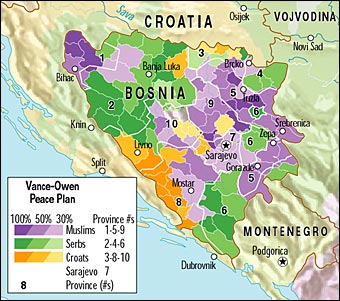
A New York Times piece a reader sent me from last month makes the same point about Yugoslavia and Syria and fostering sectarianism instead of controlling it that I tried to make in my Sullivan on Syria post: “Bosnia’s Lessons for Syria”:

“Equally crucial is that we ask how our own efforts may interfere with conflict. In Bosnia in 1993, the effect of the unsuccessful Vance-Owen Peace Plan, which proposed new political entities divided along ethnic lines, was to intensify campaigns of ethnic cleansing as warring groups tried to strengthen their positions ahead of partition. We should expect plans discussed in Switzerland to have a similar impact in Syria. This may be unavoidable, but we may be able to predict how the pattern of violence will evolve and allocate resources better to meet humanitarian needs.”

The Vance-Owen plan; like this was ever going to work:

peace_plan_vo_small