
“…spreading from Istanbul to the west and from the city of Trebizond east to Mongolia, Persia, Sumatra and China…” My emphases of course.
 –
–
“…spreading from Istanbul to the west and from the city of Trebizond east to Mongolia, Persia, Sumatra and China…” My emphases of course.
–
“I find that tears can heal the communal body as they would an individual body, in that tears garner the potential to cleanse us of the toxins named fear, shame, doubt, anxiety and guilt, that reside in the crevices of our minds, hearts, and souls. In fact, these very emotions of inferiority are what permits these modes of domination over us to begin with, and it is tears that grant us the space to heal from them.”
Whole of “Shereen Yousuf : Decolonial Practice of Majalis and its Potential for Communal Healing“.
–

The mountains that cover almost all of the surrounding country are beautiful, but I don’t think there’s more than a night of one’s life that should be haram-ed just in the capital.
–
comment: nikobakos@gmail.com
–
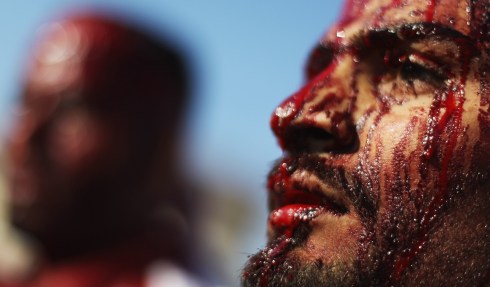
Karbala: A History of the “House of Sorrow”
In a distant age and climate, the tragic scene of the death of Husayn will awaken the sympathy of the coldest reader.
—Edward Gibbon
Jesus and his disciples, passing through the plain of Karbala, saw “a herd of gazelles, crowding together and weeping.” Astonished, the disciples looked at their Lord. He spoke: “At this site the grandson of Prophet Muhammad (Peace be upon him) will one day be killed.” And Jesus wept. Oh, that my head were waters, and mine eyes a fountain of tears, that I might weep day and night for the slain … And Jesus wept. And as if the news has just reached them—fourteen hundred years after the Battle of Karbala (near ancient Babylon, not far from the Euphrates) in the year A.H. 61/A.D. 680—mourners weep for “the prince among martyrs,” Hussain, grandson of the Prophet and son of Ali (“Father of Clay”) and Fatima (the Prophet’s only surviving child). Memorializing Hussain on the tenth of Muharram (Ashura) is the rite of Shi’a Islam—so central that at funerals those events are woven into elegies, every death framed by that “Calvary.” For just “as Jesus went to Jerusalem to die on the cross,” Hussain “went to Karbala to accept the passion that had been meant for him from the beginning of time.”
Zainab’s Lament in Damascus
Over Hussain’s mansion what night has fallen?
Look at me, O people of Shaam, the Prophet’s only daughter’s daughter, his only child’s child.
Over my brother’s bleeding mansion dawn rose—at such forever cost?
So weep now, you who of passion never made a holocaust, for I saw his children slain in the desert, crying for water.
Hear me. Remember Hussain, what he gave in Karbala, he the severed heart, the very heart of Muhammad, left there bleeding, unburied.
Deaf Damascus, here in your Caliph’s dungeons where they mock the blood of your Prophet, I’m an orphan, Hussain’s sister, a tyrant’s prisoner.
Father of Clay, he cried, forgive me. Syria triumphs, orphans all your children. Farewell.
And then he wore his shroud of words and left us alone forever.
Paradise, hear me— On my brother’s body what night has fallen?
Let the rooms of Heaven be deafened, Angels, with my unheard cry in the Caliph’s palace:
Syria hear me
Over Hussain’s mansion what night has fallen
I alone am left to tell my brother’s story
On my brother’s body what dawn has risen
Weep for my brother World, weep for Hussain
Reprinted from The Veiled Suite: The Collected Poems by Agha Shahid Ali. English translation copyright © 2009 by Daniel Hall. With the permission of the publisher, W.W. Norton & Company, Inc.
comment: nikobakos@gmail.com
So nice when they revert to form.
From Independent:
“A senior Croatian diplomat has been suspended and recalled to the country from Berlin for Facebook posts which have been described as “racist, xenophobic and homophobic”.
“Alongside images of sandy beaches on the Adriatic coast, Elizabeta Madjarevic wrote in English: “Pure and authentic Europe. Just white Europeans as it used to be only 30 years ago in the whole [of] Europe. One would think this is no longer possible but luckily it is.'”

–
–
A photo that was posted on the Dervićani (my father’s village in Albania) Facebook page, with the title: “Parade”.

I’m sorry folks, but are Albanians supposed to think flying flags like this is cool? Rama and his government have been real asses lately where the Greek minority is concerned, but what does this add to the conversation?
Or, can you imagine — καλά, Turks in Thrace we’re too scared to harass — if locals in northwest Greek Macedonia started flying North Macedonia’s Vergina star flag; or if Vlachs in Metsovo started flying a Romanian flag… Or some dudes in Salamina started flying the Shqiponja???
–
–

Now and in time to be,
Wherever green is worn…
A terrible beauty is born.
— W. B. Yeats
1
One must wear jeweled ice in dry plains
to will the distant mountains to glass.
The city from where no news can come
Is now so visible in its curfewed nights
that the worst is precise:
From Zero Bridge
a shadow chased by searchlights is running
away to find its body. On the edge
of the Cantonment, where Gupkar Road ends,
it shrinks almost into nothing, is
nothing by Interrogation gates
so it can slip, unseen, into the cells:
Drippings from a suspended burning tire
Are falling on the back of a prisoner,
the naked boy screaming, “I know nothing.”
2
The shadow slips out, beckons Console Me,
and somehow there, across five hundred miles,
I’m sheened in moonlight, in emptied Srinagar,
but without any assurance for him.
On Residency Road, by Mir Pan House,
unheard we speak: “I know those words by heart
(you once said them by chance): In autumn
when the wind blows sheer ice, the chinar leaves
fall in clusters –
one by one, otherwise.”
“Rizwan, it’s you, Rizwan, it’s you,” I cry out
as he steps closer, the sleeves of his phiren torn.
“Each night put Kashmir in your dreams,” he says,
then touches me, his hands crusted with snow,
whispers, “I have been cold a long, long time.”
3
“Don’t tell my father I have died,” he says,
and I follow him through blood on the road
and hundreds of pairs of shoes the mourners
left behind, as they ran from the funeral,
victims of the firing. From windows we hear
grieving mothers, and snow begins to fall
on us, like ash. Black on edges of flames,
it cannot extinguish the neighborhoods,
the homes set ablaze by midnight soldiers.
Kashmir is burning:
By that dazzling light
we see men removing statues from temples.
We beg them, “Who will protect us if you leave?”
They don’t answer, they just disappear
on the roads to the plains, clutching the gods.
4
I won’t tell your father you have died, Rizwan,
but where has your shadow fallen, like cloth
on the tomb of which saint, or the body
of which unburied boy in the mountains,
bullet-torn, like you, his blood sheer rubies
on Himalayan snow?
I’ve tied a knot
with green thread at Shah Hamdan, to be
untied only when the atrocities
are stunned by your jeweled return, but no news
escapes the curfew, nothing of your shadow,
and I’m back, five hundred miles, taking off
my ice, the mountains granite again as I see
men coming from those Abodes of Snow
with gods asleep like children in their arms.
(for Molvi Abdul Hai)
(See whole post “India’s Blood-stained Democracy…” by Mirza Waheed)
*******************************************************************************************************************************************************************************
* “Don’t tell my mother / my beloved brother / my sister….I’m dead” is also a common stock phrase in Balkan epic poetry of guerrilla fighters, kleftes, haiduci.
* “By that dazzling light we see men removing statues from temples”…”Who will protect us if you leave?”…”men coming from those Abodes of Snow with gods asleep like children in their arms.”
Shahid Ali’s universalist soul was as hurt by the exodus of Kashmiri Hindus (Pandits) from the region as he was by the brutality of the Indian Army against its innocent Muslim majority. I can only assume that the men with the gods asleep in their arms is a reference to this exodus. Shahid suffered from a recurrent nightmare, in fact, that the last Hindu had left Kashmir, and he fought that haunting image through the curious fashion of reproducing their distinctive cuisine as meticulously and often as possible — he was an excellent cook; there are now hardly any Hindus left in the tormented region. “Who will protect us if you leave?,” directed to the departing Hindu murti, is a line that always breaks my heart, and could only come from a poet of as sophisticated a background and from as beautifully Sufi-syncretic a region as Kashmir.

“I See Kashmir from New Delhi at Night” reprinted from The Veiled Suite: The Collected Poems by Agha Shahid Ali. English translation copyright © 2009 by Daniel Hall. With the permission of the publisher, W.W. Norton & Company, Inc.
Comment: nikobakos@gmail.com
Waheed is author of the best, most disturbing piece of Kashmir fiction I know of: “The Collaborator“. Check it out.

–
Comment: nikobakos@gmail.com
–




 Jadde: from Bosnia to Bengal