Tag Archives: Arab Christians

More on Alevis and Alawites…or Alevis and Kurds…or Iraqi Kurds…or…Christian Kurds…or Assyrians…or…

27 Sep

A video interview from 2011 of a smart, cute, articulate Kurdish guy from near Maraş that’s a good primer, as it claims, on all the intricacies of the above.

http://www.youtube.com/watch?v=sfDOWagfdms

Note the graphic at around 5:08: “Alevi = Alawite”.  And then the interviewer pops the million-dollar question: “So, who are you loyal to?  You’re an Alevi Kurd from Turkey.  Where do your loyalties lie?” — that kind of nails the whole issue on the head.  Because, not being the sharpest tool in the shed,  he doesn’t realize that the Kurdish guy never even gives him an answer.  Because there is none.  Because the question betrays, again, the Westerner’s incapacity to understand that multiple identities can co-exist in not just one nation or one community, but in a single individual.  And you can tell that the interviewer is getting bombarded with a complexity that he can’t even begin to make sense of — largely because he’s trying to make some sense of it in all the wrong ways.

Sad, prescient comment at the end concerning Syria: “It’s going to be a disaster.”

Comment: nikobakos@gmail.com

Tripoli, the northern Lebanese town that has become a microcosm of the Syrian civil war

16 Sep

Reblogged from Andrew Sullivan’s Daily Dish:

Fear And Loathing In Lebanon

Sep 15 2014 @ 7:45pm
 
View image on Twitter

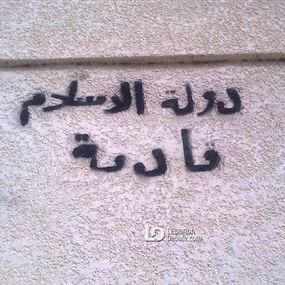
supporters vandalized churches in Tripoli . Graffiti reads: Islamic State is coming

Sulome Anderson checks in from Tripoli, the northern Lebanese town that has become a microcosm of the Syrian civil war and which today “seems to lie in ISIS’s shadow”:

Although the extremist and ultraviolent Sunni group has few open supporters here, the appearance of pro-ISIS paraphernalia and graffiti, the clash last month in the Bekaa, and the fact that Tripoli’s Sunni-majority population has a historical tendency toward radicalism, have raised worries that the group might gain a foothold here and send the city into a spiral of deepening violence.

Local tensions in Tripoli follow essentially the same ethnic lines as those in Syria’s war:

Sunni citizens largely support the increasingly fundamentalist Syrian opposition — ISIS being the most notoriously brutal of the groups fighting Syrian president Bashar al-Assad; meanwhile, the Alawites of the Jabal Mohsen neighborhood are overwhelmingly sympathetic to Assad’s regime (the Syrian leader is Alawite) and its Hezbollah allies. There are frequent and bloody gunfights between Jabal Mohsen and the Sunni district of Bab el-Tabbeneh, which border each other. Fearing violence would engulf Tripoli and potentially spread to other regions in Lebanon, the army moved in, establishing a security zone within the city limits last year. That hasn’t stopped the bloodshed, though, and the situation in Arsal triggered fresh clashes at the end of August, in which an 8-year-old girl was killed.

Also, the local Christian community is feeling threatened in a way it never has before:

Tripoli’s Christian population has been a bit skittish lately. Several churches were vandalized at the beginning of September, their walls spray-painted with ominous threats including “The Islamic State is coming” and “We come to slaughter you, you worshippers of the cross.” Crosses were allegedly burned in retaliation for the #BurnISISFlag social media movement, Lebanon’s version of the Ice Bucket Challenge, in which people have been posting videos and pictures of themselves setting fire to the group’s banner.

Father Samir Hajjar sits in the priest’s quarters of the city’s Syriac Orthodox Church, one of the buildings that was vandalized. He is measured about the incident, but admits it was worrying. “At first, we thought this could just be ordinary vandals, or the work of children,” he says. “I’ve been here 17 years, and no one bothers us. We respect our neighbors and they respect us. But this graffiti on the walls of all the churches, that’s not children’s work. They used stencils. It’s a serious matter.”

Comment: nikobakos@gmail.com

Pentecost

8 Jun

(reposted from 2012)

Today is Pentecost, the day that commemorates the descent of the Holy Spirit and the divine enlightenment of the gathered Apostles, when they were suddenly given the wisdom to speak all languages and that marks the institutional beginning of their mission and the Church generally.  What the New Testament doesn’t say is that the Apostles were gathered to celebrate Shavuos (lit. “weeks”), “Shvuyes” in deep Yiddish pronunciation, the day God gave the Torah to the people of Israel.   The Christian feast of a gift of divine wisdom was based on the existing Jewish feast of a gift of divine wisdom, and Shavuos comes seven weeks after the first day of Passover, like Pentecost comes seven weeks after Easter – it means “fiftieth” – a name Greek-speaking Hellenistic Jews were already using for the holiday long before the Christian era.

I always loved the reading for Pentecost from the Book of Acts (below in English, the original Greek and the Vulgate Latin).  In its endless list of peoples I always felt a kind of Pax Romana yearning for unity that still moves me, especially when it’s properly recited.  It’s a bit of a sad holiday too because it marks the official end of the Easter cycle (like it does the end of the Counting of the Omer in Judaism).  Significantly, the day before is one of the several “soul Saturdays” on which the Orthodox Church commemorates the dead; old folk beliefs held that the dead dwell among us from the Resurrection until the eve of Pentecost and then depart again.  And tonight at vespers, people kneel for the first time since Holy Week; the joy of the Easter season prohibits any kneeling or prostrations during the seven weeks it lasts.  It’s the return to Real from Divine time.  And from the period of renewal where death has been defeated to real existence again where it still holds full sway.  Until the promise of the next Resurrection.

I couldn’t find a recitation of the actual second chapter.  But here’s a beautiful Arabic recitation of the first chapter of Acts — which uses the same phrasing as a Greek reading would — where Christ preps the Apostles on what’s in store for them and, like a good rabbi, tells them not to ask too many questions:


And here’s Giotto’s depiction of the event from the Scrovegni Chapel in Padua, which probably contains more spectacular art than any other equivalent square footage of space in the world:

And El Greco’s more violent, Cretan-Spanish imagining (it became a tradition to include the Virgin in the scene, especially in the West, though Acts doesn’t mention her):

2 And when the day of Pentecost was fully come, they were all with one accord in one place.

And suddenly there came a sound from heaven as of a rushing mighty wind, and it filled all the house where they were sitting.

And there appeared unto them cloven tongues like as of fire, and it sat upon each of them.

And they were all filled with the Holy Ghost, and began to speak with other tongues, as the Spirit gave them utterance.

And there were dwelling at Jerusalem Jews, devout men, out of every nation under heaven.

Now when this was noised abroad, the multitude came together, and were confounded, because that every man heard them speak in his own language.

And they were all amazed and marvelled, saying one to another, Behold, are not all these which speak Galilaeans?

And how hear we every man in our own tongue, wherein we were born?

Parthians, and Medes, and Elamites, and the dwellers in Mesopotamia, and in Judaea, and Cappadocia, in Pontus, and Asia,

10 Phrygia, and Pamphylia, in Egypt, and in the parts of Libya about Cyrene, and strangers of Rome, Jews and proselytes,

11 Cretes and Arabians, we do hear them speak in our tongues the wonderful works of God.

12 And they were all amazed, and were in doubt, saying one to another, What meaneth this?


2 Καὶ ἐν τῷ συμπληροῦσθαι τὴν ἡμέραν τῆς πεντηκοστῆς ἦσαν πάντες ὁμοῦ ἐπὶ τὸ αὐτό, καὶ ἐγένετο ἄφνω ἐκ τοῦ οὐρανοῦ ἦχος ὥσπερ φερομένης πνοῆς βιαίας καὶ ἐπλήρωσεν ὅλον τὸν οἶκον οὗ ἦσαν καθήμενοι, καὶ ὤφθησαν αὐτοῖς διαμεριζόμεναι γλῶσσαι ὡσεὶ πυρός, καὶ ἐκάθισεν ἐφ’ ἕνα ἕκαστον αὐτῶν, καὶ ἐπλήσθησαν πάντες πνεύματος ἁγίου, καὶ ἤρξαντο λαλεῖν ἑτέραις γλώσσαις καθὼς τὸ πνεῦμα ἐδίδου ἀποφθέγγεσθαι αὐτοῖς.

Ἦσαν δὲ ἐν Ἰερουσαλὴμ κατοικοῦντες Ἰουδαῖοι, ἄνδρες εὐλαβεῖς ἀπὸ παντὸς ἔθνους τῶν ὑπὸ τὸν οὐρανόν· γενομένης δὲ τῆς φωνῆς ταύτης συνῆλθε τὸ πλῆθος καὶ συνεχύθη, ὅτι [ἤκουον εἷς ἕκαστος τῇ ἰδίᾳ διαλέκτῳ λαλούντων αὐτῶν· ἐξίσταντο δὲ καὶ ἐθαύμαζον λέγοντες· Οὐχ ἰδοὺ πάντες οὗτοί εἰσιν οἱ λαλοῦντες Γαλιλαῖοι; καὶ πῶς ἡμεῖς ἀκούομεν ἕκαστος τῇ ἰδίᾳ διαλέκτῳ ἡμῶν ἐν ᾗ ἐγεννήθημεν; Πάρθοι καὶ Μῆδοι καὶ Ἐλαμῖται, καὶ οἱ κατοικοῦντες τὴν Μεσοποταμίαν, Ἰουδαίαν τε καὶ Καππαδοκίαν, Πόντον καὶ τὴν Ἀσίαν, 10 Φρυγίαν τε καὶ Παμφυλίαν, Αἴγυπτον καὶ τὰ μέρη τῆς Λιβύης τῆς κατὰ Κυρήνην, καὶ οἱ ἐπιδημοῦντες Ῥωμαῖοι, 11 Ἰουδαῖοί τε καὶ προσήλυτοι, Κρῆτες καὶ Ἄραβες, ἀκούομεν λαλούντων αὐτῶν ταῖς ἡμετέραις γλώσσαις τὰ μεγαλεῖα τοῦ θεοῦ. 12 ἐξίσταντο δὲ πάντες καὶ διηπόρουν, ἄλλος πρὸς ἄλλον λέγοντες· Τί θέλει τοῦτο εἶναι;


2 et cum conplerentur dies pentecostes erant omnes pariter in eodem loco

et factus est repente de caelo sonus tamquam advenientis spiritus vehementis et replevit totam domum ubi erant sedentes

et apparuerunt illis dispertitae linguae tamquam ignis seditque supra singulos eorum

et repleti sunt omnes Spiritu Sancto et coeperunt loqui aliis linguis prout Spiritus Sanctus dabat eloqui illis

erant autem in Hierusalem habitantes Iudaei viri religiosi ex omni natione quae sub caelo sunt

facta autem hac voce convenit multitudo et mente confusa est quoniam audiebat unusquisque lingua sua illos loquentes

stupebant autem omnes et mirabantur dicentes nonne omnes ecce isti qui loquuntur Galilaei sunt

et quomodo nos audivimus unusquisque lingua nostra in qua nati sumus

Parthi et Medi et Elamitae et qui habitant Mesopotamiam et Iudaeam et Cappadociam Pontum et Asiam

10 Frygiam et Pamphiliam Aegyptum et partes Lybiae quae est circa Cyrenen et advenae romani

11 Iudaei quoque et proselyti Cretes et Arabes audivimus loquentes eos nostris linguis magnalia Dei

12 stupebant autem omnes et mirabantur ad invicem dicentes quidnam hoc vult esse.

* See next post


Comment: nikobakos@gmail.com

Vocabulary: “Frangoi”

2 Sep

I’ve used this term several times without giving a more specific definition of it and that was a mistake because some of those posts would have made more sense if I had.

Like: “Little Rock, Greece”  (May 26th, 2012):

“But an equal object of my bashing here is the European Union, which aside from proving itself to be a neo-colonialist endeavour masquerading as the Highest Achievement of Western Humanism Project, has also revealed itself to be a half-assed, thrown together mess on so many institutional and bureaucratic levels.  (Yes, neo-colonialist: the Frangoi** gave up their colonies after the war and then discovered the exploitable potential of Europe’s own periphery again.)”

And: “Russia and Syrian Christians, ctd”  (June 5th, 2012):

“Tying your survival to extra-regional players or regimes like Assad’s that are destined to soon make their exit is a losing strategy for the region’s Christians.  The threat of Islamist violence is probably real.  Iraq and even Egypt certainly seem to indicate that.  But their only choice is probably the tricky dance of fostering, or just going with, the flow of democratic change while keeping themselves as least vulnerable as possible.  Forget Russia.  And, as Constantine XI had to heroically face in the end, there’s certainly no help coming from the Frangoi.*  If you want to live in peace and security, look to your neighbor because, ultimately, he’s the only one who can provide it for you.”

And: “Un Verano en Nueva York” (July 13th, 2012):

“In Astoria I catch the end of vespers at Hagia Eirene.  This is a church that used to be the territory of fundamentalist, Old Calendar, separatist crazies but has rejoined the flock on the condition that it was granted monastic status (and I have no idea what that means).  But it has somehow got its hands on a great bunch of cantors and priests who really know what they’re doing.  I’m impressed.  I brought friends here for the Resurrection this year and for the first time I wasn’t embarrassed.  If I hadn’t invited them back home afterwards I would have stayed for the Canon.  Only one cantor now at vespers but he’s marvelous and the lighting is right and the priest’s bearing appropriately imperial.  It’s incredibly heartening to see our civilization’s greatest achievement — which is not what the Frangoi taught us about Sophocles or Pericles or some half-baked knowledge of Plato or a dumb hard-on about the Elgin marbles or the word “Macedonia,” but this, the rite and music and poetry and theatre of the Church – performed with the elegance and dignity that it deserves.”                  

So…when the Byzantines first encountered the West and the conglomeration of Germanic kingdoms that had sprung up on the territories of the western Roman Empire, or rather, when they first felt challenged by it and not just irritated, was when Charlemagne, previously just King of the Franks, was crowned Emperor of the Romans in the year 800 by Pope Leo III, whose skin he had saved after Leo had been deposed and almost lynched by the mobs of Rome.  This, of course, was intolerable to us, because we were the Romans and we had an Emperor, with an unbroken line back to Constantine, if not Augustus.  This is close to impossible an idea for anyone today to understand; it’s even hard for modern Greeks to articulate and it’s at the core of our completely mangled identity.  It’s nearly impossible to speak definitively about consciousness or identity in the present tense, much less more than a millennium past.  But this is the simplest way I can put it: by the late first millennium, the Greek-speaking Christians of the eastern Mediterranean had a stronger sense of Imperial Roman continuity than the inhabitants of even the Italian peninsula.  Till well into the twentieth century our most common term of self-designation was “Romios” – “Roman.”  If you had asked any of my grandparents, all born Ottoman subjects, what they “were” — if they even understood the question — or even my father very often, they would’ve all answered “Roman.”  For the inhabitants of my father’s village in Albania, especially the older ones, who never had “Hellenes” imposed on them by the Neo-Greek statelet, the world is still divided into Muslim “Turks” and Orthodox “Romans,” and whether they speak Greek or Albanian is irrelevant.  The Greeks of Istanbul still call themselves “Romioi” for the most part; Turks still call them “Rum” too, out of simple historical continuity, while the Turkish state is still faithful to the appellation for partly more cynical and manipulative reasons.  I’m writing a piece with the appropriately pompous working title of “A Roman Manifesto” or “A Manifesto of Romanness” that will deal with this whole theme further.

The Frankish West (click)

So Charlemagne was a Frank, a Latinized Germanic ethnic group, and though the Pope’s primacy “inter pares” was recognized, he had no right to unilaterally crown this Frank emperor in an Italy that had become a ravaged provincial backwater from the Constantinopolitan point of view.  This didn’t end relations between the Empire and the various western European kingdoms.  They continued to trade and even contract dynastic marriages and all the rest.  But the tension, which had already been planted for quite a while before that, only went from bad to worse: power tensions; trade concessions to the Italian city-states that fatally mirror the ones the Ottomans had to make to the Western powers a millennium later; massacres of Italians in C-town that are equally mirror-like.

The West grew in confidence.  The Empire shrank.  They started bickering about theological issues, and eventually, in 1054, Rome and Constantinople excommunicated each other over some nonsense about the division of labor among the Trinity that I’ve never bothered to try and understand.  Then came the Crusades — more growing Western confidence — which the Byzantines weren’t ever really enthusiastic about because I reckon on many levels they felt less animosity for and greater cultural affinity to their the Muslim/Arab neighbors than they did to the “Franks.”  Runciman, I think writes somewhere that a ninth-century Greek felt more at home in Arab Palermo or Baghdad and Cairo that he would’ve in Paris or even Rome.

Sometimes Wiki’s gets it perfect:

“The experiences of the first two Crusades had thrown into stark relief the vast cultural differences between the two Christian civilizations. The Latins (as the Byzantines called them because of their adherence to the Latin Rite) viewed the Byzantine preference for diplomacy and trade over war, as duplicitous and degenerate, and their policy of tolerance and assimilation towards Muslims as a corrupt betrayal of the faith. For their part, the educated and wealthy Byzantines saw the Latins as lawless, impious, covetous, blood-thirsty, undisciplined, and (quite literally) unwashed.”

Then came the Fourth Crusade, led by the Venetian Doge Enrico Dandolo.  The Crusaders fell into the internecine machinations of the some Angeloi  Emperors and I think ended up feeling betrayed on some promise made to them by one party in the Byzantine political scene, and they probably were, because our latter Emperors compensated for the diminishment of their real geopolitical power and the sapped strength of their once massive military machine by becoming major manipulative sleazebags and liars, initiating a long Greek tradition that persists to our day.  In retaliation, and, or, because that had been their real object all along, the Crusaders of the Fourth Crusade, in 1204, captured the City – the first time Constantinople had ever fallen to anybody and destroyed it.

They destroyed her.  They massacred thousands, desecrated churches, including Hagia Sophia herself, and carried away what, in today’s terms, I’m sure amounted to billions in loot.  The Venetians got off with enough of a lump sum of capital to fund and run their mercantile empire for another five centuries.  But aside from the loot, which on some level is comprehensible, it’s the sheer mindless destruction of 1204 that betrays the sack as the action of thuggish, resentful provincials and their envy towards what had been the civilizational center of the Mediterranean and western Asian world for almost a millennium; it’s what an army of Tea-Partiers, NRA members or armed Texan Evangelicals would do to New York if they could.  Though pregnant already with the great traditions of this supposed thing called Western Humanism, this bunch destroyed more Classical texts and melted down or smashed more Classical sculpture into gravel than had been done at any other one time in history – far more than any fanatical Christians in any pagan city or any Arabs or Muslims in any conquered Christian city before them had.  More of the ancient world was lost to us in those few days than in any other comparable time span before that.  Just sheer idiotic vandalism.  There’s probably no more epic manifestation of Killing-the-Father in human history.

Speros Vryonis, a great historian but a seriously unpleasant man, Theos’choreston, made a career out of catalogueing the injustices done to Byzantine and post-Byzantine Greeks.  He was the great modern preacher of whining Greek victimology and one often felt that all his personal bile and biterness was poured into his work in that way; his book on the anti-Greek riots of Istanbul in 1955 is one thousand pages long; you’d think it was the most important event in twentieth-century history.  In any event, in Byzantium and Europe, he wrote:

“The Latin soldiery subjected the greatest city in Europe to an indescribable sack. For three days they murdered, raped, looted and destroyed on a scale which even the ancient Vandals and Goths would have found unbelievable. Constantinople had become a veritable museum of ancient and Byzantine art, an emporium of such incredible wealth that the Latins were astounded at the riches they found. Though the Venetians had an appreciation for the art which they discovered (they were themselves semi-Byzantines) and saved much of it, the French and others destroyed indiscriminately, halting to refresh themselves with wine, violation of nuns, and murder of Orthodox clerics. The Crusaders vented their hatred for the Greeks most spectacularly in the desecration of the greatest Church in Christendom. They smashed the silver iconostasis, the icons and the holy books of Hagia Sophia, and seated upon the patriarchal throne a whore who sang coarse songs as they drank wine from the Church’s holy vessels. The estrangement of East and West, which had proceeded over the centuries, culminated in the horrible massacre that accompanied the conquest of Constantinople. The Greeks were convinced that even the Turks, had they taken the city, would not have been as cruel as the Latin Christians. The defeat of Byzantium, already in a state of decline, accelerated political degeneration so that the Byzantines eventually became an easy prey to the Turks. The Crusading movement thus resulted, ultimately, in the victory of Islam, a result which was of course the exact opposite of its original intention.”
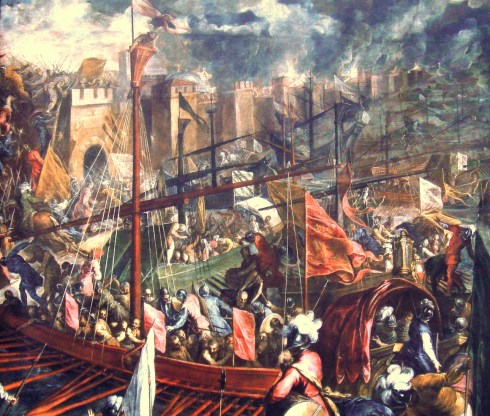
The Fall of Constantinople, Palma Le Jeune — 16th-17th century (click)

The Entry of the Crusaders into Constantinople –Eugene Delacroix, 1840 (click)

And, in fact, the Turks — fast-forward two-and-a-half centuries – weren’t as bad.  Maybe ’cause there wasn’t much left.  Aside from a sizeable amount of slaves, most of the loot Mehmet had promised his suicidally brave Janissaries when they finally made it into the City in 1453 consisted of cheap silver frames pried off of personal or parish-sized icons — Cavafy’s “bits of coloured glass.”  The Emperor’s tombs in the dilapidated Hagioi Apostoloi — the Byzantines’ Westminster — had already been desecrated and robbed by the Franks.  They may as well have sacked Astoria.  The rest was in Venice.  (Even the crown jewels had been pawned off to Venice a century before by Anne of Savoy, one of the most meddling Frangissa bitches in Byzantine history, to fund her episode of the Palaiologan civil wars; that’s the actual historical reference for Cavafy’s “coloured glass.”  Christouli mou, can you imagine what the Byzantine crown jewels were like?)  But one good thing happened for Greeks on Tuesday, May Twenty-Ninth, Fourteen-Fifty-Three: when the Turks finally broke into Hagia Sophia, they smashed Dandolo’s sepulcher — because, after all of the above, he had had the shamelessness to have himself interred there – and finding nothing of worth, they threw his bones out into the street and let the dogs gnaw on them.  I don’t care what else the conquering Turks did at that  point or that Menderes’ thugs did the same to the Patriarchs’ graves at Balikli in 1955; I sleep better at night because they did it to Dandolo.  I’m as close to a chaneller of the Byzantine mind and soul as you’ll find (aside from Vryonis) and I can tell you that the sweet Balkan hard-on of vengeance that image gives me even now is indescribable.

The Greeks got Constantinople back in 1261, but the City never really recovered, as the Empire itself didn’t.  Like the South Bronx in the eighties, whole parts of the City were eventually given over to orchards and bostania or just wilderness.  Yet even after that, the Byzantines managed to plant further seeds in the womb of friggin’ Western Humanism in the form of an artistic wave of unprecedented dimensions and creativity. 

The “Franks,” thereafter, were the unforgivable villains.  But even before, when Byzantine writers felt like being professional, they referred to Westerners as “Latins.”  When not, and eventually in most cases, they were “Frangoi.”  Frangoi stuck as the word for Westerners, or for Catholics at least, because Protestantism was only a minor blip on the East’s screen.   But generally it came to mean the Western Others and the Eastern Muslim world between which Byzantine and post-Byzantine Christians came to feel themselves stuck between.

“Fereng,” “Ferengi,” “Ferenj” and other variations is also a word that eventually came to be used as far east as India, but I can’t be sure whether in Iran or India it means/meant Westerner or just foreigner.  For Arabs and Turks, “Frank” came to mean those Christians over there, as opposed to “Romans,” our Christians over here.  So if you were Roman Catholic, either back home in Europe or in the Near East, you were a “Frank;” if you were an Orthodox Christian, you were a “Roman.”*  It’s confusing.  And I hope I haven’t made it worse.

For Greeks, Frangoi continued to mean Westerner both in a negative sense and not, until the nation-sate convinced us into thinking we ourselves were Westerners.  When Greek peasant men, for example, started wearing Western clothes, whereas their women wore traditional dress well into the twentieth century in many regions, those clothes were “Frangika.”  Frangoi also meant, with no negative connotation, the small communities of Catholics in the Aegean islands that were leftovers of the Crusader principalities that had been founded there after the Fourth Crusade.

It’s not used any more in common Greek parlance, but most Greeks know what you mean when you say it – though this generation is so profoundly ignorant historically that I’m not so sure.  I, of course, use it in a spirit of historical irony, though that spirit is entirely hostile.  The worst enemy of our part of the world is the European West, and not because of imperialist interventions or the usual gripes, but because of the ideological and cultural chaos we allowed it to throw us into.

Yes, Frangoi are the enemy.  I like to say that.  But it’s not true.  We think we’re Frangoi.  Unlike the Byzantines described above, who understood that their natural civilizational context was and always had been the eastern Mediterranean, we are either ignorant of the peoples to our East or despise them.  We disfigured our own identity in an attempt to remake it in the Westerners’ image.  We threw acid into our own face and now still look longingly into Europe’s eyes, and pathetically expect to see our Classical glory reflected back at us.

*One of the most graphic examples is Lebanon/Syria, where Orthodox Christians, who have long and poignantly tried to bridge the above gap, were still “Romans” into the nineteenth century and were among the founders and then long among the most loyal adherents of Arab nationalism, whereas Maronite Christians were the locals with the most exemplary Frangika delusions, always looking to the Western outsider to bolster their interests, first their “sweet mother France” and then Israel, and bringing disaster down upon their heads and that of all around them in the process.  That’s why in many previous posts my humble outsider’s advice to and hope for Syrian Christians in the current crisis has been that they think and act like Romans and not Franks.

Comment: nikobakos@gmail.com


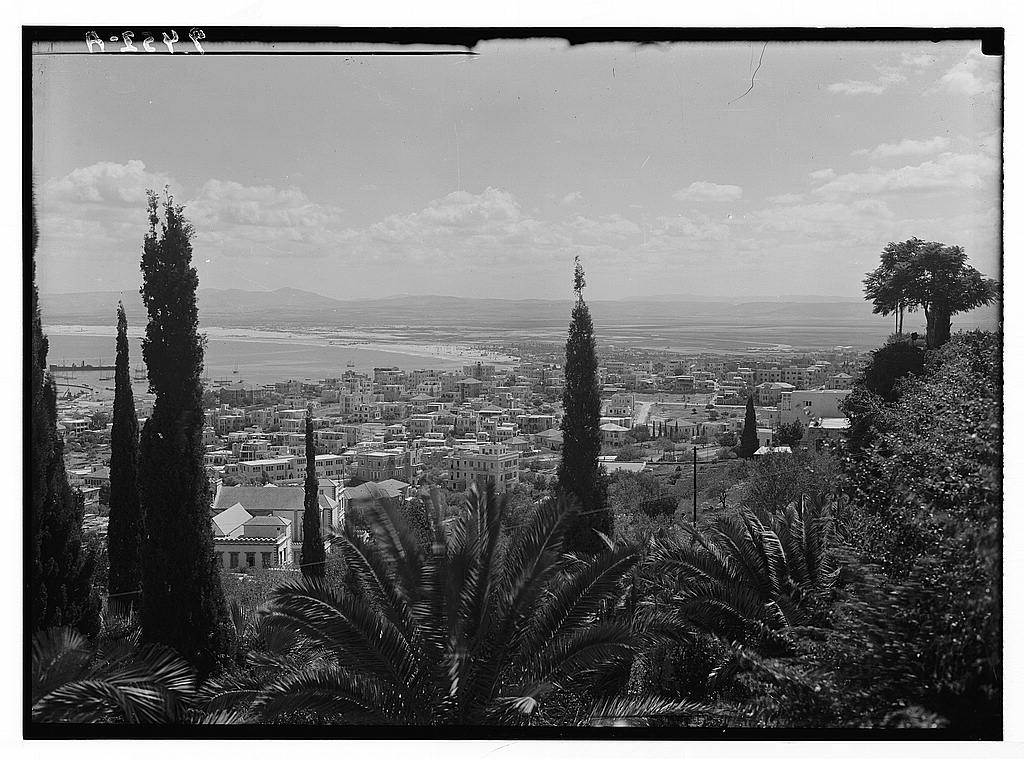
Turns out he’s the patron saint of Haifa

20 Jul

Duh…  Of course, Elijah on Mount Carmel…

An Arab icon of Elijah — and Haifa (click)


Comment: nikobakos@gmail.com

Today is the Feast of the Prophet Elijah

20 Jul

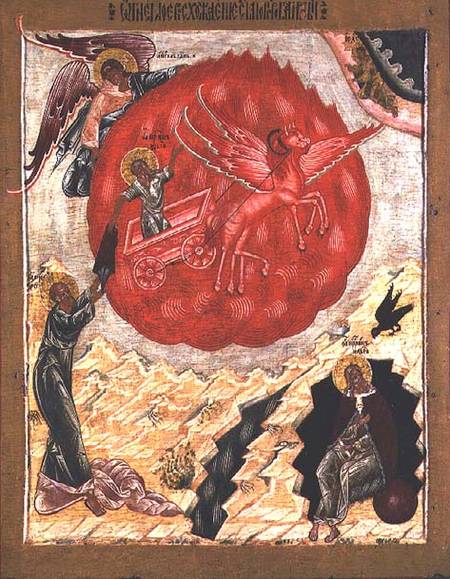
The Russians, with their flair for red, always made the most beautiful Elijah icons and were always partial to the “fiery ascent to heaven” part of his story.  Greek images of Elijah usually focus on the image in the lower right of this icon, that of Elijah in the cave in the wilderness and the “still, small voice:”

And he came thither unto a cave, and lodged there; and, behold, the word of the Lord came to him, and he said unto him, What doest thou here, Elijah?

10 And he said, I have been very jealous for the Lord God of hosts: for the children of Israel have forsaken thy covenant, thrown down thine altars, and slain thy prophets with the sword; and I, even I only, am left; and they seek my life, to take it away.

11 And he said, Go forth, and stand upon the mount before the Lord. And, behold, the Lord passed by, and a great and strong wind rent the mountains, and brake in pieces the rocks before the Lord; but the Lord was not in the wind: and after the wind an earthquake; but the Lord was not in the earthquake:

12 And after the earthquake a fire; but the Lord was not in the fire: and after the fire a still small voice.

13 And it was so, when Elijah heard it, that he wrapped his face in his mantle, and went out, and stood in the entering in of the cave. And, behold, there came a voice unto him, and said, What doest thou here, Elijah?

9 καὶ εἰσῆλθεν ἐκεῖ εἰς τὸ σπήλαιον καὶ κατέλυσεν ἐκεῖ καὶ ἰδοὺ ῥῆμα κυρίου πρὸς αὐτὸν καὶ εἶπεν τί σὺ ἐνταῦθα Ηλιο

10 καὶ εἶπεν Ηλιου ζηλῶν ἐζήλωκα τῷ κυρίῳ παντοκράτορι ὅτι ἐγκατέλιπόν σε οἱ υἱοὶ Ισραηλ τὰ θυσιαστήριά σου κατέσκαψαν καὶ τοὺς προφήτας σου ἀπέκτειναν ἐν ῥομφαίᾳ καὶ ὑπολέλειμμαι ἐγὼ μονώτατος καὶ ζητοῦσι τὴν ψυχήν μου λαβεῖν αὐτήν

11 καὶ εἶπεν ἐξελεύσῃ αὔριον καὶ στήσῃ ἐνώπιον κυρίου ἐν τῷ ὄρει ἰδοὺ παρελεύσεται κύριος καὶ πνεῦμα μέγα κραταιὸν διαλῦον ὄρη καὶ συντρῖβον πέτρας ἐνώπιον κυρίου οὐκ ἐν τῷ πνεύματι κύριος καὶ μετὰ τὸ πνεῦμα συσσεισμός οὐκ ἐν τῷ συσσεισμῷ κύριος

12 καὶ μετὰ τὸν συσσεισμὸν πῦρ οὐκ ἐν τῷ πυρὶ κύριος καὶ μετὰ τὸ πῦρ φωνὴ αὔρας λεπτῆς κἀκεῖ κύριος

13 καὶ ἐγένετο ὡς ἤκουσεν Ηλιου καὶ ἐπεκάλυψεν τὸ πρόσωπον αὐτοῦ ἐν τῇ μηλωτῇ ἑαυτοῦ καὶ ἐξῆλθεν καὶ ἔστη ὑπὸ τὸ σπήλαιον καὶ ἰδοὺ πρὸς αὐτὸν φωνὴ καὶ εἶπεν τί σὺ ἐνταῦθα Ηλιου
I don’t know what Arab images of Elijah tend to look like, but Elias is a very common name among Levantine Christians; Mar Elias is the name of the only predominantly Christian Palestinian refugee camp in the Middle East, south of Beirut.


Comment: nikobakos@gmail.com

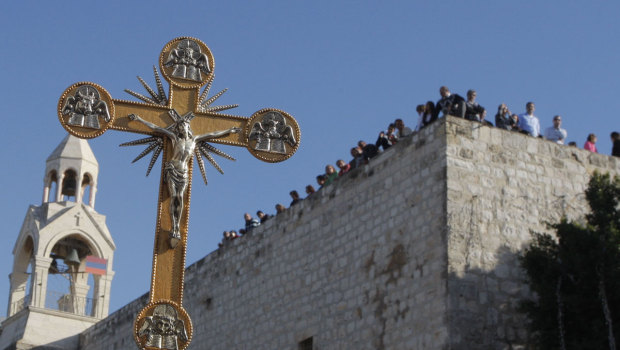
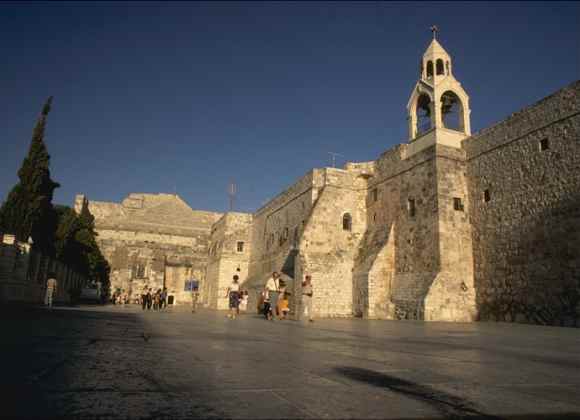
Church of the Nativity in Bethlehem placed on UNESCO’s world heritage sites in danger list: Israel and U.S. object

29 Jun

(File, AP Photo/Nasser Shiyoukhi)

PARIS (AP) – UNESCO’s World Heritage committee on Thursday approved a Palestinian bid to place the Church of the Nativity in Bethlehem on its list of sites of World Heritage in Danger – a move seen by some nations as dangerously mixing politics and culture.

Palestinian spokeswoman Hanan Ashrawi said the vote was an affirmation of Palestinian sovereignty over the site that marks the place where Christians believe Jesus was born.

Israel angrily denounced the vote, with Foreign Ministry spokeswoman Ilana Stein saying the decision “has turned UNESCO into a theater of the absurd.”

“This is a sad day for the World Heritage Committee,” she said.

The 21-member committee, meeting in St. Petersburg, Russia, voted 13-6 to include the church and pilgrimage route, located in the Israeli-controlled West Bank, on its list of sites. There were two abstentions.

The drive to get the Nativity church quickly recognized as a World Heritage site was part of the Palestinians’ bid to win international recognition since attempts to establish a Palestinian state through negotiations with Israel are frozen.

The United States was among nations opposed to the Palestinian proposal of an emergency candidacy for the iconic Christian site, shortcutting what is usually an 18-month-long process to apply for World Heritage recognition. Neither the United States nor Israel was on the committee. The U.S. ambassador to UNESCO, David Killion, said the United States is “profoundly disappointed.”

The church – which drew some 2 million visitors last year and parts of which are 1,500 years old – stands above the grotto that Christians believe was the birthplace of Jesus. The Palestinian application asks for recognition as a site of “outstanding universal value” urgently in need of attention.

The application cited lack of regular restoration of the church due to the political situation since 1967 when Israel occupied the territories, and difficulties procuring equipment because of lack of free movement imposed by Israeli forces.

The United Nations Educational, Scientific and Cultural Organization voted to admit Palestine as a full member in October. The emergency candidacy for the church clearly showed the Palestinians’ intention of making the most of their position, after a failure to join the main U.N. body because Palestine is not a recognized state.

The Palestinian application to place the Church on the list showed that they plan to put forward other sites for prestigious World Heritage recognition, eventually linking various landmarks to the life of Jesus.

“The message to Israel today is that unilateral actions will not work and that Israel cannot continue challenging the world despite its powerful allies,” Ashrawi said.

Killion, the U.S. ambassador, said “this body should not be politicized.” His statement noted the candidacy was opposed by a UNESCO experts committee, whose conclusions are almost always heeded.

The three churches acting as custodians of the site had also been opposed. The Greek Orthodox, Armenian and Roman Catholic churches keep the site under a so-called Status Quo agreement dating to the Ottoman empire, and fear the Palestinian action will upset that delicate balance.

“The site clearly has tremendous religious and historical significance,” Killion’s statement said. “However, the emergency procedure used in this instance is reserved only for extreme cases.”

Stein, the Israeli Foreign Ministry spokeswoman, said those who voted in favor of the Nativity candidacy “have given themselves up as pawns in the service of the Palestinians at the expense of UNESCO’s professionalism and good name.”

While the church needs restoration, including repair of a leaky roof, it was not seen by the experts committee as being in imminent threat of destruction – the criteria usually reserved for the emergency procedure

A site nominated by Israel depicting human evolution at Mount Carmel, the Nahal Me’arot/Wadi el-Mughara Caves, also was inscribed on the World Heritage list. That nomination, like all others under consideration in St. Petersburg, went through regular channels – not the emergency route.

Exterior and interior of the church


“Morsy to appoint Copt, woman to vice presidency…”

27 Jun

Wow!  Either a cheap public relations move or a great, beautiful piece of good news.

(Photo: Virginie Nguyen)

A political adviser of President-elect Mohamed Morsy said a Copt and woman would be appointed as vice presidents.

Ahmed al-Deif told CNN that it would be the first time in Egypt’s history that a woman would be appointed to this position that will be granted powers.

“We didn’t call for establishing an Islamic republic in Egypt. Morsy was very clear on this. He assured [he is] seeking a civilian constitutional country, a civilized one based on respecting cultures, principles and religions,” he added.

Some enthusiastic, some skeptical comments at bottom


Comment: nikobakos@gmail.com

Pentecost

27 May

Today is Pentecost (it was last Sunday in the western Church), the day that commemorates the descent of the Holy Spirit and the divine enlightenment of the gathered Apostles, when they were suddenly given the wisdom to speak all languages and that marks the institutional beginning of their mission and the Church generally.  What the New Testament doesn’t say is that the Apostles were gathered to celebrate Shavuos (lit. “weeks”), “Shvuyes” in deep Yiddish pronunciation,* the day God gave the Torah to the people of Israel.   The Christian feast of a gift of divine wisdom was based on the existing Jewish feast of a gift of divine wisdom, and Shavuos comes seven weeks after the first day of Passover, like Pentecost comes seven weeks after Easter – it means “fiftieth” – a name Greek-speaking Hellenistic Jews were already using for the holiday long before the Christian era.

I always loved the reading for Pentecost from the Book of Acts (below in English, the original Greek and the Vulgate Latin).  In its endless list of peoples I always felt a kind of Pax Romana yearning for unity that still moves me, especially when it’s properly recited.  It’s a bit of a sad holiday too because it marks the official end of the Easter cycle (like it does the end of the Counting of the Omer in Judaism).  The day before is one of the several “soul Saturdays” on which the Orthodox Church commemorates the dead; old folk beliefs held that the dead dwell among us from the Resurrection until the eve of Pentecost and then depart again.  And tonight at vespers, people kneel for the first time since Holy Week; the joy of the Easter season prohibits any kneeling or prostrations during the seven weeks it lasts.  It’s the return to Real from Divine time.  And from the period of renewal where death has been defeated to real existence again where it still holds full sway.  Until the promise of the next Resurrection.

I couldn’t find a recitation of the actual second chapter.  But here’s a beautiful Arabic recitation of the first chapter of Acts — which uses the same phrasing as a Greek reading would — where Christ preps the Apostles on what’s in store for them and, like a good rabbi, tells them not to ask too many questions:

And here’s Giotto’s depiction of the event from the Scrovegni Chapel in Padua, which probably contains more spectacular art than any other equivalent square footage of space in the world:

And El Greco’s more violent, Cretan-Spanish imagining (it became a tradition to include the Virgin in the scene, especially in the West, though Acts doesn’t mention her):

2 And when the day of Pentecost was fully come, they were all with one accord in one place.

And suddenly there came a sound from heaven as of a rushing mighty wind, and it filled all the house where they were sitting.

And there appeared unto them cloven tongues like as of fire, and it sat upon each of them.

And they were all filled with the Holy Ghost, and began to speak with other tongues, as the Spirit gave them utterance.

And there were dwelling at Jerusalem Jews, devout men, out of every nation under heaven.

Now when this was noised abroad, the multitude came together, and were confounded, because that every man heard them speak in his own language.

And they were all amazed and marvelled, saying one to another, Behold, are not all these which speak Galilaeans?

And how hear we every man in our own tongue, wherein we were born?

Parthians, and Medes, and Elamites, and the dwellers in Mesopotamia, and in Judaea, and Cappadocia, in Pontus, and Asia,

10 Phrygia, and Pamphylia, in Egypt, and in the parts of Libya about Cyrene, and strangers of Rome, Jews and proselytes,

11 Cretes and Arabians, we do hear them speak in our tongues the wonderful works of God.

12 And they were all amazed, and were in doubt, saying one to another, What meaneth this?


2 Καὶ ἐν τῷ συμπληροῦσθαι τὴν ἡμέραν τῆς πεντηκοστῆς ἦσαν πάντες ὁμοῦ ἐπὶ τὸ αὐτό, καὶ ἐγένετο ἄφνω ἐκ τοῦ οὐρανοῦ ἦχος ὥσπερ φερομένης πνοῆς βιαίας καὶ ἐπλήρωσεν ὅλον τὸν οἶκον οὗ ἦσαν καθήμενοι, καὶ ὤφθησαν αὐτοῖς διαμεριζόμεναι γλῶσσαι ὡσεὶ πυρός, καὶ ἐκάθισεν ἐφ’ ἕνα ἕκαστον αὐτῶν, καὶ ἐπλήσθησαν πάντες πνεύματος ἁγίου, καὶ ἤρξαντο λαλεῖν ἑτέραις γλώσσαις καθὼς τὸ πνεῦμα ἐδίδου ἀποφθέγγεσθαι αὐτοῖς.

Ἦσαν δὲ ἐν Ἰερουσαλὴμ κατοικοῦντες Ἰουδαῖοι, ἄνδρες εὐλαβεῖς ἀπὸ παντὸς ἔθνους τῶν ὑπὸ τὸν οὐρανόν· γενομένης δὲ τῆς φωνῆς ταύτης συνῆλθε τὸ πλῆθος καὶ συνεχύθη, ὅτι [ἤκουον εἷς ἕκαστος τῇ ἰδίᾳ διαλέκτῳ λαλούντων αὐτῶν· ἐξίσταντο δὲ καὶ ἐθαύμαζον λέγοντες· Οὐχ ἰδοὺ πάντες οὗτοί εἰσιν οἱ λαλοῦντες Γαλιλαῖοι; καὶ πῶς ἡμεῖς ἀκούομεν ἕκαστος τῇ ἰδίᾳ διαλέκτῳ ἡμῶν ἐν ᾗ ἐγεννήθημεν; Πάρθοι καὶ Μῆδοι καὶ Ἐλαμῖται, καὶ οἱ κατοικοῦντες τὴν Μεσοποταμίαν, Ἰουδαίαν τε καὶ Καππαδοκίαν, Πόντον καὶ τὴν Ἀσίαν, 10 Φρυγίαν τε καὶ Παμφυλίαν, Αἴγυπτον καὶ τὰ μέρη τῆς Λιβύης τῆς κατὰ Κυρήνην, καὶ οἱ ἐπιδημοῦντες Ῥωμαῖοι, 11 Ἰουδαῖοί τε καὶ προσήλυτοι, Κρῆτες καὶ Ἄραβες, ἀκούομεν λαλούντων αὐτῶν ταῖς ἡμετέραις γλώσσαις τὰ μεγαλεῖα τοῦ θεοῦ. 12 ἐξίσταντο δὲ πάντες καὶ διηπόρουν, ἄλλος πρὸς ἄλλον λέγοντες· Τί θέλει τοῦτο εἶναι;


2 et cum conplerentur dies pentecostes erant omnes pariter in eodem loco

et factus est repente de caelo sonus tamquam advenientis spiritus vehementis et replevit totam domum ubi erant sedentes

et apparuerunt illis dispertitae linguae tamquam ignis seditque supra singulos eorum

et repleti sunt omnes Spiritu Sancto et coeperunt loqui aliis linguis prout Spiritus Sanctus dabat eloqui illis

erant autem in Hierusalem habitantes Iudaei viri religiosi ex omni natione quae sub caelo sunt

facta autem hac voce convenit multitudo et mente confusa est quoniam audiebat unusquisque lingua sua illos loquentes

stupebant autem omnes et mirabantur dicentes nonne omnes ecce isti qui loquuntur Galilaei sunt

et quomodo nos audivimus unusquisque lingua nostra in qua nati sumus

Parthi et Medi et Elamitae et qui habitant Mesopotamiam et Iudaeam et Cappadociam Pontum et Asiam

10 Frygiam et Pamphiliam Aegyptum et partes Lybiae quae est circa Cyrenen et advenae romani

11 Iudaei quoque et proselyti Cretes et Arabes audivimus loquentes eos nostris linguis magnalia Dei

12 stupebant autem omnes et mirabantur ad invicem dicentes quidnam hoc vult esse.

* See next post


Comment: nikobakos@gmail.com

Syrian Christians

13 May

Short Al Jazeera report that follows up and answers some questions I had in previous post: April 23rd, “Turkey and religious freedom: Wooing Christians — ‘We are ready to face the past, to make amends.'”

Christ, I hope they end up on the right historical side of this one.  Not that they may have a choice — as Iraqi Christians didn’t.


Comment: nikobakos@gmail.com