Tag Archives: Armenians

“Screamers:” Genocide: what is it and why do we need the term?

7 Nov

Screamers

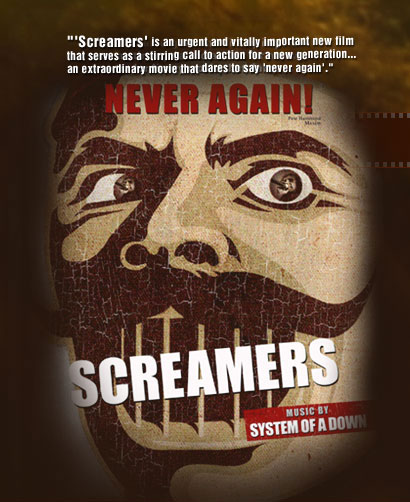
I watched “Screamers”* the other night, a 2006 documentary by Carla Garapedian about an Armenian-American synthpunk group based in California, who go around, among other things, “screaming” about the Armenian massacres of the early twentieth century and issues of genocide recognition generally.  They’re shown on tour, comparing Armenian experiences to those of Rwandans, Cambodians — Jews conspicuously less so — soliciting the support of U.S. congressmen, interviewing British aristocrats, Harvard professors and their own great-aunts and grandfathers telling their own story of the events they describe as the Armenian Genocide, all in an effort of course to get the Turkish government to acknowledge the “Genocide” as such.  And it left me with the usual thoughts I have on this issue: that this word – “genocide” – which is supposed to name an evil particular to our time and by naming it hopefully eradicate it, has come to be so overused as to be meaningless, was vague from its beginnings and has come to obscure more than it reveals about the phenomenon, if there is such.

Raphael Lemkin, the Polish Jewish Holocaust survivor who originated the term, described it as such:

By ‘genocide’ we mean the destruction of an ethnic group . . . . Generally speaking, genocide does not necessarily mean the immediate destruction of a nation, except when accomplished by mass killings of all members of a nation. It is intended rather to signify a coordinated plan of different actions aiming at the destruction of essential foundations of the life of national groups, with the aim of annihilating the groups themselves. The objectives of such a plan would be disintegration of the political and social institutions, of culture, language, national feelings, religion, and the economic existence of national groups, and the destruction of the personal security, liberty, health, dignity, and even the lives of the individuals belonging to such groups . . ..

T. Marcus Funk in Victims’ Rights and Advocacy at the International Criminal Court says genocide is “the deliberate and systematic destruction, in whole or in part of an ethnic, racial, caste or religious, or national group.” 

“…in whole or in part…” is controversially vague enough.  Then, how “deliberate and systematic” does it have to be to qualify?  And if its victims are members of any “ethnic, racial, caste, or religious, or national group,” is that not so all-encompassing as to include most of humanity?  What sets genocide apart then from any mass killing?  That it’s done to a socially or ethnically identifiable group?  Mass killing – apart from shootings in American shopping malls or movie theaters – is usually committed on such a group.  And by emphasizing that a “group,” usually an ethnic or minority group, is the object, it creates the unspoken assumption of irrationality, though most of the events we call genocides have and had a very rational end and, to be effective, must have used fairly rational means.  And thus I wonder if the word mystifies and, more importantly, decontextualizes to a point that ultimately may do more harm than good.

Obviously, our region gives us a variety of useful examples to look at.  Now, I often get emails here — most simply rants that I don’t bother publishing — in which I’m told that I am defeating the stated purpose of this blog by favoring one group over another or being so obviously preferential in some of my affections or animosities.  I’m told that I’m panderingly philosemitic; I don’t know about the “pandering” part, but otherwise, yes.  I’m accused of being both pro-Israeli and anti-Israeli, and anti-Palestinian and possessed of a blind good faith in Palestinian intentions and an enabler of their “tactics,” whatever that means; I guess if I can be all those things at once I may be doing something right.  I’m accused of being anti-Croatian: let’s leave that one to the side for a moment.  But mostly I’m accused of two things: that I’m pro-Turkish — this usually by angry Greeks — and that I’m a shameless apologist for Serbian criminality.

And here there is some truth: the two peoples may not much appreciate being linked in my heart, but one of the many reasons that I may have a special affection for Turks, or at least find myself defending them so often, is also one of the many reasons I have a special affection for Serbs: I think the two have historically been the most unfairly maligned groups in the region.  And that brings us back to the larger genocide discussion obviously.

It has always irritated me that critics of Serbia, both in the nineties and to this day, dutifully rehearse the main highlights of the “Serbian myth”: traumatic defeat at Kosovo; continued resistance to the Ottomans; among first to struggle for independence in the Balkans; a sincere if often faulty and undemocratic attempt to actually go through with the noble experiment of South Slav unity, only to have those attempts undermined from the get-go by a Croatia that was always a member of that union in bad faith; always supporters of Western causes only to be stabbed in the back after; further traumatic WWII memories – and then just blow them off as if none are legitimate, that they’re just the “mythical” or fictional building blocks of a national pathology that explains Serbs’ vicious behavior during the breakdown of Yugoslavia.

Nobody is denying the unscrupulous manipulation of the Serbian group ‘psyche,’ starting in the late eighties, by some of the most criminally opportunistic, thuggish politicians to emerge out of post-Cold War Europe.  Nobody denies the horrible war crimes of Serbs and Serbian paramilitaries, especially in the great victims of the Yugoslav wars, Bosnia and Kosovo.  But the simple fact is: Serbs had absolutely no reason to feel secure about their future in the states that emerged from the break up of Yugoslavia, especially not in Croatia, the West’s darling.  During WWII, the NDH, the Independent State of Croatia, the Ustaša, had a greater percentage of its population—Serbs, Jews and Gypsies — slated for elimination than any other of the Nazi’s puppet states in Eastern Europe.  The plan for the Serbs specifically was the famous “thirds” plan: kill one third, expel one third, convert the other third to Catholicism (the Ustaša was also fanatically Catholic and its support by the Vatican is one of the Catholic Church’s ugliest twentieth century moral “lapses”).  The numbers are uncertain, as always in these cases, but several hundred thousand Serbs were killed by the Croatian regime and – unfortunately – its Bosnian collaborators during the war.  Ustaša Croatia was the only one of the Nazi puppet states whose tactics even the Germans found excessive, and had to be told by Berlin to “tone it down” a little, because their viciousness was giving undue impetus to a Serbian resistance movement that was becoming increasingly difficult for the Germans to keep under control.  The reasons that post-Yugoslav Serbs might have felt insecure in independent Croatia or even an independent Bosnia are not simple “myths,” pathological obsessions with historical wrongs – especially when Tudjman’s Croatia started making all kinds of fascist noises again as soon as it gained recognition from its German buddies.

Turkey.  It’s maddening that what happened in early twentieth-century Turkey is never put into the broader historical context of the previous two centuries by groups like the Screamers or others who are bent on forcing Turkey to acknowledge the events as genocide.  You can talk and talk and argue and explain and then you come across a passage somewhere that condenses and puts it all into perspective.  The following is from Karen Barkey’s Empire of Difference: The Ottomans in Comparative Perspective.  Towards the end of a chapter where she’s discussing the deterioration of interethnic relations in the nineteenth-century empire, the penetration of European economic influence and the benefits that that created for Ottoman Christians and from which Muslims were excluded, she writes:

“If major misgivings regarding ethnic and religious difference and disparity were already well-rooted in the empire, competition and communal strife only got worse as Muslim refugees from the Balkans, the Caucasus, and the Crimea were settled in Anatolia.  Between 5 and 7 million refugees, mostly Muslims, were settled by the Ottoman government throughout the nineteenth century, mostly in Anatolia.  Kemal Karpat argues that between 1856 and 1876 at least 500,000 Crimean Tatars and 2.5 million Muslim immigrants from the Caucasus were settled in Anatolia, the Balkans, northern Syria and Iraq.  Not long after, in 1877-1878, the Caucasian population that had been settled in the Balkans was resettled in Anatolia together with a million others, mostly Muslims from the Balkans.  Another 2 million took refuge in Anatolia until 1914.  By the time of World War I, the immigrant [refugee] population of Anatolia represented nearly 40% of the total population. Such immigration, originating in the nationalist movements and independence politics of the Balkans, the Russian Wars, and the Ottoman defeats, brought in another element of Muslim discontent that not only altered the demographic balance of the empire, but also exacerbated social and economic tensions.”  [emphases mine]

Do we understand that?  Charles Simic has written: “Nationalists everywhere are unmoved by the suffering of people they hurt.”  But are the above figures enough to penetrate the armor-plated narcissism of the nationalist or even dent it?  Might some clubbing over the head be in order?  Let’s repeat them and see: in 1914, the year we’re supposed to think that Turks suddenly had a collective psychotic episode and just started massacring millions of people for no reason, 40% — forty percent – of the population of Anatolia, roughly the territory of contemporary Turkey, consisted of Muslims who had escaped from the various parts of the shrinking empire, usually under conditions that could be clearly labeled “genocidal” or definitely characterized as “ethnic cleansing” though for some reason they are not, and often, as Barkey alludes to, after having been brutally displaced twice in one or two generations: like the Bosnians who had settled in Salonica after 1878 and again in 1908, in such numbers that they gave their name to a neighborhood in that city, only to have to move once more to Anatolia in 1913; or the millions of Circassians, driven en masse out of their Black Sea homeland by Russia in the 1860’s and settled in the Balkans only to have to move on to Anatolia after Bulgarian independence.  Forty percent!  That is almost twice the percentage of incoming refugee population that Greece staggered under in the 1920s after the Population Exchange, and in an Empire that had dragged itself into a World War it was woefully unprepared to fight.

And here’s where we get to the question that every ethically honest Greek or Armenian has to ask himself: what did we expect Turks to do at that point?  Give up even what they had left?  Pack it up?  Go back to the Red Apple Tree?**  To expect that at some point Ottoman Muslims/Turks were not going to fight back in order to hold on to something, a state and territory of their own, is delusional in ways that only as totalizing an ideological structure as nationalism can produce.

51kGIPmTZdL

(what was a really fascinating, eye-opening book for me — highly recommended…)

At no point during the long blood-soaked mess of the past two centuries have Serbs or Turks been guilty of anything that everybody else wasn’t also doing.  Thus, one of my primary objections to the use of “genocide” as a term is that it becomes part of a tool in a chronology of preference, a political expedient for stigmatizing the bad guy of the moment.  In the late nineteenth and early twentieth centuries, when European powers were obsessing with how they were going to divide the crumbling Ottoman Empire among them, there were only Muslim perpetrators of massacre in the region, never Christian ones, only the “unspeakable Turk.”  Only a tiny group of more objective observers at the time of Gladstone’s hysterical campaign asked themselves how “speakably” the Bulgarians and their Russian supporters behaved toward the Muslim population of Bulgaria in the 1870s; only Trotsky had the intelligence and conscience to report the truth about the degree and intensity of Russian/Bulgarian atrocities against the Muslim population of those lands in the 1870’s and nearly resigned from his assignment as a reporter of a Kiev newspaper as a result — he could no longer stand to physically be around the sickening violence (See Bulgarian historian Maria Todorova‘s excellent: “War and Memory: Trotsky’s War Correspondence from the Balkan Wars”  for an excellent account of Trotsky’s reporting and, through it, his brilliant and morally courageous mind; how that mind and its obvious compassion became so twistedly cruel when he turned it on his own people and country a few decades later is one of the mysteries of Bolshevik perversity.)

Later in the century, after the Cold War gave Turkey a kind of favored nation status in the Muslim eastern Mediterranean, Turkey could and still essentially can do no wrong, even if it does conduct, like in Cyprus, campaigns of what elsewhere would be called ethnic cleansing or violates the human rights of its minorities and majorities on a systematic basis.

At the beginning of the twentieth century, Serbia was “gallant little Serbia” standing up to the Austrians, beating back two massive assaults by Austria-Hungary, almost crossing the Danube into Austrian territory itself; only when Germany came to its aid was Serbia successfully defeated, and even then while putting up some of the most suicidal and vicious resistance in military history.  Serbia was a staunch supporter of the Allies in both World Wars – essentially the liberators of the Balkans in the First World War especially.  But by the end of the same century, when Serbs refused to play along with the West’s plan for what the New Balkans would look like, they were turned into pathological savages, and locked into a pariah status from which they have still not been allowed to fully emerge.

(To switch regions and periods for a moment, and examine the selective use of terminology, we never speak of the “genocide” of urban Germans or Japanese, do we, though they were a civilian population subjected to barbaric, mass, incendiary murder on a staggering scale and of questionable strategic uses and motivations other than punitive ones.)

But perhaps my most important objection to the word “genocide” should have become obvious from the above: mass murder and expulsion is what happens during nation-state formation and labeling this kind of mass murder and expulsion with some rare-orchid terminology obscures that fact.  As long as the legitimizing principle of the modern state is ethnic/tribal identity there will be groups who by their very cultural and/or religious character cannot uphold that legitimacy and will be oppressed by it.  And the time will come when they will have to be dealt with in some way or other, either through acculturation or removal, especially if their status leads them to separatist desires.  There is no such thing ultimately as genocide.  To observe the former Ottoman sphere, which is as good as any for our purposes, the rules are: form a state by grabbing as much land as you can and keep it by eliminating those who would be opposed to being part of your state.  It’s painful to say, because Bosnians got semi-trapped and stumbled into declaring independence by their two ravenous neighbors and suffered more than any in the Yugoslav conflict: but there was no Bosnian genocide, no attempt to eliminate the cultural/ethnic group that Bosnian Muslims were from the face of the earth.  There was the brutal, systematic, cruel ethnic cleansing of Muslims from parts of Bosnia that Serbia — and, of course, Croatia — wanted to hold on to because those Bosnians wanted to be part of a separate state of their own.  There was no genocide of Anatolian or Pontic Greeks, as many Greeks have lately started referring to the events of the nineteen tens and twenties.  There were decades of chronic, inter-communal violence, a war by an invading state, and the elimination of those that supported that invasion, and mostly not even through violence or by force, but by mandatory fiat agreed upon by the leaders of the countries in question.***  It’s painful to say – they’re a familiar people, one I admire, like, am close to — but as extensive as it was, as systematic and vicious in ways that set a terrible precedent for the rest of the century, it’s hard for me to call what happened to Armenians in the early twentieth century genocide. The CUP — the Young Turks — have always seemed to me to have been a bunch of loose cannons: a nefarious, often eccentric, make-it-up-as-you-go-along group of giant egos who seemed to be talking past each other most of the time and did their best in essentially ending the Ottoman Empire in the messiest way possible; and the Armenians were their single greatest victims.  But the fact remains: a people (Armenians), in a state (the Ottoman Empire) that was being torn in a million different directions, tried to form an ethnically separate state of their own (though they constituted a majority in no single region of the territory in question), and yes, often did so through violence, armed means and with outside military help.  And they were stopped.  That it was horrifying and its dimensions staggering would be obscene to deny.  That it’s some “special” form of violence — qualitatively and not just quantitatively different — and not just an extreme example of what fundamentally happens during nation-state formation is simply unsustainable as a theory for me.  I had an Armenian-American friend, and we obviously didn’t see eye to eye on these issues.  I remember him once being incensed by what he called the “macho” insensitivity of a Turkish guy who had been arguing with him and who had said: “If we hadn’t done it to you, you would have done it to us.”  Well, it’s sad, but that’s probably the truth.

No one in Screamers, not the experts or the humanitarians, not the musicians themselves, link what they want to call ‘genocide’ to the dominant political state formation of our time.  No one sees it as inevitable that if an “ethnic, racial, caste or religious, or national group” serves as the principle legitimizing force of state organization, that then some other “group” will have to be removed.  And the Helsinki Agreement’s contradictory support of both “minority rights” and “the right to self-determination” has, needless to say, been of no help in sorting out issues of this kind; Yugoslavia was the best proof of the amateurish, do-gooder thinking behind such ideas.

In fact one wonders if it was a Jew who invented the term because he and his were really the only one victims of the irrational beast we want to call genocide and are now using rather indiscriminately all over the place.  Because I can think of only one case in history where a people were not engaged in war with another country, nor in armed or any other kind of civil conflict with the surrounding population, who did not have a separatist agenda within the states they lived in or irredentist designs on parts of neighboring states, who did not constitute any kind of threat – at least real threat – to the society around them (were, quite the opposite, in fact, among those societies’ most productive and talented members), and yet became the object of a villainizing myth of incomprehensible irrationality  that marked them for complete extermination anywhere in the world they were to be found — and that is the case of the Jews.  And since we have “Holocaust” or “Shoah” for that singular episode of human horror, do we need  “genocide” at all?

I hope I haven’t insulted — worse — hurt anyone.  I hope this is the beginning of a bigger discussion.

************************************************************************************************************************************************************************************************

* Check out the film’s Wiki site; one slightly unethical thing it does is to link the great Hrant Dink’s assassination in 2007 with the the fact that he appeared in the film the year before.  There’s also some slight misrepresentation in a scene where they show Turkish nationalists trashing a fifty-year commemorative exhibit here in Istanbul of the anti-Greek pogrom of 1955 and call it an “Armenian and Greek exhibit.”

** I have no idea of the origin of this myth, or whether it developed in late Byzantine or Ottoman times, but in Greek folklore the homeland of the Turks is a place in some distant indeterminate East called the Red Apple Tree, He Kokkine Melia, and in traditional messianic thought, when the City and Romania (what the Byzantines called their polity) were brought back under Christian rule, the Turks would go back to “the Red Apple Tree.”  Ironically, Constantinople itself was known to Muslims as the Red Apple, the prize conquest, in the centuries before the fall.  I have no idea if the two myths grew out of each other or are some kind of bizarre mirror images that paradoxically developed in opposition to each other.

*** And let us all here be disabused at once of the idea that the Population Exchange agreed to at Lausanne was something that Venizelos and his government reluctantly agreed to because circumstances had made any other solution impossible.  Lefterake, our Cretan levente, was enamoured of population exchanges and similar plans far before Lausanne or even 1919.  He thought that the section of the Aegean coast that the Allies gave Greece at Paris in 1919 was eventually going to be Hellenized through exactly such a voluntary departure of its majority Muslim population, thus giving a kind of tacit approval to the atrocities committed during those years by the occupying Greek army, and, always the careerist and opportunist, one of his earlier strategies at the Paris Peace Conference had been to promise Bulgaria eastern Macedonia (Kavalla, Drama), and move its Greek population into western Macedonia where they would offset the Slavic majority of those regions, in order to coax the allies into giving him Ionia — he was a twentieth-century nationalist social engineer of the crudest kind from the beginning.  For the definitive placing of responsibility for the disastrous Asia Minor campaign on Venizelos’ shoulders, plus an extremely competent analysis of the destructive consequences of his egotistical, polarizing political style on twentieth-century Greek political life, see Michael Llewellyn Smith’s Ionian Vision: Greece in Asia Minor, 1919-1922 — an excellent account of the entire period and a great place to start if, like me, you have embarked on a minor ideological mission to dismantle the entire Venizelos myth.

Comment: nikobakos@gmail.com

Ionian Vision

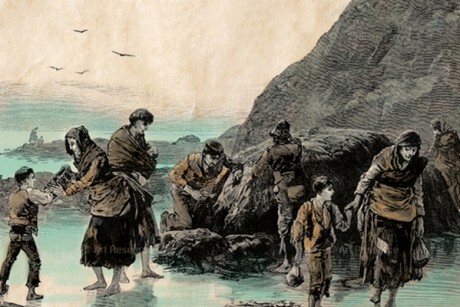
“The Graves Are Walking”: Was the Great Potato Famine a genocide?” (And, let’s rethink “genocide” in general)

20 Aug

“A new book argues that free-market ideology, not murderous intent, killed Ireland’s millions.”  See Salon‘s entire review of the book here.

Some quotes:

“Citing an Irish nationalist author who accused Britain’s Assistant Treasury Secretary Charles Trevelyan of infecting Irish children with a special “typhus poison” in a government laboratory, he writes that the man “should have stuck to the truth. It was incriminating enough.” The story Kelly tells in “The Graves are Walking” is indeed damning, a shameful, bloody blot — and far from the only one — on the history of the British Empire. But calling it a genocide, however satisfying that pitch of moral condemnation may be, only acts to obscure the chilling contemporary relevance of Ireland’s 19th-century agony.”  [my emphasis]

Exactly.  Even if there was “no murderous intent,” it was still criminal.

“Kelly, like most historians, places the brunt of the responsibility for this fiasco on the shoulders of Trevelyan. As the policy leader of the famine response program, Trevelyan was not a Mengele-style mad scientist but a civil servant known for his “unbending moral rectitude and personal intensity.” Unfortunately for the Irish, the faith he embraced was a fusion of Moralism, “an evangelical sect that preached a passionate gospel of self-help” and the laissez-faire economics of Adam Smith and Edmund Burke. At several key points in the evolution of the catastrophe, when strategic intervention might have fended off thousands of deaths, Trevelyan refused, maintaining that there was no greater evil than interfering with market forces. When a subordinate protested, he would send him a copy of Burke’s “Thoughts and Details on Scarcity.”” [my emphases]

See my older post Maybe Germans ARE Scary, my commentary on a borderline Nazi opinion piece that appeared in the New York Times“German Austerity’s Lutheran Core”, in which I argue that Protestantism-s (except for Anglicanism, which grew out of very different historical circumstances and forms of “protest”) aren’t really religions at all but moralist codes, on which capitalism depended for its growth, and for which, whatever transcendent entity their adherents may believe in, serves only as divine confirmation of their righteousness.  It was the aggressive evangelical fervor that swept Methodist, Presbyterian and “low church” Britain in the mid-Victorian age that was perhaps the primary cause of the Indian Rebellion only a decade after the Irish catastrophe (see William Dalrymple’s brilliant The Last Mughal: The Fall of a Dynasty: Delhi, 1857).

“These strategies amount to the 19th-century version of what Naomi Klein has dubbed the “Shock Doctrine”: an attempt to force economic reforms on a population reeling in the aftermath of a disaster.”

Like Germany and southern Europe today?  (Read Klein’s great book: The Shock Doctrine: The Rise of Disaster Capitalism)

“Both sides were ignorant and shortsighted, confident in their stereotypical notion of the irresponsible, fanciful and lazy “Irish character” but oblivious to all the ways that rural subsistence economies cannot be expected to start functioning like England’s more developed agricultural one overnight.”

The classic accusation of laziness in these situations (like against Greeks, who, it turns out — when they had employment — worked more hours than the population of any EU country) is just infuriating.  People don’t work when they don’t have an incentive to, when the technological and political and class restrictions imposed on them limit them to anything more than subsistence or, in the Irish case, even rob them of the means of subsistence.  That the Irish are lazy, man…  To know what work-horses, and I mean that only with great respect and admiration, these Irish kids are, who are coming to New York again in the wake of the Euro-crisis and to even think “lazy”…

Yes, well, not England’s finest hour — though it’s a nation and a people I respect and feel a curiously personal pride in.  And yes, Ireland is outside the borders of the “Jadde” world.  But I love the Irish so much that they’ll keep appearing from time to time and, actually, they’re as much objects of Western imperialism as we are.

But really I’m posting this piece because I think it’s past time that we, in the “Jadde” world, begin some serious discussion on the use of the term “genocide.”  I think it’s getting thrown around much too loosely lately, and that not only disrespects the victims of true genocides, it pariah-fies and unfairly singles out certain groups for vilification (Turks, Serbs) and creates simplistic analyses of complex historical events that then become conventional wisdom, all in ways that makes deeper dialogue between our peoples impossible.  So, we need to talk about it and what “it” really is.


Comment: nikobakos@gmail.com

Where’s Charlemagne When We Need Him?

1 Jul

Huh?

Not the most brilliant thing I’ve read lately but one important, though really flawed, point:

“BY 1900, only two genuine multinational empires remained. One was the Ottoman, which was by then in the process of abandoning its traditional religious toleration for Turkish nationalism and even racism. [A completely, unfair, simplistic and un-historical assessment]  The other was Austria-Hungary, home to 11 major national groups: a paradise in comparison with what it was to become. Its army had 11 official languages, and officers were obliged to address the men in up to four of them.

It wasn’t terribly efficient, but it secured an astonishing degree of loyalty. It also brought rapid economic and cultural progress to an area extending from the Swiss border to what is today western Ukraine. During World War I, Austria-Hungary fielded eight million soldiers commanded by, among others, some 25,000 Jewish reserve officers. Thirty years later, the nation-states that succeeded the empire sent most of the surviving Jewish officers to the gas chambers.”

Unfortunately, the poison of the ethnic-based nation-state ideal had gotten too far by then.  Even the portrait of Austria-Hungary he gives us is completely idealized and existed in the form he describes for less than a century.

(Click above)

How sweet though, to have lived in a world that interesting instead of the stupefying monotony of the modern nation-state.  But that idea is so powerful — no, not because it’s natural and inborn, but because the modern, bureaucratic state was the first with the technical apparatus to impose it on its population(s) — that it deletes all historical files dealing with plurality.  Not a single European tourist who comes to New York fails to make the same comment: “Amazing…all these peoples living together…” and I want to explain that that’s how humanity lived for most of its civilized existence — or just pull my hair out — but I usually don’t bother.

But that reminds me: I do live in a world that “sweet” and “interesting:”

Mr. Deak (Hungarian?) is also wrong on an even more crucial point.  The Ottoman and Austro-Hungarian empires were not the world’s last multi-ethnic states.  There’s still China.  Most of southeast Asia.  And Russia.  And most ex-Soviet republics.  And certain Latin American countries.  And almost all of Africa.  And Syria and Lebanon and Iraq and Iran and Afghanistan and Pakistan and the world’s great wonder, India.  Even Turkey.  (And wherever ethnic nationalism is a problem in those countries it’s based on the Western intellectual model.)  In fact, most of the world still lives in “plural” situations.  Only Europe (and even in Europe there’s Spain and the U.K.), has an issue with this concept, but it seems to be fading even there.  Its last bastion will probably be the growing number of viciously homogenized, ugly little states of Eastern Europe and the Balkans.  Which brings us back to Michael Ignatieff:

“The misery of the Balkans stems in part from a pathetic longing to be good Europeans — that is, to import the West’s murderous ideological fashions.  These fashions proved fatal in the Balkans because national unification could be realized only by ripping apart the plural fabric of Balkan village life in the name of the violent dream of ethnic purity.”

From Blood and Belonging: Journeys into the New Nationalism, Michael Ignatieff


Syrian Christians

13 May

Short Al Jazeera report that follows up and answers some questions I had in previous post: April 23rd, “Turkey and religious freedom: Wooing Christians — ‘We are ready to face the past, to make amends.'”

Christ, I hope they end up on the right historical side of this one.  Not that they may have a choice — as Iraqi Christians didn’t.


Comment: nikobakos@gmail.com

Turkey and religious freedom: Wooing Christians — “We are ready to face the past, to make amends.”

23 Apr

From the Economist:

“IT IS well known that Kurdish tribes took part in the mass slaughter by the Ottomans of around 1m Armenians in 1915. “Collaborating Kurdish clerics pledged that anyone who killed an infidel would be rewarded in heaven with 700 mansions containing 700 rooms, and that in each of these rooms there would be 700 houris to give them pleasure,” says Mala Hadi, an Islamic sheikh in Diyarbakir.

The sheikh is among a handful of local leaders seeking reconciliation with the Kurdish region’s once thriving Christians. “We are ready to face the past, to make amends,” promises Abdullah Demirbas, mayor of Diyarbakir’s ancient Sur district. To atone, Mr Demirbas has been providing money and materials to restore Christian monuments in Sur. These include the sprawling Surp Giragos Armenian Orthodox church where, until recently, drug dealers plied their trade amid piles of rubbish. It is now squeaky clean and even boasts a new roof.”

Here’s a website with some beautiful pictures of the church: http://www.futurereligiousheritage.eu/february-2012-restoration-of-dyarbakir-surp-giragos-armenian-church-dr-f-meral-halifeoglu/ 

This is a story that made me cry — I wish I could say I don’t cry easily.

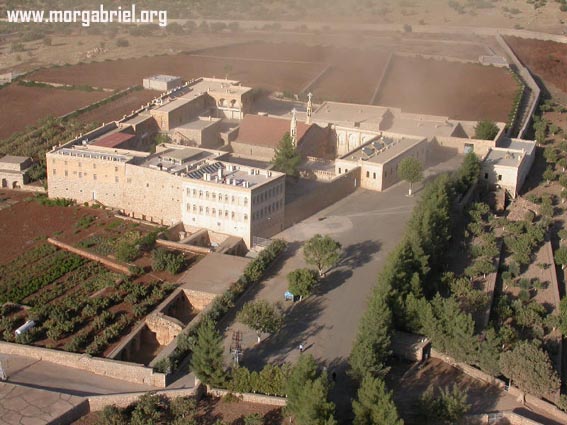
Read the whole story from the Economist here: http://www.economist.com/node/17632939  The story then goes on to talk about relations with the Syrian Christian community in southeastern Turkey, especially the conflict surrounding the Syrian monastery of Mor Gabriel, since the Armenian community that the Kurdish sheikh would like to make amends to has been practically non-existent outside Istanbul for a good century now.  Some photos of Mor Gabriel:

I keep looking for a story — because there’s definitely one there — about Syrian Christians among the refugees flowing into Turkey from Syria.  But there may not be that many, since for the most part they’ve been pretty passive in the whole conflict, nervously afraid of change as all minorities are, and maybe passively siding with the Alawite regime for fear the Sunni resistance will turn religious in ways uncomfortable for them.  And yet Homs and Hama, two of the Assad regime’s most brutalized targets, are among the largest and most ancient Christian communities in the country.  In William Dalrymple’s From the Holy Mountain: A Journey Among the Christians of the Middle East: http://www.amazon.com/From-Holy-Mountain-Journey-Christians/dp/0805061770/ref=sr_1_1?ie=UTF8&qid=1335220105&sr=8-1 he describes the Christians of Syria as the most happy, confident, open, and optimistic about their future of any of the Christian communities of the region, even those that constitute a larger percentage of their country’s population, like those of Lebanon or Egypt (on Lebanon, he has a kind of sensationalist chapter on Maronite “savagery,” which reminds me of a lot of Western journalism about Serbs, or older travel accounts of Albania, and pretty much tows the standard line that if they, Maronites, are on their way out demographically and politically, it’s their own fault.)  That optimism on Syrian Christians’ part must certainly have changed.  And if they were going to flee, it would be to their pretty numerous co-religionists in Turkey, wouldn’t it?

I always wanted to know what percentage of Arabs in southeastern Turkey were Christian and could never find any definitive information on it.  But if there were that many, they probably wouldn’t have to be fighting such an outnumbered battle to protect the property of one of their main religious centers.

Anyway, kudos to the sheikh, Demirbas, and I guess guarded kudos to AK leaders too; I think their concern for issues like this might actually be genuine; I mean Hillary talked about the Chalke seminary when she was in Turkey last and they didn’t freak out.

I have a few acquaintances who would roll their eyes at this post, irritated, along the lines of: “So many people being killed and you’re only concerned about Christians…”  No, I’m not just concerned about Christians.  But — shout out to the MESA thought police — I’m not going to waste any more time arguing my basic non-sectarian ethics either.

As a final note: the great villain here is not Assad, but his prime backer, Vladimir Putin, the last twentieth-century totalitarian dictator of the twenty-first century and a Chekist murderer and Stalinist criminal on all levels.  Be afraid of him — very afraid.  Recent NYRB article about him: http://www.nybooks.com/articles/archives/2012/apr/26/vladimirs-tale/


Comment: nikobakos@gmail.com

The name of this blog

6 Apr

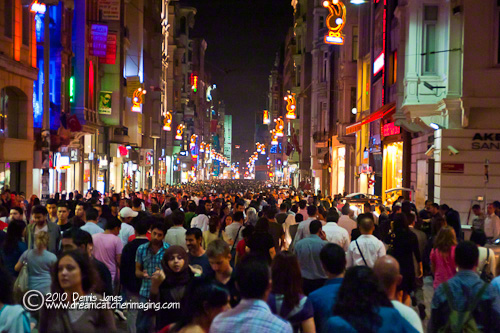
The name of this blog is the old Ottoman name for the main street of the new, ‘European’ side of Istanbul, the part of the City that grew and developed on the northern side of the Golden Horn beginning more or less in the late eighteenth or early nineteenth century, the neighborhood known as Pera or Beyoglu, the Greek Pera reappearing in more and more contexts lately as nostalgia about the city has become a minor industry and cultural phenomenon (Robinson Crusoe, easily one of the coolest bookstores in the world, now refers to itself as a “bookstore in Pera”).  Originally, I was going to confine this blog to Greek and Turkish issues and though that’s changed, I’ve kept the name because it’s the main drag of what – as far as I’m concerned – is still the zone’s keystone city.  I had thought of the street as an appropriately symbolic piece of territory where Greek and Turkish interaction was for a time at its most intense, most claustrophobic, even risky.  But even more, I thought of it as a space that best represents our mutual delusions, lies and hypocrisies.

Greeks think of the Jadde as the Main Street of Greek Istanbul, but neither the neighborhood nor Istanbul itself was ever as demographically Greek as the fantasy has it.  Further, the obvious wealth to which the street’s architecture bears witness always smelled a bit too much to me of nineteenth-century minority pretensions, by which I mean those six or seven post-Tanzimat* decades during which we enjoyed unprecedented access to the Empire’s wealth and financial resources without paying any of the obligations of being part of it; it’s apparently where Greek crowds had become so brazen that they gathered to yell: “Zwa! Zwa!”…”Animals!” at Turkish troops during the Balkan War as they left for the front and the mind-boggling casualties they were to experience there.  It’s also when, as soon as traditional restrictions on church construction were lifted, our new confidence raised up the three ugliest Greek churches ever built in the entire history of Constantinople – quite a feat.  And the palatial embassies of the Great Powers that breathed down the neck of the Ottomans for two hundred years and made those idyllic conditions possible for us still line the street.

Turks in the past couple of decades have spent considerable resources ‘restoring’ the area: the street was pedestrianized at some point in the late eighties I think; they set up a cute retro trolley car that runs down the middle and seems to serve no purpose but to annoy the crowds that have to constantly get out of its way; they’ve put some money into remodeling some buildings.  All of this has come hand in hand with a subtle psychological process running in many urbanized Turks’ minds that has gradually made of the neighborhood a symbol of Istanbul’s historically multi-cultural essence, which in many and moving ways it is.

It’s also where hundreds of  Armenians were murdered in a shockingly urban episode of the Hamidian massacres of 1896**, right there in the middle of all the Belle Epoque elegance and the cafes and the hotels, an event so brilliantly handled in the ‘duck with bamya’ (bamiyeh, bhindi, okra) chapter of Loksandra, and where, in one night of September 1955, every single Greek business on the street (marked beforehand in a perverse, inverted Passover), from Taksim to Tunel, down the Yuksek Kaldirim to Karakoy, along with almost every Greek church and cemetery in the rest of the city, were vandalized or completely destroyed in what turned out, after much bogus blaming and bullshitting, to have been nothing less than a government organized pogrom — pure and simple.  The event was later cynically used as one of the lesser charges brought against Adnan Menderes, the first ever democratically elected Prime Minister of Turkey, who had been in power at the time (‘55), by the military junta that removed him in 1960 and then hanged him and several other members of his government in 1961.  That doesn’t mean he wasn’t guilty of his part in organizing the riots — this, thefirst ever democratically elected Prime Minister of Turkey – he was; that’s just not why the Turkish military hanged him.  He was later exonerated, in fact, and has been semi-canonized since.  The Greek community got bubkes in compensation.  The riots were the beginning of the end, a shocking wake-up call to the complacent sense of security the City’s Greeks had started to feel in Turkey again after the fear and discrimination of the WWII years had passed, and they produced a massive exodus, exacerbated by other measures taken against them in the early sixties, as tensions over Cyprus and the usual tit-for-tat stupidities between the two countries grew.  (One will often hear Greek Polites*** bitterly blame Greek Cypriots for the progressive dissolution of their world, in the sad tones of one irrationally seeking a reason for an unassimilable loss.)  By the late seventies, their numbers had dropped below that point of critical mass that makes the sustaining of a meaningful community life possible: old people waiting to die, young people waiting to move to Greece.  I’m sure Thracian Turks in Greece can identify.

All this unpleasantness is usually excised from the contemporary Turkish nostalgia phenom’.  I remember on my first trips to Turkey as a teenager in the eighties even, often finding myself in the confusing position of being told: “Oh, lots of Greeks used to live around here,” in a smiling and totally sincere attempt at bonding and with a totally blissful indifference or maybe ignorance as to why they didn’t anymore, leaving me feeling both touched and irritated.  Granted, people have become markedly more sophisticated since then.

Anyway…  I could have called this blog the Istiklal Caddesi, which has been the street’s name since the nineteen-twenties and which I’m usually forced to use as well so people know where I’m talking about or don’t think I’m some freaky history nerd, but that would’ve been — no offense — too Republican.  I could have called it He Megale Hodos, but nobody ever really called it that except in the most official contexts (Greeks just called it the Straight Street, ‘Ho Isios Dromos’).  The a la Franca pretensions of la Grande Rue are just as self-evident.  So the old Perso-Ottoman “Great Way,” Jadde-ye Kabir, most fit my gousta and purposes.  Jadde means “street” in Farsi (and in modern Turkish and Arabic too; they’re originally Arabic — both words) but I like “way” because I liked the sort of ironic counterpoint between the great ceremonial routes of the old Imperial city on the other side with this thoroughly bourgeois little avenue.  The “path” too, says my Farsi dictionary, which also had a nice Zen ring.

Istanbul has twice septupled in size since the middle of the last century and Greek life there has faded away into nothing: the City has turned into a gigantic, intractable monstropolis like so many others.  Almost no one in Istanbul is from Istanbul anymore.  Yet this relatively small stretch of one small street still attracts massive daily and nightly crowds.  After a couple of depressed decades caused by the minority exodus, some criminally abusive urban planning projects and the criminal neglect of its architectural heritage, the street and the whole neighborhood have come back into their own again, and then some, in a way that frankly makes me so giddily proud and happy whenever I’m in C-town that any of the past’s bitterness just vanishes — it’s ok it’s not “ours” anymore; it’s still mine.  It’s perhaps the most instant snapshot one can get of Turkey’s current cultural dynamism, sophistication, prosperity, and growing freedom – in however tricky a state that freedom still may be.  Despite the clubs and malls of the northern or Asian suburbs, and despite the even more endless suburbs beyond them, inhabited by Anatolian migrants who may have never even seen it, the Jadde still gives the impression of being the default destination of any Istanbullu who’s meeting friends, looking to consume an urban pleasure of some kind, or just has nowhere else to go or anything else to do.  It’s a delicious, overwhelming mix of commercial crassness, elegance, sexiness, good music, cool bookstores, garbage and great food: an Eastern flaneur’s paradise.  In fact, aside from the Nevsky in Petersburg, I can think of no one street in which one can read so much of a great metropolis’ experience of modern urbanity as the Jadde.  It’s one of my favorite places on earth.

— For C., Istanbul, 2010

*Tanzimat: the “reforms” I think…or the “new order” maybe.  I don’t know if it refers to the actual beginning or the whole long nineteenth-century process; the response to the barrage of external and internal problems faced by the Ottoman Empire starting in the late eighteenth century: the interference of Western power interests and extortion; the loss of Balkan and Black Sea territories and the non-stop influx of refugees from those areas; the rise of local warlords (like Ali Pasha of Jiannena) who controlled large fiefdoms that were practically independent of Constantinople; an attempt to modernize the army in an attempt to recentralize things; the attempt to enfranchise the non-Muslim minorities (who didn’t, however, give up their nationalist aspirations in return) without totally freaking out the Muslim clerical establishment; a new constitution at some point, which was then suspended by Abdul Hamid, etc., etc.  Here, read about it yourselves: Tanzimat  The politics of the period are so torturously complex that no matter how much I read, I still can’t grasp the entire process.  I can’t remember which Sultan was pro-reform and which anti and which tried to take a middle path, except for A.H., who was eventually proven to be fairly undemocratic and a bit of a paranoid nut but was responsible for some impressive modernization projects anyway.  I don’t know when or how the Young Ottomans morphed into the Young Turks or who belonged to which group.

I know that it was all a titanic, often heroic, struggle to turn the Empire into a modern state.  I know there was a half-sincere, but belated and pathetic attempt to create a sense of “Ottomaness” among all its subjects/citizens; I won’t be the first one to make the comparison to Hapsburg Austria.  I know that when the constitution was restored in 1908, a year before Abdul Hamid was finally deposed,  there are stories — way too many, frankly, to be believable – of men of all ethnicities and imams and priests embracing in the streets of cities throughout the Empire in the spirit of their new found Ottoman brotherhood.  Then just five years later, in 1912, Greece, Bulgaria and Serbia joined forces and effectively ended what was left of the Ottoman presence in the Balkans and the Turks decided: “Well, fuck this…” and started concentrating on building a modern Turkish nation-state for Turks just like everyone else was doing for themselves.  And the rest, as they say…

It’s an important period for Greeks to know about because it puts into perspective the fact that our influence and wealth in nineteenth-century Turkey was not just due to our diligence and ingenuity and brilliance — to daimonio tes fyles — but also because we were operating in a host body weakened by daunting, almost insurmountable challenges, both internal and external.

** In August of 1896, a group of Dashnaks, an Armenian independence group, took hostages at the Ottoman Bank in Karakoy – I can’t remember what their demands were — and I think set off some grenades or something.  The Pera murders were a response to this, though violence against Armenians and inter-communal violence between Armenians and Muslims, especially in the southeast, had been growing exponentially in the months and years beforehand, all during the reign of Abdul Hamid (“Ho adikiorismenos,” as Loksandra would call him), hence “Hamidian.”

*** Greeks will often refer to Constantinople as “The City” “He Pole” – since it goes without saying which city one means.  “Polites” then are Greeks from The City.

Comment: nikobakos@gmail.com