
“The Ashta-Nayika is a collective name for eight types of nayikas or heroines as classified by Bharata in his Sanskrit treatise on performing arts – Natya Shastra. The eight nayikas represent eight different states (avastha) in relationship to her hero or nayaka.[1] As archetypal states of the romantic heroine, it has been used as theme in Indian painting, literature, sculpture as well as Indian classical dance and music.”


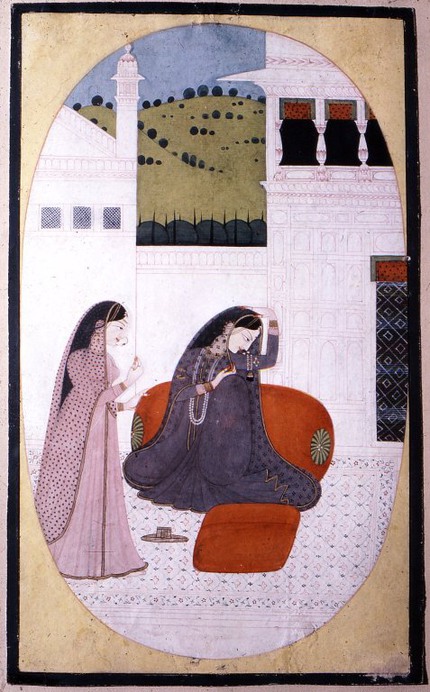
The full taxonomy below. Assuming that Krishna and Radha come up very often as models for each of these erotic-psychic states, since their love manifests itself in almost every conceivable amorous form, from the most divine and exalted states of theosis, to the most delightfully petty states of betrayal, jealousy, spite, vengeance, longing and depressed insomnia, especially in the Gita Govinda. See also: Radha-Krishna.
| 1 | Vasakasajja Nayika | वासकसज्जा नायिका | One dressed up for union |
| 2 | Virahotkanthita Nayika | विरहोत्कंठिता नायिका | One distressed by separation |
| 3 | Svadhinabhartruka Nayika | स्वाधीनभर्तृका नायिका | One having her husband in subjection |
| 4 | Kalahantarita Nayika | कलहांतरिता नायिका | One separated by quarrel |
| 5 | Khandita Nayika | खंडिता नायिका | One enraged with her lover |
| 6 | Vipralabdha Nayika | विप्रलब्धा नायिका | One deceived by her lover |
| 7 | Proshitabhartruka Nayika | प्रोषितभर्तृका नायिका | One with a sojourning husband |
| 8 | Abhisarika Nayika | अभिसारिका नायिका | One going to meet her lover |
One of the most fun moments in the Gita Govinda is when Radha, suffering from Krishna’s sleep-around indiscretions with the gopis, the cow girls of Vrindavan, finds the strength to blow off Krishna, and immediately gets “hand” in the relationship, as we used to say, leaving the young prince-god stressed out, depressed and insomnia-plagued. Who hasn’t known the sweet pleasure of successfully turning the tables on somebody you’re involved with like that? “I care nothing for your sufferings.“ as Heathcliff (or is it Catherine?) says in Wuthering Heights; or at least I’ll pretend that I don’t care. Then they reconcile and engage in some raunch-lite love, complete with bloody scratch marks on backs and bights and sloppy kisses… Great stuff, especially when we remember that this handsome young lover with a lover in his arms who’s salivating on his already sweaty, saffron-smeared chest is a manifestation of God himself, or, as the other …Gita tells us, the Very Principle of Existence Itself: “I am the taste of water.”
“And that, Charlie Brown, is what [Hindusim] is all about.”


*********************************************************************************************************
Write us: with comments or observations, or to be put on our mailing list or to be taken off our mailing list — at nikobakos@gmail.com.

 Jadde: from Bosnia to Bengal