Tag Archives: European Union

GREEK ELECTIONS: “Greek voters may be about to plunge the European Union into a full-fledged economic and political crisis.” For real?

21 Jan

Greek parliament

Don’t look to me for economic analyses. I think I had had my first credit card in college for a while, before I realized that the amount you paid back to them was more than what you bought with them. That means credit and debt – the foundations of Western Civilization – were things I didn’t understand until like my mid-twenties. So as far as economics are concerned, I generally listen as carefully as I can to those who seem remotely intelligent to me and weigh what I can gather.

Greece is shaking up the Eurozone again, because parliament couldn’t vote for a President, I believe, and parliament was dissolved and now we’re having elections on January 25th. And everyone, or many people, are trembling at the thought of a SYRIZA, the left-of-center party, victory. I don’t know why they chose to call themselves by an acronym that means “The Coalition of the Radical Left.” Paranoiacs who talk about them as if they were Bolsheviks are already crazed enough in their attacks on the party, and SYRIZA really is, just that, a left-of-center-party. They only seem radical because the “center” – in Greece and everywhere – has moved so far to the right in every sense for the past few decades.

People in Greece whose intellects I respect think that a SYRIZA government – since they are in the lead in polls – would be a disaster: they think the best route for getting Greece out of its economic stagnation is to continue to follow the austerity dictates of the so-called “Troika” — the European Commission (EC), the International Monetary Fund (IMF), and the European Central Bank (ECB) – though Greece has followed them pretty much to the letter and steadily for the past two years, and there are more rounds of austerity coming, and little has improved. And if I ask them the more theoretical question of why Greeks should keep voting for the PASOK/ND two-party clique whose politicians have run the show since 1974 and are a bunch of almost Putinesque cronies in their brazen, shameless corruption and who got the country in the mess it’s in in the first place, they really don’t have an answer for me. One says he just doesn’t vote at all. But how fast a way is that for turning Greece into an American kind of politics-less civil society – which should be an oxymoron.

But I have reason to think that some of the people I listen to in Greece are listening to their class interests – worse, their class instincts, in the most knee-jerk sense – so I also try to listen to Americans I respect: like and especially Paul Krugman. I’ve cited him on this blog often, especially in reference to France – a country which I care about deeply – and he’s a vociferous critic of the EU’s austerity policies towards its prodigal southern and Celtic brothers. He points out that the economy of France, to speak about the center for a moment and not the perhaps hopeless periphery, and how much better it’s doing on every indicator than even Britain itself, precisely for sticking to some of its old-fashioned, socialized (not “socialist”) ideology. And to how much better the United States is doing, because, fairly or not, it sent a fresh flush of cash into its finance industry (instead of setting up a guillotine on Wall and Broad, which would’ve been my instinct) and now is probably the first major economy to have more or less dragged itself out of the hole. He’s written e-n-d-l-e-s-s-l-y about how the Great American Depression was on the verge of ending in 1936, when the government decided to “tighten belts” again and plunged the country back into the deepest economic slump ever in 1937, until it changed policies and then WWII spending ultimately saved it. And he sees the lag in Europe’s recovery, include the euro’s precipitous plunge to near one-to-one parity with the dollar, as the result — and purely — of moralizing and moralist, German-guided, insistence on austerity.

But as far as Greece goes, all the fear-mongers have brought out their heavy artillery. Maybe because I am such an economic illiterate, I recognize the psychological poker game involved in economics so much more clearly than others may. It’s amazing how the “Masters of the Universe” – these Alpha-Male studs that run our world in ways we’re too stupid to understand, because as it turns out, they don’t really understand them either – suddenly become menacing thugs or henny-penny pussies, alternating between the two, as soon as the width of their profit margins is even slightly threatened. This may be more an American problem than a European one, but I think it is what’s going on with Greece, the prospects of a SYRIZA victory and the discourse it’s generated. “Disaster” will follow. “Germans are ready to let Greece leave the Eurozone.” Frau Merkel dusts off her Lutheran-Communist pastor daddy’s sermons, and like the Biskop in Bergman’s “Fanny and Alexander,” threatens fire and brimstone if Greece does not “koopereit.” “You must pay us,” say the lenders, “or it will be a disaster for all of us.” “We can’t…and won’t” say the borrowers, “and actually it will only be a disaster for you. You’ve already pushed us into a corner where we don’t have anything to lose, so…what are you going to do about that? Send us to debtors prison?” Hmmm…? Then what?

I’ve called the European Union “a neo-colonialist body disguised as the Highest Form of Western Humanism Project” before. And I can’t speak for Spain or Portugal or Ireland. But what I see the Union doing in Greece is engaging in the systematic destruction of a small economy.* By “small economy” I don’t mean a small territory of ten million with limited resources and a small-scale GDP. It’s a given that that’s what Greece always was. What I mean is a society of small-scale, personal, economic units. Some may balk at this idea, but I’m talking about something that’s one of the most positive aspects of our Ottoman inheritance. Late Byzantium was moving toward a system of large-scale landowners with an increasingly enserfed population – whether it was an organic development or the influence of Frankish feudalism is a big question. The fact, though, is that this process was arrested by Ottoman systems of land tenure and the block those systems put on the development of a landed, inherited aristocracy. And then in the twentieth century, Greece was the only former Ottoman country lucky enough to not have that small-scale type economy disrupted and perverted by the experiments of communism or even the economically statist policies that came to dominate Republican Turkey itself.

Why am I going so far back in history to talk about Greek elections in 2015? Because you might have to look that far back to see why we were spared the experiences of a large landless peasantry that could then be turned into a disenfranchised industrial proletariat – to a great extent at least; yes, there was Thessaly and there was Laurio, but nothing like what Western Europe or Russia experienced. The Greek entered modernity armed with few advantages, but one was a widespread public education system of fairly high standard for a country of its resources, the roots of which were already well-established in Ottoman times and put into systematic place almost immediately after independence. And the other was that, generally, he did so as an economically independent entity. A small-scale free peasant. A middle-class owner of some property. A “nation of shopkeepers,” as Napoleon condescendingly (and inaccurately) said of Britain. And all the better for it. Not even the sweeping flood of refugees from the Population Exchange of the 1920s with Turkey, which involved the absorption of an almost 30% increase in our population in less than five years; not even the tragic depopulation of rural Greece in the 1950s — for all its economic and military reasons — and the hideous Athens it created; neither of those massive sociological transformations changed the average Greek citizen from what he was: a free and reasonably independent economic agent of his own destiny.

THIS is what the “memoranda” are trying, and will succeed if allowed — if they already haven’t actually — in destroying. The tax on home-ownership and personal real estate is what I consider the most heinous and symbolic, even if it’s not the issue most Greeks are likely to get rabid about. Don’t ask me how: maybe the beauty of Athens had to be sacrificed to the πολυκατοικία, the apartment houses that I’ve called “cement-caves” where most Athenians and other Greek city-dwellers live, to create the domestic structure of Neo-Greek society. But what did emerge from the process of post-war Greek urbanization was a country where most people owned their own homes, and where – to a certain extent – a vertical version of traditional society was maintained. Relatives lived near each other, often in the same building, and though during the heady credit-backed lifestyle of the nineties it was common among Neo-Greeks to mock themselves for such domestic arrangements – grandma, or worse, your in-laws, living upstairs, and thirty-something-year-old kids living with their parents – I can’t tell you how many people I’ve seen having come to rely on precisely those networks to survive the present crisis…and actually did back then even, before things got bad, as well: a mother-in-law that will take care of the children while mom’s working and have lunch ready by mid-afternoon for the family to share together; a sister-in-law with whom you can move in for an indeterminate amount of time till you’ve found a job again; networks that extend back to one’s ancestral village, where some lone, remnant relative has some olive trees for oil or some animals for cheese or just a bostani that can provide you with some tomatoes or cucumbers or some apricots that provide you with some jam. I remarked to others on how more civil and warm people in the public sphere seemed to be towards each other the last time I was in Greece, on what a, perhaps silent, but palpable, sense of greater solidarity people seemed to feel for one another and I got a dose of that almost instinctive Greek cynicism from most: “You’re romanticizing”… “Yeah, try going downtown during the midday rush…” But I also was witness, in a very memorable conversation, to one of those cynics getting dressed down by someone else: “Μη το λες…μερικοί έχουν βρει το φιλότιμό τους…” “Don’t say that so easily. A lot of people have found their sense of honor again.”

“Honor” is a bad translation for “φιλότιμo,” which means honor and amour propre and sense of dignity and reciprocity, all in one complex structure of emotions and social acts. Basically, “philotimo” is the sense of self-respect that’s intimately tied up with the upholding of your obligations to others that held Greeks together for centuries. All readers here know I’m a fanatic opponent of reading Classicizing virtues – or Classical anything — into Neo-Greek society, but the importance of “philotimo,” I feel, even if just discursive, even if only in its lapses, is a millennia-long constant.

The reader may be excused in thinking I’ve strayed from a basic issue of economics to an excavation of Greek cultural morals. And the truth is that I’m feeling kind of challenged right now in tying together the threads of where I’ve ended up with those I started with.

Well, here then: it’s those patterns of economic independence and the traditional bonds of morality that supported them that the Troika is determined to destroy. The Greek civil sector was not particularly bloated, not even compared with France, for example, which is my prime model for a life well-lived. And if it employed more people than it actually needed, let’s stop talking, like some are, as if it were a civil sector along Soviet lines: “They pretend to pay us and we pretend to work.” The Greek worker actually worked more hours than anyone in any industrialized country but South Korea – South Korea. Not efficient? Efficient for what and to what purpose? For the surpluses the Greek or other governments should enjoy? Since when is the state a business that has to pull in big profit margins and not primarily a structure for meeting the needs of its citizens? The same for the cutting of pensions that allowed older people to live in dignity and even help younger members of the family and have now been slashed by the Troika dictates? Really? Why? For whom?

And then on top of it all to tax people’s homes… We’re used to it in the United States, but I can’t convey what a sense of shock, and rightly so, this caused among Greeks – and even me. You’re going to tax me on the one roof I have over my head, the one thing I’m sure of, the one thing that I can grab at for some form of security, even if it’s Karagözi’s corrugated tin çandiri?
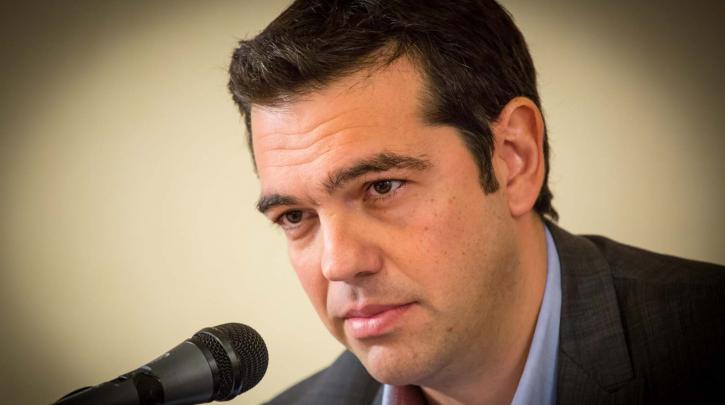
alexis-tsipras-neo-cvg-cvfvAlexis Tsipras

But let better minds than mine explain. This is an interview that Costas Lapavitsas recently gave a rather lame and argument-less Stephen John Sackur on the BBC’s Hardtalk. Lapavitsas is an economist, a graduate of the London School of Economics, a professor at the University of London and a columnist for The Guardian. He has the kind of intellectual confidence, articulateness and steel-trap mind that is — not just super-sexy — but is the gift of a certain kind of Greek who makes me immensely proud.  He’s an advisor for SYRIZA and I’m sure he’s detested by the party’s opponents because they can’t dismiss him as a childish, bratty demagogue the way they can dismiss Alexis Tsipras (above), the party’s actual leader, about whom I, too, have mixed feelings. There’s the BBC interview and then if you have the patience there are another interview and two longer lectures of his that get into stuff much more deeply.


He’s compelling…and smart…and not afraid of the truth. He makes the argument for what was always the small-scale of Greek economics: that it was never a country that lived off of large-scale foreign investment, that like I stated above, it never had a large “alienated proletariat” waiting for foreign industries to come and employ – exploit — which is precisely what the European Union wants to do to all of its southern periphery. He’s realistic; he was for exiting the Eurozone back in 2011-12, but admits it’s unfeasible now. He calmly listens to interviewer Sackur pose the smuggest kind of conventional wisdom, “but, surely…” questions, and without skipping a beat, says: “No..” and proceeds to demolish him. (His response to Sackur’s attempt to use Ireland as an example in his argument is not only point-on, but historically poignant, personally moving to me as a Queens boy, and a really satisfying little slap in the Brit’s face.**) He sees his Greece as the humanitarian disaster it has become, with a GDP that has fallen 25%, 50% youth unemployment and 25% overall unemployment, skyrocketing suicide rates and other rates of psychological diseases such as acute depression.  He says that it has moved beyond melt-down into what he calls “permafrost” and a stone from which no more blood can be drawn.*** He sees high, macroeconomic finance for the poker game it is: like I said – again – a game in which those who hold the reins of power alternately disseminate panic or fear in an intentionally self-fulfilling prophecy; and that those people are bullies, who will probably back down from their demands if a critical mass refuses to be bullied by them.

The point is building that critical mass.  And I thought I could vote in Greek elections for the first time this Sunday, but there are no consular elections for ex-pats possible with Greece as there is for a multitude of other countries — typical…  But if I could vote, I know who I’d be voting for.

Comment: nikobakos@gmail.com

**************************************************************************************************************************************************************************

* Tangentially but, I think, not in the least irrelevant to this post…  One of the starkest lessons in geopolitics and political economy I was ever taught was when I started teaching English as a Second Language in New York’s CUNY system and realized that my Latin American students weren’t destitute, landless peasants from the Guatemalan highlands or Caracas slum-dwellers.  They were well-educated teachers, accountants, civil servants, small business owners…  They were part of a sizeable but fragile urban middle-class that the Neo-Liberalism applied to many South American economies in the ’80s trapped in a vice, and forced out into emigration.  And that’s what’s happening in countries like Greece and Spain and Ireland today.

** Meaning, that given the history of the British in Ireland, it’s a bit rich for an Englishman to be using that country as an example of “recovery.”  Yeah, Ireland is doing better.  Better because the tragic full-scale emigration of its youth has started again — something you can’t miss all around you in New York and especially in Queens — the continuation of a demographic catastrophe which first started when Great Britain practically depopulated the island by ripping apart the fabric of the Irish economy, its people and its civilization in the nineteenth century, with policies based on a moralizing, racist, Protestant set of arguments that are remarkably similar to those that Frau Merkel likes to spout about the European South today. And Lapavitsas makes that abundantly clear to him.  Plus Sackur’s whole fussy, donnish demeanor and Oxbridge accent make him so the perfect dude to cast if you need a target Englishman that you almost feel sorry for him; if I were him I’d need a drink after that interview.  See my: “The Graves Are Walking”: Was the Great Potato Famine a genocide?”  

And when I say “Protestant” in contexts like this, you can be sure — as per Weber — that I mean capitalist, for which most mainstream White Protestantism and its moral codes  — again, as per Weber (maybe a bit exaggerated) — is simply a front.

*** Or the homier example of Nasreddin Hoca and his donkey might make things clearer: Merkel, Spain, Greece and Nasreddin’s donkey

karikat__r_tan_oral

Comment: nikobakos@gmail.com

“Greece, though, has gotten nothing but fiscal and monetary tightening.”

17 Nov

Greece Is Growing

Nov 17 2014 @ 5:22pm

Greece

Finally:

Greece’s crisis-stricken economy has returned to growth following six years of recession, official data showed Friday, marking an end to one of the steepest and longest economic contractions in postwar European history.

But Matt O’Brien warns that “Greece’s comeback, like its collapse, will be nasty, brutish, and long”:

Greece’s depression … is still nowhere near done. You can see that easily enough in the chart above, which I’ve modified from The Economist. It compares Greece the past few years with what used to be the gold standard of economic catastrophe: the U.S. during the Great Depression. Now, Greece’s economy fell marginally less than America’s did back then — around 27 percent at its worst — but the biggest difference between the two is the slope of the recovery. The U.S., as you can see, rocketed back once FDR devalued the dollar and started spending more. Only the double whammy of premature fiscal and monetarytightening knocked it off track in 1937.

Greece, though, has gotten nothing but fiscal and monetary tightening.

Comment: nikobakos@gmail.com

Catalonia: “Nationalism effaces the individual…”

7 Nov

…fuels imaginary grievances and rejects solidarity. It divides and discriminates. And it defies the essence of democracy: respect for diversity. Complex identities are a key feature of modern society. [my emphasis] Spain is no exception.”

A brilliant op-ed piece from the Times today by Mario Vargas LLosa, among others, that exposes all the petty narcissism and destructiveness of the orgy of separatist movements that Europe has seen come to the fore in the past few decades: A Threat to Spanish Democracy .”

Catalunya+Prov+EnglishOther money quotes:

“In their attempt to undermine the workings of the constitutional government, Catalan separatists have displayed a remarkable indifference to historical truth. Catalonia was never an independent state. It was never subjected to conquest. And it is not the victim of an authoritarian regime. As a part of the crown of Aragon and later in its own right, Catalonia contributed decisively to making Spain what it has been for over three centuries: an impressive attempt to reconcile unity and diversity — a pioneering effort to integrate different cultures, languages and traditions into a single viable political community.

“Compared with the crises occasioned by the collapse of dictatorships in many European states, Spain’s transition to democracy, following the 1975 death of Francisco Franco, was exemplary, resulting in a democratic constitution granting broad powers to Spain’s autonomous regions. Yet Catalan separatists have glossed over the positive aspects of the transition.”

and:

“But the advent of democracy brought official recognition to Spain’s distinctive cultures, and set the foundations for the autonomy the Catalans enjoy today. Catalonia has its own official language, its own government, its own police force. Catalans endorsed the Constitution overwhelmingly: 90 percent of them voted yes in the referendum of Dec. 6, 1978. The millions of tourists who flock to Barcelona every year, drawn by the beguiling blend of Gothic and Gaudí, attest to the vigor of Catalonia’s culture. The claim that Catalonia’s personality is being stifled and its freedoms oppressed is simply untrue.”

The piece pretty much says it all: the bogus democraticness of separatist rights and the supposed right to self-determination completely debunked as nothing more than “little” nationalisms, which as Vassily Grossman points out in this post …the nationalism of little nations,” can be just as dangerous and certainly as small-minded as that of “bigger” nationalisms.  Ditto this op-ed for Abkhazia, South Ossetia, Ukraine (both sides), for Belgium, Scotland and, of course, for the most nightmarish manifestation of these tendencies in our time, the tragic break-up of Yugoslavia.  And that’s without even going as far back as the Partition of India, or the Greco-Turkish Population Exchange of the 1920s.

“Complex identities are a key feature of modern society.”  No, no and no…  Complex identities are not just a key feature of modern society, but humanity period, a feature of pre-modern society since the beginning of time.  The roughly two centuries of modernity or “the modern,” which we can probably date from the French Revolution on, is the only period in history when the ethnicity-based nation-state and its brutal, levelling, anti-humanist attempt to “de-complicate” human identity held sway as the predominant form of sociopolitical organization.  It’s just a blip on the screen of history and will soon come to be seen as such.  Multiple cultural identities and stable state political organization can co-exist easily.  Thinking otherwise is an idea whose burial is long overdue.

So, what irritates me most about separatist movements like that of the Catalans is that they’re really retrograde ideologies disguised as liberation movements.  Since the Barcelona Olympics of 1992, when the autonomous Catalan government had the impudence, I remember, to plaster New York City subway cars with ads that read “Catalonia is a country in Spain,” (???) Catalans have been engaged in a massive public relations campaign to project an image of sophistication, liberalism, bogus hipness, and artistic innovation (including culinary — if you can actually call the molecular nonsense Ferran Adrià put out food…) all meant to be juxtaposed against a clichéd, “Black Legend” stereotype of Spain — under whose repression Catalonia suffers — that’s just plain racist. Catalan nationalism rests mostly on the laurels of its Republican-ness and struggle against the forces of Spanish reaction in the 1930s — Hemmingway and Orwell’s “Homage.”  But the attitude of today’s average Catalan nationalist more resembles that of the average member of Italy’s Northern League, a far-right if not quite fascist but certainly racist bunch of jerks: the same smug sense of superiority towards their co-citizens and the same petit bourgeois self-righteousness about how their wealth and resources get sucked up by the parasitic rest of the country.

There is no convincing evidence that Catalan society is any more liberal or open or sophisticated than the rest of Spain.  See González Iñárritus film “Biutiful” (if you can bear to watch it; I couldn’t make it though a second viewing…but it’s the perfect antidote to Woody Allen’s nauseating “Vicky, Cristina, Barcelona”), for how much better Catalonia treats its immigrants, for example, including those from poorer parts of Spain, than any other part of Europe, or do some reading up on the discrimination Castillian-speakers in Catalonia suffer.  Catalan independence is not a liberal or liberatory idea; it’s exclusionary and elitist to the core.  The problem is that most of the world falls for the discourses of these movements –the way the West did with Croatia in the 90s — because they’re so good at playing victim.

The finger-flipping at the impressive democratic achievements of Spanish society since 1975 is particularly galling.

See also my Leader of Catalonia Calls for Independence Vote (September 27th).  And  More on Alevis and Alawites…or Alevis and Kurds…or Iraqi Kurds…or…Christian Kurds…or Assyrians…or… (September 27th)


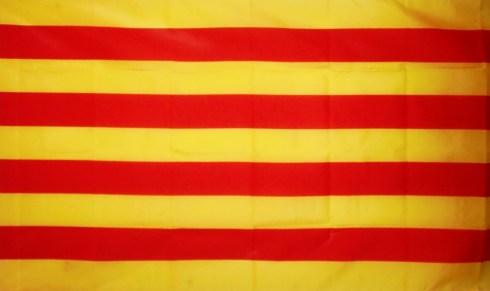
catalonia-5-x-3-flag-3475-p

Comment: nikobakos@gmail.com

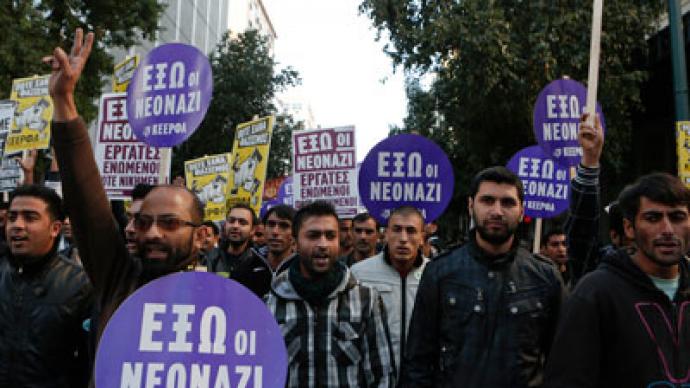
Συγχαρητήρια! Congratulations! for trumpetting Al Jazeera headline: “Greece, a front line for state-sponsored racism in Europe”

29 Sep

“…a front line for state-sponsored racism in Europe.”

Are you proud of yourselves?  Και εις ανώτερα!

immigrants-19-banners-athens.si(Reuters/Yorgos Karahalis)

“Once the cradle of European civilization, Athens is now the center of a continental decivilizing process.”  See whole article .

And I want to make sure you all know my heartfelt congratulations go out to all and every one of you, every inhabitant of the statelet that’s sat by silently doing and saying nothing all these years as this ugliness built up its now seemingly unstoppable momentum.  And instead are worried about whether Albanian genes will show up on your DNA chart

Comment: nikobakos@gmail.com


“Leader of Catalonia Calls for Independence Vote”

27 Sep

From The New York Times:  Leader of Catalonia Calls for Independence Vote

Cataluña.svg(click)

Oh well, you know what?  Good riddance!

See my very personal and rather emotional feelings about Catalans in “Why I can’t stand watching Rafael Nadal win“:

I have a serious repellent reflex towards Catalans. This is largely because I love Spain so much, and their anti-Spanishness really gets my goat. I find their Gallic delusions that they’re so much more European and Mediterranean and civilized than the rest of Spain to be insufferable. (And some day I’ll get around to dismantling the cult of “Mediterranean-ness” itself that’s grown since the 1980s and that I find a completely false and fabricated pop-multi-culti identity that grew out of tourist literature, the public relations campaigns of olive oil companies and a popular sprinkling of Braudel, and nothing else. When even Turks start acting and feeling like they’re “Mediterraneans,” you know that a discourse is b.s. and needs to be taken apart; the extremeness of the hype surrounding Barcelona is part of this, and is why I love the gravitas and even crudeness of Madrid and Castille so much more deeply.)  I find Catalans’ ‘noli me tangere’ squeamishness about how they shouldn’t have to suffer by being a part of this barbaric country of monarcho-fascists and Catholics and gypsies and bull-torturers to be racist pure and simple. They’re Iberian Croatians, in short. There are plenty out there who will get the analogy, I believe.

That’s essentially what it comes down to…because I think I should finally get serious about this issue and not just joke around or make bitchy remarks about Nadal’s hair.  All of us on the periphery, and yes you can include Spain, struggle to define ourselves and maintain an identity against the enormous centripetal power of the center.  So when one of us — Catalans, Croatians, Neo-Greeks — latches onto something — usually some totally imaginary construct — that they think puts them a notch above their neighbors on the periphery and will get them a privileged relationship to the center, I find it pandering and irritating and in many cases, “racist pure and simple.”  It’s a kind of Uncle-Tom-ism that damages the rest of us: damages our chances to define ourselves independent of the center, and damages a healthy, balanced understanding of our self culturally and historically and ideologically and spiritually.  I find it sickening.

Spain — in part because it’s felt it had to compensate for the darker elements of its past — has transformed itself in just a few decades, and in a way I find extremely moving and mature, into perhaps one of the most progressive countries in Europe on a whole range of moral and social issues and especially in being open to regional autonomy and regional, cultural rights.  There is no way you can’t be happily and solidly Catalan, and maintain your culture and language to the fullest degree, within the Spanish state.  Objections are nonsense.

But they had already lost me when they banned bullfighting.

People have written to me that Catalonia leaving will hurt Spain economically.  Maybe.  But we’re not going to beg them either.  So good-bye.  And that’s my “Homage to Catalonia.”

(And then there are the Basques.  Do you know how many inhabitants of the Basque regions of Spain who identify as Basque actually speak the language?  Some 18%!  And yet, this practically identity-less identity has been the motivation for decades of violence and terror.  There’s no more twisted example of post-modern identity foolishness than I can think of.  A violent political struggle to save a museum culture.  When 50% of you have bothered to actually learn the devilishly difficult language you’re so proud of, then go ahead and engage in any kind of separatist resistance — violent or non — that you feel like.)

And I’m just sick to death, generally — in a globalizing world — of childish, whiny separatist movements among every two-bit tribe that thinks it’s special.  A waste of time, energy, often a cause for completely unnecessary violence and deafeningly narcissistic.

Comment: nikobakos@gmail.com

Fixing the “mistake…” Joining Europe… Doesn’t this sound familiar?

16 Sep

“We are fixing the 350-year old mistake — Ukraine is Europe,” Arseniy Yatsenuk, the prime minister, told the Parliament, known as the Rada.

From a Times article today — Ukraine Moves to Strengthen Ties With Europe, and Bolster Truce — about the Ukrainian parliament passing “a series of laws…meant to cement the country’s Western orientation while strengthening its truce with pro-Russian separatists in the southeast.”

Being considered on the inside of the bounds of European civilization is not just what every civilized nation should aspire to, but being in a position external to Europe was always a “mistake” — a misconception, we really are and always were Europeans — and now we’re righting that misconception.  Nationalism is always creating new fictions that it passes off as the restoration of a pre-Fall condition.  And everybody buys it.

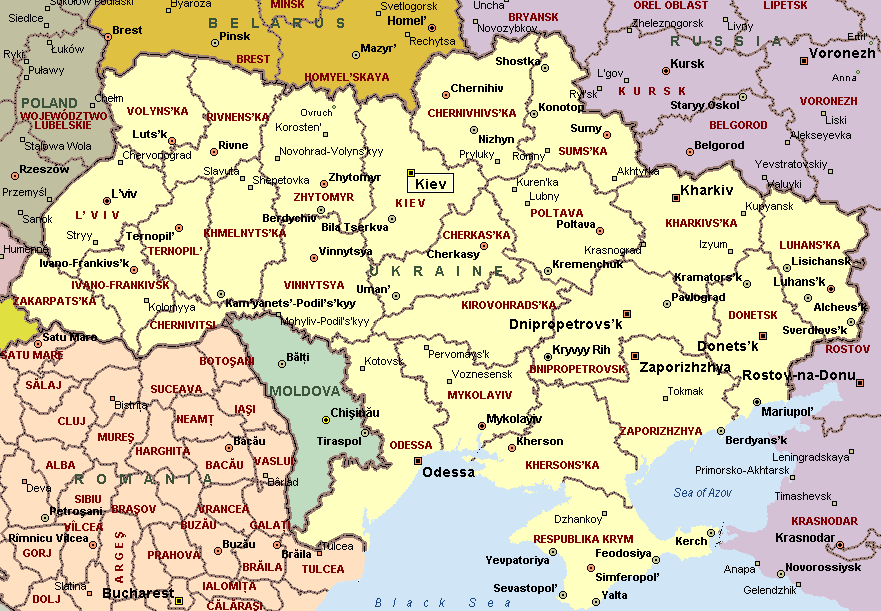
Go to Donetsk or Luhansk, go to Dnepropetrovsk…or Khar’kov or Poltava even, and tell me you feel like you’re in a place that even remotely resembles what you call or think of as Europe!

UkraineMap

(click)

Comment: nikobakos@gmail.com

Life as an Illegal Immigrant in Greece — from VICE

16 Sep

Or what the Messenger would call my “aiding and abetting the enemies of our Fatherland.”

A great video piece done this past spring by that increasingly brilliant outlet, Vice.

Felt proud, though, at the number of intelligent, articulate, compassionate Greeks who appear in the video taking a stand against this deplorable situation and not indulging in the usual apologetics that have unfortunately become the Neo-Greek man-on-the-street’s default discourse: “We can’t afford to have these people here …Golden Dawn helps the people, etc.”  Or this one from the Messenger: “If that percentage of immigrants had descended on the United States all of a sudden, wouldn’t the Ku Klux Klan be voted into office the next day?”  Errr…no.  It wouldn’t.  A classic piece of simplistic knee-jerk anti-Americanism touched with his own brand of fascism-lite.

 “Greece has always been a gateway for immigrants searching for what they assumed would be a better life in Europe. But many of those who have crossed illegally into Greece have found that they have traded one bad situation for another. Refugees from war-torn countries like Syria and Afghanistan are finding themselves stuck in a country that is not only battling an economic crisis but is witnessing a rise in anti-immigrant violence—exemplified by the a nationalist political party known as the Golden Dawn.

VICE News’ Alex Miller travelled from Athens to the western port of Patras to find out what it is like to be trapped in a country you never wanted to be in in the first place.”

Comment: nikobakos@gmail.com

Montenegro: Baptized in the Tara

2 May

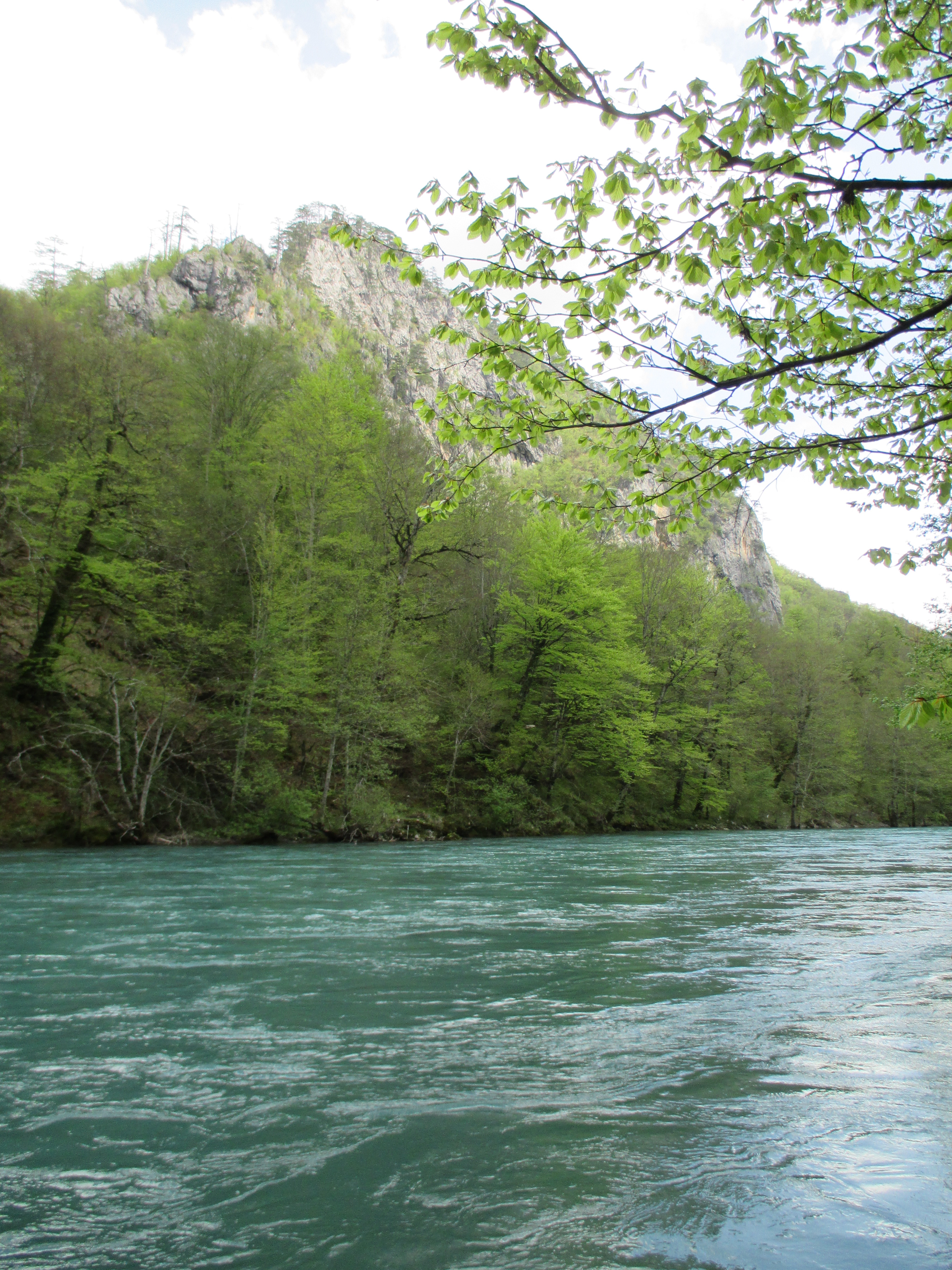
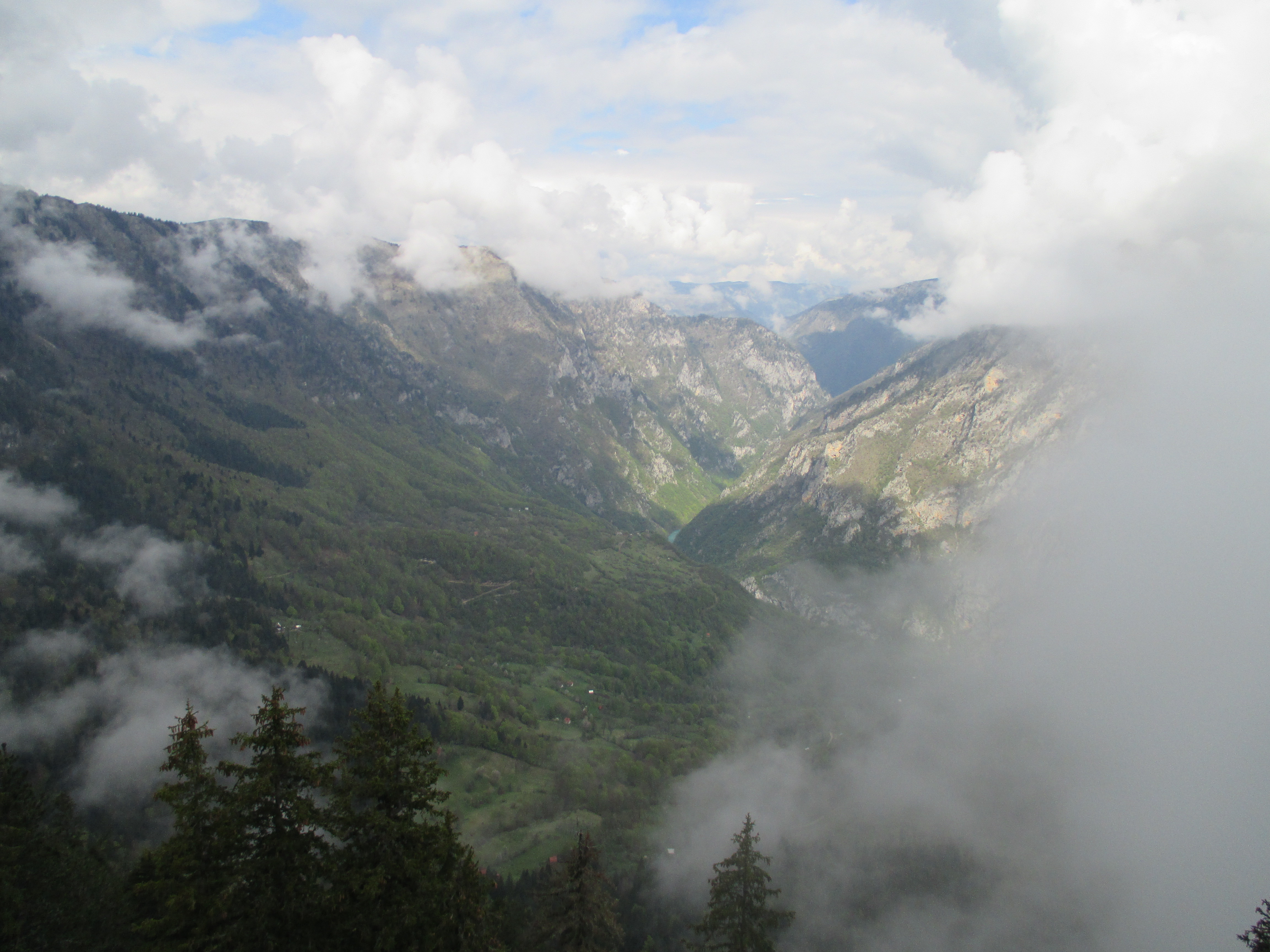
Τό’χα τάμα.  I had promised myself I’d do it.  The river and the canyon are spectacular.  Like an idiot I dove right in and got the most vicious ice cream headache in the world in one second flat.  I could only bear about two more minutes in the freezing waters.  But I never felt cleaner in my life.

IMG_0362 IMG_0357 IMG_0358(click on all)

Unfortunately, the bridge over the beautiful river is pretty ugly, since Montenegro isn’t in the European Union and can’t get a zillion dollars from Brussels, so they can pocket half of it and then hire Santiago Calatarava to build them some spectacular eagle span across the canyon with whatever’s left.  Like Greece.

IMG_0364

Note: I’m still in Montenegro but will be jumping back and forth between countries, so expect “redux” posts on Macedonia and Kosovo.

The Tara canyon — the river barely visible — from further up on Durmitor (click).

IMG_0370

Comment: nikobakos@gmail.com

The Annunciation: “And I thank you for choosing me…”

25 Mar

AnnunciationSantaMariaMaggiore

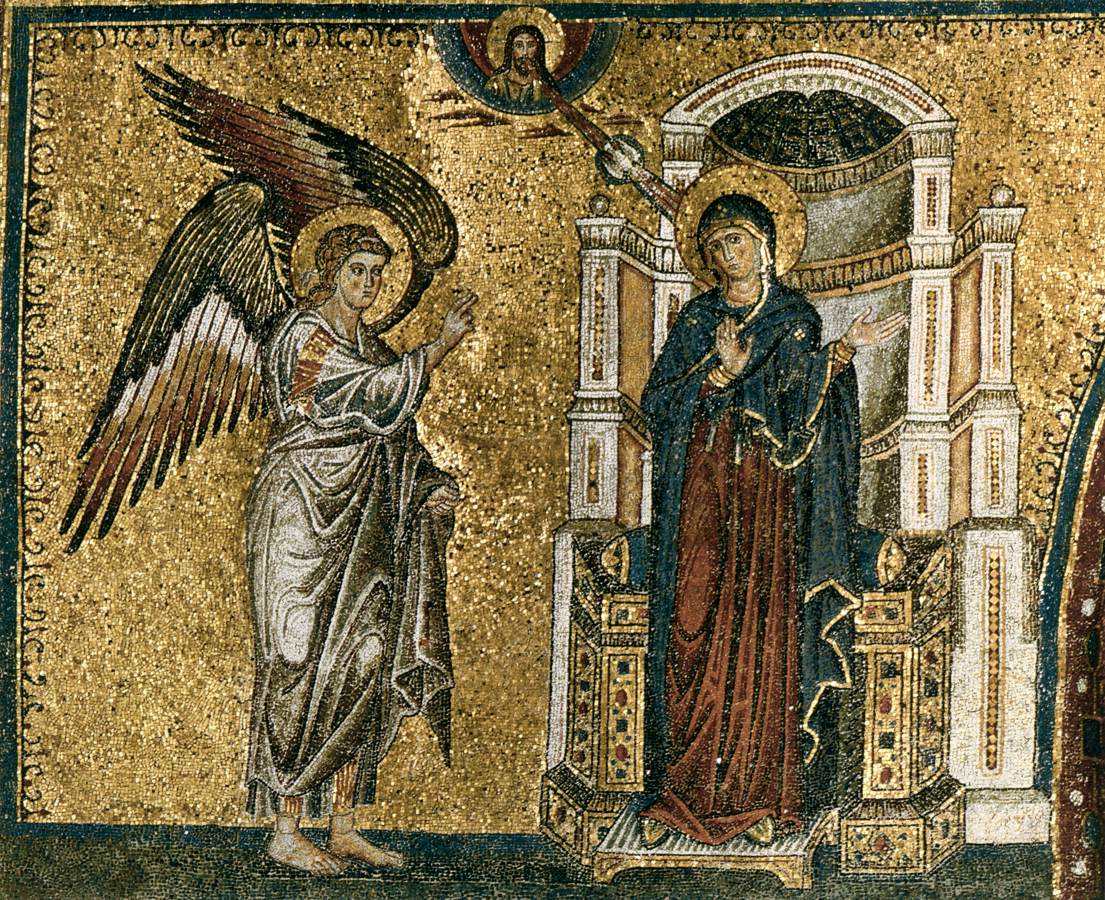
The Annunciation of the Virgin mosaic from Rome’s Santa Maria Maggiore (click)

Today is the Feast of the Annunciation, when the Archangel Gabriel appeared to a terrified, barely post-adolescent Jewish girl in a village in Galilee and told her that she was going to become God’s mother.  And in one of the greatest acts of moral bravery in history, this — what? fourteen-year-old? — Jewish girl said: “Yeah…ok.”

This is a “yes” which we should all pray to be given the opportunity to offer up to some one or to some greater thing, in even the tiniest of manners, at some one point in our lives.  It, oddly enough or not, always puts me in mind of the name “Reza,” which I’ve always loved on Persian men, since as far as I understand it, it means “willingness, acceptance, consent…” a saying-yes to Life or to the Divine Will.  (The other is “Peyman,” with its comparable sense of promise and commitment.)  Except in Mary’s case it’s a “saying-yes” that’s particularly female in its bravery, since she barely understands what’s being asked of her and she consents out of pure love, and most men find such consent difficult without first knowing what glory there is in it for them.  Instead Mary does the glorifying:

Μεγαλύνει ἡ ψυχή μου τὸν Κύριον καὶ ἠγαλλίασεν τὸ πνεῦμά μου ἐπὶ τῷ Θεῷ τῷ σωτῆρί μου,
ὅτι ἐπέβλεψεν ἐπὶ τὴν ταπείνωσιν τῆς δούλης αυτοῦ. ἰδοὺ γὰρ ἀπὸ τοῦ νῦν μακαριοῦσίν με πᾶσαι αἱ γενεαί,
ὅτι ἐποίησέν μοι μεγάλα ὁ δυνατός, καὶ ἅγιον τὸ ὄνομα αὐτοῦ, καὶ τὸ ἔλεος αὐτοῦ εἰς γενεὰς καὶ γενεὰς τοῖς φοβουμένοις αυτόν.
Ἐποίησεν κράτος ἐν βραχίονι αὐτοῦ, διεσκόρπισεν ὑπερηφάνους διανοίᾳ καρδίας αὐτῶν·
καθεῖλεν δυνάστας ἀπὸ θρόνων καὶ ὕψωσεν ταπεινούς, πεινῶντας ἐνέπλησεν ἀγαθῶν καὶ πλουτοῦντας ἐξαπέστειλεν κενούς.
ἀντελάβετο Ἰσραὴλ παιδὸς αὐτοῦ, μνησθῆναι ἐλέους, καθὼς ἐλάλησεν πρὸς τοὺς πατέρας ἡμῶν τῷ Αβραὰμ καὶ τῷ σπέρματι αὐτοῦ εἰς τὸν αἰῶνα.

46 And Mary said, My soul doth magnify the Lord,

47 And my spirit hath rejoiced in God my Saviour.

48 For he hath regarded the low estate of his handmaiden: for, behold, from henceforth all generations shall call me blessed.

49 For he that is mighty hath done to me great things; and holy is his name.

50 And his mercy is on them that fear him from generation to generation.

51 He hath shewed strength with his arm; he hath scattered the proud in the imagination of their hearts.

52 He hath put down the mighty from their seats, and exalted them of low degree.

53 He hath filled the hungry with good things; and the rich he hath sent empty away.

54 He hath helped his servant Israel, in remembrance of his mercy;

55 As he spake to our fathers, to Abraham, and to his seed for ever.

That’s March 25th: the Annunciation of the Virgin.  The rest — by which we mostly mean Greek Independence Day — is bullshit.  Nothing that led to the establishment of the first independent Kingdom of Greece happened on March 25th.  There were sporadic outbreaks of rebellion, some semi-coordinated, among Ottoman Greeks throughout the Empire in the early spring of 1821, but there was no raising of any standards, or launching of any campaigns or declarations of any kind made on March 25, 1821 as far as we know.  Except for sporadic massacring nothing much occurred at all that year until the fall, when, only with foreign help, the Greek rebels were able to finally take Tripolitsa in the Peloponnese and butcher the majority of its Muslim and Jewish — meaning practically its entire — population.  And eventually all that happened is that the Greek statelet slapped its observation of Independence Day onto the Annunciation in a conscious-or-not appropriation of the holiday’s already inherent meanings of conception, inception and beginning (I think that, the Julian Calendar still in operation at the time, March 25th was also Easter Sunday that year so, with the theme of Resurrection added, the temptation was irresistible) and so Althusser’s Ideological State Apparatus smothered one of the loveliest holidays of the Church with flags and parades and tanks and national anthem sap and all the other cheezy trappings of N/S patriotism.

But by the same token, the Annunciation itself was slapped by the Church onto the pre-existing observation of the Vernal Equinox (by a few days), the Persian Zoroastrian New Year, Nowruz, the first day of spring, the first day of the month of Aries — with its already inherent meanings of conception, inception and beginning.  And fast forward nine months, exactly (she was nothing if not on-time our Pantanassa*) and we have Christ born on (or near) another Zoroastrian holiday, Yalda, which marks the Winter Solstice and the beginning of the lengthened days and the Sun’s return to our lives.  The Winter Solstice, in more ancient Iranian religion, was the birth date of the deity Mithra, often associated with the Sun, and who — guess what? — was often said to be born in a cave, of a virgin mother, and who saved the world through the sacrifice of a bull along with a whole other complex of shifting tales and myths that I’m not an expert on.

But though Mithra seemed to fade into a secondary deity in classical Sassanian Zoroastrianism, he was accepted with great fervor and enthusiasm into the highly eclectic polytheism of the late Roman world, where he was especially popular in the Roman army.  Many of the latter emperors were devout followers and there are historians that believe — seems like a bit of an exaggeration to me — that the West came close to being a Mithraic civilization instead of a Christian one.  But the Church slapped Christ’s December 25th birthday onto Mithra’s (I’m simplifying some) and that was the end of Mithraism.  Which is a bummer, because by the Second Century A.D., Mithraism had evolved, in Roman hands, into a super-butch, male virility bull-cult for an initiated military elite, all wrapped-up in the full panoply of Hermetic-Alexandrian-Astrological wisdom, where Roman officers and soldiers gathered in caves and commemorated the sacrificed bull and honored its blood  (we don’t really know what occurred because it was only for the initiated but a sacrifice and subsequent shared meal of some kind was probably involved) and Christianity is kinda — well — is kind of lacking in those kinds of thrills.  One of my best beloved Roman ancestors, Julian the Apostate (the subject of four Cavafy poems), a fascinating figure, who was both a devotee of Mithra and an initiate into the Eleusinian mysteries, tried to reverse his uncle Constantine’s establishment of Christianity as the Roman state religion and give support to the traditional pagan cults, their rites, rituals and sacrifices, but it was already too late.  People just wanted their blood as metaphor by then, a shift in consciousness that has always been considered psychic or intellectual progress of some kind though — like the shift to monotheism itself — I could never quite understand why.  Those of us who still like reality better still have and have always had Spain though; that’s unless the European Union and PETA and the Catalans take their sanitary Handy-Wipes to the corrida too and that’ll be the real end.

Ah, but even then we’ll still have Mexico…

"Tauroctony" - Mithras slaying a bull

Mithra and the Bull, from the Vatican Museum (no other info) (click: it’s a huge and beautiful file)

What conclusions can we draw from all this?  One, is that humanity is not particularly imaginative and just kinda copies itself over and over ad infinitum.  Second, is the idea that often comes up when looking at our zone, thinking about “our parts,” more closely — and that’s the simple conclusion that everything is Persian.  Not just our food, our music or dance, our dress, our color palette, our poetic sensibility and ideas about love, but our common penchant for narrative cycles of martyrdom and rebirth (see: “Ashura 1435: a poem from Agha Shahid Ali”) and the deeper structures of our spiritual psyches.  It’s tempting; instead of the inane arguments about what’s Greek and what’s Arab and what’s Indian and what’s Turkish — everything is Persian, and be done with it.  Alexander seemed to have gotten it; shouldn’t be too hard for the rest of us.  But probably the truth lies and always will lie with Jung: and that is that all of the imaginary activity of the human unconscious operates on one, unified, symbolic grid of archetypes.

Chronia Polla to those whose namedays are today.  And signing off this post with R&B singer Lauryn Hill’s beautiful “To Zion” where the subtitle of this post comes from.  This was a song that came from her real-life experience of having to choose between having an unexpected baby and sticking with her career.  “One day…you gonna understand…”  Lyrics are below:

“To Zion”

Unsure of what the balance held
I touched my belly overwhelmed
By what I had been chosen to perform
But then an angel came one day
Told me to kneel down and pray
For unto me a man child would be born
Woe this crazy circumstance
I knew his life deserved a chance
But everybody told me to be smart
Look at your career they said,
“Lauryn, baby use your head”
But instead I chose to use my heart

Now the joy of my world is in Zion

How beautiful if nothing more
Than to wait at Zion’s door
I’ve never been in love like this before
Now let me pray to keep you from
The perils that will surely come
See life for you my prince has just begun
And I thank you for choosing me
To come through unto life to be
A beautiful reflection of His grace
See I know that a gift so great
Is only one God could create
And I’m reminded every time I see your face

That the joy of my world is in Zion
Now the joy of my world is in Zion

Marching, marching, marching to Zion
Marching, marching
Marching, marching, marching to Zion
Beautiful, beautiful Zion
[repeat to end of song]

*************************************************************************************************************************************************************************************************************

*”παντάνασσα,” pantanassa, is one of my favorite epithets for the Virgin, but whether it means “all-breathing, giver-of-breath, breath-granting” I can’t tell, nor can anybody else I know.

**Latest addendum note: Beloved dinosaur cousin — who is the always the one one should go to for these question, since he’s a monster of erudition in most fields, but especially Greek language, informs us that Pantanassa has nothing to do with breath or breathing, as many of us must assume, but: Η άνασσα είναι το θηλυκό του άνακτος (ονομαστική: άναξ), του βασιλέως (εξ ου και ανάκτορα).  “Anassa” is the feminine form of “Anax,” meaning king, same root as “Anaktora,” or palace.  So it simply means “Queen of Queens,” which is kind of disappointingly Catholic-sounding.  Speaks to a whole history of Greek and Latin vocabulary mixing itself up, replacing, re-replacing, disappearing and then appearing again, especially in titles of government or military due to initial composite character of Byzantine state structure.  I’m assuming, i.e., άνασσα was already an archaically Greek word at the time, for example, the Chairetismoi were written.

And a personal sensory note:  According to the guidelines of Orthodox fasting, which if observed carefully constitute the most elegantly designed spiritual economy of partaking and abstaining one can imagine (probably only Hinduism could produce a more intelligent  schema) — again, the guidelines, not the rules, meaning it doesn’t affect your G.P.A. at the end of term if you slip up, like if you’re Catholic — fish is considered meat, and is not eaten during Lent.  But there are festive days, essentially the Annunciation and Palm Sunday, which even in the sorrow of Lent, should be marked as Feasts, and then the eating of fish is practically obligatory.  Today in the streets of Greek neighborhoods, therefore, here in Athens or in Astoria, in apartment house corridors and restaurants, the smell of fried bacalao is all-pervasive.  One of my strongest sensory memories of Holy Week as a child is being taken to the matins for Holy Monday on Palm Sunday evening, the first of the so-called “Nymphios” or “Bridegroom” services (the reference being to Christ coming to Jerusalem for Passover and to meet his fate) and all the old women in church smelling like fish fritanga.

And a really interesting article from Wiki about “Tauroctony” or “Bull-slaying” if you’re interested in the phenomenon religio-anthropologically.  Again, the best book, that’s both an anthropology of Mediterranean bull cults and the best sociological history of Spanish bullfighting there is, is Timothy Mitchell’s “Blood Sport: A Social History of Spanish Bullfighting.”

Comment: nikobakos@gmail.com

Krugman backs me up on France

13 Nov

From the Times: The Plot Against France:”

“A year ago the magazine The Economist declared France “the time bomb at the heart of Europe,” with problems that could dwarf those of Greece, Spain, Portugal and Italy. In January 2013, CNN Money’s senior editor-at-large declared France in “free fall,” a nation “heading toward an economic Bastille.” Similar sentiments can be found all over economic newsletters.

“Given such rhetoric, one comes to French data expecting to see the worst. What you find instead is a country experiencing economic difficulties — who isn’t? — but in general performing as well as or better than most of its neighbors, with the admittedly big exception of Germany. Recent French growth has been sluggish, but much better than that of, say, the Netherlands, which is still rated AAA. According to standard estimates, French workers were actually a bit more productive than their German counterparts a dozen years ago — and guess what, they still are.

“Meanwhile, French fiscal prospects look distinctly nonalarming. The budget deficit has fallen sharply since 2010, and the International Monetary Fund expects the ratio of debt to G.D.P. to be roughly stable over the next five years.”

And money quote:

“If all this sounds familiar to American readers, it should. U.S. fiscal scolds turn out, almost invariably, to be much more interested in slashing Medicare and Social Security than they are in actually cutting deficits. Europe’s austerians are now revealing themselves to be pretty much the same. France has committed the unforgivable sin of being fiscally responsible without inflicting pain on the poor and unlucky. And it must be punished.” [my emphasis]

Living securely, productively, growing at a reasonable rate, relatively stable — and all with high quality of life intact.  How do they do it?  It makes the Teutons crazy.  See my post from last week: “…some thoughts on the “crise;” or, “…the brevity of time and the immediacy of pleasure.”

marianne

(click)

comment: nikobakos@gmail.com