Tag Archives: Gračanica

The Dormition — denim shorts at the analoi…

16 Aug

dormition-decani2

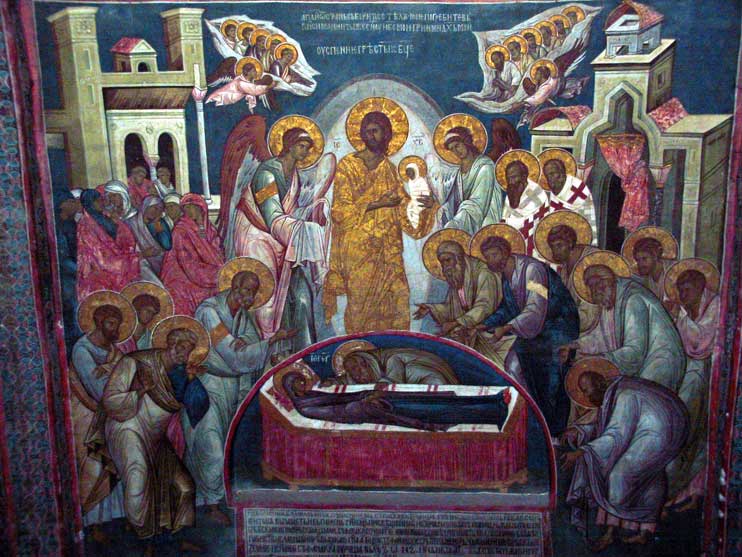
The Dormition fresco at the monastery of Gračanica in Kosovo. (click)

Rebecca West’s description of the fresco and the meaning of the event in the Orthodox Church (s opposed to the Catholic Assumption) is still the most moving and right-on that exists:

“Across one of the walls of Grachanitsa is shown the Falling Asleep of the Virgin Mary, the state which preceded her Assumption, a subject often treated by the Byzantines.  There is no man living today who, exploring his mind in the light of that idea, could draw out so much.

“In the foreground of the fresco is the Virgin lying on her bier.  By the lax yet immutable line is rendered the marvel of death, the death which is more than the mere perishing of consciousness, which can strike where there is no consciousness and annul a tree, a flower, an ear of corn.  Above her bier there shines a star of light; within it stands Christ, taking into his arms his mother’s soul in the likeness of a swaddled child.  Their haloes make a peaceful pattern, the stamp of a super-imperial power, within the angles of the star.  About them throngs a crowd of apostles and disciples, come hastily from the next world or from distant lands to attend the Virgin’s death, wearing their haloes as bubbling yet serene spheres.  On the edge of the crowd stand some bishops in their cross-covered mantles, rock-like with the endurance of the Church, which cannot be perturbed by the most lacerating grief, and still others, also in flowing garments but with bodies liquid with grief, and others, also in flowing garments but with bodies tautened by effort, low under the weight of the bier.  The background is full of angels as the Eastern Church loved to conceive them, ethereal messengers who are perpetually irradiated by the divine beauty and communicate its laws to flesh-bound man, a dream of perfect vision and unfrustrated will.

“The huge imaginative space occupied by this small fresco is washed by two swinging tides. There is a wave of such sincere and childish grief as children feel when their mothers die, that breaks and falls and ebbs; there is a rising sea of exaltation in the Son who can work all magic and cancel this death or any other, making glory and movement where stillness and the end seem to be ineluctable. The sides of the fresco are filled in with buildings, distorted with the most superb audacity in order to comply with the general pattern, yet solid and realistic in effect; we are amazed, as we all so often are during our lives, that our most prodigious experiences take place in the setting of the everyday world, that the same scenery should be used for the pantomine and the tragedy. Behind these buildings there is a firmament which evokes another recurrent amazement. It is the most astonishing of all the things which happen to us that anything should happen at all. It is incredible that there should be men and women, mothers and sons, biers and buildings, grief and joy; it would seem so much more probable that the universe should have as its sole packing empty nothingness. Existence in itself, taken at its least miraculous, is a miracle.”

*******************************************************************************************************************************************************************

Cute young cantor in t-shirt and denim shorts at the analoi at Hagia Eirene last night.  (???)   Fine by me.  Especially with the sweetest lyrical tenor.  The cantors at Hagia Eirene in Astoria have become the best without compare in all of New York, and if they’re the best in New York, they’re the best in the United States.  Though this is not the place to get into the pitiful state of ecclesiastic music in most of the Greek Church in America.

*******************************************************************************************************************************************************************

I’M SORRY FOR LONG ABSENCE.  THE JADDE WILL SOON BE BACK WITH MORE SERIOUS MATERIAL.  Personal issues and the overwhelming flood of international developments worldwide — especially Djok defending his Wimbledon title against Rolex Federer — left me drowned in more than I could intelligently comment on.  But will be back soon.

novak-djokovic-wimbledon-2015-quarters

(click)

Comment: nikobakos@gmail.com

“A falcon drinks water from the Vardar” — good-bye to Macedonia

27 Apr

Left Macedonia this morning and crossed into Kosovo; in Gračanica now, where we found the most amazing place to stay right by the famous monastery, and a world away from the horrible mess of Priština.

The six simple lines of this beautiful Macedonian song:

A falcon drinks water from the Vardar.
Oh Jana, white-throated Jana.
O falcon, hero’s bird, Have you not seen a hero go past?
A hero go past with nine heavy wounds?
Nine heavy wounds, all from bullets.
And a tenth wound, stabbed with a knife.

…encapsulate all you need to know about the Balkan cult of blood and tragic masculinity, which is the root of everything horrific you’ve read and heard about the region, yet, fortunately — or unfortunate, at least,  for those who, as they say, can’t hold two contradictory ideas in their heads at the same time — the foundation for everything so stunningly beautiful about it.  This is what Rebecca West understood so profoundly and in her soul and why she loved and defended the region’s peoples with such unapologetic passion.  This is what Milovan Djilas accepts with such love and intelligence, when he describes his Homeric people as capable of the most profound sweetness and tenderness in the midst of the grossest violence and destitution — again, with no apologies and no judgements, just true understanding of the their humanity.  The Macedonian transliteration is below.  You get it or you don’t.

The photographs are extraordinary.  Balkan female dress — which all over the southern Balkans is an entire civilization in itself — reaches the apogee of richness and complexity across this swath of southern Albania, Macedonia, Kosovo and the rest of Old Serbia.  More about Macedonia to come.

More sokol pie,
Voda na Vardaro,
More sokol pie,
Voda na Vardaro.

Jane, Jane le belo grlo
Jane, Jane le krotko jagne.

More oj sokole,
Ti junacko pile.
More neli vide,
Junak da pomine,

Jane, Jane le belo grlo
Jane, Jane le krotko jagne.

Junak da pomine,
S’devet luti rani
S’devet luti rani,
Site kursumlii

Jane, Jane le belo grlo
Jane, Jane le krotko jagne.

A desetta rana,
So noz probodena.
A desetta rana,
So noz probodena.

Jane, Jane le belo grlo
Jane, Jane le krotko jagne.

And another beautiful Macedonian song, “Jovano, Jovanke.”  “Mor’ Gianno, mor’ Giannoula” closest translation into Greek.  Jovana, Gianna…Joan, more exact translation is, again,  impossible with English’ lack of diminutives.

Only translation — from my half-assed Russian, which actually served me in good stead in all these countries — of transliterated lyrics I can make out from the one verse given:

“Jovano, Jovanke
Kraj Vardarot sedish, mori
Belo platno belish
Belo platno belish dusho
Se na gore gledash”

is

“Gianno, mor’ Giannoula, You sit on the banks of the Vardar,

“Washing your white linen, and glancing off into the mountains.”

(I think – can anybody help us with the rest of the translation)

The “Jovano” video is also beautiful, and has some interesting photos: the first shot is of a gathering at the monastery of Sveti Jovan Bigorski, the defending mountain fortress of  Macedonian Orthodoxy (more on that later), and the third photo — all of them really —  is pretty amazing in showing how little male body language in “our parts” has changed over the centuries.  That’s the connection of the two pics on the blog’s homepage, but nobody got it.  Here are some more boys from my village at Easter; maybe that’ll make it more obvious.

IMG_0148(click)

Notes: I don’t know if these two songs above are composed “folk” songs, analogous to “Gerakina” or “Xekinaei mia psaropoula” in Greek, but the lyrics are stark enough to seem authentic.  In those Greek “folk” songs I’m talking about, their “composed” status is made obvious by not only the melody but the conspicuously over-folksy content of the lyrics.  The “folk” did not sing about the mundane details of their everyday life — going to get water from the well or mending fishing nets.  They sang about nature, about love, about the pain of emigration, about death,  and about the heroic exploits of their men and often their women.  A friend of mine from Naousa in Greek Macedonia, the town just south of Vodena that is famous for its carnival celebrations, says both “More Sokol” and “Jovano” are played as instrumentals in that region, the gypsy musicians who play them usually being the carriers of songs and musical forms from country to country and region to region.

Also surprising: “more,” a word, like “bre,” used all across the southern Balkans, means “hey you” or “yo” or “oh, listen”…I dunno, a vocative case pronoun basically — does that sound right Philopomeon?  In Macedonian it has Greek gender endings: “more” and “mori.”  How did that happen?  That was the only way I knew that Jovano was a female and not a male name.

Comment: nikobakos@gmail.com