Tag Archives: Israel

Church of the Nativity in Bethlehem placed on UNESCO’s world heritage sites in danger list: Israel and U.S. object

29 Jun

(File, AP Photo/Nasser Shiyoukhi)

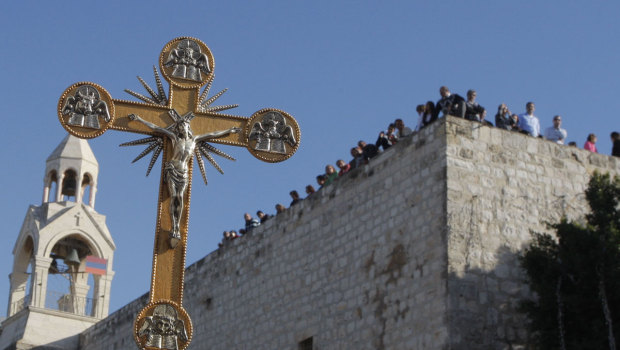
PARIS (AP) – UNESCO’s World Heritage committee on Thursday approved a Palestinian bid to place the Church of the Nativity in Bethlehem on its list of sites of World Heritage in Danger – a move seen by some nations as dangerously mixing politics and culture.

Palestinian spokeswoman Hanan Ashrawi said the vote was an affirmation of Palestinian sovereignty over the site that marks the place where Christians believe Jesus was born.

Israel angrily denounced the vote, with Foreign Ministry spokeswoman Ilana Stein saying the decision “has turned UNESCO into a theater of the absurd.”

“This is a sad day for the World Heritage Committee,” she said.

The 21-member committee, meeting in St. Petersburg, Russia, voted 13-6 to include the church and pilgrimage route, located in the Israeli-controlled West Bank, on its list of sites. There were two abstentions.

The drive to get the Nativity church quickly recognized as a World Heritage site was part of the Palestinians’ bid to win international recognition since attempts to establish a Palestinian state through negotiations with Israel are frozen.

The United States was among nations opposed to the Palestinian proposal of an emergency candidacy for the iconic Christian site, shortcutting what is usually an 18-month-long process to apply for World Heritage recognition. Neither the United States nor Israel was on the committee. The U.S. ambassador to UNESCO, David Killion, said the United States is “profoundly disappointed.”

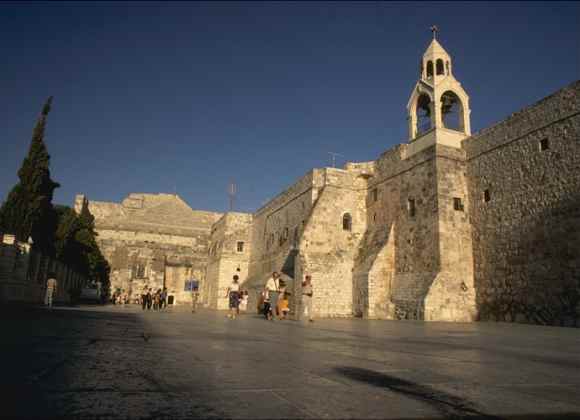
The church – which drew some 2 million visitors last year and parts of which are 1,500 years old – stands above the grotto that Christians believe was the birthplace of Jesus. The Palestinian application asks for recognition as a site of “outstanding universal value” urgently in need of attention.

The application cited lack of regular restoration of the church due to the political situation since 1967 when Israel occupied the territories, and difficulties procuring equipment because of lack of free movement imposed by Israeli forces.

The United Nations Educational, Scientific and Cultural Organization voted to admit Palestine as a full member in October. The emergency candidacy for the church clearly showed the Palestinians’ intention of making the most of their position, after a failure to join the main U.N. body because Palestine is not a recognized state.

The Palestinian application to place the Church on the list showed that they plan to put forward other sites for prestigious World Heritage recognition, eventually linking various landmarks to the life of Jesus.

“The message to Israel today is that unilateral actions will not work and that Israel cannot continue challenging the world despite its powerful allies,” Ashrawi said.

Killion, the U.S. ambassador, said “this body should not be politicized.” His statement noted the candidacy was opposed by a UNESCO experts committee, whose conclusions are almost always heeded.

The three churches acting as custodians of the site had also been opposed. The Greek Orthodox, Armenian and Roman Catholic churches keep the site under a so-called Status Quo agreement dating to the Ottoman empire, and fear the Palestinian action will upset that delicate balance.

“The site clearly has tremendous religious and historical significance,” Killion’s statement said. “However, the emergency procedure used in this instance is reserved only for extreme cases.”

Stein, the Israeli Foreign Ministry spokeswoman, said those who voted in favor of the Nativity candidacy “have given themselves up as pawns in the service of the Palestinians at the expense of UNESCO’s professionalism and good name.”

While the church needs restoration, including repair of a leaky roof, it was not seen by the experts committee as being in imminent threat of destruction – the criteria usually reserved for the emergency procedure

A site nominated by Israel depicting human evolution at Mount Carmel, the Nahal Me’arot/Wadi el-Mughara Caves, also was inscribed on the World Heritage list. That nomination, like all others under consideration in St. Petersburg, went through regular channels – not the emergency route.

Exterior and interior of the church


“Tal” Law exemption done…

27 Jun

The question is: does Israel — or the rest of the world — want these guys as soldiers?  Seems to me it’s a toss-up as to whether they’ll be completely incompetent or the most vicious bunch yet.  Or, they’ll just move back to Borough Park and annoy us.

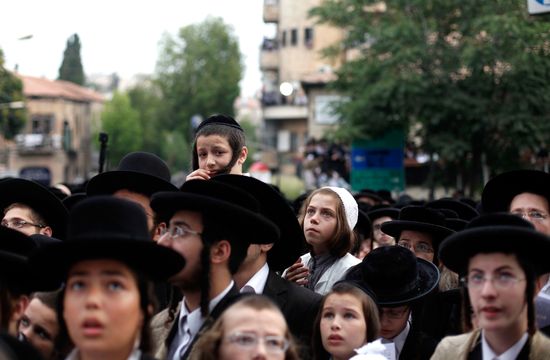
Ultra-Orthodox Jewish men and boys (some of them dressed in sacks as a sign of mourning) protest against Tal Law replacement on June 25, 2012 in Jerusalem, Israel. The Tal Law, which exempts ultra-Orthodox yeshiva students from mandatory military service, was declared unconstitutional by the High Court in February and is due to expire in August. (By Lior Mizrahi/Getty Images.)


Comment: nikobakos@gmail.com

The Third Intifada Is Inevitable

23 Jun
The New York Times
      June 22, 2012
    By NATHAN THRALL

(West Bank: Second Intifada)

Jerusalem

EARLIER this month, at a private meeting with the Israeli prime minister, Benjamin Netanyahu, and his security advisers, a group of Middle East experts and former intelligence officers warned that a third Palestinian intifada was imminent. The immediate catalyst, they said, could be another mosque vandalized by Jewish settlers, like the one burned on Tuesday, or the construction of new settlement housing. Whatever the fuse, the underlying source of ferment in the West Bank is a consensus that the Palestinian Authority president, Mahmoud Abbas, has reached a dead end.

Mr. Abbas’s political strategy was premised on the notion that security cooperation between the Palestinian Authority and the Israeli government would make Israel feel safer and remove its primary justification for continuing to occupy the West Bank, thereby clearing the way for a Palestinian state. Ironically, owing to the success of his efforts, many Israelis have had the luxury of forgetting that there is an occupation at all.

Thanks to the American- and European-financed peace that Mr. Abbas’s government has been keeping in the West Bank, Israelis have come to believe they can eat their cake and have it, too. A majority of citizens polled earlier this year said their state could remain Jewish and democratic without relinquishing any of the West Bank. Years of peace and quiet in Tel Aviv allowed hundreds of thousands of Israelis to take to the streets last summer to protest the high price of cottage cheese, rent and day care without uttering a word about Palestinians in the West Bank. The issue has ceased to be one of Israel’s primary security concerns. Mr. Netanyahu would have to be either politically suicidal or exceptionally forward-thinking to abandon a status quo with which a vast majority appears satisfied.

By contrast, Palestinians today see their leadership banging its head against a wall, hoping against reason that a bit more good behavior will bring about an independent state. As a result, longstanding debates over how to achieve national liberation — by comforting Israel or confronting it — have now been resolved. Palestinians of all political stripes are no longer arguing about whether to make Israel’s occupation more costly, but how.

During the 1990s, Mr. Abbas was one of the key architects of the Oslo peace process, which envisioned a phased Israeli withdrawal from the West Bank leading to a permanent peace agreement (though not necessarily to a Palestinian state). Today, he is perhaps its last remaining believer. He has been forced to pay lip service to the demands of those who advocate confrontation by issuing repeated pledges to confront Israel — by dismantling the Palestinian Authority or refusing to negotiate unless Israel freezes settlement construction — only to renege on each one.

As the gap between the Palestinian president’s words and actions has grown, so has the distance of his policies from public sentiment, leading to his government’s turn to greater repression: torturing political opponents, blocking Web sites and arresting journalists and bloggers critical of Mr. Abbas. Even Mr. Abbas’s close advisers confide that he is at risk of becoming another Antoine Lahad, the leader of Israel’s proxy force during its occupation of southern Lebanon. The chief steward of Mr. Abbas’s policies, the unelected prime minister, Salam Fayyad, has acknowledged, “I think we are losing the argument, if we have not already lost.” And Mr. Abbas himself has admitted that the peace process is “jammed” and that his government had merely helped create “a good situation” for Israel, which, enjoying years of unprecedented cooperation with Palestinian forces in the West Bank, lacks incentives to agree to any change.

But these days, Palestinian security forces have little reason to believe their efforts are advancing national goals, and Israel can’t assume that the Palestinian Authority will provide security indefinitely. Last month, as gunfire returned to the streets of Jenin, and 1,600 Palestinian prisoners entered the fourth week of a hunger strike, Mr. Abbas said: “I cannot control the situation. I am afraid, God forbid, that the security system here will collapse.” That sentiment echoed remarks by Yuval Diskin, the recently retired head of Israel’s internal security agency: “When the concentration of gas fumes in the air is so high,” he said, “the question is only when the spark will come to light it.”

The root cause of this instability is that Palestinians have lost all hope that Israel will grant them a state. Each attempt to exert what little leverage Palestinians possess has been thwarted or has proved ineffective. Boycotts of settlement jobs and products haven’t gained mass support, and would not stop settlement growth even if they did. The Palestinians could have pushed for a vote last September in the United Nations General Assembly — a move that frightened Israel and America because of its implications for Palestinian accession to the International Criminal Court. Mr. Abbas abandoned that effort in favor of a petition for statehood at the Security Council, which was always guaranteed to fail, and then deftly sold his capitulation as defiance.

These failures have left Palestinians who hope to make present conditions untenable for Israel with only two options: popular protest and armed resistance. The first option faces enormous obstacles because of political divisions between Hamas in Gaza and Mr. Abbas’s Fatah in the West Bank. Each faction regards mass mobilization as a potential first step to its overthrow, as well as a means of empowering a new generation of leaders at the expense of existing ones.

If mass demonstrations erupted in the West Bank, Israel would ask Palestinian security forces to stop any protests near soldiers or settlers, forcing them to choose between potentially firing on Palestinian demonstrators or ending security cooperation with Israel, which Mr. Abbas refuses to do. As he knows and fears, mass protests could quickly become militarized by either side. For that reason, his government has offered little more than rhetorical support for the small weekly protests so beloved by foreign activists and the Western press, and has actively prevented demonstrators from approaching any Jewish settlements.

The second option is armed confrontation. Although there is widespread apathy among Palestinians, and hundreds of thousands are financially dependent on the Palestinian Authority’s continued existence, a substantial number would welcome the prospect of an escalation, especially many supporters of Hamas, who argue that violence has been the most effective tactic in forcing Israel and the international community to act.

THEY believe that rocks, Molotov cocktails and mass protests pushed Israel to sign the Oslo Accords in 1993; that deadly strikes against Israeli troops in Lebanon led Israel to withdraw in 2000; that the bloodshed of the second intifada pressured George W. Bush to declare his support for Palestinian statehood and prodded the international community to produce the Arab Peace Initiative, the Geneva Initiative, and the Road Map for Middle East Peace. They are also convinced that arms pressured Ariel Sharon, then Israel’s prime minister, to evacuate settlers and troops from Gaza in 2005. That pullout also had the effect of freezing the peace process, supplying “the amount of formaldehyde that is necessary,” as a Sharon adviser put it, “so there will not be a political process with the Palestinians.”

For more militant Palestinian leaders, who never believed in the peace process, the lesson was clear: “Not an inch of Palestinian land will be liberated,” Mousa Abu Marzook, deputy head of Hamas’s political bureau, told me, “while Israelis feel that controlling it exacts few costs.” Matti Steinberg, a former senior adviser to Israeli security chiefs, described Mr. Abbas as the most obliging, nonviolent Palestinian leader Israel has encountered and warned of taking him for granted. “The Israeli center is caught in a vicious cycle,” he said. “It argues that it cannot make peace while there is violence, and when there is no violence it sees little reason to make peace.”

History may credit Mr. Abbas with reigning over the more virtuous phase of this cycle, but he has likely laid the groundwork for the uglier one. Hamas, meanwhile, has already moved on. “Israelis had a golden opportunity to sign an agreement with Abbas,” Hamas’s health minister, Basem Naim, told me in Gaza last November. “But the chance has already passed. They will not get it again.”

 Nathan Thrall is a Middle East analyst at the International Crisis Group.

Nablus (2005)


Comment: nikobakos@gmail.com

Jewish New York gets scary, ctd.

20 Jun

I’ve written about the Israeli colonization of the Diaspora mind (in and not in connection with similar process among Greeks) here and here, so I was really intrigued by reading some of the comments on The Forward‘s* original post, which put a really interesting twist on things:

“They couldn’t even write it in Yiddish?” [asks one poster]

[reply]  “The billboard isn’t sanctioned by any official Orthodox organization but rather the work of a lone wolf accentric [sic]. The use of Hebrew rather than Yiddish or English suggests this to be the work of an Israeli trying to import Mea Shearim standards to Brooklyn,  [see: Haredi Judaism**]  The overwhelming majority of Orthodox Brooklynites (including Hassidic and yeshivish) view public spiritual policing as distasteful and bordering on incitefull [sic]. Also, the use of a billboard for this message is an oxymoron, since a spiritually sensitive person that tries to watch his eyes avoids looking at billboards altogether.”

*The Jewish Daily Forward (“Forverts”), a New York institution, central to progressive causes in the city and the country since its founding: The Forward.

**Haredi Judaism: these guys are the ones that made front pages last year for terrorizing a little girl in a short skirt in Israel, and have generally worked their way into a place where they hold much of Israeli politics hostage, though they don’t serve in the Israeli army on grounds that they don’t recognize Israel, but do accept massive amounts of public assistance from the Israeli state because their birthrate is so high and much of them, having only religious education, are unemployable (just so many yeshiva bochers an economy can absorb).  “The vast majority of Haredi Jews rejected Zionism for a number of reasons. Chief among these was the claim that Jewish political independence could only be obtained through Divine intervention, with the coming of the Messiah.”

“Jim Crow was never this extensive…”

29 May

From Andrew Sullivan’s Daily Beast:

The Labyrinth of a Segregated Ethnocracy

“A map showing how Palestinian cars are marked by differently colored number plates, and where they are allowed to go and not to go. Imagine living in a country where your race prevented you from traveling on certain roads in your own country, and where newcomers enjoy tunnels, bypasses and new roads to facilitate their travel. There are even roads which are parallel, with one being for Jews and the other for Palestinian Arabs. Jim Crow was never this extensive:

Segregated-roads-2012-05-28

“Looking at maps like this, it becomes clearer to me every day that the two-state solution is a chimera for long-term Israeli occupation of the whole area with permanent segregation for the natives, and inducements for them to leave.”  — Andrew Sullivan


Comment: nikobakos@gmail.com

Shvuyes

27 May

I am categorically opposed to the Zionist tyranny of neo-Hebrew pronunciation, though I don’t know what gives me the right to such a strong opinion on the subject since I’m not even Jewish.  But I am a New Yorker, and pretty proprietary about at least my city’s Jewish and Yiddish-speaking heritage, and it bugs me to no end that most young New York Jews now say: “L’Shan-ah To-vah” in their best Hebrew school accents, instead of “Lu-sha-nuh To-vuh,” or “Sim-chat To-rah” instead of “Sim-ches Toy-ruh” like they used to.

We have no idea how ancient, pre-Babylonian Hebrew was pronounced; the Jews returning from exile having thoroughly become Aramaic speakers.  The pronunciation of Modern Hebrew was constructed on the basis of Sephardic liturgical pronunciation of the language, on the flimsy assumption of some kind of Semitic purity to be found in Sephardic usage, which the nineteenth-century Zionists in Europe who formulated the pronunciation and other structures of Modern Hebrew were probably attracted to mostly as an exotic escape from Galizianer shtetl-stigma and not any serious linguistic or historical considerations — the lost Golden Age of Jewish Spain being a nobler basis for Zionism’s new start than the muddy reality of Poland.  The old Ashkenazi-Yiddish pronunciations served the vast majority of the world’s Jews perfectly fine for many centuries and there was no need to “correct” them.

But Zionism is so often about reducing the entire Jewish historical experience — before the success of its ethically problematic project — to shame, though it was through the diaspora that Jews were forced to cultivate their greatest and most extraordinary gifts and share them with the rest of humanity as well.  That’s why I feel there’s an anti-diaspora shame in this pronunciation issue too that I don’t like.  And an Israeli colonization of the diaspora Jewish mind and soul, culturally and politically, that I like even less, but which is probably now irreversible.  Worse — a victim-shame which, combined with genuine, horrific trauma, has all kinds of negative and destructive consequences for Jews and everyone around them.  While Joseph Massad’s claim that Zionism is an: “anti-Semitic project of destroying Jewish cultures and languages in the diaspora,” is a bit hyperbolic, that’s pretty close to how I feel as well.

On a lighter note, Shvuyes is when you eat blintzes – and other dairy.  I don’t know why.

Comment: nikobakos@gmail.com
The Great Book Robbery

13 May

“Was the appropriation of Palestinian books and manuscripts in 1948 a case of cultural theft or preservation?”

Another great Al Jazeera documentary about the looting of Palestinian books during the Nakba.

“Goodbye, my books!  Farewell to the house of wisdom, the temple of philosophy, the scientific institute, the literary academy!
How much midnight oil did I burn with you, reading and writing, in the silence of the night while the people slept … farewell, my books!
I do not know what became of you after we left: were you looted?  Burned?  Were you transferred with due respect, to a public or private library?  Did you find your way to the grocer, your paper wrapping onions?”

— Khalil al-Sakanini


Comment: nikobakos@gmail.com

“…the innocent boy of seventeen…”

12 May

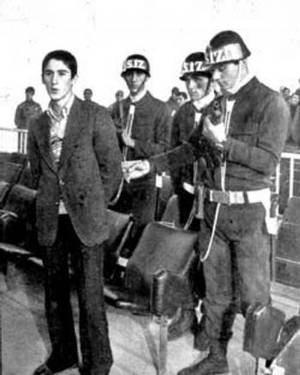
Though it was only incidental to the previous post, the image of Erdal Eren has haunted me for the rest of the night; perhaps it’s the photo of him and its painful youth and innocence; obviously the terrifying quote: that he looked forward to his execution in order to avoid thinking of the torture he had witnessed; maybe it’s that hanging has always struck me as a particularly obscene form of capital punishment’s obscenity (the setting looks prison-like, like he’s actually entering the gallows chamber there…)

Then the eerie reminder of the Cavafy poem: “27 June 1906, 2 p.m.”

27 Iουνίου 1906, 2 μ.μ.

Σαν το ’φεραν οι Xριστιανοί να το κρεμάσουν
το δεκαεφτά χρονώ αθώο παιδί,
η μάνα του που στην κρεμάλα εκεί κοντά
σέρνονταν και χτυπιούνταν μες στα χώματα
κάτω απ’ τον μεσημεριανό, τον άγριον ήλιο,
πότε ούρλιαζε, και κραύγαζε σα λύκος, σα θηρίο
και πότε εξαντλημένη η μάρτυσσα μοιρολογούσε
«Δεκαφτά χρόνια μοναχά με τα ’ζησες, παιδί μου».
Κι όταν το ανέβασαν την σκάλα της κρεμάλας
κι επέρασάν το το σκοινί και το ’πνιξαν
το δεκαεφτά χρονώ αθώο παιδί,
κ’ ελεεινά κρεμνιούνταν στο κενόν
με τους σπασμούς της μαύρης του αγωνίας
το εφηβικόν ωραία καμωμένο σώμα,
η μάνα η μάρτυσσα κυλιούντανε στα χώματα
και δεν μοιρολογούσε πια για χρόνια τώρα·
«Δεκαφτά μέρες μοναχά», μοιρολογούσε,
«δεκαφτά μέρες μοναχά σε χάρηκα, παιδί μου».

“27 June 1906, 2 p.m.”

When the Christians brought him out to be hanged
the innocent boy of seventeen
his mother there near the scaffold
was dragging and beating herself in the dust,
under the sun, the savage noon-day sun,
and now would screech, and now would howl like a wolf, like a beast,
and then exhausted the martyred woman would keen
“You only lived these seventeen years my child.”
And when they raised the boy up on the scaffold,
and passed the rope around his neck,
the innocent boy of seventeen,
and his body swung hideously in the void
wracked by the spasms of his black agony
the beautifully made youthful body,
the martyred mother rolling in the dirt
was no longer keening of years,
“Seventeen days only” she keened,
“Seventeen days only did I enjoy you, my child.”

(my translation)

Erdal Eren

Cavafy wrote the poem in remembrance of the 1906 Denshawi affair, one of Britain’s unfinest hours.  Apparently some British military personnel were returning from Cairo to Alexandria and, near the village of Denshawi, shot some pigeons that belonged to the locals.  A scuffle ensued; a rock was thrown that hit a British soldier on the head and, though he died of what was later proven to be sunstroke, like a delicate E.M. Forster memsahib, five of the residents of Denshawi, including the seventeen-year old of the poem, were imprisoned.  Fortunately, there was such a public outcry after the execution of the young man that the other four men were released, though not till two years later in 1908.  The episode still remains disgusting and Cavafy’s poem one of his most chilling, a register he usually didn’t work in.

At the same time it’s a beautiful reminder of his humanity on several levels.  One is his life-long opposition to capital punishment: “Whenever I have the opportunity I declare this,” he wrote in 1902.  The other, without re-outfitting him as a post-colonialist before his time, is his affection for and lack of alienation and estrangement towards Egypt itself.  He could have had the cloistered emotional outlook of an erudite fag in the European cocoon of Alexandria, yet the otherness that life imposed on him taught his heart the right lessons.  The above poem (even his use of “the Christians,” which in the context can mean nothing less than “the kafirs,”* is a jarring statement of identification) is only his most poignant expression of his love for the country, not just the historical Egypt of so much of his poetry, but the actual Arab Egypt he lived in; “To glyky mas Misiri,” as he calls it in one poem: “Our sweet Misiri” — our sweet Egypt.**

I wonder what he would have thought of the current state of Greek politics – not that he ever cared much for either the Neo-Greek statelet or its inhabitants.  What would a man that lived and wrote on the cusp of every possible human margin and in every plural space conceivable, who would have died before he let his Hellenism be trapped by geography, nationalism or its idiocy, have thought of Greece having the most potentially powerful Nazi (I’m tired of dignifying them with the prefix neo-) party on the European continent?  And that granted to them by a significant youth vote.  A thirty-something Athenian, and a left-leaning one at that, recounting to me the multiple incidents of petty anti-immigrant animosity that she had been witness to in Athens even before the current crisis, recently said to me, in glib defensiveness: “Well, we’re not used to strangers in our country.”  This from us, malaka, the inventors of migration and its pain, who since the beginning of our historical presence have been strangers in every stranger’s land on the planet, except those corners ventured into only by more intrepid or desperate Jews or Gypsies.  It’s beyond even remotely doubting for me that it’s partly the loss of a diaspora consciousness on Neo-Greeks’ part, and the wider sense of world it gives you, that has made us such closed, parochial idiots, just as Israel — sorry to say — has had the same effect on Jews.  And the comparison doesn’t end there; in both cases the diaspora is not just forgotten and ignored, but a source of embarrassment and shame, and each state and its official and/or fabricated culture has the hubris to think itself the metropolitan standard that those left outside should aspire to, when neither state in question contained a serious metropolitan center of either Hellenism or Jewishness until the twentieth century (…with Israel causing a progressive closing of the Jewish mind everywhere — a disaster for all of us).  Now maybe that some young Greeks have had to start emigrating again some of that attitude will get a real reality check.  The economic crisis in Greece is a source of genuine consternation for me and I’m guardedly on the anti-EU/Troika side; at the same time some humility may be exactly what that society needed.  Maybe…though voting for Nazis doesn’t exactly indicate humility but childish rage.


*Qafr, kafir: infidel

**Masr is Egypt in Arabic.  Cavafy uses “Misiri” because in Modern Greek words can only end in certain consonants.  This is something  — tzatziki, kazani, kadaifi, kokoretsi, duvari — that makes Turks giggle and strikes them as particularly funny when they hear it in Greek and the kick they get out of it has always struck me as particularly sweet in return.  I think Cavafy intended it to have this effect.


Comment: nikobakos@gmail.com

“Soft Ethnic Cleansing”

7 May

From Andrew Sullivan’s Daily Beast:

Greater Israel And “Soft Ethnic Cleansing”

I guess we should be grateful that congressman Joe Walsh did not get into specifics, when he unveiled his proposal for an Israel-Palestine settlement. But it’s a disarmingly candid expression of what many in the GOP now believe:

The two-state solution has failed. Only a one-state solution – a single, undivided Israel – will bring peace, security and prosperity to Israelis and Palestinians alike.

What about the Palestinians? Bob Wright explains Walsh’s project:

Give Palestinians who live in those territories “limited voting power” in the new, bigger Israel that they’ll have suddenly become residents of. (Walsh doesn’t define his euphemism, but no doubt the idea is that Jews get one-person-one-vote and Palestinians get something less, so that Israel can remain a Jewish state.) … Palestinians who don’t like having “limited voting power” can move to Jordan.

Bob explains why this is more than troubling:

When you (1) tell members of an ethnic group that the land they live on is being given to another nation; (2) tell them that neither they nor their descendants will be allowed to vote in that nation’s elections, even though next-door neighbors of a different ethnicity can; (3) tell them that the only way to avoid this fate is to go to another country–yeah, I’d call that ethnic cleansing, at least of a “soft” variety.

I think that’s where Israel is eventually headed: ethnic cleansing by a variety of means, sealing its abandonment of the Western tradition for pure tribalism – and worse. I desperately hope I’m wrong, but the last few years are deeply discouraging for any serious two-state solution. Greenwald notes:

Screen shot 2012-05-07 at 12.00.34 PM

We all know the rules by now: it’s okay to tell Palestinians to get out of Israel, but not Jews. Why? Er …

Comment: nikobakos@gmail.com

Palestinian Christians Respond

28 Apr

Nice if they had gotten a few more interviews.  I also just don’t believe it’s completely true either; “there was no difference; we all lived so happy together” is one of the most pernicious and lying cliches of the region.  One of the sub-plots in Scandar Copti and Yaron Shani’s great 2009 Ajami is of a Palestinian Christian girl who is violently prohibited from marrying a Muslim boy (the two shown below — in a very funny scene — and at 0:36 of the trailer pretending not to know each other).  SEE this film and if you get your hands on the DVD make sure and watch the “Making of…” part.  It’s as good as the film itself.

Here’s the film’s website: http://www.kino.com/ajami/ and trailer:

It’s just not for Oren, in his perfect Jersey English, to weigh in on the issue.


Comment: nikobakos@gmail.com