Tag Archives: Istanbul

Chitterlings…and mageiritsa

12 Apr

What are chitterlings, or chitterlins, or chit’lins?  They’re pig intestines, which people eat all over the world wherever they eat pigs.  (Where they don’t, they eat lamb intestines.)  Unfortunately, in the United States, the only people with the sensory refinement to appreciate them are African-Americans.  (And yes, girlfriend, the casing on that $25 a pound artisanal Calabrian soppressata you get at Whole Foods…pig gut.)

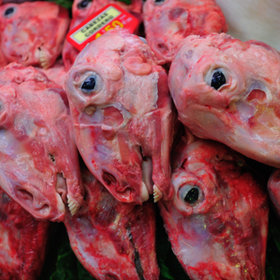
“Mageiritsa” is a Greek soup made of lamb offal that is made at – and only at – Easter.  It’s an incredibly time-consuming and labor- intensive production, which is probably why.  First comes the all-day or over-night simmering of the lamb’s heads and feet, to get the appropriately kelle paça type broth necessary.  (Kaleh pacheh seems to be a Friday after-prayer tradition in Afghanistan, so starting Thursday morning in front of all the butcher shops in Kabul, usually collected on one street, and by shacks along roads leading out of the city that seem to open just for that purpose, one sees giant piles of recently severed, bloody heads next to piles of bloody feet, both still in their fur, swarming with flies.  It’s a beautiful sight and one that, like so many other things in Afghanistan, I didn’t get a photo of while there because I thought I would embarrass people by taking pictures of things that I was afraid they would think I thought backwards.)  Then comes the cleaning out of faeces from about a football field’s length of lamb intestines (below), which is not that bad because they come from young animals that only eat grass anyway so it’s kind of the texture of baby poop.  (The European Union Daddy-State tried to ban the sale of intestines a few years ago and the Greeks to their credit, which I don’t grant them often, got into an uproar and Brussels backed down.  I actually have a theory that the intestine issue was the behind-the-scenes deal-breaker between the EU and Turkey, and rightly so; make me bend over backwards about how I run my country, make me reorganize my economy to enrich you and impoverish myself, treat me like an unwanted guest because I’m Muslim, but I’ll be damned if you take away my kokoreç.*)  Then you braise the intestines, and the sweetbreads (thymus glands) and hearts and kidneys in the broth (some people use liver or spleen and testicles too, but I don’t ‘cause the liver and spleen can get bitter and the testicles retain an unpleasant spongy texture when boiled which they don’t when grilled, or when sautéed with oil and a ton of garlic like they do with the bull’s balls in Spain after a bullfight — talk about sympathetic magic – and are quite yummy — see bottom.)  Then they’re all minced up, browned in a healthy amount of butter, added to the broth with lots of scallions and dill, some rice, and, just before serving, terbiye-d** with eggs and lemon.
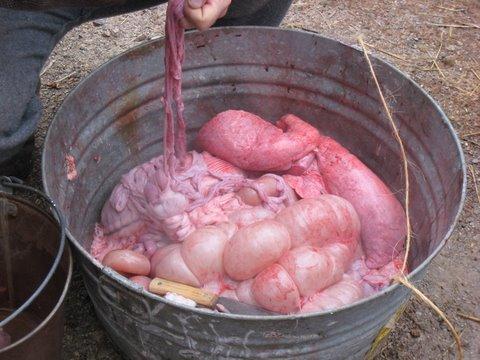
Intestines

It’s generally acknowledged that I make the best mageiritsa in the world.  You can get pretty good mageiritsa lots of places, but mine is the best…in the world.  When I serve it at Easter, some people can’t get enough of it and some people politely decline.  Others, unfortunately – and tellingly, it’s usually younger Greek-American family – have always felt they have license to grimace and make faces of disgust and revulsion.
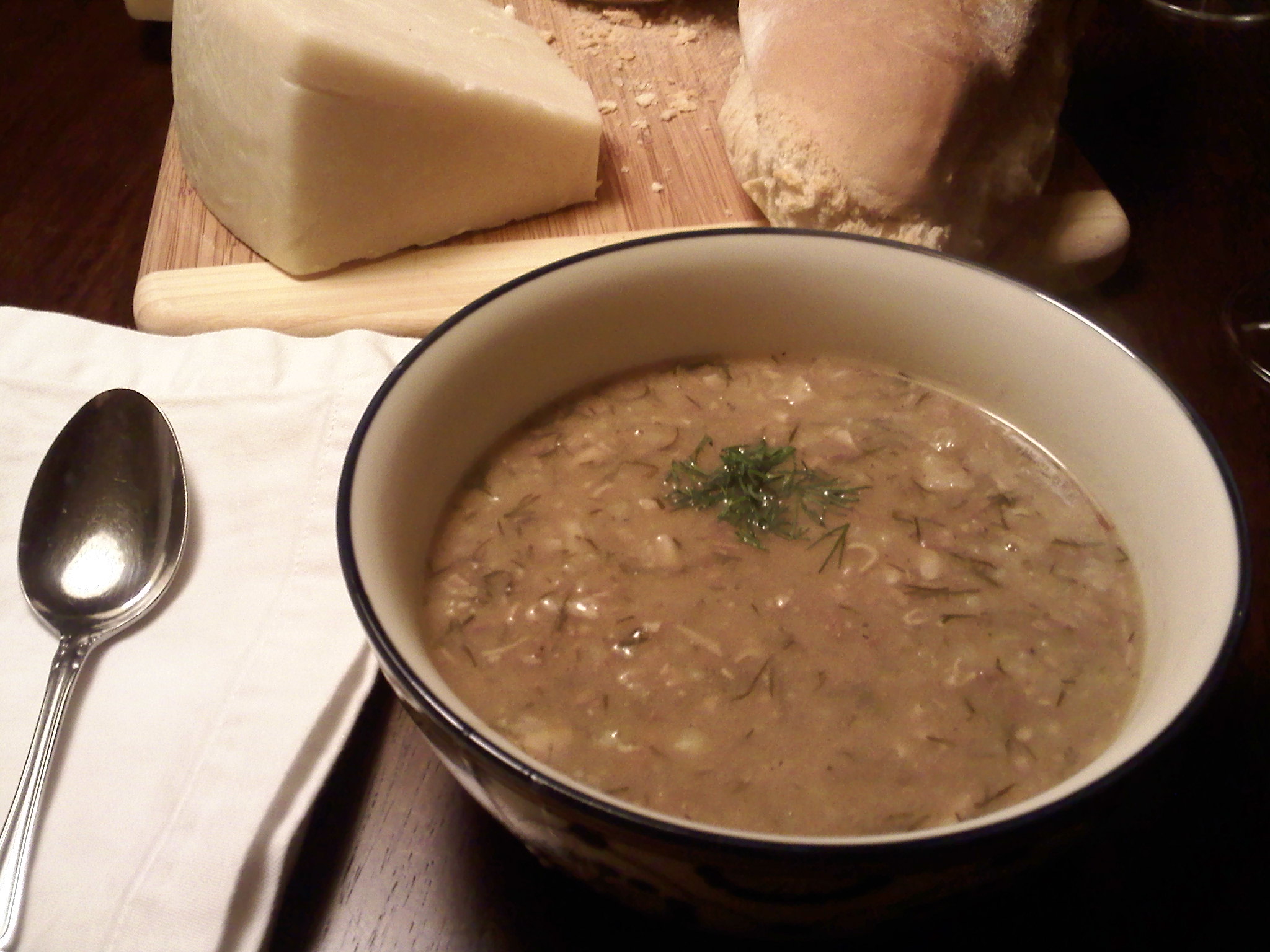
Mageiritsa — the finished product (click)

It’s bad enough that so much art and time and work on my part should be met with that kid of rudeness.  Then I have to listen to the anthropology tes poutsas about how people only used to eat that stuff because they were poor and they had to eat everything available, like eating intestines were the equivalent of the dirt-eating that tragically occurs in third world countries under famine conditions.  No they didn’t; they ate those things because they taste good.  Organ meats perform more complex biochemical functions in our and other animals’ bodies than muscle does; joints: feet and hocks, are complexly interconnected with tendons and cartilage of various kinds.  They therefore have more varied textures, mineral content and other elements, which gives them a richer and more varied taste than regular flesh has.  As mentioned in this brilliant book Nourshing Traditions: The Cookbook that Challenges Politically Correct Nutrition and the Diet Dictocrats by Sally Fallon, when a carnivorous animal (which we are, by the way; ignore false, scientifically faulty Vegan and Buddhist propaganda) kills another animal in the wild, the first thing it goes for are the guts because it instinctively knows they’re the most nutritious part.  Instead of teaching their kids the value and variety of our traditions or pointing out the beautiful economy with which our ancestors made use of every part of the animal, or their respect for and intimate knowledge of the world, the plants, and the animals which fed them, as opposed to our obscene wastefulness and complete alienation from any food which actually looks like food or reminds us of where it comes from, these people stupidly and condescendingly put it down to their poverty.
I never, ever heard anyone in older generations reminisce about the breast of any chicken or the dry, grey boti meat of a traditionally over-cooked Greek leg of lamb.  My mother used to wax nostalgic about an aunt’s Sunday pacha or the street kokoretsi they sold down by the lake in Jiannena next to the Karagöz puppet box (you’d get slices of it on wax paper, that or a cone of pumpkin seeds or a stick-full of pişmaniye and sit and watch Karagöz and Hacivat’s brilliant antics; I can’t be grateful enough that all these survived until I myself was a child.)  If a whole animal were roasted, the kids would fight over the head and its brains, tongue and the delicious, gelatinous cheek flesh.  And pig feet and andouillete are enjoyed in the best Parisian bistros, not just in supposedly impoverished Balkan or South American villages.

It’s a growing ecological disaster – a cultural one – and that’s what depresses me most.  We’re tangling ourselves (like most things modern, it starts in America but is spreading throughout the world) in such a neurotic, kosher-like web of food anxieties and hysteria that we’ll have soon lost access to half the things humanity used to enjoy at the table if we haven’t already.  I truly believe that it’s a phenomenon connected to the disappearance of other forms of diversity:

“All these seemingly disconnected events are the symptoms, you could say, of a global epidemic of sameness. It has no precise parameters, but wherever its shadow falls, it leaves the landscape monochromatic, monocultural, and homogeneous. Even before we’ve been able to take stock of the enormous diversity that today exists — from undescribed microbes to undocumented tongues — this epidemic carries away an entire human language every two weeks, destroys a domesticated food-crop variety every six hours, and kills off an entire species every few minutes. The fallout isn’t merely an assault to our aesthetic or even ethical values: As cultures and languages vanish, along with them go vast and ancient storehouses of accumulated knowledge. And as species disappear, along with them go not just valuable genetic resources, but critical links in complex ecological webs.”  — “In Defense of Differerence.”

“Oh, this is so salty.  Oh, this is so fatty.  Oh, this is so oily.  Oh, this must have so much cholesterol; I can feel my arteries clogging.  Eeew, this has liver in it.  It’s what?! Made with blooood?!”  (You can’t imagine how many people I’ve known who had heard of blood sausage but thought it was a metaphor.)  “Ugh, this is so sweet – I can’t take a second bite.”  We think we’re so sophisticated but are pretty much as incapable of thinking comparatively or relatively as an Amazonian tribe shooting arrows at airplanes.  It never occurs to us that fattiness, or cloying sweetness, or fishiness or gumminess were and are qualities that people enjoy.  One of the most interesting pieces of etymology that I’ve ever learned is that the word “funky” – one of the few African words to have passed into American English usage – actually means “stinky” in whatever West African language it comes from.  But it’s telling that it’s come to mean what it means for us: weirdly, pleasantly off-beat.  Cool — in a way you can’t put your finger on — ‘cause it’s off.  Get it?  Like certain French cheeses when they’re good and ripe and smell like your boyfriend’s unwashed underwear, or the obviously slimy texture and smell – the obviously slimy look even, with all its erotic overtones — of oysters or other raw seafood.  Funky.  Yum.

Even in foodie paradise New York — where curious Brooklyn Heights ladies are taking butchery classes and where you’ve started seeing more and more of the kind of tastes and smells I’m talking about on restaurant menus: tripe and boudin and fatback (and if that’s a good thing to you because you love good food, you’re indebted more than you know for that to one man: one of my best beloved heroes, Anthony Bourdain***, who wrote in his first best-seller, Kitchen Confidential: “My body is not a temple; it’s a playground.”) – try going out to dinner with a group of friends.  It’ll take several hours of conference calling before everybody’s food concerns and quirks are taken into consideration and then, if the night’s not over, you’ve ended up at a least common denominator restaurant where one of your group is still bound to torment a busy waiter with a barrage of anxious questions, requests for substitutions, no peanut oil, “light on the butter” or the resounding, echoing sound of “sauce on the side.”  This is most often a white girl who doesn’t cook (“sauce” is usually a fundamental component of a dish produced by the entire, holistic process of preparing it; you can’t put it on the “side;” it’s not the jarred tomato sauce you grew up eating, babe; you can’t make a blanquette de veau with the sauce on the ‘side,’ or a mole poblano with the mole on the side!) or it’s someone who has never worked in that business and has no idea what a tightly organized military operation a good New York restaurant is and what chaos that behavior throws both the floor and kitchen staff into, not to mention the offense to the chef himself and his line, who might not just be doing their jobs, but might actually be proud of the carefully conceived and prepared dishes they’re trying to put out.

I understand people have different tastes and that they even have different biochemical make-ups that might make certain tastes seriously unpleasant to them.  I mean, even Tom Colicchio doesn’t like okra, which I love, but I don’t hold it against him.  (I just know that he hasn’t eaten them properly prepared).  But the preparation and sharing of food is such a fundamental part of most human socializing and it’s become almost impossible to conduct in any civilized form through this thicket of prohibitions and fears. Which brings me to my final point: the social aspect, which includes issues of hospitality, personal pride, and what Greeks call philotimo, all heavily weighted and codified issues in ‘our parts.’

But my intestines need cleaning, so I’ll have to tackle the rest of this issue in another post.

*Kokoreç (shown below) is basically the same ingredients as mageiritsa but spitted and roasted.  The organ meats are spitted and the whole thing is wrapped around with the intestines like a giant andouillette.  In Greece, they cut it in slices and serve it like that, which I prefer.  In Turkey they usually mince it all up with red pepper after roasting and put it in a sandwich, which is delicious but doesn’t allow the texture of each constituent organ meat to be appreciated as much.

** Terbiye, what Greeks call augolemono, is supposed to be an egg-lemon liaison sauce used in many dishes or to thicken soups and is the greatest culinary hoax ever perpetrated on the peoples of the Near East.  Very simply, the recipe, as usually given, does not work, and does not produce a thickened sauce but a watery, sour mess.  When you make a béarnaise or a hollandaise you use minimal acid (vinegar or lemon respectively) only the egg yolks and pure butter, ideally clarified.  It’s impossible to scramble some whole eggs with lemon, pour some watery liquid out of a pot of cabbage sarma into it and expect that it will produce something comparable.  If you’ve ever seen a truly smooth, thick terbiye, some kind of extra binder (corn or regular flour) was added to it, and if the cook tells you otherwise she’s lying.  Never underestimate the tactics a Turkish or Greek woman (especially one from Istanbul) will resort to in order to protect her recipes and ensure no one else’s version is as good; lying is the least of it.

***Anthony Bourdain
My man Bourdain — get all his books here.
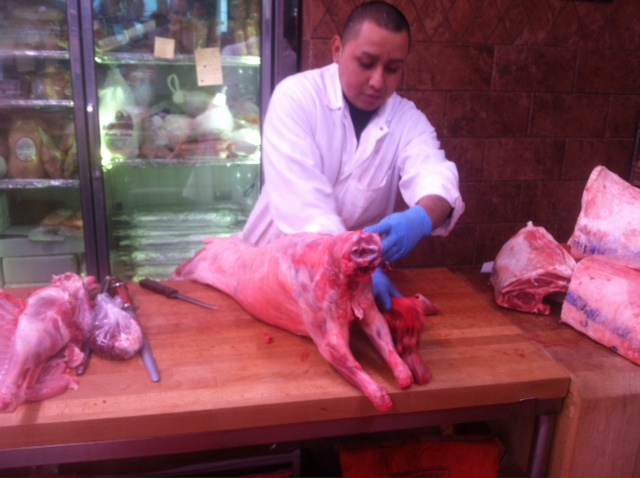
International Meats in Astoria, staffed almost entirely by Mexicans, who speak perfect Greek and know every detail of innards terminology in not only Greek, but Serbian and some Roumanian.  A Queens insituton.
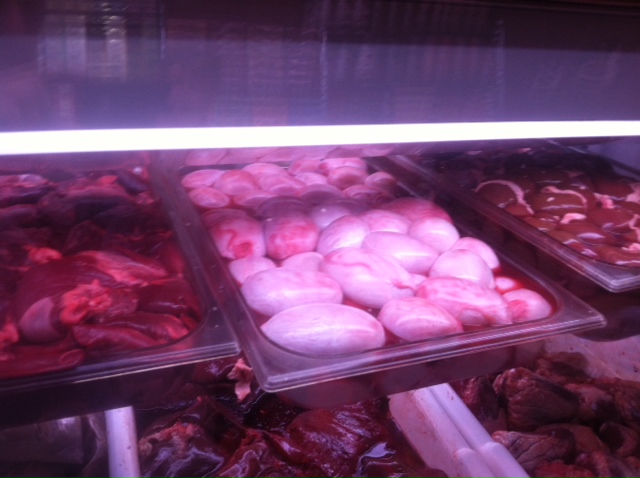
Bull balls at International, with liver to the left, kidneys on the right, spleen on bottom left, hearts on bottom right.

Comment: nikobakos@gmail.com

The Banner Photos

7 Apr

A few people have asked what the two photographs at the top of the blog are of and, even more, what their juxtaposition is supposed to mean?

The photo on the left is of a coffeehouse in Istanbul at the turn of the previous century.  The photo on the right is one taken by me in the mid-eighties of children in the Vlach village of Samarina in the Pindos mountains, near the watershed that separates Epiros (where my family is from) from western Greek Macedonia.  As for the relationship between the two, I’ll leave that to readers to ponder or figure out if they care to.  As a certain Nasreddin Hoca joke (Mullah Nasreddin in Iranian lands) much beloved by my father says: “Well, if you don’t know, go home…”

Maybe I’ll make a competition out of it…

Again, any questions: what’s a Vlach? where’s Epiros? why do I call it Greek Macedonia?  Please ask.


Comment: nikobakos@gmail.com

Egypt: The Other Homeland

6 Apr

Another people’s exodus from Egypt… 

I always feel like smirking a bit when I come across the title of Mark Mazower’s 2005 book: Salonica: City of GhostsIt’s not just that “our parts” with their ‘ancient, tribal hatreds’ always seem to be ‘haunted’ in the Western imagination; it’s just that, truly, which of our cities isn’t a city of ghosts?  Salonica, Sarajevo, Istanbul, Izmir?  Beirut, Alexandria, Lahore, Delhi?  Which?

Well, Al Jazeera has produced a beautiful little documentary by Giorgos Augeropoulos about the story of Alexandrian Greeks.  Augeropoulos is apparently the director of a highly praised Greek documentary series and has been pretty vocal in Greece’s recent political and fiscal crisis/rezili, but I had never heard of him before.

Al Jazerera, by the way, has now become my primary source of news.  It’s the only place one can get any serious international news, run from the idiocy of American politics, escape from MSNBC’s twenty-four hour liberal catechism class, and catch genuinely original and — I don’t know how else to put it — sincere documentaries like this.  Watch it when you have the chance.

Below are the complete texts of the two Cavafy poems used at the beginning and end of the documentary, “Candles” and “The City” in both Greek and English.  Single-accent Greek (the appropriately named “monotonic”) literally causes me visual pain — like, I can’t look at it, actually have more trouble reading it — and when used for Cavafy the pain reaches excruciating levels, but I couldn’t find the poems in polytonic versions anywhere on line; those who know what I mean, please forgive me.  And this from “The Official Website of the Cavafy Archive,” malaka: http://www.kavafis.gr/index.asp   …criminal, ntrope.  And I’m beyond certain Cavafy himself, so much of whose work was dedicated to memory, the past, and the continuity of Greek civilization, would have agreed

The English translations are by Edmund Keeley and Phillip Sherrard, still the best around, despite the attempts of many others.  Under the Greek version of “Candles” is the Greek actress Eirene Pappa’s performance of the poem set to music by Mimes Plessas.  Below the Greek version of the “The City” is a gorgeous reading of the poem by the truly great actress Elle Lambete, whose stunning Greek face I think readers should have a photo of as a visual reference:

Patricia Storace,  in her Dinner with Persephone: http://www.amazon.com/Dinner-Persephone-Travels-Patricia-Storace/dp/0679744789/ref=sr_1_1?s=books&ie=UTF8&qid=1333821533&sr=1-1, the first book I recommend to anyone who wants to get Greece and Greeks (along with Patrick Leigh Fermor’s classic Roumeli: http://www.amazon.com/Roumeli-Travels-Northern-Greece-Classics/dp/159017187X/ref=sr_1_1?s=books&ie=UTF8&qid=1333821635&sr=1-1), writes:

“Greek is not a voluptuous language, or a lilting one, but stony and earthy, a language full of mud, volcanic rock, and glittering precious stones…”

Listen to Lambete and you’ll know what she means.

Κεριά

Του μέλλοντος η μέρες στέκοντ’ εμπροστά μας
σα μια σειρά κεράκια αναμένα —
χρυσά, ζεστά, και ζωηρά κεράκια.

Η περασμένες μέρες πίσω μένουν,
μια θλιβερή γραμμή κεριών σβυσμένων·
τα πιο κοντά βγάζουν καπνόν ακόμη,
κρύα κεριά, λυωμένα, και κυρτά.

Δεν θέλω να τα βλέπω· με λυπεί η μορφή των,
και με λυπεί το πρώτο φως των να θυμούμαι.
Εμπρός κυττάζω τ’ αναμένα μου κεριά.

Δεν θέλω να γυρίσω να μη διω και φρίξω
τι γρήγορα που η σκοτεινή γραμμή μακραίνει,
τι γρήγορα που τα σβυστά κεριά πληθαίνουν.

Pappa and Plessas: http://www.youtube.com/watch?v=_0DiYKzHHdY&feature=related

Candles

Days to come stand in front of us
like a row of lighted candles—
golden, warm, and vivid candles.
 
Days gone by fall behind us,
a gloomy line of snuffed-out candles;
the nearest are smoking still,
cold, melted, and bent.
 
I don’t want to look at them: their shape saddens me,
and it saddens me to remember their original light.
I look ahead at my lighted candles.
 
I don’t want to turn for fear of seeing, terrified,
how quickly that dark line gets longer,
how quickly the snuffed-out candles proliferate.

Η Πόλις

Είπες· «Θα πάγω σ’ άλλη γη, θα πάγω σ’ άλλη θάλασσα.
Μια πόλις άλλη θα βρεθεί καλλίτερη από αυτή.
Κάθε προσπάθεια μου μια καταδίκη είναι γραφτή·
κ’ είν’ η καρδιά μου — σαν νεκρός — θαμένη.
Ο νους μου ως πότε μες στον μαρασμόν αυτόν θα μένει.
Όπου το μάτι μου γυρίσω, όπου κι αν δω
ερείπια μαύρα της ζωής μου βλέπω εδώ,
που τόσα χρόνια πέρασα και ρήμαξα και χάλασα.»

Καινούριους τόπους δεν θα βρεις, δεν θάβρεις άλλες θάλασσες.
Η πόλις θα σε ακολουθεί. Στους δρόμους θα γυρνάς
τους ίδιους. Και στες γειτονιές τες ίδιες θα γερνάς·
και μες στα ίδια σπίτια αυτά θ’ ασπρίζεις.
Πάντα στην πόλι αυτή θα φθάνεις. Για τα αλλού — μη ελπίζεις—
δεν έχει πλοίο για σε, δεν έχει οδό.
Έτσι που τη ζωή σου ρήμαξες εδώ
στην κώχη τούτη την μικρή, σ’ όλην την γη την χάλασες.

Lambete: http://www.youtube.com/watch?v=y32nzLanljY

The City

You said: “I’ll go to another country, go to another shore,
find another city better than this one.
Whatever I try to do is fated to turn out wrong
and my heart lies buried as though it were something dead.
How long can I let my mind moulder in this place?
Wherever I turn, wherever I happen to look,
I see the black ruins of my life, here,
where I’ve spent so many years, wasted them, destroyed them totally.”
 
You won’t find a new country, won’t find another shore.
This city will always pursue you. You will walk
the same streets, grow old in the same neighborhoods,
will turn gray in these same houses.
You will always end up in this city. Don’t hope for things elsewhere:
there is no ship for you, there is no road.
As you’ve wasted your life here, in this small corner,
you’ve destroyed it everywhere else in the world.


Comment: nikobakos@gmail.com

The name of this blog

6 Apr

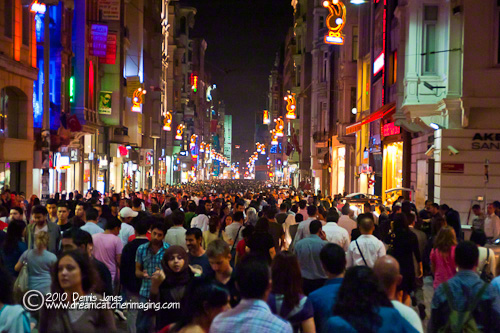
The name of this blog is the old Ottoman name for the main street of the new, ‘European’ side of Istanbul, the part of the City that grew and developed on the northern side of the Golden Horn beginning more or less in the late eighteenth or early nineteenth century, the neighborhood known as Pera or Beyoglu, the Greek Pera reappearing in more and more contexts lately as nostalgia about the city has become a minor industry and cultural phenomenon (Robinson Crusoe, easily one of the coolest bookstores in the world, now refers to itself as a “bookstore in Pera”).  Originally, I was going to confine this blog to Greek and Turkish issues and though that’s changed, I’ve kept the name because it’s the main drag of what – as far as I’m concerned – is still the zone’s keystone city.  I had thought of the street as an appropriately symbolic piece of territory where Greek and Turkish interaction was for a time at its most intense, most claustrophobic, even risky.  But even more, I thought of it as a space that best represents our mutual delusions, lies and hypocrisies.

Greeks think of the Jadde as the Main Street of Greek Istanbul, but neither the neighborhood nor Istanbul itself was ever as demographically Greek as the fantasy has it.  Further, the obvious wealth to which the street’s architecture bears witness always smelled a bit too much to me of nineteenth-century minority pretensions, by which I mean those six or seven post-Tanzimat* decades during which we enjoyed unprecedented access to the Empire’s wealth and financial resources without paying any of the obligations of being part of it; it’s apparently where Greek crowds had become so brazen that they gathered to yell: “Zwa! Zwa!”…”Animals!” at Turkish troops during the Balkan War as they left for the front and the mind-boggling casualties they were to experience there.  It’s also when, as soon as traditional restrictions on church construction were lifted, our new confidence raised up the three ugliest Greek churches ever built in the entire history of Constantinople – quite a feat.  And the palatial embassies of the Great Powers that breathed down the neck of the Ottomans for two hundred years and made those idyllic conditions possible for us still line the street.

Turks in the past couple of decades have spent considerable resources ‘restoring’ the area: the street was pedestrianized at some point in the late eighties I think; they set up a cute retro trolley car that runs down the middle and seems to serve no purpose but to annoy the crowds that have to constantly get out of its way; they’ve put some money into remodeling some buildings.  All of this has come hand in hand with a subtle psychological process running in many urbanized Turks’ minds that has gradually made of the neighborhood a symbol of Istanbul’s historically multi-cultural essence, which in many and moving ways it is.

It’s also where hundreds of  Armenians were murdered in a shockingly urban episode of the Hamidian massacres of 1896**, right there in the middle of all the Belle Epoque elegance and the cafes and the hotels, an event so brilliantly handled in the ‘duck with bamya’ (bamiyeh, bhindi, okra) chapter of Loksandra, and where, in one night of September 1955, every single Greek business on the street (marked beforehand in a perverse, inverted Passover), from Taksim to Tunel, down the Yuksek Kaldirim to Karakoy, along with almost every Greek church and cemetery in the rest of the city, were vandalized or completely destroyed in what turned out, after much bogus blaming and bullshitting, to have been nothing less than a government organized pogrom — pure and simple.  The event was later cynically used as one of the lesser charges brought against Adnan Menderes, the first ever democratically elected Prime Minister of Turkey, who had been in power at the time (‘55), by the military junta that removed him in 1960 and then hanged him and several other members of his government in 1961.  That doesn’t mean he wasn’t guilty of his part in organizing the riots — this, thefirst ever democratically elected Prime Minister of Turkey – he was; that’s just not why the Turkish military hanged him.  He was later exonerated, in fact, and has been semi-canonized since.  The Greek community got bubkes in compensation.  The riots were the beginning of the end, a shocking wake-up call to the complacent sense of security the City’s Greeks had started to feel in Turkey again after the fear and discrimination of the WWII years had passed, and they produced a massive exodus, exacerbated by other measures taken against them in the early sixties, as tensions over Cyprus and the usual tit-for-tat stupidities between the two countries grew.  (One will often hear Greek Polites*** bitterly blame Greek Cypriots for the progressive dissolution of their world, in the sad tones of one irrationally seeking a reason for an unassimilable loss.)  By the late seventies, their numbers had dropped below that point of critical mass that makes the sustaining of a meaningful community life possible: old people waiting to die, young people waiting to move to Greece.  I’m sure Thracian Turks in Greece can identify.

All this unpleasantness is usually excised from the contemporary Turkish nostalgia phenom’.  I remember on my first trips to Turkey as a teenager in the eighties even, often finding myself in the confusing position of being told: “Oh, lots of Greeks used to live around here,” in a smiling and totally sincere attempt at bonding and with a totally blissful indifference or maybe ignorance as to why they didn’t anymore, leaving me feeling both touched and irritated.  Granted, people have become markedly more sophisticated since then.

Anyway…  I could have called this blog the Istiklal Caddesi, which has been the street’s name since the nineteen-twenties and which I’m usually forced to use as well so people know where I’m talking about or don’t think I’m some freaky history nerd, but that would’ve been — no offense — too Republican.  I could have called it He Megale Hodos, but nobody ever really called it that except in the most official contexts (Greeks just called it the Straight Street, ‘Ho Isios Dromos’).  The a la Franca pretensions of la Grande Rue are just as self-evident.  So the old Perso-Ottoman “Great Way,” Jadde-ye Kabir, most fit my gousta and purposes.  Jadde means “street” in Farsi (and in modern Turkish and Arabic too; they’re originally Arabic — both words) but I like “way” because I liked the sort of ironic counterpoint between the great ceremonial routes of the old Imperial city on the other side with this thoroughly bourgeois little avenue.  The “path” too, says my Farsi dictionary, which also had a nice Zen ring.

Istanbul has twice septupled in size since the middle of the last century and Greek life there has faded away into nothing: the City has turned into a gigantic, intractable monstropolis like so many others.  Almost no one in Istanbul is from Istanbul anymore.  Yet this relatively small stretch of one small street still attracts massive daily and nightly crowds.  After a couple of depressed decades caused by the minority exodus, some criminally abusive urban planning projects and the criminal neglect of its architectural heritage, the street and the whole neighborhood have come back into their own again, and then some, in a way that frankly makes me so giddily proud and happy whenever I’m in C-town that any of the past’s bitterness just vanishes — it’s ok it’s not “ours” anymore; it’s still mine.  It’s perhaps the most instant snapshot one can get of Turkey’s current cultural dynamism, sophistication, prosperity, and growing freedom – in however tricky a state that freedom still may be.  Despite the clubs and malls of the northern or Asian suburbs, and despite the even more endless suburbs beyond them, inhabited by Anatolian migrants who may have never even seen it, the Jadde still gives the impression of being the default destination of any Istanbullu who’s meeting friends, looking to consume an urban pleasure of some kind, or just has nowhere else to go or anything else to do.  It’s a delicious, overwhelming mix of commercial crassness, elegance, sexiness, good music, cool bookstores, garbage and great food: an Eastern flaneur’s paradise.  In fact, aside from the Nevsky in Petersburg, I can think of no one street in which one can read so much of a great metropolis’ experience of modern urbanity as the Jadde.  It’s one of my favorite places on earth.

— For C., Istanbul, 2010

*Tanzimat: the “reforms” I think…or the “new order” maybe.  I don’t know if it refers to the actual beginning or the whole long nineteenth-century process; the response to the barrage of external and internal problems faced by the Ottoman Empire starting in the late eighteenth century: the interference of Western power interests and extortion; the loss of Balkan and Black Sea territories and the non-stop influx of refugees from those areas; the rise of local warlords (like Ali Pasha of Jiannena) who controlled large fiefdoms that were practically independent of Constantinople; an attempt to modernize the army in an attempt to recentralize things; the attempt to enfranchise the non-Muslim minorities (who didn’t, however, give up their nationalist aspirations in return) without totally freaking out the Muslim clerical establishment; a new constitution at some point, which was then suspended by Abdul Hamid, etc., etc.  Here, read about it yourselves: Tanzimat  The politics of the period are so torturously complex that no matter how much I read, I still can’t grasp the entire process.  I can’t remember which Sultan was pro-reform and which anti and which tried to take a middle path, except for A.H., who was eventually proven to be fairly undemocratic and a bit of a paranoid nut but was responsible for some impressive modernization projects anyway.  I don’t know when or how the Young Ottomans morphed into the Young Turks or who belonged to which group.

I know that it was all a titanic, often heroic, struggle to turn the Empire into a modern state.  I know there was a half-sincere, but belated and pathetic attempt to create a sense of “Ottomaness” among all its subjects/citizens; I won’t be the first one to make the comparison to Hapsburg Austria.  I know that when the constitution was restored in 1908, a year before Abdul Hamid was finally deposed,  there are stories — way too many, frankly, to be believable – of men of all ethnicities and imams and priests embracing in the streets of cities throughout the Empire in the spirit of their new found Ottoman brotherhood.  Then just five years later, in 1912, Greece, Bulgaria and Serbia joined forces and effectively ended what was left of the Ottoman presence in the Balkans and the Turks decided: “Well, fuck this…” and started concentrating on building a modern Turkish nation-state for Turks just like everyone else was doing for themselves.  And the rest, as they say…

It’s an important period for Greeks to know about because it puts into perspective the fact that our influence and wealth in nineteenth-century Turkey was not just due to our diligence and ingenuity and brilliance — to daimonio tes fyles — but also because we were operating in a host body weakened by daunting, almost insurmountable challenges, both internal and external.

** In August of 1896, a group of Dashnaks, an Armenian independence group, took hostages at the Ottoman Bank in Karakoy – I can’t remember what their demands were — and I think set off some grenades or something.  The Pera murders were a response to this, though violence against Armenians and inter-communal violence between Armenians and Muslims, especially in the southeast, had been growing exponentially in the months and years beforehand, all during the reign of Abdul Hamid (“Ho adikiorismenos,” as Loksandra would call him), hence “Hamidian.”

*** Greeks will often refer to Constantinople as “The City” “He Pole” – since it goes without saying which city one means.  “Polites” then are Greeks from The City.

Comment: nikobakos@gmail.com