Tag Archives: Jews

Salonica and Izmir “…the absence of history.”

23 Jun

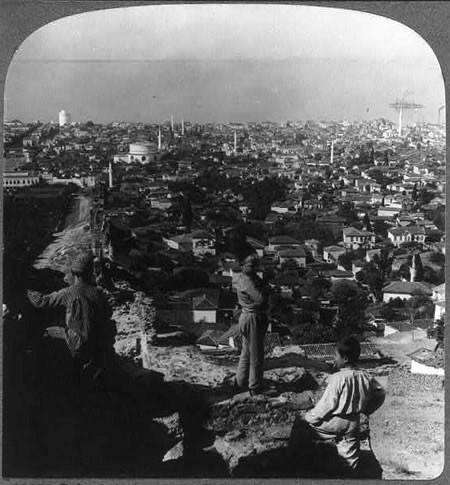
From my previous post’s comments on Salonica and Izmir…

A great book on the Population Exchange, with both extensive historical background that helps a reader from outside the region understand the events; a deep theoretical analysis on nationalism and ethnicity as concepts; the wars involved; the mechanics of the Exchange itself and its consequences, both large-scale and personal; how it would be considered the most objectionable kind of Ethnic Cleansing today and would raise howls of protest from the international community, but was then considered a perfectly rational way by our two Great Leaders to solve a problem and “nation-build” — move almost three million people against their will –setting a horrible twentieth-century precedent (which we’ll later see in Eastern Europe, Palestine, most tragically of all, India, in Yugoslavia…); and all somewhat miraculously condensed into a book of less then three hundred pages, is Bruce Clark’s Twice a Stranger: the Mass Expulsions that Forged Modern Greece and Turkey.

And if there’s a first book I recommend to anyone who wants to understand our complicated, often beautiful, mostly dysfunctional romance, and how it continues even after the Great Divorce, it’s this one:

Clark strikes the absolute perfect balance between historical and journalistic research and poignant personal accounts of both the Turkish and Greek refugees.  But these personal accounts are made even more moving by Clark’s own deep, emotional sense of loss and time and violence and his investment in his subject matter (his first chapter on Ayvalik, with it’s haunting, closing quote from one of his subjects: “It’s too early to remember,” is a masterpiece).  When you find out that Clark is Northern Irish, so knows of what he speaks when it comes to inter-communal viciousness, another layer of profundity is added to the experience of reading this book.  Many thanks to him for his generosity in allowing me to reproduce sections of his work.

I thought of one passage in particular, like I said, when mentioning both Salonica and Izmir’s sterility in the previous post:

“In this region of ancient settlement and civilization, there is often an unhappy mismatch between where people live now, and the places to which they feel the deepest attachment; and that mismatch is reflected in the physical environment.  Monuments and places of worship seem to be in the wrong place, or to be used for the wrong purpose.  In contrast with European cities like Bologna or Salamanca, where the past and present seem to blend quite seamlessly, the Aegean landscape is full of odd, unhappy disjunction; places where people have lived, prayed and done business for centuries feel as soulless and ill-designed as a strip development on an American turnpike.  That is partly the result, of course, of ill-managed and corrupt forms of economic development; but the legacy of an artificial exercise in social and ethnic remodeling has played a part.” [my emphases]

Some older photos that might help:
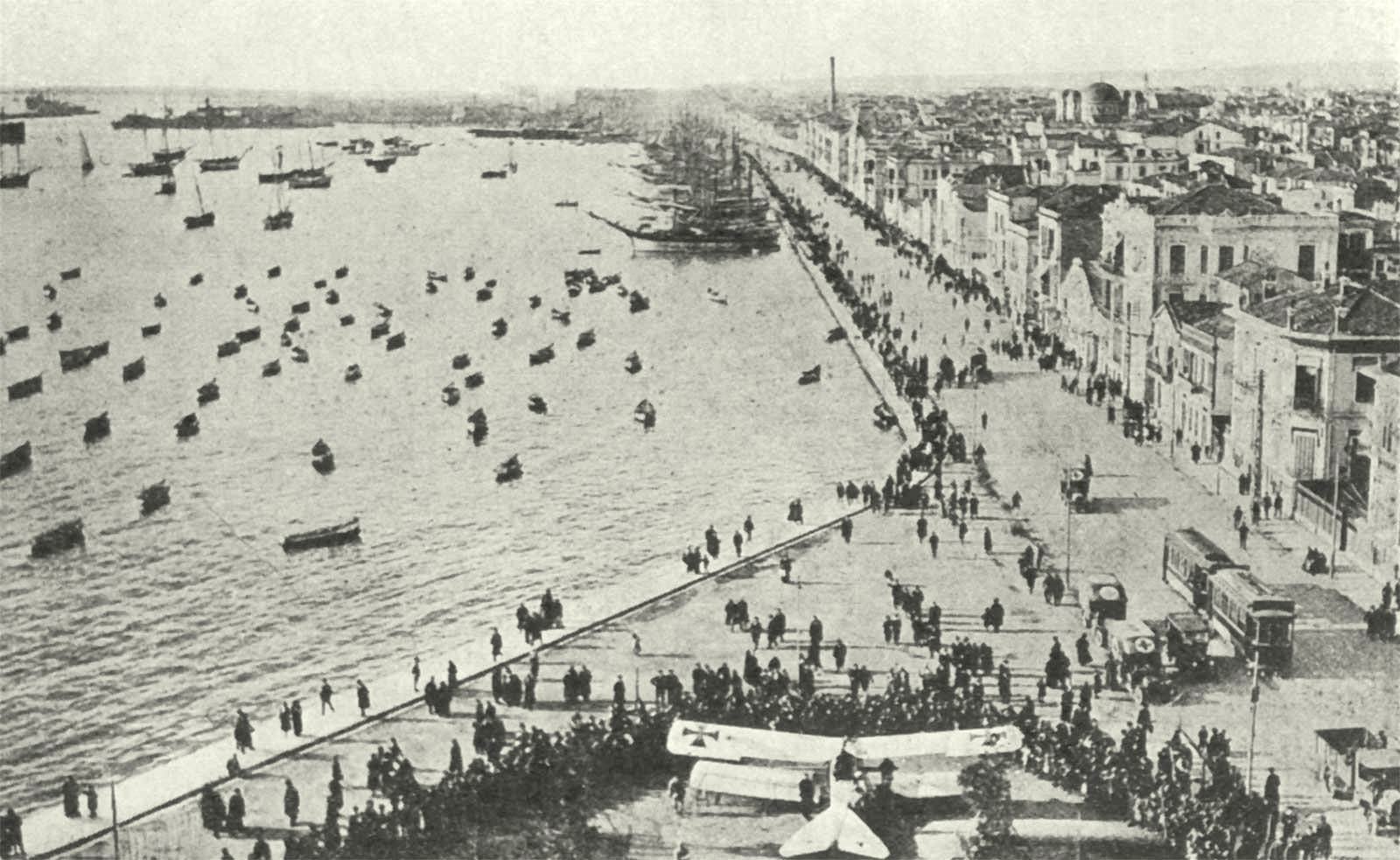
Salonika
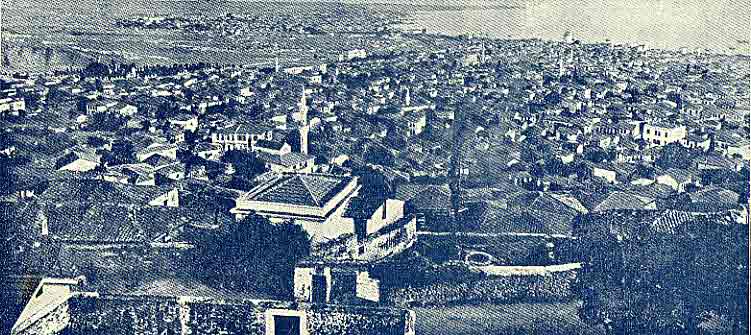
Solun: from a Bulgarian website.  That Kievan mosaic in the previous post should actually be titled Dmitiri Solunskiy, as he’s known throughout the Slavic world, where he’s widely venerated, but especially by Bulgarians and Macedonians.

Smyrna before the twenties

Stuff like this below, though, doesn’t really help, but I find clownish and borderline offensive: Izmir’s “Aegean Greek Wine Tavern” (though the food looks great and probably is)*; I mean, if it were in Istanbul, where there’s still a living memory of Greeks, it wouldn’t be so weird, but in Izmir, where there haven’t been any Greeks in almost a century, and from where they left under horrific conditions that can’t be compared to Istanbul Greeks’ slow exodus…plus, where due to the Exchange and the flood of refugees from Greece, there are probably hardly any native Izmirli Turks to remember them either (try finding a true native Salonikan who’s not of refugee origin) makes it a little creepy.


*The classic seafood-meze-raki meyhane was almost exclusively a Greek insitution in Turkey, and clearly the association lives on.  For obvious reasons, the tavern has always been default “gavur” territory, since the beginnings even of Islamic poetic culture.  The fish tavern continued to be mostly Greek terrain (and Armenian) in Istanbul itself until well into the sixties; in what little modern Turkish fiction I know set in C-town the only Greeks are waiters in seaside restaurants.  There are still a couple of Greek-owned ones left.  Which doesn’t mean that the genre doesn’t live on without us.  It flourishes in fact, and a good Turkish seafood-meze-raki meal in Istanbul is one of life’s sublime experiences.  I pity those who die without having experienced it.

Comment: nikobakos@gmail.com

Jewish New York gets scary, ctd.

20 Jun

I’ve written about the Israeli colonization of the Diaspora mind (in and not in connection with similar process among Greeks) here and here, so I was really intrigued by reading some of the comments on The Forward‘s* original post, which put a really interesting twist on things:

“They couldn’t even write it in Yiddish?” [asks one poster]

[reply]  “The billboard isn’t sanctioned by any official Orthodox organization but rather the work of a lone wolf accentric [sic]. The use of Hebrew rather than Yiddish or English suggests this to be the work of an Israeli trying to import Mea Shearim standards to Brooklyn,  [see: Haredi Judaism**]  The overwhelming majority of Orthodox Brooklynites (including Hassidic and yeshivish) view public spiritual policing as distasteful and bordering on incitefull [sic]. Also, the use of a billboard for this message is an oxymoron, since a spiritually sensitive person that tries to watch his eyes avoids looking at billboards altogether.”

*The Jewish Daily Forward (“Forverts”), a New York institution, central to progressive causes in the city and the country since its founding: The Forward.

**Haredi Judaism: these guys are the ones that made front pages last year for terrorizing a little girl in a short skirt in Israel, and have generally worked their way into a place where they hold much of Israeli politics hostage, though they don’t serve in the Israeli army on grounds that they don’t recognize Israel, but do accept massive amounts of public assistance from the Israeli state because their birthrate is so high and much of them, having only religious education, are unemployable (just so many yeshiva bochers an economy can absorb).  “The vast majority of Haredi Jews rejected Zionism for a number of reasons. Chief among these was the claim that Jewish political independence could only be obtained through Divine intervention, with the coming of the Messiah.”

Jewish New York gets scary…

18 Jun

Once the saving shelter of American society:

From Andrew Sullivan’s Dish:

Josh Nathan-Kazis provides translation and context:

“Dear Jew: You are entering a dangerous place. Shield your eyes.” That’s the Hebrew-language text on a huge billboard that an Orthodox group has paid to post alongside a Brooklyn highway. The “dangerous place” is Manhattan. The danger isn’t specified, but it’s clear they’re not talking about muggings.

Presumably directed at ultra-Orthodox Jews traveling to Manhattan for work, the billboard puts a stark spin on the new study out yesterday from the UJA-Federation of New York, which raised the possibility of an impending Orthodox majority among New York Jews. New York’s Orthodox Jews and non-Orthodox Jews exist in separate, parallel worlds. In the broadest terms, each group has its own borough. Brooklyn Jews are poor, young, and religious. Manhattan Jews are rich, old, and more secular. While Brooklyn’s Jewish community is exploding, Manhattan’s is shrinking. And judging in part by the highway billboard, the ascendant Brooklynites have little regard for the declining Manhattanites.”

It’s a culture war within a minority.


Comment: nikobakos@gmail.com

Photo: Greek Holocaust survivor

2 Jun

(Photo: Isaac Mizan (R), a survivor of the Holocaust, shows his tattooed serial number to university students in the Philosophical department at the University of Athens, May 29, 2012, in Athens, during an event dedicated to the remembering of the Holocaust. Greek Holocaust survivors made a rare public appearance today to challenge a neo-nazi party whose leader has cast doubt on the genocide and which won its first seats in parliament this month. They told of their ordeals during the killings and deportations by the Nazis that decimated the Greek Jewish population during World War II, a part of wartime history that is little talked about in Greece. By STR/AFP/GettyImages.)

Did they talk about the pre-war experiences of Greek Jews?  That they faced discriminatory re-housing policies after the 1917 fire that destroyed most of the Jewish-inhabited areas of Salonica, including about thirty of  what were probably some of the oldest and most historic synagogues in the world?  About violence against the community by fascist elements during the twenties and thirties, uncontained by any government, including the Campbell Riot of 1931 that destroyed shops, homes and synagogues?  That the great Venizelos had the community registered on a separate electoral role to neutralize any political power they might have on the grounds that you could not have a “foreign arbiter” playing a role in Greek politics, but really because Greek Jews were generally monarchists in their sympathies.*  About the community’s running battle with the municipality of Salonica during the inter-war years to prevent appropriation of its cemetery, one of the oldest and largest in the world that contained an estimated 350,000 graves before the war?  About how after the Germans destroyed it the municipality used discarded gravestones as sidewalk pavement and built the city’s university on the ruins?  That there’s been no effort to save relics of the cemetery found at any point during the university’s expansion or during the recent metro construction through the area?

* See Syrian Christians; minorities have almost always feared “liberals” and “democrats,” wary of the tyranny of the majority without a protecting “patron” of their own.

Comment: nikobakos@gmail.com

Shvuyes

27 May

I am categorically opposed to the Zionist tyranny of neo-Hebrew pronunciation, though I don’t know what gives me the right to such a strong opinion on the subject since I’m not even Jewish.  But I am a New Yorker, and pretty proprietary about at least my city’s Jewish and Yiddish-speaking heritage, and it bugs me to no end that most young New York Jews now say: “L’Shan-ah To-vah” in their best Hebrew school accents, instead of “Lu-sha-nuh To-vuh,” or “Sim-chat To-rah” instead of “Sim-ches Toy-ruh” like they used to.

We have no idea how ancient, pre-Babylonian Hebrew was pronounced; the Jews returning from exile having thoroughly become Aramaic speakers.  The pronunciation of Modern Hebrew was constructed on the basis of Sephardic liturgical pronunciation of the language, on the flimsy assumption of some kind of Semitic purity to be found in Sephardic usage, which the nineteenth-century Zionists in Europe who formulated the pronunciation and other structures of Modern Hebrew were probably attracted to mostly as an exotic escape from Galizianer shtetl-stigma and not any serious linguistic or historical considerations — the lost Golden Age of Jewish Spain being a nobler basis for Zionism’s new start than the muddy reality of Poland.  The old Ashkenazi-Yiddish pronunciations served the vast majority of the world’s Jews perfectly fine for many centuries and there was no need to “correct” them.

But Zionism is so often about reducing the entire Jewish historical experience — before the success of its ethically problematic project — to shame, though it was through the diaspora that Jews were forced to cultivate their greatest and most extraordinary gifts and share them with the rest of humanity as well.  That’s why I feel there’s an anti-diaspora shame in this pronunciation issue too that I don’t like.  And an Israeli colonization of the diaspora Jewish mind and soul, culturally and politically, that I like even less, but which is probably now irreversible.  Worse — a victim-shame which, combined with genuine, horrific trauma, has all kinds of negative and destructive consequences for Jews and everyone around them.  While Joseph Massad’s claim that Zionism is an: “anti-Semitic project of destroying Jewish cultures and languages in the diaspora,” is a bit hyperbolic, that’s pretty close to how I feel as well.

On a lighter note, Shvuyes is when you eat blintzes – and other dairy.  I don’t know why.

Comment: nikobakos@gmail.com

Pentecost

27 May

Today is Pentecost (it was last Sunday in the western Church), the day that commemorates the descent of the Holy Spirit and the divine enlightenment of the gathered Apostles, when they were suddenly given the wisdom to speak all languages and that marks the institutional beginning of their mission and the Church generally.  What the New Testament doesn’t say is that the Apostles were gathered to celebrate Shavuos (lit. “weeks”), “Shvuyes” in deep Yiddish pronunciation,* the day God gave the Torah to the people of Israel.   The Christian feast of a gift of divine wisdom was based on the existing Jewish feast of a gift of divine wisdom, and Shavuos comes seven weeks after the first day of Passover, like Pentecost comes seven weeks after Easter – it means “fiftieth” – a name Greek-speaking Hellenistic Jews were already using for the holiday long before the Christian era.

I always loved the reading for Pentecost from the Book of Acts (below in English, the original Greek and the Vulgate Latin).  In its endless list of peoples I always felt a kind of Pax Romana yearning for unity that still moves me, especially when it’s properly recited.  It’s a bit of a sad holiday too because it marks the official end of the Easter cycle (like it does the end of the Counting of the Omer in Judaism).  The day before is one of the several “soul Saturdays” on which the Orthodox Church commemorates the dead; old folk beliefs held that the dead dwell among us from the Resurrection until the eve of Pentecost and then depart again.  And tonight at vespers, people kneel for the first time since Holy Week; the joy of the Easter season prohibits any kneeling or prostrations during the seven weeks it lasts.  It’s the return to Real from Divine time.  And from the period of renewal where death has been defeated to real existence again where it still holds full sway.  Until the promise of the next Resurrection.

I couldn’t find a recitation of the actual second chapter.  But here’s a beautiful Arabic recitation of the first chapter of Acts — which uses the same phrasing as a Greek reading would — where Christ preps the Apostles on what’s in store for them and, like a good rabbi, tells them not to ask too many questions:

And here’s Giotto’s depiction of the event from the Scrovegni Chapel in Padua, which probably contains more spectacular art than any other equivalent square footage of space in the world:

And El Greco’s more violent, Cretan-Spanish imagining (it became a tradition to include the Virgin in the scene, especially in the West, though Acts doesn’t mention her):

2 And when the day of Pentecost was fully come, they were all with one accord in one place.

And suddenly there came a sound from heaven as of a rushing mighty wind, and it filled all the house where they were sitting.

And there appeared unto them cloven tongues like as of fire, and it sat upon each of them.

And they were all filled with the Holy Ghost, and began to speak with other tongues, as the Spirit gave them utterance.

And there were dwelling at Jerusalem Jews, devout men, out of every nation under heaven.

Now when this was noised abroad, the multitude came together, and were confounded, because that every man heard them speak in his own language.

And they were all amazed and marvelled, saying one to another, Behold, are not all these which speak Galilaeans?

And how hear we every man in our own tongue, wherein we were born?

Parthians, and Medes, and Elamites, and the dwellers in Mesopotamia, and in Judaea, and Cappadocia, in Pontus, and Asia,

10 Phrygia, and Pamphylia, in Egypt, and in the parts of Libya about Cyrene, and strangers of Rome, Jews and proselytes,

11 Cretes and Arabians, we do hear them speak in our tongues the wonderful works of God.

12 And they were all amazed, and were in doubt, saying one to another, What meaneth this?


2 Καὶ ἐν τῷ συμπληροῦσθαι τὴν ἡμέραν τῆς πεντηκοστῆς ἦσαν πάντες ὁμοῦ ἐπὶ τὸ αὐτό, καὶ ἐγένετο ἄφνω ἐκ τοῦ οὐρανοῦ ἦχος ὥσπερ φερομένης πνοῆς βιαίας καὶ ἐπλήρωσεν ὅλον τὸν οἶκον οὗ ἦσαν καθήμενοι, καὶ ὤφθησαν αὐτοῖς διαμεριζόμεναι γλῶσσαι ὡσεὶ πυρός, καὶ ἐκάθισεν ἐφ’ ἕνα ἕκαστον αὐτῶν, καὶ ἐπλήσθησαν πάντες πνεύματος ἁγίου, καὶ ἤρξαντο λαλεῖν ἑτέραις γλώσσαις καθὼς τὸ πνεῦμα ἐδίδου ἀποφθέγγεσθαι αὐτοῖς.

Ἦσαν δὲ ἐν Ἰερουσαλὴμ κατοικοῦντες Ἰουδαῖοι, ἄνδρες εὐλαβεῖς ἀπὸ παντὸς ἔθνους τῶν ὑπὸ τὸν οὐρανόν· γενομένης δὲ τῆς φωνῆς ταύτης συνῆλθε τὸ πλῆθος καὶ συνεχύθη, ὅτι [ἤκουον εἷς ἕκαστος τῇ ἰδίᾳ διαλέκτῳ λαλούντων αὐτῶν· ἐξίσταντο δὲ καὶ ἐθαύμαζον λέγοντες· Οὐχ ἰδοὺ πάντες οὗτοί εἰσιν οἱ λαλοῦντες Γαλιλαῖοι; καὶ πῶς ἡμεῖς ἀκούομεν ἕκαστος τῇ ἰδίᾳ διαλέκτῳ ἡμῶν ἐν ᾗ ἐγεννήθημεν; Πάρθοι καὶ Μῆδοι καὶ Ἐλαμῖται, καὶ οἱ κατοικοῦντες τὴν Μεσοποταμίαν, Ἰουδαίαν τε καὶ Καππαδοκίαν, Πόντον καὶ τὴν Ἀσίαν, 10 Φρυγίαν τε καὶ Παμφυλίαν, Αἴγυπτον καὶ τὰ μέρη τῆς Λιβύης τῆς κατὰ Κυρήνην, καὶ οἱ ἐπιδημοῦντες Ῥωμαῖοι, 11 Ἰουδαῖοί τε καὶ προσήλυτοι, Κρῆτες καὶ Ἄραβες, ἀκούομεν λαλούντων αὐτῶν ταῖς ἡμετέραις γλώσσαις τὰ μεγαλεῖα τοῦ θεοῦ. 12 ἐξίσταντο δὲ πάντες καὶ διηπόρουν, ἄλλος πρὸς ἄλλον λέγοντες· Τί θέλει τοῦτο εἶναι;


2 et cum conplerentur dies pentecostes erant omnes pariter in eodem loco

et factus est repente de caelo sonus tamquam advenientis spiritus vehementis et replevit totam domum ubi erant sedentes

et apparuerunt illis dispertitae linguae tamquam ignis seditque supra singulos eorum

et repleti sunt omnes Spiritu Sancto et coeperunt loqui aliis linguis prout Spiritus Sanctus dabat eloqui illis

erant autem in Hierusalem habitantes Iudaei viri religiosi ex omni natione quae sub caelo sunt

facta autem hac voce convenit multitudo et mente confusa est quoniam audiebat unusquisque lingua sua illos loquentes

stupebant autem omnes et mirabantur dicentes nonne omnes ecce isti qui loquuntur Galilaei sunt

et quomodo nos audivimus unusquisque lingua nostra in qua nati sumus

Parthi et Medi et Elamitae et qui habitant Mesopotamiam et Iudaeam et Cappadociam Pontum et Asiam

10 Frygiam et Pamphiliam Aegyptum et partes Lybiae quae est circa Cyrenen et advenae romani

11 Iudaei quoque et proselyti Cretes et Arabes audivimus loquentes eos nostris linguis magnalia Dei

12 stupebant autem omnes et mirabantur ad invicem dicentes quidnam hoc vult esse.

* See next post


Comment: nikobakos@gmail.com

“…the innocent boy of seventeen…”

12 May

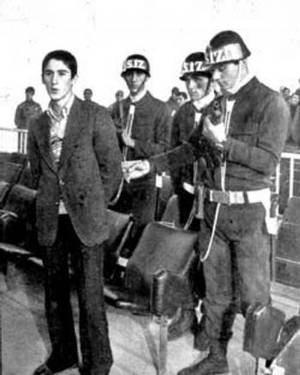
Though it was only incidental to the previous post, the image of Erdal Eren has haunted me for the rest of the night; perhaps it’s the photo of him and its painful youth and innocence; obviously the terrifying quote: that he looked forward to his execution in order to avoid thinking of the torture he had witnessed; maybe it’s that hanging has always struck me as a particularly obscene form of capital punishment’s obscenity (the setting looks prison-like, like he’s actually entering the gallows chamber there…)

Then the eerie reminder of the Cavafy poem: “27 June 1906, 2 p.m.”

27 Iουνίου 1906, 2 μ.μ.

Σαν το ’φεραν οι Xριστιανοί να το κρεμάσουν
το δεκαεφτά χρονώ αθώο παιδί,
η μάνα του που στην κρεμάλα εκεί κοντά
σέρνονταν και χτυπιούνταν μες στα χώματα
κάτω απ’ τον μεσημεριανό, τον άγριον ήλιο,
πότε ούρλιαζε, και κραύγαζε σα λύκος, σα θηρίο
και πότε εξαντλημένη η μάρτυσσα μοιρολογούσε
«Δεκαφτά χρόνια μοναχά με τα ’ζησες, παιδί μου».
Κι όταν το ανέβασαν την σκάλα της κρεμάλας
κι επέρασάν το το σκοινί και το ’πνιξαν
το δεκαεφτά χρονώ αθώο παιδί,
κ’ ελεεινά κρεμνιούνταν στο κενόν
με τους σπασμούς της μαύρης του αγωνίας
το εφηβικόν ωραία καμωμένο σώμα,
η μάνα η μάρτυσσα κυλιούντανε στα χώματα
και δεν μοιρολογούσε πια για χρόνια τώρα·
«Δεκαφτά μέρες μοναχά», μοιρολογούσε,
«δεκαφτά μέρες μοναχά σε χάρηκα, παιδί μου».

“27 June 1906, 2 p.m.”

When the Christians brought him out to be hanged
the innocent boy of seventeen
his mother there near the scaffold
was dragging and beating herself in the dust,
under the sun, the savage noon-day sun,
and now would screech, and now would howl like a wolf, like a beast,
and then exhausted the martyred woman would keen
“You only lived these seventeen years my child.”
And when they raised the boy up on the scaffold,
and passed the rope around his neck,
the innocent boy of seventeen,
and his body swung hideously in the void
wracked by the spasms of his black agony
the beautifully made youthful body,
the martyred mother rolling in the dirt
was no longer keening of years,
“Seventeen days only” she keened,
“Seventeen days only did I enjoy you, my child.”

(my translation)

Erdal Eren

Cavafy wrote the poem in remembrance of the 1906 Denshawi affair, one of Britain’s unfinest hours.  Apparently some British military personnel were returning from Cairo to Alexandria and, near the village of Denshawi, shot some pigeons that belonged to the locals.  A scuffle ensued; a rock was thrown that hit a British soldier on the head and, though he died of what was later proven to be sunstroke, like a delicate E.M. Forster memsahib, five of the residents of Denshawi, including the seventeen-year old of the poem, were imprisoned.  Fortunately, there was such a public outcry after the execution of the young man that the other four men were released, though not till two years later in 1908.  The episode still remains disgusting and Cavafy’s poem one of his most chilling, a register he usually didn’t work in.

At the same time it’s a beautiful reminder of his humanity on several levels.  One is his life-long opposition to capital punishment: “Whenever I have the opportunity I declare this,” he wrote in 1902.  The other, without re-outfitting him as a post-colonialist before his time, is his affection for and lack of alienation and estrangement towards Egypt itself.  He could have had the cloistered emotional outlook of an erudite fag in the European cocoon of Alexandria, yet the otherness that life imposed on him taught his heart the right lessons.  The above poem (even his use of “the Christians,” which in the context can mean nothing less than “the kafirs,”* is a jarring statement of identification) is only his most poignant expression of his love for the country, not just the historical Egypt of so much of his poetry, but the actual Arab Egypt he lived in; “To glyky mas Misiri,” as he calls it in one poem: “Our sweet Misiri” — our sweet Egypt.**

I wonder what he would have thought of the current state of Greek politics – not that he ever cared much for either the Neo-Greek statelet or its inhabitants.  What would a man that lived and wrote on the cusp of every possible human margin and in every plural space conceivable, who would have died before he let his Hellenism be trapped by geography, nationalism or its idiocy, have thought of Greece having the most potentially powerful Nazi (I’m tired of dignifying them with the prefix neo-) party on the European continent?  And that granted to them by a significant youth vote.  A thirty-something Athenian, and a left-leaning one at that, recounting to me the multiple incidents of petty anti-immigrant animosity that she had been witness to in Athens even before the current crisis, recently said to me, in glib defensiveness: “Well, we’re not used to strangers in our country.”  This from us, malaka, the inventors of migration and its pain, who since the beginning of our historical presence have been strangers in every stranger’s land on the planet, except those corners ventured into only by more intrepid or desperate Jews or Gypsies.  It’s beyond even remotely doubting for me that it’s partly the loss of a diaspora consciousness on Neo-Greeks’ part, and the wider sense of world it gives you, that has made us such closed, parochial idiots, just as Israel — sorry to say — has had the same effect on Jews.  And the comparison doesn’t end there; in both cases the diaspora is not just forgotten and ignored, but a source of embarrassment and shame, and each state and its official and/or fabricated culture has the hubris to think itself the metropolitan standard that those left outside should aspire to, when neither state in question contained a serious metropolitan center of either Hellenism or Jewishness until the twentieth century (…with Israel causing a progressive closing of the Jewish mind everywhere — a disaster for all of us).  Now maybe that some young Greeks have had to start emigrating again some of that attitude will get a real reality check.  The economic crisis in Greece is a source of genuine consternation for me and I’m guardedly on the anti-EU/Troika side; at the same time some humility may be exactly what that society needed.  Maybe…though voting for Nazis doesn’t exactly indicate humility but childish rage.


*Qafr, kafir: infidel

**Masr is Egypt in Arabic.  Cavafy uses “Misiri” because in Modern Greek words can only end in certain consonants.  This is something  — tzatziki, kazani, kadaifi, kokoretsi, duvari — that makes Turks giggle and strikes them as particularly funny when they hear it in Greek and the kick they get out of it has always struck me as particularly sweet in return.  I think Cavafy intended it to have this effect.


Comment: nikobakos@gmail.com

“Soft Ethnic Cleansing”

7 May

From Andrew Sullivan’s Daily Beast:

Greater Israel And “Soft Ethnic Cleansing”

I guess we should be grateful that congressman Joe Walsh did not get into specifics, when he unveiled his proposal for an Israel-Palestine settlement. But it’s a disarmingly candid expression of what many in the GOP now believe:

The two-state solution has failed. Only a one-state solution – a single, undivided Israel – will bring peace, security and prosperity to Israelis and Palestinians alike.

What about the Palestinians? Bob Wright explains Walsh’s project:

Give Palestinians who live in those territories “limited voting power” in the new, bigger Israel that they’ll have suddenly become residents of. (Walsh doesn’t define his euphemism, but no doubt the idea is that Jews get one-person-one-vote and Palestinians get something less, so that Israel can remain a Jewish state.) … Palestinians who don’t like having “limited voting power” can move to Jordan.

Bob explains why this is more than troubling:

When you (1) tell members of an ethnic group that the land they live on is being given to another nation; (2) tell them that neither they nor their descendants will be allowed to vote in that nation’s elections, even though next-door neighbors of a different ethnicity can; (3) tell them that the only way to avoid this fate is to go to another country–yeah, I’d call that ethnic cleansing, at least of a “soft” variety.

I think that’s where Israel is eventually headed: ethnic cleansing by a variety of means, sealing its abandonment of the Western tradition for pure tribalism – and worse. I desperately hope I’m wrong, but the last few years are deeply discouraging for any serious two-state solution. Greenwald notes:

Screen shot 2012-05-07 at 12.00.34 PM

We all know the rules by now: it’s okay to tell Palestinians to get out of Israel, but not Jews. Why? Er …

Comment: nikobakos@gmail.com

Palestinian Christians Respond

28 Apr

Nice if they had gotten a few more interviews.  I also just don’t believe it’s completely true either; “there was no difference; we all lived so happy together” is one of the most pernicious and lying cliches of the region.  One of the sub-plots in Scandar Copti and Yaron Shani’s great 2009 Ajami is of a Palestinian Christian girl who is violently prohibited from marrying a Muslim boy (the two shown below — in a very funny scene — and at 0:36 of the trailer pretending not to know each other).  SEE this film and if you get your hands on the DVD make sure and watch the “Making of…” part.  It’s as good as the film itself.

Here’s the film’s website: http://www.kino.com/ajami/ and trailer:

It’s just not for Oren, in his perfect Jersey English, to weigh in on the issue.


Comment: nikobakos@gmail.com

Greeks

28 Apr

This is also us at our absolute, perverse best.  This is when I love us.  What the biker screams at the mini-van driver is: “Fuck my Virgin, you had a red light!!  You had a red light!!  (‘Fuck my Virgin’  ‘Fuck my Christ’  ‘Fuck my Cross’ are vulgar, if pretty common, ways to say ‘goddamnit’ in Greek.  You can also say ‘Fuck your Virgin’ but then things can get ugly).

I love this guy!  He comes within an inch of his life but, a true Greek, his primary concern is making his argument, making his rhetorical point: “You had a red light!!”

And then the priceless walking away; not even angry, just irritated at the other guy’s impermeable stupidity.

“You had a red light!!”

It’s like a Jewish joke with violence…


Comment: nikobakos@gmail.com