Tag Archives: Kashmir

Photo: Kashmir

26 Jun

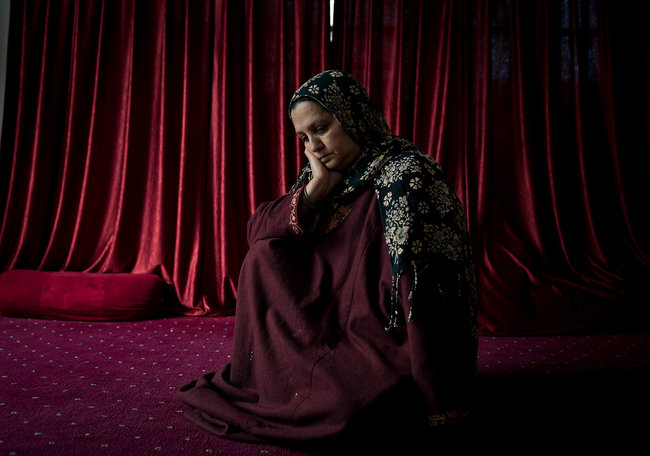
Grief. Red. Ruby. Blood. Velvet. Agha Shahid Ali. His mother. The Virgin. The clean, empty comfort of a Muslim home. The great disgrace of the “world’s largest democracy.”

Parveena Ahangar has not seen her son since three officers took him away in 1990, she said. The officers have not been punished.  (The New York Times)

“In Kashmir, Killing Ebbs, but Killers Roam Free”


Comment: nikobakos@gmail.com

Srinagar: Miraj-Ul-Alam

24 Jun

Kashmiri Muslims pray as an unseen custodian displays a holy relic, believed to be a hair from the Prophet Muhammad’s beard, at Kashmir’s main Hazratbal Shrine in Srinagar on June 22, 2012, during the last Friday of celebrations for Miraj-Ul-Alam (Ascension to Heaven).  (By Tauseef Mustafa/AFP/Getty Images.)

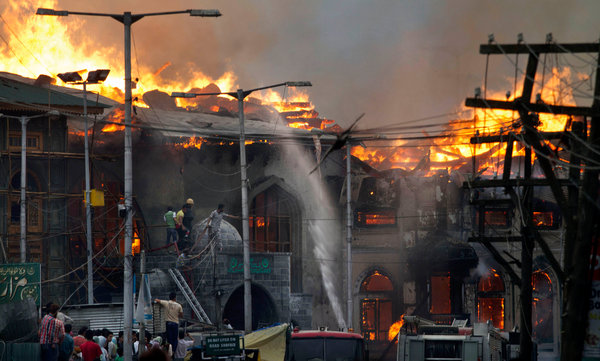
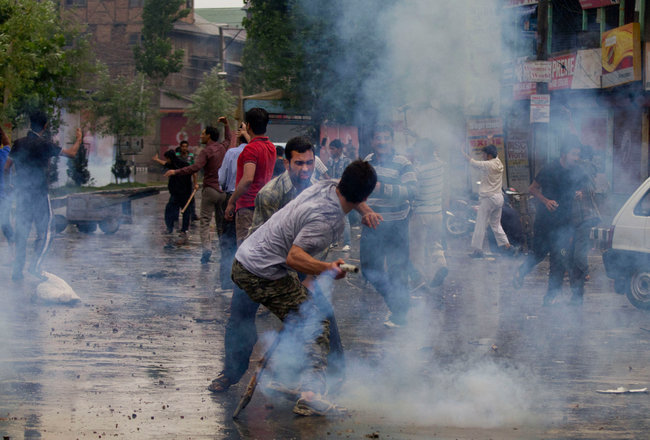
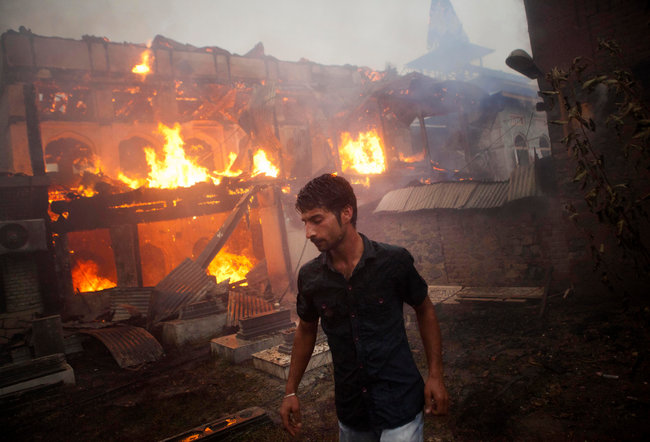
P.S.: Blaze at Sufi Shrine Triggers Violence in Indian Kashmir

Kashmiri residents helped firefighters extinguish the blaze at a Sufi shrine in Srinagar on Monday.  (Dar Yasin/Associated Press)

Protesters clashed with security forces in downtown Srinagar.  (Dar Yasin/Associated Press)

The cause of the fire at the shrine, which housed a relic of an 11th century Sufi saint, was not immediately known.  (Dar Yasin/Associated Press)

Residents pulled a water pipe to help battle the blaze.  (Danish Ismail/Reuters)

“Police sealed off roads leading to the shrine where hundreds of men and women had gathered, many of them wailing and crying.

“I feel like I’ve lost everything,” cried a 45-year-old woman, Shameema Akhtar, tears rolling down her cheeks.

Muslim militants spearheading the anti-India campaign in Kashmir have in the past tried to enforce a radical form of Islam, banning beauty parlors, cinemas and liquor shops, as well as asking women to wear the veil.

But they have had little success in a region where people mostly follow Sufiism, a gentle, mystic tradition of Islam.”

Tens of thousands of people have been killed in the years of strife in the region that both of the nuclear-armed rivals, India and Pakistan, claim. Pakistan controls part of Kashmir in the west.


Comment: nikobakos@gmail.com

Agha Shahid Ali

11 May

Talk of poetry, the Delhi Wallah and Kashmir (May 10, “Favorite Blogs: The Delhi Wallah”) made me think of one of my favorite poets of the past few years, the Kashmiri-American — I guess one would call him — Agha Shahid Ali, a prolific poet who wrote about the ghazal, edited a book of ghazals in English: Ravishing DisUnities: Real Ghazals in English and wrote a collection of his own ghazals in English: Call Me Ishmael Tonight a tiny volume that obsessed me for months the first time I got my hands on it.  That one of the most beautiful men I’ve ever known — a friend and the saqi at a bar in Astoria I used to go to — introduced me to it didn’t hurt either.  “Strange and beautiful” he called them, and I still do, and often think that the one must always by necessity partake of the other to some extent: in poetry, in religion, in the physical beauty of a man or woman, in an idea…

Here’s part of Ali’s description of the genre:

“The ghazal is made up of couplets, each autonomous, thematically and emotionally complete in itself… once a poet establishes the scheme—with total freedom, I might add—she or he becomes its slave. What results in the rest of the poem is the alluring tension of a slave trying to master the master.”

In Arabic

A language of loss? I have some business in Arabic.
Love letters: a calligraphy pitiless in Arabic.

At an exhibit of miniatures, what Kashmiri hairs!
Each paisley inked into a golden tress in Arabic.

This much fuss about a language I don’t know? So one day
perfume from a dress may let you digress in Arabic.

A “Guide for the Perplexed” was written–believe me–
by Cordoba’s Jew–Maimonides–in Arabic.

Majnoon, by stopped caravans, rips his collars, cries “Laila!”
Pain translated is O! much more–not less–in Arabic.

Writes Shammas: Memory, no longer confused, now is a homeland–
his two languages a Hebrew caress in Arabic.

When Lorca died, they left the balconies open and saw:
On the seat his qasidas stitched seamless in Arabic.

Ah, bisexual Heaven: wide-eyed houris and immortal youths!
To your each desire they say Yes! O Yes! in Arabic.

For that excess of sibilance, the last Apocalypse,
so pressing those three forms of S in Arabic.

I too, O Amichai, saw everything, just like you did–
In Death. In Hebrew. And (please let me stress) in Arabic.

They ask me to tell them what Shahid means: Listen, listen:
It means “The Beloved” in Persian, “witness” in Arabic.
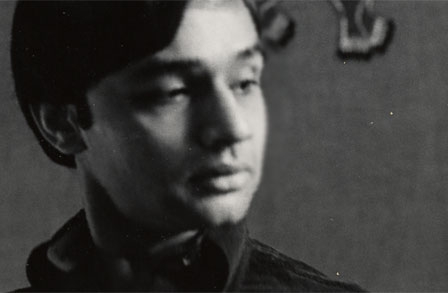
Agha Shahid Ali (1949-2001)

More here: Poetry Foundation

Some more mundane info on the ghazal: Ghazal

“In Arabic” “Reprinted from The Veiled Suite: The Collected Poems by Agha Shahid Ali. English translation copyright © 2009 by Daniel Hall. With the permission of the publisher, W.W. Norton & Company, Inc.”


Comment: nikobakos@gmail.com

Favorite Blogs: The Delhi Wallah

10 May

The Delhi Wallah: Your gateway to alternate Delhi, the city of Hazrat Nizamuddin Auliya and Arundhati Roy is one of my favorite sub-continental blogs and even has the endorsement of the great historian and travel writer Walter Dalrymple: “The Delhi Walla is Delhi’s most idiosyncratic and eccentric website, and reflects a real love of this great but under-loved and underrated city.”  The work of the assumedly pseudonymed Mayank Austen Soofi, the blog really is written with the true tenderness that only a great city fallen on slightly hard times can inspire.  One thinks of Orhan Pamuk’s Istanbul, written about his youth in that city before it became the ISTANBUL! it’s become since the 1990’s.

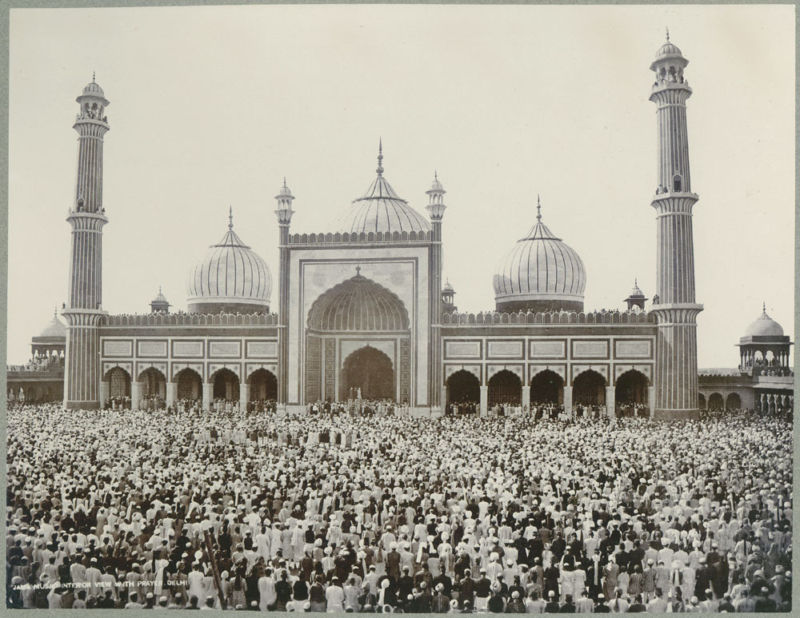
Delhi’s Jama Masjid in the 1890’s

Anyone who knows me, and some who don’t but might have already picked it out from this blog, know that I’m interested in all of India and even engage in certain Hindu practices and rites but that my true fascination is the Mughal culture of the northern Doab heartland.  This comes from — just among myriad things — the composite, deeply syncretic and super-elegant aesthetic of that culture and, more personally, from a deep affinity for lost worlds and for the dignity maintained in the face of the most tragic circumstances under which Indian Islam, much like the Byzantines, not only laboured but continued to flourish for so long.

Bahadur Shah, the last reigning member of the Mughal dynasty

When I read Dalrymple’s masterpiece, The Last Mughal, The Fall of A Dynasty 1857 I was left shell-shocked, not just by the sheer scale of the Indian Rebellion’s violence, but by the mindless, post-conflict destruction of the vindictive and obviously terrified Brits, determined to teach Indian Muslims a lesson for their “mutiny.”  Even the outer walls of the Red Fort and the Jama Masjid itself were saved at the eleventh hour by the orders of more intelligent superiors.  It makes my head spin to think that had the cooler heads that the British so pride themselves on prevailed, Delhi today would still be a showcase of Muslim art and architecture on a par with Isfahan and Cairo or even Istanbul.

The Red Fort in Delhi, once the largest palace complex in the world, eighty per cent of which was dynamited by the British after the Indian rebellion was crushed. (click)

One can read about how upper-class Muslim life in north India proudly soldiered on into the twentieth century in books like Ahmed Ali’s beautiful Twilight in Delhi or made it through the trauma of Partition and modernity in films like Garm Hawa and Sardari Begum.  (For a fairly insightful look — but one that doesn’t really tackle the most radical questions — at Indian Muslim life in the cinema seeIslamicate Cultures of Bombay Cinema by Ira Bhaskar and Richard Allen but all these can’t help but strike a certain elegiac tone.

But…what I love about the Delhi Wallah is what detailled coverage he brings you of how alive and well Muslim life and culture in Delhi still are: mushairas, qawwali gatherings, celebrations at sufi tombs — and not just Hazrat Nizamuddin Auliya’s — old ruins and mausoleums he’s constantly digging up among the chaos of the modern city — and the glorious food.  He has a four-volume guidebook to the city and he’s recently done a beautiful four-part photo op and piece of his trip to Kashmir.  Don’t miss this blog!


Comment: nikobakos@gmail.com