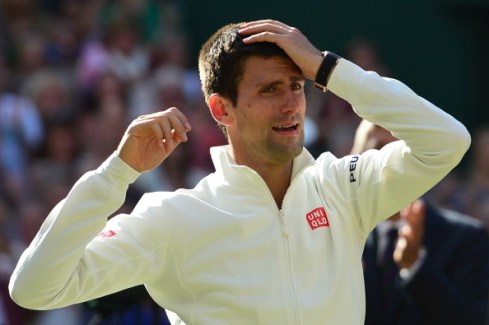
Tag Archives: Novak Djokovic

Djokovic Reaches 600 Match Wins Milestone

3 Nov

Djokovicshow_image_248.phpEPA/IAN LANGSDON

“Djokovic competes with a flair for the dramatic that is embedded in the fabric of his identity. A 46-time titlist on the ATP World Tour, good for third-most among active players (Federer, Nadal), he boasts a defensive-oriented game that has dominated in an era of titanic servers and baseline bombers. The Serb is an elastic wall at the back of the court that defies the laws of physics, relying on a seemingly impervious transition game to win matches.”

Watch match highlights.

See whole story at ATP World Tour.

novak-djokovicReuters (click)

Comment: nikobakos@gmail.com

Some more Nadal-bashing: “Whatever it is, it begins to grate.” And Nole rules.

6 Oct

See October 4th’s “Did Rafa Nadal’s whining set him up for Beijing Open collapse?” YES!

Angry-Rafa-rafael-nadal-16483173-1024-1365

And the full story from the always spot-on Bleacher Report:

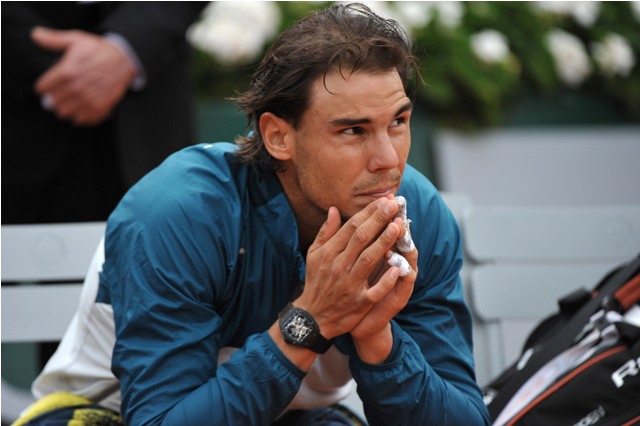
Rafael Nadal, the tennis king of idiosyncrasies, might be adding another ritual to his routine: whining. 

In case you haven’t heard, Nadal hated the tennis balls used at the China Open in Beijing. He thinks those things are freak’n dangerous. 

He told the Associated Press (via Tennis.com), “This week we are playing with one ball. Next week we are playing with a different ball,” he said. “That’s dangerous for the shoulder, dangerous for the elbow.”

Oh, Rafa, Rafa, Rafa. What now?

Sometimes it seems the Spaniard is always complaining about something.  

Nadal certainly wasn’t the only player to raise questions about the balls. Andy Murray complained too. It’s just that Nadal’s beef with the balls lands on a growing list of grievances.

You see, this week, it was the balls. Every year he grumbles about the number of hard-court tournaments and the impact it has on his knees.

In November 2013, Nadal complained about the ATP finals being played on indoor hard courts. He told Tennis.com, “During these nine years the Masters Cup was on indoor, a surface that was not the best for me … I understand, but I think this is unfair.”

You think Roger Federer wishes a few French Opens could be played on grass? But every year, the same thing…clay. That’s just wrong. 

Oh, Rafa, Rafa, Rafa.

Sometimes he acts like the world is against him. Like last year, at the French Open. That’s when he slammed the French for their scheduling and called it  “unfair.”

Nadal thinks many things are unfair. 

Two years ago, he was unhappy about the blue clay in Madrid. He and Novak Djokovic threatened to skip the tournament the next year if the blue clay came back. It didn’t. 

There’s nothing wrong with a professional athlete speaking his mind. However, instead of appearing outspoken, Nadal comes across as a whiner. 

He avoids bombastic outbursts like those from Richard Sherman. Yet, there’s something about the way in which Nadal states his case. It rubs folks the wrong way.

Perhaps it’s the tone of his voice, which sometimes barely rises above a mumble? Maybe it’s his shoulder shrugging demeanor in press conference?

Whatever it is, it’s beginning to grate. Like finger nails run across a chalk board, Nadal’s constant complaining irks. 

It’s unfortunate too because otherwise, Nadal is considered humble. He’s gracious in defeat and has been an excellent ambassador for the sport. Just this week, he carried roses out to Li Na at her retirement celebration in Beijing. He was one of the few ATP players to make an appearance. 

But oh Rafa, Rafa, Rafa. Complaining about the balls?

What used to be mere fodder for Rafa haters has spilled over into editorials and tweets.  A recent headline by USA Today asked: “Did Rafa Nadal’s whining set him up for Beijing Open collapse?”

After Nadal went on and on about the experimental blue clay in Madrid, veteran tennis writer Peter Bodo devoted an entire column for Tennis Magazine to questioning Nadal’s persistent whining. Bodo wrote (via NBC Sports):

Most of you are familiar with his dissatisfactions: The engorged calendar, the ranking system (he lobbied to have it transformed into one that was based on 24 months or results, rather than 12), his seemingly never quite right knees, the blue clay. . . Rafa isn’t the only player to complain about such things, but none of his peers at the top of the game seems to have quite as many issues, or appear to take them so personally (to the point where he quit the ATP player council, seemingly because his fellow pros just didn’t understand).

Whether or not the whiner label is justified, the fact that it’s coming up more often speaks to the prevalence of the perception.

Nadal’s talent and accomplishments have already earned him a future spot in the Hall of Fame and probably a few pages in the record books. That’s why the whining seems beneath him. 

Oh Rafa, Rafa, Rafa. It’s OK to remain conscientious and opinionated. Just pick your battles better, or else earn a new nickname: “Rafaree.” 


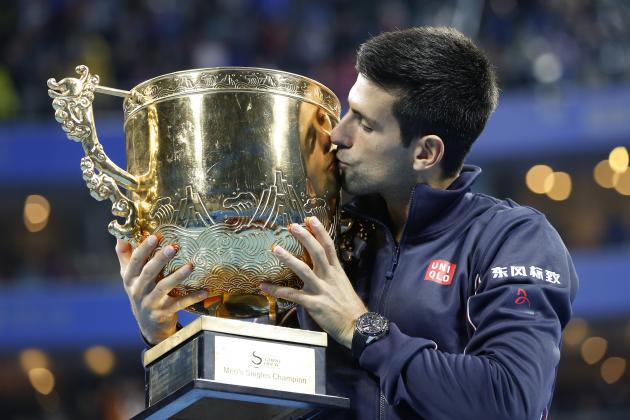
Meanwhile, more Bleacher Report on Djoković’s insanely beautiful final match at China Open, Novak Djokovic’s Late-Season Form Will Lead to 4th World Tour Finals Trophy:

Novak Djokovic played arguably the greatest final of his phenomenal career at the China Open on Sunday, beating Tomas Berdych 6-0, 6-2, and his excellent late-season form will lead him to a third consecutive and fourth overall ATP World Tour Finals win in London.

The Joker’s domination on Sunday was absolute. In just over an hour, the Serb sprinted to a 6-0, 5-0 lead against a bewildered opponent. Everything was working. He was exceptional in the return game, almost perfect from the baseline and played with just enough aggression without pushing things over the top.

Berdych was lost for words after the match, via the ATP World Tour’s official website:

“I met somebody in the final who I’ve never seen before. I was just swept off the court. I just said to my coach now that I probably played over 700 matches in my career…But I have never, ever experienced anything like that.”

hi-res-7177ad13c3b93cd38692d28ebf961885_crop_northVincent Thian/Associated Press

Comment: nikobakos@gmail.com

Όχι, παίζουμε… The Big Croat sweeps away hyper-touted Japanese opponent

9 Sep

09MENS-1-master675-v5 Credit Barton Silverman/The New York Times

The media are so enamoured with young, come-out-of-nowhere under-dog narratives — and calling Djoković, 27, and Murray, 27, old — that they exaggerate things wildly.  Even — or especially — in today’s world of high-bio-tech training and conditioning, two years do not make or break a champion.  Like this Times story which will seem embarrassing in its prophetic pretensions just a few months from now; that’s my prediction: Tennis World Wobbles as Competitive Axis Begins to Shift“.

Čilić, 25, steamrolled supposed wonderboy Kei Nishikori, 24, in straight sets: an elegant 6-3, 6-3, 6-3.  That Djoković played an unpardonably childish and bad game against him in the semis Saturday did not automatically elevate Nishikori to the Hall of Legends.

Times coverage: Marin Cilic Defeats Kei Nishikori at U.S. Open for His First Grand Slam Title

And The Guardian live:  US Open Final: Marin Cilic beats Kei Nishikori – as it happened

US Open Tennis Photograph: JASON SZENES/EPA

Comment: nikobakos@gmail.com

And much respect for the Big Croat…

6 Sep

…who — I think it’s accurate to say — satisfyingly creamed the pretentiously heir-presumptuous Federer in straight sets.  (I love that his trainer has no last name.  He’s just “Goran” — another big bearded Croat.)

I would’ve given ANYTHING for a Djoković — Čilić Final, but I can make do with this.

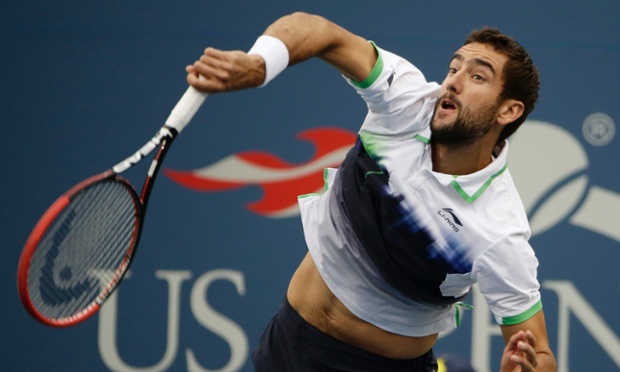
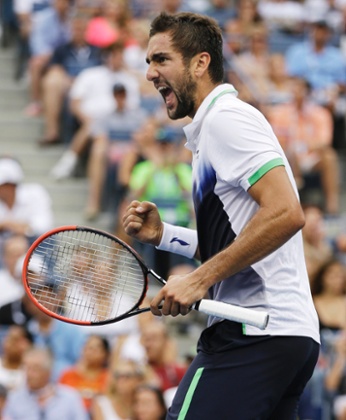
Marin CilicMarin Čilić — “Well might he roar.” Photograph: Darron Cummings/AP

Guardian‘s live blog of both matches – whole day: US Open 2014: Marin Cilic beats Roger Federer – as it happened

Tennis Aegon Championships(click)

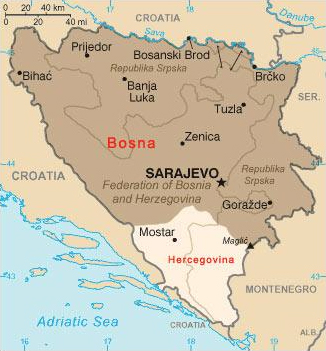
And some interesting side things you learn from the most unexpected places, like American TV tennis coverage: Čilić, it turns out, is from Medjugorje in Herzegovina, the Croatian Lourdes, capital of a Catholic-Virgin-apparition national cult, in the most virulently nationalist part of Croatian-held BH.*  (Not a reflection on Marin, of course, who’s actually best buds with Nole; one reason I wanted to see them go at it in the final would’ve been the pleasure of watching how quick “best buds” flies out the window when two Alphas are forced to go for the jugular.)  Always interesting how these cults always have an unerring way of appearing in just those regions, and just when you need them.  And a sad indication, also, of how we’ve written off Bosnia-Herzegovina as a viable entity: CBS’ US Open blurb-profile of Čilić listed his birthplace as “Medjugorje, Croatia.”

Medjugorje is famous as the site of some of the most vicious Ustaše massacres of Serbs during WWII and of subsequent vicious massacres of Franciscan monks and priests by Serbian partisans.  Of course, the Virgin only decided to appear at Medjugorje in 1981 — just one uncanny year after Tito‘s death — when Croatian nationalist sentiments and separatist grumblings had already gathered unstoppable speed and volume, and Yugoslavia was immediately — almost upon cue with Tito’s departure — starting to show signs of coming apart at the seams.

See whole Wiki page: Medjugorje

marin‑cilic-2012-01(click)

******************************************************************************************************************************************************************************************************************

Bosna_regija_update

*Desperately poor traditionally, rocky, marginal Herzegovina, the barren plateau just a short steep inland climb from the idyllic, Italianate Dalmatian coast, is one part of the Balkans for which the Serbo-Croatian word vukojebina was coined — “wolf-fuck” — and is not just famous for producing rabid Croatian nationalists, but rabid Serbian and rabid Bosnian and — I think a tiny section that considers itself Montenegrin — rabid Montenegrin nationalists too.  These are not the Croats that Rebecca West could throw her hateful lawyer epithet at.  And don’t let the stunning beauty (below) of any part of ex-Yugoland fool you.

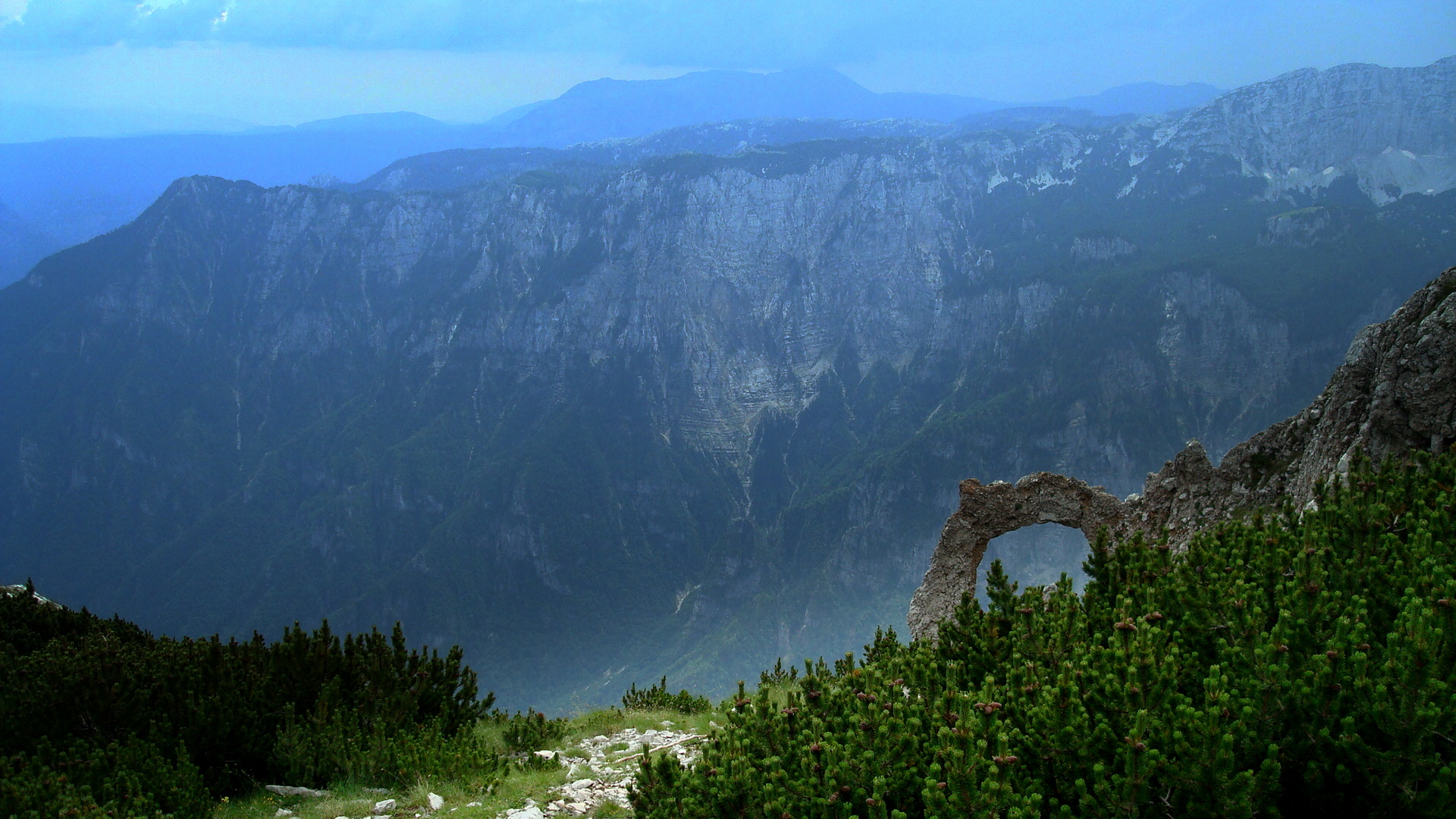
Hajdučka_Vrata“Hajdučka vrata” (the “Bandit’s Den” or “Κλέφτικο Λημέρι”) on Mt. Čvrsnica in Herzegovina (click)


Comment: nikobakos@gmail.com

Djoković at his worst…

6 Sep

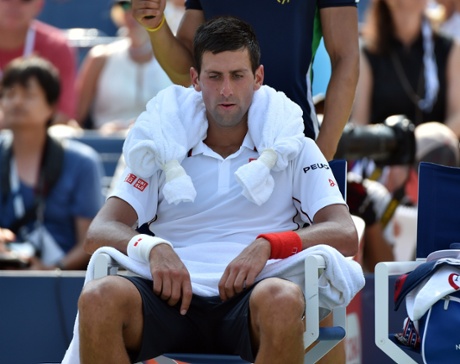
368d4e2a-509b-40a6-af0b-56c9241a6773-460x364Photograph: Stan Honda/AFP/Getty Images

Moody, distracted, irritable, unable to come back from even the tiniest initial set-back, seemingly pissed off that it’s hot — like it’s a personal conspiracy against him — pissed off that #11 seed can be winning against him; till he decides he’s just too exhausted to even try and throws it in like a little child who doesn’t want to play anymore.

I don’t know why so much tennis is played in the most vicious heat imaginable either — July in London, New York in September, Melbourne in January — but deal with it.  It’s not like the gods have set up an invisible parasol for your opponent.  And, he’s not that much younger than you.

Then you got the announcers: “Having to be away from pregnant wife Jelena must be taking its toll on Novak too…”  Spare me the heterosentimentality, please.  (Or maybe they’re right: cherchez la femme…she’ll drain you dry every time…)  I adore this dude, but when he just gives up, he just gives up and it’s a real let-down for fans.  You’re getting too old for this sh*t Nole; the pissy defeatism is unacceptable; it’s not cute anymore.

Now I’m in a position where I have to root for a Croat…

The Guardian — like I’ve said before, best coverage of anyone — hasn’t posted yet, but see their Twitter in the meantime.

Woops… here they go.

P.S. Decent, polite and humble at press conference after, though…

Comment: nikobakos@gmail.com

Becker says Nole is ready to beat Murray tonight

3 Sep

Novak Djokovic talks with his coach, Boris Becker, in New York in the build-up to the US OpenNovak Djokovic talks with his coach, Boris Becker, in New York in the build-up to the US Open at Flushing Meadows. Photograph: Julian Finney/Getty Images

See Gurdian’s — almost always the best tennis coverage of any major media outfit — story at: “Boris Becker, Novak Djokovic’s coach, plots Andy Murray’s US Open downfall”

Comment: nikobakos@gmail.com


Belgrade: Wimbledon 2014, rakia with M., and what’s with me and all the Djoković…

12 Jul

TENNIS-GBR-WIMBLEDONGetty Images (click)

“What’s with you and all the Djoković?”

This is M. in Belgrade, after the sixth or seventh rakia, giving me a hard time about my Nole cult. M. is an old Serbian student of mine from New York. He’s one of my favorites actually; out of the nearly ten years I taught English at CUNY, he’s one of those special ones that I can count on one hand. Funny, charismatic, super-smart – when he came to class – he was a real asset to have.

“I was your best student,” he says, a propos of nothing and with characteristic modesty.

“Yeah, when you came to class,” I say.

We live ten minutes from each other in New York but never see each other – bumped into each other at some bars a couple of times – except that every year at Orthodox Easter he comes to my house. But I haven’t been home for Easter for the past three years, so we didn’t see each other then either. Except for one night, two nights ago, the stars arranged for us to both be in Belgrade together and we couldn’t pass up the opportunity to get some long-due drinking done.

So this is M. getting all up in my face Serbian style:

“If you’re such a fan, why are you here? Why aren’t you in Montenegro at his wedding trying to get a picture?”

I didn’t even know Djoković was getting married this weekend and M. knows I’m too old and probably knows enough else about me to know I’m not some idiot groupie:

“Like the other groupies…” he says nevertheless. “You could try to take a picture of him with the bride…one with the bride alone…one with…”

The thing is his teasing is so good humored it makes you wanna jump right into the ring with him and take him on, so it’s always fun and it only makes you like him more. I also came away from the evening feeling good because M. and I barely know each other actually, but a bunch of his friends showed up and it was obvious how loved he was by all of them and that was nice to see; I like when my instincts about a person are correct even when I don’t have much evidence to go by.  But he’s relentless…

“You could try to get a picture of the dog…”

Well for M. or anybody, if you still don’t know what my Djoković thing is about and how it relates to my Serb thing and how possessive and defensive I get about both, you haven’t been reading my blog very regularly. So let me try again. Back to Wimbledon…

I don’t think any real tennis aficionado could’ve asked for a better Wimbledon 2014 – unless you have the frankly hilarious misfortune of being a Nadal fan, in which case you deserve your fate and I’ll tell you when it’s ok to come out of your room and stop being embarrassed. For Djoković it was no easy climb. Great tennis all the way, but he wasn’t granted anything. With Čilić, with Raonić, with Dimitrov, there was practically not a single give-away. He had to wrestle every point from the hands of the universe.

Of course the finals match between him and Federer was a friggin’ dream. It was everything you want from good tennis, from good sport, competition, art, or a good war even: matched skill and guts, intelligent tactics, constant reversal and coming back from behind – and the masochistic pleasure or knowing that even if your guy loses, he’ll have lost to someone you respect. This was one of those matches that the phrase “toe-to-toe” was invented for. At no single point during the more than three hours did either man have enough of a numerical lead to allow his supporters to relax for a few minutes. Neither of them was ever more than just one step ahead of the other and that never lasted long enough for you to take even half a breath.

I watched the game in an empty Greek bar with a friend of mine and don’t think I actually sat back on my seat for a second. And I don’t know whether it was the emptiness of a bar in suburban Athens, perhaps, on a hot July, Sunday afternoon — the hours of high summer heat in Attica still turn the city into a desert — but this was the first time that Djoković’ loneliness on the court struck me so hard. Existentially.  How completely lonely he sometimes seems.  Of course, that day, Wimbledon had to do with it as well. For a variety of reasons we all know, Novak’s always been considered the kind of odd man out in the tennis world despite his stupendous capabilities as an athlete, and Wimbledon is clearly the most classist of all tennis venues where that would show up in its starkest form. I don’t know if it was the shots that the Greek network we were watching was being fed, but not once during the whole match, were the cameras able to get even a single shot of the crowd looking satisfied or anything but stressed whenever an exchange went well for Nole; except occasionally from Becker and his team; no one from his family even seemed to be there — getting ready for the wedding circus I can now presume, but didn’t know at the time. Unlike the always cool French, who’ll applaud you for your art no matter who you are or where you’re from, like the standing ovation they gave Djok for his battle against the Catalan that left him in tears at Roland Garros, here there was the unmistakable look of British and other jet-set spectators at a sporting event in the grip of pure class terror: that their suave Swiss aristocrat would lose to this Balkan nut-job…and at Wimbledon.

I remembered that shitty little article by Lauren Collins that The New Yorker had run last September — The Third Man — about Novak, which kept essentially asking whether he can learn how to act like a proper tennis player: “Can he make us like him?” Like you guys are the arbiters of what exactly and he needs your liking?  And all my pro-Serb and pro-Nole nerves got twisted into knots again, like when I had first read it. The whole article was just dripping with condescension and I thought to myself that if Collins had written an article like that about an athlete from a “country of color,” The New Yorker would have been faced with a howling riot of censoring anger and cries of racism. “Is Nole too ghetto for Wimbledon?” Collins had essentially wanted to know. She could’ve consulted me and I would’ve come up with at least twenty terms from half a dozen Balkan languages for “ghetto” that she could have used.

Then the fifth set started and it became clear that both men knew this was it, life or death, especially because it started to become clear that physical and – from the tightness of the game and competition – nervous exhaustion had started to set in. And Nole got that look he gets late in matches, where he alternates between a look of steely professionalism and hunger that’s ready to rip his opponent to shreds, and this strange watery-eyed look of almost spiritual exaltation, looking dreamily skyward, or gazing down at the ground blankly. And this latter look, though beautiful, is a little worrisome because it means he’s either going to start playing like a man possessed by some god and steamroll whoever he’s up against into the ground – or just start f*cking up and making a royal mess of everything.

It became clear that he was in a state of deity-possession almost as soon as the set started. And then he stopped looking lonely to me. Instead we was simply magnificently alone, the akritas fighting it out on the marble threshing-floor, the young kraljević single-handedly taking on the hostile hordes of pink frangoi in their sun-screen and appropriate hats.

NOLEUSE1404667649000-AFP-531415517Glyn Kirk, AFP/Getty Images (click)

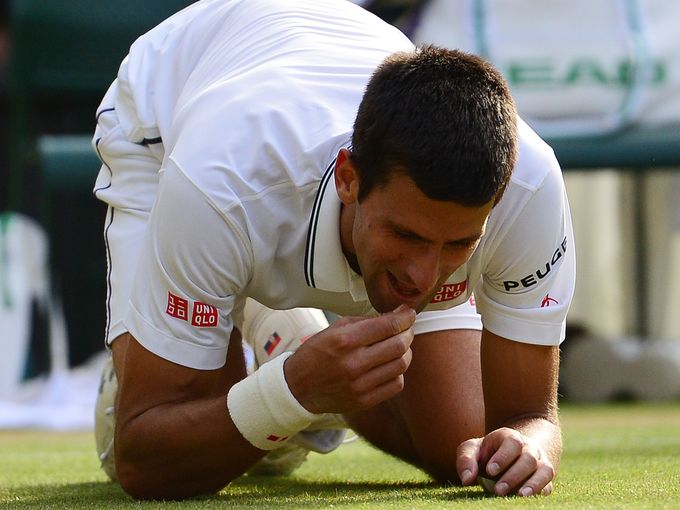
And Federer hit the ball into the net and it was all over. And Nole cracked open; not up, open — like the cracks that Leonard Cohen says let the light get in, except the light here was not flooding in but out of him in this great luminous glow. I don’t know what mad idea of redemption or humility or gratitude was going through his crazed Slavic mind when he knelt and started eating the grass off the court, but in the back of my mind I could hear some Serbian Sonya Marmeladova crying:

“This is what you shall do! Go at once, this very moment to the crossroads and kiss the earth which you have defiled and bow down to the world and say: ‘I am grateful. I am humble. I am grateful. I am humble.’”

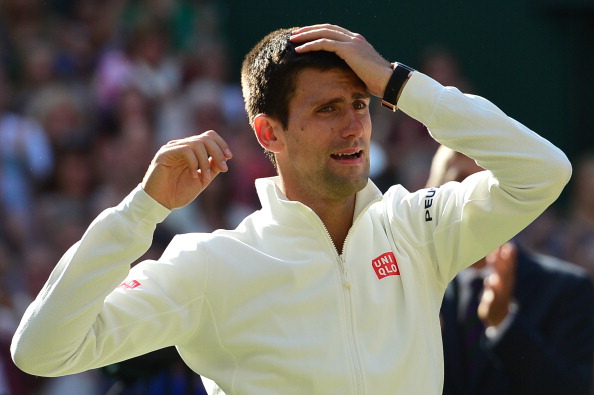
And then the tears of that gratitude and humility started flowing and I haven’t even wanted to watch any of the post-game interviews or read anything; I just want to be left with that image of him holding the cup and bawling. Weeping copiously.  Like a man.

wimbledon-men-novak-djokovic-wimbledon-trophy_3169070Getty images (click)

My sense here in Serbia is that there’s a little bit of a conflict between Djoković’ status as saintly national hero and the celebrity circus that’s constantly flowing around him, and that that’s what M.’s cynicism was about with the wedding and all. But a girl, I., who was in M.’s kompaniya that night: very smart and pretty, who speaks absolutely native-speaker American English and who is always running what’s apparently one of Serbia’s fastest-growing websites from from her IPad – which she was doing that night – while still managing to remain front and center of any conversation she happens to find herself in, says that’s the girlfriend and the media’s fault, not his, and that it really irks her.

“What does ‘irk’ mean, M.?” I decide to play professor with him, addressing him by his last name.

“It means like when something bother-… What do you mean what does it mean?!  I know what it means.  I was your best student!”

“Yeah. When you came to class.”

I. also talked some about some genuine darkness that was part of Nole’s childhood, the details of which are common knowledge here, but I’m not going to get into because it’s part of this blog’s journalistic policy not to go there with cheaply personal and especially hurtful personal issues, and especially not with someone I love and admire and who’s as much of a hero of mine as Djoković is. But let’s just say the redeeming, protecting hero archetype is a structurally core part of his psyche.

“He’s a beautiful man and he has a beautiful soul,” I. declared, definitively ending that conversation, as I imagine she must definitively end others when she wants to.

And I felt vindicated.

Do you have your answer now, M.?

Out of respect for this spectacular victory and the Djoković-and-tennis tolerance of my readers I promise there will be no Djoković or tennis at all until the U.S. Open.

But see you before then.
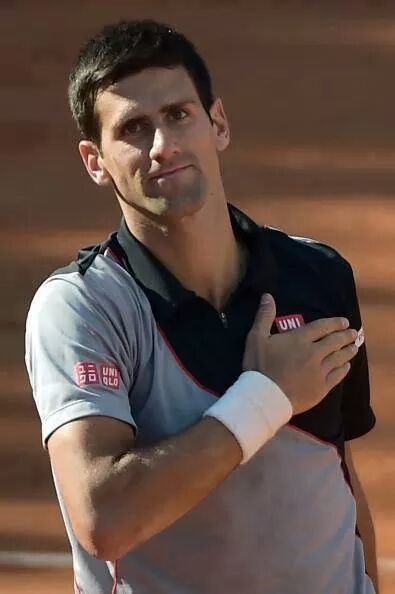
Djokunnamed

Comment: nikobakos@gmail.com

Note:  Speaking of “marble threshing-floors…”  The court at Wimbledon is in such shit state that it can only be called a grass court in the most ideally Platonic terms.  Really; cute British shabbiness has its limits.  Beer and probably piss-stained pub carpeting is one thing.  A court where most of the playing is done on parched, packed, rock-hard dirt, made that much more treacherous by the fine layer of sand it kicks up and coats itself with, is another.  It definitely put a cramp on both players’ styles at several moments during the match and there were times where it even looked like it could cause dangerous injury.  With Nole I didn’t know whether his super-human flexibility would protect him or if it would make his propensity for taking acrobatic risks that much more risky.  Either way, do something.  It’s one of those things that’s not charming about England anymore.

“It was tough and it was tight, but it went according to plan.”

4 Jul

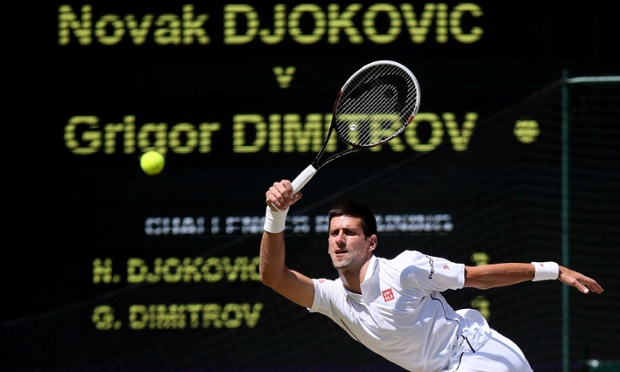
Tennis - 2014 Wimbledon Championships - Day Twelve - The All England Lawn Tennis and Croquet ClubNovak Djokovic returns to Grigor Dimitrov. Photograph: John Walton/PA (click)

7-6?!  7-8?!  7-9?!!!!   Yes!  Tennis!  THIS is what we want!

No joke this Dimitrov kid, eh?

And I love Xan Brooks constant use of corrida metaphors: “Steely experience won out over youthful flash and fire.  The matador speared the bull.”  Surprised The Guardian’s P.C. Thought Police or some pissy PETA chicks haven’t gotten on his case.  He uses them constantly.

Brooks whole wrap-up:

It was tough and it was tight, but it went according to plan. Steely experience won out over youthful flash and fire. The matador speared the bull.

Full credit to top seed Novak Djokovic, who kept his cool throughout a terrific, red-blooded contest that could very easily have gone to the fifth and final set. But credit, too, to Grigor Dimitrov, who put up a vibrant fight out on a dusty, dissolving Centre Court. Hi chance, no doubt, will come again.

So that’s it, Novak Djokovic advances to the Wimbledon final, where he faces the winner of the second match between Roger Federer and Milos Raonic. That’s just getting started. You can follow it here.

And we all know, few apologies from me either.  From here till the Flushing it’s mostly tennis from me or me fretting about tennis.  I’m gonna be in Belgrade Tuesday.  If Nole takes the title it’s gonna be a mad house.  Actually, either way.

P.S.  I had said:But pretty sure it’ll be Nole and Federer in the end, though Federer over Raonić is not that easy a call to make.”  Turned out it was an easy call to make; what a little mariconada of a game compared to the death match between these two.  Now I don’t know what that means for Sunday’s Final: that Nole will be exhausted after tearing it up like a mountain lion for the past month while Federer’s energy-conservative style will have him all relaxed and fit — or Nole will still be in high gear and Federer playing old-man, one step closer to retirement style.

Comment: nikobakos@gmail.com

What…A…Fucking…GUY!

28 Jun

And can I get a witness please…  Like, several.  Because I have some big time testimony to make…

Read the Fox piece below ( I know — what are you gonna do?)

From now on I promise, Lord, that next time anybody disses Nole as a baby or a Balkan-wild-man clown, or unprofessionally erratic, or as uncoolly displaying too much emotional investment in his game (like…huh?).  Or as anything else even, other than a noble, generous, chivalrous, sportsmanlike, kick-ass athlete that shows up once a decade if we’re lucky in any sport — a knight, a fighter, a caballero, a steel-balled Kosovar and a man Russians would anoint with their highest possible compliment: “Broad-souled” (and yeah, yeah, of course, a Serb and gorgeous, we know), he’s gonna have to have me to deal with.  So help me God AND praise the Lord.  Amen.

And this is at Wimbledon too — where he knows he’s probably not gonna get to the top anyway and it takes heart to give away even tiny potential advantages like this.  HEART.

062514-TENNIS-Radek-Stepanek-of-Czech-Republic-hugs-Novak-Djokovic-PI.vadapt.955.medium.0Steve Bardens / Getty Images Europe

Novak Djokovic opts for ‘fair play’ during win over Radek Stepanek


The Centre Court match at Wimbledon featured only two service breaks, but wait, there was much, much more:

* Novak Djokovic giving away a point to Radek Stepanek that could have been replayed following an over-rule on a line call during a crucial time in the match, a move seldom seen in tennis.

* Stepanek cutting his right knee on one of his dozen or so falls on the grass during the 3-hour, 17-minute second-round match Wednesday.

* And on the final point of the match, a successful challenge by Djokovic on a call originally called out, with Stepanek getting down on his hands and knees in a prayer pose.

“Today in the challenges I was so unlucky, a millimeter here, a millimeter there,” Stepanek said. “I guess I hoped and I prayed that one time it will go with me.”

It didn’t. Djokovic’s forehand cross-court pass was ruled in after the video replay showed the ball landed on the line. Djokovic completed a 6-4, 6-3, 6-7 (5), 7-6 (5) win. The two players, good friends and frequent practice partners, hugged at the net.

The third-set tiebreaker featured each player winning five points in a row — Djokovic to take a 5-2 lead, only to have Stepanek come back to take it 7-5.

“I was two sets up, I had some break-point chances in the third and should have closed it out in the third-set tiebreak,” Djokovic said. “But credit to him for fighting. He’s 35 years old and still moving very well and surface wise grass is probably his most preferred. He loves to engage the crowd.”

That Stepanek did, with his give-it-all style of play swaying the Centre Court spectators his way late in the match. Stepanek repeatedly made unsuccessful challenges on line calls. When he finally got one right, he looked up to the skies in relief.

Stepanek said he couldn’t recall ever falling down so many times in a match.

“Maybe not, but that’s the way I play on grass, you have a little bit of comfort,” he said. “But that’s how I play anyway, with my heart.”

Stepanek said he was surprised by Djokovic’s gesture to give him the point. At 5-all in the third set, Djokovic had a game point on his serve when Stepanek hit a backhand that was called long. After Stepanek successfully challenged the call, Djokovic conceded the point even though it could have been replayed.

“That’s why I asked the whole crowd to clap,” Stepanek said. “It was incredible sportsmanship, and it proves just what a great champion he is.”

Djokovic played down the move.

“For me it’s just natural, just something that is normal to do,” he said. “I felt like I had no chance to play that ball, (so) of course I would concede the point. I’ve done it a few times in the past. OK, yes, the point was very important. …

“Nevertheless, I think it’s fair play. It’s something that I would expect my opponent to do for me. It doesn’t happen very often, unfortunately.”  [my emphases]

Why I can’t stand watching Rafael Nadal win

12 Jun

??????????????????????????????????????????????????????????????????????????????????????????????????????????????????????????????????????????

I’m just going to come out and say this stuff and I’m sure not a few readers will end up considering me a quack or some quasi-Nietzschean fascist aestheticizer of things and never log on again. But, hey, that’s the price…

I’ll start with the most petty and irrelevant reasons. I have a serious repellent reflex towards Catalans. This is largely because I love Spain so much, and their anti-Spanishness really gets my goat. I find their Gallic delusions that they’re so much more European and Mediterranean and civilized than the rest of Spain to be insufferable. (And some day I’ll get around to dismantling the cult of “Mediterranean-ness” itself that’s grown since the 1980s and that I find a completely false and fabricated pop-multi-culti identity that grew out of tourist literature, the public relations campaigns of olive oil companies and a popular sprinking of Braudel, and nothing else. When even Turks start acting and feeling like they’re “Mediterraneans,” you know that a discourse is b.s. and needs to be taken apart; the extremeness of the hype surrounding Barcelona is part of this, and is why I love the gravitas and even crudeness of Madrid and Castille so much more deeply.)  I find Catalans’ noli me tangere squeamishness about how they shouldn’t have to suffer by being a part of this barbaric country of monarcho-fascists and Catholics and gypsies and bull-torturers to be racist pure and simple. They’re Iberian Croatians, in short. There are plenty out there who will get the analogy, I believe.

But none of that has any real bearing here.  And poor Rafa shouldn’t have to be the object of my scorn just because he’s Catalan; Ferrer is too and I think he’s one of the most compelling and wonderful to watch tennis players out there.

I simply hate watching Rafael Nadal win because he’s ugly.

And by ugly I don’t mean short and mousey-looking or that his thinning hair is always already a greasy mess from before the match has even started. I mean ugly with a lack of that kind of inner force that manifests itself as a visible form of athletic charisma and magic.

Since the beginning of institutional athletics in human civilization, meaning the Greeks, of course, we’ve always expected our athletes to partake of “some part of beauty.” To have something that made us feel, even if just partly, that a god were being incarnated here in this man, in our presence. “En-thusiasm” in English comes from the Greek ενθούς, ‘possessed by a god, inspired.”  Whether it’s the gorgeous dance of a great basketball or tennis player, or the weightlessness and super-human strength of a gymnast, or the painful duet of two wrestlers or martial artists of any kind, or just the sublime bulk of a rugby player or Olympic weightlifter, or the highly choreographed beauty of a good American football game (yes, it’s a beautiful, highly choreographed, strategically intricate game, much more compelling than…wait…let me swallow first…soccer), we need to experience this glow, which is not a conventional handsomeness or prettiness that I’m talking about, but the need to sense this power and this powerful yearning for glory and victory emanating out of this being, who we want to feel is slightly more just-above-human than the rest of us are.

You never feel any of that glow emanating from Rafael Nadal. It’s just the same cold, technically precise game and the same cold, pissy look on his mug: the most emotion we’re treated to is if things start going a little badly and the pissy mug just gets a little pissier. After the match, if you mute your set and if the score box isn’t showing on the bottom, you almost can’t tell if he’s won or lost. Just the same cold shaking of hands and greasy slinking off of the court.

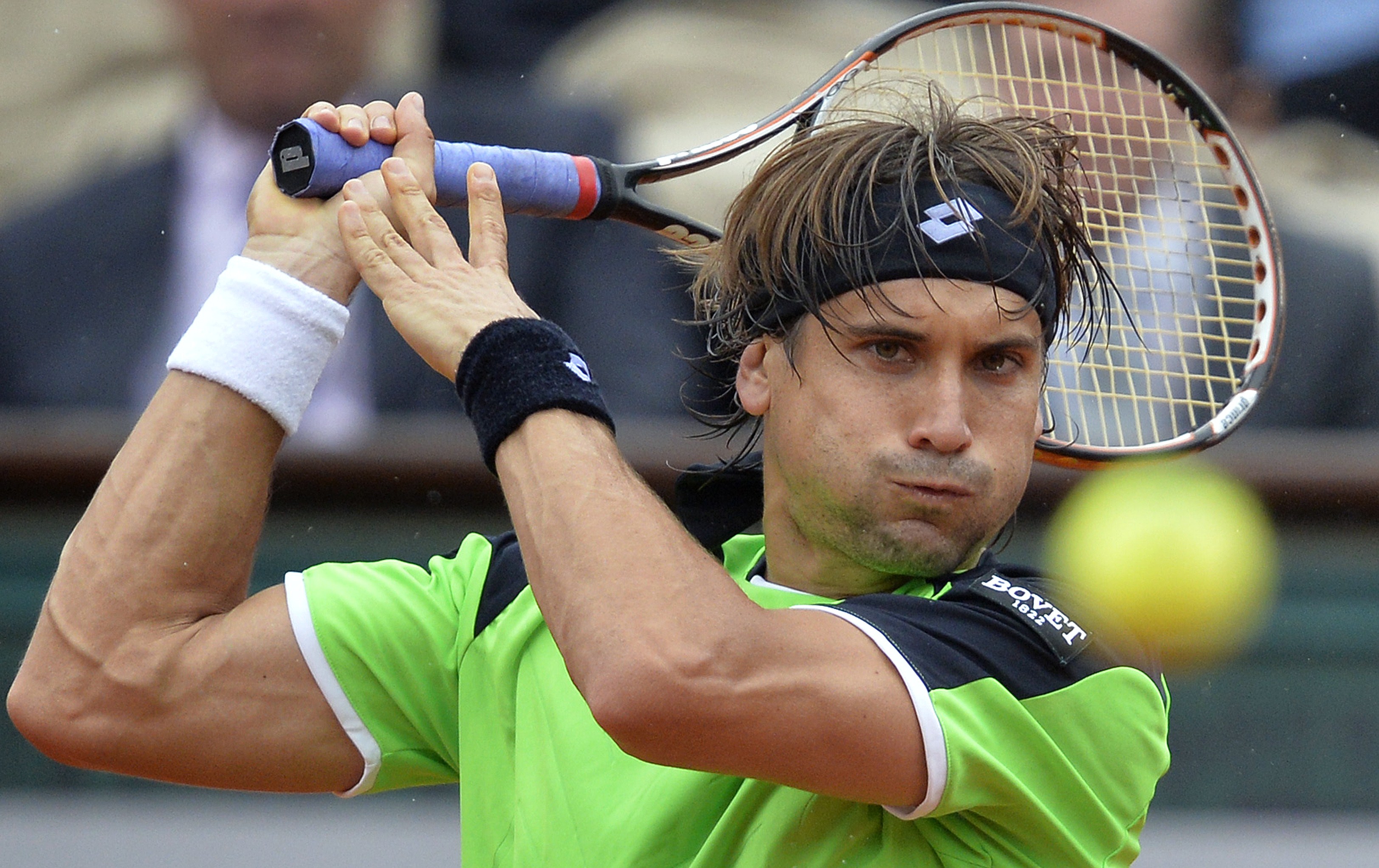
TOPSHOTS Spain's David Ferrer returns aDavid Ferrer – Picture: AFP/Getty – (click)

Compare this to the elegant gentlemanliness of a Federer. Or the brute, Rodrigo Díaz de Vivar, clanking mediaeval long-swords game of a Valencian muscle-brick like Ferrer (above).  Or the young, beautifully British, sportsmanly hunger of Murray. And then there’s my dear, sweet Nole, of course, who in every endearing way is still a teenager of sorts, and may have the purest soul of any professional athlete out there. (Talk about “the tenderness of the warrior.”)  No matter what his rank or seed are, or how well his season has been going, he’s as desperately trying to keep his nervousness under control before a match as a young volunteer going into combat for his first engagement, because I think that that’s what he genuinely feels in his heart each time. And when things go badly, and he tragically can’t stop them from going even more badly, because, like an adolescent, he beats up on himself mercilessly because he feels like he’s failed to prove himself, failed to earn his “red badge,” he inspires the purest Aristotelian feelings of pity in me.* And yet, his dignity in defeat is always impeccable. And his howling glory in victory is all his own too. Lots of people don’t like that or feel it unsportsman-like. Trust me, Olympia was a scene of howling winners just like him – and probably then some.  Finally, the spectacular grace of Nole’s feel for his own body is unmatched by anyone in the sport.  Almost like a bullfighter, you sometimes feel he’s risking an easy point just for the gracia and and pure elegance of a braver, more dramatic play.

(And Michael Phelps…let’s not even go there.  See his tag box for posts on him if you want.)

novak-djokovic-volley (Clive Brunskill/Getty Images)

You feel no sense of any of that pathos or agon in Nadal’s game. None. So when Djoković loses to a man like Federer, or Ferrer – which I don’t think he ever has – or even Murray, I say helal olsun,** να’ν καλά ο άνθρωπος, he deserved it. And I don’t walk around with this churning feeling in my stomach for days afterwards.

But when Nole loses to a Rafael Nadal – I can feel the gods of our ancestors looking down and saying: “What the hell? This can’t be right…”

At least a big, Russian kouklara like Sharapova won the women’s…

maria-sharapova-wallpapers-tennis-star-maria-sharapova-hd-wallpapers-widescreen-desktop

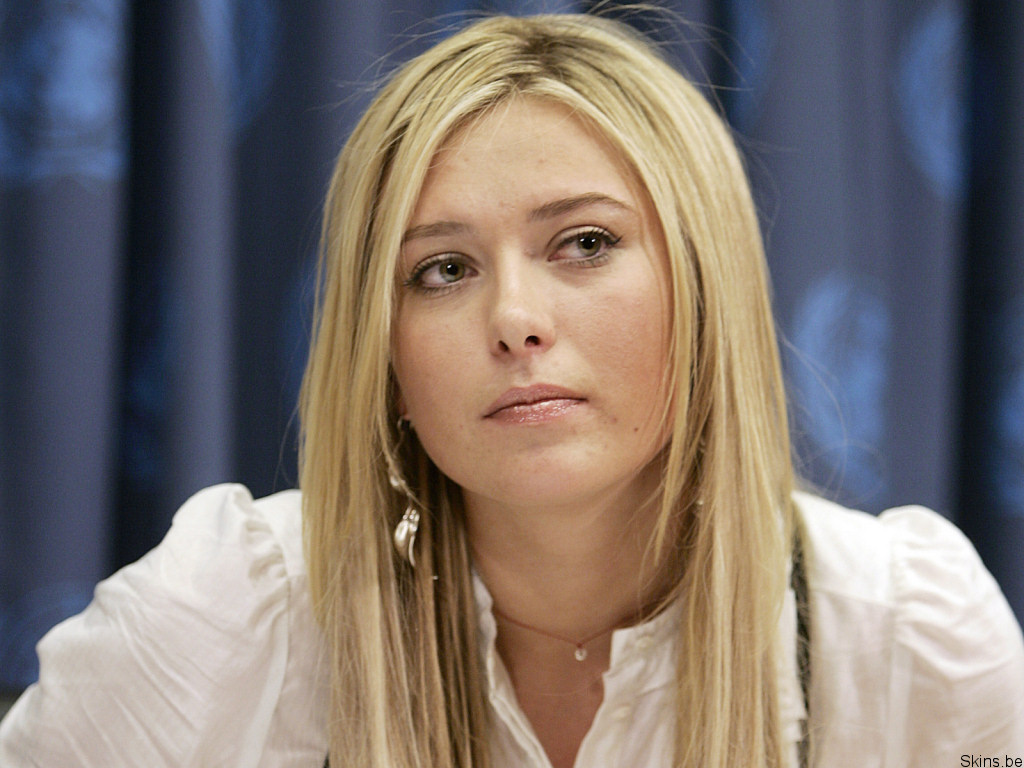
Maria Sharapova, Women’s Campion at Roland Garros 2014. (click)

See also July 3rd post: “Why I love watching Rafael Nadal lose.”

*************************************************************************************************************************************************************************************************************

* Aristotelian “Pity”In his Rhetoric, Aristotle defines “pity” thus: “Let pity, then, be a kind of pain in the case of an apparent destructive or painful harm of one not deserving to encounter it, which one might expect oneself, or one of one’s own, to suffer, and this when it seems near.”

Effing Greeks had said everything, hadn’t they?  Everything else is a footnote.

** “Helal olsun” means, roughly, “may it be blessed” in its mixed Arab-Turkish vocabulary.  This is where the Greek: “χαλάλι του” comes from, “it went to good cause, to deserving reason, good for him or her.”  The opposite is when somethings has gone “χαράμι” — haram — meaning gone to waste, not to blessed purpose, blown off into the wind, spent badly, made unusable by its having been defiled or tainted.  “Χαράμισα τα νιάτα μου” are lyrics you’ll hear in many Greek songs: “I made haram of my youth” — the implication usually being “with you.”

I was talking to a friend here about the term “Helal olsun” and she said that you could use it in Turkish the way you do in Greek, but also that at Muslim funerals the imam asks the gathered congregation if anyone has any outstanding grudges or feels he is owed something by the deceased, and the congregated reply — I don’t know if in unison or individually: “Helal olsun” — “No, may he be blessed,” (or maybe: “even if I do…helal olsun.”)  And I found that unbearably just and beautiful.  And something to remember when Christians feel we have a monopoly on mercy and forgiveness.  It’s the Quran that says that “Mercy is a greater virtue than justice.”

Comment: nikobakos@gmail.com