
Let’s also take a moment today to remember one of history’s great crimes and its millions of victims.

Comment: nikobakos@gmail.com
Let’s also take a moment today to remember one of history’s great crimes and its millions of victims.
Comment: nikobakos@gmail.com

Kashmiri women attend a protest organized by the Association of Parents of Disappeared Persons in Srinagar in November 2010. (Rouf Bhat/Agence France-Presse — Getty Images)
from The New York Times, July 6th
“LAST September, a lawmaker in Indian-controlled Kashmir stood up in the state’s legislative assembly and spoke of a valley filled with human carcasses near his home constituency in the mountains: “In our area, there are big gorges, where there are the bones of several hundred people who were eaten by crows.”
“I read about this in faraway London and was filled with a chill — I had written of a similar valley, a fictional one, in my novel about the lost boys of Kashmir. The assembly was debating a report on the uncovering of more than 2,000 unmarked and mass graves not far from the Line of Control that divides Indian- and Pakistani-controlled Kashmir. The report, by India’s government-appointed State Human Rights Commission, marked the first official acknowledgment of the presence of mass graves. More significantly, the report found that civilians, potentially the victims of extrajudicial killings, may be buried at some of the sites.
“Corpses were brought in by the truckload and buried on an industrial scale. The report cataloged 2,156 bullet-riddled bodies found in mountain graves and called for an inquiry to identify them. Many were men described as “unidentified militants” killed in fighting with soldiers during the armed rebellion against Indian rule during the 1990s, but according to the report, more than 500 were local residents. “There is every probability,” the report concluded, that the graves might “contain the dead bodies of enforced disappearances,” a euphemism for people who have been detained, abducted, taken away by armed forces or the police, often without charge or conviction, and never seen again.
“Had the graves been found under Col. Muammar el-Qaddafi’s compound in Libya or in the rubble of Homs in Syria, there surely would have been an uproar. But when over 2,000 skeletons appear in the conflict-ridden backyard of the world’s largest democracy, no one bats an eye. While the West proselytizes democracy and respect for human rights, sometimes going so far as to cheerlead cavalier military interventions to remove repressive regimes, how can it reconcile its humanitarianism with such brazen disregard for the right to life in Kashmir? Have we come to accept that there are different benchmarks for justice in democracies and autocracies? Are mass graves unearthed in democratic India somehow less offensive?”
Now and in time to be,
Wherever green is worn…
A terrible beauty is born.
— W. B. Yeats
1
One must wear jeweled ice in dry plains
to will the distant mountains to glass.
The city from where no news can come
Is now so visible in its curfewed nights
that the worst is precise:
From Zero Bridge
a shadow chased by searchlights is running
away to find its body. On the edge
of the Cantonment, where Gupkar Road ends,
it shrinks almost into nothing, is
nothing by Interrogation gates
so it can slip, unseen, into the cells:
Drippings from a suspended burning tire
Are falling on the back of a prisoner,
the naked boy screaming, “I know nothing.”
2
The shadow slips out, beckons Console Me,
and somehow there, across five hundred miles,
I’m sheened in moonlight, in emptied Srinagar,
but without any assurance for him.
On Residency Road, by Mir Pan House,
unheard we speak: “I know those words by heart
(you once said them by chance): In autumn
when the wind blows sheer ice, the chinar leaves
fall in clusters –
one by one, otherwise.”
“Rizwan, it’s you, Rizwan, it’s you,” I cry out
as he steps closer, the sleeves of his phiren torn.
“Each night put Kashmir in your dreams,” he says,
then touches me, his hands crusted with snow,
whispers, “I have been cold a long, long time.”
3
“Don’t tell my father I have died,” he says,
and I follow him through blood on the road
and hundreds of pairs of shoes the mourners
left behind, as they ran from the funeral,
victims of the firing. From windows we hear
grieving mothers, and snow begins to fall
on us, like ash. Black on edges of flames,
it cannot extinguish the neighborhoods,
the homes set ablaze by midnight soldiers.
Kashmir is burning:
By that dazzling light
we see men removing statues from temples.
We beg them, “Who will protect us if you leave?”
They don’t answer, they just disappear
on the roads to the plains, clutching the gods.
4
I won’t tell your father you have died, Rizwan,
but where has your shadow fallen, like cloth
on the tomb of which saint, or the body
of which unburied boy in the mountains,
bullet-torn, like you, his blood sheer rubies
on Himalayan snow?
I’ve tied a knot
with green thread at Shah Hamdan, to be
untied only when the atrocities
are stunned by your jeweled return, but no news
escapes the curfew, nothing of your shadow,
and I’m back, five hundred miles, taking off
my ice, the mountains granite again as I see
men coming from those Abodes of Snow
with gods asleep like children in their arms.
(for Molvi Abdul Hai)
*******************************************************************************************************************************************************************************
* “Don’t tell my mother / my beloved brother / my sister….I’m dead” is also a common stock phrase in Balkan epic poetry of guerrilla fighters, kleftes, haiduci.
* “By that dazzling light we see men removing statues from temples”…”Who will protect us if you leave?”…”men coming from those Abodes of Snow with gods asleep like children in their arms.”
Shahid Ali’s universalist soul was as hurt by the exodus of Kashmiri Hindus (Pandits) from the region as he was by the brutality of the Indian Army against its innocent Muslim majority. I can only assume that the men with the gods asleep in their arms is a reference to this exodus. Shahid suffered from a recurrent nightmare, in fact, that the last Hindu had left Kashmir, and he fought that haunting image through the curious fashion of reproducing their distinctive cuisine as meticulously and often as possible — he was an excellent cook; there are now hardly any Hindus left in the tormented region. “Who will protect us if you leave?,” directed to the departing Hindu gods, is a line that always breaks my heart, and could only come from a poet of as sophisticated a background and from as beautifully Sufi-syncretic a region as Kashmir.

“I See Kashmir from New Delhi at Night” reprinted from The Veiled Suite: The Collected Poems by Agha Shahid Ali. English translation copyright © 2009 by Daniel Hall. With the permission of the publisher, W.W. Norton & Company, Inc.
Comment: nikobakos@gmail.com
Not the most brilliant thing I’ve read lately but one important, though really flawed, point:
“BY 1900, only two genuine multinational empires remained. One was the Ottoman, which was by then in the process of abandoning its traditional religious toleration for Turkish nationalism and even racism. [A completely, unfair, simplistic and un-historical assessment] The other was Austria-Hungary, home to 11 major national groups: a paradise in comparison with what it was to become. Its army had 11 official languages, and officers were obliged to address the men in up to four of them.
It wasn’t terribly efficient, but it secured an astonishing degree of loyalty. It also brought rapid economic and cultural progress to an area extending from the Swiss border to what is today western Ukraine. During World War I, Austria-Hungary fielded eight million soldiers commanded by, among others, some 25,000 Jewish reserve officers. Thirty years later, the nation-states that succeeded the empire sent most of the surviving Jewish officers to the gas chambers.”
Unfortunately, the poison of the ethnic-based nation-state ideal had gotten too far by then. Even the portrait of Austria-Hungary he gives us is completely idealized and existed in the form he describes for less than a century.

(Click above)
How sweet though, to have lived in a world that interesting instead of the stupefying monotony of the modern nation-state. But that idea is so powerful — no, not because it’s natural and inborn, but because the modern, bureaucratic state was the first with the technical apparatus to impose it on its population(s) — that it deletes all historical files dealing with plurality. Not a single European tourist who comes to New York fails to make the same comment: “Amazing…all these peoples living together…” and I want to explain that that’s how humanity lived for most of its civilized existence — or just pull my hair out — but I usually don’t bother.
But that reminds me: I do live in a world that “sweet” and “interesting:”
Mr. Deak (Hungarian?) is also wrong on an even more crucial point. The Ottoman and Austro-Hungarian empires were not the world’s last multi-ethnic states. There’s still China. Most of southeast Asia. And Russia. And most ex-Soviet republics. And certain Latin American countries. And almost all of Africa. And Syria and Lebanon and Iraq and Iran and Afghanistan and Pakistan and the world’s great wonder, India. Even Turkey. (And wherever ethnic nationalism is a problem in those countries it’s based on the Western intellectual model.) In fact, most of the world still lives in “plural” situations. Only Europe (and even in Europe there’s Spain and the U.K.), has an issue with this concept, but it seems to be fading even there. Its last bastion will probably be the growing number of viciously homogenized, ugly little states of Eastern Europe and the Balkans. Which brings us back to Michael Ignatieff:
“The misery of the Balkans stems in part from a pathetic longing to be good Europeans — that is, to import the West’s murderous ideological fashions. These fashions proved fatal in the Balkans because national unification could be realized only by ripping apart the plural fabric of Balkan village life in the name of the violent dream of ethnic purity.”
From Blood and Belonging: Journeys into the New Nationalism, Michael Ignatieff
Comment: nikobakos@gmail.com

Kashmiri Muslims pray as an unseen custodian displays a holy relic, believed to be a hair from the Prophet Muhammad’s beard, at Kashmir’s main Hazratbal Shrine in Srinagar on June 22, 2012, during the last Friday of celebrations for Miraj-Ul-Alam (Ascension to Heaven). (By Tauseef Mustafa/AFP/Getty Images.)
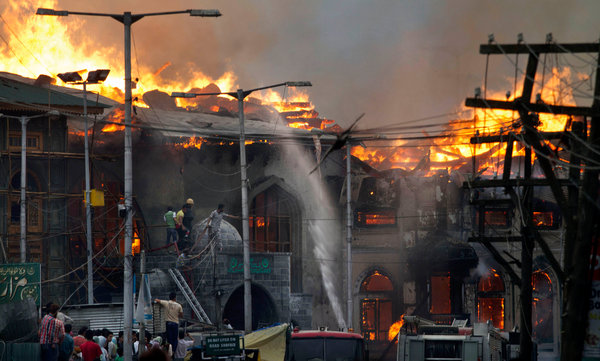
Kashmiri residents helped firefighters extinguish the blaze at a Sufi shrine in Srinagar on Monday. (Dar Yasin/Associated Press)
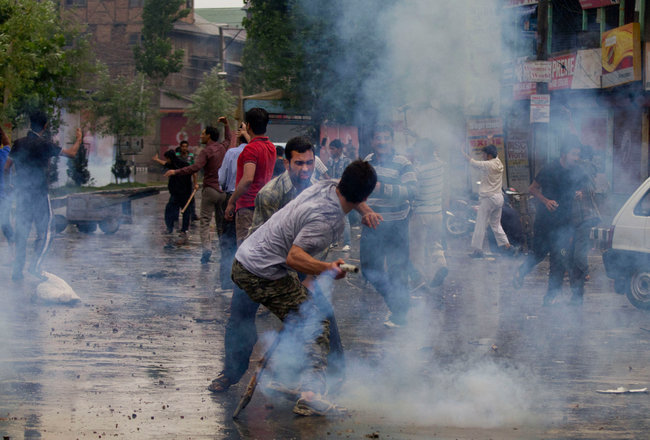
Protesters clashed with security forces in downtown Srinagar. (Dar Yasin/Associated Press)
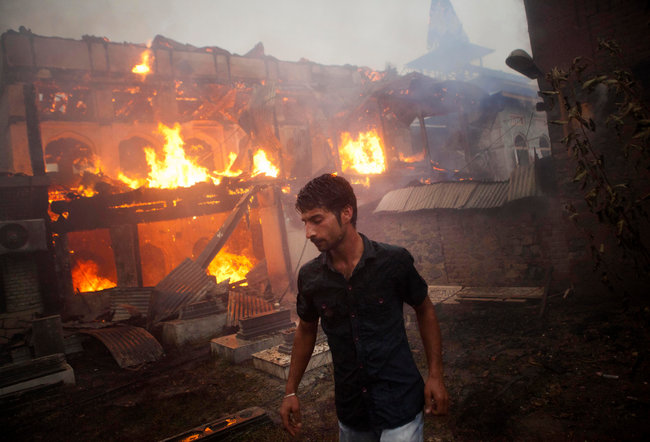
The cause of the fire at the shrine, which housed a relic of an 11th century Sufi saint, was not immediately known. (Dar Yasin/Associated Press)

Residents pulled a water pipe to help battle the blaze. (Danish Ismail/Reuters)
“Police sealed off roads leading to the shrine where hundreds of men and women had gathered, many of them wailing and crying.
“I feel like I’ve lost everything,” cried a 45-year-old woman, Shameema Akhtar, tears rolling down her cheeks.
Muslim militants spearheading the anti-India campaign in Kashmir have in the past tried to enforce a radical form of Islam, banning beauty parlors, cinemas and liquor shops, as well as asking women to wear the veil.
But they have had little success in a region where people mostly follow Sufiism, a gentle, mystic tradition of Islam.”
Tens of thousands of people have been killed in the years of strife in the region that both of the nuclear-armed rivals, India and Pakistan, claim. Pakistan controls part of Kashmir in the west.
Comment: nikobakos@gmail.com
The Delhi Wallah: Your gateway to alternate Delhi, the city of Hazrat Nizamuddin Auliya and Arundhati Roy is one of my favorite sub-continental blogs and even has the endorsement of the great historian and travel writer Walter Dalrymple: “The Delhi Walla is Delhi’s most idiosyncratic and eccentric website, and reflects a real love of this great but under-loved and underrated city.” The work of the assumedly pseudonymed Mayank Austen Soofi, the blog really is written with the true tenderness that only a great city fallen on slightly hard times can inspire. One thinks of Orhan Pamuk’s Istanbul, written about his youth in that city before it became the ISTANBUL! it’s become since the 1990’s.
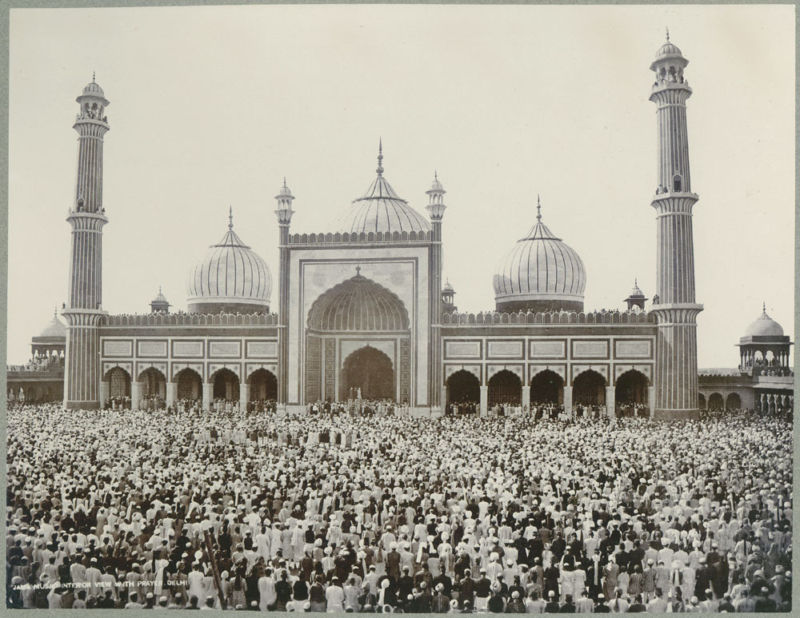
Delhi’s Jama Masjid in the 1890’s
Anyone who knows me, and some who don’t but might have already picked it out from this blog, know that I’m interested in all of India and even engage in certain Hindu practices and rites but that my true fascination is the Mughal culture of the northern Doab heartland. This comes from — just among myriad things — the composite, deeply syncretic and super-elegant aesthetic of that culture and, more personally, from a deep affinity for lost worlds and for the dignity maintained in the face of the most tragic circumstances under which Indian Islam, much like the Byzantines, not only laboured but continued to flourish for so long.

Bahadur Shah, the last reigning member of the Mughal dynasty
When I read Dalrymple’s masterpiece, The Last Mughal, The Fall of A Dynasty 1857 I was left shell-shocked, not just by the sheer scale of the Indian Rebellion’s violence, but by the mindless, post-conflict destruction of the vindictive and obviously terrified Brits, determined to teach Indian Muslims a lesson for their “mutiny.” Even the outer walls of the Red Fort and the Jama Masjid itself were saved at the eleventh hour by the orders of more intelligent superiors. It makes my head spin to think that had the cooler heads that the British so pride themselves on prevailed, Delhi today would still be a showcase of Muslim art and architecture on a par with Isfahan and Cairo or even Istanbul.

The Red Fort in Delhi, once the largest palace complex in the world, eighty per cent of which was dynamited by the British after the Indian rebellion was crushed. (click)
One can read about how upper-class Muslim life in north India proudly soldiered on into the twentieth century in books like Ahmed Ali’s beautiful Twilight in Delhi or made it through the trauma of Partition and modernity in films like Garm Hawa and Sardari Begum. (For a fairly insightful look — but one that doesn’t really tackle the most radical questions — at Indian Muslim life in the cinema seeIslamicate Cultures of Bombay Cinema by Ira Bhaskar and Richard Allen but all these can’t help but strike a certain elegiac tone.

But…what I love about the Delhi Wallah is what detailled coverage he brings you of how alive and well Muslim life and culture in Delhi still are: mushairas, qawwali gatherings, celebrations at sufi tombs — and not just Hazrat Nizamuddin Auliya’s — old ruins and mausoleums he’s constantly digging up among the chaos of the modern city — and the glorious food. He has a four-volume guidebook to the city and he’s recently done a beautiful four-part photo op and piece of his trip to Kashmir. Don’t miss this blog!
Comment: nikobakos@gmail.com
Oh… But wait… No! It’s Greece! Who’da thought it?

New York Times‘ cover story today: “Hard Times Lift Greece’s Anti-Immigrant Fringe” about the gaining of political traction by Greece’s neo-fascist party/movement, Golden Dawn. http://www.nytimes.com/2012/04/13/world/europe/far-right-golden-dawn-sees-opening-in-greeces-woes.html?_r=1&ref=world#
See their website t-shirts http://xabooks.blogspot.com/ for some of the more sickening (and just plain embarrassing) manifestations of the bogus “Hellenic” classicism, which is the fabricated basis of Neo-Greek identity. Inevitable, if you ask me. Christoule mou — the word “Hellas” makes my skin crawl.
Few money quotes:
““This is our party’s program, for a clean Greece, only for Greeks, a safe Greece,” Ilias Panagiotaros, the group’s spokesman and a candidate for office, said as he handed out leaflets.”
“But even if Golden Dawn fails to enter Parliament, it has already had an impact on the broader political debate. In response to the fears over immigration and rising crime, Greece’s two leading parties — the Socialist Party and the center-right New Democracy Party — have also tapped into nationalist sentiment and are tacking hard right in a campaign in which immigration has become as central as the economy.”
“Greek society at this point is a laboratory of extreme-right-wing evolution,” said Nicos Demertzis, a political scientist at the University of Athens. “We are going through an unprecedented financial crisis; we are a fragmented society without strong civil associations” and with “generalized corruption in all the administration levels.”
“Mr. Kasidiaris added that he believed that all illegal immigrants should be “deported immediately,” and that Greece should plant minefields along its border with Turkey “Not to kill the immigrants,” he said, “but to clearly define an area that would stop anyone from thinking of accessing the country.””
“If Pakistanis squat your front door, call me, not the cops,” he [Michalis Karakostas] said.
Humanity is so depressingly predictable. Boy, it was so easy to call Americans vicious racists as long as Greeks were sophisticated, liberal Europeans living the Southern California high life with “xena kolyba,” wasn’t it?
“If Pakistanis squat your front door, call me, not the cops…” Mwr’ ti mas les… Greece was always a society where mangia came very cheaply; it’s no surprise that in times of crisis it’s even easier to indulge in. So, just so that the boys at Auge youth headquarters know, most of the Pakistani immigrants in Greece come from the ethnic group that constitutes the majority of internal migrants in Pakistan itself; they’re Pashtun mountain kids from the northwest highlands (the people almost evenly divided by the Pak-Afghan border), who are generally known as the most hard-core warriors on the planet, who scared away the British, the Soviets and the Americans, who can handle a Kalshknikov at age ten, a good butcher’s knife by seven, and about whom Congressman Charlie Wilson said in the eighties: “I’d rather spar with a live chainsaw than go up against these guys.” I’d love these little Athenian tsoglania to meet up with them on their home turf and put their physical well-being where their posturing fascist mouths are. It’s easy to beat up a lone Albanian on a Patissia side-street. Let’s see how tough these “Hellenic” pallikaria are when they run the risk of ending up with their heads on a pike.
Lots of unexplained vocabulary in that one — sorry — but it was mostly directed at my paesani anyway. As the Golden Dawn website says: Kale Anastase…
Comment: nikobakos@gmail.com
“Had she been a politician’s daughter or a general’s daughter, then we would have seen what would have happened,” Ms. Durrani said. “But who was going to fight for a dancing girl?” [my emphasis]
This Holy Tuesday, when the evening service in the Orthodox Church commemorates the heroic love and generosity of the “myrrh-bearing harlot,” please remember vulnerable and exploited women everywhere.

Relatives of Fakhra Younas in Karachi, Pakistan, last month. The man Ms. Younas long accused of dousing her with acid, her ex-husband, Bilal Khar, was acquitted at trial nine years ago. (Associated Press)
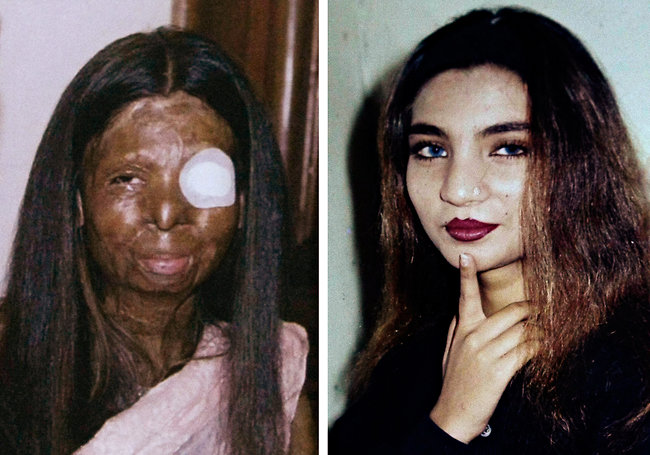
From the right, Ms. Younas before and after she was disfigured in an acid attack that she blamed on her then-husband. (Associated Press)
Comment: nikobakos@gmail.com
This group — “The Dishonourable Brigade” — of smart and very cute…and very brave…Pakistani kids out of Lahore put out this cool song last year that became an instant hit. It’s called “Aalu Anday” or potatoes and eggs, and the Punjabi refrain says “my mom made me potatoes and eggs [again]” i.e. “I’m sick of this shit,” and the song then proceeds to bash and mock the whole landscape of corruption, religious fanaticism and social stagnation of contemporary Pakistan. A viewer will need a bigger expert than me to explain all the references, but enough can be gleaned from just the subtitles, and the YouTube comments contain a lot of information too, if you can pick it out of the mutual Indo-Pak bashing and obscenity that’s usual to YouTube comments.
Takes a lot of guts to put out a song like that but it obviously hit a nerve because it became wildly popular and was embraced in both Pakistan and India. Does anybody know what happened to them?
Don’t miss this television interview with them, conducted in that effortless switching back and forth between Hindustani* and beautiful English that it is so damn enchanting to listen to (or is it Punjabi?):
And another one where the lead singer Ali Aftab Saeed gives us a nice acoustic version towards the end:
I’d love to get some further news on them.
Are things shifting on the sub-continent? A new thaw apparently; Zardari visits India: http://articles.cnn.com/2012-04-08/asia/world_asia_pakistan-india-visit_1_pakistan-and-india-pakistani-leader-islamabad?_s=PM:ASIA
A start, eh? Now let’s get to work on reversing Partition. Well, we can dream, can’t we?
*I use “Hindustani” as often as possible because I try — as often as possible — not to acknowledge the supposed difference between Hindi and Urdu, despite the intense efforts on respective sides of the border to Sanskritize and Islamicize what is essentially one language. Nationalism’s manipulating of what people spontaneously speak is one of its most insidious forms of mind control. Serbs and Croats have been trying to prove their language is not the same one for almost a century now — unsuccessfully, given the capacity of Serbian and Croatian paramilitary thugs to hurl the most fertile insults at each other across battle lines in the nineties with no comprehension problems whatsoever — and now there’s a third contender, the ‘Bosnian’ spoken by ‘Bosniaks.’ To some extent Turks and us went through the same process, though they’re obviously not the same languages: nineteenth-century Greece tried to make Greek Greeker, which meant archaicizing it, and though I don’t necessarily think katharevousa was the artificial monster a lot of people do — in its simpler, less pretentious forms it was capable of great beauty in the hands of certain writers like Papadiamantes — the ideology behind it was a deeply problematic one. Ditto the Turkish Republic, which in the late twenties and early thirties tried to eliminate remnant Persian syntactical features from Turkish and replace all Persian and Arabic words in the language with new Turkish ones (even forcing muezzins to sing the call to prayer in Turkish), an attempt which, if it had succeeded to the full orthodox extent of its intentions, would have left the entire Turkish people mute for everything except the most basic human communication — like in the Hundred Years of Solitude where they have to write “cow” on the cow. Apparently, in 1934, the Great Leader himself made a series of speeches in the New Turkish which were completely unintelligible to everyone except him and his inner clique. They backed off a little afterwards apparently but, between the high learnedness of much Ottoman literature and the Republic’s tinker-tampering, much of nineteenth-century Turkish literature is now unreadable to most modern Turks. As Benedict Anderson said, the nation-state pretends to be the guardian of your culture and traditions but “is actually hostile to the real ways of the past.”
Comment: nikobakos@gmail.com
 Jadde: from Bosnia to Bengal