Tag Archives: Putin

Blogging of a hero of mine: Alexey Naval’niy

4 Jan

Navalny on Putin, Being Bugged and Revolution

Great Krugman on Putin

22 Dec

putin-russia-military-750a_4eeedb96f23edfb4cd42615d86323da2(click — if you can stand to…)

In today’s Times: Conquest Is for Losers: Putin, Neocons and the Great Illusion

Good for someone to remember these things — and say them straight up to.  Whether it’ll sink through Russian heads is not a call I can make.

“First, why did Mr. Putin do something so stupid? Second, why were so many influential people in the United States impressed by and envious of his stupidity?

“The answer to the first question is obvious if you think about Mr. Putin’s background. Remember, he’s an ex-K.G.B. man — which is to say, he spent his formative years as a professional thug. [My emphasis] Violence and threats of violence, supplemented with bribery and corruption, are what he knows. And for years he had no incentive to learn anything else: High oil prices made Russia rich, and like everyone who presides over a bubble, he surely convinced himself that he was responsible for his own success. At a guess, he didn’t realize until a few days ago that he has no idea how to function in the 21st century.”

And from me August 3rd: From the Times: Putin uses the Church…and the Church mostly lets him… ‘Позор…’  

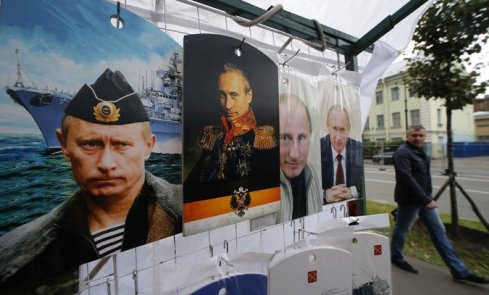
“Does anybody remember that Putin was a KGB agent for decades — not just a cop, an agent of an instrument of mass state terror with perhaps no equal in history — and that part of his job was ruining the lives of anyone who engaged in the kind of religious pilgrimage these people are?  No.  It’s like that never happened.  And though my stomach turns when I see him on news footage solemnly standing with his candle at Easter, engaging in the non-stop crossing and bowing that Russians do in church, I’m also just stunned by his brazenness.  The word Позор (pa-zor’) in the heading of this post means “shame” but as I was trying to find somewhere to cut and paste it from I came across its etymology.  It originally meant “remarkable,” or someone or something remarkably “watchable,” from the root “zor” for vision.  And this is, in fact, the response Putin provokes: you simply stand there, staring and dumbfounded by his shamelessness.

“As for Russians themselves, sometimes I get so angry, not just at their acceptance of the political manipulation of an Orthodox Christianity that’s important to me, but at their general passiveness, gullibility, and willingness to play along with anything that promises even some tiny alleviation of their suffering, that I just want to think that they deserve their fate.”

Comment: nikobakos@gmail.com


“Scenes that Russians hoped had receded into the past reappeared on the streets.” — from Times

16 Dec

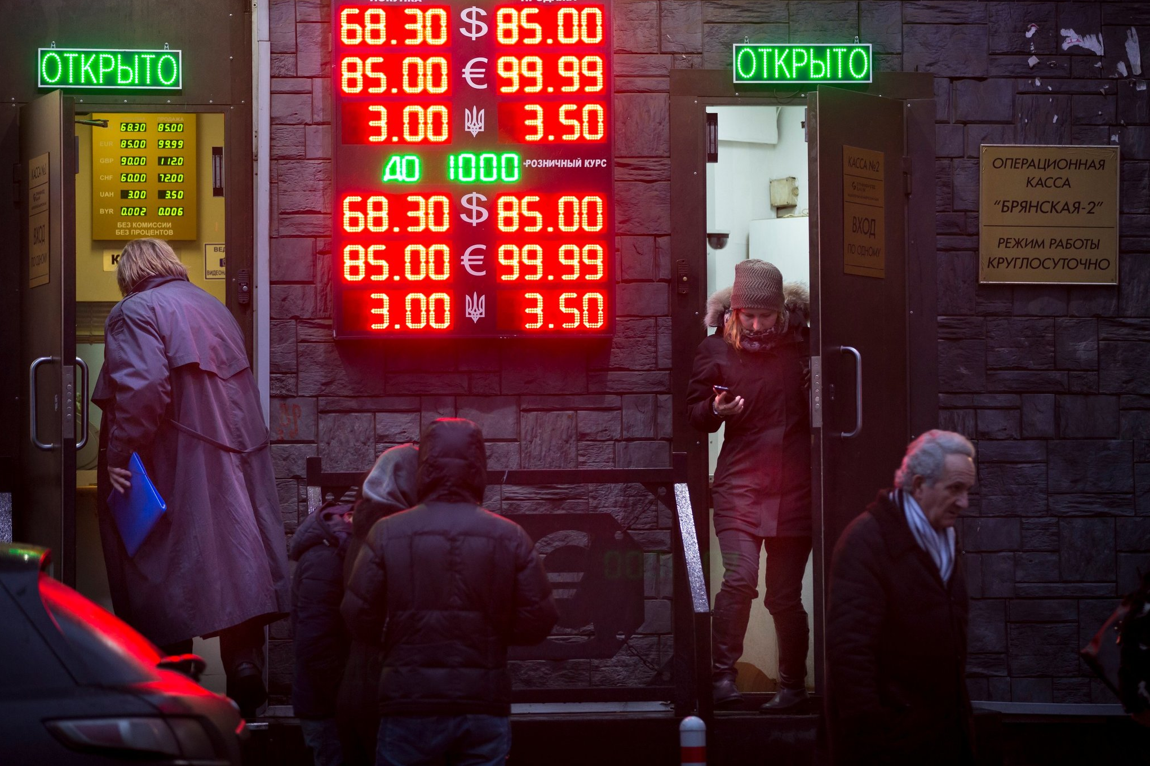
As in the case of Iran, just what exactly are the sanctions meant to accomplish? except make ordinary Russians, most of whom have already suffered enough in their lifetimes, suffer even more.  They’re not going to turn against Putin (and needless to say, he and his cronies aren’t suffering*), nor is he going to back down under these conditions.

See whole story: Russia’s Steep Rate Increase Fails to Stem Ruble’s Decline by Andrew Kramer.

Russia Screen Shot 2014-12-16 at 4.23.43 PMThe scene at an electronics shop in Moscow. Fearing inflation, Russians are reacting to the falling ruble by snapping up expensive items like appliances and laptops. Sergey Ponomarev for The New York Times.  (click)

Russia Screen Shot 2014-12-16 at 4.27.49 PMOutside a currency exchange in Moscow on Tuesday. The ruble continued to slip in value despite the central bank’s decision to raise its short-term interest rate to 17 percent. Alexander Zemlianichenko/Associated Press. (click)

See also my :  The first two of my cents on Ukraine and Russia… from August 31st.

Comment: nikobakos@gmail.com

**************************************************************************************************************************************************************************

* Apparently, Putin made some crack when the EU announced restrictions on the export of foodstuffs to Russia, that: “Who needs their food?  We have Russian vodka and caviar!”  And then the joke immediately started going around: “Well, it’ll probably be moonshine and cabbage for most of us…”


Scary Op-Ed piece from the Times

13 Oct

Imagine the unimaginable: Suppose an American supreme court chief justice asserts in an interview that “slavery in the United States, despite its extremes, was a principal bond that maintained the deep unity of the nation.” Now replace “slavery in the United States” with “serfdom in Russia,” and you have the exact quote from an article by the chairman of Russia’s Constitutional Court, Valery D. Zorkin, published on Sept. 30.

In legal terms, serfdom, an institution that bound peasants to the land, is considered to be a less-cruel form of bondage than slavery. In practice, however, Russian serfs were routinely bought and sold and regularly physically abused. The abolition of serfdom in 1861 paved the way for the Great Reforms aimed at modernizing the Russian empire and setting free 23 million people, or more than a third of Russia’s population.

Mr. Zorkin wrote his comments while discussing a newly proposed law that would make failure to register with the local police authorities at a place of one’s residence a criminal offense. He further suggested that Russia during the 1990s under the leadership of President Boris N. Yeltsin was similar to the period of the Great Reforms in the 1860s. Then as now the reforms produced political chaos and social disorder, requiring counterreforms and repression to restore stability.

But if Mr. Zorkin sounds like an unreconstructed 19th-century Russian landlord, he is not alone. On April 17, President Vladimir V. Putin, in his televised question-and-answer session with the public, emphasized the inner strength of the Russians, particularly their readiness for self-sacrifice, which he said distinguished his country from the West. He hastened to add that these qualities would soon come in handy. Mr. Putin further suggested that country’s great strength was its peoples’ “unique and very powerful genetic code,” and that Russians possessed greater souls and superior moral values than self-indulgent Westerners. His glorification of the Russian soul and spiritual values repeated a popular theme among Russian nationalists throughout the 19th century.

Enter Mr. Putin’s inner circle. Dmitri O. Rogozin, a deputy prime minister in charge of the military industry, is known for his hawkishness and his numerous pronouncements of Russia’s readiness to use nuclear weapons. In September, he reiterated his statement that, if attacked, Russia would respond with nuclear arms. In Mr. Rogozin’s words, they represent a perfect “weapon of retribution” intended to stop Western aggression against Russia. There have been several reports that Russian officials informally threatened their Ukrainian counterparts with nuclear weapons.

Russia also has its own, nonfictional, Dr. Strangelove. Dmitry Kiselev, the head of the news network Russia Today, is widely considered to reflect Kremlin views. In one of his programs early in the Ukrainian crisis, he told his audience that Russia was “the only country in the world capable of turning the United States into radioactive dust.” He illustrated his case with charts showing the trajectories of Russian missiles, adding that even if the United States was able to intercept these, the missiles from nuclear submarines would do the job.

If this sounds alarming, consider the boundless anti-Americanism of Mr. Putin’s close adviser, Sergei Glazyev. Just last month, Mr. Glazyev recapped a favorite theme: The United States has started a series of regional wars in preparation for World War III. Why? Because America is in decline and needs war in order to prevail in its competition with China, weaken the European Union and undermine Russia. Only then will it be able to control Eurasia.

The troubles in Ukraine, Mr. Glazyev argued, were a part of Washington’s strategy. In the past, Mr. Glazyev frequently called for bombing and a full-scale invasion of Ukraine, which he invariably referred to as the American-installed “fascist, Nazi junta.”

These and other pronouncements by the Russian president and his close advisers are increasingly stated in vague and mystical language, with references to the “Russian world.” The leader of the Russian Orthodox Church, Patriarch Kirill, explained during his regular TV program on Sept. 8 that the “Russian world” is a distinct civilization and that its unique spiritual and cultural values must be preserved. According to the patriarch, it includes Ukraine, Belarus and any non-Slavic peoples who share these values. He derided the concept of a melting pot, suggesting that it was a perfect example of the failure of contemporary Western civilization.

Such pronouncements may appear bizarre. Yet they cannot simply be dismissed as the ideas of the political fringe because they belong to the Kremlin’s inner circle. In a desperate attempt to preserve their power, Russia’s ruling class has concocted an ideological brew that borrows from every corner of the repressive and outdated world of Slavic nationalism, isolationism and anti-Westernism.

The German chancellor, Angela Merkel, was right when several months ago she described Mr. Putin as inhabiting his own mental universe. Worse, the worldview of Mr. Putin’s Russia leaves little room for compromise.

Michael Khodarkovsky, who grew up in the Soviet Union and is a professor of history at Loyola University in Chicago, is at work on a history of the Russian empire.

“…Russia’s ruling class has concocted an ideological brew that borrows from every corner of the repressive and outdated world of Slavic nationalism, isolationism and anti-Westernism.”  Yes, thank you.  So let’s keep pushing them into that corner, right?  This is what I argued against in The first two of my cents on Ukraine and Russia.”

Comment: nikobakos@gmail.com

The first two of my cents on Ukraine and Russia…

31 Aug

01UKRAINE1-master675

Alexander Demianchuk/Reuters (click)

See this story from the Times: Putin Urges Talks on Greater Autonomy for Eastern Ukraine,” which I’m pretty sure was his objective to begin with: force a crisis to get so bad and then negotiate for autonomy.  What repercussions that will have for Ukraine’s future or what patterns it’ll set for other areas (like the Baltic countries — Putin’s most vociferous critics — or Central Asia) of the former Soviet/Russian sphere that contain large Russian minorities has to be seen.

Belgravia Dispatch had an excellent and frighteningly prescient opinion piece on the escalating Ukrainian crisis back in March:  What To Do–And Not Do–About Ukraine — which, unfortunately, the whole world ignored and whose worse case scenarios have now come true, including the annexation of Crimea and what I think it is now safe to call a full-scale invasion of Ukraine by Russian forces and not just a rebel movement of local Russian separatists.

One important point from me, first and up front: the West can rush to get tough on Russia if it wants to; I can guarantee you that Russians are tougher.  This is a point that Gregory Djerejian on Belgravia makes and one that has certainly manifested itself in exactly the way he predicted.  We need to remember that this generation of Russians that has come of age since the momentous changes of the nineties are the first generation in that people’s history, perhaps, to not have been dragged to hell and back at least once in their lifetime.  They’re proud — rightfully, I feel — of their capacity for survival.  This isn’t an expression of support on my part for Putin’s cheap machismo: my loathing for him and his posturing, his whole persona and everything he represents — including the craven adulation of him that is Russians at their most infantile — is something I’ve written on endlessly.  It’s just stating a fact that the West should be aware of: they’re not going to be pushed around.  Think hard before you put them in a position where they have to prove that to you…because they will.  So treating Russia like a pariah will only play into Putin’s hand.  That’s, in fact, what has happened; the whole country has fallen in line behind him and anything like the РОССИЯ БЕЗ ПУТИНА — “Russia without Putin” — protests of two years ago would be considered, in a spontaneous act of socially unanimous censoring, pure treason these days with no one even daring to publicly air such opinions in the current heady climate of nationalist excitement.

The other point is one that Belgravia makes right off the top of his post with the following quotes:

Yet, Kievan Russia, like the golden days of childhood, was never dimmed in the memory of the Russian nation. In the pure fountain of her literary works anyone who wills can quench his religious thirst; in her venerable authors he can find his guide through the complexities of the modern world. Kievan Christianity has the same value for the Russian religious mind as Pushkin for the artistic sense: that of a standard, a golden measure, a royal way.”

–Georgy Fedotov

“The problem of the origin of the first Russian state, that of Kiev, is exceedingly complex and controversial.”

–Nicholas Riasanovksy

“Without Ukraine, Russia can remain an empire, but it cannot remain Russia.”

–Title of a recent article in Russkoye Obozreniye, a Russian periodical.

It’s like Scotland.

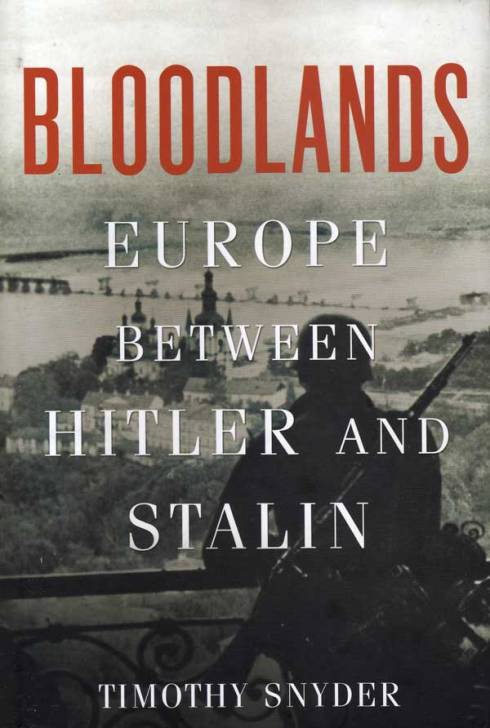
This was one of the first things you would’ve realized if you were on the ground in Russia this July and August like I was (but despite my suggestions to several industry friends and acquaintances, no Western journalists seemed to think that the “story” was not just in Donetsk or Luhansk, but in living rooms and at kitchen tables in Moscow and Petersburg and countless other places): that is that Russians simply don’t consider Ukraine a foreign country or foreign culture.  I’m not making a judgement call on whether that’s right or wrong or imperialist on their part or not; judging such sentiments “ethically” or putting them through the political-correctness grinder is pointless and counter-productive.  It’s just that their historical experiences have led Russians — and arguably, till a certain point, had led most of the people who now call themselves Ukrainians — to think that way: that they were both intimately and inseparably related, and there’s as much point in calling those feelings “wrong” as there would be in your therapist telling you that your neuroses are “wrong.”  And so Russians were/are, in fact, in shock that the rest of the world thinks it has no role to play in Ukraine or no vital interests in political developments there.  The reason that this doesn’t seem to register in Western consciousness is a result of the fact that the West is so immersed in thinking along an ethnicity-based nation-state model of discrete national units with clear, essentialized, historical trajectories, that it is incapable of seeing nationalism as a construct: flexible, malleable, unclear, even “made-up-as-you-go-along” if you will — so that Russians, and the new Ukrainian nationalists, can have radically opposing views on what their relationship is, without either of them being “wrong.”  As brilliant a historian as Timothy Snyder, author of the devastating Bloodlands: Europe between Hitler and Stalin is capable of writing in The New Republic this past May, in an article called: The Battle in Ukraine Means Everything  the following:

“Ukraine does of course have a history. The territory of today’s Ukraine can very easily be placed within every major epoch of the European past. Kiev’s history of east Slavic statehood begins in Kiev a millennium ago. Its encounter with Moscow came after centuries of rule from places like Vilnius and Warsaw, and the incorporation of Ukrainian lands into the Soviet Union came only after military and political struggles convinced the Bolsheviks themselves that Ukraine had to be treated as a distinct political unit. After Kiev was occupied a dozen times, the Red Army was victorious, and a Soviet Ukraine was established as part of the new Soviet Union in 1922.”

Snyder’s history — “of course” — with its suggestion of a straight, uninterrupted historical lineage of “Ukrainian-ness” from Kievan Rus’ to modern Ukraine is just patent bullsh*t, and is one that simply chooses, in the glossing-over-of-breaks-and-ruptures fashion and in the fabricating of false unities that nationalist narratives always engage in, to ignore several fundamental, historical realities: one, the fact that the Russian principalities that rose up in the northern forests of what we now consider the Russian heartland after Kiev’s demise at the hands of the Mongol-Tatars — Vladimir, Pskov, Novgorod and later Moscow and its unifying power — were more highly conscious of their political descent from early mediaeval Kiev and were, in fundamental ways, far more its true political and cultural and spiritual heirs than any “Ukrainian” polity could even try to claim to be until the twentieth century; two, that most of what is now Ukraine had already been part of Russia for more than two centuries before the Bolshevik revolution; and that, three, before that, the western quarter of it, maybe, was Polish and then Austrian, while much of the rest — through “every major epoch of the European past…” — was just a frontier no-man’s-land, a coming-and-going corridor for nomadic peoples either conquering or fleeing someone else.  (You can find a place for each and every corner of the world in “every major epoch of the European past” if you want to; that doesn’t mean it was central or even remotely important to that past.)  Also, thence, a crucial point: that Ukraine wasn’t so much conquered, but settled by Russia, while Snyder’s quote taken on its own makes it sound like an eternal Ukraine, populated by a people who had always thought of themselves as solidly and eternally Ukrainian, was just subjugated by the Soviet Union in the twenties.*  So it ignores all the ways that “Ukrainian-ness,” a term that did not even come into common usage until the late nineteenth and early twentieth centuries, was the product of a complex negotiation and mixture of different sub-identities converging from different directions in those fertile flatlands and has always, in that sense, been bound up in a million intricate ways with the history of its larger kin-nation to the north.  But we’re making the same mistake I believe we made in Yugoslavia: seeing the “nation” as something essential and essentialized, first and foremost; and secondly, assuming that the nationalism of the powerful player — in this case Russia, in the Yugoslav case, the Serbs — is pathological, inherently oppressive and dangerous, while ignoring the fact that the nationalism of the “little” — in these cases, Ukraine, and in Yugoslavia, that poor, powerless victim, Croatia — can not only be just as venomous and illiberal and murderous, but is often more so because it has a point to prove or a chip on its shoulder.  But the West is so in love with what by now should be the completely discredited Wilsonian idea of “self-determination” (while simultaneously supporting the “inviolability” of national borders**) that it fails to see that dark truth.  I’ll probably need to get into greater historical detail in another post in order to clarify a bit better.

(And now I’m ready for the barrage of accusations that all I ever do is knee-jerk defend my Orthodox brethren, but that’s cool — just par for the course.)

History, climate, geography have always conspired to isolate Russia.  And, in a sense, the pathos that drives Russian history and is the force behind her brilliant civilizational achievements (and, yes, her imperialism too), is  that of a constant, heroic struggle to break out of that isolation and find her place in the larger world.  Yacking on, like Snyder, about how Ukraine is somehow “essential” and central to the very idea of Europe, when, ironically, the very name Ukraine means “the edge” (from the same Indo-European cognate as the Greek “άκρη”…height or edge as in acropolis, or as Serbian “Krajina”).  The edge of what? of Russia/Poland…the EDGE of Europe…what an elevation of status Snyder grants to a proverbial Podunk, while treating Russia as dispensable or as a dangerous threat that needs to be hemmed around and contained — isolated again — is criminally unfair to Russians (if not to Putin and his cronies) and will end up backfiring on the West in ways it hasn’t even begun to anticipate.  Russia is not dispensable.  Nor is she to be ignored or patronized.  We think of her in those terms and the results will just get uglier and messier.
bloodlandsweb

**************************************************************************************************************************************************************************************************************

* There’s even a subtle subtext to the narrative of the Revolution and subsequent Civil War that Snyder gives us, which suggests some kind of identity between Ukrainian-ness and White Russian resistance to the Bolsheviks, when, in fact, I think that if the White Russian movement can be said to have had an ethnic or regional “base,” it was among the Russians of eastern Ukraine (the grandfathers of these very separatists of today? I wouldn’t know…) and the neighboring parts of southeastern Russia that stretch to the Caucasus.  The independent “frontiersman” mentality of the Russians of these areas, a sort of Russian Texas  — among its ethnic Cossack peoples especially — should not be underestimated and should not be disregarded as a possible element in the current conflict.  (See: And Quiet Flows the Don at Amazon and at Wiki.)

** The contradiction between the ideas of self-determination for peoples and the inviolability of borders — a contradiction that can’t be avoided if we keep thinking in terms of the EBNS (ethnicity-based nation-state) — has plagued do-gooder Western policies in all parts of the non-Western world from Wilson and Paris till Helsinki and still does.  And this despite the fact that its randomness and practical inapplicablity have been made so obviously clear on so many occasions: if Croatia can secede from Yugoslavia, why can’t Krajina Serbs secede from Croatia?  If Ukraine deserves — has an inalienable right — to be a country independent of Russia, then why doesn’t its overwhelmingly Russian eastern parts have an inalienable right to be independent of Ukraine?  Obviously it just comes down a particular bias of the West at a particular time

As for where it all started, Crimea, I hate to report to outraged Western observers that of all parts of Ukraine, Crimea was always the area with a practically non-existent Ukrainian element in its population.  Not that the March “referendum” was not a total farce.  But if any people have a right to Crimea and to feeling displaced and dispossessed it’s Crimean Tatars — not Ukrainians.  Hell, just to play Devil’s advocate…the millenia of Greek presence on the northern shores of the Black Sea, and the numerous Greek mercantile communities that existed in Crimea and around the Sea of Azov until the twentieth century (Chekhov attended a Greek elementary school in Taganrog), give even us a technically greater ethnic claim to Crimea than it does to Ukrainians.

In any event, I knew as far back as the early nineties, that sooner or later Russia would find a way to take Crimea back (Crimea was part of the Russian Soviet Republic until 1955) and am actually surprised it took so long.  The drang nach süden impulse that drove Russian imperial policy for hundreds of years — the equivalent of American “Manifest Destiny” — south into Ukraine and on to the Black Sea, with the ultimate objective of a re-Orthodoxed Constantinople and Russia as a Mediterranean and world super-power with access to India and the East, was not a desire for the rich soils of the Dnieper valley.  It was a need for access to warm weather ports.  Crimea thus became a crucial site for the base and deployment of Russian and then Soviet naval power and there was no way that it was just going to be handed over so casually.  Ask the United States to just hand over Camp Pendleton and Twenty-Nine Palms, the naval bases at Coronado and Loma Catalina, along with the whole San Diego metropolitan area, to Mexico.  Or just grant Hawaii its independence.  Or give it to Japan.  Or try, even, just to get the U.S. to close its base in Okinawa!  It’s the same thing.  Is this an apology for imperialism?  No.  It’s just a statement of a historical and political reality that can’t be ignored.  Or one that it’s necessarily the West’s business to “fix.”

Note: The Ukrainian national case or argument may have one key point that is rarely discussed and is surprising to me in that sense.  I’m not certain of it, but it may be that eastern Ukraine acquired its overwhelming Russian ethnic character because it was the region hardest hit and left most depopulated by Lenin and Stalin’s murderous collectivization disaster, and that many Russians were settled there afterwards when the region was turned into one of the industrial heartlands of the Soviet Union.  This is seriously guessing on my part and someone with greater knowledge should be sought out for a definitive answer.

A corollary to that is the hypocrisy of western Ukrainians, the most fanatical nationalists and quasi-Catholics, and perhaps the most extreme element on the Ukrainian political stage today (whom Putin uses, of course, to paint all Ukrainian nationalists as fascists and Nazi collaborators), who did not suffer any of the horrors of collectivization and famine because they were under Polish rule at the time — not always so benign either — and only became part of the Soviet Union in 1945.  Yet, they use those events as some of the main tools in their anti-Russian arsenal.  Furthermore, just as many Russians suffered during those violent socioeconomic processes and it’s a slightly cheap appropriation to call them a purely Ukrainian set of humanitarian disasters.

Comment: nikobakos@gmail.com

My Circassians

25 May

AdygeaReaders might remember I’ve had a long-term interest in Circassians since high school.  Of all the peoples collectively known in Turkey as muhacir, the Ottoman Muslims who took refuge in the Anatolian heartland of the Empire as it shrank, probably none had a more torturously, circuitous odyssey to ultimate safety in Turkey than the Circassians.  Here’s a selection about them from a post I wrote in February about why I was boycotting the Sochi Olympics; it wasn’t just for Putin and his filthy, murderous personage, but because the games were being held on land an admirable and honorable people had fought long and hard to keep and had been brutally thrown out of by Imperial Russia:

“And then there are the Circassians.  I became obsessed with Circassians in high school because I had to know who these people were, so physically beautiful apparently, that they held the entire Near East in thrall for centuries.  Circassians were the first reason I ever went into the New York Public Library, because the library at Stuyvesant didn’t have anything on them.  This is also around the time, as a nerdy sixteen-year-old, that I started developing the totally adolescent, romantic fascination I still suffer from, for honor-obsessed, heavily-armed highlanders — Montenegrins, northern Albanians, Pashtuns — who don’t easily let themselves get pushed around by outsiders.   It fed a lonely teenager’s fantasies of empowerment then.  Now, I couldn’t tell you.  Probably still.

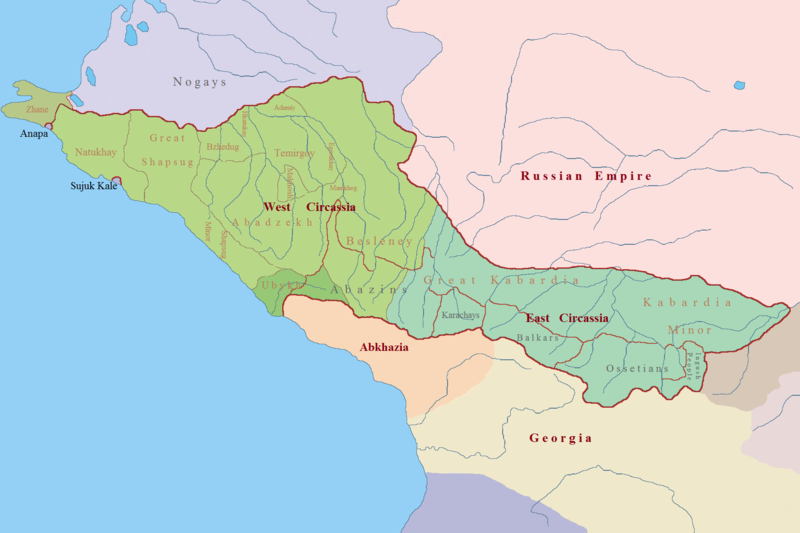
“The Circassians lived in a huge swath of plain, foothill and high mountain country in the northern Caucasus.  Most of the sites of the this month’s games are being held on formerly Circassian territory.  This is a map of their general distribution in the eighteenth century, right before Russian expansion southwards began:

Circassia_in_1750

(click)

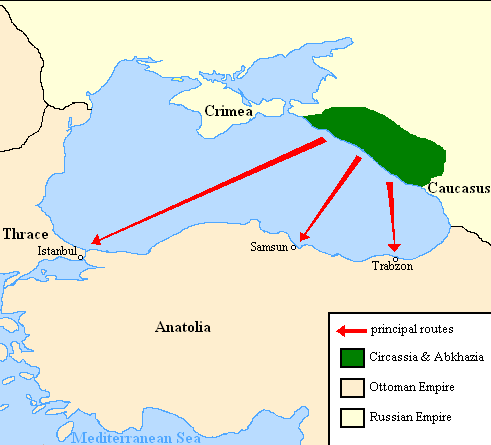
“For more than a century they fought a brutal tooth-and-nail war against the Russians and their Cossacks.  When they finally capitulated in 1864 it was in Sochi.  The majority, which would not agree to an oath of loyalty to Russia were deported, in what was probably the first campaign of ethnic cleansing of such dimensions in modern history.  For months, the beach at Sochi was a Dunkerque-like humanitarian disaster zone, with tens of thousands of shelterless, starving and diseased Circassians waiting for Ottoman ships to take them to safety in Anatolia or the still-Turkish Balkans or dying on the spot.

Expulsion_map_of_the_Circassians_in_19th_century“It certainly represented the largest civilian death toll of any war up to its time and today, ninety percent of people of Circassian descent live outside their original homeland, mostly Turkey, but also Syria, Jordan and Lebanon.”

(To read the whole post: Ignoring Sochi.“)

And as with Native Americans in North America, as their government was massacring and expelling them, Russian poets and writers like Lermontov, Pushkin and Tolstoy were romanticizing them, sympathizing with them and entering in a love affair with all the peoples of the Caucasus that literary Russia still has not recovered from.  Someone, everywhere, at all times, has a heart and a soul — for whatever good it does.

I had assumed muhacir is constructed from the Arabic “mu = doer of something” plus the roots ‘h’ + ‘j’ + ‘j’ (?) which almost sounds more like “pilgrim” –  as in “Hajj.”  But “mu” turns out to be a passive participle marker of someone who is made to do something, in this case not as in “Hajj, pilgrimage, but  ‘h’ + ‘j’ + ‘r’ as in “Hejira?” which would mean “fleer,” as in those who fled with Muhammad to Medina from Mecca in 622.  That would make more sense than traveller, which would be the “mu-sa-fir” recognizable to any Greeks as an old-fashioned word for “guest,” except to those Neo-Greeks that are so Post-Ottoman that they’re Post-Culture-of-Any-Kind and most certainly Post-Hospitality.  The Muslims that left India after Partition in 1947 to go to the land of Islamic Purity are also known as muhajir in South Asia.  I say that the Circassians’ route was particularly circuitous because many of them were first settled by the Ottoman government in the Balkans — especially Bulgaria and Kosovo (where there’s still a tiny community), where they were used to demographically offset the Christian population and because their warrior reputation would come in handy against Christian rebellions and Russian invasions.  (Though there is one wild episode of the Greco-Turkish War where a band of Circassian çeteler [çetes] in western Anatolia actually aided the invading Greek army.  Go figure.  Any-thing is possible in our part of the world.)  Needless to say with the coming of independence for the nations of the Balkans, they were uprooted again to Anatolia and other parts of the still Ottoman Arab world.

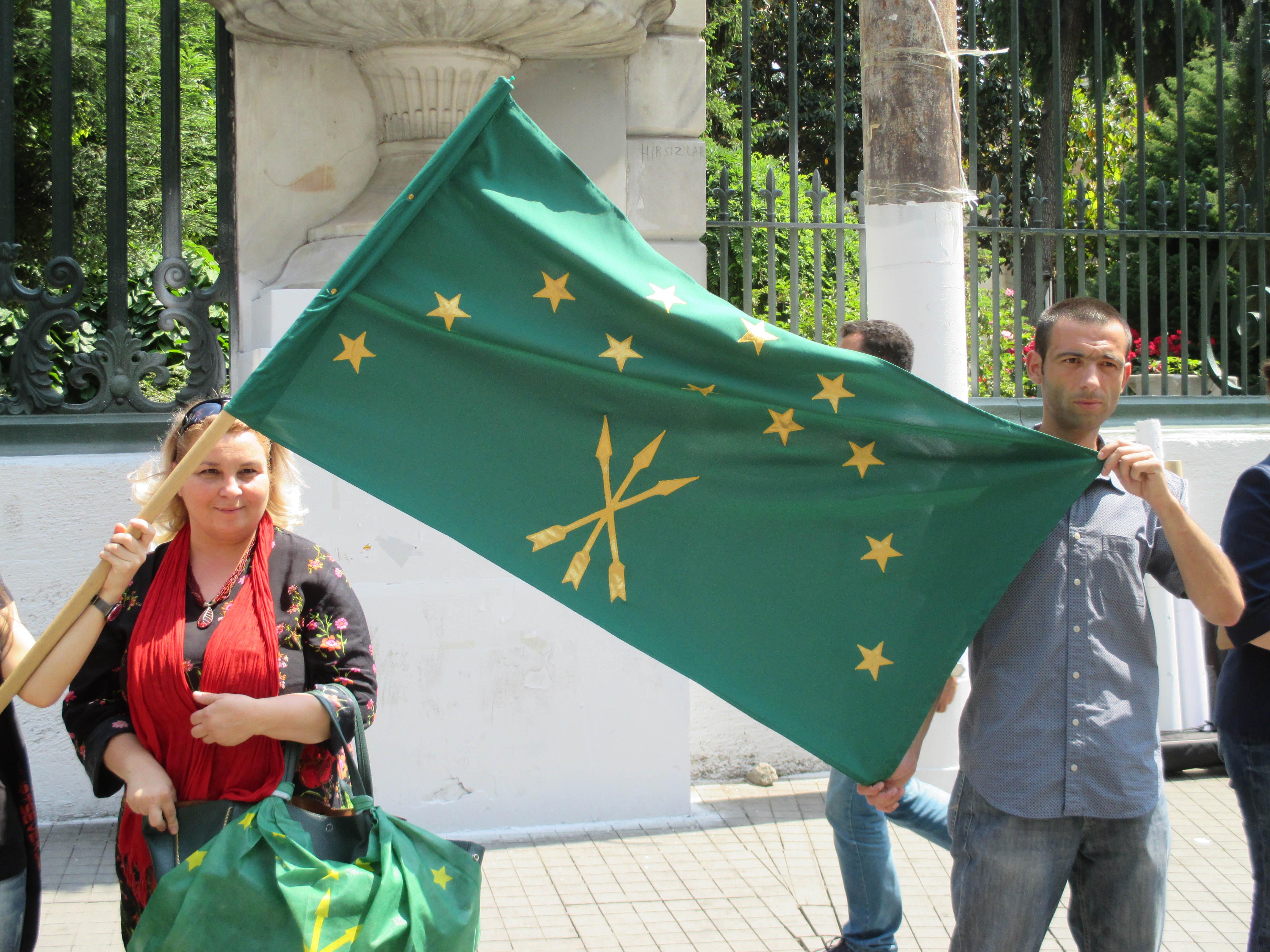
This year is the 150-year anniversary of the final, catastrophic expulsion from their Caucasian homeland and local Circassians (“Çerkes” in Turkish) have been holding demonstrations in front of the Russian Consulate down here on the Jadde (I wouldn’t even lower myself to asking for Putin’s ear) and then closer here to my place in front of Galatasarary.  (Click)

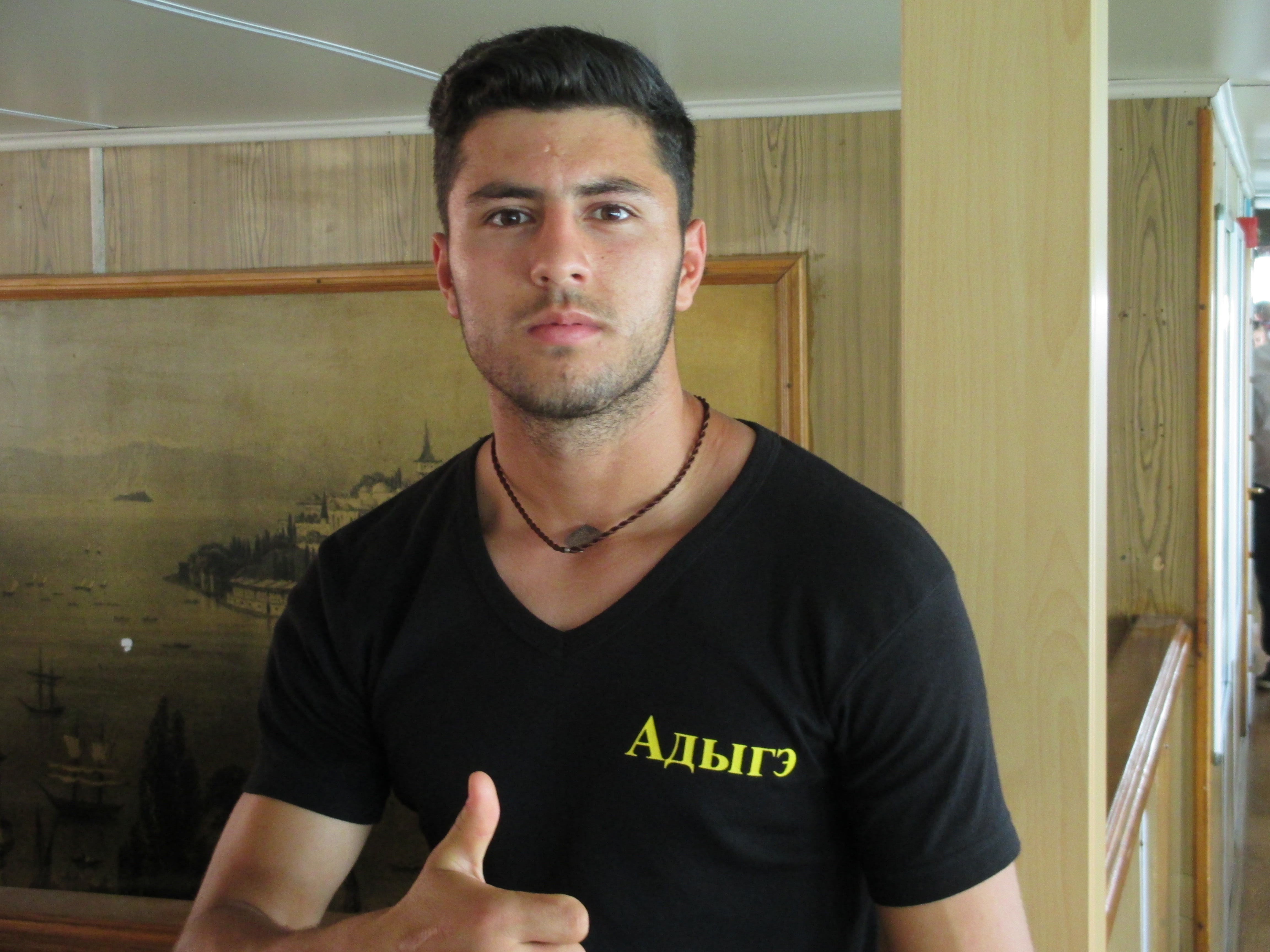
IMG_0777IMG_0775But I was kind of disappointed because I couldn’t get any really good pictures except some like these above.  Then I get on the ferry from Beşiktaş to go to Kadiköy with my cousin, Vangeli, to feed him at the spectacular Çiya restaurant there and visit Beylerbeyi, my favorite Ottoman palace, and by blogger-photographer’s luck right across from me is sitting this handsome Circassian kid from central casting (click):

IMG_0780 He was surprised I knew that his t-shirt said “Адыгэ” – “Adyghe,” which is what Circasians call themselves, written in the Cyrillic script they now use.  I asked him if he spoke the language and he said no, but some other Circassians I found the next day in Pera said that due to a concerted effort on the Turkey-wide community’s part — language classes, theater workshops, radio programs — more Circassians in Turkey of this kid’s age speak more of at least a little bit of the language than their parents do and that interest is increasing.  Insha’allah.  Cool.  So if you don’t respect these people for their legendary beauty, their ferocious warrior rep, the fact that they managed to stave off the forces of Imperial Russia for two centuries, that as the Mamluk military elite they effectively ran Egypt for five-hundred years till Mehmet Ali the Albanian massacred them in a totally, shitty, un-Albanian, pabesiko (“pa” = no + BESA), dishonorable, ambush — see  (“BESA: A Code of Honour,“) — then just admire them for sticking together as a cohesive and living identity after being scattered across the world for a century and a half now.

The suffering of Circassians and all the other Muslim peoples of the Caucasus are laid out in a bit of an uneven but heartfelt and informative book by Oliver Bullough called Let Our Fame Be Great: Journeys Among the Defiant People of the Caucasus — here’s his website too (check out some interesting pics): Oliver Bullough: Let Our Fame Be Great.

lofbg-usa-cover-300wUnfortunately, I don’t know if there’s a Turkish translation (or Arabic: Jordan, where Circassians still make up the King’s Royal Guard, Syria and, some extent Israel, is where most Circassians outside of Turkey now live) for young Circassians today to read.

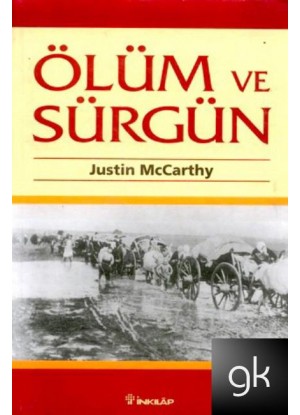
Another book that I do know there’s a Turkish translation of, and is probably the only monograph to deal with the step by step expulsion and ethnic cleansing of Ottoman Muslims through the nineteenth and and early twentieth centuries, but tracing roots of the process back to even the century before is Justin McCarthy’s Death and Exile: The Ethnic Cleansing of Ottoman Muslims, 1821-1922Not polemic, not propagandistic, just the facts and figures that speak for themselves.  It should be required reading for every Christian in the former Ottoman sphere.  It’s not exclusively about the Circassian tragedy but there is, as you can imagine, a great deal of material on their experiences.

51qnwpuNCVL._SY344_BO1,204,203,200_Turkish-speaking Circassians should definitely check this book out that’s available everywhere in İstanbul; they’ll learn a lot.  I really hope they get a chance to.  Share this post with friends if you found it interesting.  Feel free to write me with any comments.  And keep the memory alive!.  NB

55696-olum-ve-surgun-death-and-exile-justin-mccarthy

Comment: nikobakos@gmail.com

Ignoring Sochi

18 Feb

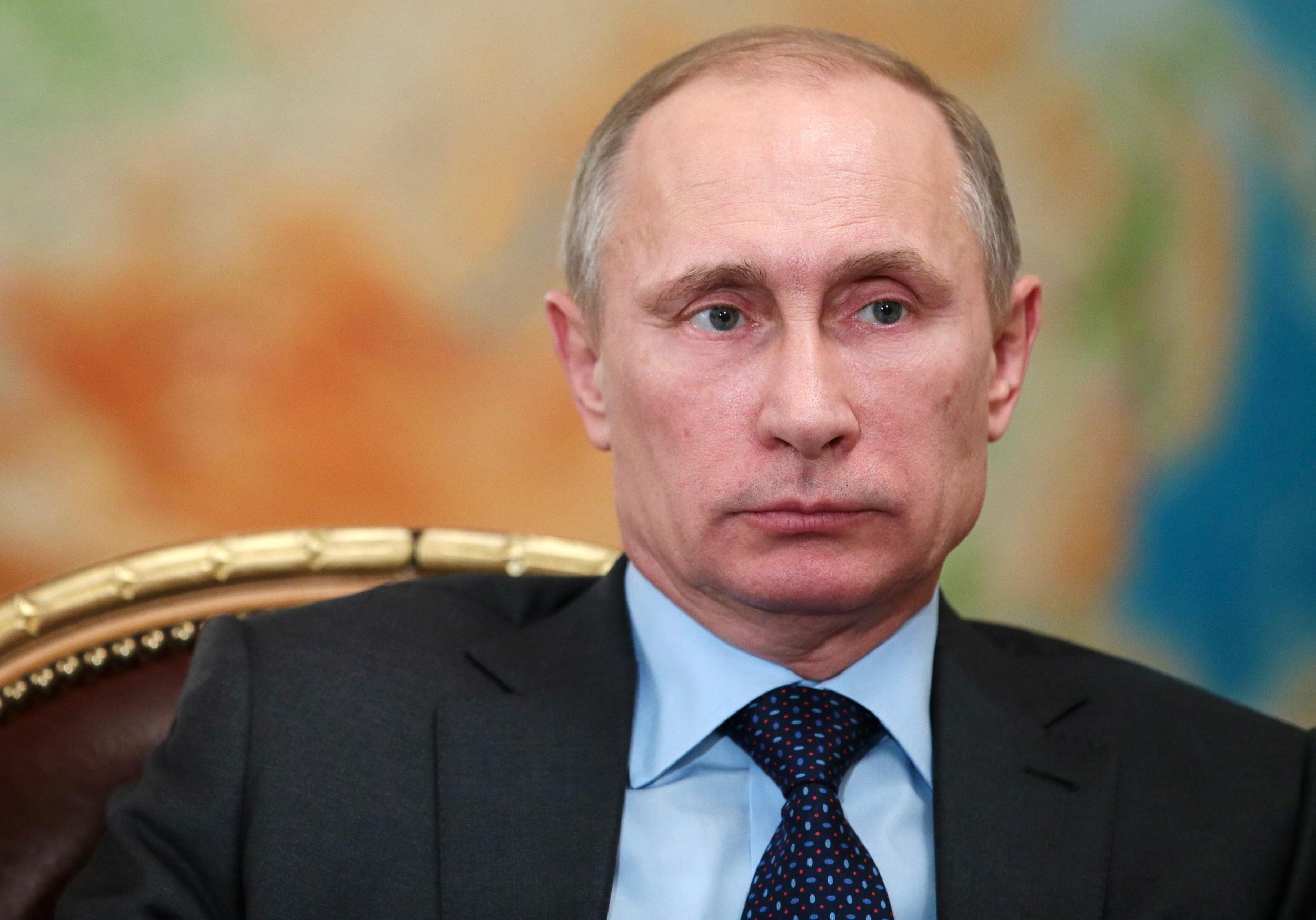
putin-bigALEXEY NIKOLSKY/RIA NOVOSTI/KREMLIN POOL (click)

Not so hard to do.  I was never such a fan of winter sports; nothing leaves me transfixed like the gymnastics or the swimming or the tennis of the summer games.  But mostly, I had just made up my mind to not participate in any way in the Putinshchina’s premier celebration of its imperial splendor.  They’re the most expensive games ever; they’re the most corrupt, with the Tsar’s cronies making billions on construction contracts given away at astronomical costs; they’re the most ecologically destructive; they’re run by a government that’s a grotesque human rights violator on all levels.  I understand we make some compromises; I had my problems with Beijing too.  But here there is no more room for compromise, because I think — without exaggeration — that these are the most morally compromised Olympic games since Berlin 1936.

And then there are the Circassians.  I became obsessed with Circassians in high school because I had to know who these people were, so physically beautiful apparently, that they held the entire Near East in thrall for centuries.  Circassians were the first reason I ever went into the New York Public Library, because the library at Stuyvesant didn’t have anything on them.  This is also around the time, as a nerdy sixteen-year-old, that I started developing the totally adolescent, romantic fascination I still suffer from, for honor-obsessed, heavily-armed highlanders — Montenegrins, northern Albanians, Pashtuns — who don’t easily let themselves get pushed around by outsiders.   It fed a lonely teenager’s fantasies of empowerment then.  Now, I couldn’t tell you.  Probably still.

The Circassians lived in a huge swath of plain, foothill and high mountain country in the northern Caucasus.  Most of the sites of the this month’s games are being held on formerly Circassian territory.  This is a map of their general distribution in the eighteenth century, right before Russian expansion southwards began:

Circassia_in_1750

(click)

For more than a century they fought a brutal tooth-and-nail war against the Russians and their Cossacks.  When they finally capitulated in 1864 it was in Sochi.  The majority, which would not agree to an oath of loyalty to Russia were deported, in what was probably the first campaign of ethnic cleansing of such dimensions in modern history.  For months, the beach at Sochi was a Dunkerque-like humanitarian disaster zone, with tens of thousands of shelterless, starving and diseased Circassians waiting for Ottoman ships to take them to safety in Anatolia or the still-Turkish Balkans or dying on the spot.

Expulsion_map_of_the_Circassians_in_19th_centuryIt certainly represented the largest civilian death toll of any war up to its time and today, ninety percent of people of Circassian descent live outside their original homeland, mostly Turkey, but also Syria, Jordan and Lebanon.

The suffering of Circassians and all the other Muslim peoples of the Caucasus are laid out in a bit of an uneven but heartfelt and informative book by Oliver Bullough called Let Our Fame Be Great: Journeys Among the Defiant People of the Caucasus — here’s his website too (check out some interesting pics): Oliver Bullough: Let Our Fame Be Great.

lofbg-usa-cover-300w

Bullough goes through, in excruciating detail, the suffering of the Circassians in the past, and the non-stop massacres, mass deportations and repeated mass deportations, carpet bombings and cleansing campaigns that the mountain Turks, the Chechens, the Ingushetians and the various peoples of Dagestan have been subjected to till practically our day.  It’ll certainly give you a keener insight into the sources of Chechen rage.  (Dzhokhar Tsernaev.)  It’s torturous to read.  But it also must have been extremely difficult for Bullough to write as well — I don’t envy him his position — since you realize early in the book that he has a deep and personal relationship to Russia, Russians and Russian culture as well and that he did not go to the Caucasus to simply vilify Russians and make an account of two hundred years of Russian atrocities.  He has one very painful to read passage in his conclusion, where he recalls an image told to him of a young Chechen boy cowering and hiding in a corner as bullets fly around him, an image he would like to convey to Russians:

“And it is a an image that I have kept in my head when writing this book, to avoid the world view of the Russian rulers who have imposed their own pictures on the Caucasus for too long.  I hope readers will have seen that the history of Russia’s conquest is one of tragedy for the people of the mountains.  The Circassians, the mountain Turks, the Ingush and the Chechens have all suffered horribly just so the map of Russia could be the shape the tsars, the general secretaries and the presidents wanted it to be.

Sadly, that suffering is not well-known in Russia, perhaps because Russians themselves have suffered so terribly that they prefer not to remember the horrors they have imposed on others.  Joseph Stalin is supposed to have said: ‘One death is a tragedy, a million deaths is a statistic.’”

After what his project consisted of, it’s hard not to be moved by the compassion Bullough shows for Russians.  But as someone with his own respective affective investment in Russia and Russians, I think he may get something slightly wrong there; it may not just be that Russians prefer not to remember the horrors they have imposed on others.  Perhaps most Russians cannot even bear to remember the horrors imposed on them yet.  I often find myself feeling like an ass with my Russian friends, hounding them on how they’re not angry enough about their past, or, especially, angry at how their future is starting to increasingly look like their past.  I had one friend burst into tears at my haranguing once: “Kolya, you’re expecting us to walk around every conscious minute with the awareness that eighty years of our lives were one nightmarish mistake.”  What do you say to that?  In a society where two generations ago every family lost one in five of its men, in a society where there is almost no family that didn’t, at some point, have a first degree relative taken away in the middle of the night who was never seen or heard from again, does the word even fall to me — to use the Greek expression — to tell them what to remember and how?

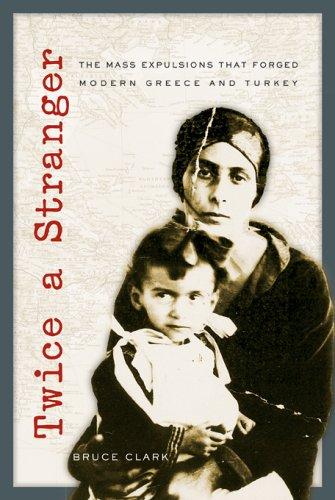
A book I’ve talked about a lot on this blog is Bruce Clark’s Twice a Stranger: the Mass Expulsions that Forged Modern Greece and Turkey, about the Population Exchange of the twenties.  In one really fascinating chapter he tells the story of a mayoral election in Ayvali in the nineties I think, the town on the Aegean coast opposite Mytilene that was one hundred percent Greek before the twenties and is now almost exclusively populated by Greek-speaking (till a generation ago at least) Turks from Crete.  The more progressive mayoral candidate has, as part of his agenda, a plan to restore some of the town’s Greek churches as tourist sights, generally playing on Ayvali’s Greek past as an asset and not something to be forgotten or hidden.  And when he loses he experiences this very poignant moment of realization — that the idea was a little too much, was asking too much, that the pain of the past was still too raw; that, as he put it: “It’s too soon to remember.”

For Russians, for Chechens, for Turks packed up and out of their beloved Crete, it may be too soon to remember.

But when then?

412711-l