 ALEXEY NIKOLSKY/RIA NOVOSTI/KREMLIN POOL (click)
Not so hard to do. I was never such a fan of winter sports; nothing leaves me transfixed like the gymnastics or the swimming or the tennis of the summer games. But mostly, I had just made up my mind to not participate in any way in the Putinshchina’s premier celebration of its imperial splendor. They’re the most expensive games ever; they’re the most corrupt, with the Tsar’s cronies making billions on construction contracts given away at astronomical costs; they’re the most ecologically destructive; they’re run by a government that’s a grotesque human rights violator on all levels. I understand we make some compromises; I had my problems with Beijing too. But here there is no more room for compromise, because I think — without exaggeration — that these are the most morally compromised Olympic games since Berlin 1936.
And then there are the Circassians. I became obsessed with Circassians in high school because I had to know who these people were, so physically beautiful apparently, that they held the entire Near East in thrall for centuries. Circassians were the first reason I ever went into the New York Public Library, because the library at Stuyvesant didn’t have anything on them. This is also around the time, as a nerdy sixteen-year-old, that I started developing the totally adolescent, romantic fascination I still suffer from, for honor-obsessed, heavily-armed highlanders — Montenegrins, northern Albanians, Pashtuns — who don’t easily let themselves get pushed around by outsiders. It fed a lonely teenager’s fantasies of empowerment then. Now, I couldn’t tell you. Probably still.
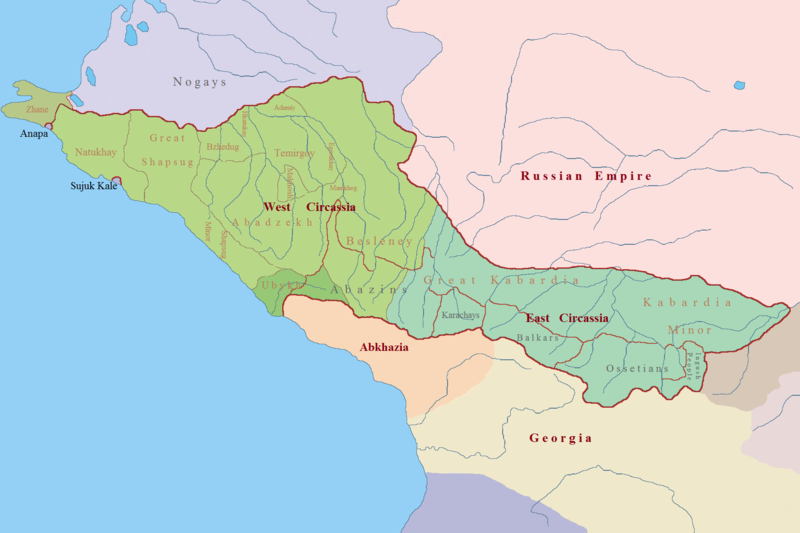
The Circassians lived in a huge swath of plain, foothill and high mountain country in the northern Caucasus. Most of the sites of the this month’s games are being held on formerly Circassian territory. This is a map of their general distribution in the eighteenth century, right before Russian expansion southwards began:

(click)
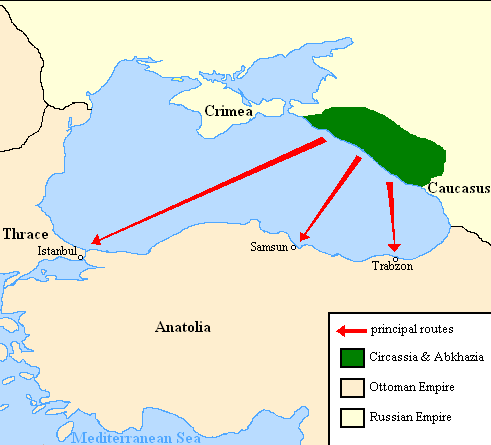
For more than a century they fought a brutal tooth-and-nail war against the Russians and their Cossacks. When they finally capitulated in 1864 it was in Sochi. The majority, which would not agree to an oath of loyalty to Russia were deported, in what was probably the first campaign of ethnic cleansing of such dimensions in modern history. For months, the beach at Sochi was a Dunkerque-like humanitarian disaster zone, with tens of thousands of shelterless, starving and diseased Circassians waiting for Ottoman ships to take them to safety in Anatolia or the still-Turkish Balkans or dying on the spot.
 It certainly represented the largest civilian death toll of any war up to its time and today, ninety percent of people of Circassian descent live outside their original homeland, mostly Turkey, but also Syria, Jordan and Lebanon.
The suffering of Circassians and all the other Muslim peoples of the Caucasus are laid out in a bit of an uneven but heartfelt and informative book by Oliver Bullough called Let Our Fame Be Great: Journeys Among the Defiant People of the Caucasus — here’s his website too (check out some interesting pics): Oliver Bullough: Let Our Fame Be Great.
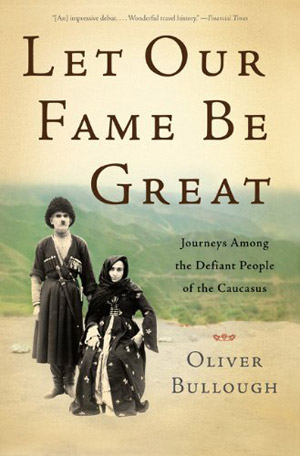
Bullough goes through, in excruciating detail, the suffering of the Circassians in the past, and the non-stop massacres, mass deportations and repeated mass deportations, carpet bombings and cleansing campaigns that the mountain Turks, the Chechens, the Ingushetians and the various peoples of Dagestan have been subjected to till practically our day. It’ll certainly give you a keener insight into the sources of Chechen rage. (Dzhokhar Tsernaev.) It’s torturous to read. But it also must have been extremely difficult for Bullough to write as well — I don’t envy him his position — since you realize early in the book that he has a deep and personal relationship to Russia, Russians and Russian culture as well and that he did not go to the Caucasus to simply vilify Russians and make an account of two hundred years of Russian atrocities. He has one very painful to read passage in his conclusion, where he recalls an image told to him of a young Chechen boy cowering and hiding in a corner as bullets fly around him, an image he would like to convey to Russians:
“And it is a an image that I have kept in my head when writing this book, to avoid the world view of the Russian rulers who have imposed their own pictures on the Caucasus for too long. I hope readers will have seen that the history of Russia’s conquest is one of tragedy for the people of the mountains. The Circassians, the mountain Turks, the Ingush and the Chechens have all suffered horribly just so the map of Russia could be the shape the tsars, the general secretaries and the presidents wanted it to be.
Sadly, that suffering is not well-known in Russia, perhaps because Russians themselves have suffered so terribly that they prefer not to remember the horrors they have imposed on others. Joseph Stalin is supposed to have said: ‘One death is a tragedy, a million deaths is a statistic.’”
After what his project consisted of, it’s hard not to be moved by the compassion Bullough shows for Russians. But as someone with his own respective affective investment in Russia and Russians, I think he may get something slightly wrong there; it may not just be that Russians prefer not to remember the horrors they have imposed on others. Perhaps most Russians cannot even bear to remember the horrors imposed on them yet. I often find myself feeling like an ass with my Russian friends, hounding them on how they’re not angry enough about their past, or, especially, angry at how their future is starting to increasingly look like their past. I had one friend burst into tears at my haranguing once: “Kolya, you’re expecting us to walk around every conscious minute with the awareness that eighty years of our lives were one nightmarish mistake.” What do you say to that? In a society where two generations ago every family lost one in five of its men, in a society where there is almost no family that didn’t, at some point, have a first degree relative taken away in the middle of the night who was never seen or heard from again, does the word even fall to me — to use the Greek expression — to tell them what to remember and how?
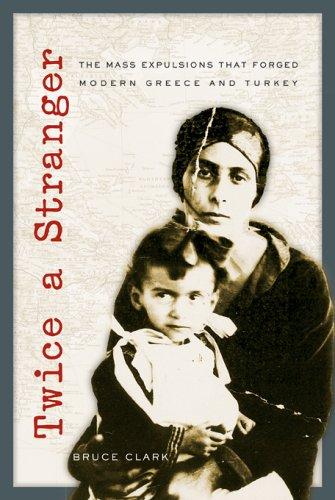
A book I’ve talked about a lot on this blog is Bruce Clark’s Twice a Stranger: the Mass Expulsions that Forged Modern Greece and Turkey, about the Population Exchange of the twenties. In one really fascinating chapter he tells the story of a mayoral election in Ayvali in the nineties I think, the town on the Aegean coast opposite Mytilene that was one hundred percent Greek before the twenties and is now almost exclusively populated by Greek-speaking (till a generation ago at least) Turks from Crete. The more progressive mayoral candidate has, as part of his agenda, a plan to restore some of the town’s Greek churches as tourist sights, generally playing on Ayvali’s Greek past as an asset and not something to be forgotten or hidden. And when he loses he experiences this very poignant moment of realization — that the idea was a little too much, was asking too much, that the pain of the past was still too raw; that, as he put it: “It’s too soon to remember.”
For Russians, for Chechens, for Turks packed up and out of their beloved Crete, it may be too soon to remember.
But when then?

–
–
Tags: Chechens, Circassians, Dagestan, Greeks, Ingushetians, mountain Turks, Population Exchange, Putin, Russia, Russians, Sochi Olympics, Turks

 (click)



 Jadde: from Bosnia to Bengal