Tag Archives: Syria

The viciousness of the ISIS beheadings

3 Sep

Sorry for the graphicness of this post…

…but have we taken a good look at what they’re using???!!!  It’s a knife that’s like the size of a Marine Ka-bar, with like a seven-inch blade or so.  In fact, I think it’s the Royal Marines equivalent.  I haven’t been able to watch the video but it must take several or so minutes of hacking and slicing and sawing to get through an average man’s neck with a blade that short…   Not to be facetious — but that’s not halal.  Καθίκια.  Not only does the ordeal probably last forever for the victim; it’s sickening that another man can go to work on such a sustained and physically strenuous act of brutality for such an extended period of time.

But I guess God-is-Great and gives him strength…


isis-jihadi-john-executes-beheads-steven-sotloff-taunts-obama

2014.08.19-mrconservative-53f3cab66e7c2

Comment: nikobakos@gmail.com

More on Syrian art and archaeological destruction

19 Feb

Originally from The Independent, by Patrick Cockburn, February 11th, 2014.  Reblogged from Tom Sawford’s  Byzantine Blog: Making Byzantium Live for People Today :

 
Aleppo’s Umayyad mosque: the rubble is all that remains of its minaret, which was blown up during fighting last year (Getty)

by Patrick Cockburn

First published in The Independent 11 Feb 2014

Islamic fundamentalists in Syria have started to destroy archaeological treasures such as Byzantine mosaics and Greek and Roman statues because their portrayal of human beings is contrary to their religious beliefs. The systematic destruction of antiquities may be the worst disaster to ancient monuments since the Taliban in Afghanistan dynamited the giant statues of Buddha at Bamiyan in 2001 for similar ideological reasons.

In mid-January the Islamic State of Iraq and the Levant (Isis), an al-Qa’ida-type movement controlling much of north-east Syria, blew up and destroyed a sixth-century Byzantine mosaic near the city of Raqqa on the Euphrates. The official head of antiquities for Raqqa province, who has fled to Damascus and does not want his name published, told The Independent: “It happened between 12 and 15 days ago. A Turkish businessman had come to Raqqa to try to buy the mosaic. This alerted them [Isis] to its existence and they came and blew it up. It is completely lost.”

Other sites destroyed by Islamic fundamentalists include the reliefs carved at the Shash Hamdan, a Roman cemetery in Aleppo province. Also in the Aleppo countryside, statues carved out of the sides of a valley at al-Qatora have been deliberately targeted by gunfire and smashed into fragments.

Professor Maamoun Abdulkarim, general director of antiquities and museums at the Ministry of Culture in Damascus, says that extreme Islamic iconoclasm puts many antiquities at risk. An expert on the Roman and early Christian periods in Syria, he says: “I am sure that if the crisis continues in Syria we shall have the destruction of all the crosses from the early Christian world, mosaics with mythological figures and thousands of Greek and Roman statues.”

Of the mosaic at Raqqa, discovered in 2007, he says: “It is really important because it was undamaged and is from the Byzantine period but employs Roman techniques.”

Syria has far more surviving archaeological sites and ancient monuments than almost any country in the world. These range from the Umayyad Mosque in Damascus with its magnificent eighth-century mosaics to the Bronze Age Ebla in Idlib province in north-west Syria, which flourished in the third and second millennia BC and where 20,000 cuneiform tablets were discovered. In eastern Syria on the upper Euphrates are the remains of the Dura-Europos, a Hellenistic city called “the Pompeii of the Syrian desert” where frescoes were found in an early synagogue. Not far away, close to the border with Iraq, are the remains of Mari, which has a unique example of a third-millennium BC royal palace.

Unfortunately, many of the most famous ancient sites in Syria are now held by the fundamentalist Islamic opposition and are thereby in danger. Professor Abdulkarim says that it is not just Isis but “Jabhat al-Nusra [the official affiliate of al-Qa’ida] and the other fundamentalists who are pretty much the same”.

He emphasises at the same time that he approaches his job of trying to preserve Syria’s heritage during the civil war from a politically neutral point of view. The civil war has inflicted heavy damage, notably in Aleppo, where the minaret of the Great Umayyad Mosque was destroyed along with seven medieval souks, or markets, with over 1,000 traditional shops burnt out.

Aleppo’s Umayyad mosque: the rubble is all that remains of its minaret, which was blown up during fighting last year. Homs Old City has suffered serious damage and is still held by the rebels, while the immense Crusader fortress of Krak des Chevaliers has been battered by government air strikes. The great church at St Simeon has been turned into a military training area and artillery range by rebels.

Syria’s museums are generally secure and moveable items have been taken elsewhere for safe-keeping. Museum staff say they saw what happened in Iraq after 2003 and moved quickly. A folk museum at Deir Atieh between Damascus and Homs was taken over, but the rebels were after old pistols and rifles on display that they intended to put to military use.

The most devastating and irreversible losses to Syria’s rich heritage of ancient cities and buildings are the result of looting. Much of this is local people looking for treasure, though in many cases they are obliterating the archaeological record by using bulldozers. Two looters were killed when they used a bulldozer to excavate a cave at Ebla, causing its roof to collapse.

What worries Professor Abdulkarim and his staff is that over the last year the looting has become large scale. He says that there is “a mafia from Turkey, Iraq and Lebanon hiring hundreds of people to strip sites”. Among what are known as the Dead Cities in Idlib province in northern Syria, once prosperous and then mysteriously abandoned 1,000 years ago, there are signs that thieves have brought in antiquities experts to advise them about the best places to dig, going by the orderly nature of the excavations.

Theft of antiquities is particularly bad in the far east of Syria at Mari where an armed gang  numbering 500 has taken over the site. An official report says that the looters have been focusing on “the Royal Palace, the southern gate, the public baths, Temple of Ishtar, the Temple of Dagan and the temple of the Goddess of Spring”.

Even worse is the situation at Dura-Europos where 300 people are excavating. A report by the Directorate-General of Antiquities and Museums says that efforts by local communities to stop the digging here have failed and heavy machinery is being used. The report says that illegal excavations have “led to the destruction of 80 per cent of the site as perpetrators are digging holes that can reach three metres in depth”.

For some Syrians, often well-armed in war-ravaged, impoverished areas, the looting of antiquities has become a full-time job. In great stretches of the country outside state control there is total disorder with banditry and kidnapping common. Rebel commanders, even if they wanted to, are not going to give priority to protecting ancient monuments.

Professor Abdulkarim complains that he has received little international help in preventing the looting of Syria’s rich heritage. The deliberate targeting by Isis and other jihadist groups of mosaics and statues seen as profane will accelerate the speed of destruction. Antiquities that have survived invasions and wars for 5,000 years may soon be rubble.

Comment: nikobakos@gmail.com


Andrew Sullivan: “Syria is not a country” — addendum

18 Feb

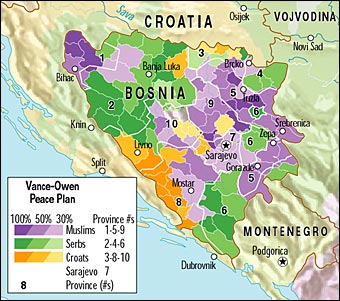
A New York Times piece a reader sent me from last month makes the same point about Yugoslavia and Syria and fostering sectarianism instead of controlling it that I tried to make in my Sullivan on Syria post: “Bosnia’s Lessons for Syria”:

“Equally crucial is that we ask how our own efforts may interfere with conflict. In Bosnia in 1993, the effect of the unsuccessful Vance-Owen Peace Plan, which proposed new political entities divided along ethnic lines, was to intensify campaigns of ethnic cleansing as warring groups tried to strengthen their positions ahead of partition. We should expect plans discussed in Switzerland to have a similar impact in Syria. This may be unavoidable, but we may be able to predict how the pattern of violence will evolve and allocate resources better to meet humanitarian needs.”

The Vance-Owen plan; like this was ever going to work:

peace_plan_vo_small

From the Guardian: Syria’s heritage in ruins

29 Jan

Syria’s heritage in ruins: before-and-after pictures

The war in Syria has claimed more than 130,000 lives and, as these images reveal, it is also laying waste to its historic buildings and Unesco-listed sites:
Martin Chulov
Umayyad mosqueUmayyad mosque, Aleppo – pictured in 2012, before fighting destroyed it in 2013. Photograph: Alamy

They were sleepy tree-lined boulevards where people lived and worked, time-worn markets where they came to trade and exquisitely detailed mosques where, throughout the ages, they prayed.

All now stand in ruins, ravaged by a war that is not only killing generations of Syrians but also eradicating all around them, including sites that have stood since the dawn of civilisation. Across Syria, where a seemingly unstoppable war is about to enter a third year, a heritage built over 5,000 years or more is being steadily buried under rubble.

The Old Souk in Aleppo  The Old Souk, Aleppo. Above in 2007 and below in 2013. Photographs: Corbis, Stanley Greene/Noor/Eyevine

The destruction of towns and villages is regularly revealed by raw, and often revolting, videos uploaded to the web, which many people stopped watching long ago. Only seldomly do the shaky images reveal the damage being done beyond the battle – to ancient churches, stone Crusader fortresses and ruins that have stood firm during several millennia of insurrection and purge but are being withered away by this unforgiving war.Syria’s war has claimed more than 130,000 lives. At least two million of its citizens have fled into neighbouring states and more than two million others have been displaced within its borders. Industry and economy has long ground to a halt. Hope too has been on a relentless slide. Syria has six Unesco sites, representing at least 2,000 years of history. All have been damaged.Al-Kindi hospital in Aleppoal-Kindi hospital, Aleppo. Above in 2012 and below in 2013. Photographs: Getty
These before and after pictures show the old world order of Syria reflected for decades in history books; where people bought wares in marketplaces or mingled in mosque courtyards. They also reveal the shocking scale of devastation in all corners of the country and the damage done to Syria’s soul and identity.In Aleppo, one of the oldest covered marketplaces in the world is now in ruins; its maze of stone streets has been one of the most intense battlefields in the country for the past 18 months, bombed from above by air force jets and chipped away at ground level by close quarter battles that show no sentiment towards heritage. Those who dare raise their heads above the ruins, towards the ancient citadel that stands at the centre of the city, can also see damage to several of its walls.A street in Homs, Syria in 2011 and 2014        A street in Homs, in 2011 (above) and 2014 (below)Several hundred miles south, just west of Syria’s third city, Homs, one of the most important medieval castles in the world, Krak des Chevaliers, has taken an even heavier toll. Directly struck by shells fired from jets and artillery, the hilltop fortress now stands in partial ruin.Krak_des_Chevaliers_01Krak des Chevaliers (click)
Homs itself has fared even worse. A residential street, where cars not long ago parked under gum trees, has been destroyed. Life has ceased to function all around this part of the city, as it has in much of the heartland of the country. In one shot, a destroyed tank stands in the centre of a street. The old minaret next to it has also been blown up. This photograph is thought to have been taken in the countryside near Hama, to the north of Homs. But it could just as easily encapsulate the damage done in parts of the capital, Damascus, or in towns and villages from Idlib in the north to Deraa in the south, where the first stirrings of insurrection in March 2011 sparked the war.Omari Mosque in DeraaOmari mosque in Deraa. Above in 2011 and below in 2013. Photographs: Reuters
In May 2012, Emma Cunliffe, a Durham University PhD student, and member of the Global Heritage Network, prepared a report on the damage done to Syria’s heritage sites, detailing the tapestry of civilisations that helped build contemporary Syria.“Numerous bronze-age civilisations left their successive marks, including the Babylonians, the Assyrians and the Hittites,” she said. “They, in turn, were replaced by the Greeks, the Sasanians, the Persians, the Romans and the Arabs, many of whom chose Syrian cities as their capitals. The European Crusaders came and left some of the most impressive castles known and the Ottoman Empire also made its mark. All these cultures co-existed and conflicted, forming something new and special and found nowhere else in the world.”Souk Bab Antakya in AleppoSouq Bab Antakya, Aleppo. Above in 2009 and below after an attack in 2012. Photographs: Alamy, Reuters
Speaking this week, she said the threat to Syria’s heritage was now greater than ever. “Archaeological sites in Syria are often on the front lines of conflict and are experiencing heavy damage. Economic hardship and decreased security mean even sites away from the fighting are looted. This is denying not only Syrians but the world a rich heritage which can provide a source of income and inspiration in the future.”With little or no access to the country, satellite imagery is being used to track the destruction. The Global Heritage Fund’s director of Global Projects, Dan Thompson said: “All of the country’s world heritage sites have sustained damage, including the Unesco site cities, and a great many of the other monuments in the country have been damaged, destroyed or have been subject to severe looting..Umayyad Mosque in AleppoUmayyad mosque, Aleppo, pictured in 2012 (above) and 2013 (below). Photographs: Alamy, Corbis
“Shelling, shooting, heavy machinery installed in sites, and major looting are the leading causes of damage and destruction to the sites, although I would not discount that vandalism is also playing a part. As far as we know, no concrete action is being taken to combat the damage in the present moment.”

“Syria Is Not A Country” — Andrew Sullivan lets fly another one of his kotsanes and then rushes to cover his tuches

27 Jan

Sykes-Picot

He got enough flak for the post (read through all the ctd.’s too — very interesting) and I feel kind of bad giving him more after so many months, but it’s been in the back of my mind since the fall and the argument is so irritating that I had to put in my own two cents.

It seems that every Sullivan-type pundit rushed out in 2001, or more probably 2003 when they were making their Iraq predictions, and bought some book about the Paris Peace Conference: “Paris 1919” “The Peace to End All Peace” — it’s an entire genre in itself.  And there they found out about some magic secret, like in a Dan Brown novel, called the Sykes Picot line, that supposedly explains everything about the Middle East’s dysfunction, and like a little kid who realizes he’s said something that the adults have found smart or funny, they go around repeating it ad nauseum: “Sykes-Picot Line”…”Sykes Picot Line” … “this guy Sykes and this guy Picot”…”The Sykes Picot Line…”  Listen to Sullivan’s own pedantic tone:

“Syria as we now know it was created by one Brit, Mark Sykes, and one Frenchman, Francois Georges-Picot in 1920. Originally, it included a chunk of Iraq (another non-country), but when oil was discovered there (in Mosul), the Brits wanted and got it. With that detail alone, you can see how valid the idea is of a Syrian “nation” is.”

The whole point is that most of the nations of the present Middle East are artificial, colonial creations — arbitrary lines drawn on a map –and that explains everything.  First, these lines are not arbitrary.  Whatever you might want to say about Sykes or Picot, or Churchill or Lloyd George or Clemenceau — that they were gross imperialists (which is not even redundant really but simply a tautology: “The King is a gross monarchist…”) or anything else, they weren’t ignorant or anistoretoi.*  The units they put together corresponded, as so many of Sullivan’s readers point out to him, with regions with long, historically recognized identities.  Where you look at a map of the Middle East and do see straight artificially drawn lines, they were drawn through places where nobody lives.  Otherwise, within every one of those lines, there has always existed a shifting, changing, re- or de-centralizing identity, but one with clear continuities nonetheless.

(*Anistoretoi – ανιστόρητοι – is a Greek word that I like very much, because it literally means “un-historied” — historically ignorant, obviously, but there’s something about “un-historied” that just seems to me like a sharper condemnation of inexcusable lack of knowledge — no? — so you’ll see it on this blog here and there.)

Thankfully, no one says this about Egypt, because it so obviously has a longer continuous history of unified consciousness than even China.  But what Sullivan, so damn pompous — or just so gay and so Magdalen — dismisses as the “non-country” of Iraq, the flatlands of the Tigris and the Euphrates basin, even when semi-splintered into northern, central, and southern parts, as Iraq seems to be doing now, was always seen as a unit: certainly geographically but even culturally.  The two regions the Greeks called Libya and Cyrene may correspond to a west-east division that is still apparent in modern Libya (Tripoli and Benghazi), but their union is not necessarily artificial or inherently problematic.  The headland to the west of Libya we call Tunisia was the first region called Africa by the Romans, where their ancient enemy Carthage had once stood.  And the region where the northwestern section of the Fertile Crescent bends over and meets the Mediterranean has been called Syria since the Greeks and was probably seen as a recognized cultural entity far before them.  The mountainous Mediterranean littoral of this Syria — what’s now Palestine and Lebanon and maybe a new Alawite state waiting to be born — was always a space slightly apart and more heterogeneous, but Syria nonetheless.  (The arid plateau across the Jordan, inhabited by the Moabites and Edomites and Nabataeans and all those other peoples the Israelites are always defeating in the Old Testament because God loves them more, was also a region of a recognized coherence of sorts not just made up by the Brits when they decided to call it Trans-Jordan.)  Syria was the birthplace of Christianity as an organized religion.  Syria was the Romans-Byzantines’ richest and most sophisticated eastern province.  Syria was the prize catch for the Crusaders; the real studs among them who could, got themselves a piece of booty there, not the “Holy Land.”  When Zainab bears her lament to the people of Shaam (Syria or the Levant) in Agha Shahid Ali’s beautiful poem she cries out: “Hear me Syria…” addressing the people of the seat of Umayyad power in Damascus — the one in Syria — that had massacred her sacred family.  Sykes and Picot didn’t make this stuff up.

What Sullivan wants to say, and what’s truly problematic about his assertion, is that Syria is not a country because it’s not ethnically or confessionally homogeneous, and dismissing it as a state for those reasons is a far more eurocentric, and anistoreto, an idea than he may know.  Because if those are our standards for nation-hood, there are very few countries in the world.  By those standards, if Syria is not a country, then England and France aren’t countries either.  Because a polity called the Kingdom of England, or the Kingdom of France — both of which one could argue were “artificially” created by the powers that be of the time — had existed for far longer than Englishmen and Frenchmen have.  And the process by which a unified national consciousness was created to match these pre-existing political units — England or France — was a long and complex one and one that followed the particular course it did only in Western Europe and trying to force it onto the peoples of states in other parts of the world is impossible and extremely dangerous.  Forget what Sullivan thinks is the Machiavelian divide-and-rule politics of the colonizers that pitted ethnic groups in Syria and Iraq against each other; these colonizers were probably never as devilishly smart as we like to imagine them.  What Sullivan finds inconceivable is that one can be a Latakian Alawite or a Sunni from Homs or an Aleppo Christian or a northeastern Kurd and still function as a citizen of a legitimate country called Syria; that these groups have always had boundaries that fluctuated or were permeable; and, that though relations between them historically were better at some moments than others, they were brought together in this place called Syria by organic historic processes and not corraled together there by outsiders.  And by believing that it’s inconceivable they can all function as citizens of this place, he’s actually participating in the creation of a discourse that pits these groups against each other in a manner far more fatal than the supposed manipulations of the British or French.  He’s creating a poetics of sectarianism, pure and simple.  One only has to look at how reinforcing ethnic differences, often with the naive supposition that satisfying each group’s demands will lead to peace, only exacerbated the tragedy — the tragedies — of Yugoslavia in the 90s to see where thinking like Sullivan’s leads.

To his credit, Sullivan gives the Ottomans credit for maintaining a semblance of peace and stability in the region for several centuries.  But the Ottomans had molded, over the centuries, a complex and flexible system of negotiated corporatism and autonomy that recognized the different groups of their empire and yet that held them together in one unit successfully until modern nationalism started making that impossible.  What Sullivan is doing with blowhard statements like the above is just continuing that process: making it impossible for the peoples of the region that have to live together to do so peacefully and productively.

Finally, as a somewhat tangential but important aside, I’d really be interested in finding out why Sullivan doesn’t think that India is “not a country.”

And, folks, what is going on in Syria?  I’ve been in France for a month and my French isn’t good enough to follow the news and the American stuff on-line seems to have less and less coverage.  Has some sort of stalemate been reached?  Is some kind of compromise being forged?  Are people just tired?  Anyone want to enlighten me?

Bulgaria’s own “Golden Dawn” gathers momentum

16 Dec

From Saturday’s Times: Far Right in Eastern Europe Makes Gains as Syrians Arrive”

“SVILENGRAD, Bulgaria — After spreading turmoil and desperate refugees across the Middle East, Syria’s brutal civil war has now leaked misery into Europe’s eastern fringe — and put a spring in the step of Angel Bozhinov, a nationalist activist in this Bulgarian border town next to Turkey.

“The local leader of Ataka, a pugnacious, far-right party, Mr. Bozhinov lost his seat in the town council at the last municipal elections in 2011 but now sees his fortunes rising thanks to public alarm over an influx of Syrian refugees across the nearby frontier.

“Membership of the local branch of Ataka, he said, had surged in recent weeks as “people come up to me in the street and tell me that our party was right.” Ataka, which means attack, champions “Bulgaria for Bulgarians” and has denounced Syrian refugees as terrorists whom Bulgaria, the European Union’s poorest nation, must expel. An Ataka member of Parliament has reviled them as “terrible, despicable primates.”

The ability of these groups to focus in on the most wretched-of-the-earth group of the moment is astounding.

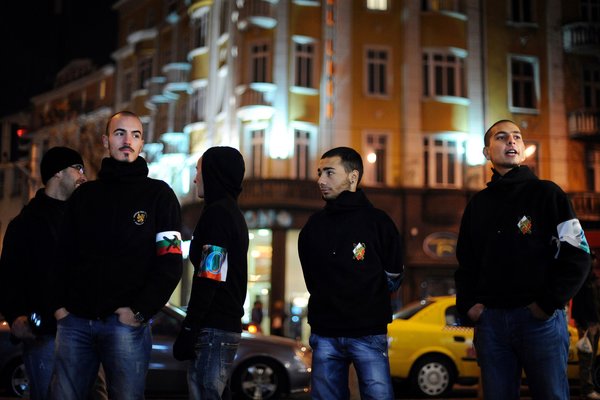
BULGARIA-articleLargeNikolay Doychinov/Agence France-Presse — Getty Images

Members of Bulgarian nationalist groups patrolled Sofia, Bulgaria’s capital, last month, an example of “civil patrols” by nationalists in immigrant regions.

And perhaps the article also potentially exaggerates the extent to which the Greek government has cracked down on Golden Dawn:

“The party was more comparable to the neo-fascist Golden Dawn movement in Greece, he said, but conceded, “Ataka’s strategy works.” Yet while Greece’s government has cracked down on Golden Dawn, in Bulgaria, Ataka is in effect a government ally.”

Several Golden Dawn MPs in Greece had their immunity withdrawn due to violent crimes committed, but though not Ataka may be “a government ally” in Bulgaria, Golden Dawn is still a sitting part of Greece’s parliament, the party has certainly been proven to be an ally of the Greek police (even to the extent of sharing training camps with them) and no one has cracked down on that connection or those on the police side involved in it at all.

comment: nikobakos@gmail.com

“Syria hear me…”

13 Nov

Just that that line shook me up upon re-reading it…

Ashura 1435: a poem from Agha Shahid Ali

13 Nov

Iraq Transitions As U.S. Forces Withdraw After 8-Year Presence

(click)

Karbala: A History of the “House of Sorrow”

In a distant age and climate, the tragic scene of the death of Husayn will awaken the sympathy of the coldest reader.
—Edward Gibbon

Jesus and his disciples, passing through the plain of Karbala, saw “a herd of gazelles, crowding together and weeping.” Astonished, the disciples looked at their Lord. He spoke: “At this site the grandson of Prophet Muhammad (Peace be upon him) will one day be killed.” And Jesus wept. Oh, that my head were waters, and mine eyes a fountain of tears, that I might weep day and night for the slain … And Jesus wept. And as if the news has just reached them—fourteen hundred years after the Battle of Karbala (near ancient Babylon, not far from the Euphrates) in the year A.H. 61/A.D. 680—mourners weep for “the prince among martyrs,” Hussain, grandson of the Prophet and son of Ali (“Father of Clay”) and Fatima (the Prophet’s only surviving child). Memorializing Hussain on the tenth of Muharram (Ashura) is the rite of Shi’a Islam—so central that at funerals those events are woven into elegies, every death framed by that “Calvary.” For just “as Jesus went to Jerusalem to die on the cross,” Hussain “went to Karbala to accept the passion that had been meant for him from the beginning of time.”


Zainab’s Lament in Damascus

Over Hussain’s mansion what night has fallen?

Look at me, O people of Shaam, the Prophet’s only daughter’s daughter, his only child’s child.

Over my brother’s bleeding mansion dawn rose—at such forever cost?

So weep now, you who of passion never made a holocaust, for I saw his children slain in the desert, crying for water.

Hear me. Remember Hussain, what he gave in Karbala, he the severed heart, the very heart of Muhammad, left there bleeding, unburied.

Deaf Damascus, here in your Caliph’s dungeons where they mock the blood of your Prophet, I’m an orphan, Hussain’s sister, a tyrant’s prisoner.

Father of Clay, he cried, forgive me. Syria triumphs, orphans all your children. Farewell.

And then he wore his shroud of words and left us alone forever.

Paradise, hear me— On my brother’s body what night has fallen?

Let the rooms of Heaven be deafened, Angels, with my unheard cry in the Caliph’s palace:

    Syria hear me

    Over Hussain’s mansion what night has fallen

    I alone am left to tell my brother’s story

    On my brother’s body what dawn has risen

      Weep for my brother World, weep for Hussain


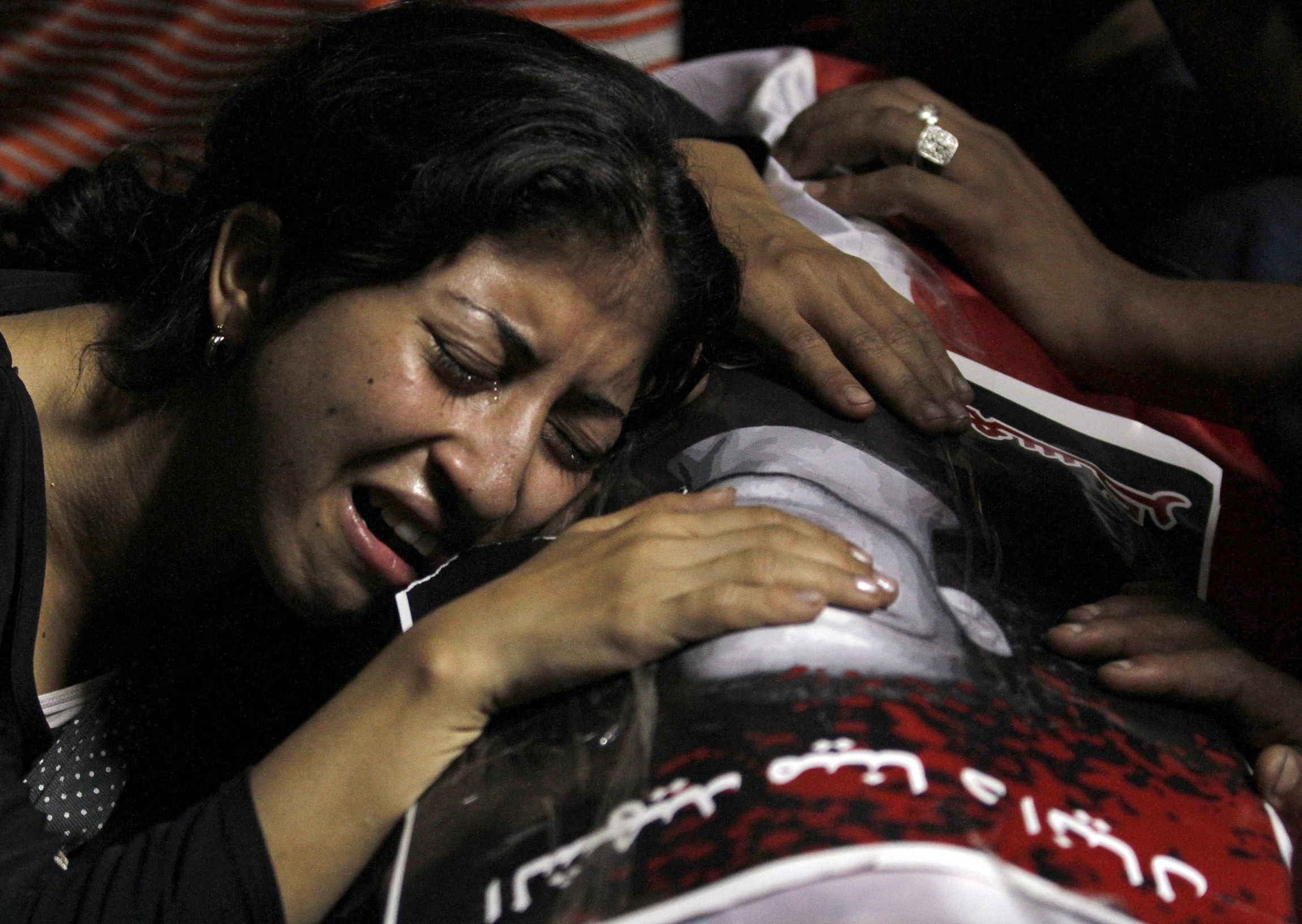
WOMAN MOURNS ON COFFIN OF VICTIM KILLED DURING PROTEST IN CAIRO

(click)

Reprinted from The Veiled Suite: The Collected Poems by Agha Shahid Ali. English translation copyright © 2009 by Daniel Hall. With the permission of the publisher, W.W. Norton & Company, Inc.

comment: nikobakos@gmail.com

Vocabulary: “Frangoi”

2 Sep

I’ve used this term several times without giving a more specific definition of it and that was a mistake because some of those posts would have made more sense if I had.

Like: “Little Rock, Greece”  (May 26th, 2012):

“But an equal object of my bashing here is the European Union, which aside from proving itself to be a neo-colonialist endeavour masquerading as the Highest Achievement of Western Humanism Project, has also revealed itself to be a half-assed, thrown together mess on so many institutional and bureaucratic levels.  (Yes, neo-colonialist: the Frangoi** gave up their colonies after the war and then discovered the exploitable potential of Europe’s own periphery again.)”

And: “Russia and Syrian Christians, ctd”  (June 5th, 2012):

“Tying your survival to extra-regional players or regimes like Assad’s that are destined to soon make their exit is a losing strategy for the region’s Christians.  The threat of Islamist violence is probably real.  Iraq and even Egypt certainly seem to indicate that.  But their only choice is probably the tricky dance of fostering, or just going with, the flow of democratic change while keeping themselves as least vulnerable as possible.  Forget Russia.  And, as Constantine XI had to heroically face in the end, there’s certainly no help coming from the Frangoi.*  If you want to live in peace and security, look to your neighbor because, ultimately, he’s the only one who can provide it for you.”

And: “Un Verano en Nueva York” (July 13th, 2012):

“In Astoria I catch the end of vespers at Hagia Eirene.  This is a church that used to be the territory of fundamentalist, Old Calendar, separatist crazies but has rejoined the flock on the condition that it was granted monastic status (and I have no idea what that means).  But it has somehow got its hands on a great bunch of cantors and priests who really know what they’re doing.  I’m impressed.  I brought friends here for the Resurrection this year and for the first time I wasn’t embarrassed.  If I hadn’t invited them back home afterwards I would have stayed for the Canon.  Only one cantor now at vespers but he’s marvelous and the lighting is right and the priest’s bearing appropriately imperial.  It’s incredibly heartening to see our civilization’s greatest achievement — which is not what the Frangoi taught us about Sophocles or Pericles or some half-baked knowledge of Plato or a dumb hard-on about the Elgin marbles or the word “Macedonia,” but this, the rite and music and poetry and theatre of the Church – performed with the elegance and dignity that it deserves.”                  

So…when the Byzantines first encountered the West and the conglomeration of Germanic kingdoms that had sprung up on the territories of the western Roman Empire, or rather, when they first felt challenged by it and not just irritated, was when Charlemagne, previously just King of the Franks, was crowned Emperor of the Romans in the year 800 by Pope Leo III, whose skin he had saved after Leo had been deposed and almost lynched by the mobs of Rome.  This, of course, was intolerable to us, because we were the Romans and we had an Emperor, with an unbroken line back to Constantine, if not Augustus.  This is close to impossible an idea for anyone today to understand; it’s even hard for modern Greeks to articulate and it’s at the core of our completely mangled identity.  It’s nearly impossible to speak definitively about consciousness or identity in the present tense, much less more than a millennium past.  But this is the simplest way I can put it: by the late first millennium, the Greek-speaking Christians of the eastern Mediterranean had a stronger sense of Imperial Roman continuity than the inhabitants of even the Italian peninsula.  Till well into the twentieth century our most common term of self-designation was “Romios” – “Roman.”  If you had asked any of my grandparents, all born Ottoman subjects, what they “were” — if they even understood the question — or even my father very often, they would’ve all answered “Roman.”  For the inhabitants of my father’s village in Albania, especially the older ones, who never had “Hellenes” imposed on them by the Neo-Greek statelet, the world is still divided into Muslim “Turks” and Orthodox “Romans,” and whether they speak Greek or Albanian is irrelevant.  The Greeks of Istanbul still call themselves “Romioi” for the most part; Turks still call them “Rum” too, out of simple historical continuity, while the Turkish state is still faithful to the appellation for partly more cynical and manipulative reasons.  I’m writing a piece with the appropriately pompous working title of “A Roman Manifesto” or “A Manifesto of Romanness” that will deal with this whole theme further.

The Frankish West (click)

So Charlemagne was a Frank, a Latinized Germanic ethnic group, and though the Pope’s primacy “inter pares” was recognized, he had no right to unilaterally crown this Frank emperor in an Italy that had become a ravaged provincial backwater from the Constantinopolitan point of view.  This didn’t end relations between the Empire and the various western European kingdoms.  They continued to trade and even contract dynastic marriages and all the rest.  But the tension, which had already been planted for quite a while before that, only went from bad to worse: power tensions; trade concessions to the Italian city-states that fatally mirror the ones the Ottomans had to make to the Western powers a millennium later; massacres of Italians in C-town that are equally mirror-like.

The West grew in confidence.  The Empire shrank.  They started bickering about theological issues, and eventually, in 1054, Rome and Constantinople excommunicated each other over some nonsense about the division of labor among the Trinity that I’ve never bothered to try and understand.  Then came the Crusades — more growing Western confidence — which the Byzantines weren’t ever really enthusiastic about because I reckon on many levels they felt less animosity for and greater cultural affinity to their the Muslim/Arab neighbors than they did to the “Franks.”  Runciman, I think writes somewhere that a ninth-century Greek felt more at home in Arab Palermo or Baghdad and Cairo that he would’ve in Paris or even Rome.

Sometimes Wiki’s gets it perfect:

“The experiences of the first two Crusades had thrown into stark relief the vast cultural differences between the two Christian civilizations. The Latins (as the Byzantines called them because of their adherence to the Latin Rite) viewed the Byzantine preference for diplomacy and trade over war, as duplicitous and degenerate, and their policy of tolerance and assimilation towards Muslims as a corrupt betrayal of the faith. For their part, the educated and wealthy Byzantines saw the Latins as lawless, impious, covetous, blood-thirsty, undisciplined, and (quite literally) unwashed.”

Then came the Fourth Crusade, led by the Venetian Doge Enrico Dandolo.  The Crusaders fell into the internecine machinations of the some Angeloi  Emperors and I think ended up feeling betrayed on some promise made to them by one party in the Byzantine political scene, and they probably were, because our latter Emperors compensated for the diminishment of their real geopolitical power and the sapped strength of their once massive military machine by becoming major manipulative sleazebags and liars, initiating a long Greek tradition that persists to our day.  In retaliation, and, or, because that had been their real object all along, the Crusaders of the Fourth Crusade, in 1204, captured the City – the first time Constantinople had ever fallen to anybody and destroyed it.

They destroyed her.  They massacred thousands, desecrated churches, including Hagia Sophia herself, and carried away what, in today’s terms, I’m sure amounted to billions in loot.  The Venetians got off with enough of a lump sum of capital to fund and run their mercantile empire for another five centuries.  But aside from the loot, which on some level is comprehensible, it’s the sheer mindless destruction of 1204 that betrays the sack as the action of thuggish, resentful provincials and their envy towards what had been the civilizational center of the Mediterranean and western Asian world for almost a millennium; it’s what an army of Tea-Partiers, NRA members or armed Texan Evangelicals would do to New York if they could.  Though pregnant already with the great traditions of this supposed thing called Western Humanism, this bunch destroyed more Classical texts and melted down or smashed more Classical sculpture into gravel than had been done at any other one time in history – far more than any fanatical Christians in any pagan city or any Arabs or Muslims in any conquered Christian city before them had.  More of the ancient world was lost to us in those few days than in any other comparable time span before that.  Just sheer idiotic vandalism.  There’s probably no more epic manifestation of Killing-the-Father in human history.

Speros Vryonis, a great historian but a seriously unpleasant man, Theos’choreston, made a career out of catalogueing the injustices done to Byzantine and post-Byzantine Greeks.  He was the great modern preacher of whining Greek victimology and one often felt that all his personal bile and biterness was poured into his work in that way; his book on the anti-Greek riots of Istanbul in 1955 is one thousand pages long; you’d think it was the most important event in twentieth-century history.  In any event, in Byzantium and Europe, he wrote:

“The Latin soldiery subjected the greatest city in Europe to an indescribable sack. For three days they murdered, raped, looted and destroyed on a scale which even the ancient Vandals and Goths would have found unbelievable. Constantinople had become a veritable museum of ancient and Byzantine art, an emporium of such incredible wealth that the Latins were astounded at the riches they found. Though the Venetians had an appreciation for the art which they discovered (they were themselves semi-Byzantines) and saved much of it, the French and others destroyed indiscriminately, halting to refresh themselves with wine, violation of nuns, and murder of Orthodox clerics. The Crusaders vented their hatred for the Greeks most spectacularly in the desecration of the greatest Church in Christendom. They smashed the silver iconostasis, the icons and the holy books of Hagia Sophia, and seated upon the patriarchal throne a whore who sang coarse songs as they drank wine from the Church’s holy vessels. The estrangement of East and West, which had proceeded over the centuries, culminated in the horrible massacre that accompanied the conquest of Constantinople. The Greeks were convinced that even the Turks, had they taken the city, would not have been as cruel as the Latin Christians. The defeat of Byzantium, already in a state of decline, accelerated political degeneration so that the Byzantines eventually became an easy prey to the Turks. The Crusading movement thus resulted, ultimately, in the victory of Islam, a result which was of course the exact opposite of its original intention.”
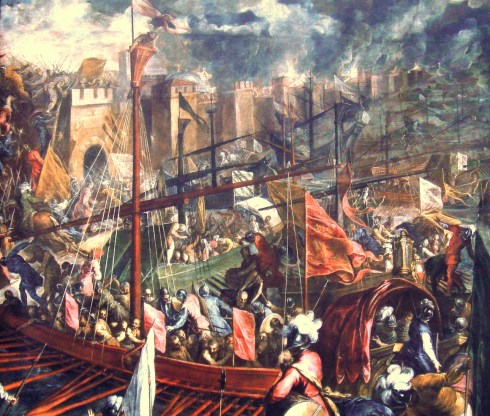
The Fall of Constantinople, Palma Le Jeune — 16th-17th century (click)

The Entry of the Crusaders into Constantinople –Eugene Delacroix, 1840 (click)

And, in fact, the Turks — fast-forward two-and-a-half centuries – weren’t as bad.  Maybe ’cause there wasn’t much left.  Aside from a sizeable amount of slaves, most of the loot Mehmet had promised his suicidally brave Janissaries when they finally made it into the City in 1453 consisted of cheap silver frames pried off of personal or parish-sized icons — Cavafy’s “bits of coloured glass.”  The Emperor’s tombs in the dilapidated Hagioi Apostoloi — the Byzantines’ Westminster — had already been desecrated and robbed by the Franks.  They may as well have sacked Astoria.  The rest was in Venice.  (Even the crown jewels had been pawned off to Venice a century before by Anne of Savoy, one of the most meddling Frangissa bitches in Byzantine history, to fund her episode of the Palaiologan civil wars; that’s the actual historical reference for Cavafy’s “coloured glass.”  Christouli mou, can you imagine what the Byzantine crown jewels were like?)  But one good thing happened for Greeks on Tuesday, May Twenty-Ninth, Fourteen-Fifty-Three: when the Turks finally broke into Hagia Sophia, they smashed Dandolo’s sepulcher — because, after all of the above, he had had the shamelessness to have himself interred there – and finding nothing of worth, they threw his bones out into the street and let the dogs gnaw on them.  I don’t care what else the conquering Turks did at that  point or that Menderes’ thugs did the same to the Patriarchs’ graves at Balikli in 1955; I sleep better at night because they did it to Dandolo.  I’m as close to a chaneller of the Byzantine mind and soul as you’ll find (aside from Vryonis) and I can tell you that the sweet Balkan hard-on of vengeance that image gives me even now is indescribable.

The Greeks got Constantinople back in 1261, but the City never really recovered, as the Empire itself didn’t.  Like the South Bronx in the eighties, whole parts of the City were eventually given over to orchards and bostania or just wilderness.  Yet even after that, the Byzantines managed to plant further seeds in the womb of friggin’ Western Humanism in the form of an artistic wave of unprecedented dimensions and creativity. 

The “Franks,” thereafter, were the unforgivable villains.  But even before, when Byzantine writers felt like being professional, they referred to Westerners as “Latins.”  When not, and eventually in most cases, they were “Frangoi.”  Frangoi stuck as the word for Westerners, or for Catholics at least, because Protestantism was only a minor blip on the East’s screen.   But generally it came to mean the Western Others and the Eastern Muslim world between which Byzantine and post-Byzantine Christians came to feel themselves stuck between.

“Fereng,” “Ferengi,” “Ferenj” and other variations is also a word that eventually came to be used as far east as India, but I can’t be sure whether in Iran or India it means/meant Westerner or just foreigner.  For Arabs and Turks, “Frank” came to mean those Christians over there, as opposed to “Romans,” our Christians over here.  So if you were Roman Catholic, either back home in Europe or in the Near East, you were a “Frank;” if you were an Orthodox Christian, you were a “Roman.”*  It’s confusing.  And I hope I haven’t made it worse.

For Greeks, Frangoi continued to mean Westerner both in a negative sense and not, until the nation-sate convinced us into thinking we ourselves were Westerners.  When Greek peasant men, for example, started wearing Western clothes, whereas their women wore traditional dress well into the twentieth century in many regions, those clothes were “Frangika.”  Frangoi also meant, with no negative connotation, the small communities of Catholics in the Aegean islands that were leftovers of the Crusader principalities that had been founded there after the Fourth Crusade.

It’s not used any more in common Greek parlance, but most Greeks know what you mean when you say it – though this generation is so profoundly ignorant historically that I’m not so sure.  I, of course, use it in a spirit of historical irony, though that spirit is entirely hostile.  The worst enemy of our part of the world is the European West, and not because of imperialist interventions or the usual gripes, but because of the ideological and cultural chaos we allowed it to throw us into.

Yes, Frangoi are the enemy.  I like to say that.  But it’s not true.  We think we’re Frangoi.  Unlike the Byzantines described above, who understood that their natural civilizational context was and always had been the eastern Mediterranean, we are either ignorant of the peoples to our East or despise them.  We disfigured our own identity in an attempt to remake it in the Westerners’ image.  We threw acid into our own face and now still look longingly into Europe’s eyes, and pathetically expect to see our Classical glory reflected back at us.

*One of the most graphic examples is Lebanon/Syria, where Orthodox Christians, who have long and poignantly tried to bridge the above gap, were still “Romans” into the nineteenth century and were among the founders and then long among the most loyal adherents of Arab nationalism, whereas Maronite Christians were the locals with the most exemplary Frangika delusions, always looking to the Western outsider to bolster their interests, first their “sweet mother France” and then Israel, and bringing disaster down upon their heads and that of all around them in the process.  That’s why in many previous posts my humble outsider’s advice to and hope for Syrian Christians in the current crisis has been that they think and act like Romans and not Franks.

Comment: nikobakos@gmail.com


Can Hezbollah Survive the Fall of Assad?

31 Aug

Did this opinion piece in The New York Times, Hezzbollah Survive the Fall of Assad?“make sense to anybody?  Does Ghaddar really think that a phenomenon like Hezbollah is going to be mortally wounded in some way soon or that it will go away some time very soon?  And do we want it too?

“Something fundamental has changed: the Shiite militant group Hezbollah, long Syria’s powerful proxy in Lebanon [a sweeping simplification of the Hezb phenomenon], has become a wounded beast. And it is walking a very thin line between protecting its assets and aiding a crumbling regime next door.”

A “wounded beast” ?  Really?


Comment: nikobakos@gmail.com