Tag Archives: Turkey

Syrian Alawites and Turkish Alevis closer than I thought

5 Aug

From The New York Times:As Syrian War Roils, Sectarian Unrest Seeps Into Turkey”

As Syria’s civil war degenerates into a bloody sectarian showdown between the government’s Alawite-dominated troops and the Sunni Muslim majority, tensions are increasing across the border between Turkey’s Alawite minority and the Sunni Muslim majority here.

Many Turkish Alawites, estimated at 15 million to 20 million strong and one of the biggest minorities in this country, seem to be solidly behind Syria’s embattled strongman, Bashar al-Assad, while Turkey’s government, and many Sunnis, supports the Syrian rebels.

The Alawites fear the sectarian violence spilling across the border. Already, the sweltering, teeming refugee camps along the frontier are fast becoming caldrons of anti-Alawite feelings.

“If any come here, we’re going to kill them,” said Mehmed Aziz, 28, a Syrian refugee at a camp in Ceylanpinar, who drew a finger across his throat.

He and his friends are Sunnis, and they all howled in delight at the thought of exacting revenge against Alawites.

Many Alawites in Turkey, especially in eastern Turkey where Alawites tend to speak Arabic and are closely connected to Alawites in Syria, are suspicious of the bigger geopolitics, and foreign policy analysts say they may have a point. The Turkish government is led by an Islamist-rooted party that is slowly but clearly trying to bring more religion, particularly Sunni Islam, into the public sphere, eschewing decades of purposefully secular rule. Alawites here find it deeply unsettling, and a bit hypocritical, that Turkey has teamed up with Saudi Arabia, one of the most repressive countries in the world, and Qatar, a religious monarchy, both Sunni, to bring democracy to Syria.

The Alawites point to the surge of foreign jihadists streaming into Turkey, en route to fight a holy war on Syria’s battlefields. Many jihadists are fixated on turning Syria, which under the Assad family’s rule has been one of the most secular countries in the Middle East, into a pure Islamist state.

More:

The Alawites here are worried they could become easy targets. Historically, they have been viewed with suspicion across the Middle East by mainstream Muslims and often scorned as infidels. The Alawite sect was born in the ninth century and braids together religious beliefs, including reincarnation, from different faiths.

Many Alawites do not ever go to a mosque; they tend to worship at home or in Alawite temples that have been denied the same state support in Turkey that Sunni mosques get. Many Alawite women do not veil their faces or even cover their heads. The towns they dominate in eastern Turkey, where young women sport tank tops and tight jeans, feel totally different than religious Sunni towns just a few hours away, where it can be difficult even to find a woman in public.
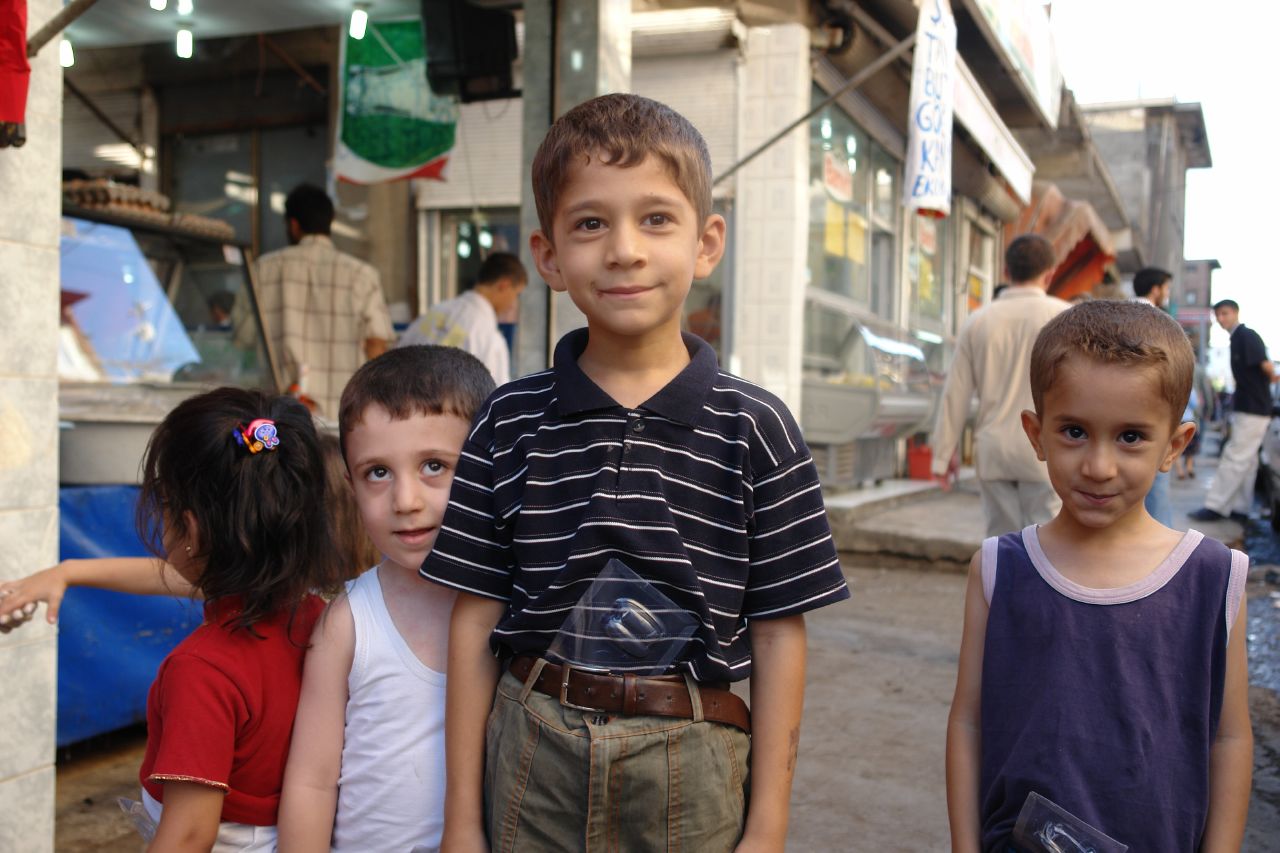
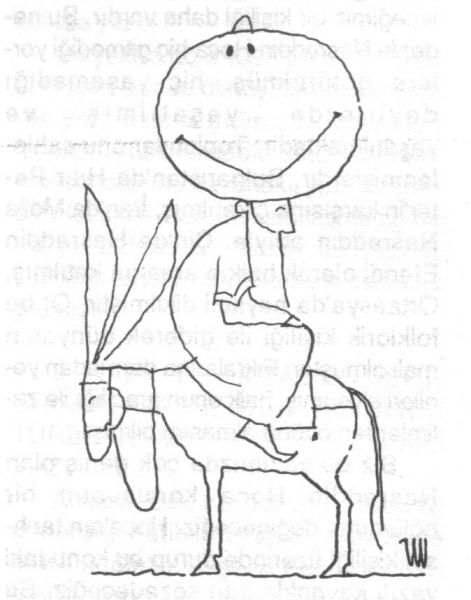
Photo: Kurdish kids in Diyarbakir

31 Jul

Just really damn cute. (click)


Comment: nikobakos@gmail.com

Merkel, Spain, Greece and Nasreddin’s donkey

21 Jul

Nasreddin Hoca had a donkey.  One day he got it into his head that he could save a lot of money on feed by training the donkey not to eat.  So every day he gave his donkey just a little less food.  At first the animal seemed to labor on as if nothing had changed.  Even after his diet had been halved, the poor strong young donkey just soldiered on.  But eventually, as his daily caloric intake got reduced to almost nothing, he got weaker and weaker and slower and slower, but Nasreddin was so happy at the money he was saving through his brilliant austerity plan that he didn’t even notice.

Then one fine day, the poor, martyred beast just up and died on him, on the road, right from under his legs.

Dead.

“Damn,” said Nasreddin, “and just when he had learned not to eat.”

And without a donkey’s back to ride, he had to walk.


(All Nasreddin Hoca stories are versions learned from my father and I think would be public domain already anyway.)

Comment: nikobakos@gmail.com

Köprüdekiler

11 Jul

“Bridge-on-that-(are)-ones” would be the name of this film if you constructed a literal calque in English from the Turkish word order.  We used to play a game like that in grad school — the Turks and the rest of us poor schmucks who were trying to learn Turkish — would play at having whole conversations in an English constructed on the fascinating syntactic structure of Turkic languages.  “Sent-me-by book you-to yet came, huh?” if I remember correctly;  “huh?” was what we used to serve as the Turkish interrogative particle “mi?” — like the Japanese “-ka” — because it was the best we could come up with.  It was pretty silly but a lot of fun.  And when I was teaching ESL, one thing every Turkish student of mine learned from me when he asked an Asian student whether Korean or Japanese was more similar to Chinese was that Korean and Japanese are more grammatically similar to Turkish than either of them are to Chinese.  Their reaction was interesting.  They swallow the silly Turanianism of Turkish Republican ideology whole, but don’t seem to like being confronted by it in such bluntly real and not mythic terms.  “Wait a sec…me…and this Korean guy?”

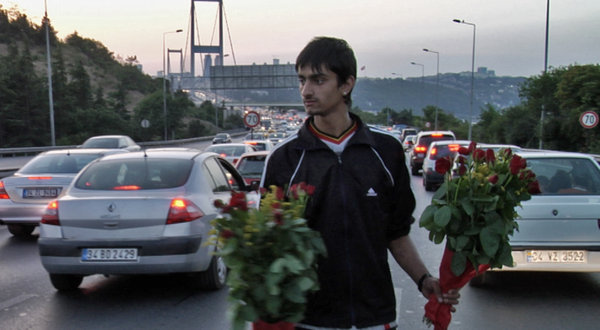
“The Men on the Bridge” — to get back to the post here — is about three men in İstanbul who are connected only by the fact that they work on the Bosphorus Bridge, the older and southernmost span between the two sides of the city.  One is a gypsy boy who sells flowers to people stuck on the bridge’s usually horrendous traffic; he tries to find other employment but is functionally illiterate, can’t even hold down a job at a working-class lokanta, and ends up back on the bridge.  The other is a poor, exhausted dolmuş driver (group taxi — same root as dolma, “stuffed,” which gives you an idea of how comfortable they are, though the new ones are actually very nice), who’s usually stuck in the bridge’s horrendous traffic and tormented by a frankly bitchy wife, who can’t understand why he can’t make enough money to move into a bigger apartment, though she herself doesn’t work and has no skills to get a job either, who, like most of her type, is fairly useless around the house as well, and whom any self-respecting Turkish man would have long sent packing back to her mother.  The third character is a traffic cop who tries to keep the horrendous traffic moving, including by harassing the gypsy boy with the flowers and giving the dolmus driver a ticket when his wife has called him to bitch about something and won’t let him get off his cell.  Played by the only professional actor in the film (his brother is an actual traffic cop), he’s a slightly dorky but handsome kid from Kayseri, with the shy, good manners that still exist in the Turkish provinces.  He’s doing a bit of religious exploring, misses home, works out, and tries to find girls to date on-line — snotty İstanbullu chicks he meets up with who start looking at their watch when he says “Kayseri” and suddenly have to leave when he says “a village near Kayseri.”  He’s particularly proud of his Turcoman clan lineage, one of the first, he claims, to come to Anatolia, and launches into its history with one of these girls, which I wanted to hear more of; she yawns, I think.

“Köprüdekiler” is not some major work, but it’s a very Turkishly melancholy and sweet film that makes its point powerfully enough: that is, that even if all of the recent years’ hype about Booming İstanbul and Booming Turkey is real and not the product of a good American public relations firm — like one sometimes suspects — that certainly not every Turk has gotten to be a part of it.  Aslı Özge makes that point most effectively by refusing to show us even one shot of the glamorous New İstanbul that gets a major piece in the Times travel section, The New Yorker and Travel and Leisure at least once every other issue.  Even the city’s beautiful sea views are almost invisible — and this in a film about a bridge — and even the one scene shot on the Jadde, a scene that makes you want to cry, where the gypsy kid and a friend are innocently checking out CD’s on a stand outside a shop and are suddenly hustled away by security to be frisked and brutally threatened, is shot in such close frame that you see none of the street’s other activity or entertainment or crowds.  She takes an effective swipe at Turkish militarism and nationalism too while she’s at it.

The dumb psychedelic lights they’ve put on the bridge — which if you know how it dominates the City’s sea-and-landscape you must know are particularly irritating — weren’t present in the film and I wondered why.  And then I checked and found it was made in 2009.  I wondered why so many films come even to New York so late and then remembered what profit pigs and cowards American distribution companies are.  I saw it at a one time screening at MOMA last month.  But it’s worth the effort to find.  See it.  Trailers below.

Where’s Charlemagne When We Need Him?

1 Jul

Huh?

Not the most brilliant thing I’ve read lately but one important, though really flawed, point:

“BY 1900, only two genuine multinational empires remained. One was the Ottoman, which was by then in the process of abandoning its traditional religious toleration for Turkish nationalism and even racism. [A completely, unfair, simplistic and un-historical assessment]  The other was Austria-Hungary, home to 11 major national groups: a paradise in comparison with what it was to become. Its army had 11 official languages, and officers were obliged to address the men in up to four of them.

It wasn’t terribly efficient, but it secured an astonishing degree of loyalty. It also brought rapid economic and cultural progress to an area extending from the Swiss border to what is today western Ukraine. During World War I, Austria-Hungary fielded eight million soldiers commanded by, among others, some 25,000 Jewish reserve officers. Thirty years later, the nation-states that succeeded the empire sent most of the surviving Jewish officers to the gas chambers.”

Unfortunately, the poison of the ethnic-based nation-state ideal had gotten too far by then.  Even the portrait of Austria-Hungary he gives us is completely idealized and existed in the form he describes for less than a century.

(Click above)

How sweet though, to have lived in a world that interesting instead of the stupefying monotony of the modern nation-state.  But that idea is so powerful — no, not because it’s natural and inborn, but because the modern, bureaucratic state was the first with the technical apparatus to impose it on its population(s) — that it deletes all historical files dealing with plurality.  Not a single European tourist who comes to New York fails to make the same comment: “Amazing…all these peoples living together…” and I want to explain that that’s how humanity lived for most of its civilized existence — or just pull my hair out — but I usually don’t bother.

But that reminds me: I do live in a world that “sweet” and “interesting:”

Mr. Deak (Hungarian?) is also wrong on an even more crucial point.  The Ottoman and Austro-Hungarian empires were not the world’s last multi-ethnic states.  There’s still China.  Most of southeast Asia.  And Russia.  And most ex-Soviet republics.  And certain Latin American countries.  And almost all of Africa.  And Syria and Lebanon and Iraq and Iran and Afghanistan and Pakistan and the world’s great wonder, India.  Even Turkey.  (And wherever ethnic nationalism is a problem in those countries it’s based on the Western intellectual model.)  In fact, most of the world still lives in “plural” situations.  Only Europe (and even in Europe there’s Spain and the U.K.), has an issue with this concept, but it seems to be fading even there.  Its last bastion will probably be the growing number of viciously homogenized, ugly little states of Eastern Europe and the Balkans.  Which brings us back to Michael Ignatieff:

“The misery of the Balkans stems in part from a pathetic longing to be good Europeans — that is, to import the West’s murderous ideological fashions.  These fashions proved fatal in the Balkans because national unification could be realized only by ripping apart the plural fabric of Balkan village life in the name of the violent dream of ethnic purity.”

From Blood and Belonging: Journeys into the New Nationalism, Michael Ignatieff


“It’s Turkey’s Time” — NYT

28 Jun

May 23, 2012, 8:49 am 14 Comments

By ANDREW FINKEL
(Murad Sezer/Associated Press)

ISTANBUL — If patience is a virtue, then Turkey’s place among the angels is secure. The country’s efforts to become a member of the European Union has been dragging on for some 50 years, and while Ankara has not always been free from blame, since 2005 — when negotiations began in earnest — it has been trying hard to climb over the wall of Europe’s prejudices.

Yet now there is hope at last that the process may accelerate. Voter disenchantment in the euro zone recently claimed the head of President Nicolas Sarkozy of France, the leader of the die-hard Turko-skeptics. France had been refusing to even discuss with Turkey important provisions of the accession document known as the acquis communautaire, including those about budgetary affairs and agriculture. Along with his ally German Chancellor Angela Merkel — who has also been answering to constituencies that regard Turkey as not European enough to join the European club — Sarkozy favored granting Turkey a form of association that would stop well short of full membership.

News from the latest NATO summit in Chicago is that Sarkozy’s successor, François Hollande, is trying to turn the page. German attitudes may also be changing. Last week Merkel’s foreign minister, Guido Westerwelle, a member of the Liberal Democrats — partners of Merkel’s Christian Democratic Union in the governing coalition — delivered to Ankara a message very different from hers. “What is important is to seize the opportunity that emerged after the latest elections in Europe and restart E.U.-Turkey ties,” he said.

Turkey itself must seize the moment. Making the E.U. a priority again would quiet growing criticism that the government of Recep Tayyip Erdogan is becoming more autocratic as its traditional opponents (including the military) become weaker. But doing so will not be an easy matter. If Europeans may be said to suffer from enlargement fatigue, in the case of the Turks, it’s more like narcolepsy. The Turkish government is understandably tired of banging its head against a wall.

Turkey first approached Brussels in 1959. In 1963 it signed the Ankara Agreement, which set out a path for its joining what was then the European Communities. As Europe’s economic integration became political, too, sharing sovereignty with Turkey started to look like a more elaborate project. Still, in 2004, after an intense period of reform, Turkey was declared a full candidate for E.U. membership. Enthusiasm for joining Europe among Turks shot up, with 73 percent of respondents to a survey by the German Marshall Fund saying they thought accession would be a good thing.

But then Europe’s leaders slowed down negotiations, and the Turkish public started to look on the E.U. as a club that did not want them as members. By 2010, support for E.U. membership among Turks had dropped to 38 percent.

Europe wasn’t the only guilty party. My own jaundiced take is that Ankara was more interested in becoming a full candidate for E.U. membership than in becoming a full member of the E.U. Candidacy was an advertisement that Turkey was on a stable course, and it was instrumental in attracting much-needed foreign direct investment. Actual progress toward membership, on the other hand, would have meant implementing more reforms — environmental policies, greater transparency for government tenders — all at a steep economic and political cost. Turkey also refused to recognize the E.U. member Cyprus, or even open its ports to Cypriot vessels.

Turkish attitudes may change again, though. Over the past few years, Turks had begun to flirt with the notion that the Middle East was Ankara’s natural backyard. But they’ve started to realize that the Arab Spring has brought some stormy weather. Turkey’s relations with Iraq, Iran and Syria are at a low, and its export opportunities in Libya and Egypt have taken a hit. Despite the economic crisis in Europe, Turkey still carries out about 43 percent of its trade with the E.U.

Now is just the time when Turkey should want to join the union. With Europe more skeptical about itself these days, it may be less skeptical about admitting Turkey. While Europe staggers under austerity measures, Turkey is experiencing a boom. In the last two years its G.D.P. grew by 9.2 percent and 8.5 percent. The figure for this year will likely be lower, but Turkey can present itself as an engine of Europe’s recovery; it already is the E.U.’s fifth-largest export market. And though incorporating such a big country is still a major challenge, the task may seem less daunting if a “two-tier” Europe — with political integration occurring at different rates for different countries — emerges from the current crisis.

Turkey should spin Europe’s economic problems to its advantage and revive talks for E.U. membership. To its credit, the government has begun to speak about a “new era” and a “clean page.” At a time when Turkey is trying to adopt a more liberal constitution and better enforce the civil rights of the minorities like the Kurds, progress toward E.U. membership would strengthen democracy here. That would be good for Turkey, Europe and for Turkey’s neighborhood.


Andrew Finkel has been a foreign correspondent in Istanbul for over 20 years, as well as a columnist for Turkish-language newspapers. He is the author of the book “Turkey: What Everyone Needs to Know.”


Comment: nikobakos@gmail.com

Why Euro(pe) is doomed?

6 Jun

Derek Thompson at The Atlantic:

Here is what this chart shows. Compared across more than 100 factors measured by the World Economic Forum Global Competitiveness Report, from corruption to deficits, JP Morgan analyst Michael Cembalest calculates that the major countries on the euro are more different from each other than basically every random grab bag of nations there is, including: the make-believe reconstituted Ottoman Empire [my emphasis]; all the English speaking Eastern and Southern African countries; and all countries on Earth at the 5th parallel north.

And here is your tweetable fact: A monetary union might make more sense for every nation starting with the letter “M” than it does for the euro zone.


Comment: nikobakos@gmail.com

“Kurbet — yes, the Turks have a word for it too…”

1 Jun

A film about Turkish immigrants in Germany and a homecoming trip they go on that looks delightful.  What a creative voice German Turks have become.

The little boy is terrified of the crucifix because the other boy earlier in the trailer tells him that in Germany they eat swine-flesh and people: “They eat people?  Yeah, and on Sunday they get together and eat them and drink their blood!,” which is sure throwing the anti-Jewish blood libel in Christianity’s face; it’s that slight chill that always makes a good laugh funnier.

The other, more poignant scene — scenes of which I have an infinite file of from my own childhood — is of the mother trying as hard as possible to give her kids a real German Christmas: “Nooooo!” they yell at her, “you’re supposed to wrap them!”  And the sad little tree…

I don’t know all this because the Holy Spirit suddenly blessed me with the ability to understand German but because I caught a discussion with the filmmakers on — where else — Al Jazeera.  I couldn’t find a trailer with English subtitles, though you can put it on your Netlix “saved” list already.

Does there always have to be a white-girl girlfriend in these movies?  You can so predict what the jokes and problems are gonna be…


Comment: nikobakos@gmail.com

Syrian Christians

13 May

Short Al Jazeera report that follows up and answers some questions I had in previous post: April 23rd, “Turkey and religious freedom: Wooing Christians — ‘We are ready to face the past, to make amends.'”

Christ, I hope they end up on the right historical side of this one.  Not that they may have a choice — as Iraqi Christians didn’t.


Comment: nikobakos@gmail.com

Pious Turks Push for Labor Justice

11 May

http://www.nytimes.com/2012/05/10/world/middleeast/pious-turks-push-for-labor-justice.html?pagewanted=1&ref=world

Turkish kids think new Turkish capitalists (and the AKP) aren’t morally Muslim enough.

Turkish demonstrators at a May Day rally at Taksim Square in central Istanbul, Turkey, on May 1, 2012. (European Pressphoto Agency)

“Now that there are many rich Muslims, they have begun to regard themselves as a separate class,” Mr. Icoz said. “They live in their new suburbs, far away from the poor, to comply with the admonition of the Prophet against ‘sleeping sated while one’s neighbor goes hungry.’ That’s how low they have dragged Islam.

“They think it is enough to perform the rituals of Islam, like praying, fasting, the Hajj,” he added. “They exploit the workers and then go to prayers. They give no thought to the spiritual, moral side of Islam.”

If even twenty years ago you had told me that any prosperous Turkish middle class would be described in these terms I wouldn’t have known what country you were talking about.  Praying…fasting…the Hajj…huh?  Who?

Nor would I have imagined much of the below.  Whatever their government and political factions, their military or the wild wolves of the Altai mountains might be up to, average Turks continue to exceed my expectations at an almost dizzying rate:

In their march, the youths brandished placards demanding an end to nuclear energy, a right to conscientious objection, a lifting of the head scarf ban and more rights for Kurds and Armenians.

“All Property Belongs to God,” proclaimed one sign; “All Oppressed Are Equal,” said another. A large banner read “Freedom From Slavery” in Kurdish, Armenian and Arabic as well as in Turkish. Some of the female marchers wore head scarves, while others went bareheaded. An impromptu manifesto read out at the rally included quotations from the Bible and the Torah as well as the Koran.

“They are very open and inclusive,” Ihsan Eliacik, a theologian whose writings have influenced the students, said in a telephone interview last week.

“They are also very courageous,” he added, alluding to the fate of former Turkish youth activists such as the iconic Deniz Gezmis, who was hanged at the age of 25 exactly 40 years ago this week, or Erdal Eren, executed at age 16 along with other young activists after the 1980 coup.

Deniz Gezmis: http://en.wikipedia.org/wiki/Deniz_Gezmi%C5%9F

http://en.wikipedia.org/wiki/1980_Turkish_coup_d%27%C3%A9tat

http://tr.wikipedia.org/wiki/Erdal_Eren  “One notable victim of the hangings was a 17-year-old Erdal Eren, who said he looked forward to it in order to avoid thinking of the torture he had witnessed.”


Comment: nikobakos@gmail.com