Tag Archives: Turkey

Turkey and religious freedom: Wooing Christians — “We are ready to face the past, to make amends.”

23 Apr

From the Economist:

“IT IS well known that Kurdish tribes took part in the mass slaughter by the Ottomans of around 1m Armenians in 1915. “Collaborating Kurdish clerics pledged that anyone who killed an infidel would be rewarded in heaven with 700 mansions containing 700 rooms, and that in each of these rooms there would be 700 houris to give them pleasure,” says Mala Hadi, an Islamic sheikh in Diyarbakir.

The sheikh is among a handful of local leaders seeking reconciliation with the Kurdish region’s once thriving Christians. “We are ready to face the past, to make amends,” promises Abdullah Demirbas, mayor of Diyarbakir’s ancient Sur district. To atone, Mr Demirbas has been providing money and materials to restore Christian monuments in Sur. These include the sprawling Surp Giragos Armenian Orthodox church where, until recently, drug dealers plied their trade amid piles of rubbish. It is now squeaky clean and even boasts a new roof.”

Here’s a website with some beautiful pictures of the church: http://www.futurereligiousheritage.eu/february-2012-restoration-of-dyarbakir-surp-giragos-armenian-church-dr-f-meral-halifeoglu/ 

This is a story that made me cry — I wish I could say I don’t cry easily.

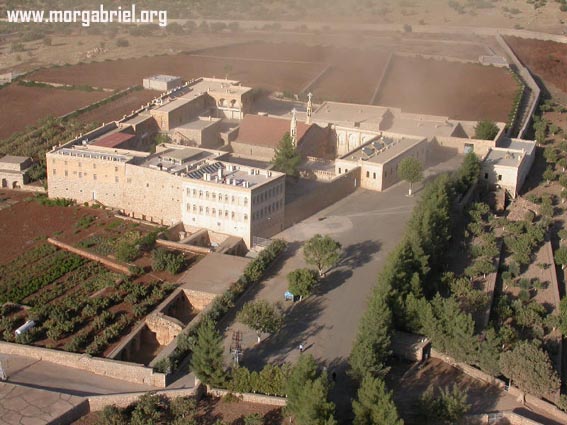
Read the whole story from the Economist here: http://www.economist.com/node/17632939  The story then goes on to talk about relations with the Syrian Christian community in southeastern Turkey, especially the conflict surrounding the Syrian monastery of Mor Gabriel, since the Armenian community that the Kurdish sheikh would like to make amends to has been practically non-existent outside Istanbul for a good century now.  Some photos of Mor Gabriel:
I keep looking for a story — because there’s definitely one there — about Syrian Christians among the refugees flowing into Turkey from Syria.  But there may not be that many, since for the most part they’ve been pretty passive in the whole conflict, nervously afraid of change as all minorities are, and maybe passively siding with the Alawite regime for fear the Sunni resistance will turn religious in ways uncomfortable for them.  And yet Homs and Hama, two of the Assad regime’s most brutalized targets, are among the largest and most ancient Christian communities in the country.  In William Dalrymple’s From the Holy Mountain: A Journey Among the Christians of the Middle East: http://www.amazon.com/From-Holy-Mountain-Journey-Christians/dp/0805061770/ref=sr_1_1?ie=UTF8&qid=1335220105&sr=8-1 he describes the Christians of Syria as the most happy, confident, open, and optimistic about their future of any of the Christian communities of the region, even those that constitute a larger percentage of their country’s population, like those of Lebanon or Egypt (on Lebanon, he has a kind of sensationalist chapter on Maronite “savagery,” which reminds me of a lot of Western journalism about Serbs, or older travel accounts of Albania, and pretty much tows the standard line that if they, Maronites, are on their way out demographically and politically, it’s their own fault.)  That optimism on Syrian Christians’ part must certainly have changed.  And if they were going to flee, it would be to their pretty numerous co-religionists in Turkey, wouldn’t it?

I always wanted to know what percentage of Arabs in southeastern Turkey were Christian and could never find any definitive information on it.  But if there were that many, they probably wouldn’t have to be fighting such an outnumbered battle to protect the property of one of their main religious centers.

Anyway, kudos to the sheikh, Demirbas, and I guess guarded kudos to AK leaders too; I think their concern for issues like this might actually be genuine; I mean Hillary talked about the Chalke seminary when she was in Turkey last and they didn’t freak out.

I have a few acquaintances who would roll their eyes at this post, irritated, along the lines of: “So many people being killed and you’re only concerned about Christians…”  No, I’m not just concerned about Christians.  But — shout out to the MESA thought police — I’m not going to waste any more time arguing my basic non-sectarian ethics either.

As a final note: the great villain here is not Assad, but his prime backer, Vladimir Putin, the last twentieth-century totalitarian dictator of the twenty-first century and a Chekist murderer and Stalinist criminal on all levels.  Be afraid of him — very afraid.  Recent NYRB article about him: http://www.nybooks.com/articles/archives/2012/apr/26/vladimirs-tale/


Comment: nikobakos@gmail.com

Turkey in Europe

22 Apr

According to Stephen Kinzer, New York Times correspondent and the paper’s bureau chief in Istanbul for a good part of the nineties, the appeal of EU membership to those countries waiting for it is (or was) political, social, and economic.  “For Turkey it is also psychological,” he writes in his 2001 Crescent and Star:

“The central question facing Turks today is whether their country is ready for full democracy, but behind that question lies a more diffuse and puzzling one: who are we?  The Ottomans knew they were the servants of God and lords of a vast and uniquely diverse empire.  The true heart of their empire, however, was not Anatolia but the Balkans…  But by caprice of history the founders of the Turkish republic found themselves bereft of the Balkans and masters instead of Anatolia.  To make matters worse, through a series of twentieth-century tragedies Anatolia lost most of the Armenians, Greeks and Jews who had given it some of the same richness that made the Balkans so uniquely appealing.”

There’s a lot there I’m not sure of, like the Ottomans’ heart having been in the Balkans and their backs turned on Anatolia.  I also don’t know if “who are we?” isn’t too categorical a way to phrase the dilemma Kinzer is talking about.  Unlike Greeks, Turks know who they are; their growing willingness to accept, not only the former existence of their neighbors among them, but the plurality of their own ethnic make-up would indicate that: Albanian fraternal associations, Tatar and Circassian language classes, seem to be coming out of the woodwork of the Republic’s forced homogenization, and even the lay-low-and-keep-your-head-down Alevis have found a new courage in asserting themselves.  (Poor Republic: no sooner does it harass one minority out of its existence, another one pops up to take its place.)  That’s a process that requires confidence, whereas we remain isolated in our ignorant dream of purity — and banging our feet to prove it to the rest of the world on top of it — a ringing sign of insecurity.  As mangled as Turks’ knowledge of themselves may have become by their own nationalism, I think phenomena like nostalgia for the multiethnic or the Neo-Ottomanism that has pervaded cultural life and even motivated political life and foreign policy in Turkey recently (and I don’t think that’s a bad thing or necessarily a “threat” to anyone; we, Greeks, might want to take advantage of it actually) is an attempt to right that disfigurement, not a deep existential reorientation.  Proof might be that since Kinzer wrote his book in 2001, Turkish membership in the European Union has pretty much become a dead-in-the-water issue.  And that may be partly because, in almost head-on contrast to Kinzer’s interpretation, Turkey was looking for political and economic benefits and not for Europe to validate its psychological needs, as the Neo-Greek statelet always has since its beginnings, a craven and cringingly embarrassing pandering to the West’s classical image of what Greeks are supposed to be being the foundation of Neo-Greek identity.  However the Ottomans may have felt about the Balkans or wherever modern Turks end up with their renewed embracing of the Ottoman past, they seem to be increasingly feeling — even the old, staunchly Kemalist bourgeoisie, or at least their children — that they don’t need European validation to prove they’re part of a civilization that they’re not.  And good for them.  I wonder when we’ll get the message.

On a lighter note, it’s not often one hears the Balkans described as “so uniquely appealing.”  It’s a line I’ll have to remember.  Often when people find out I’m Greek, they launch into delirious and happy memories of the Aegean and little white houses and sparkling blue waters and then I have to watch their faces drop as I tell them: “Well, the part of Greece my family is from is really more the Balkans than the Mediterranean…  And it rains all the time.”

Landscape approaching my mother’s village, in its usual mood. (click)

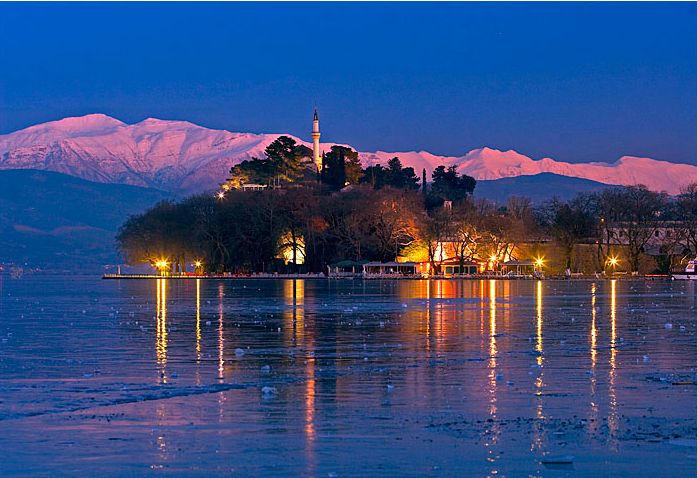
But then it is often “so uniquely appealling,” to get back to the Turks and the Balkans.  The main city of the region (Epiros) is Jiannena/Yanya, a beautiful little city by a lake that always had an air of luxuriant civility about it, proof of which may be that the Greek population didn’t rush to pull down the minarets or demolish all the mosques of the city as soon as the last Turks left in the twenties.*  It’s one of those Balkan cities the Turks loved.  Here’s a winter photo of Yanya’s main cami, the Aslan Pasha Mosque, overlooking the icy lake, below. (click)

Jiannena deserves a post of its own.  I gotta dig up some 2010 notes I have.

* On the other hand, the city government and developers have done all they can since WWII, including harassment and straight-out vandalism, to expropriate the city’s large and very romantic Jewish cemetery, which unfortunately for the city’s 40 surviving Jews, sits on some prime real estate.  Last I heard they had taken the issue to the EU, which makes me very happy.  Maybe the economic slump will give them a reprieve.  More on Jiannena’s Jews in the future.


Comment: nikobakos@gmail.com

The Beygairat Brigade

9 Apr

This group — “The Dishonourable Brigade” — of smart and very cute…and very brave…Pakistani kids out of Lahore put out this cool song last year that became an instant hit.  It’s called “Aalu Anday” or potatoes and eggs, and the Punjabi refrain says “my mom made me potatoes and eggs [again]” i.e. “I’m sick of this shit,” and the song then proceeds to bash and mock the whole landscape of corruption, religious fanaticism and social stagnation of contemporary Pakistan.  A viewer will need a bigger expert than me to explain all the references, but enough can be gleaned from just the subtitles, and the YouTube comments contain a lot of information too, if you can pick it out of the mutual Indo-Pak bashing and obscenity that’s usual to YouTube comments.

Takes a lot of guts to put out a song like that but it obviously hit a nerve because it became wildly popular and was embraced in both Pakistan and India.  Does anybody know what happened to them?

Don’t miss this television interview with them, conducted in that effortless switching back and forth between Hindustani* and beautiful English that it is so damn enchanting to listen to (or is it Punjabi?):

And another one where the lead singer Ali Aftab Saeed gives us a nice acoustic version towards the end:

I’d love to get some further news on them.

Are things shifting on the sub-continent?  A new thaw apparently; Zardari visits India: http://articles.cnn.com/2012-04-08/asia/world_asia_pakistan-india-visit_1_pakistan-and-india-pakistani-leader-islamabad?_s=PM:ASIA 

A start, eh?  Now let’s get to work on reversing Partition.  Well, we can dream, can’t we?

*I use “Hindustani” as often as possible because I try — as often as possible — not to acknowledge the supposed difference between Hindi and Urdu, despite the intense efforts on respective sides of the border to Sanskritize and Islamicize what is essentially one language.  Nationalism’s manipulating of what people spontaneously speak is one of its most insidious forms of mind control.  Serbs and Croats have been trying to prove their language is not the same one for almost a century now — unsuccessfully, given the capacity of Serbian and Croatian paramilitary thugs to hurl the most fertile insults at each other across battle lines in the nineties with no comprehension problems whatsoever — and now there’s a third contender, the ‘Bosnian’ spoken by ‘Bosniaks.’  To some extent Turks and us went through the same process, though they’re obviously not the same languages: nineteenth-century Greece tried to make Greek Greeker, which meant archaicizing it, and though I don’t necessarily think katharevousa was the artificial monster a lot of people do — in its simpler, less pretentious forms it was capable of great beauty in the hands of certain writers like Papadiamantes — the ideology behind it was a deeply problematic one.  Ditto the Turkish Republic, which in the late twenties and early thirties tried to eliminate remnant Persian syntactical features from Turkish and replace all Persian and Arabic words in the language with new Turkish ones (even forcing muezzins to sing the call to prayer in Turkish), an attempt which, if it had succeeded to the full orthodox extent of its intentions, would have left the entire Turkish people mute for everything except the most basic human communication — like in the Hundred Years of Solitude where they have to write “cow” on the cow.  Apparently, in 1934, the Great Leader himself made a series of speeches in the New Turkish which were completely unintelligible to everyone except him and his inner clique.  They backed off a little afterwards apparently but, between the high learnedness of much Ottoman literature and the Republic’s tinker-tampering, much of nineteenth-century Turkish literature is now unreadable to most modern Turks.  As Benedict Anderson said, the nation-state pretends to be the guardian of your culture and traditions but “is actually hostile to the real ways of the past.”


Comment: nikobakos@gmail.com

Jadde — Starting off — the Mission

6 Apr

Dropoli

The Valley of Dropoli, the pass up to the Pogoni plateau near Libochovo, and in the distance, the snowcapped peaks of Nemerčka, from the Monastery of the Taxiarches in Derviçani, Easter 2014 (click)

When my father used to say “ta mere mas” (literally “our parts”) he was referring to the thirty or so Greek-speaking villages in the valley (shown above) and surrounding mountains of southern Albania where he grew up.  It was a term that, before I had gotten too deep into my childhood, before I could even name those places, I had understood instinctively, almost oppressively.  I knew who these people from our parts were, these landsmen, exotic even to me in certain ways.  I knew how they comported themselves, knew their body postures; I knew how they spoke, how they treated a guest.  I knew how they danced, how they sang; I knew their weird, haunting music before I could articulate why it stirred me so deeply.  I knew how they prayed; I knew how they grieved.  They didn’t laugh much.  Or smile easily.

Later, in graduate school, students from Greece, the Balkans, Turkey, Iran, the Arab Middle East and even South Asia seemed to instinctively gravitate towards one another, and not just because they were all working in the history or the politics of the area but, well, mostly because we partied well together.  I started using my father’s “our parts” semi-ironically, a little guiltily as well because it was without the Appalachian tone of mystery with which he used it, to indicate the region that all of us were somehow connected to – the region that, however vast and varied, and where, however viciously we treated each other in past and present — seemed to bring us together in an automatic comfort and feeling of ease.  The term inevitably caught on and without irony.  I guess it was bound to.

This blog is about “our parts.”  It’s about that zone, from Bosnia to Bengal that, whatever its cultural complexity and variety, constitutes an undeniable unit for me.  Now, I understand how the reader in Bihać, other than the resident Muslim fundamentalists, would be perplexed by someone asserting his connection to Bengal.  I can also hear the offended screeching of the Neo-Greek in Athens, who, despite the experiences of the past few years, or the past two centuries, not only still feels he’s unproblematically a part of Europe, but still doesn’t understand why everyone else doesn’t see that he’s the gurgling fount of origin and center of Europe.

But set aside for one moment Freud’s “narcissism of petty differences,” if we have the generosity and strength to, and take this step by step.  Granted there’s a dividing line running through the Balkans between the meze-and-rakia culture and the beer-and-sausage culture (hats off to S.B. for that one), but I think there’s no controversy in treating them as a unit for most purposes; outsiders certainly have and almost without exception negatively.  And the Balkans, like it or not, include Greece.  And Greece, even more inextricably, means Turkey, the two being, as they are, ‘veined with one another,’ to paraphrase the beautiful words of Patricia Storace.  Heading south into the Levant and Egypt, we move into the Arab heartland that shares with us the same Greek, Roman-Byzantine, Ottoman experiences, and was always a part of the same cultural and commercial networks as the rest of us.  East out of Anatolia or up out of Mesopotamia I challenge anyone to tell me where the exact dividing line between the Turkic and Iranian worlds are, from the Caucasus, clear across the Iranian Plateau into Afghanistan and Central Asia.

Granted, the descent into the suffocating Indo-Gangetic plain and its polytheism, from the suffocating monotheism of the highlands, is a cultural and most of all perhaps, a sensory rupture.  But one has to know nothing about the “dazzlingly syncretic” civilization of north India to not know how much of it is Islamo-Persian in origin or was at least forged in an Islamic crucible, and if you do know that then the Khyber pass becomes what it always was, the Khyber link.

Are the borders of this zone kind of random?  Maybe.  But to step into Buddhist Burma is somehow truly a leap for me, which maybe I would take if I knew more.  And in the other direction, I stop in Bosnia only because for the moment I’d like to leave Croatia to Europe – mit schlag – if only out of respect for the, er, vehemence with which it has always insisted that it belongs there.  Yes, I guess this is Hodgson’s “Islamicate” world, since one unifying element is the experience of Islam in one form or another, but I think it’s most essential connections pre-date the advent of Islam.  I’ll also probably be accused, among other things, of Huntingtonian border drawing, but I think those borders were always meant to be heuristic in function and not as hard-drawn as his critics used to accuse him of, and that’s the case here as well.

Ultimately what unites us more singularly than anything else, and more than any other one part of the world, is that the Western idea of the ethnic nation-state took a hold of our imaginations – or crushed them – when we all still lived in complex, multi-ethnic states.  What binds us most tightly is the bloody stupidity of chilling words like Population Exchange, Partition, Ethnic Cleansing – the idea that political units cannot function till all their peoples are given a rigid identity first (a crucial reification process without which the operation can’t continue), then separated into little boxes like forks after Easter when you’ve had to use both sets – and the horrendous violence and destruction that idea caused, causes and may still do in “our parts” in the future.

What I hope this blog accomplishes, then, is to create even the tiniest amount of common consciousness among readers from the parts of the world in question.  A very tall order, I understand, maybe even grandiose.  Time will tell if it all ends up an unfocussed mess and I end up talking to myself; it’s very likely.  But hopefully readers will respond and contribute material or comments even if they don’t feel the entire expanse of territory as their own.  I hope it’ll be a place where one can learn something, including me; in fact, I expect most of my posts will end with “does anybody know anything more about…” or “can anyone explain…” I’ll be using vocabulary and making references from all over the place, sometimes footnoting them with an explanation, but if not hoping that readers will be interested enough to please, please ask when a word or topic is unfamiliar.

Clearly my intentions are more than just explicitly anti-nationalist, but please feel free to contribute even if you consider yourself ardently opposed to those intentions (just refrain from vulgarity please).  Feel free to tell us how you’re the origins of civilization or how you saved it or how you restarted it or that you speak the first language that came from the Sun or that we don’t understand that you’re surrounded by enemies or that — in the language of a grammar school playground — you were here first and they started it, or how everything beautiful about your neighbors is ripped off from you and how everything ugly about you is the unfortunate result of your neighbor’s polluting influence.  Feel free to express legitimate concerns and disagreements as well.  Please.

I’m also sure that sooner than later the subject matter will spill over into neighboring areas (the rest of eastern Europe and southern Italy immediately come to mind), and that there’ll be occasional comments on American socio-political reality, which for better or worse affects us all. And there will probably be the more than occasional post on New York, because that’s where I live, that’s where I’m from, because it’s only from a vantage point that’s both heterogeneous and external that the phenomena I’ll be talking about can be apprehended in their fullness and because that’s where, more than any other single place or any single time in history, the cosmopolitan ideal that motivates me has manifested itself in one actual, throbbing, hopelessly chaotic and deeply sure of itself city.

I’ve been collecting material for this blog for a long time before actually sitting down to start it up, partly because life got in the way, as it tends to do, and partly cause I’m a technological spaz, so some stuff will be old (including some journal entries from a couple of years ago when I took a trip through the region), but my comments will be contemporary.  If there’s any one out there in NYC who is inspired or interested enough to help me out with things like the blog’s design or things like Greek or Arabic fonts or Turkish letter markings (sorry, on a volunteer basis for now) please feel more than free to contact me at: nikobakos@gmail.com