
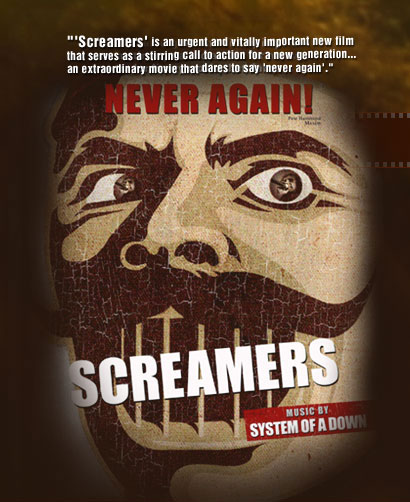
I watched “Screamers”* the other night, a 2006 documentary by Carla Garapedian about an Armenian-American synthpunk group based in California, who go around, among other things, “screaming” about the Armenian massacres of the early twentieth century and issues of genocide recognition generally. They’re shown on tour, comparing Armenian experiences to those of Rwandans, Cambodians — Jews conspicuously less so — soliciting the support of U.S. congressmen, interviewing British aristocrats, Harvard professors and their own great-aunts and grandfathers telling their own story of the events they describe as the Armenian Genocide, all in an effort of course to get the Turkish government to acknowledge the “Genocide” as such. And it left me with the usual thoughts I have on this issue: that this word – “genocide” – which is supposed to name an evil particular to our time and by naming it hopefully eradicate it, has come to be so overused as to be meaningless, was vague from its beginnings and has come to obscure more than it reveals about the phenomenon, if there is such.
Raphael Lemkin, the Polish Jewish Holocaust survivor who originated the term, described it as such:
By ‘genocide’ we mean the destruction of an ethnic group . . . . Generally speaking, genocide does not necessarily mean the immediate destruction of a nation, except when accomplished by mass killings of all members of a nation. It is intended rather to signify a coordinated plan of different actions aiming at the destruction of essential foundations of the life of national groups, with the aim of annihilating the groups themselves. The objectives of such a plan would be disintegration of the political and social institutions, of culture, language, national feelings, religion, and the economic existence of national groups, and the destruction of the personal security, liberty, health, dignity, and even the lives of the individuals belonging to such groups . . ..
T. Marcus Funk in Victims’ Rights and Advocacy at the International Criminal Court says genocide is “the deliberate and systematic destruction, in whole or in part of an ethnic, racial, caste or religious, or national group.”
“…in whole or in part…” is controversially vague enough. Then, how “deliberate and systematic” does it have to be to qualify? And if its victims are members of any “ethnic, racial, caste, or religious, or national group,” is that not so all-encompassing as to include most of humanity? What sets genocide apart then from any mass killing? That it’s done to a socially or ethnically identifiable group? Mass killing – apart from shootings in American shopping malls or movie theaters – is usually committed on such a group. And by emphasizing that a “group,” usually an ethnic or minority group, is the object, it creates the unspoken assumption of irrationality, though most of the events we call genocides have and had a very rational end and, to be effective, must have used fairly rational means. And thus I wonder if the word mystifies and, more importantly, decontextualizes to a point that ultimately may do more harm than good.
Obviously, our region gives us a variety of useful examples to look at. Now, I often get emails here — most simply rants that I don’t bother publishing — in which I’m told that I am defeating the stated purpose of this blog by favoring one group over another or being so obviously preferential in some of my affections or animosities. I’m told that I’m panderingly philosemitic; I don’t know about the “pandering” part, but otherwise, yes. I’m accused of being both pro-Israeli and anti-Israeli, and anti-Palestinian and possessed of a blind good faith in Palestinian intentions and an enabler of their “tactics,” whatever that means; I guess if I can be all those things at once I may be doing something right. I’m accused of being anti-Croatian: let’s leave that one to the side for a moment. But mostly I’m accused of two things: that I’m pro-Turkish — this usually by angry Greeks — and that I’m a shameless apologist for Serbian criminality.
And here there is some truth: the two peoples may not much appreciate being linked in my heart, but one of the many reasons that I may have a special affection for Turks, or at least find myself defending them so often, is also one of the many reasons I have a special affection for Serbs: I think the two have historically been the most unfairly maligned groups in the region. And that brings us back to the larger genocide discussion obviously.
It has always irritated me that critics of Serbia, both in the nineties and to this day, dutifully rehearse the main highlights of the “Serbian myth”: traumatic defeat at Kosovo; continued resistance to the Ottomans; among first to struggle for independence in the Balkans; a sincere if often faulty and undemocratic attempt to actually go through with the noble experiment of South Slav unity, only to have those attempts undermined from the get-go by a Croatia that was always a member of that union in bad faith; always supporters of Western causes only to be stabbed in the back after; further traumatic WWII memories – and then just blow them off as if none are legitimate, that they’re just the “mythical” or fictional building blocks of a national pathology that explains Serbs’ vicious behavior during the breakdown of Yugoslavia.
Nobody is denying the unscrupulous manipulation of the Serbian group ‘psyche,’ starting in the late eighties, by some of the most criminally opportunistic, thuggish politicians to emerge out of post-Cold War Europe. Nobody denies the horrible war crimes of Serbs and Serbian paramilitaries, especially in the great victims of the Yugoslav wars, Bosnia and Kosovo. But the simple fact is: Serbs had absolutely no reason to feel secure about their future in the states that emerged from the break up of Yugoslavia, especially not in Croatia, the West’s darling. During WWII, the NDH, the Independent State of Croatia, the Ustaša, had a greater percentage of its population—Serbs, Jews and Gypsies — slated for elimination than any other of the Nazi’s puppet states in Eastern Europe. The plan for the Serbs specifically was the famous “thirds” plan: kill one third, expel one third, convert the other third to Catholicism (the Ustaša was also fanatically Catholic and its support by the Vatican is one of the Catholic Church’s ugliest twentieth century moral “lapses”). The numbers are uncertain, as always in these cases, but several hundred thousand Serbs were killed by the Croatian regime and – unfortunately – its Bosnian collaborators during the war. Ustaša Croatia was the only one of the Nazi puppet states whose tactics even the Germans found excessive, and had to be told by Berlin to “tone it down” a little, because their viciousness was giving undue impetus to a Serbian resistance movement that was becoming increasingly difficult for the Germans to keep under control. The reasons that post-Yugoslav Serbs might have felt insecure in independent Croatia or even an independent Bosnia are not simple “myths,” pathological obsessions with historical wrongs – especially when Tudjman’s Croatia started making all kinds of fascist noises again as soon as it gained recognition from its German buddies.
Turkey. It’s maddening that what happened in early twentieth-century Turkey is never put into the broader historical context of the previous two centuries by groups like the Screamers or others who are bent on forcing Turkey to acknowledge the events as genocide. You can talk and talk and argue and explain and then you come across a passage somewhere that condenses and puts it all into perspective. The following is from Karen Barkey’s Empire of Difference: The Ottomans in Comparative Perspective. Towards the end of a chapter where she’s discussing the deterioration of interethnic relations in the nineteenth-century empire, the penetration of European economic influence and the benefits that that created for Ottoman Christians and from which Muslims were excluded, she writes:
“If major misgivings regarding ethnic and religious difference and disparity were already well-rooted in the empire, competition and communal strife only got worse as Muslim refugees from the Balkans, the Caucasus, and the Crimea were settled in Anatolia. Between 5 and 7 million refugees, mostly Muslims, were settled by the Ottoman government throughout the nineteenth century, mostly in Anatolia. Kemal Karpat argues that between 1856 and 1876 at least 500,000 Crimean Tatars and 2.5 million Muslim immigrants from the Caucasus were settled in Anatolia, the Balkans, northern Syria and Iraq. Not long after, in 1877-1878, the Caucasian population that had been settled in the Balkans was resettled in Anatolia together with a million others, mostly Muslims from the Balkans. Another 2 million took refuge in Anatolia until 1914. By the time of World War I, the immigrant [refugee] population of Anatolia represented nearly 40% of the total population. Such immigration, originating in the nationalist movements and independence politics of the Balkans, the Russian Wars, and the Ottoman defeats, brought in another element of Muslim discontent that not only altered the demographic balance of the empire, but also exacerbated social and economic tensions.” [emphases mine]
Do we understand that? Charles Simic has written: “Nationalists everywhere are unmoved by the suffering of people they hurt.” But are the above figures enough to penetrate the armor-plated narcissism of the nationalist or even dent it? Might some clubbing over the head be in order? Let’s repeat them and see: in 1914, the year we’re supposed to think that Turks suddenly had a collective psychotic episode and just started massacring millions of people for no reason, 40% — forty percent – of the population of Anatolia, roughly the territory of contemporary Turkey, consisted of Muslims who had escaped from the various parts of the shrinking empire, usually under conditions that could be clearly labeled “genocidal” or definitely characterized as “ethnic cleansing” though for some reason they are not, and often, as Barkey alludes to, after having been brutally displaced twice in one or two generations: like the Bosnians who had settled in Salonica after 1878 and again in 1908, in such numbers that they gave their name to a neighborhood in that city, only to have to move once more to Anatolia in 1913; or the millions of Circassians, driven en masse out of their Black Sea homeland by Russia in the 1860’s and settled in the Balkans only to have to move on to Anatolia after Bulgarian independence. Forty percent! That is almost twice the percentage of incoming refugee population that Greece staggered under in the 1920s after the Population Exchange, and in an Empire that had dragged itself into a World War it was woefully unprepared to fight.
And here’s where we get to the question that every ethically honest Greek or Armenian has to ask himself: what did we expect Turks to do at that point? Give up even what they had left? Pack it up? Go back to the Red Apple Tree?** To expect that at some point Ottoman Muslims/Turks were not going to fight back in order to hold on to something, a state and territory of their own, is delusional in ways that only as totalizing an ideological structure as nationalism can produce.
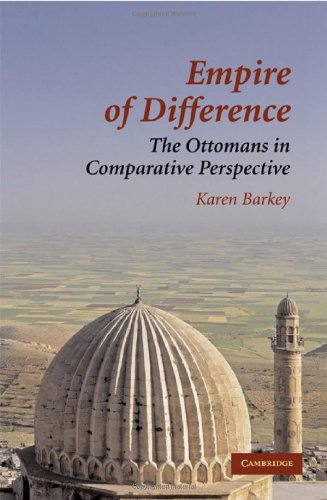
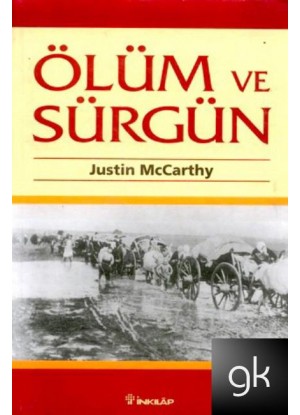
(what was a really fascinating, eye-opening book for me — highly recommended…)
At no point during the long blood-soaked mess of the past two centuries have Serbs or Turks been guilty of anything that everybody else wasn’t also doing. Thus, one of my primary objections to the use of “genocide” as a term is that it becomes part of a tool in a chronology of preference, a political expedient for stigmatizing the bad guy of the moment. In the late nineteenth and early twentieth centuries, when European powers were obsessing with how they were going to divide the crumbling Ottoman Empire among them, there were only Muslim perpetrators of massacre in the region, never Christian ones, only the “unspeakable Turk.” Only a tiny group of more objective observers at the time of Gladstone’s hysterical campaign asked themselves how “speakably” the Bulgarians and their Russian supporters behaved toward the Muslim population of Bulgaria in the 1870s; only Trotsky had the intelligence and conscience to report the truth about the degree and intensity of Russian/Bulgarian atrocities against the Muslim population of those lands in the 1870’s and nearly resigned from his assignment as a reporter of a Kiev newspaper as a result — he could no longer stand to physically be around the sickening violence (See Bulgarian historian Maria Todorova‘s excellent: “War and Memory: Trotsky’s War Correspondence from the Balkan Wars” for an excellent account of Trotsky’s reporting and, through it, his brilliant and morally courageous mind; how that mind and its obvious compassion became so twistedly cruel when he turned it on his own people and country a few decades later is one of the mysteries of Bolshevik perversity.)
Later in the century, after the Cold War gave Turkey a kind of favored nation status in the Muslim eastern Mediterranean, Turkey could and still essentially can do no wrong, even if it does conduct, like in Cyprus, campaigns of what elsewhere would be called ethnic cleansing or violates the human rights of its minorities and majorities on a systematic basis.
At the beginning of the twentieth century, Serbia was “gallant little Serbia” standing up to the Austrians, beating back two massive assaults by Austria-Hungary, almost crossing the Danube into Austrian territory itself; only when Germany came to its aid was Serbia successfully defeated, and even then while putting up some of the most suicidal and vicious resistance in military history. Serbia was a staunch supporter of the Allies in both World Wars – essentially the liberators of the Balkans in the First World War especially. But by the end of the same century, when Serbs refused to play along with the West’s plan for what the New Balkans would look like, they were turned into pathological savages, and locked into a pariah status from which they have still not been allowed to fully emerge.
(To switch regions and periods for a moment, and examine the selective use of terminology, we never speak of the “genocide” of urban Germans or Japanese, do we, though they were a civilian population subjected to barbaric, mass, incendiary murder on a staggering scale and of questionable strategic uses and motivations other than punitive ones.)
But perhaps my most important objection to the word “genocide” should have become obvious from the above: mass murder and expulsion is what happens during nation-state formation and labeling this kind of mass murder and expulsion with some rare-orchid terminology obscures that fact. As long as the legitimizing principle of the modern state is ethnic/tribal identity there will be groups who by their very cultural and/or religious character cannot uphold that legitimacy and will be oppressed by it. And the time will come when they will have to be dealt with in some way or other, either through acculturation or removal, especially if their status leads them to separatist desires. There is no such thing ultimately as genocide. To observe the former Ottoman sphere, which is as good as any for our purposes, the rules are: form a state by grabbing as much land as you can and keep it by eliminating those who would be opposed to being part of your state. It’s painful to say, because Bosnians got semi-trapped and stumbled into declaring independence by their two ravenous neighbors and suffered more than any in the Yugoslav conflict: but there was no Bosnian genocide, no attempt to eliminate the cultural/ethnic group that Bosnian Muslims were from the face of the earth. There was the brutal, systematic, cruel ethnic cleansing of Muslims from parts of Bosnia that Serbia — and, of course, Croatia — wanted to hold on to because those Bosnians wanted to be part of a separate state of their own. There was no genocide of Anatolian or Pontic Greeks, as many Greeks have lately started referring to the events of the nineteen tens and twenties. There were decades of chronic, inter-communal violence, a war by an invading state, and the elimination of those that supported that invasion, and mostly not even through violence or by force, but by mandatory fiat agreed upon by the leaders of the countries in question.*** It’s painful to say – they’re a familiar people, one I admire, like, am close to — but as extensive as it was, as systematic and vicious in ways that set a terrible precedent for the rest of the century, it’s hard for me to call what happened to Armenians in the early twentieth century genocide. The CUP — the Young Turks — have always seemed to me to have been a bunch of loose cannons: a nefarious, often eccentric, make-it-up-as-you-go-along group of giant egos who seemed to be talking past each other most of the time and did their best in essentially ending the Ottoman Empire in the messiest way possible; and the Armenians were their single greatest victims. But the fact remains: a people (Armenians), in a state (the Ottoman Empire) that was being torn in a million different directions, tried to form an ethnically separate state of their own (though they constituted a majority in no single region of the territory in question), and yes, often did so through violence, armed means and with outside military help. And they were stopped. That it was horrifying and its dimensions staggering would be obscene to deny. That it’s some “special” form of violence — qualitatively and not just quantitatively different — and not just an extreme example of what fundamentally happens during nation-state formation is simply unsustainable as a theory for me. I had an Armenian-American friend, and we obviously didn’t see eye to eye on these issues. I remember him once being incensed by what he called the “macho” insensitivity of a Turkish guy who had been arguing with him and who had said: “If we hadn’t done it to you, you would have done it to us.” Well, it’s sad, but that’s probably the truth.
No one in Screamers, not the experts or the humanitarians, not the musicians themselves, link what they want to call ‘genocide’ to the dominant political state formation of our time. No one sees it as inevitable that if an “ethnic, racial, caste or religious, or national group” serves as the principle legitimizing force of state organization, that then some other “group” will have to be removed. And the Helsinki Agreement’s contradictory support of both “minority rights” and “the right to self-determination” has, needless to say, been of no help in sorting out issues of this kind; Yugoslavia was the best proof of the amateurish, do-gooder thinking behind such ideas.
In fact one wonders if it was a Jew who invented the term because he and his were really the only one victims of the irrational beast we want to call genocide and are now using rather indiscriminately all over the place. Because I can think of only one case in history where a people were not engaged in war with another country, nor in armed or any other kind of civil conflict with the surrounding population, who did not have a separatist agenda within the states they lived in or irredentist designs on parts of neighboring states, who did not constitute any kind of threat – at least real threat – to the society around them (were, quite the opposite, in fact, among those societies’ most productive and talented members), and yet became the object of a villainizing myth of incomprehensible irrationality that marked them for complete extermination anywhere in the world they were to be found — and that is the case of the Jews. And since we have “Holocaust” or “Shoah” for that singular episode of human horror, do we need “genocide” at all?
I hope I haven’t insulted — worse — hurt anyone. I hope this is the beginning of a bigger discussion.
************************************************************************************************************************************************************************************************
* Check out the film’s Wiki site; one slightly unethical thing it does is to link the great Hrant Dink’s assassination in 2007 with the the fact that he appeared in the film the year before. There’s also some slight misrepresentation in a scene where they show Turkish nationalists trashing a fifty-year commemorative exhibit here in Istanbul of the anti-Greek pogrom of 1955 and call it an “Armenian and Greek exhibit.”
** I have no idea of the origin of this myth, or whether it developed in late Byzantine or Ottoman times, but in Greek folklore the homeland of the Turks is a place in some distant indeterminate East called the Red Apple Tree, He Kokkine Melia, and in traditional messianic thought, when the City and Romania (what the Byzantines called their polity) were brought back under Christian rule, the Turks would go back to “the Red Apple Tree.” Ironically, Constantinople itself was known to Muslims as the Red Apple, the prize conquest, in the centuries before the fall. I have no idea if the two myths grew out of each other or are some kind of bizarre mirror images that paradoxically developed in opposition to each other.
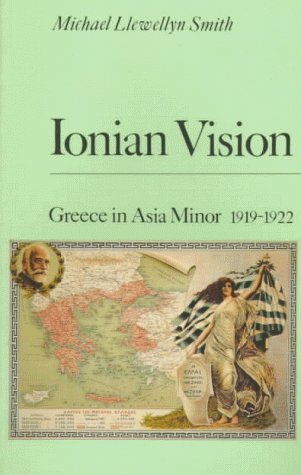
*** And let us all here be disabused at once of the idea that the Population Exchange agreed to at Lausanne was something that Venizelos and his government reluctantly agreed to because circumstances had made any other solution impossible. Lefterake, our Cretan levente, was enamoured of population exchanges and similar plans far before Lausanne or even 1919. He thought that the section of the Aegean coast that the Allies gave Greece at Paris in 1919 was eventually going to be Hellenized through exactly such a voluntary departure of its majority Muslim population, thus giving a kind of tacit approval to the atrocities committed during those years by the occupying Greek army, and, always the careerist and opportunist, one of his earlier strategies at the Paris Peace Conference had been to promise Bulgaria eastern Macedonia (Kavalla, Drama), and move its Greek population into western Macedonia where they would offset the Slavic majority of those regions, in order to coax the allies into giving him Ionia — he was a twentieth-century nationalist social engineer of the crudest kind from the beginning. For the definitive placing of responsibility for the disastrous Asia Minor campaign on Venizelos’ shoulders, plus an extremely competent analysis of the destructive consequences of his egotistical, polarizing political style on twentieth-century Greek political life, see Michael Llewellyn Smith’s Ionian Vision: Greece in Asia Minor, 1919-1922 — an excellent account of the entire period and a great place to start if, like me, you have embarked on a minor ideological mission to dismantle the entire Venizelos myth.
Comment: nikobakos@gmail.com
Tags: 1919-1922, Armenians, Balkan Muslims, Bosnia, Bosnians, Caucasus, Charles Simic, Circassians, Committee of Union and Progress, Constantinople, Crimeans, Croatia, Croats, CUP, Cyprus, Genocide, Greco-Turkish war, Greece, Greek irredentism, Greeks, invasion of Anatolia, Ionian Vision: Greece in Asia Minor, Istanbul, Jews, Karen Barkey's Empire of Difference: The Ottomans in Comparative Perspective, Kosovo, Leon Trotsky, Maria Todorova, Michael Llewellyn Smith's, Population Exchange, Russo-Ottoman War of 1870s, Salonica, Serbia, Serbs, Smyrna, The Red Apple Tree, the Screamers, Treaty of Lausanne, Turkey, Turks, Venizelos, Young Turks, Yugoslav Wars








 Jadde: from Bosnia to Bengal