Balkans, Anatolia, Caucasus, Levant and other Middle East, Iran, Afghanistan, South Asia, occasional forays into southern Italy, Spain or eastern Europe, minorities, the nation-state and nationalism — and whatever other quirks or obsessions lurk inside my head.
“A map showing how Palestinian cars are marked by differently colored number plates, and where they are allowed to go and not to go. Imagine living in a country where your race prevented you from traveling on certain roads in your own country, and where newcomers enjoy tunnels, bypasses and new roads to facilitate their travel. There are even roads which are parallel, with one being for Jews and the other for Palestinian Arabs. Jim Crow was never this extensive:
“Looking at maps like this, it becomes clearer to me every day that the two-state solution is a chimera for long-term Israeli occupation of the whole area with permanent segregation for the natives, and inducements for them to leave.” — Andrew Sullivan
I am categorically opposed to the Zionist tyranny of neo-Hebrew pronunciation, though I don’t know what gives me the right to such a strong opinion on the subject since I’m not even Jewish. But I am a New Yorker, and pretty proprietary about at least my city’s Jewish and Yiddish-speaking heritage, and it bugs me to no end that most young New York Jews now say: “L’Shan-ah To-vah” in their best Hebrew school accents, instead of “Lu-sha-nuh To-vuh,” or “Sim-chat To-rah” instead of “Sim-ches Toy-ruh” like they used to.
We have no idea how ancient, pre-Babylonian Hebrew was pronounced; the Jews returning from exile having thoroughly become Aramaic speakers. The pronunciation of Modern Hebrew was constructed on the basis of Sephardic liturgical pronunciation of the language, on the flimsy assumption of some kind of Semitic purity to be found in Sephardic usage, which the nineteenth-century Zionists in Europe who formulated the pronunciation and other structures of Modern Hebrew were probably attracted to mostly as an exotic escape from Galizianer shtetl-stigma and not any serious linguistic or historical considerations — the lost Golden Age of Jewish Spain being a nobler basis for Zionism’s new start than the muddy reality of Poland. The old Ashkenazi-Yiddish pronunciations served the vast majority of the world’s Jews perfectly fine for many centuries and there was no need to “correct” them.
But Zionism is so often about reducing the entire Jewish historical experience — before the success of its ethically problematic project — to shame, though it was through the diaspora that Jews were forced to cultivate their greatest and most extraordinary gifts and share them with the rest of humanity as well. That’s why I feel there’s an anti-diaspora shame in this pronunciation issue too that I don’t like. And an Israeli colonization of the diaspora Jewish mind and soul, culturally and politically, that I like even less, but which is probably now irreversible. Worse — a victim-shame which, combined with genuine, horrific trauma, has all kinds of negative and destructive consequences for Jews and everyone around them. While Joseph Massad’s claim that Zionism is an: “anti-Semitic project of destroying Jewish cultures and languages in the diaspora,” is a bit hyperbolic, that’s pretty close to how I feel as well.
On a lighter note, Shvuyes is when you eat blintzes – and other dairy. I don’t know why.
Today is Pentecost (it was last Sunday in the western Church), the day that commemorates the descent of the Holy Spirit and the divine enlightenment of the gathered Apostles, when they were suddenly given the wisdom to speak all languages and that marks the institutional beginning of their mission and the Church generally. What the New Testament doesn’t say is that the Apostles were gathered to celebrate Shavuos (lit. “weeks”), “Shvuyes” in deep Yiddish pronunciation,* the day God gave the Torah to the people of Israel. The Christian feast of a gift of divine wisdom was based on the existing Jewish feast of a gift of divine wisdom, and Shavuos comes seven weeks after the first day of Passover, like Pentecost comes seven weeks after Easter – it means “fiftieth” – a name Greek-speaking Hellenistic Jews were already using for the holiday long before the Christian era.
I always loved the reading for Pentecost from the Book of Acts (below in English, the original Greek and the Vulgate Latin). In its endless list of peoples I always felt a kind of Pax Romana yearning for unity that still moves me, especially when it’s properly recited. It’s a bit of a sad holiday too because it marks the official end of the Easter cycle (like it does the end of the Counting of the Omer in Judaism). The day before is one of the several “soul Saturdays” on which the Orthodox Church commemorates the dead; old folk beliefs held that the dead dwell among us from the Resurrection until the eve of Pentecost and then depart again. And tonight at vespers, people kneel for the first time since Holy Week; the joy of the Easter season prohibits any kneeling or prostrations during the seven weeks it lasts. It’s the return to Real from Divine time. And from the period of renewal where death has been defeated to real existence again where it still holds full sway. Until the promise of the next Resurrection.
I couldn’t find a recitation of the actual second chapter. But here’s a beautiful Arabic recitation of the first chapter of Acts — which uses the same phrasing as a Greek reading would — where Christ preps the Apostles on what’s in store for them and, like a good rabbi, tells them not to ask too many questions:
And here’s Giotto’s depiction of the event from the Scrovegni Chapel in Padua, which probably contains more spectacular art than any other equivalent square footage of space in the world:
And El Greco’s more violent, Cretan-Spanish imagining (it became a tradition to include the Virgin in the scene, especially in the West, though Acts doesn’t mention her):
2 And when the day of Pentecost was fully come, they were all with one accord in one place.
2 And suddenly there came a sound from heaven as of a rushing mighty wind, and it filled all the house where they were sitting.
3 And there appeared unto them cloven tongues like as of fire, and it sat upon each of them.
4 And they were all filled with the Holy Ghost, and began to speak with other tongues, as the Spirit gave them utterance.
5 And there were dwelling at Jerusalem Jews, devout men, out of every nation under heaven.
6 Now when this was noised abroad, the multitude came together, and were confounded, because that every man heard them speak in his own language.
7 And they were all amazed and marvelled, saying one to another, Behold, are not all these which speak Galilaeans?
8 And how hear we every man in our own tongue, wherein we were born?
9 Parthians, and Medes, and Elamites, and the dwellers in Mesopotamia, and in Judaea, and Cappadocia, in Pontus, and Asia,
10 Phrygia, and Pamphylia, in Egypt, and in the parts of Libya about Cyrene, and strangers of Rome, Jews and proselytes,
11 Cretes and Arabians, we do hear them speak in our tongues the wonderful works of God.
12 And they were all amazed, and were in doubt, saying one to another, What meaneth this?
One of the Little Rock Nine*, among the Black students who were the first to bravely attend officially desegregated high schools in 1957 despite the violent opposition.
If you’re Greek, and your wish that the earth would open up and swallow you hasn’t materialized yet, here’s some videos of Greeks acting like the crazed yahoos in the background of the above, now classic, photo, only towards the destitute and suffering migrants stuck in their country by EU stupidity.
One report from Al Jazeera:
And another two-part but short documentary by a Norwegian production crew that I couldn’t get any more information on:
Epiros, the beautiful but rocky and barren part of Greece readers must by now know that my family is from, is known f0r two kinds of folk songs especially: dirges to be sung at wakes for the dead (or on other occasions too, just for the cathartic pleasure they give, which tells you a lot about the region and its people), and songs of emigration (“xeniteia” — “kurbet” — yes, the Turks have a word for it too). Xeniteia, from “xeno-” strange or foreign, is not so much emigration itself, as it is the state of being in a foreign place, away from your home, your people. For as far back as I know, meaning up to three generations, every man on all sides of my family worked and lived abroad for perhaps the greater chunk of his adult life, in places as diverse as Constantinople, Bucharest, Buenos Aires, New York and Watch Hill, Rhode Island. When my father’s village had around fifteen hundred people, there were around another five hundred Dervitsiotes living in Peabody, Massachusetts, working mostly in that town’s tanneries; they would joke that “Peabody, Mass.” meant “Our Peabody” — “mas” being the first person plural possessive pronoun in Greek. Many of Epiros’ villages were inhabited almost entirely by women, children and old people; it was almost inconceivable that an able-bodied young man would just stay home and not try his luck abroad somewhere.
But Epirotes are not the only Greeks for whom xeniteia constitutes (or did) a deeply embedded chunk of consciousness and identity. There wasn’t a Greek family from any region that didn’t have someone living and working abroad, and the longing and sorrow of that condition was something everyone instinctively felt; it was a collective emotion.
And that’s what makes these outbursts of anti-foreigner violence even more shameful and disgusting. Again, one sees how the loss of diaspora consciousness is one of the things that has so cheapened and impoverished the Neo-Greek soul in the past few decades. Again, I suggest, as I did in a previous post, that we all re-watch Gianni Amelio’s beautiful 1994 Lamerica: “…which is the story of how a cool, smug Young European Sicilian gets stranded in Albania and realizes that he’s only a generation away from being counted among the wretched of the earth himself — and how dangerous it is to forget that.”
I bash my peeps a lot. There are reasons for it, complicated ones, but among them is the responsibility I feel to make sure my tribe’s slate is clean before I criticize anybody else. But an equal object of my bashing here is the European Union, which aside from proving itself to be a neo-colonialist endeavour masquerading as the Highest Achievement of Western Humanism Project, has also revealed itself to be a half-assed, thrown together mess on so many institutional and bureaucratic levels. (Yes, neo-colonialist: the Frangoi** gave up their colonies after the war and then discovered the exploitable potential of Europe’s own periphery again.) A large part of these destitute peoples’ problem has been caused by EU refugee-immigration policy, which dictates that you can’t expel an asylum-seeker from the Union, but you can return him to his country of entry, which, since 2009, when Spain and Italy, with their greater resources, tightened up their maritime border security, has been Greece, the country least able to absorb them economically or deal with them administratively. The above videos are two years old, but since that time, when by some estimates, one million refugees had accumulated in the country, all Europe did was ignore the problem while prescribing more diet pills for Greece.
Only this past spring did Brussels even give some aid to Greece to open up frighteningly named “closed hospitality centers,” detention camps on unused military sites, which given the condition I imagine those sites are in, and the fact that Greek police, who recently voted for the Nazi Golden Dawn party at a rate of more than fifty percent in some districts in Athens, will be involved in running them, will be a human rights paradise, I’m sure:
Thank God, the Merciful and the Compassionate, that we have a large, healthy Turkish minority in the northeast that provides imams, like the one in the second video, to give a decent burial to the mostly Muslim, anonymous and alone migrants who get blown up or who drown trying to cross our Rio Grande.
I’m nauseated by this tone of: “phhhheewwww….that was tough, but we put our Yank’ ingenuity to work and our men on the line, did what we could and now it’s time to say good-bye.”
Stop pretending. Stop pretending you or anybody else had a plan. Stop pretending that, except for the Turks, the rest of NATO wasn’t the bunch of non-committed pussies you knew they were. Stop pretending that all you did wasn’t to wage a pointless counterinsurgency with some brave and skilled but totally clueless kids who didn’t deserve to be sent on such a dumb mission if they weren’t going to be given full back-up. Stop pretending you tried to actually bring the Taliban into the political process in any serious, small-scale, on-the-ground way or that the United States even had people who could’ve negotiated such a tricky, labour-intensive manoeuvre (the Army only has 8,000 Civil Affairs troops, less than 1% of Army total) or that you gave even one Pashtun kid any incentive to not join the Taliban.
Stop pretending that you invested in any roads other than the one to the airport and Bagram, that you invested in any infrastructure at all, that you invested in schools or education for a smart, entrepreneurial-minded people that were starving for it. Stop pretending you didn’t just irresponsibly throw around a bunch of billions, and a bunch more millions as bakshish to line Karzai and his clan’s pockets, which won’t even be reinvested in Afghanistan but have already found their way to the Emirates by now and will pay for all their sons’ weddings for at least a generation.
STOP PRETENDING YOU DID EVEN THE SIMPLEST SHIT, like pave most of the streets of Kabul, give it a modern sewage system, that it didn’t take you until last year to even put up streetlights in at least the central arteries of Shehr-e-Nau, for fuck’s sake, so that people could see where they were going at night through the smog, and that you’re not probably now leaving that city to the mercy of a civil conflict and a destruction that may be worse than the nineties.’
Stop pretending you did any-thing. And that if Afghans now get it together somehow, insha’allah, that it won’t only be through their own strength and tenacity, which comes from, I swear, God only knows what mysterious and hidden source and that in the end it won’t be as if you had never been there at all.
Ask any Afghan. The Soviets did more. Rezili.
So stop. Please!
“And I think the reports we get are relatively accurate in the sense that there is real improvement. In those areas where we’ve had a significant presence, you can see the Taliban not having a foothold, that there is genuine improvement in the performance of Afghan national security forces.
But the Taliban is still a robust enemy. And the gains are still fragile, which leads me then to the second point that you’ve made in terms of a premature withdrawal. I don’t think that there is ever going to be an optimal point where we say, this is all done, this is perfect, this is just the way we wanted it and now we can wrap up all our equipment and go home. This is a process and it’s sometimes a messy process, just as it was in Iraq.
But think about it. We’ve been there now 10 years. We are now committing to a transition process that takes place next year, but the full transition to Afghan responsibility is almost two years away. And the Afghan Security Forces themselves will not ever be prepared if they don’t start taking that responsibility.
And, frankly, the large footprint that we have in Afghanistan over time can be counterproductive. We’ve been there 10 years, and I think no matter how much good we’re doing and how outstanding our troops and our civilians and diplomats are doing on the ground, 10 years in a country that’s very different, that’s a strain not only on our folks but also on that country, which at a point is going to be very sensitive about its own sovereignty.
So I think that the timetable that we’ve established is a sound one, it is a responsible one. Are there risks involved in it? Absolutely. Can I anticipate that over the next two years there are going to be some bad moments along with some good ones? Absolutely.
But I think it is the appropriate strategy whereby we can achieve a stable Afghanistan that won’t be perfect, we can pull back our troops in a responsible way and we can start rebuilding America and making some of the massive investments we’ve been making in Afghanistan here back home, putting people back to work, retraining workers, rebuilding our schools, investing in science and technology, developing our business climate.”
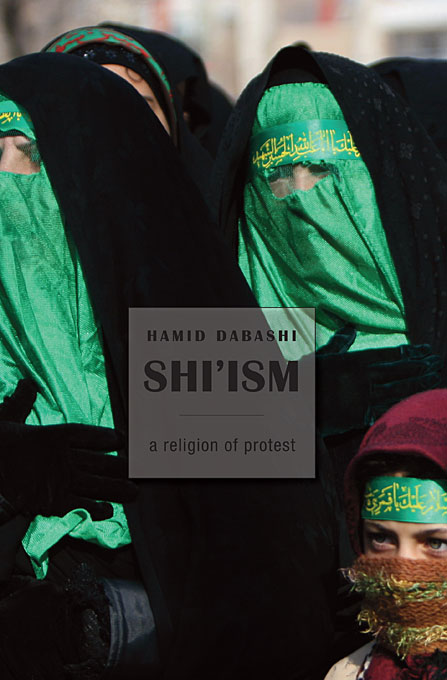
…till Syria got me asking: that there are Alawites in Lebanon too; that Hezbollah supports the Asad regime even though (I would’ve previously thought) they’re Alawite; that Alawites and Anatolian Alevis aren’t as consciously related as lots of people think, though they’re similar in many concepts and rites and are probably both a product — or remnant — of inherently heterodox frontier zones between Byzantine-Arab-Turkic-Iranian spiritual worlds, before the lines hardened; that the relationship of both to “mainstream” Shi’ism varies in intensity and in the degree to which they’re accepted by that mainstream as part of the fold (Alawites, as in the Asad-Hezbollah relation, more than Anatolian Alevis, who are kind of a world of their own); that Iran’s support of Hezbollah is part of a relationship that’s neither new nor one-way — that, in fact, Shi’ia clerics and theologians from southern Lebanon/Jabal Amil (including the Sadr clan) were instrumental in establishing Shi’ism as Safavid Iran’s state creed in the sixteenth century; that that happened in a kind of simultaneous, binary process, as such things tend to, with Ottoman Turkey becoming more orthodoxly Sunni…and more.
This is a cool, very informative book, though sometimes so personal and emotional and out-there-Persian that it becomes confusing as straight history or sociology:
Otherwise not good though…not Syria, not another spillover into Lebanon or its again becoming the catch-basin of Levantine conflict. None of it…
Men in a Beirut suburb burned tires and blocked roads after fellow Lebanese Shiites were abducted in the Syrian city of Aleppo. (Anwar Amro/Agence France-Presse — Getty Images)
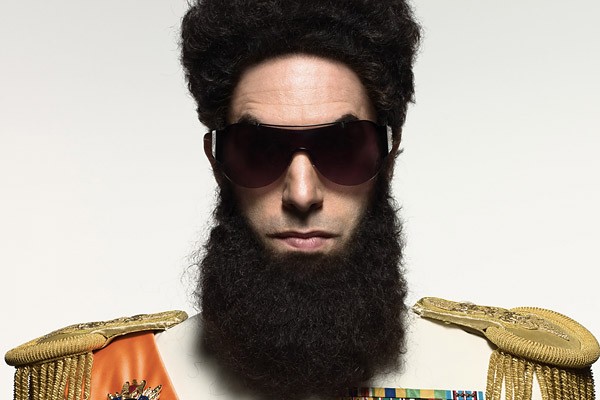
“Yes, the film includes some send-ups of American hypocrisy in the war on terror — there’s a pretty good bit in which Aladeen sniffs at the outdated torture devices of his American captor including one that was “banned in Saudi Arabia for being too safe” — and most of the American characters are either Islamophobic rubes or patronizingly P.C. liberals, but it’s not as if any of them are wrong in their perceptions of Aladeen. He’s a violent, misogynistic, anti-Semitic ignoramus who has the real Osama bin Laden stashed in his palace’s guest suite. The only ordinary Wadiyan citizen in the film, the body double also portrayed by Cohen, is a dumb peasant who drinks his own urine and has difficulty distinguishing between women and goats. Whose prejudices are we mocking here? Cohen even throws in a few Chinese and African caricatures for good measure. …
The best satire targets the powerful, bringing them down a few notches and deflating their bubbles of self-importance. But in the first Hollywood film to address last year’s Arab uprisings, Cohen seems less interested in laughing with the people who live under the Qaddafis and Mubaraks of the world than at them.“[my emphasis]
Thank you. And the ‘laughing at them’ part doesn’t start with this film. That’s just what he does. See “The Dictator ” (April 28th) He’s f*ing infuriating.
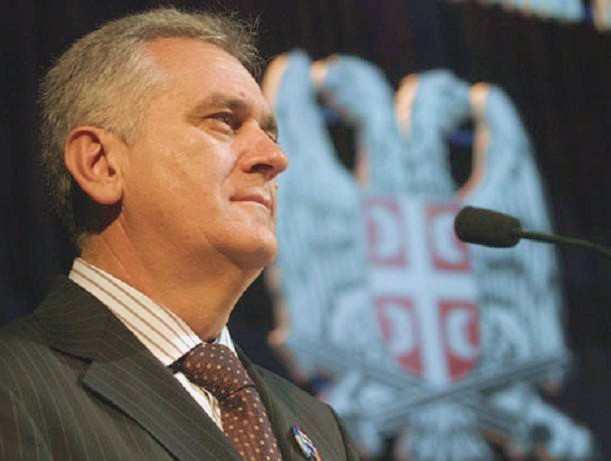
“Tomislav Nikolic, a nationalist and former cemetery supervisor, declared victory on Sunday in Serbia’s presidential runoff election, a surprising result that cast doubt on whether Serbia would remain on its path toward entry into the European Union or look east toward Russia.”
The most depressing, and what may turn out to be the most dangerous, part is the apathy — only 36% of the electorate voted.
A lot of us probably had our doubts about this one – in retrospect, unfair doubts and probably (not a little bit) sexist ones. La Jolie has made a film about us Balkanians… How could she possibly understand our mystery, our inscrutable savagery, the complexity of our past? A Hollywood vanity project, for sure.
It turns out this is a great film. It’s beautiful as a film: beautifully written, shot, acted (some tragic editing errors or omissions though). And it’s beautiful and intelligent as ethnography and history as well. She’s modest about her descriptions of her work, but whatever corner of the collective unconscious belongs to our fucked up little part of the world, she was channeling it.
The film recently “premiered” in Belgrade. A few dozen people showed up and half of those left after the first few scenes, which tells you how much progress we’re making on the Serbian front. But it struck me really hard that Jolie didn’t attend either. I thought it was cowardly and, after the love and intelligence she’s obviously put into the project, just plain stupid on her part. Granted, some of the actors, all Bosnian, meaning Serb and Muslim, have been threatened, had their car windows smashed but, you know, all great art has always provoked…
No really, why was she not there? I clearly, for whatever historical or cultural or mostly emotional reasons, have a special love for Serbs. I understand they often come across as — or are even – unruly, contrarian, inat-driven, loose cannons (this word, “inat,” deserves an entry of its own and can’t be wrapped up in a footnote). But I know that more than anything they want to hear and be heard; they crave a healthy confrontation. That the nineties continue to be simplistically narrated as the story of their villainy rightly pisses them off to no end and they want the chance, at least, to present another narrative; if they pretend that they don’t give a shit what the world thinks it’s just hurt pride or they’ve just given up trying. Without wanting to add to the reams of crap written about what macho lunatics they are, Serbs are guys – by which I mean the women too – and if Jolie had gone it would’ve gained her instant balls and street cred’ in their eyes and led to all kinds of productive discussion and exchange; I’m not kidding one bit. If she had truly wanted to say something about the Balkans or the Yugoslav wars and not just about women, she undid more than half the good she could’ve done.
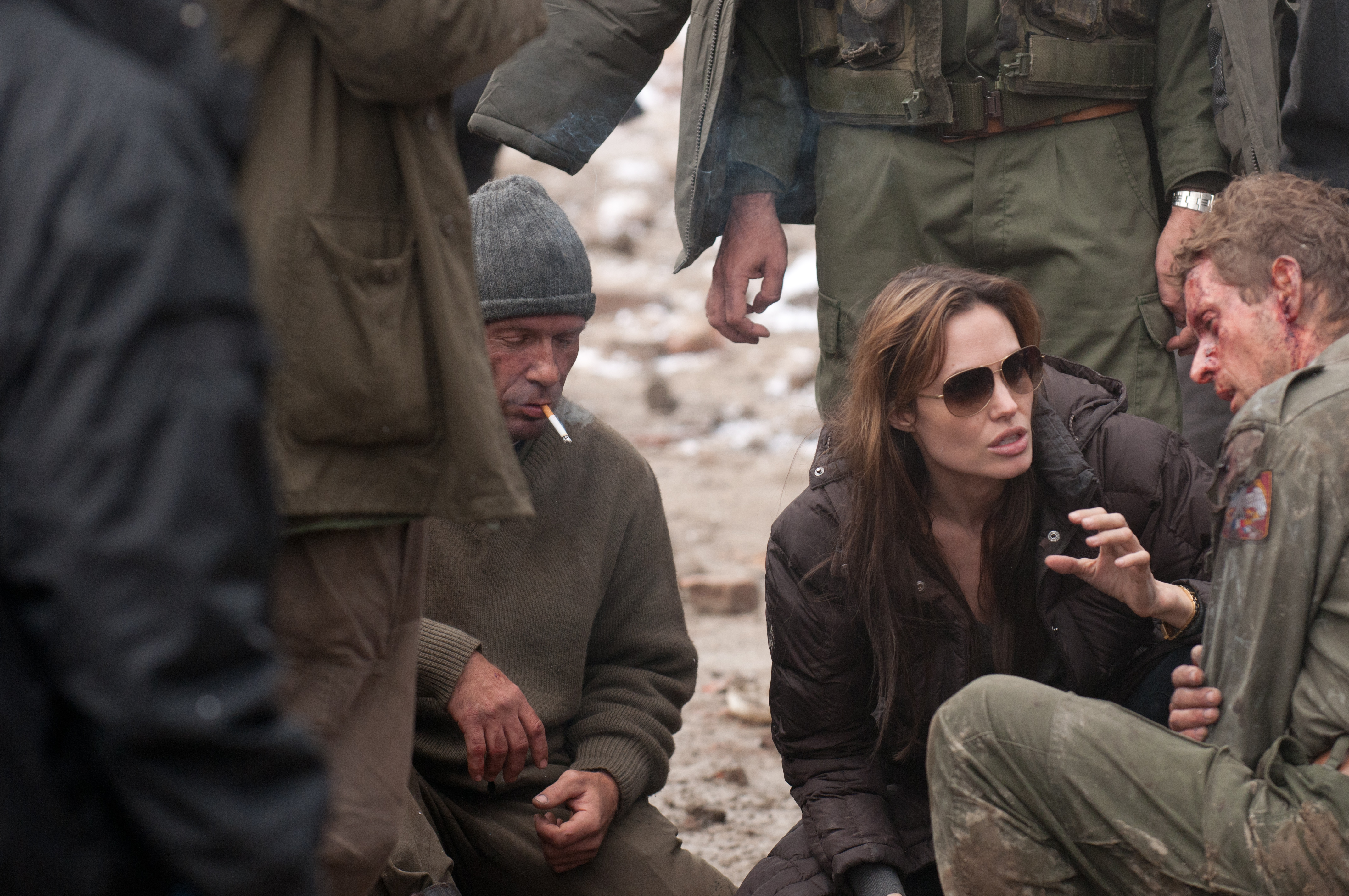
Jolie with extras
One thing that makes you furious about the isolation that was the result of that pointless separating into dumb little countries is that we don’t otherwise know these actors; we got a near fatal dose of Kusturica while Bosnia was on our screens and then it disappeared. (See below for some extra photos of all.) Their performances are flawless and their technical competence is proven, if by nothing else, than by the fact that they pulled off the amazing feat of shooting the entire film in both languages. Not dubbing or anything. They shot the entire film twice: once in SerboCroatoBosnoHerzegovinoMontenegrin (to be scrupulously correct but which I’ll just call Serbian from here on) and once in English. Jolie and her team had something to do with how well this came off too. They let the actors speak the English they speak, which is literally perfect but has the tiny idiosyncrasies that a non-native speaker’s naturally has. This is the opposite of what Hollywood usually does, which is write a role for, say, Penelope Cruz, in an absolutely impeccable American English which someone with her incomprehensible accent couldn’t possibly speak and which makes her even more incomprehensible and cripples what might otherwise be a decent performance. But beyond that, they’re all great. If this one Sarajevo can produce all these actors it makes you want to live there just to go to the theatre or wait for someone to make their next film.
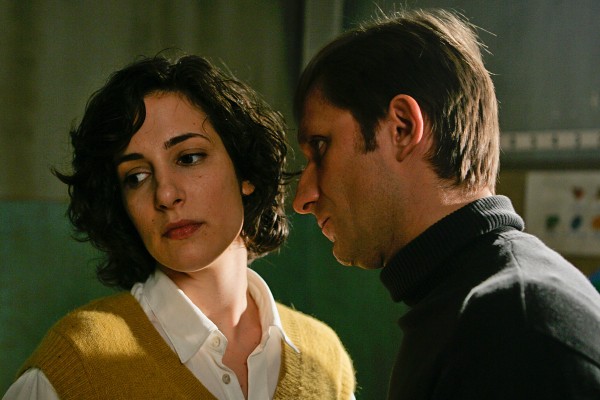
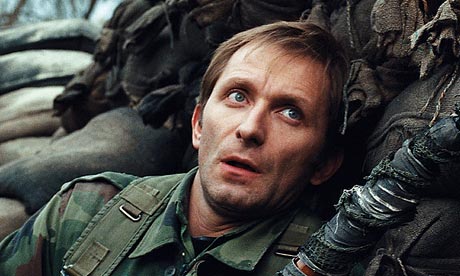
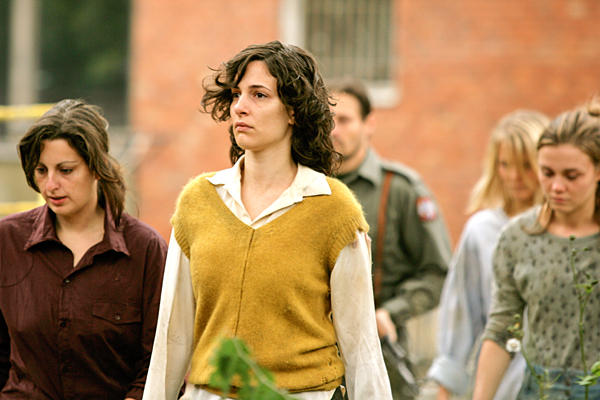
Of course the two you can’t take your eyes off and can’t get out of your head afterwards are the two leads: the painfully sexy Goran Kostić as Danijel, the Serbian cop thrust into the role of Bosnian Serb army captain, and Žana Marjanović as the inscrutable Ajla, the Muslim woman he falls for, one of those close to six-foot Dinaric beauties that make you hate all ex-Yugos; she goes out in one of the opening sequences in heels, a blue dress and a traditional silverwork belt and makes you want to cry, for all kinds of reasons. I say inscrutable partly because a South American friend who saw the film described her as “parca,” which means dry or stiff or cold — the same root as “parched” maybe – and I had to explain that that attitude implies nobility in our parts, a posture that Ajla doesn’t slip from even for one moment, despite the hell she’s put through; in fact she clings to it even more desperately throughout, her dignity the only thing she has left, her only weapon against male power. (“Archontia” is another word I need to give a full entry to at some point.)
Goran Kostić (Danijel) and Žana Marjanović (Ajla)
They meet, fall in love just before the war — he in a spellbound way that would be unbelievable if Kostić’s performance didn’t make it so naively magical that you buy it — and then, under circumstances which also strain belief a tiny bit but which you forgive, she ends up in his “custody” as a female POW, for lack of a better word. Jolie says some trite stuff in the “Making of…” about a “love story that could’ve ended up in happiness, in marriage and children and what war does to that” but, whether she knows it or not, she’s made a film about something so much more complex and true. Ajla (Marjanović) is both terrified and in the grips of the acute, aching desires of Stockholm Syndrome, but though Danijel is constantly groping around blindly in her heart, he never knows whether she’s there because she “wants” to be with him or not. Kostić plays the perfect good soldier and officer — the way perfect good soldiers have always been perfect: he’s brave, tough, loves his men, is completely scared to death the whole time and never finds the slightest relief from the tormenting doubts of what he’s doing.
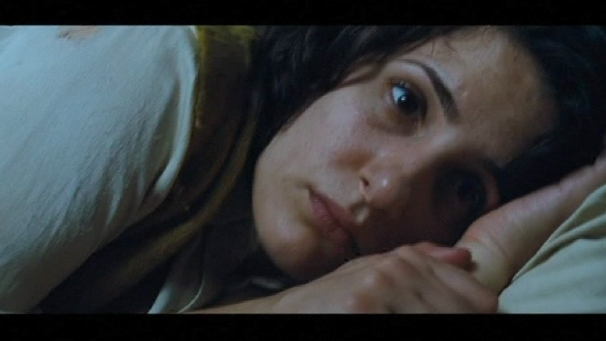
This is a film about anything but a love story — or it’s about a real love story, since these two are in love not in spite of, but because of, war. It’s a story about the fear that women feel in the presence of potential male violence, something that no man will ever, ever understand in his gut, and Marjanović, like the painter her character Ajla is, gives you a hundred different shades of that fear; it’s about how men will never stop feeling the temptations of that violence; it’s about how sex and love are always about fear and violence. It’s about how your tribal affiliations are not the product of the Western media but will burst out of you under the slightest pressure in what you had thought was a forgotten and buried language of hatred; it inverts the traditional Muslim-Christian power structure of the region’s sexual captivity narratives; it confronts your loyalties and asks what they’re worth to you; it throws your capacity for betrayal in your face and challenges you to deny it. Serbian viewers might have been slightly flattered by the discursive lip service given to the Serbian position in the conflict. But if the film has any real compassion for that position it’s in how the two lovers end up, a subtle and powerful metaphor for the two societies.* Ajla is battered to no end — and a horrible one; it leaves you feeling crushed in ways that I am unable to describe and, as a man, wouldn’t try to. But she achieves a kind of heroic closure ultimately that Danijel never can. He’s the film’s true tragic figure, driven by a child’s insatiable thirst to be loved that’s impossible to quench and that ultimately destroys him in ways that she’s spared.
(* The absent Croats in this metaphor are that species of bad driver who never gets into any accidents himself but causes them all around him — just a calculating version.)
Get the Blu-Ray if you can. It gives you a choice between the English or Serbian. On either DVD or Blu-Ray, watch the “Making of…” segment and definitely see the “Deleted Scenes” because I don’t know what they were thinking when they cut these segments out of the final film. If it was to fit Hollywood commercial length expectations it was particularly dumb because that audience is just not going to see this film anyway. There are several segments in there that help you understand the sado-masochistic intensity of Danijel and Ajla’s relationship and how they get to that point. And there’s one scene of priceless beauty where Ermin Bravo (Mehmet), sings what I think is a “sevdalinka,” a Bosnian love song, to his beloved, Vanesa Glodjo (Lejla) — see both below – a scene that breaks your heart with the realization that even another’s most exquisite tenderness will only relieve the agony of a tragic loss for a brief moment. Every soul is on its own.
Some of the rest of cast:
Vanesa Glodjo (Lejla)
Ermin Bravo (Mehmet)
Boris Ler (Tarik)
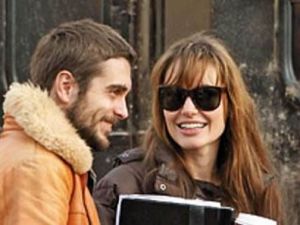
And with Jolie
Ler and Bravo in a great shot (from another, unknown stage production) — again, this city must have great theatre…(photo: Irfan Redzović)
Balkans, Anatolia, Caucasus, Levant and rest of ME, Iran, South Asia
Me, I'm Nicholas Bakos, a.k.a. "NikoBako." I'm Greek (Roman really, but when I say that in English some five people in the world today understand what I'm talking about, so I use "Greek" for shorthand). I'm from New York. I live all over the place these days. The rest should become obvious from the blog.











 Jadde: from Bosnia to Bengal