Archive | Uncategorized RSS feed for this section

“Hapja e ekspozitës LGBT “Kukafshehti”

14 May

From the American Anthropological Association, Mindy Michels Ph.D.: http://www.huffingtonpost.com/american-anthropological-association/albania-gay-rights_b_1497865.html :

“Next week Albanian activists will host the country’s first-ever gay, lesbian, bisexual, and transgender (LGBT) photo exposition, with invitations sent out to ambassadors and foreign dignitaries. More important than the presence of diplomats, though, is the fact that the exhibition is open to the public, and that the exhibition, part of the activities for the International Day Against Homophobia, will be covered by the media. Attendees will walk through a labyrinth of one-meter-square photos that evoke the feeling of being an LGBT person in Albania. Such a high-profile event featuring same-sex desire is extraordinary in this small, Balkan country. What is even more exceptional is the recent history leading to this moment.

“Not quite three years ago, lesbian, gay, bisexual, and transgender issues suddenly became Albanian headlines when Prime Minister Sali Berisha (who is still in office) unexpectedly declared his support for same-sex marriage at a televised meeting of his ministers. The surprising July 2009 comment came amidst his expected support for a comprehensive national anti-discrimination law.

“…Today, to the surprise of the Albanian public, Albanian gay activists are stepping forward, showing their faces, and claiming their right to participate in the conversation about their lives.

“What lies behind this remarkable and swift transformation? In 2009 fears about possible violence, discrimination, lack of acceptance, and, perhaps most importantly, the shame that it would cause family members meant that not one person in Albania would publicly acknowledge same-sex attraction. Today, there are LGBT activists openly protesting the homophobic and violent remarks of governmental officials. Young LGBT Albanians are giving presentations in college classrooms and going on television talk shows, educating students and the Albanian public about the realities of their lives. Leaders of LGBT organizations are speaking out in newspapers and on television. There is widespread publicity for the photo exhibit. What made it possible for such change to happen in three years, for these new activists to overcome the barriers to public action and dialogue?”


Go figure…


Comment: nikobakos@gmail.com

Syrian Christians

13 May

Short Al Jazeera report that follows up and answers some questions I had in previous post: April 23rd, “Turkey and religious freedom: Wooing Christians — ‘We are ready to face the past, to make amends.'”

Christ, I hope they end up on the right historical side of this one.  Not that they may have a choice — as Iraqi Christians didn’t.


Comment: nikobakos@gmail.com

The Great Book Robbery

13 May

“Was the appropriation of Palestinian books and manuscripts in 1948 a case of cultural theft or preservation?”

Another great Al Jazeera documentary about the looting of Palestinian books during the Nakba.

“Goodbye, my books!  Farewell to the house of wisdom, the temple of philosophy, the scientific institute, the literary academy!
How much midnight oil did I burn with you, reading and writing, in the silence of the night while the people slept … farewell, my books!
I do not know what became of you after we left: were you looted?  Burned?  Were you transferred with due respect, to a public or private library?  Did you find your way to the grocer, your paper wrapping onions?”

— Khalil al-Sakanini


Comment: nikobakos@gmail.com

The Dark Lord

12 May

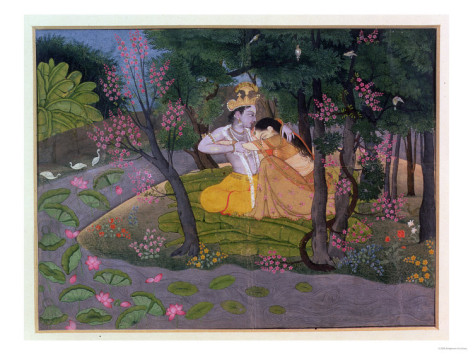
In a previous post, April 10th “A Dancing Girl,” I wrote about the ubiquity of Krishna-Radha imagery in Indian culture, from the obvious traditionally religious contexts to Bollywood cinema.  Sudhir Kakar, Indian psychologist and I guess all around cultural critic has a very interesting analysis of the Krishna archetype in Indian cinema.  He contrasts him, the playful phallic teaser, with the Majnun archetype, the distraught, longing lover (“majnun” means crazed in Arabic, the same Semitic root as “meshugeh” in Yiddish), setting up an interesting Hindu-Muslim interplay between the two:

“The Krishna-lover is the second important hero of Indian films.  Distinct from Majnun,the two may, in a particular film, be sequential rather than separate.  The Krishna-lover is physically importunate, what Indian-English will perhaps call the “eve-teasing” hero, whose initial contact with women verges on that of sexual harrassment.  His cultural lineage goes back to the episode of the mischievous Krishna hiding the clothes of the gopis (cow-herdesses) while they bathe in the pond and his refusal to give them back in spite of the girls’ repeated entreaties.  From the 1950s Dev Anand movies to those (and especially) of Shammi Kapoor in the 1960s and of Jeetendra today, the Krishna-lover is all over and all around the heroine who is initially annoyed, recalcitrant, and quite unaware of the impact the hero’s phallic intrusiveness has on her.  The Krishna-lover has the endearing narcissism of the boy in the eve of the Oedipus stage, when the world is felt to be his “oyster.”  He tries to draw the heroine’s attention by all possible means – aggressive innuendoes and double entendres, suggestive song and dance routines, bobbing up in the most unexpected places to startle and tease her as she goes about her daily life.  The more the heroine dislikes the hero’s incursions, the greater his excitement.  As the hero of the film Aradhana remarks, “Love is only fun when the woman is angry.”

“For the Krishna-lover, it is vital that the woman be a sexual innocent and that in his forcing her to become aware of his desire she get in touch with her own.  He is phallus incarnate, with distinct elements of the “flasher” who needs constant reassurance by the woman of his power , intactness, and especially his magical qualities that can transform a cool Amazon into a hot, lusting female.  The fantasy is one of the phallus – Shammi Kapoor in his films used his whole body as one – humbling the pride of the unapproachable woman, melting her indifference and unconcern into submission and longing.  The spirited, androgynous virgin is awakened to her sexuality and thereafter reduced to a groveling being, full of a moral masochism wherein she revels in her “stickiness” to the hero.  Before she does so, however, she may go through a stage of playfulness where she presents the lover with a mocking version of himself.  This in Junglee, it is the girl from the hills – the magical fantasy-land of Indian cinema where the normal order of things is reversed – who throws snowballs at the hero, teases him, and sings to him in a good-natured reversal of the man’s phallicism, while it is now the hero’s turn to be provoked and play the recalcitrant beloved.”

—  Intimate Relations: Exploring Indian Sexuality, Sudhir Kakar

Bollywood classicists will probably object to my not using one of the above-mentioned actors as a movie clip example, but I’ve chosen to use recent meteor-hottie Imran Khan instead:

Not that Imran Khan…  No relation to Shahrukh Khan either or Salman Khan, but the nephew of Aamir Khan — just in case you doubted how nepotistic Bollywood is, how full of super-size Khan egos it is, or how disproportionately Muslim the industry is, a fact that usually remains unspoken.  Other than his still teenage swagger, which the other Khans are getting a little too old to pull off, I think Imran is so perfect in the role of this archetype because he has those exaggeratedly large, murti-like* eyes and eyebrows that so many Indians have and have such deep religious significance and symbolism.  “Darshan,” or the viewing of a deity, is usually centered on the eyes — on a visit to any temple one will usually find at least one devotee staring endlessly into the god’s eyes — and Hindus believe that the deity’s energy does not come to reside in an image until that very final moment when its pupils are painted in.

Anyway, here’s Imran with his Gopis, in the title number of the 2010 I Hate Luv Stories, playing the Dusky One to perfection (though as in Kakar’s classic trajectory, he’s later humbled into the Majnun lover):

And for those old-schoolers, here’s SRK, perhaps the central casting expert at the type, in the wedding scene from Kabhi Khushi Kabhi Gham, the wedding he’s impudent enough to crash because he’s smitten with the bride’s sister and shows up to hit on her.


*”Murti” is the image of a deity in Hinduism, any image: statue, painting, drawing, cheap print from the kiosk.  Obviously I don’t use the word “idol,” with its reek of monotheist condescension and demonization, as I generally consider monotheism — all of them — to be something of a plague and a great historical tragedy.  We’ll just have to do the best we can with what we have for now.

Comment: nikobakos@gmail.com

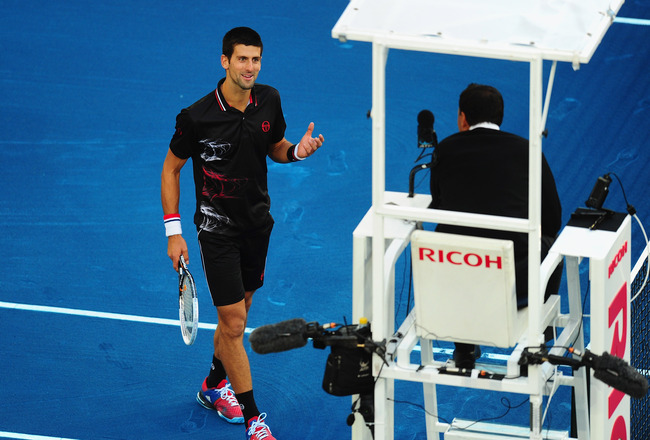
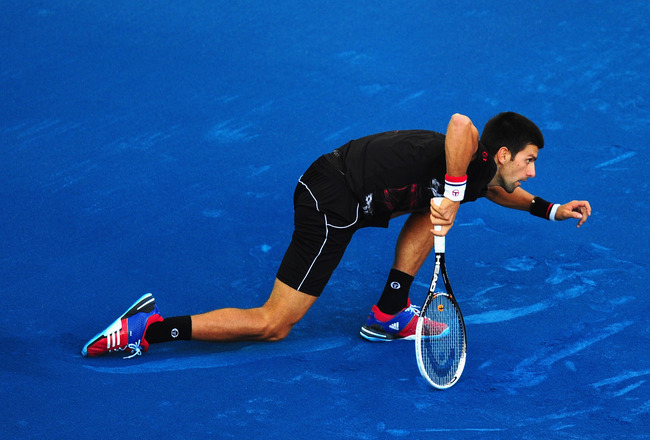
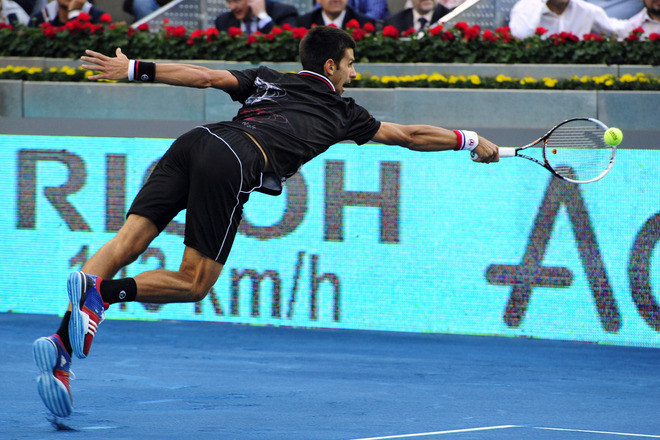
Nole don’t like the blue court!

12 May

World No. 1 Novak Djokovic is in danger of suffering an early exit at the 2012 Madrid Open unless he tempers his emotions on the court. 

Djokovic struggled in his first match against No. 137 Daniel Gimeno-Traver, ultimately winnning 6-2, 2-6, 6-3. It wasn’t the dominant performance we’re used to seeing from Djokovic in the early rounds, and he was furious about the unconventional blue clay that’s being used in this year’s Open.

Per BBC.com:

To me that’s not tennis. Either I come out with football shoes or I invite Chuck Norris to advise me how to play on this court. I hit five balls throughout the whole match. With everything else, I was just trying to keep the ball in the court.

When you slide on the red clay you have a feeling you can stop and recover from that step. But here, whatever you do, you are always slipping. Not a single player – not woman, not man – I didn’t hear anyone say ‘I like blue clay’.

Our Serb is p-i-s-s-e-d!   :)


Comment: nikobakos@gmail.com

“…the innocent boy of seventeen…”

12 May

Though it was only incidental to the previous post, the image of Erdal Eren has haunted me for the rest of the night; perhaps it’s the photo of him and its painful youth and innocence; obviously the terrifying quote: that he looked forward to his execution in order to avoid thinking of the torture he had witnessed; maybe it’s that hanging has always struck me as a particularly obscene form of capital punishment’s obscenity (the setting looks prison-like, like he’s actually entering the gallows chamber there…)

Then the eerie reminder of the Cavafy poem: “27 June 1906, 2 p.m.”

27 Iουνίου 1906, 2 μ.μ.

Σαν το ’φεραν οι Xριστιανοί να το κρεμάσουν
το δεκαεφτά χρονώ αθώο παιδί,
η μάνα του που στην κρεμάλα εκεί κοντά
σέρνονταν και χτυπιούνταν μες στα χώματα
κάτω απ’ τον μεσημεριανό, τον άγριον ήλιο,
πότε ούρλιαζε, και κραύγαζε σα λύκος, σα θηρίο
και πότε εξαντλημένη η μάρτυσσα μοιρολογούσε
«Δεκαφτά χρόνια μοναχά με τα ’ζησες, παιδί μου».
Κι όταν το ανέβασαν την σκάλα της κρεμάλας
κι επέρασάν το το σκοινί και το ’πνιξαν
το δεκαεφτά χρονώ αθώο παιδί,
κ’ ελεεινά κρεμνιούνταν στο κενόν
με τους σπασμούς της μαύρης του αγωνίας
το εφηβικόν ωραία καμωμένο σώμα,
η μάνα η μάρτυσσα κυλιούντανε στα χώματα
και δεν μοιρολογούσε πια για χρόνια τώρα·
«Δεκαφτά μέρες μοναχά», μοιρολογούσε,
«δεκαφτά μέρες μοναχά σε χάρηκα, παιδί μου».

“27 June 1906, 2 p.m.”

When the Christians brought him out to be hanged
the innocent boy of seventeen
his mother there near the scaffold
was dragging and beating herself in the dust,
under the sun, the savage noon-day sun,
and now would screech, and now would howl like a wolf, like a beast,
and then exhausted the martyred woman would keen
“You only lived these seventeen years my child.”
And when they raised the boy up on the scaffold,
and passed the rope around his neck,
the innocent boy of seventeen,
and his body swung hideously in the void
wracked by the spasms of his black agony
the beautifully made youthful body,
the martyred mother rolling in the dirt
was no longer keening of years,
“Seventeen days only” she keened,
“Seventeen days only did I enjoy you, my child.”

(my translation)
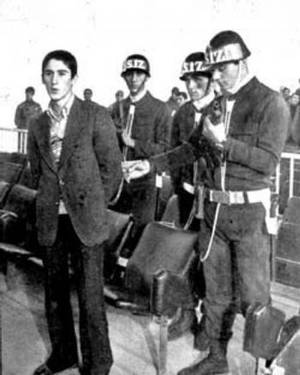
Erdal Eren

Cavafy wrote the poem in remembrance of the 1906 Denshawi affair, one of Britain’s unfinest hours.  Apparently some British military personnel were returning from Cairo to Alexandria and, near the village of Denshawi, shot some pigeons that belonged to the locals.  A scuffle ensued; a rock was thrown that hit a British soldier on the head and, though he died of what was later proven to be sunstroke, like a delicate E.M. Forster memsahib, five of the residents of Denshawi, including the seventeen-year old of the poem, were imprisoned.  Fortunately, there was such a public outcry after the execution of the young man that the other four men were released, though not till two years later in 1908.  The episode still remains disgusting and Cavafy’s poem one of his most chilling, a register he usually didn’t work in.

At the same time it’s a beautiful reminder of his humanity on several levels.  One is his life-long opposition to capital punishment: “Whenever I have the opportunity I declare this,” he wrote in 1902.  The other, without re-outfitting him as a post-colonialist before his time, is his affection for and lack of alienation and estrangement towards Egypt itself.  He could have had the cloistered emotional outlook of an erudite fag in the European cocoon of Alexandria, yet the otherness that life imposed on him taught his heart the right lessons.  The above poem (even his use of “the Christians,” which in the context can mean nothing less than “the kafirs,”* is a jarring statement of identification) is only his most poignant expression of his love for the country, not just the historical Egypt of so much of his poetry, but the actual Arab Egypt he lived in; “To glyky mas Misiri,” as he calls it in one poem: “Our sweet Misiri” — our sweet Egypt.**

I wonder what he would have thought of the current state of Greek politics – not that he ever cared much for either the Neo-Greek statelet or its inhabitants.  What would a man that lived and wrote on the cusp of every possible human margin and in every plural space conceivable, who would have died before he let his Hellenism be trapped by geography, nationalism or its idiocy, have thought of Greece having the most potentially powerful Nazi (I’m tired of dignifying them with the prefix neo-) party on the European continent?  And that granted to them by a significant youth vote.  A thirty-something Athenian, and a left-leaning one at that, recounting to me the multiple incidents of petty anti-immigrant animosity that she had been witness to in Athens even before the current crisis, recently said to me, in glib defensiveness: “Well, we’re not used to strangers in our country.”  This from us, malaka, the inventors of migration and its pain, who since the beginning of our historical presence have been strangers in every stranger’s land on the planet, except those corners ventured into only by more intrepid or desperate Jews or Gypsies.  It’s beyond even remotely doubting for me that it’s partly the loss of a diaspora consciousness on Neo-Greeks’ part, and the wider sense of world it gives you, that has made us such closed, parochial idiots, just as Israel — sorry to say — has had the same effect on Jews.  And the comparison doesn’t end there; in both cases the diaspora is not just forgotten and ignored, but a source of embarrassment and shame, and each state and its official and/or fabricated culture has the hubris to think itself the metropolitan standard that those left outside should aspire to, when neither state in question contained a serious metropolitan center of either Hellenism or Jewishness until the twentieth century (…with Israel causing a progressive closing of the Jewish mind everywhere — a disaster for all of us).  Now maybe that some young Greeks have had to start emigrating again some of that attitude will get a real reality check.  The economic crisis in Greece is a source of genuine consternation for me and I’m guardedly on the anti-EU/Troika side; at the same time some humility may be exactly what that society needed.  Maybe…though voting for Nazis doesn’t exactly indicate humility but childish rage.


*Qafr, kafir: infidel

**Masr is Egypt in Arabic.  Cavafy uses “Misiri” because in Modern Greek words can only end in certain consonants.  This is something  — tzatziki, kazani, kadaifi, kokoretsi, duvari — that makes Turks giggle and strikes them as particularly funny when they hear it in Greek and the kick they get out of it has always struck me as particularly sweet in return.  I think Cavafy intended it to have this effect.


Comment: nikobakos@gmail.com

Pious Turks Push for Labor Justice

11 May

http://www.nytimes.com/2012/05/10/world/middleeast/pious-turks-push-for-labor-justice.html?pagewanted=1&ref=world

Turkish kids think new Turkish capitalists (and the AKP) aren’t morally Muslim enough.

Turkish demonstrators at a May Day rally at Taksim Square in central Istanbul, Turkey, on May 1, 2012. (European Pressphoto Agency)

“Now that there are many rich Muslims, they have begun to regard themselves as a separate class,” Mr. Icoz said. “They live in their new suburbs, far away from the poor, to comply with the admonition of the Prophet against ‘sleeping sated while one’s neighbor goes hungry.’ That’s how low they have dragged Islam.

“They think it is enough to perform the rituals of Islam, like praying, fasting, the Hajj,” he added. “They exploit the workers and then go to prayers. They give no thought to the spiritual, moral side of Islam.”

If even twenty years ago you had told me that any prosperous Turkish middle class would be described in these terms I wouldn’t have known what country you were talking about.  Praying…fasting…the Hajj…huh?  Who?

Nor would I have imagined much of the below.  Whatever their government and political factions, their military or the wild wolves of the Altai mountains might be up to, average Turks continue to exceed my expectations at an almost dizzying rate:

In their march, the youths brandished placards demanding an end to nuclear energy, a right to conscientious objection, a lifting of the head scarf ban and more rights for Kurds and Armenians.

“All Property Belongs to God,” proclaimed one sign; “All Oppressed Are Equal,” said another. A large banner read “Freedom From Slavery” in Kurdish, Armenian and Arabic as well as in Turkish. Some of the female marchers wore head scarves, while others went bareheaded. An impromptu manifesto read out at the rally included quotations from the Bible and the Torah as well as the Koran.

“They are very open and inclusive,” Ihsan Eliacik, a theologian whose writings have influenced the students, said in a telephone interview last week.

“They are also very courageous,” he added, alluding to the fate of former Turkish youth activists such as the iconic Deniz Gezmis, who was hanged at the age of 25 exactly 40 years ago this week, or Erdal Eren, executed at age 16 along with other young activists after the 1980 coup.

Deniz Gezmis: http://en.wikipedia.org/wiki/Deniz_Gezmi%C5%9F

http://en.wikipedia.org/wiki/1980_Turkish_coup_d%27%C3%A9tat

http://tr.wikipedia.org/wiki/Erdal_Eren  “One notable victim of the hangings was a 17-year-old Erdal Eren, who said he looked forward to it in order to avoid thinking of the torture he had witnessed.”


Comment: nikobakos@gmail.com

Begum Akhtar

11 May

Still the undisputed queen of the sung Urdu ghazal and a figure of great and deep love for Agha Shahid Ali:

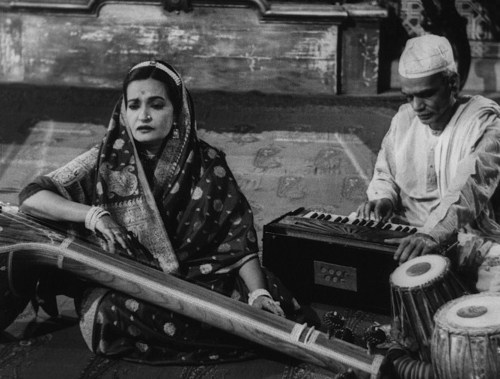
And below, in Satyajit Ray’s 1958 Jalsaghar (The Music Room), though here I need to own up to my ignorance and admit that I’m not sure if she’s singing a ghazal or thumri or some other genre.  It’s also extremely annoying and, to say the least, odd, that Ray would disrespect her performance so much by pasting most of it over by cutaways of the audience and especially the film’s idiot nouveau-riche neighbor who doesn’t even know what he’s listening to:

Begum Akhtar in Jalsaghar : (not allowed to embed it, logic of which I never understood…)

Here’s a photo anyway and more info: Begum Akhtar


Comment: nikobakos@gmail.com

Agha Shahid Ali

11 May

Talk of poetry, the Delhi Wallah and Kashmir (May 10, “Favorite Blogs: The Delhi Wallah”) made me think of one of my favorite poets of the past few years, the Kashmiri-American — I guess one would call him — Agha Shahid Ali, a prolific poet who wrote about the ghazal, edited a book of ghazals in English: Ravishing DisUnities: Real Ghazals in English and wrote a collection of his own ghazals in English: Call Me Ishmael Tonight a tiny volume that obsessed me for months the first time I got my hands on it.  That one of the most beautiful men I’ve ever known — a friend and the saqi at a bar in Astoria I used to go to — introduced me to it didn’t hurt either.  “Strange and beautiful” he called them, and I still do, and often think that the one must always by necessity partake of the other to some extent: in poetry, in religion, in the physical beauty of a man or woman, in an idea…

Here’s part of Ali’s description of the genre:

“The ghazal is made up of couplets, each autonomous, thematically and emotionally complete in itself… once a poet establishes the scheme—with total freedom, I might add—she or he becomes its slave. What results in the rest of the poem is the alluring tension of a slave trying to master the master.”

In Arabic

A language of loss? I have some business in Arabic.
Love letters: a calligraphy pitiless in Arabic.

At an exhibit of miniatures, what Kashmiri hairs!
Each paisley inked into a golden tress in Arabic.

This much fuss about a language I don’t know? So one day
perfume from a dress may let you digress in Arabic.

A “Guide for the Perplexed” was written–believe me–
by Cordoba’s Jew–Maimonides–in Arabic.

Majnoon, by stopped caravans, rips his collars, cries “Laila!”
Pain translated is O! much more–not less–in Arabic.

Writes Shammas: Memory, no longer confused, now is a homeland–
his two languages a Hebrew caress in Arabic.

When Lorca died, they left the balconies open and saw:
On the seat his qasidas stitched seamless in Arabic.

Ah, bisexual Heaven: wide-eyed houris and immortal youths!
To your each desire they say Yes! O Yes! in Arabic.

For that excess of sibilance, the last Apocalypse,
so pressing those three forms of S in Arabic.

I too, O Amichai, saw everything, just like you did–
In Death. In Hebrew. And (please let me stress) in Arabic.

They ask me to tell them what Shahid means: Listen, listen:
It means “The Beloved” in Persian, “witness” in Arabic.

Agha Shahid Ali (1949-2001)

More here: Poetry Foundation

Some more mundane info on the ghazal: Ghazal

“In Arabic” “Reprinted from The Veiled Suite: The Collected Poems by Agha Shahid Ali. English translation copyright © 2009 by Daniel Hall. With the permission of the publisher, W.W. Norton & Company, Inc.”


Comment: nikobakos@gmail.com

Domes

10 May

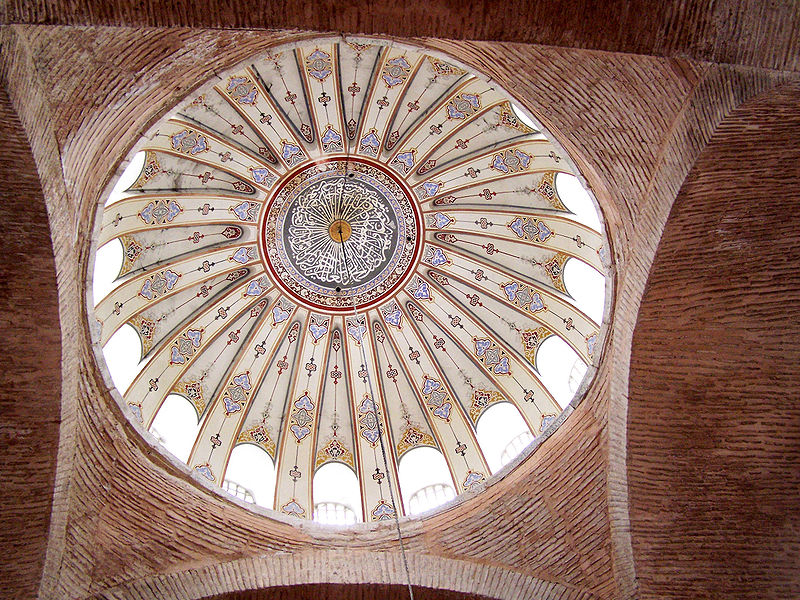
I love the remnant decoration against the bare brick of certain churches/mosques in Istanbul.

Ho Akataleptos or He Theotokos Kyriotissa/Kalenderhane Camii

He Pammakaristos/Fethiye Camii

Ho Hagios Swstes tes Choras/Kariye Camii

or just bare entirely, He Mone tou Libos or He Mone tou Prodromou/Fenari Isa Camii (top and bottom)


Comment: nikobakos@gmail.com