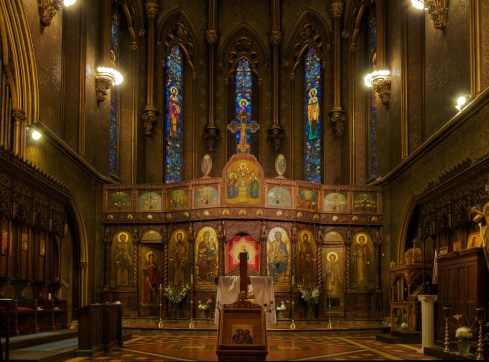
A buddy from Novi Sad reminds me to be optimistic: “Оно што радиш на божић, радићеш целе године.”

9 Jan

djok-falcon

“Ono šta radiš na Božić radićeš cele godine” — “What you do for Christmas, you will do for the entire year.”

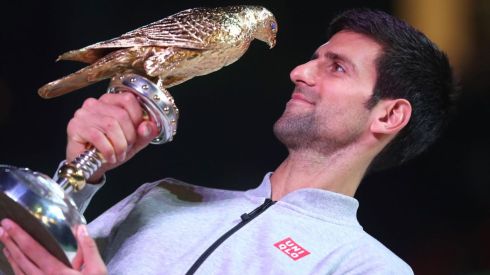
I think that when I start worrying about Djoković’ nervous condition, my friends start to worry about my nervous condition.  So — the timing couldn’t have been better — I posted that piece about Nole’s possible meltdown as 2016 closed, and the day after Christmas, he wins the first of the year’s Grand Slams in Melbourne.  A great start!

(And a great game from Murray too.)

590eff59-2017-4387-8d0c-31870d87824c_mw1024_s_n-australia-2017

And M. from Novi Sad rushed to send me this Serbian proverb to lift my spirits even higher than they already were.  Nice of friends to think of you.

She actually sent me the proverb in Latin script first, and I asked her for the Cyrillic for the post.  We then bonded around our concern for the use of Cyrillic script, because it actually does bug me in Serbia that so much “public” language uses Latin script.

There’s even a graffiti campaign apparently:

unnamed-cyrillic

“Write with the Cryrllic.”

Take heed.  It’s a slippery slope.  You write Latin script for this and then for that and then for everything and the Cyrillic gets harder and harder to use.  Then one morning you wake up and you’re Croatian.

And Христос се роди!  Christ is born!  Merry Christmas!  And let’s hope Djok bears out the truth in the proverb.

Comment: nikobakos@gmail.com

What is January 6th? (reposted from 2015)

6 Jan


This is a question, or comes as part of misguided well-wishing, that I get at this time of the year when people find out I’m Orthodox.  “Your Christmas is January 6th, right?”  “Epiphany?  What’s Epiphany?”  “That’s right!  Three Kings’ Day?!”  “But Russian Christmas is January 6th, right?”  “Is that what they call ‘little Christmas’?”  And the thing is that this is one of those questions that people aren’t really interested in hearing the entire answer to because it’s so complicated, and you see their eyes start glazing over just as you’ve started to explain, so I usually mumble “uh-huh” or something and change the topic.  So let this post be my official statement on the issue that people can refer to when they want to know what the deal is, or on those nights when the Ambien isn’t working.

Once upon a time, Julius Caesar created a calendar.  Well, even if it wasn’t Caesar himself but his astronomers, it was known as the Julian calendar and it was what the entire Christian world used until the sixteenth century.  That’s when Western astronomers — during the reign of Pope Gregory XIII — who were smarter than Caesar’s astronomers, realized that the calendar we were all using was off, vis-à-vis certain fixed astronomical events like solstices and equinoxes, and especially the all-important Vernal Equinox* by which the date of Easter is calculated: that it had drifted back some ten days over the centuries, meaning the day that was actually March 20th, let’s say, had slipped back to the day we were calling March 10th at the time.  So they came up with a new calendar that was more accurate, called Gregorian, like the Pope.  They just skipped the errant ten days.  And one fine evening of March 10th, let’s say, Christians the world over went to bed and when they woke up it wasn’t March 11th but March 21st.  With me so far?

After some fuss, Western Christians accepted the new calendar.  The hyper-traditional Russian Orthodox Church and the rest of the Orthodox Churches, which were mostly part of Muslim states at the time, kept the Old/Julian Calendar, till the early twentieth-century when the Greek and Romanian churches adopted the New/Gregorian Calendar, while the other ones (and the monastic communities of Mount Athos) continued and continue using the Julian Calendar.  One of several critical points: since the sixteenth-century change the discrepancy has grown so that the Julian Calendar is now thirteen days behind the astronomically correct Gregorian Calendar.

So, Christmas?  Well, Russians celebrate Christmas on what the West calls January 7th.  Mind you, their church calendars say December 25th when ours say January 7th, so they don’t really celebrate it on January 7th.  It’s just January 7th to us.  Though, actually, if you ask a Serb or a Russian when, for example, St. Nicholas’ Day is, they’ll say December 19th — meaning on our current, modern Gregorian calendar — though on their church books it’s still December 6th, when the West and Greeks and Romanians celebrate it.  The key point is that on the Old/Julian Calendar everything is thirteen days later.

gregory xiiiPope Gregory XIII (click)

I generally find this calendar difference to be a nuisance, one of the negatives of the decentralized structure of the Orthodox Church, mostly because you get vacation at all the wrong times and have to ask for days off, but also because, despite the often scathing condescension I feel for most of Western Christianity, I am an oecumenist at heart.  And it’s unpleasant to celebrate Christmas on a different day than other Orthodox Christians or even Easter on a different date than the West.  On the other hand, sometimes it’s nice.  It’s nice to celebrate Easter without the cheap plastic crap of Easter Bunnies and parades all around.  And it’s nice to get to drop into church in early January when the late December craziness of Christmas in this country — no matter how hard one has tried to stay out of it — has made it impossible for you to even light a simple candle for the holiday. Convenient, in a sense, as well; if I can’t get to a Greek church on August 15th, for example, for the Dormition of the Virgin, (or here) I can always go to a Russian one on August 28th.  But generally, I think it’s the dumbest kind of traditionalism to stick to the Old Calendar.  I mean, even if we’re so literal-minded as to think that we know when Christ was born — or even so literal-minded as to think He actually existed — we now know, scientifically, that the day we were calling December 25th is not December 25th.  So what’s the problem?  Russians, of course, make off like bandits with this deal.  Communism made New Year the most important holiday of the year, but even then everyone still celebrated Old New Year on January 13th.  Now festivities in post-communist Russia start around Western Christmas, go through New Year’s, celebrate Russian Christmas proper on January 7th, and still celebrate Old New Year on January 13th — a month of more than the usual everybody-being-plastered.

Easter?  Oh, Easter.  Why do Greeks celebrate Christmas with the West but Easter with other Orthodox Churches?  Again, a result of the decentralized structure of Orthodoxy.  The Greek Church switched to the Gregorian calendar for everything else, but, due to the fundamental centrality of Easter and the Easter cycle (Lent-Easter-Pentecost) to the faith (something the West has quite seriously lost sight of), it was decided that Greeks and Romanians would continue to calculate the date of Easter according to the Julian Calendar in order to stay in step with the others and maintain Orthodox solidarity.

“But what about January 6th then??!!” you ask, desperately seeking Christian truth.  January 6th is the Feast of the Epiphany.  I repeat: January 6th is the Feast of the Epiphany.  The Богоявление in Church Slavonic, Bogojavljenje — The “God Revelation,” literally, or also colloquially called Jordaninden in some South Slav languages: “Jordan Day.”  Er, like the river, right?  That’s right.  It’s the day Jesus Christ was baptized in the river Jordan by his cousin John the Baptist and the beginning of Christ’s ministry.  But this happened when Christ was 30.  He was baptized on January 6th, thus the Twelve Days of Christmas, but it was January 6th thirty years later; it’s purely coincidental that they come so close to each other, but understandable that Christian observance would lump them together into one holiday season.**  But Epiphany is not a holiday thematically related to Christmas or Christ’s birth; it’s not part of the first few weeks of His life.  It’s also purely coincidental that Epiphany comes twelve days after Christmas and that the Old and New Calendars diverge by thirteen days.  But that’s the reason people have heard of something about January 6th and think “Russian Christmas” is January 6th.  It’s not.  It’s the 7th.  January 6th is Russian Christmas Eve.  And that means Russian Epiphany is…..?  Have you been paying attention?  Very good.  January 19th.  Thirteen days later.  Though, again, Russian and Serbian and Bulgarian Churches are celebrating it on what — for them — is January 6th.

The Epiphany is one of the Great Feasts of the Church and of great theological significance, which is really why I get so worked up about this issue.  It’s not just the day Christ was baptized in the Jordan by his cousin John the Baptist.  At the moment of His baptism, the Holy Spirit descended from heaven in the form of a dove, and the voice of the Father was heard saying: Οὗτός ἐστιν υἱός μου ἀγαπητός, ἐν εὐδόκησα.” “This is my Son, in whom I am well pleased.”  Thus, it’s the first time that the Trinity was revealed to mankind in all three of its forms at once.  That’s what Epiphany, or Theophany, as it’s also known, (Επιφάνεια or Θεοφάνεια) mean: the “showing” or “revelation” of God — in all His forms.  It was also my father’s nameday (“Fotios,” like “photo” for light — the day is often colloquially known as “The Lights” in Greek) and an important holiday in his village.

Baptism_(Kirillo-Belozersk)Russian icon of the Epiphany, the baptism of Jesus Christ (click)

And the Three Kings?  Three Kings’ Day is an abomination whose prohibition I will begin to work towards as soon as I am elected to the College of Cardinals.  Honestly, sorry to be so churlish and ruin the fun of hundreds of millions of little Hispanic kids, but I genuinely find the observance to be more than mildly offensive.  I don’t care that it doesn’t make any sense textually – that the gospels are clear that within days of His birth Mary and Joseph had whisked Christ off to safety in Egypt and that they weren’t sitting around in the cold for almost two weeks waiting for these “kings” to come.  (Though it’s cool that these “kings” were likely Zoroastrian priests from Iran — searching for something they had heard would happen towards the West around the Winter Solstice — Yalda).  I just think it’s the Catholic Church at its cheapest, most propagandistic worst to let a holiday of such theological importance degenerate into a by-product of Franciscan Christ-Child piety (like most of Christmas in the West anyway) and to officially condone this sentimental tripe about frankincense and myrrh, while the real meaning of the holiday is completely forgotten, as if believers are incapable of understanding the real theology behind the day.  It’s the Catholic Church at its Grand Inquisitor worst, actually — and there I’m with Dostoyevsky: give ’em a show and a nice little parade and keep their loyalty and submission; they’re too stupid to get the deep stuff anyway and you’ll only risk confusing them and then, enraged, they’ll turn on you: “Ecco homo….Ἰδοὺ ὁ ἄνθρωπος.”  It’s one of the many ways that Rome still seems to be incapable of finding a way between the most ruthless authoritarianism and the cheapest populism.  Though that, of course, was exactly Dostoyevsky’s point: that the two work hand-in-hand.

Which is why, aside from its incredible power as a scene in and of itself, I find the segment from Twelve Years a Slave I posted at top to be immensely gratifying; a slave at least knew that “John” and “baptism in the Jordan” had something to do with “Three” — and not three kings

blessing-of-the-waters

In seaside parts of Greece, the “blessing of the waters” is performed, where the priest throws a cross into the sea and young men dive in to retrieve it.

A few years ago, the Turkish government permitted Greeks in İstanbul to perform the rite again, though for the Patriarch to do so at the Fanari on the Golden Horn, they generally have to call out Turkish commandos to protect the participants from the Çarşamba*** crazies from up the hill.

Oh, and just to add to the confusion, early Christians actually did celebrate the Nativity of Christ on January 6th, but the Church moved it to the 25th of December at some point so they could get a piece of the Saturnalia and Mithra-Birthday celebration market.

Comment: nikobakos@gmail.com

**************************************************************************************************************************************************************************

* Easter is the first Sunday after the first Full Moon after the Vernal Equinox, thus, the first Sunday after the first Full Moon, 14-15 of Nissan — the first night of Passover — in the Jewish Calendar…I think.  In short, the first Sunday after the first night of Passover, one more indication that the New calendar is the more correct way to calculate and number things.

** On the Old Julian Calendar Easter often came so early that Carnival began in late January, thus Epiphany, or Twelfth Night, was considered the beginning of Carnival — one long wintery festival season from Christmas to Ash Wednesday.  This is why Shakespeare’s play, which has nothing to do with the Epiphany, was called “Twelfth Night” — because it was a comedy commissioned for the beginning of Carnival.  For some reason, in the more Slavic, — yes, I said it: S-L-A-V-I-C — parts of northwestern Greece, like Lerin or Kostur, serious Carnival time is early January, and includes elements much like what we know of the Roman Saturnalia, and not the pre-Lenten season that it is elsewhere.  And he have evidence that the Byzantines celebrated a similar, Roman-Saturnalia-derived extended festive time throughout the winter.

Oh…  But what’s Carnival?  And Lent?  Ash Wednesday?  Oooofff….other posts…

*** Çarşamba is a hyper-religious — yes, I’ll just call it fundamentalist — mahalla, up the hill from the Fanari, the once entirely Greek neighborhood on the northern shore of the Old City where the Patriarchate is located.  It’s the only part of İstanbul I — and not a few İstanbullus themselves — genuinely feel uncomfortable being in or walking through, and occasional bits of fun like Molotovs tossed into the Patriarchate’s compound usually come from these lovely black-clad, bearded neighbors of ours.

Edit This

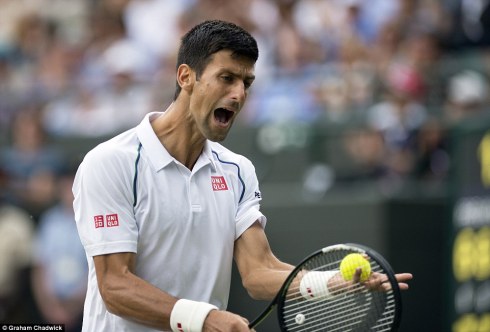
And Djoković suffering from a long, late season, Serbian meltdown didn’t make 2016 any better

6 Jan

2a4ed38c00000578-3152319-image-a-51_1436284456573

Maybe Melbourne will be the beginning of a new start, because we know there’s a thin line with him between these flip-outs and professional disintegration; though usually he sadistically tortures us by bringing us to the edge of the abyss, then making some sort of theatrical recovery.

Comment: nikobakos@gmail.com

Turkey and Silence

6 Jan

istanbul-mourning

I’ve been silent for a year, more or less. And the reason is pretty simple: Turkey. It’s been hard to watch a country you feel (or should) so close to, are for better or worse geographically adjacent to, (mostly worse), and which is so key in every way to the subject matter and internal structure of this blog, implode in such spectacular fashion and not have something to say.

And yet I didn’t have anything to say that could do justice or offer any insights into what was happening. I look back at a blog entry from the end of 2015 about my arriving in C-Town on November 2nd, the day after Turks gave Erdoğan a parliamentary reward for inciting the unspeakable violence that had already occurred — and would soon start spiralling exponentially out of control — instead of punishing him for it, and note that I feel an internal tectonic shift towards the place and its people; a weird, kind of science-fiction-like creepiness and discomfort…City of Zombies.

But every time I’d try to say something, events would overgallop and trample me and I’d say nothing again. Instead of posting here, I started writing acerbic, aggressive-aggressive emails to small groups of friends – partly to get my bile out, partly to hurt some of them. I felt myself starting to fall back on ancestral nastiness: Greek clichés of Turks as inherently slow-geared: a kind of dumb manipulable mob, one who’ll sooner or later be steered by the powers-that-be that they revere so idiotically into finding a way to take out their society’s dysfunction on us.

It’s been nice to be in Jiannena since Christmas. (“Jianniotes’ Jianniotiko passion for their Jiannena is well-known…” states with unapologetic Jianniotiko pride the introduction to a really interesting book I’,ve stumbled across here about the little known late Roman and early Byzantine history of the city.*) It is an addictively pleasant town and on December 30th some friends of mine from Istanbul came to spend a few days with me here. We were glad to see each other. It had been a long time. The weather was chilly but bright and sunny. The raki bracing. And to show two Turkish friends around a city whose primary tourist sites are Ottoman, and its general ‘Ottomaness,’ is the kind of irony in such matters that I love.

So I think it might have been a kind of perverse blessing to be with them New Year’s morning after the Reina attack in Ortaköy. Here were two real people I love, in pain: not straw men to beat up or take out my frustrations on. And that made a difference. It slows down your thinking.  It doesn’t let you cut emotional or intellectual corners. I might actually have something to say soon.

Comment: nikobakos@gmail.com

*************************************************************************

* index-jp

Ιωάννινα: Ίδρυση – Χωροταξικός Ρόλος – Μορφή της Πρωτοβυζαντινής Πόλεως (Ioannina: Foundation, Functional Layout, Form of the Proto-Byzantine City); Βασίλης Αναστ. Χαρίσης, Αρχηιτέκτων (Vasiles Anast. Harises, Architect)

A Happier 2017

6 Jan

pom-with-section-on-white

Comment: nikobakos@gmail.com

St. Sava Reconstruction Fund

9 May

33BD768F00000578-0-image-a-93_1462202222549

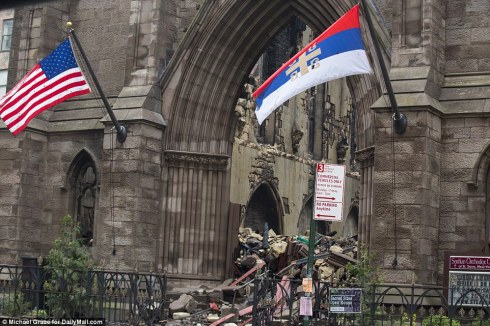
As some might know, New York’s Serbian Orthodox Cathedral, St. Sava, was pretty much gutted by a fire on Easter Sunday.  The church was built as an Episcopalian church in 1855 and was a New York City landmark.  Full story and more photos here and from the WSJ.

To contribute to the church’s reconstruction fund please go to the church’s site here.

8172088020_a53e07b1b7_b

Comment: nikobakos@gmail.com

“Οὐκ ἔστιν ὧδε.”

5 May
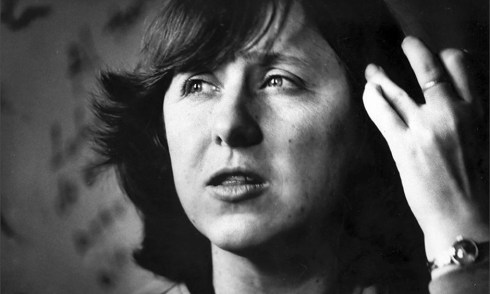
Svetlana Alexievich

Svetlana Alexievich

I’m reposting this story “The Man Who Flew Like  Bird,” by Belorussian Nobel Prize winner Svetlana Alexievich, first printed by The New York Review of Books back in the fall.  It might seem a strange piece for an Easter message.  But if you’ve got the guts to wade through the mud — perhaps a cliché, if so forgive me — of muddy, Russian hopelessness, through the Vanya-Karamazovish Russian cerebral suffering, that of a culture that seems incapable of not giving even the most materialist, anti-transcendental thought a religious cast, and how that inexorably leads to psychotic break, then you’ll find the subtle element of heroic Russian hope and Resurrection all the more moving.

Христос Воскресе

***********************************************************************

The Man Who Flew Like a Bird

Svetlana Alexievich, translated by Jamey Gambrell

November 19, 2015 Issue

Introduction

On October 8, the Nobel Committee announced that the 2015 Nobel Prize for Literature was being awarded to Svetlana Alexievich, a writer and journalist whose body of work is unique both in scope and in genre.

The bare facts of Alexievich’s biography reflect the nature of her greater subject: the memory, aspirations, tragedy, and fluid historical identity of Homo sovieticus. She was born in Ivano-Frankivsk, a city in western Ukraine that lies at the eastern edge of the Carpathian Mountains, about 85 miles south of Lviv, and a mere 150 or so miles from the borders of Poland, Romania, Hungary, and Slovakia, respectively. The city was annexed by the USSR only a few years before her birth in 1948. Her mother was Ukrainian and her father Belarussian. She grew up in Minsk, Belarus, where she studied journalism, developed her own exceptional voice, and became a Russian writer.

Over the course of several decades and numerous books, Alexievich has pursued a distinctive kind of narrative based on journalistic research and the distillation of thousands of firsthand interviews with people directly affected by all the major events of the Soviet and post-Soviet period. She has uncovered the unknown but crucial work that Soviet women did in World War II, recounted the memories of children caught up in the “Great Patriotic War,” documented the realities facing soldiers in the Soviet-Afghan war, which were kept from the Soviet public, and recorded the experiences of those who lived through the Chernobyl nuclear disaster.

In her most recent book, she deftly orchestrates a great chorus of diverse voices to chronicle the human toll—emotional, physical, economic, and political—of the collapse of the USSR, a country that once made up a sixth of the world’s land mass.1 Alexievich’s oeuvre comprises nothing less than a history of epic proportions, which she has called “Voices of Utopia.” This undertaking has brought the writer many awards and accolades from Western European countries in particular, and from Russia, where her books have been printed and reprinted many times; she is a well-known critic of the Putin regime. In her home, Belarus, however, under the dictatorship of Aleksandr Lukashenko, she has been subject to the same political censorship and pressure as many of her colleagues (as Timothy Snyder pointed out in the NYR Daily
2). For over a decade she lived in various European cities, because it was not safe to return to Minsk (though she did in 2011), and her books have not been published in Belarus since 1994.

In announcing the award, the Swedish Academy called Alexievich’s “polyphonic writings…a monument to suffering and courage in our time.” “By means of her extraordinary method—a carefully composed collage of human voices,” the Academy went on to say, “Alexievich deepens our comprehension of an entire era.” As she writes:

I don’t just record a dry history of events and facts, I’m writing a history of human feelings. What people thought, understood and remembered during the event. What they believed in or mistrusted, what illusions, hopes and fears they experienced. This is impossible to imagine or invent, at any rate in such multitude of real details. We quickly forget what we were like ten or twenty or fifty years ago….

I’m searching life for observations, nuances, details. Because my interest in life is not the event as such, not war as such, not Chernobyl as such, not suicide as such. What I am interested in is what happens to the human being….

Svetlana Alexievich’s interest in what happens to the human being is evident on every page of her writing. Among other things, her work testifies to the immense power of compassion to create understanding of our fellow human beings.

The text below is from a collection of more than a dozen tales of suicide that Alexievich published in Russia in 1994 under the title Zacharovannye smert’iu (Enchanted by Death). In the introduction she wrote that she sought to “distinguish…the lonely human voice. They all sound different. Each one has its own secret.”

—Jamey Gambrell

Archive of Svetlana AlexievichSvetlana Alexievich

************************************************************************

The Story of the Man Who Flew Like a Bird:
Ivan Mashovets—Graduate Student of the Philosophy Department

From the account of his friend, Vladimir Staniukevich, graduate student in the Philosophy Department:

…He wanted to leave unnoticed, of course. It was evening. Twilight. But several students in the nearby dormitory saw him jump. He opened his window wide, stood up on the sill, and looked down for a long time. Then he turned around, pushed hard, and flew… He flew from the twelfth floor…

A woman was passing by with a little boy. The youngster looked up:

“Mama, look, that man is flying like a bird…”

He flew for five seconds…

The district police officer told me all this when I returned to the dormitory; I was the only person who could be called his friend in any sense. The next day I saw a photo in the evening paper: he lay on the pavement face down…in the pose of a flying man…

I can try to put some of it into words… Although everything is slipping away… You and I won’t make it out of this labyrinth… It will be a partial explanation, a physical explanation, not a spiritual one. For instance, there’s something called the trust hotline. A person calls and says: “I want to commit suicide.” In fifteen minutes they dissuade him. They find out the reason. But it isn’t really the reason, it’s the trigger…

The day before he saw me in the hall:

“Be sure to come by. We have to talk.”

That evening I knocked on his door several times, but he didn’t open it. Through the wall I could hear he was there (our rooms are adjacent). He was pacing. Back and forth. Back and forth. “Well,” I thought, “I’ll drop by tomorrow.” Tomorrow I talked to the policeman.

“What’s this?” The policeman showed me a vaguely familiar folder.

I leaned over the table:

“It’s his dissertation. There’s the title page: Marxism and Religion.”

All the pages were crossed out. Diagonally, in red pencil, he’d written furiously: “Nonsense!! Gibberish!! Lies!!” It was his handwriting… I recognized it…

He was always afraid of water… I remember that from our college days. But he’d never said that he was afraid of heights…

His dissertation didn’t pan out. Well, to hell with it! You have to admit you’re a prisoner of utopia… Why jump from the twelfth floor on account of that? These days how many people are rewriting their master’s essay, their doctoral dissertation, and how many are afraid to admit what the title was? It’s embarrassing, uncomfortable… Maybe he decided: I’ll throw off these clothes and this physical shell…

Behavioral logic didn’t lead to this, but the act was committed nonetheless… There’s the concept of fate. You’ve been given a path to follow… You rise to it… You either rise, or fall… I think he believed that there is another life… In a thin layer… Was he religious? This is where speculation begins… If he believed, it was without intermediaries, without cultish organizations, without any ritual. But suicide is impossible for a religious person, he wouldn’t dare violate God’s plan… Break the thread… The trigger mechanism works more easily for atheists. They don’t believe in another life, aren’t afraid of what might be. What’s the difference between seventy years or a hundred? It’s just a moment, a grain of sand. A molecule of time…

He and I once talked about socialism not resolving the problem of death, or at least of old age. It just skirts it…

I saw him make the acquaintance of a crazy guy in a used bookstore. This guy, too, was rummaging around in old books on Marxism, like we were. Then he told me:

“You know what he said? ‘I’m the one who’s normal—but you’re suffering.’ And you know, he was right.”

Art Resource‘Marx as Prometheus’; engraving, 1843

I think that he was a sincere Marxist and saw Marxism as a humanitarian idea, where “we” means much more than “I.” Like some kind of unified planetary civilization in the future… When you’d drop by his room he’d be lying there, surrounded by books: Plekhanov, Marx, biographies of Hitler, Stalin, Hans Christian Andersen stories, Bunin, the Bible, the Koran. He was reading it all at once. I remember some fragments of his thoughts, but only fragments. I reconstructed them afterward… I’m trying to find meaning in his death… Not an excuse, not a reason… Meaning! In his words…

“What is the difference between a scholar and a priest? The priest comes to know the unknown through faith. But the scholar tries to comprehend it through facts, through knowledge. Knowledge is rational. But let’s take death, for instance. Just death. Death goes beyond thought.

“We Marxists have taken on the role of church ministers. We say we know the answer to the question: How do you make everyone happy? How?! My favorite childhood book was The Human-Amphibian by A. Belyaev. I reread it again recently. It’s a response to all the utopians of the world… The father turns his son into a human-amphibian. He wants to give him the oceans of the world, to make him happy by changing his human nature. He’s a brilliant engineer… The father believes that he’s uncovered the secret… That he’s God! He made his son into the most miserable of people… Nature doesn’t reveal itself to human reason… It only entices it.”

Here are a few more of his monologues. As I remember them, at least.

“The phenomenon of Hitler will trouble many minds for a long time to come. Excite them. How, after all, is the mechanism of mass psychosis launched? Mothers held their children up crying: ‘Here, Führer, take them!’

“We are consumers of Marxism. Who can say he knows Marxism? Knows Lenin, knows Marx? There’s early Marx… And Marx at the end of his life… The halftones, shades, the whole blossoming complexity of it all, is unknowable to us. No one can increase our knowledge. We are all interpreters…

“At the moment we’re stuck in the past like we used to be stuck in the future. I also thought I hated this my whole life, but it turns out that I loved it. Loved?… How can anyone possibly love this pool of blood? This cemetery? What filth, what nightmares…what blood is mixed into it all… But I do love it!

“I proposed a new dissertation topic to our professor: ‘Socialism as an Intellectual Mistake.’ His response was: ‘Nonsense.’ As if I could decipher the Bible or the Apocalypse with equal success. Well, nonsense is a form of creativity, too… The old man was bewildered. You know him yourself—he’s not one of those old farts, but everything that happened was a personal tragedy for him. I have to rewrite my dissertation, but how can he rewrite his life? Right now each of us has to rehabilitate himself. There’s a mental illness—multiple, or dissociated, personality disorder. People who have it forget their names, social positions, their friends and even their children, their lives. It’s a dissolution of personality…when a person can’t combine the official take or government belief, his own point of view, and his doubts…how true is what he thinks, and how true is what he says. The personality splits into two or three parts… There are plenty of history teachers and professors in psychiatric hospitals… The better they were at instilling something, the more they were corrupted… At the very least three generations…and a few others are infected… How mysteriously everything eludes definition… The temptation of utopia…

“Take Jack London… Remember his story about how you can live life even if you’re in a straitjacket? You just have to shrivel up, sink down, and get used to it… You’ll even be able to dream…”

Now that I analyze what he said…follow his train of thought… I can see that he was preparing for departure…

We were drinking tea one time, and out of the blue he said:

“I know how long I have…”

“Vanya, what on earth are you saying!” my wife exclaimed. “We were just getting ready to marry you off.”

“I was joking. You know, animals never commit suicide. They don’t violate the course…”

The day after that conversation the dormitory housekeeper found a suit, practically brand new, in the rubbish bin; his passport was in the pocket. She ran to his room. He was embarrassed and muttered something about having been drunk. But he never ever touched a drop! He kept the passport, but gave her the suit: “I don’t need it anymore.”

He’d decided to get rid of these clothes, this physical membrane. He had a more subtle, detailed understanding than we did of what awaited him. And he liked Christ’s age.

One might think he’d gone mad. But a few weeks earlier I’d heard his research presentation… Water-tight logic. A superb defense!

Does a person really need to know when his time will come? I once knew a guy who knew it. A friend of my father’s. When he left for the war, a gypsy woman prophesied: he needn’t be afraid of bullets because he wouldn’t die in the war, but at age fifty-eight at home, sitting in an armchair. He went through the whole war, came under fire, was known as a foolhardy fellow, and was sent on the most difficult missions. He returned without a scratch. Until age fifty-seven he drank and smoked since he knew he’d die at fifty-eight, so until then he could do anything. His last year was terrible… He was constantly afraid of death… He was waiting for it… And he died at age fifty-eight, at home…in an armchair in front of the television…

Is it better for a person when the line has been drawn? The border between here and there? This is where the questions begin…

Once I suggested he dig into his childhood memories and desires, what he’d dreamed of and then forgotten. He could fulfill them now… He never talked to me about his childhood. Then suddenly he opened up. From the age of three months he had lived in the country with his grandmother. When he got a bit older he would stand on a tree stump and wait for his mama. Mama returned after he’d finished school, with three brothers and sisters—each child from a different man. He studied at the university, kept ten rubles for himself, and sent the rest of his stipend home. To Mama…

“I don’t remember her ever washing anything for me, not even a handkerchief. But in the summer I’ll go back to the country: I’ll repaper the walls. And if she says a kind word to me, I’ll be so happy…”

He never had a girlfriend…

His brother came for him from the countryside. He was in the morgue… We began looking for a woman to help, to wash him, dress him. There are women who do that sort of thing. When she came she was drunk. I dressed him myself…

In the village I sat alone with him all night. Amid the old men and women. His brother didn’t hide the truth, although I’d asked him not to say anything, at least to their mother. But he got drunk and blabbed everything. It poured for two days. At the cemetery a tractor had to pull the car with the casket. The old ladies crossed themselves fearfully and zealously:

“Went against God’s will, he did.”

The priest wouldn’t let him be buried in the cemetery: he’d committed an unforgivable sin… But the director of the village council arrived in a van and gave his permission…

We returned at twilight. Wet. Destroyed. Drunk. It occurred to me that for some reason righteous men and dreamers always choose these kinds of places. This is the only kind of place they are born. Our conversations about Marxism as a unified planetary civilization floated up in my memory. About Christ being the first socialist. And about how the mystery of Marxist religion wasn’t fully comprehensible to us, even though we were up to our knees in blood.

Everyone sat down at the table. They poured me a glass of homemade vodka right away. I drank it…

A year later my wife and I went to the cemetery again…

“He’s not here,” my wife said. “When we came the other times we were visiting him, this time it’s just a tombstone. Remember how he used to smile in photographs?”

So he had moved on. Women are more delicate instruments than men, and she felt it.

The landscape was the same. Wet. Dilapidated. Drunk. His mother showered us with apples for the trip. The tipsy tractor driver drove us to the bus stop…

English translation © 2011 by Jamey Gambrell

  1. 1

To be published in 2016 under the tentative title Time Second Hand by Fitzcarraldo Editions, London.  

  1. 2

“Svetlana Alexievich: The Truth in Many Voices,” October 12, 2015.  

*************************************************************************

Comment: nikobakos@gmail.com

“April is the cruelest month…”

1 Apr

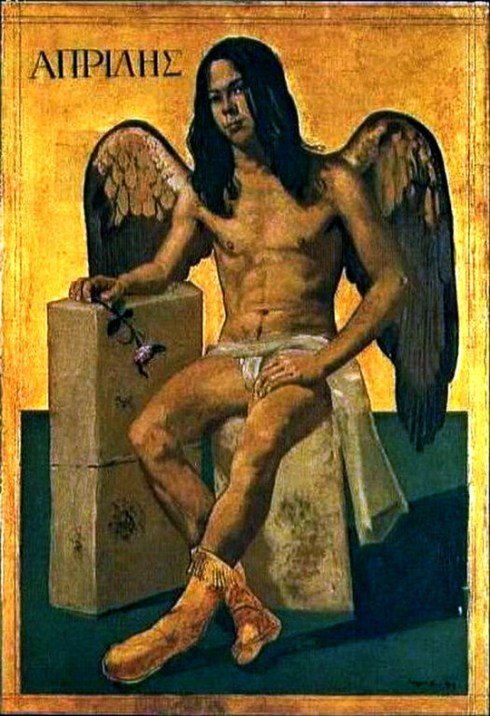
Apriles

Tsarouches’ Apriles

“April is the cruellest month, breeding
Lilacs out of the dead land, mixing
Memory and desire, stirring
Dull roots with spring rain.
Winter kept us warm, covering
Earth in forgetful snow, feeding
A little life with dried tubers.”
And Roger Cohen’s weird hallucinatory piece in the Times, “A Time of Bullies”:

Every Jew of the second half of the 20th century was a child of the Holocaust. So was all humanity. Survival could only be a source of guilt, whether spoken or unspoken. We bore the imprint of departed souls.

The silence that descended was the silence of the lost. It seems to me that I was raised in silence and that I was far from alone in that. Language could not accommodate such a volume of ashes. Death’s German mastery lingered. The new European prosperity was an epilogue to the unspeakable, its disguise.

Beneath the gleaming postwar surfaces there lurked the indelible stain of barbarism. A human stain, the bruise of complicity in all its shades.

After a while I wanted to understand the things unsaid in the rush to build on the ruins. The covered-over came after me. As a child of the repetitively displaced, I was perhaps a natural target for smothered memory. I wanted to understand where I came from. I wanted to understand my mother’s madness. Never should it be forgotten how onerous it is to forget.

There were clues along the way.

I stand with my then-wife Frida Baranek at Auschwitz gazing at the entangled piles of spectacles left behind by the gassed. Glasses removed for a “shower” form a labyrinthine mound of wire. Frida’s grandmother and most of her maternal family from Poland were killed in the camps. Raised in Brazil, she has never seen this residue of mass murder. Yet her gravity-defying sculptures from the tropics resemble nothing so much as this living tangle of metal.

Some feeling had passed from her murdered grandmother — of the weightlessness of life, of sightlessness, of imbalance and collapse. What it was, at the end, to crumple naked into a cold wall and scream.

My own family skirted the Holocaust. I am not strictly a child of the Holocaust — perhaps a stepchild. They fled the Russian pogroms of Lithuania for the sun and gold of South Africa. My parents left the ravages of apartheid for the tolerance of England. I bounced back and forth in infancy between London and Johannesburg, before being educated at bastions of British privilege, Westminster School and Balliol College, Oxford.

Yet — that old Jewish thing — I never quite belonged. I left England and sotto voce Jewishness to become an American and full-throated Jew in New York. I settled in Brooklyn just in time to see the Twin Towers come down, watch the papers flutter like confetti over the East River, and inhale the acrid-sweet smell of burnt flesh below Canal Street.

Ashes again, vanishing in the air, motes of darkness.

Hatred, fomented in the name of utopian illusion, returns. It is unbearable for some to accept Kant’s “crooked timber of humanity” out of which no straight thing was ever fashioned. The essence of liberalism is acceptance of our human limits and our human differences. It is acceptance of multiple and perhaps incompatible truths. In Europe and America, liberalism is threatened today. Anger rises. Bullies have workable material.

When societies leave many people feeling excluded, they grow volatile. Belonging is a fundamental human need.

In the United States we tend to think of immigration as new opportunity and new hope. That is the bright star of movement and displacement.

The black sun is loss and forgetting, losing an identity to craft another. It is the enormous effort of rebuilding a life far from the familiar — the cherries of Lithuania, the firm yellow peaches of Cape Town, the certain moments and certain pleasures that once inhabited Aleppo or Homs.

The Holocaust was an uprooting, an eviction and an effacement executed on a scale never imagined. For Jews, belonging ceased. My parents, bearing the subliminal shame of Jewish survivors, tried to assimilate in Britain. But my mother was a transplant that would not take.

Hollowness: spaces between the wires, empty spectacle frames and shattered glass. My mother looked for an anchor in a strange land. Her mind raged like an infernal machine, or folded into inertia.

My young cousin in Tel Aviv who took her life, an Israeli unable to establish her own borders in a Jewish state of uncertain borders.

The horror is endlessly refracted.

I feel a great unease. We have embarked on the 21st century with the painful yet essential knowledge of the last one slipping from us. Last month, some American Jews cheered a dangerous demagogue.

Two thousand years ago Hillel admonished us: “If I am not for myself, who will be for me? But if I am only for myself, who am I? If not now, when?”

It is incumbent on all the inheritors of the silence of the lost to raise their voices against the barbarians and bullies before it is too late.

Comment: nikobakos@gmail.com

Happy Noruz from Justin Trudeau

21 Mar

The idea that Afghans are “economic migrants”…

1 Mar

…unlike Syrians and Iraqis, because Afghanistan is no longer a war zone, is obscene.  What does the barometer for endemic violence, chronic poverty or a people’s desperation have to read for someone to be considered a “real” refugee?