Sorry, but it’s pretty funny that Romney’s trip has made of Tisha B’Av such a central metaphor for contemporary Israeli politics and the problematics of Jewish conscience (see previous post). In old Ashkenazi humour — at least as I know it from Brooklyn — Tisha B’Av, Ti-shabuv in Yiddish pronunciation, is used ironically because it’s such an obscure holiday that no one ever knows when it is.
“If you’re waiting for the perfect girl to come along, you’ll be waiting till Tishabuv…”
What other people, even if they lapse so often and so often tragically, are so honest and clear-eyed about their faults?
**************************************************************************************
(Sorry…only now getting a chance to respond to some of these)

The Arch of Titus in Rome, built to commemorate the Roman suppression of the first Jewish revolt in 70 A.D. (click)
In reference to Jadde posts: “Romney in Israel: How High To Jump?“and “Tisha B’av?,” “Jewish London” writes:
“it seems appropriate that he should visit on Tisha B’Av, a day when great calamities befell the Jewish people”
Oooooofffff… This is like teaching…when you’ve spent hours researching and preparing, and then another half hour conducting, a brilliantly detailed and structured, thrillingly executed lesson on participial phrases, only to have one student, while you’re catching your breath right after, ask a question that proves none of the class has understood shit the entire time you were lecturing.
My point was simply that there’s a genre of Ashkenazi jokes, among the many, based on “When is Tishabuv?” Beinart’s point, “Mitt Romney Misuses Judaism…” is that in the long tradition of Rabbinic and Talmudic learning, Tishabuv has been a time to reflect on why a certain tragedy has struck Jews and not just commemorate that tragedy in a victimized and ad nauseum form.
Yes, brother, “terrible calamities befell the Jewish people” on Tishabuv. The Second Temple, the One and Only House of God in the One and Only Holy City, was levelled. Jews were slaughtered in unbelievable numbers. In trying to figure out whether these events happened as part of the Roman response to the Jewish rebellion of 70 A.D. or that of 135 A.D. — which has never been clear to me — I learned that there’s a trend of Jewish mystical thought that fascinatingly believes all Jewish tragedies occurred, occur and will occur on Tishabuv: the selling of Joseph into slavery; Moses’ shattering of the first tablets at seeing the Jews revert to idolatry; the destruction of the First Temple and the Babylonian captivity; the destruction of the Second Temple; the first massacre of European Jews at the beginning of the Crusades; the issuing of the Edict of Expulsion from Spain in 1492; the day the first train left for Auschwitz – all become mystically assimilated into Tishabuv. That’s a tragic and moving idea. However, I do know that the Roman suppression of the revolt of 135 A.D. was so brutal in its massacre and expulsion of Jews that it’s easy to say that it officially marks the beginning of the Jewish Diaspora.
Tishabuv is also intimately related to Jewish messianic thought. The revolts themselves were partly inspired by messianic expectations. And the crushing of those hopes by the greatest cluster of disasters to befall Jews before the Holocaust made Rabbinic thought retreat into the sharpest of all cautions against any such expectations. This, I suspect, is what marked the final rupture between Christian Jews and the rest of Jewry. It’s not that Jews didn’t succumb to the temptation again. Kabbalism is a mystic desire to correct the world that is a barely concealed messianic impulse. And there was the great fever of messianic ecstasy that swept the Jewish world in the seventeenth century, when Sabbatai Zevi, a rabbi from Smyrna, started declaring himself the Messiah – one of the most fascinating and, in the end, sadly absurdist, episodes in Jewish history. Zevi, either a con artist or a psychotic, had raised Jewish expectations to such a frenzied pitch, that when he ended up converting to Islam and becoming a ward of the Sultan, it sent shockwaves of psychological distress, not only through Ottoman Jewry, but throughout the entire Jewish world; in fact, due to renewed persecution and massacres at the time in Eastern Europe, the effects on Ashkenazi Jewry may have been even greater than on Sephardim. The crisis sent the Eastern European Jewish universe careening into two different directions: on the one hand a trend that reemphasized Rabbinical textualism and that eventually responded to the Jewish Enlightenment, the Haskalah, the movement out of Germany that attempted to bring European Jewry into the modern world; and on the other, a retreat into the most introverted mysticism, out of which Hasidism, and an even greater immersion in Kabbalistic thought, grew. To some extent, this split is one that old New York Jews still codedly refer to, whether they know it or not, as “Litvaks” and “Galizianers” (explanation in subsequent post). See Michal Waszynski’s 1937 film version of S. Ansky’s Dybbuk. I think there’s no greater primary text of Jewish spiritual impulses and its conflicts.

Lili Liana as Lea, the bride who becomes possessed by the spirit of her wronged beloved on her wedding day to another man, in Waszynski’s 1937 Yiddish film, the Dybbuk. (click)
(Two interesting notes that I’d like to make here. One is that the Jewish revolts of the early first millennium were partially led by political groups whom we, today, wouldn’t hesitate to compare to, not only the first New England Puritans, but even the Taliban, and who engaged in certain tactics, like the surprise slaughter of masses of innocent civilians that we like to associate with Palestinian “terrorism” – or that of…errrr….Irgun, Haganah, the Stern Gang, Mssrs. Ben Gurion and Begin and all the rest. The other is that maybe the real basis of Tishabuv jokes is still unconsciously based in messianic expectations, the way older Greek women who, say, have missed a bus, will mumble: “Oy, now we’ll be waiting till the Second Coming.”)
But if “Jewish London” is to understand my point, he needs to better understand the transformation that Tishabuv has undergone in Israel since its founding, because I suspect that, not living among the most vibrant Diaspora communities in the world, Israel is his model. Obviously, Zionism didn’t need to worry about the Messiah, since it had solved the “Jewish Question,” as must be obvious to anyone who throws even a cursory glance at the Middle East today and sees the peace and happiness in which Jews there live can attest to, and no Messiahs need apply anymore. Tishabuv had been forgotten by the Jewish Diaspora, reduced to such an obscure holiday that it was the object of humour; I’ve lived most of my life in a city, and worked for a great part of it in an environment, where, believe me, it was impossible to not know that a great, or even just important, Jewish feast was being celebrated or was coming up, and Tishabuv wasn’t one of them. In Israel, however, the “secular” Jewish state raised Tishabuv to new, official status as a holiday-fast day. But not as a day of introspection; but as a day to remember, as “Jewish London” puts it, “a day when great calamities befell the Jewish people.” This is because “calamities” are Israel’s justification for being; it was Israel’s down-payment and it’s still how it pays its mortgage; it’s the currency in which it trades. And the ignorant Romney’s visit to the Western Wall with Netanyahu or whoever on that day, was just another slimy exchange in that same currency — and, in fact, a dishonour to centuries of Jewish suffering.
But back to the Diaspora, and a time when Judaism hadn’t locked itself into a barricaded nation-state. More than just self-reflection and introspection, the repeated, century-after-century dashing of Jewish hopes may have generated an even more important element in the Jewish psyche: doubt. The great Christopher Hitchens, quotes the equally great Rebecca West in his introduction of her book, Black Lamb and Grey Falcon, and her own ruminations about the origins of anti-Semitism:
“West reflects on the virus of anti-Semitism, shrewdly locating one of its causes in the fact that ‘many primitive peoples must receive their first intimation of the toxic quality of thought from Jews. They knew only the fortifying idea of religion; they see in Jews the effect of the tormenting and disintegrating ideas of skepticism.’”
That’s why on Easter night, the night of the Resurrection, I always remember to have one, only one, glass of wine that’s offered to the suspicion – the same one born out of the fact that Elijah never actually walks through that open door at Passover — that this whole idea is bullshit.
So what is Tishabuv for (when we know when it is)? Introspection, moral responsibility, skepticism, doubt and the saving beauty of being eternally able to convert suffering into humour and irony – these last may be the most important — a pretty whole summation of what Jews have given us, given me, at least.
When “Jewish London” can tell me what Israel has given us, he should let us know. These Days of Awe might be the perfect time to think about that.
Comment: nikobakos@gmail.com
**************************************************************************************
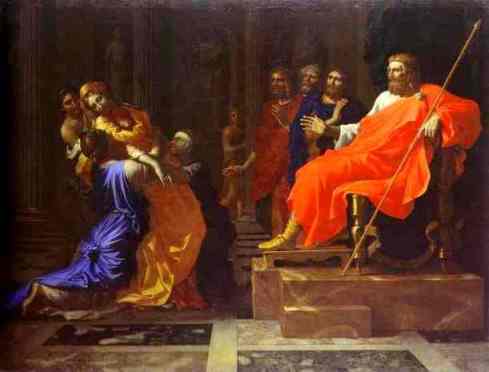 Esther before Assuereus, Nicolas Poussin, circa 1640 (click)
For Purim this year I’m posting this poem by Greek Jewish poet Joseph Eliya, who was from my mother’s hometown of Jiannena in the northwestern Greek region of Epiros. (See the tab box on the right for the hundred references to Jiannena and Epiros on the Jadde).
The Jews of Jiannena were Greek-speaking Romaniotes, descendants of the Jewish communities of Greece, the Balkans and Asia Minor that existed since Hellenistic times and that held out culturally against the flood of Spanish-speaking Sephardim that found refuge in the Ottoman Empire after their expulsion from Spain in 1492. They were called Romaniotes because Romania (the kingdom of the Romans) was what the Byzantines called their polity and what we too – till the early twentieth century – also called ourselves: “Romans” – which it always aggravates me to have to explain. But it is one of the rich ironies of history that the only inhabitants of Greek lands that stayed faithful to their true name for themselves were Jews, while we sold our souls to the West for the promises and prestige we thought the re-excavated neologism “Hellene” would curry us from the Frangoi.
So Eliya’s native language was Greek, and though he wrote some of the most beautiful translations of Jewish Biblical texts into Modern Greek, particularly one of the Song of Songs and a series of love poems to Rebecca, in a rich, florid, archaic idiom, he also wrote homelier poems in a folksier Jianniotiko style like this one, “something like a letter to his mother” on the occasion of the feast of Purim.
For those who don’t know, Purim is the day that the Esther, the Queen Consort to the Persian King Ahasureus, and her uncle Mordechai, foiled the plans of the king’s evil minister Haman, to have the Jews of the kingdom massacred. It’s generally celebrated by listening to the book of Esther in synagogue, the Megilla, sending food and giving charity to the poor and dressing up in costume, an aspect of the celebration that may be an interborrowing due to the fact that it tends to fall around Christian Carnival.
Eliya was a poor schoolteacher who died at the young age of thirty, and I believe this poem was written when he was away from his beloved Jiannena, and his beloved mother, on a teaching post in the Macedonian city of Kolkush. It’s a sad, therefore — and very Epirotiko in that sense and in tone — poem, that’s in sharp contrast to the happiness of the holiday.
This poem also has an added emotional subtext for me. My mother’s best friend when she was in elementary school was a Jewish girl, Esther — Esther Cohen. “Astro” they called her, in the Epirotiko diminutive; “Tero” is also another form for the same name. And as a little girl from a peasant family recently moved to Jiannena from their village in the mountains just to the south, I could tell that her stories about her friendship with Astro were her first lessons in tolerance and difference, whether she would’ve called them that or not (we certainly wouldn’t in our day…I’ll leave them for another post). And she may have known it even less, but her friendship with Astro may have prepared her for life in New York in ways she was probably never conscious of. And what she may have been even less conscious of — though maybe I should give her some credit: I do know for sure that my mother’s stories of her friendship with Astro served as my first lessons in decency and openness to those different from you. Of that there’s no doubt. So this post is something like a letter to my mother too.
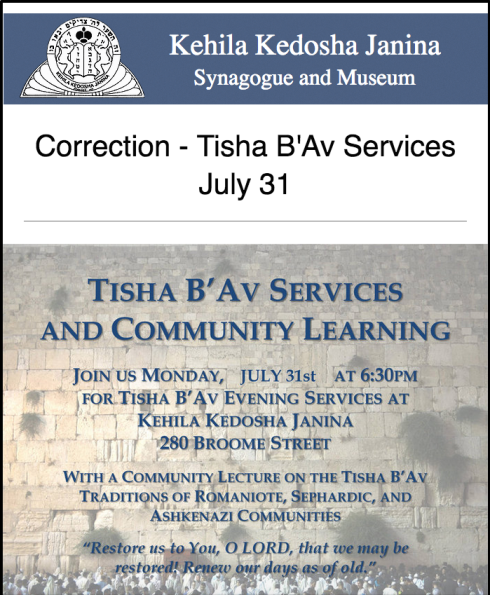
Always they ended in a kind of distracted silence, for she never knew what had happened to her friend during the war: “Τι νά’χει γίνει η Άστρω;” she would mumble. “What can have happened to Astro?” And what was strange was that she could’ve found out; there were surviving Jews in Jiannena that she knew and there were even Jewish Jianniotes in New York she could have asked. But it was like she didn’t want to know. Even odder, I’ve had several opportunities to find out as well; Kehila Kedosha Jiannena, the Jianniotiko shul in New York on Broome Street has records on the whole community. But it’s been almost as if I don’t want to know either.
Here is Eliya’s original Greek, with my free verse translation below.
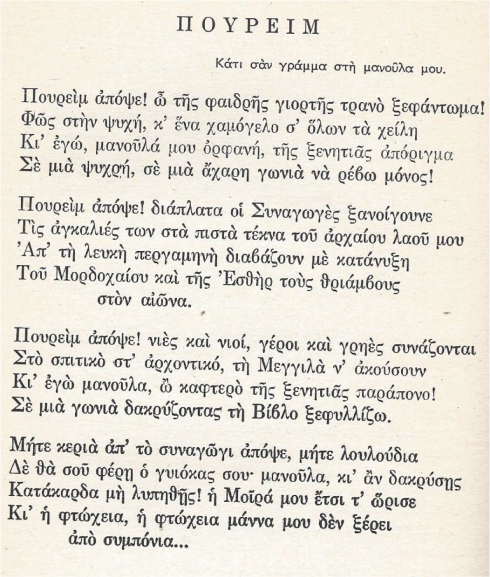
Purim
(Something like a letter to my mother)
It’s Purim tonight! The thrill and joy of the great feast!
Light in our souls, and a smile on the lips of all.
And I, my orphaned mother, the refuse of exile*
Waste away in a chill joyless corner.
It’s Purim tonight! And the synagogues open their arms wide to the faithful children of my ancient people.
And they read again with wonder, from the white parchment, the triumphs of Mordechai and Esther through the ages.
It’s Purim tonight! Young and old gather at home, at hearth, to hear the Megilla’s** tale.
And I mother – with the burning lament of exile – tearily thumb through my Bible in a lonely corner.
Your son won’t be bringing you candles or flowers from shul*** tonight, mother. And if your crying is bitter, don’t lament too deeply. My Fate has been decided, and poverty — poverty, mammele**** – has no feel for sympathy.
**********************************************************************************************************************************************************************************************
Notes on my translation:
*”Exile” here does not imply political banishment or anything of the sort. It’s the word “ξενητιά” as Eliya spells it, that’s so central to understanding the Greek and — it probably goes without saying — the Jewish soul, but is so devilishly difficult to translate precisely. It means absence — absence from the place where one should be, from one’s heart’s homeland. Through and because of emigration and poverty most often but not always; it’s often something one feels without having had to leave. The Turkish “kurbet” is the word closest in meaning that I know from another language.
**Not to be disrespectful, but the Megilla, the Book of Esther, is quite long, and is proverbial, in at least Ashkenazi humor, for being tedious and monotonous to listen to — but one bears it. It’s exactly the same as the Greek term “εξάψαλμος,” the Hexapsalm, a selection of six psalms that is always read at the beginning of Matins and I’m not sure if during other offices, and would be beautiful if correctly and carefully recited according to the rules of Orthodox recitation. Unfortunately, it’s usually read in an incomprehensible blur of mumbled boredom by the lector or cantor, which actually makes it even more tedious and irritating to sit through. It’s usually a good time to go out for a cigarette. I just always thought the similarity was funny. “Ωχ, τώρα θα’κούσουμε τον εξάψαλμο,” a Greek will say with dread when faced with a berating lecture or kvetch session or someone’s tiring complaint that’s so repetitive you just tune it out, just like a Jewish New Yorker will say: “I really can’t listen to his whole Megilla right now…”
***In the second verse, Eliya uses the Greek word for synagogues and I translated it as such. In this last verse, he uses a homier, Epirotiko form whose intimacy I felt was better conveyed by “shul.”
****And last but not least, we run into the painful translation issues that are generated by the fact that English is almost completely lacking in a system of diminutive terms of affection, especially compared with the highly elaborate diminutive terminologies of Slavic languages or Yiddish (or I assume Ladino) or even Greek. At no point in the poem does Eliya refer to his mother as “mother” but rather “my little mother” — “μανούλα’μ” — “manoula’m.” This is a term of affection used often by Greeks and especially Epirotes to refer to anyone, not just one’s mother, not even necessarily a female (Athenian idiots making fun will darken or double up the “l” to make it sound more northern and Slavic and hickish; for me it’s just more beautiful…); one will say to a young boy or even a friend: “Come here, manoula mou… What’s wrong, manoula mou?” Just like “mammele” is used in Yiddish. But I felt that using “mammele” throughout would have sounded too Yiddishy and cute, and so I saved it for that last, most intimate verse, and used mother elsewhere. After all, this is a poem that above all is an expression of the most Jewish kind of mother-son bond. But Yiddish and its many beauties is cursed now, by its sudden, dramatic extinction in Europe, and its shadow survival only in American entertainment, with the danger of always lapsing into a default comic tone. It’s sad. The translation from the Greek of the last line of the poem, for example: “poverty has no feel for sympathy…” would literally be: “…but poverty doesn’t know from sympathy.” But then I’d be writing Larry David dialogue.
**********************************************************************************************************************************************************************************************
FINALLY, I’d like to thank Marcia Haddad Ikonomopoulos for the scan of the Greek text of the poem. I’m in Athens now, away from my library and couldn’t find it anywhere online. I wrote to her and within five minutes she had written back to me with both “Purim” and “Esther,” another of Eliya’s poems about the biblical heroine. She suggested that “Esther” is a poem more appropriate to the happiness of Purim than the melancholy of “Purim.” Unfortunately, it’s written in a much more difficult, semi-biblical, archaic language that I didn’t have the time to translate. I promise her however, that as soon as I get a chance I will work on it and post it on the Jadde — out of gratitude to her helping me out for this, and out of gratitude to the one-woman pillar of the Kehila Kadosha Janina community that she is. I’d also like to thank the whole congregation there for always making me feel so welcome when I attend on Erev Simchas Torah; the rabbi and his stentorian voice, the three young men who lead prayer and are perhaps the community’s most precious resource — let’s see if I remember correctly: Seth, the rabbi’s son, and the brothers Andrew and Ethan, who though they’re from a Sephardic family from Berroia, devote their shabbes and yontif time to energizing this tiny community in need of outside help. The warmth of the community has always moved me and I’m grateful for both the odd need for Jewishness in my life and the link to my mother and her childhood that they unknowingly provide. Thank you.
–
Comment: nikobakos@gmail.com

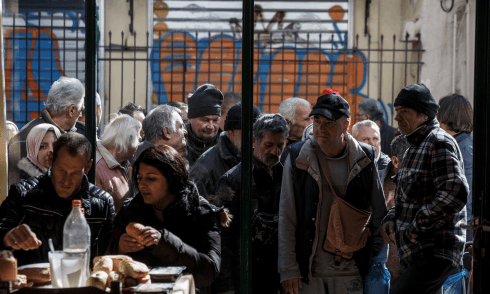 Greek people queue to enter a soup kitchen run by the Orthodox church in Athens. Photograph: Alkis Konstantinidis/Reuters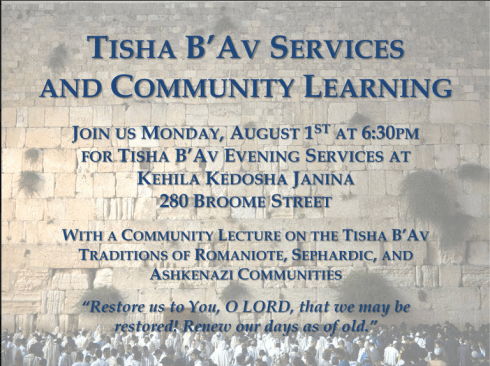










 Jadde: from Bosnia to Bengal