“Glykosimoritis” brings us the story of the Karamanlidiko map…sort of

1 Oct

From this post a couple of weeks ago:

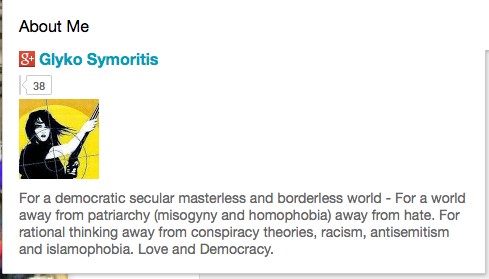
tumblr_n85l4e4ePN1srjuvno1_1280His google profile:

Screen Shot 2014-09-30 at 9.04.31 PM

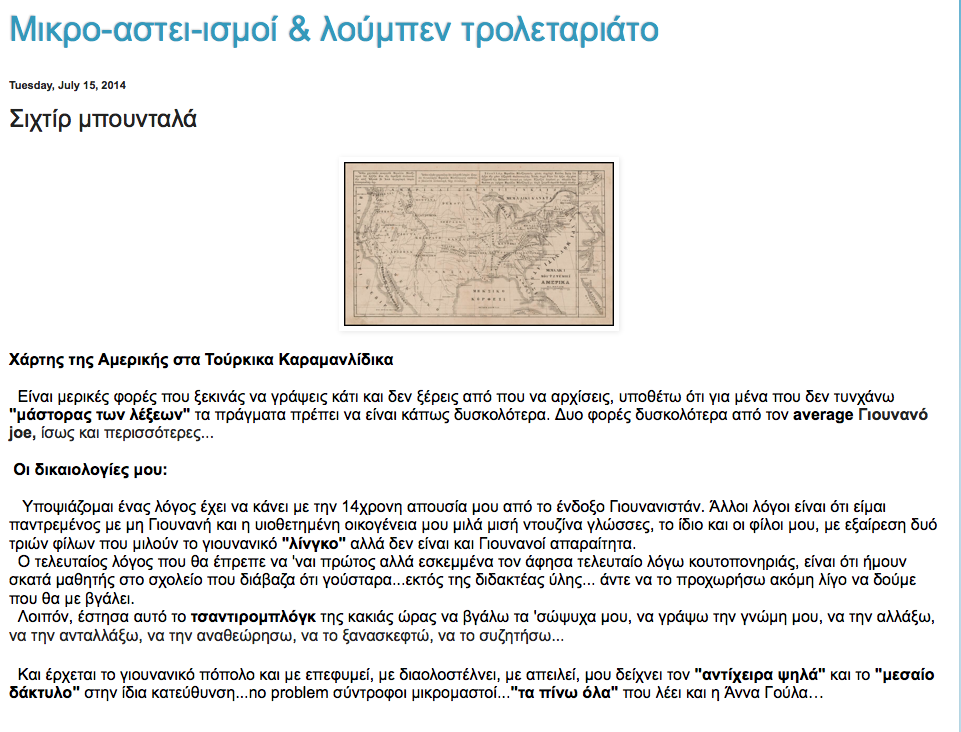
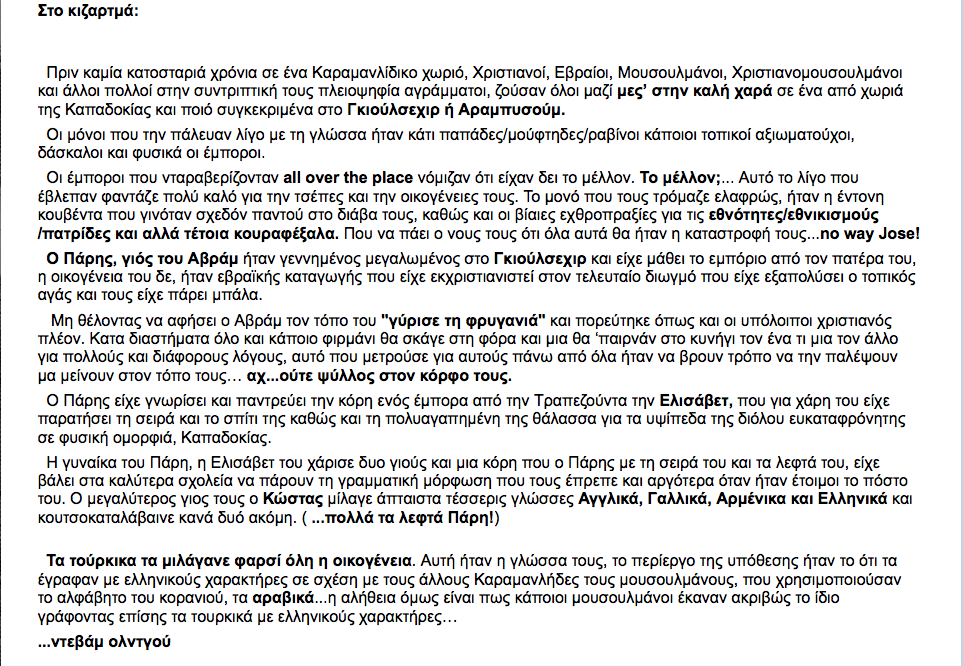
And his quirky, funny story below about — well, I can’t quite say what it’s about — a kind of Alice in Wonderland walkabout through Karamanlı Cappadocia and his own life, which, I’m sorry, is just too idiomatic and full of delightful Greco-Turkisms for me to find time to translate now…that is, if it is even remotely translatable.  But it manages, in its absurdist glee,  to be a hundred times more devastating a slap at the statelet’s bourgeoisie (“glorious Yunanistan” he calls it) than even my most vitriolic posts. 

More power to you Γλυκέ μας.

Greek-readers enjoy:

(click to open screen-shots)

Screen Shot 2014-09-30 at 9.11.59 PMScreen Shot 2014-09-30 at 9.13.07 PM

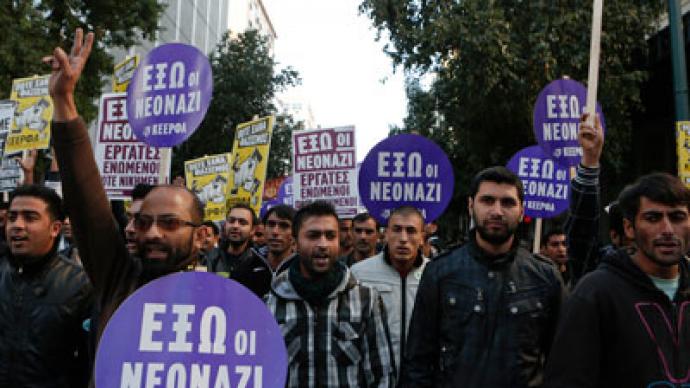
Συγχαρητήρια! Congratulations! for trumpetting Al Jazeera headline: “Greece, a front line for state-sponsored racism in Europe”

29 Sep

“…a front line for state-sponsored racism in Europe.”

Are you proud of yourselves?  Και εις ανώτερα!

immigrants-19-banners-athens.si(Reuters/Yorgos Karahalis)

“Once the cradle of European civilization, Athens is now the center of a continental decivilizing process.”  See whole article .

And I want to make sure you all know my heartfelt congratulations go out to all and every one of you, every inhabitant of the statelet that’s sat by silently doing and saying nothing all these years as this ugliness built up its now seemingly unstoppable momentum.  And instead are worried about whether Albanian genes will show up on your DNA chart

Comment: nikobakos@gmail.com


OK. Who ARE the MESA Thought Police?

28 Sep

MEast-pol(click)

Readers have wanted to know.  I explain below.

MESA is the Middle Eastern Studies Association, an organization like the AAA for anthropologists or the MLA for – well, for practically anybody these days – that brings together American scholars of the Middle East.

The Thought Police (TP), are agents of that association charged with maintaining ideological correctness and compliance among the members of their community. They are not nearly as active now as they once were, largely because the ideological and intellectual climate has changed so radically in the past couple of decades, but they are still a body to be feared and respected in my opinion.

What did it used to take for them to open a file on you? Well, almost anything. Just being a Westerner (the definition of which was random and usually made up as they went along and according to circumstances and whim) immediately made you a potential target…or looking too WASP-y…or too inside-the-Beltway…or having a high-and-tight or any similarly military haircut.  Or, even if you’re from the region, but because you’re a Near Eastern Christian, and your immediate emotional attention is automatically drawn to Christianity’s losing struggle for survival there before it’s drawn to other regional issues that may also concern you deeply, or if you even suggested that life for non-Muslims in a Muslim world was not, historically or now, always paradise, you were immediately a potential target. If, out of intellectual affinity, or just your personal affective structure as a New Yorker, you exhibited as much concern for how Zionism is bad and morally destructive for Jews as you do to the painful suffering of Palestinians, chances are there’d be a file on you. If you weren’t falling over yourself during the 90s – burdened by post-colonial guilt and the most stupid, simplistic revisionism — trumpeting the superiority of Islamic civilization and its sophistication, and proclaiming the long-buried truth that all the learning of the classical world had been preserved in Baghdad and Damascus and Cordoba…ad nauseum (yes, there, and in a dinky provincial town called Constantinople….) or if you were caught even suggesting, heaven forbid, that maybe — just maybe — Arabs had simply conquered what were already the most sophisticated and civilized parts of the Greco-Roman and Sassanian worlds, or you weren’t apologizing for the Crusades, or if you didn’t immediately accept at face value the bloated claims of tolerance — completely unsupported by the historical record — that Islam often makes for itself, you were a target. If you weren’t willing to immediately “understand” any response of the Muslim world to the depredations of colonialism-neo-colonialism as — if not a legitimate form of resistance — as at least something that needs to be seen “in the context of…” you were immediately suspect.

You don’t necessarily need to be an Arab or an Arab-American of some sort to rise in the ranks of the TP. But Turks are usually too patient and soft-spoken to be as ruthless as necessary to make effective agents, and Iranians and their South-and-Central Asian cultural protégées are usually too invested in their dignity and aloofness — the whole cult of ta’arof and tahzeeb — to get down and dirty in the way necessary. To really make it to the top of the MESA TP, that famous Arab poetic sensibility, and the ability it gives to indulge in baroque rhetorical excess and some strategically used vein-popping anger and ranting, is usually a prerequisite.

But despite having clearly inherited those ranting skills, most TP agents are, tellingly, of the more déracinés strata of the societies they come from, or are ethnic-Americans embarrassed by their parents’ white wish, so a great deal of their zeal comes from the screamingly obvious need to overcompensate. So one of the more central elements or characteristics of this sociological profile is the TP intellectual’s inability to take religion seriously into any critical calculation of events, trends and processes in the region that is his oh-so-passionate object of concern. So, if you did have a reasoned philosophical critique of Islam, and even if it were only one very small part of your much larger intellectual apprehensions about monotheism generally,* there was no possible way to engage them on that level. Because they’re really just a bunch of “more-royalist-than-the-king”, middle-class white-boys-and-girls, raised in a spiritual vacuum without the vaguest of metaphysical impulses or yearnings, they simply think of religion as epiphenomenal, in the most retrograde, reductive Marxist manner of thinking imaginable, and your “critique” would immediately be reduced to just a façade for your racism and anti-Muslim prejudice. Don’t even expect to be listened to.

What could or can they do to you? Well, if you’re not in academia yourself, aside from how generally unpleasant and abrasive they will succeed in making any kind of interaction with them, they really can’t do much. But that abrasiveness is unpleasant enough an experience to want to make the weak-kneed run and hide; and the most “weak-kneed” especially includes non-Middle-Eastern or non-Muslim academics in the field who are terrified of professional marginalization and loss of funding. Otherwise, you’ll simply be subjected to intolerable, self-righteous tirades. (One bridge over the humor-desert of Turkey that I always felt bound Greeks to Arabs was a similar sense of sardonic wit and irony and infectious jokiness – but absolute, literal-minded humorlessness is a prerequisite to being a TP agent.) You’ll be assaulted with hostile silence and disdain. If you’re not among the weak-kneed and you continue to challenge them in some way, they’ll resort to that cheapest weapon in the professional intellectual’s arsenal – the pulling of academic rank: “Do you even know anything about the Middle East, Niko?!?”  Well. Yeah. Actually habibti, for a layman, I kinda do. Or at least enough to be able to formulate an intelligent question or set of intelligent questions about certain things that you – despite your credentials – seem to be having an extraordinarily difficult time in answering. So maybe that inability on your part should be more the object of your focus and not what you’re convinced are my prejudices and hatreds. Ultimately, complete ostracism was the maximum punishment, with no regard for the social or personal intimacy previously established and which you thought might soften the tone of the discourse and make more productive talk possible. None of that mattered or came into play. How could the warmest of friendships compete with the shrill thrill and smug, self-satisfaction that being a successful TP agent gave one? No contest.

It sounds like a man’s job, but that’s deceptive. This is because at the height of the TP’s influence over its environment in the 90s, it had, as its allies, a certain kind of rough-sandpaper feminism, and that period’s politically correct pedantry, that could only be truly drawn together into a successful act of rhetorical terror by a woman, and it’s the memory of the TP women of that time that still sends chills down my spine.

Times have changed. They’re not nearly as powerful in their reach as they once were. The “events of 2001” – as I’ve taken to calling them, since all other monikers seem to me too loaded with extraneous crap — took a lot of wind out of their sails, because even they had to face (though till this day they’d down a pitcher of cyanide before they admit it) the fact of the excesses to which their political positions (“positions…” rage mostly) had been giving tacit – however indirect – approval. (And this despite the immediate – before the smoke had even started clearing — blossoming of the rich Sontagian “chickens-coming-home-to-roost” discourse that they could have taken shelter in.) At first they acted like cornered animals, lashing out and gashing and slashing in whatever manner they could. They then took asylum in the “not the right time to talk about this” position. (For those who always think it’s “not the right time” to talk about something, any time, it turns out, is the wrong time; they just want to wait until, hopefully, the issue or challenge goes away.) Eventually they grew more and more silent. And then they got jobs. And then starting hitting fifty. And probably menopause.

I don’t think about them much today. But at the height of their powers and reach back in the day they were a true terror. And I would rather have faced the Spanish Inquisition or maybe even the horrors of the Yezhovshchina, than be confronted with them and their ferocity again.

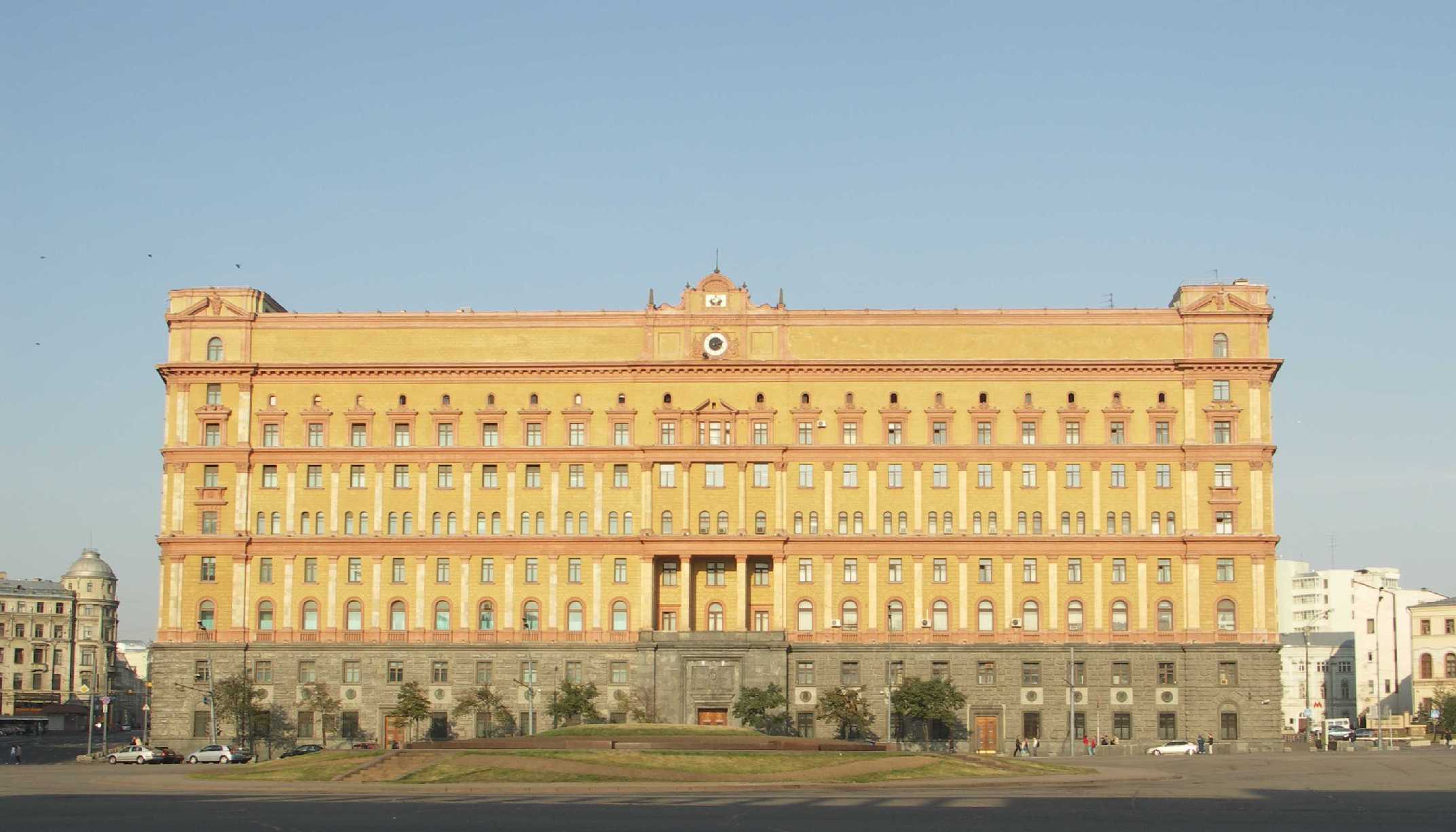
Lyubyanka_The Lubyanka, former KGB headquarters in Moscow. (click)

******************************************************************************************************************************************************************************************************************

* On what “my story” is religiously — a word I don’t like to use but am forced to resort to — something other readers have wanted to know…I’ll have more to say at some point soon.

Comment: nikobakos@gmail.com

More on Alevis and Alawites…or Alevis and Kurds…or Iraqi Kurds…or…Christian Kurds…or Assyrians…or…

27 Sep

A video interview from 2011 of a smart, cute, articulate Kurdish guy from near Maraş that’s a good primer, as it claims, on all the intricacies of the above.

Note the graphic at around 5:08: “Alevi = Alawite”.  And then the interviewer pops the million-dollar question: “So, who are you loyal to?  You’re an Alevi Kurd from Turkey.  Where do your loyalties lie?” — that kind of nails the whole issue on the head.  Because, not being the sharpest tool in the shed,  he doesn’t realize that the Kurdish guy never even gives him an answer.  Because there is none.  Because the question betrays, again, the Westerner’s incapacity to understand that multiple identities can co-exist in not just one nation or one community, but in a single individual.  And you can tell that the interviewer is getting bombarded with a complexity that he can’t even begin to make sense of — largely because he’s trying to make some sense of it in all the wrong ways.

Sad, prescient comment at the end concerning Syria: “It’s going to be a disaster.”

Comment: nikobakos@gmail.com

“Leader of Catalonia Calls for Independence Vote”

27 Sep

From The New York Times:  Leader of Catalonia Calls for Independence Vote

Cataluña.svg(click)

Oh well, you know what?  Good riddance!

See my very personal and rather emotional feelings about Catalans in “Why I can’t stand watching Rafael Nadal win“:

I have a serious repellent reflex towards Catalans. This is largely because I love Spain so much, and their anti-Spanishness really gets my goat. I find their Gallic delusions that they’re so much more European and Mediterranean and civilized than the rest of Spain to be insufferable. (And some day I’ll get around to dismantling the cult of “Mediterranean-ness” itself that’s grown since the 1980s and that I find a completely false and fabricated pop-multi-culti identity that grew out of tourist literature, the public relations campaigns of olive oil companies and a popular sprinkling of Braudel, and nothing else. When even Turks start acting and feeling like they’re “Mediterraneans,” you know that a discourse is b.s. and needs to be taken apart; the extremeness of the hype surrounding Barcelona is part of this, and is why I love the gravitas and even crudeness of Madrid and Castille so much more deeply.)  I find Catalans’ ‘noli me tangere’ squeamishness about how they shouldn’t have to suffer by being a part of this barbaric country of monarcho-fascists and Catholics and gypsies and bull-torturers to be racist pure and simple. They’re Iberian Croatians, in short. There are plenty out there who will get the analogy, I believe.

That’s essentially what it comes down to…because I think I should finally get serious about this issue and not just joke around or make bitchy remarks about Nadal’s hair.  All of us on the periphery, and yes you can include Spain, struggle to define ourselves and maintain an identity against the enormous centripetal power of the center.  So when one of us — Catalans, Croatians, Neo-Greeks — latches onto something — usually some totally imaginary construct — that they think puts them a notch above their neighbors on the periphery and will get them a privileged relationship to the center, I find it pandering and irritating and in many cases, “racist pure and simple.”  It’s a kind of Uncle-Tom-ism that damages the rest of us: damages our chances to define ourselves independent of the center, and damages a healthy, balanced understanding of our self culturally and historically and ideologically and spiritually.  I find it sickening.

Spain — in part because it’s felt it had to compensate for the darker elements of its past — has transformed itself in just a few decades, and in a way I find extremely moving and mature, into perhaps one of the most progressive countries in Europe on a whole range of moral and social issues and especially in being open to regional autonomy and regional, cultural rights.  There is no way you can’t be happily and solidly Catalan, and maintain your culture and language to the fullest degree, within the Spanish state.  Objections are nonsense.

But they had already lost me when they banned bullfighting.

People have written to me that Catalonia leaving will hurt Spain economically.  Maybe.  But we’re not going to beg them either.  So good-bye.  And that’s my “Homage to Catalonia.”

(And then there are the Basques.  Do you know how many inhabitants of the Basque regions of Spain who identify as Basque actually speak the language?  Some 18%!  And yet, this practically identity-less identity has been the motivation for decades of violence and terror.  There’s no more twisted example of post-modern identity foolishness than I can think of.  A violent political struggle to save a museum culture.  When 50% of you have bothered to actually learn the devilishly difficult language you’re so proud of, then go ahead and engage in any kind of separatist resistance — violent or non — that you feel like.)

And I’m just sick to death, generally — in a globalizing world — of childish, whiny separatist movements among every two-bit tribe that thinks it’s special.  A waste of time, energy, often a cause for completely unnecessary violence and deafeningly narcissistic.

Comment: nikobakos@gmail.com

WOW! These are Russians? — “Russians Protest Putin’s Stance on Ukraine”

27 Sep

See New York Times article.

russia-superJumbo A man wore a Ukrainian flag around his shoulders during an antiwar rally in Moscow that drew thousands on Sunday. Credit Sergei Karpukhin/Reuters (click)

You have to have been there during this July and August to watch the crazed nationalist virus invade even intelligent people’s brains to understand my “WOW!” bewilderment.  Maybe there is hope.

Comment: nikobakos@gmail.com

“A Greek Politician Willing to Face the People”

27 Sep

An amazingly flattering article on Rena Dourou, MP of Syriza, from the Times:

DOUROU-superJumbo “People were amazed to see me. They had never met a politician. They were touching me, saying, ‘You are Rena Dourou?’” Credit Lynsey Addario for The New York Times (click: great pic and great Greek female face — not conventionally beautiful, but sexy in our sharp and edgy and smart and witty way.)

Not in a position to judge Syriza, Dourou’s slightly left of center party; people whose opinions I respect think the party’s leader, Alexis Tsipras (see Nicholas Gage’s assessment here and and my response here) is a not-to-be-taken-seriously posturer and brat; and the truth is he reminds me and others a little too much of a young Papandreou — and smells a little like too many Athens College graduates I know, though I don’t actually know where he went to high school.  But the portrait of Dourou is convincing enough.  Just the way she’s apparently dealt with the sexism of the Greek political establishment, at least, seems something to commend her for.

Money quotes:

Easy to mock as cheap and populist:

…for the time being, Ms. Dourou’s election as prefect, the rough equivalent of the governor of New York, represents the party’s biggest victory so far.

Petite and blond, Ms. Dourou ran an American-style campaign, going door to door, something most Greek politicians avoid out of fear of being assaulted by angry citizens. [My emphasis — only ’cause I thought it was really funny] On her office wall, she kept a map of the region with dozens of pins indicating where she had traveled. Few opinion polls correctly predicted her victory.

But she brought her handshakes and her motto — “if you feel you have the life you deserve, don’t do anything and vote for the same old people” — all over the city, even to areas considered bastions of the right-wing Golden Dawn party.

“I don’t know whether it got me any votes,” she said. “But people were amazed to see me. They had never met a politician. They were touching me, saying, ‘You are Rena Dourou?’ ”

And a perfect little detail with which you can paint the Greek political establishment’s level of professionalism, and Neo-Greek spoiled loser pettiness:

But for the time being, she remains an official with few allies in office and little experience. A few months after winning and before taking office, she sent a formal letter to her predecessor asking to be briefed on the “loose ends” and “current issues” in the region. In his response, he told her the information was on “corresponding websites.”

And this is the kind of stuff for which Syriza gets my ambivalent respect:

NONETHELESS, she has already made headlines for a public brawl with the central government over the future of thousands of municipal workers in her region. The central government wants to review their credentials and evaluate their performance. But Ms. Dourou sees this as a thinly veiled starting point for cutting workers and pleasing Greece’s creditors, and she is refusing to hand over their files.

Dealing with Neo-Greek male garden slugs:

STILL, politics in patriarchal Greece can be tough on women. Last year, the vice president of the government, Evangelos Venizelos, told a female member of Parliament that “she should be pregnant.”

As Ms. Dourou was campaigning for office, a former deputy prime minister from the socialist Pasok Party, Theodoros Pangalos, said in a radio interview that he could not stand seeing posters of Ms. Dourou’s “filthy face” all over Athens. He added that he would “like to see her campaign complete with a full-body picture of her with a bikini.”

Dunno…  We’ll have to see.

Comment: nikobakos@gmail.com

Photo: Belgrade, summer 2014

26 Sep

Belgrade photgraphersZorana Marković

A Karamanlidiko map of the Americas

16 Sep

From Annia Ciezadlo, author of the delicious and also extraordinarily moving Day of Honey: A Memoir of Food, Love, and War (which I advise you not to read until you’re certain that there’s decent Middle-Eastern food in reasonable proximity to where you are, because otherwise the cravings it creates will kill you), and via someone on Tumblr called “glykosymoritis” — “sweet gangster”? comes this map of the Americas in Karamanlı, the Greek script that the Turkish-speaking Christians of central Anatolia used to write Turkish in. 

tumblr_n85l4e4ePN1srjuvno1_1280

Who could this have possibly have been drawn up for? (click)

9781416583936_custom-a24320eb4ef46c1e284f8aa30ac07c67eeae9ad2-s99-c85

Comment: nikobakos@gmail.com

More Ukraine: best summing up of what happened today, from Andrew Sullivan’s DAILY DISH

16 Sep

Ukraine Splits The Difference

Sep 16 2014 @ 2:59pm
BxphZLHCMAAdnz2

The Ukrainian parliament had two big items on its agenda today:

In a vote synchronized with the European Parliament in Strasbourg, Ukrainian lawmakers unanimously approved the association pact over objections from Russia, which fears the loss of a market for its goods and damage to its economy from an influx of European products through Ukraine. … Earlier Tuesday, legislators voted behind closed doors to approve two bills granting amnesty to rebels and greater autonomy for eastern regions as part of an effort to consolidate a tenuous Sept. 5 cease-fire and end the fighting in eastern Ukraine. The decision on Tuesday to enshrine in law an amnesty and a framework for self-rule in the east represented a major concession to Russia that in many ways gave the Kremlin what it had been seeking since early in the conflict, long before the violence broadened and thousands died.

Bershidsky doubts Ukrainians will thank Poroshenko for this:

That, in effect, is Ukraine’s signature under the creation of a frozen conflict area.

For Russia, that kind of buffer is the best: It’s not an unrecognized state with a murky status, but an officially recognized enclave within Ukraine. Kiev takes responsibility for it, but has little or no influence on what happens there. The law will probably stand for now, as long as Poroshenko and Putin manage to make the shaky cease-fire in eastern Ukraine stick.

This is a bitter pill for Ukrainians to swallow. “I wouldn’t have voted for this bill if I had been a legislator,” journalist Mustafa Nayyem, who is running for a parliament seat as part of Poroshenko’s electoral bloc,wrote on Facebook. “I see no value in compromises that can lead to another political split in Kiev, mutual accusations of treachery and a show-off patriotism contest.”

Linda Kinstler is despondent:

A frozen conflict, when the Kremlin is involved, is what happens when, as the BBC put it, “a bloody, territorial conflict with no obvious solution is put on hold, with Russia stepping in to keep the peace on its own terms.” On Tuesday, the self-declared Donetsk and Luhansk People’s Republicsannounced they are merging their militias into a single force, the United Army of Novorossiya, which will liberate Ukraine from “Nazi scum.” These are the people who will be ruling the populations of Donetsk and Luhansk for the next three years. It’s hard to look at all this and not get the feeling that those who died fighting for Ukraine gave their lives for naught.

Walter Russell Mead is aghast:

Make no mistake about this. The settlement is a deeply damaging blow to our values, to our prestige and to our geopolitical interests. The foolish and distracted Western policies that encouraged Ukraine into a confrontation with Russia in which the West was unwilling to back it; the shameful and feckless mix of triumphalist rhetoric and minimalist action; the cluelessness in the face of Putin’s skillful mastery of Western psychology and divisions; the miserable consequences of all this for the Ukrainian state: every country, every leader in the world has been paying close attention. Historians, by the way, will also pay attention; the Obama legacy has been permanently tarnished. Unless some real changes take place, neither this President nor his close associates will cut an impressive figure when the accounts are drawn up.

And Jan Techau is skeptical that the EU will be able to act as “the de facto guarantee power for another entity’s political success against the declared intentions of a regional rival”:

There is already a sense creeping into the foreign policy crowd that Europeans may have bitten off more than they can chew. Unity among 28 member states is extremely fragile. The remodeling of the European Neighborhood Policy—the instrument that guides EU relations with Ukraine and other Eastern neighbors—will be tedious and fraught with institutional infighting in Brussels. And money is scarce. More significantly, there are severe doubts that the EU has the political will and the diplomatic toughness to insist on conditionality, the core piece of the neighborhood policy. But without a swift, watertight, and potentially brutal sanctions mechanism for neighbors that do not adhere to an agreed reform process, the transformative power of any new policy will be exactly what it was under the old one: close to zero.

On the other hand, the recent US-EU sanctions on Russia really do seem to be biting, with the Russian ruble falling and state-owned industries like Rosneft asking the government for aid:

Economist Alexei Kudrin, who served as finance minister under President Vladimir Putin for 11 years until 2011, said Tuesday that the sanctions could send Russia into a long recession. “The sanctions that have been imposed are going to have an effect (on the economy) for the next one or two years because they have limited opportunities for investment in this uncertain environment,” Russian news agency Interfax quoted him as saying. … The rouble is this year’s biggest-declining major emerging currency, having lost more than 15 percent in value to hit a new low against the US dollar on Tuesday.

Zenon Evans sees signs that tensions are de-escalating:

Russian state-owned media has made a “drastic change” lately by softening its anti-Ukrainian rhetoric, according to the independent Moscow Times. This may be a positive sign of Russia winding down its war. For its part, the U.S. is also speaking somewhat more softly about Russia. President Barack Obama admitted that Crimea “is gone,” and Secretary of State John Kerry last week called upon Moscow to help America fight the Islamic State, which has personally threatened Putin.

But Katie Zavadski catches a Russian official talking about Russians in the Baltics in a manner eerily reminiscent of the lead-up to the Crimea invasion:

Konstantin Dolgov — Russia’s foreign minister on issues of human rights, democracy, and rule of law — voiced concern Saturday over the treatment of Russian citizens in the Baltic states. Consider that a warning. According to the text of a speech published on the Russian foreign ministry’s website (and evidently given at the Regional Conference of Russian Compatriots of Latvia, Lithuania, and Estonia in Riga), the “protection of the rights and lawful interests of our compatriots abroad is one of the prioritized actions” of the foreign ministry. The speech’s inflammatory language echoed the precursors of Russia’s annexation of Crimea, citing concerns for the well-being and rights of Russians in the territory.

NATO is hip to this threat, Eli Lake reports, and is warning the Kremlin against trying to pull off a stealth invasion of a Baltic state:

[NATO Commander Gen. Philip] Breedlove, speaking at the Atlantic Council on Monday, said if the Kremlin tried that in one of the NATO allies that border Russia—like the former Soviet republics in the Batlics, for example—it would risk triggering Article Five of NATO’s charter which is the section that calls on the alliance to come to the defense of a member state being attacked. … Breedlove added that the issue was discussed this month at Wales at the head of state summit. “We had great acceptance among the NATO allies though that if you attribute this ‘little green men’ issue to an aggressor nation, it is an Article Five action and then all of the assets of NATO come to bear.”