Balkans, Anatolia, Caucasus, Levant and other Middle East, Iran, Afghanistan, South Asia, occasional forays into southern Italy, Spain or eastern Europe, minorities, the nation-state and nationalism — and whatever other quirks or obsessions lurk inside my head.
Two dumb articles from the Times: one on “saving” “dying” French food: “Can Anyone Save French Food?” and another condescending screed: “Letter from France – A Vegetarian and Gluten Free Guide to Paris” — so patronizing and culturally presumptuous about so many things that if it had been about any other country we would call it colonialist — about how France is finally becoming a civilized country and giving Vegans and other related creatures more dining options. It just doesn’t stop.
Chef James Henry of Bones. Jonathan de Villiers for The New York Times (click)
The Resurrection of Lazarus, Giotto, Assisi, Lower chapel (click)
(This Saturday of Lazarus, I’m just pretty much reposting a post I put up three years ago, only a few days after this blog was started)
“Today, the day before Palm Sunday, is known as the Saturday of Lazarus in the Orthodox Church, the day that commemorates Christ’s raising of his friend Lazarus from the dead, prefiguring his own Resurrection.
“And here’s Aretha Franklin’s incomparable rendition of the old gospel song: “Mary Don’t You Weep,” which commemorates the story of Lazarus and the Passover story as well. Below are the lyrics (“If you hadda been here, my brother woudna died…” always kills me) of this spiritual, which dates from before the Civil War, as its moving conflation of the two tales of redemption would indicate:”
(Choir) Oh oh mary (x8) (Soloist) Mmm don’t moan Listen Mary
(Choir) Oh Mary don’t you weep Oh Martha don’t you moan Oh Mary don’t you weep (Soloist) Tell your sister to don’t moan (Choir) Oh Martha don’t you moan
(Soloist) Pharaohs Army (Choir) Pharaohs army (Soloist) All of them men got drowned in the sea one day (Choir) Drown in the Red Sea (Soloist) Yes they did
(Soloist) Now if I could (Choir) If I could (Soloist) If I could I surly would (Choir) Surely would (Soloist) I’d stand right up on the rock (Choir) Stand on the rock (Soloist) I’d stand right where moses stood (Choir) Moses stood (Soloist) Yes I would
(Soloist) Pharaohs army (Choir) Pharaohs army (Soloist) I know you know that story of how they got drowned in the sea one day, oh yeah (Choir) Drown in the Red Sea
(Soloist Lazarus Story Ad-lib)
We gonna review the story of two sisters Called mary and martha They had a brother Named Lazarus One day while Jesus was away Their dear ol’ brother died, yeah yeah Well now Mary went running to Jesus She said, “Master, My sweet lord!” “Oh if you had’ve been here my brother wouldn’t have died!” Oh yes she did. Jesus said, “come on and show me, show me where you, show me where you buried him, show me where you laid him down!” And when he got there, Jesus said, “For the benefit of you who don’t believe, Who don’t believe in me this evening! I’m gone call this creature, oh yes I am! He said “Lazarus, Mmm Lazarus, Hear my Hear my voice! Lazarus! Oh yeah!” He got up walking like a natural man, oh yes he did! Jesus said, “Now now now, Mary, Mary don’t you weep!” Mmm Oh mary don’t you weep Go on home and don’t you and your sister moan. Don’t moan. Tell martha not to moan
(Choir) Pharaohs army (Soloist) Because you see Pharaohs army, (Choir) Drown in the red sea (Soloist) they got drowned in the Red Sea
(Soloist) Oh Mary don’t weep (Choir) Oh Mary don’t you weep (x3) (Soloist) Mary dont weep (Choir) Oh Mary don’t you weep (Soloist) Mary don’t weep (Together) Tell Martha don’t you moan
(Sorry, but sometimes the Jadde is just gonna be the Nole Djokovic page for a few days…. Especially at times like this. I know…there are more important things happening in the world, but sometimes the most important is, well…)
From The Bleacher Report:
Novak Djokovic’s Win over Andy Murray Isn’t Tainted by Bad Call
NovakDjokovic has gotten off to a relatively slow start this year, but the world No. 2 is in the process of knocking his game into overdrive.
Don’t let the fact that his victory over Andy Murray in the quarterfinals of the Sony Open was heavily assisted by a bad call fool you into thinking any differently.
Nole is 12-2 on the year, and he got his first tournament title of the year at Indian Wells in the last event. It is hard to knock that kind of start, but we’ve grown accustomed to Djokovic having multiple titles at this point of the year. This was the first time in four years he hasn’t won the Australian Open.
Apparently, that does not mean he is headed for a down year, and the Serb asserted his dominance against Murray.
“With the win at the BNPParibas Open, the No. 2 player in the world looked sharp, strong and returned to a superb form of tennis that had him as one of the most dominant forces just years ago.
“Not only did Djokovic come away with a title, but he also proved to himself that he had returned to the mentality that he had when he was crushing the competition. The 26-year-old spoke about the regained confidence with ESPN:
“Not winning a title and coming here, there were certain doubts. I had ups and downs in my concentration in opening rounds, but I managed to stay mentally strong and have that self-belief. That’s something that definitely makes this title very special to me.”
Did we all hear that?“C-R-U-S-H-I-N-G THE COMPETITION!!!”
Maybe being No. 2 is a good thing, man…keeps him hungry, I dunno… But HUUUAAAHHH!!! CRUSH the competition!!!
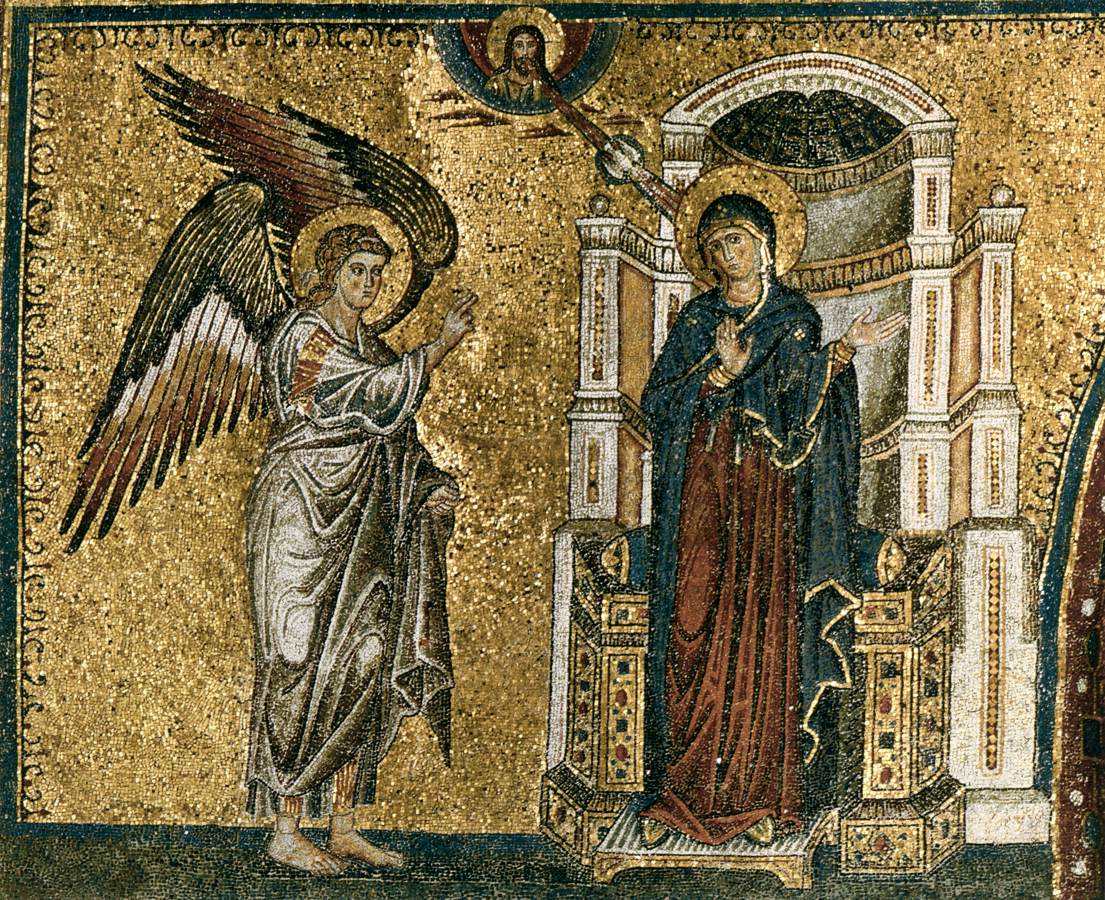
The Annunciation of the Virgin mosaic from Rome’s Santa Maria Maggiore (click)
Today is the Feast of the Annunciation, when the Archangel Gabriel appeared to a terrified, barely post-adolescent Jewish girl in a village in Galilee and told her that she was going to become God’s mother. And in one of the greatest acts of moral bravery in history, this — what? fourteen-year-old? — Jewish girl said: “Yeah…ok.”
This is a “yes” which we should all pray to be given the opportunity to offer up to some one or to some greater thing, in even the tiniest of manners, at some one point in our lives. It, oddly enough or not, always puts me in mind of the name “Reza,” which I’ve always loved on Persian men, since as far as I understand it, it means “willingness, acceptance, consent…” a saying-yes to Life or to the Divine Will. (The other is “Peyman,” with its comparable sense of promise and commitment.) Except in Mary’s case it’s a “saying-yes” that’s particularly female in its bravery, since she barely understands what’s being asked of her and she consents out of pure love, and most men find such consent difficult without first knowing what glory there is in it for them. Instead Mary does the glorifying:
48 For he hath regarded the low estate of his handmaiden: for, behold, from henceforth all generations shall call me blessed.
49 For he that is mighty hath done to me great things; and holy is his name.
50 And his mercy is on them that fear him from generation to generation.
51 He hath shewed strength with his arm; he hath scattered the proud in the imagination of their hearts.
52 He hath put down the mighty from their seats, and exalted them of low degree.
53 He hath filled the hungry with good things; and the rich he hath sent empty away.
54 He hath helped his servant Israel, in remembrance of his mercy;
55 As he spake to our fathers, to Abraham, and to his seed for ever.
That’s March 25th: the Annunciation of the Virgin. The rest — by which we mostly mean Greek Independence Day — is bullshit. Nothing that led to the establishment of the first independent Kingdom of Greece happened on March 25th. There were sporadic outbreaks of rebellion, some semi-coordinated, among Ottoman Greeks throughout the Empire in the early spring of 1821, but there was no raising of any standards, or launching of any campaigns or declarations of any kind made on March 25, 1821 as far as we know. Except for sporadic massacring nothing much occurred at all that year until the fall, when, only with foreign help, the Greek rebels were able to finally take Tripolitsa in the Peloponnese and butcher the majority of its Muslim and Jewish — meaning practically its entire — population. And eventually all that happened is that the Greek statelet slapped its observation of Independence Day onto the Annunciation in a conscious-or-not appropriation of the holiday’s already inherent meanings of conception, inception and beginning (I think that, the Julian Calendar still in operation at the time, March 25th was also Easter Sunday that year so, with the theme of Resurrection added, the temptation was irresistible) and so Althusser’s Ideological State Apparatus smothered one of the loveliest holidays of the Church with flags and parades and tanks and national anthem sap and all the other cheezy trappings of N/S patriotism.
But by the same token, the Annunciation itself was slapped by the Church onto the pre-existing observation of the Vernal Equinox (by a few days), the Persian Zoroastrian New Year, Nowruz, the first day of spring, the first day of the month of Aries — with its already inherent meanings of conception, inception and beginning. And fast forward nine months, exactly (she was nothing if not on-time our Pantanassa*) and we have Christ born on (or near) another Zoroastrian holiday, Yalda, which marks the Winter Solstice and the beginning of the lengthened days and the Sun’s return to our lives. The Winter Solstice, in more ancient Iranian religion, was the birth date of the deity Mithra, often associated with the Sun, and who — guess what? — was often said to be born in a cave, of a virgin mother, and who saved the world through the sacrifice of a bull along with a whole other complex of shifting tales and myths that I’m not an expert on.
But though Mithra seemed to fade into a secondary deity in classical Sassanian Zoroastrianism, he was accepted with great fervor and enthusiasm into the highly eclectic polytheism of the late Roman world, where he was especially popular in the Roman army. Many of the latter emperors were devout followers and there are historians that believe — seems like a bit of an exaggeration to me — that the West came close to being a Mithraic civilization instead of a Christian one. But the Church slapped Christ’s December 25th birthday onto Mithra’s (I’m simplifying some) and that was the end of Mithraism. Which is a bummer, because by the Second Century A.D., Mithraism had evolved, in Roman hands, into a super-butch, male virility bull-cult for an initiated military elite, all wrapped-up in the full panoply of Hermetic-Alexandrian-Astrological wisdom, where Roman officers and soldiers gathered in caves and commemorated the sacrificed bull and honored its blood (we don’t really know what occurred because it was only for the initiated but a sacrifice and subsequent shared meal of some kind was probably involved) and Christianity is kinda — well — is kind of lacking in those kinds of thrills. One of my best beloved Roman ancestors, Julian the Apostate (the subject of four Cavafy poems), a fascinating figure, who was both a devotee of Mithra and an initiate into the Eleusinian mysteries, tried to reverse his uncle Constantine’s establishment of Christianity as the Roman state religion and give support to the traditional pagan cults, their rites, rituals and sacrifices, but it was already too late. People just wanted their blood as metaphor by then, a shift in consciousness that has always been considered psychic or intellectual progress of some kind though — like the shift to monotheism itself — I could never quite understand why. Those of us who still like reality better still have and have always had Spain though; that’s unless the European Union and PETA and the Catalans take their sanitary Handy-Wipes to the corrida too and that’ll be the real end.
Ah, but even then we’ll still have Mexico…
Mithra and the Bull, from the Vatican Museum (no other info) (click: it’s a huge and beautiful file)
What conclusions can we draw from all this? One, is that humanity is not particularly imaginative and just kinda copies itself over and over ad infinitum. Second, is the idea that often comes up when looking at our zone, thinking about “our parts,” more closely — and that’s the simple conclusion that everything is Persian. Not just our food, our music or dance, our dress, our color palette, our poetic sensibility and ideas about love, but our common penchant for narrative cycles of martyrdom and rebirth (see: “Ashura 1435: a poem from Agha Shahid Ali”) and the deeper structures of our spiritual psyches. It’s tempting; instead of the inane arguments about what’s Greek and what’s Arab and what’s Indian and what’s Turkish — everything is Persian, and be done with it. Alexander seemed to have gotten it; shouldn’t be too hard for the rest of us. But probably the truth lies and always will lie with Jung: and that is that all of the imaginary activity of the human unconscious operates on one, unified, symbolic grid of archetypes.
Chronia Polla to those whose namedays are today. And signing off this post with R&B singer Lauryn Hill’s beautiful “To Zion” where the subtitle of this post comes from. This was a song that came from her real-life experience of having to choose between having an unexpected baby and sticking with her career. “One day…you gonna understand…” Lyrics are below:
“To Zion”
Unsure of what the balance held I touched my belly overwhelmed By what I had been chosen to perform But then an angel came one day Told me to kneel down and pray For unto me a man child would be born Woe this crazy circumstance I knew his life deserved a chance But everybody told me to be smart Look at your career they said, “Lauryn, baby use your head” But instead I chose to use my heart
Now the joy of my world is in Zion Now the joy of my world is in Zion
How beautiful if nothing more Than to wait at Zion’s door I’ve never been in love like this before Now let me pray to keep you from The perils that will surely come See life for you my prince has just begun And I thank you for choosing me To come through unto life to be A beautiful reflection of His grace See I know that a gift so great Is only one God could create And I’m reminded every time I see your face
That the joy of my world is in Zion Now the joy of my world is in Zion Now the joy of my world is in Zion Now the joy of my world is in Zion
Marching, marching, marching to Zion Marching, marching Marching, marching, marching to Zion Beautiful, beautiful Zion [repeat to end of song]
*”παντάνασσα,” pantanassa, is one of my favorite epithets for the Virgin, but whether it means “all-breathing, giver-of-breath, breath-granting” I can’t tell, nor can anybody else I know.
**Latest addendum note: Beloved dinosaur cousin — who is the always the one one should go to for these question, since he’s a monster of erudition in most fields, but especially Greek language, informs us that Pantanassa has nothing to do with breath or breathing, as many of us must assume, but: Η άνασσα είναι το θηλυκό του άνακτος (ονομαστική: άναξ), του βασιλέως (εξ ου και ανάκτορα). “Anassa” is the feminine form of “Anax,” meaning king, same root as “Anaktora,” or palace. So it simply means “Queen of Queens,” which is kind of disappointingly Catholic-sounding. Speaks to a whole history of Greek and Latin vocabulary mixing itself up, replacing, re-replacing, disappearing and then appearing again, especially in titles of government or military due to initial composite character of Byzantine state structure. I’m assuming, i.e., άνασσα was already an archaically Greek word at the time, for example, the Chairetismoi were written.
And a personal sensory note: According to the guidelines of Orthodox fasting, which if observed carefully constitute the most elegantly designed spiritual economy of partaking and abstaining one can imagine (probably only Hinduism could produce a more intelligent schema) — again, the guidelines, not the rules, meaning it doesn’t affect your G.P.A. at the end of term if you slip up, like if you’re Catholic — fish is considered meat, and is not eaten during Lent. But there are festive days, essentially the Annunciation and Palm Sunday, which even in the sorrow of Lent, should be marked as Feasts, and then the eating of fish is practically obligatory. Today in the streets of Greek neighborhoods, therefore, here in Athens or in Astoria, in apartment house corridors and restaurants, the smell of fried bacalao is all-pervasive. One of my strongest sensory memories of Holy Week as a child is being taken to the matins for Holy Monday on Palm Sunday evening, the first of the so-called “Nymphios” or “Bridegroom” services (the reference being to Christ coming to Jerusalem for Passover and to meet his fate) and all the old women in church smelling like fish fritanga.
And a really interesting article from Wiki about “Tauroctony” or “Bull-slaying” if you’re interested in the phenomenon religio-anthropologically. Again, the best book, that’s both an anthropology of Mediterranean bull cults and the best sociological history of Spanish bullfighting there is, is Timothy Mitchell’s “Blood Sport: A Social History of Spanish Bullfighting.”
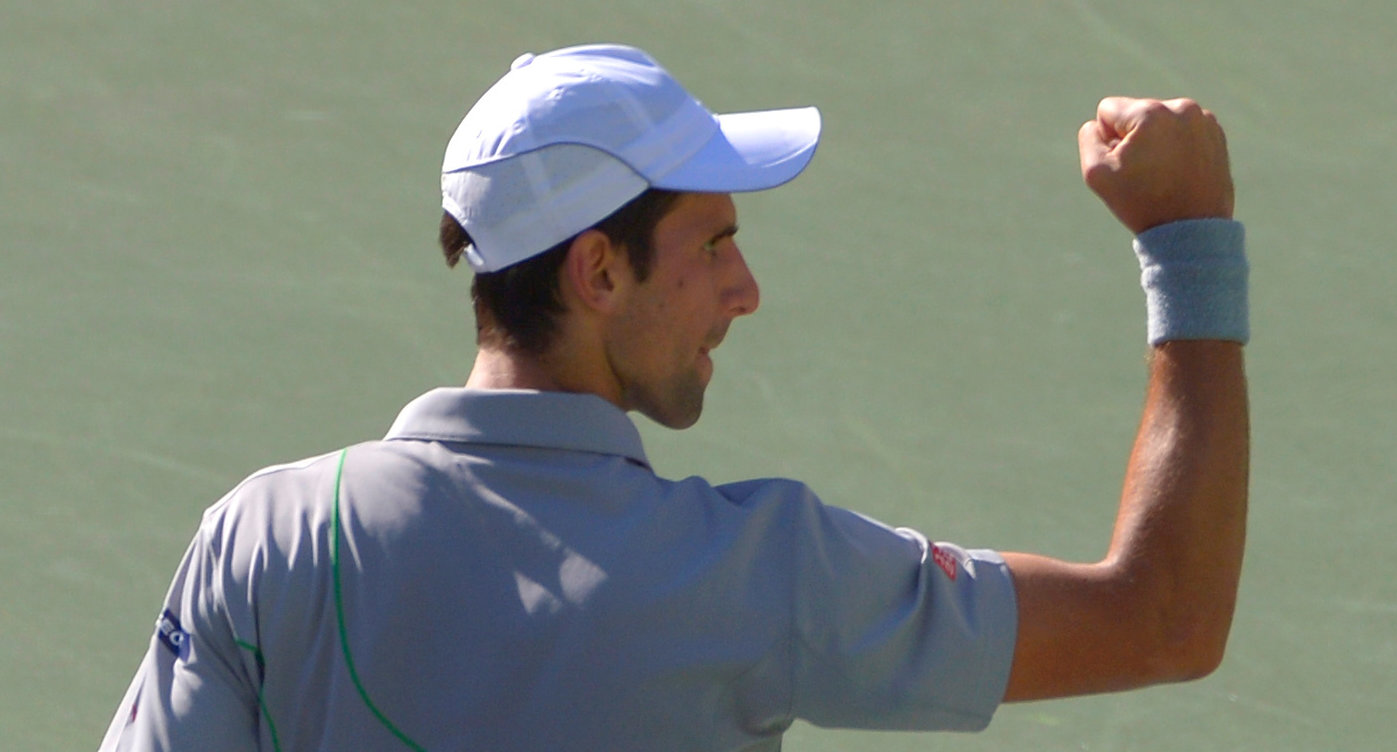
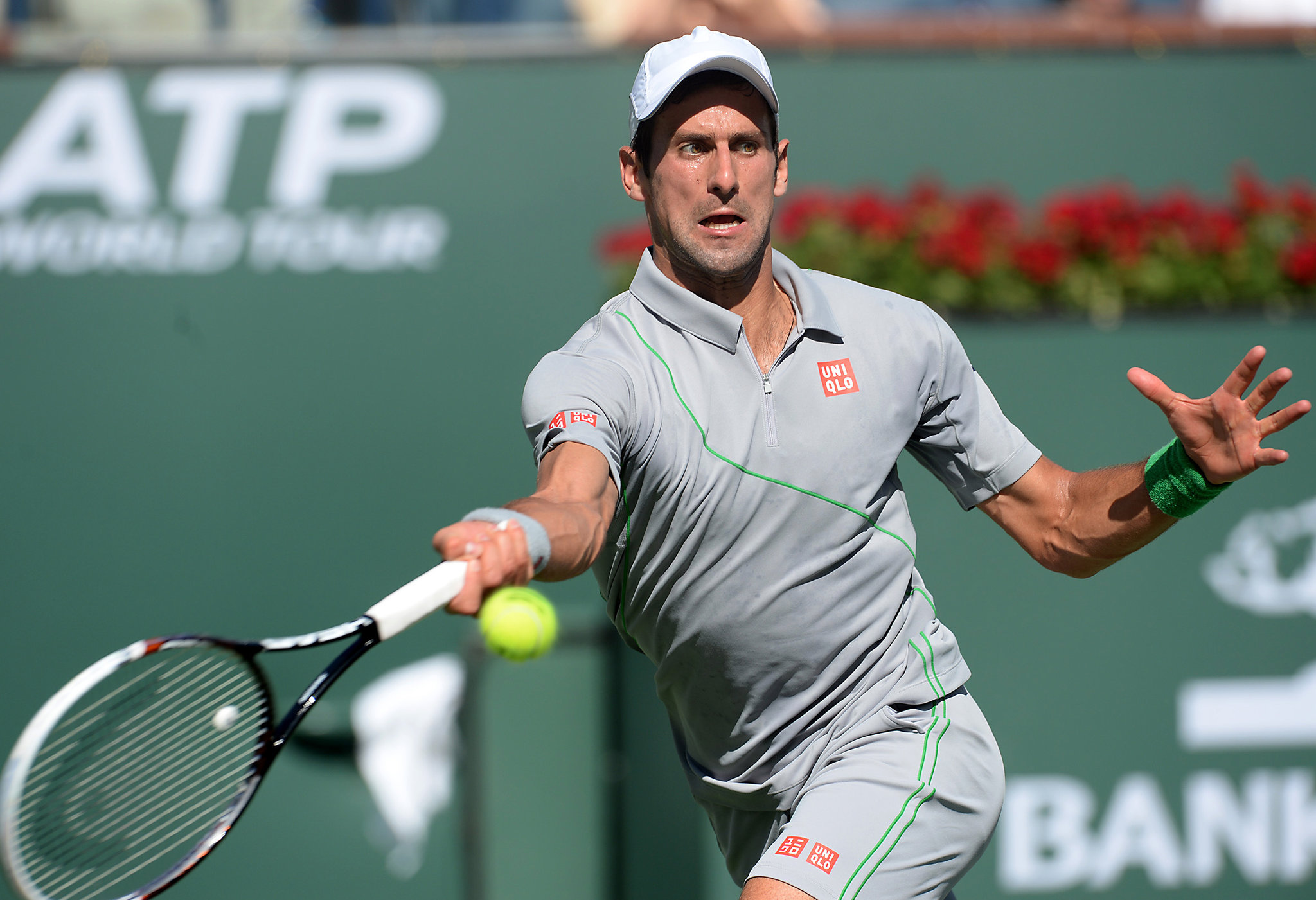
They can’t let Nole win, without making it about how well Federer lost. Granted, Federer is Federer, but sometimes the bias just seems too obvious. (Hot pic at least…)
Djokovic reasserted himself in the tiebreaker that ended the match. Credit Mark J. Terrill/Associated Press (click)
From The New York Times:
In Loss, Federer Shows More Evidence of Resurgence
By BEN ROTHENBERGMARCH 16, 2014
INDIAN WELLS, Calif. — Roger Federer leaves the BNP Paribas Open having reclaimed his champion’s aura, even after finishing as the runner-up.
After winning the first set of the final on Sunday, the seventh-seeded Federer dropped the next two, ultimately losing, 3-6, 6-3, 7-6 (3), to No. 2 Novak Djokovic, who claimed his third title at this Masters 1000 event in the desert of the Coachella Valley.
Serving for the match at 5-4 in the third set, Djokovic became more tentative and Federer pounced, racing out to a 0-40 lead that had the crowd roaring. When he broke, the crowd rose to salute his resilience.
But in the tiebreaker that ended the match, Djokovic reasserted himself. He won two of the first three points on Federer’s serve in the tiebreaker to take a 5-1 lead and eventually sealed the match at 7-3. When Federer’s final backhand hit the net, Djokovic calmly removed his hat and raised his fist toward his player’s box as he walked to the net.
“I stayed mentally tough, and that, for me, is something that gives me a lot of encouragement and hopefully a confidence boost for the rest of the season,” Djokovic said of his late-match recovery.
Novak Djokovic won the BNP Paribas Open title over Roger Federer, 6-3, 3-6, 7-6 (3). Credit Jayne Kamin-Oncea/USA Today Sports, via Reuters
–
Both Federer and Djokovic dressed in shades of gray, and there was little to distinguish them statistically, either. Each man struck the same number of winners as unforced errors — 34 in each category for Federer, 28 for Djokovic. Djokovic won just one more point, 99 to Federer’s 98.Though the tournament began with several upsets — Djokovic was the only one of the top six seeds to reach the quarterfinals — it ended in a familiar battle between two of the most dominant players of this era. The so-called Big Four — Djokovic, Federer, Rafael Nadal and Andy Murray — have won 28 of the last 29 Masters 1000 events.Federer’s continued presence in that ruling elite has been shaky over the last 10 months. His streak of 36 consecutive appearances in the quarterfinals of Grand Slam events ended last June with a second-round loss at Wimbledon to No. 116 Sergiy Stakhovsky. His listless fourth-round exit at the United States Open to 22nd-ranked Tommy Robredo was perhaps more unsettling.During that time Federer, 32, had back problems. He doubted his racket, switching to a larger model, only to switch back. He had a stretch of nine months without defeating a top-10 player. His pretournament ranking of No. 8 was his lowest since 2002.But in 2014, Federer has looked like his old self. With a healthier back, a larger racket and a new adviser, Stefan Edberg, he has gone 19-3, and he beat Djokovic and sixth-ranked Tomas Berdych to win in Dubai last month. By reaching Sunday’s final, he will re-enter the top five at No. 5.After the match, Federer said critics might have rushed to bury his career without seeing his slump in perspective.“You have to look at the overall case, Federer said. “What’s been happening, what are the reasons for maybe not playing so well, or for playing well? You don’t just forget how to play tennis, you know. Age is just a number. It’s nothing more, really. That’s how I see it, anyway.”For Federer, whose back problems began at this tournament a year ago, the second-place finish had a silver lining.
“If you see the angle that last year was difficult — especially this time around last year in Indian Wells — I’m able to turn it all around now, and I’m really playing nice tennis,” Federer said. “You know, that’s also what I said out on the court. And I truly believe that I’m playing good tennis, and then it’s maybe sometimes a little easier to lose this way.”
Though Federer leaves Indian Wells technically a loser despite the boost to his confidence, another 32-year-old leaves the desert with a trophy. Flavia Pennetta, an Italian veteran who acknowledged contemplating retirement last year when her ranking fell outside the top 100, beat second-seeded Agnieszka Radwanska, 6-2, 6-1, for the biggest title of her career and her first in four years. Pennetta’s ranking will move to 12th, from 22nd.
Radwanska, who began the match with her left knee taped, struggled with the injury throughout the match and barely ran for balls as the second set wore on. Several visits from the trainer to apply more tape provided little relief.
“I’m so sorry that I couldn’t run as much as I could,” she said later, fighting tears.
For Pennetta, there were only smiles.
“Thirty-two, O.K., we are old,” Pennetta said, using air quotation marks with the adjective. “But we’re still good athletes.”
P.S., then this: “Evidence Mounts That Men’s Top Four Tennis Players Are No Longer on Pedestal ,“ about how the top four — Nadal, Djokovic, Federer, Murray — aren’t all that anymore. Whatever. Just as long as I live to see the Catalan crushed and humiliated and forced to leave the game and his career in disgrace — I’ll be happy.
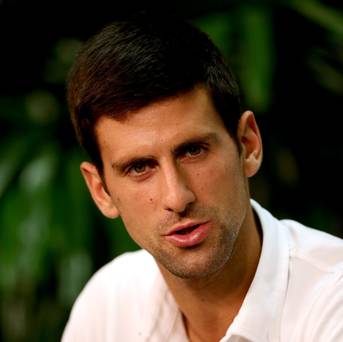
There are times, but especially in certain photos and poses, like this recently posted one:
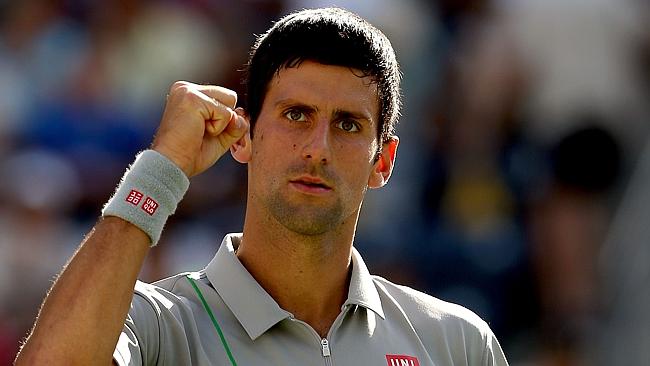
where Djokovic looks so completely Albanian to me it almost gives me a start. He was involved as spokesman for that controversial Kosovo je Srbija (Kosovo is Serbia) campaign, but he’s not known as a rabid nationalist and I’m sure he wouldn’t mind my observation. For all I know, it’s my imagination. I only know that his father’s family is from Kosovo; he may look entirely like his mother and she may be from far northern Vojvodina and be as blonde as a German. But…a Nole just like in this picture…thinner and more beaten-up by life, more sunburned and less suntanned, was a face you saw on every construction site in Athens for more than a decade.
But that’s not so much the case any more. As I’ve written elsewhere, it’s gratifying to see how Albanians (once again) have integrated into Greek society, owning their own businesses, buying homes, and living as well (or as badly) as anybody else here.
I go to a gym here near the house of some friends I’m staying with in Athens’ Northern Suburbs. Now, the “Northern Suburbs” are more than just a set of beautiful, pleasant, green neighborhoods, perhaps the most attractive part of the city, and certainly the areas that have most preserved the ravaged natural beauty of Attica. The Northern Suburbs are a state of mind. They’re an accent (affected and obnoxious), an attitude (affected and obnoxious) and an entire world view (provincial, affected and obnoxious) and, in general, the manifestation of the whole vacuous culture of hollow prosperity that characterized Modern Greek society from 1974 until the present Crisis. What will come out of the present Crisis is yet to be seen; it may be an opportunity. Don’t hold your breaths though.
Anyway, today I was at the gym and this kid asked me for a spot. Attractive, nice body, pushing thirty, perfect Greek, even with the local “Northern Suburb” intonation. If I had had to say I would’ve said Thessaly or Epiros over Crete or Cyprus, certainly, but not regionally distinguishable in any particular way. We started talking. He asked where I was from. I said New York. “Esy?” “From Tepeleni.” Pause. “Like Ali Pasha…,”* he smiled. “I know,” I said… “My dad was from near Gjirokaster.” We didn’t talk religion or language. It was nice.
Just some thoughts. Worlds and peoples coming together. The waste of having been separated to begin with. More when I deal with that silly DNA piece I promised to translate a few weeks ago.
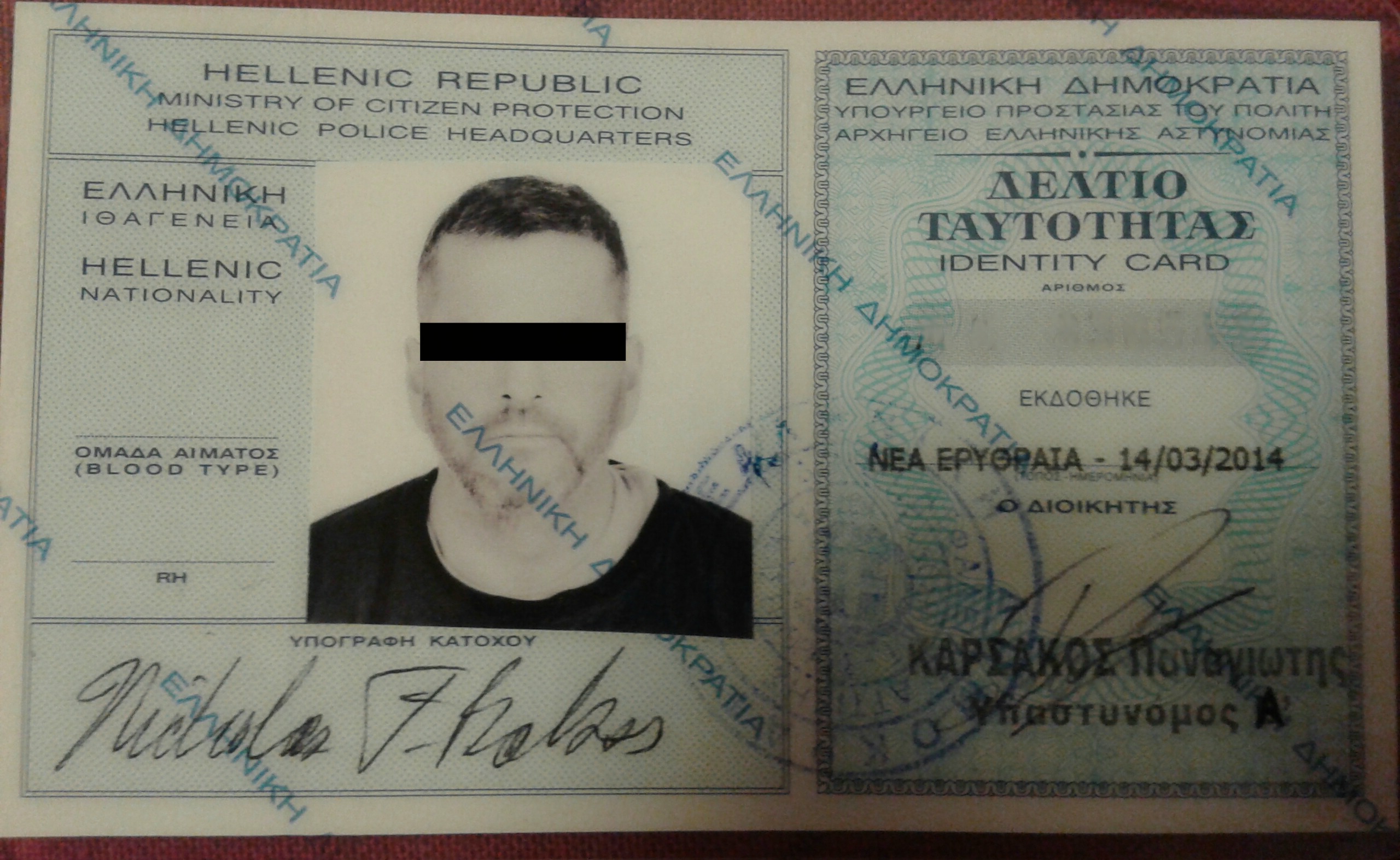
…right there in the police station, like an idiot.
It irritates me, aggravates me, frustrates me, disappoints me, I feel like sending it and most of its inhabitants to the Devil most of the time. I can’t even stand the name (Republic of Greece wasn’t gloriously ancient enough apparently):
But I’m a Roman, a Roman, a Roman…born one, will die one. So I’ll just have to make do with what there is for now, because even that touches me.
So there I am, being branded by the nation-state’s means of my identification, surveillance and control…and tearing up like an idiot.
Balkans, Anatolia, Caucasus, Levant and rest of ME, Iran, South Asia
Me, I'm Nicholas Bakos, a.k.a. "NikoBako." I'm Greek (Roman really, but when I say that in English some five people in the world today understand what I'm talking about, so I use "Greek" for shorthand). I'm from New York. I live all over the place these days. The rest should become obvious from the blog.

 Daal makhani at Kesar da Dhaba. (Credit Kuni Takahashi for The New York Time)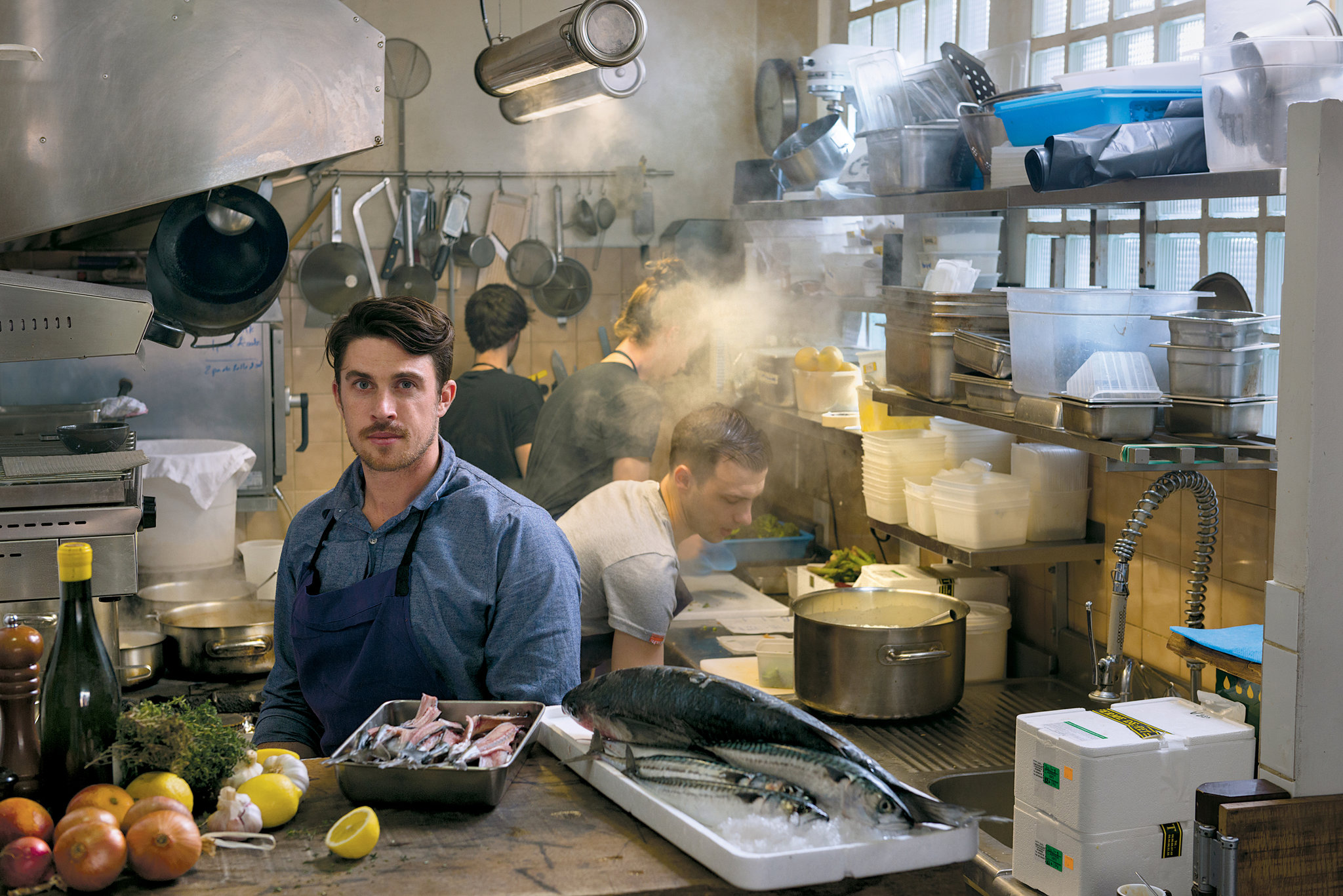






 Jadde: from Bosnia to Bengal