
…sluggish to the point of inaction till they reach the the brink of destruction, then a burst of fighting energy and tactical brilliance that bulldozes the enemy. Gold. Excellent!
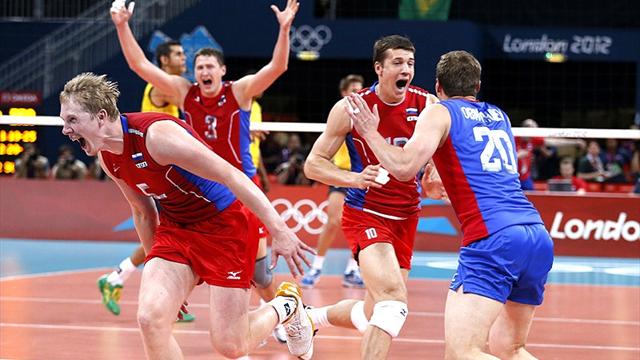
Russia Defeats Brazil For Olympic Gold
Comment: nikobakos@gmail.com
…sluggish to the point of inaction till they reach the the brink of destruction, then a burst of fighting energy and tactical brilliance that bulldozes the enemy. Gold. Excellent!
Russia Defeats Brazil For Olympic Gold
Comment: nikobakos@gmail.com
But against Montenegro, a sad victory. And Italy played like they did against Spain in the Euro final (or like they fought in WWII), so now we have to put up with the Croats’ gloating for an eternity. See: “History has made lawyers of the Croats, soldiers and poets of the Serbs. It is an unhappy divergence.” — Rebecca West.
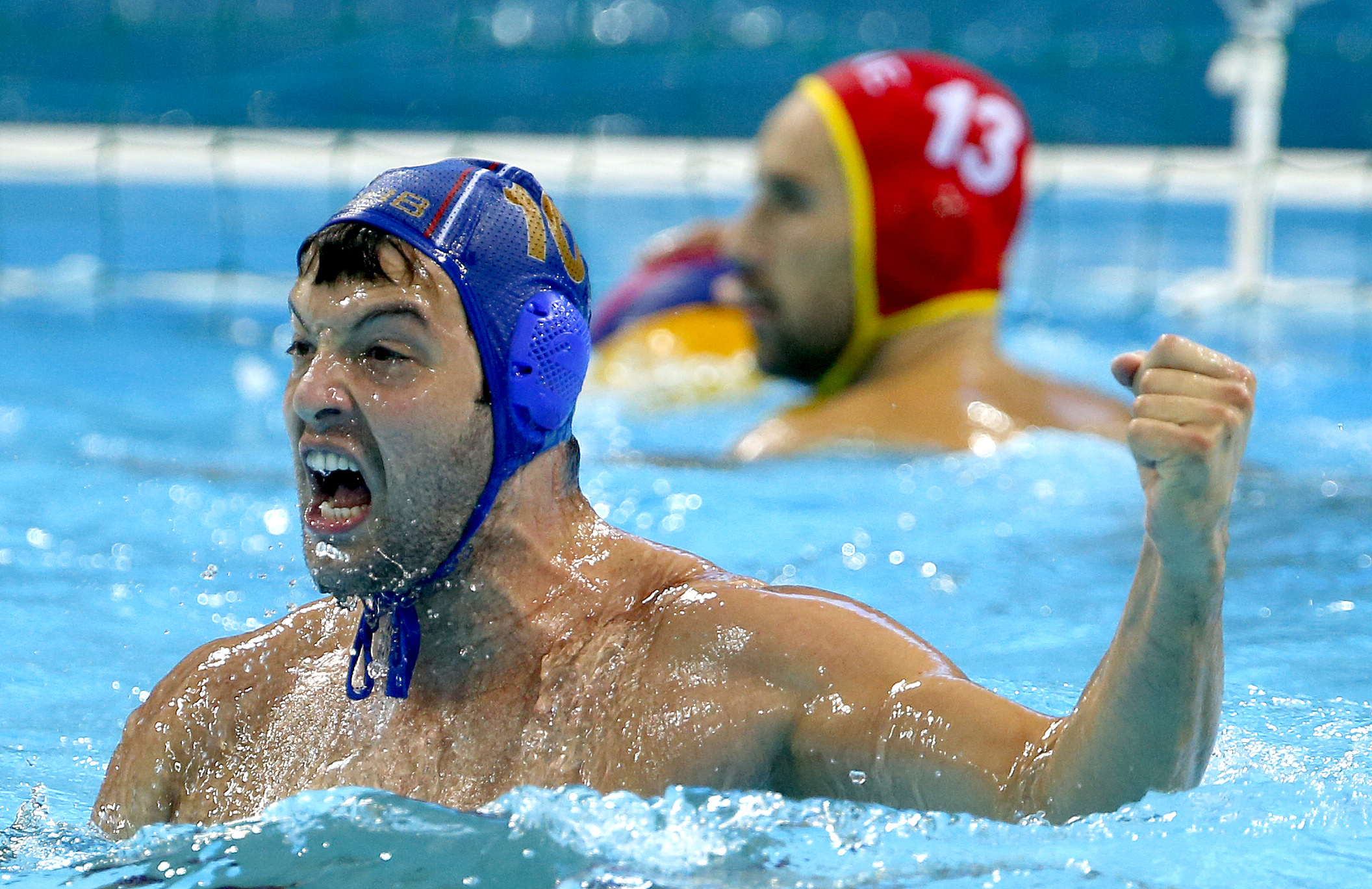
Serbia’s Filip Filipovic reacts after scoring on a penalty against Montenegro goalkeeper Milos Scepanovic, back, during the men’s water polo bronze medal match at the 2012 Summer Olympics, Sunday, Aug. 12, 2012, in London. (AP Photo/Julio Cortez)
Comment: nikobakos@gmail.com


See: Tarlabaşı I and Tarlabaşı II
Hagioi Konstantinos and Helene in Tarlabaşı
Kyra Smaro was born in Tarlabaşı and grew up there. When she was a teenager, they moved to Tatavla, (in one of those military re-grouping manoeuvres minority communities in the City have done every now and then when their numbers have grown scarce in a certain mahalla), and that’s where she’s lived ever since and as far as I know; but like a real Cockney, she was raised in the sound of Hagio Konstantino’s bells.
She was a consummate, almost clichéd, Politissa in every way: from her funky, old-fashioned name (“Smaragdo” – “Emerald”), to her learnedness, playfulness, awareness of the world, quick, ironic humour — down to what a great cook she was. She was a Greek school-teacher, constantly being shuffled across the city from school to school as they closed for lack of students, every reappointment taking longer and longer as the Turkish Ministry of Education engaged in deliberate bureaucratic foot-dragging with people like her. “But can I get angry?” she’d say. “How can I get angry when I know we do the same to them in Thrace? Tell me, with what face can I get angry?” “Mmmm…bu kadar…” she’d end every long treatise with. “Auta.” It always amazed me how clear-eyed and fair most of these people were – like Kyra Smaro, like my father, like my godfather – who had actually lived with the “other,” compared to the nationalist, Athenian tsoglania and their decontextualized animosity, who are always enraged on the part of people like her. She could do without them and would say so. Like one of my heroes, the brave Turkish Armenian journalist Hrant Dink, whose repeated message to the Armenian diaspora with their Genocide obsession was essentially to fuck off. We live here. We live with them. You don’t know shit except the frisson you get from your hatred. This is for us and them to figure out. Not you.
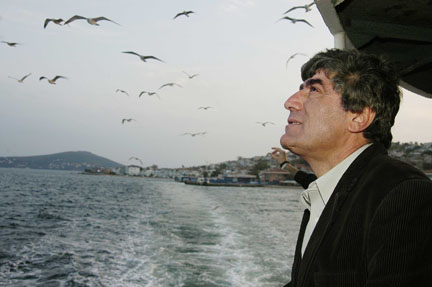
Hrant Dink: a hero and true martyr — ’cause the word gets a little too much trite over-use these days.
But it would have been ridiculous to suggest she felt no bitterness at all. One particular form of it, that I heard from almost every Polite in a myriad different versions, was not just the pain of your community shrinking around you so much, or your city becoming unrecognizable around you, but of you becoming unrecognizable to your city. Armenians and Jews chose a path to greater assimilation after the twenties; they usually spoke Turkish without an accent. But a Greek of Kyra Smaro’s generation (she must’ve been in her fifties in the nineteen-nineties), still spoke Turkish with an accent, an accent Turkish İstanbullus recognized, and to which they would toss a greeting or a word of Greek when she was shopping or at the manave’s or at the butchers. But as the century wore on, those İstanbullus disappeared as surely as the Greeks did.
She was in a cab once, and a young Kurdish driver, who, she remembers, couldn’t have been much more than twenty and who not only didn’t recognize her accent but probably didn’t even know that there used to be any Greeks in İstanbul, politely asked her: “Ma’am, where are you from?” And she snapped – she even felt bad afterwards: “Where am I from? I’m from here! Where are you from?!” I’m sure the poor kid was left mystified.
A Turkish, leftist friend of mine from back in the nineties, of most solid bourgeois background (like most leftists), didn’t think, tellingly, that that story was funny. She thought Kyra Smaro’s attitude was racist and patronizing. She didn’t understand that maybe there was a certain poignance or hurt in Kyra Smaro’s story and that just because she was a comfortable (tamam…diyelim ki comfortable…) civil servant from Kurtuluş, it didn’t mean she was any less the Republic’s victim than a poor Kurdish kid was. She couldn’t sense that Kyra Smaro’s parapono — which like queja in Spanish or klage in German, means both “complaint” and “lament” — was of a different order of emotion than that of her Teşvikiye, headscarf-phobic aunties bitching about “too many Anatolians in the city” and “the smell of kebab everywhere.” But like I said, this was the nineties already, when there wasn’t much Left left in anybody’s Left except for the self-righteousness, and humour has never been a very abundant resource in Turkey anyway. Some White Turk guilt in action there too, overcompensating by defending the country boy she would generally have nothing to do with in real life.
Orhan Pamuk might’ve understood Smaro better. He does us two great honours in his last two books, auto-biographical semi-fictions which I think are his greatest works, far more readable than the Eco-Rushdie-ish historical magic realism he used to work in. One is in Istanbul: Memories and the City, where he dedicates a whole chapter to the 1955 riots. He didn’t have to do that. The book was a beautiful and coherent piece of literary and personal history without that chapter. In fact, the ’55 chapter sticks out in an almost jarring way. Thank you.
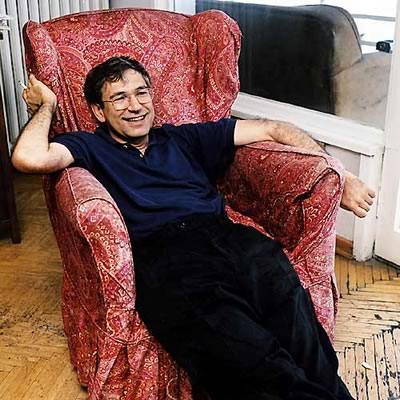
A photo of Orhan Pamuk (below) from a website called: Pictures of Muslims Wearing Things (?) with a caption that reads: “This is Orhan Pamuk. He likes to wear little pink chairs that are too small for his greatness.”

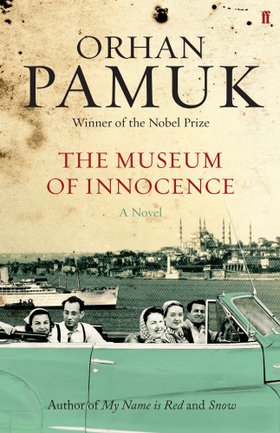
The other is just one clause in The Museum of Innocence. He’s describing the neighborhood of his beloved, Füsun, in C-town — Çukurcuma, down the hill, I think, behind Galatasaray and the Greek Consulate. He calls it a mahalla of artisans, Kurdish migrants and “the last few Greek families that didn’t have the heart to leave.”
How did he know that and where did he sense it from? His own passion for the City clearly… But this was a feeling you got from almost every Greek left in Istanbul that I was sure you had to know them to feel. “When Gianne finishes high school…” “When we sell the apartment in Feriköy…” “When Theia Helene, God bless her, passes on; we can’t leave her alone in Balıklı…” With every family, and every individual even, artificial deadlines would be set and then passed and then new ones set. People, you felt, just “didn’t have the heart to leave.”
That’s a sign of respect and recognition, and a look into one’s self from another, which you don’t easily ignore or forget. Thank you, Mr. Pamuk.
Mmmmmm…bu kadar.
But here’s a photo of Çukurcuma, below (which looks much more up-scale these days) All these C-town ‘hoods must’ve started looking the same to you guys by now, sorry… :)

And Pamuk as a child from a Turkish edition of Istanbul.
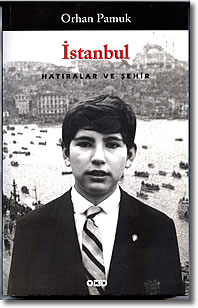
Kai to vaporaki. With I think Hagia Sophia in the background (click)
See: Tarlabaşı I and Tarlabaşı II
Comment: nikobakos@gmail.com
 This is a disaster…and infuriating! “This is another revenge for what they have done to us during the war,” said Mate Bacic, a Croatian fan in the nearby ancient Croatian city of Dubrovnik. “We are defeating them in peace.”
Croatia beat Montenegro in the Water Polo semi-finals, 7-5. Italy beat Serbia 9-7. Not staggering losses, but losses nonetheless, which means that Croatia will get the silver, possibly gold! And the most infuriating thing is the Western medias repetition of the same lame cliches at the end of AP piece: Serbo-Montenegrins blamed, without examination, as the villains and the quote from the mean, whiney, vindictive Croat: “This is another revenge for what they have done to us during the war…” — playing the role of peace-loving victim, getting away scott-free with his own crimes, which include starting the war itself.
No Serb, even Montenegrin, would have made a statement to a journalist so smugly vengeful and niggardly and bitter. He may have smashed a few things or pulled a knife or punched somebody out, but never copped that hypocritical “wasn’t-me” pose of innocence.
And now we have to watch what would always have been the painful game between Serbia and Montenegro tomorrow for only the bronze.
*********************************************************************************************************************************************
Published August 10, 2012
Associated Press
KOTOR, Montenegro – When the Red Sharks lose, Montenegro mourns.
The water polo team of this tiny Adriatic Sea country, the pride of Montenegrin sports, lost 7-5 to Croatia, its wartime Balkan adversary, in the Olympic semifinals Friday, triggering despair in the ancient walled city of Kotor.
“This is a disaster,” Mladen Martac said as he watched the game at the Vardar cafe in the city center. “If it was football, basketball, or some other sports, it would hurt … but this is water polo, our beloved game.”
Montenegro reached the semifinals at the London Olympics along with Italy and two other former Yugoslav republics, Serbia and Croatia. Serbia faced Italy in the other Olympic semifinal later Friday.
The quarterfinals demonstrated the region’s power in water polo. Montenegro, population 625,000, beat Spain, population 47.2 million. Croatia, 4.7 million, beat the U.S, 312 million. Serbia, 7.3 million, beat Australia, 22.6 million.
Many doubted that after the bloody 1990s breakup of Yugoslavia, which won three Olympic water polo titles, the states that emerged could carry on the glory of the old communist country.
But many were wrong. Serbia has won three world and European championships since 1991. Croatia has captured one world and one European title in that time. Montenegro won the 2008 European crown.
The phenomenon of water polo dominance is nowhere more striking than in Montenegro, a picturesque southern European country nestled between pristine rocky mountains and the turquoise of the Adriatic.
Out of 13 Montenegro players on the Olympic roster, 12 come from two small coastal towns, Kotor and the summer resort of Herceg Novi, on the border with Croatia, where water polo grounds are cordoned off in the waters that dot nearly all villages.
On Friday, old wooden goalposts and plastic line markers swayed in the hot breeze and the waves of the Adriatic.
“It’s real rarity that so many world-class players come from such a small area inhabited only by some 60,000 people,” said Dusan Davidovic, a former player for Primorac Kotor, the 2009 European club champion.
He attributed the success to the “old Yugoslav water polo school.”
“That’s the school of improvisation, fitness and discipline,” he said, adding that the tradition of tall and muscly Balkan men has something to do with it.
“The ex-Yugo teams play with a lot of contact,” he said, describing a sport that often includes brutal underwater wrestling unseen above the surface of the water, and to referees.
War broke out in Croatia after it declared independence from Yugoslavia in 1991, and 10,000 people died in the conflict. Montenegrin troops took part in the fighting around the walled city of Dubrovnik.
Lingering rivalry among the former Yugoslav republics is perhaps best seen in water polo, which triggers national pride and emotion.
“This is another revenge for what they have done to us during the war,” said Mate Bacic, a Croatian fan in the nearby ancient Croatian city of Dubrovnik. “We are defeating them in peace.”
Comment: nikobakos@gmail.com

Immigrants being detained in central Athens on Sunday. About 6,000 people were held in a police operation over the weekend.
“As Greece Rounds Up Migrants, Official Says ‘Invasion’ Imperils National Stability”
This is the part that kills me and makes me want to kill somebody:
“They complain that the foreign residents are depriving them of jobs and threatening the national identity.”
No fucking Athenian brat — as I’ve said elsewhere — has condescended to do the jobs immigrants do in Greece for at least two generations.
And, I’m sorry… What “national identity?”
My main piece on the issue: Little Rock, Greece:
Epiros, the beautiful but rocky and barren part of Greece readers must by now know that my family is from, is known f0r two kinds of folk songs especially: dirges to be sung at wakes for the dead (or on other occasions too, just for the cathartic pleasure they give, which tells you a lot about the region and its people), and songs of emigration (“xeniteia” — “kurbet” — yes, the Turks have a word for it too). Xeniteia, from “xeno-” strange or foreign, is not so much emigration itself, as it is the state of being in a foreign place, away from your home, your people. For as far back as I know, meaning up to three generations, every man on all sides of my family worked and lived abroad for perhaps the greater chunk of his adult life, in places as diverse as Constantinople, Bucharest, Buenos Aires, New York and Watch Hill, Rhode Island. When my father’s village had around fifteen hundred people, there were around another five hundred Dervitsiotes living in Peabody, Massachusetts, working mostly in that town’s tanneries; they would joke that “Peabody, Mass.” meant “Our Peabody” — “mas” being the first person plural possessive pronoun in Greek. Many of Epiros’ villages were inhabited almost entirely by women, children and old people; it was almost inconceivable that an able-bodied young man would just stay home and not try his luck abroad somewhere.
But Epirotes are not the only Greeks for whom xeniteia constitutes (or did) a deeply embedded chunk of consciousness and identity. There wasn’t a Greek family from any region that didn’t have someone living and working abroad, and the longing and sorrow of that condition was something everyone instinctively felt; it was a collective emotion.
And that’s what makes these outbursts of anti-foreigner violence even more shameful and disgusting. Again, one sees how the loss of diaspora consciousness is one of the things that has so cheapened and impoverished the Neo-Greek soul in the past few decades. Again, I suggest, as I did in a previous post, that we all re-watch Gianni Amelio’s beautiful 1994 Lamerica: “…which is the story of how a cool, smug Young European Sicilian gets stranded in Albania and realizes that he’s only a generation away from being counted among the wretched of the earth himself — and how dangerous it is to forget that.”
National identity… Me chesw…malakes.
Comment: nikobakos@gmail.com
Our man keeps the Rogers in Montreal, little subdued, more thoughtful game… Keep my advice anyway.

Comment: nikobakos@gmail.com
And the closer each team gets to medals, the more I dread the emotion of the game between them…

Montenegro’s Drasko Brguljan (R) and the bench celebrate a goal against Spain during their Men’s Quarterfinal water polo match during the London 2012 Olympic Games August 8, 2012. REUTERS/Sergio Moraes
(From Reuters)
By Sarah Young
Aug 8 (Reuters) – Gold-medal favourites Serbia joined their Balkan neighbours Montenegro in the semi-finals of the Olympic water polo tournament on Wednesday, after staging a decisive turnaround in the second half of their match against Australia.
Serbia, who won their group and were playing the lowest seed from the opposite pool narrowly avoided a huge upset. They trailed Australia right until the final four minutes of the match, before winning 11-8.
Montenegro beat Spain 11-9 in an earlier quarter final clash to book into the semis, giving the country a shot at winning its first Olympic medal as an independent nation.
“I was afraid,” admitted Serbia’s Filip Filipovic said of how he felt when they were behind, but he said he took confidence from the team’s ability to turn the match around.
“I think that this team showed spirit. When we play badly like in the first two quarters, we can rise up again, and we can play the most beautiful water polo.”
The team roared back to life in the second half of the match with a torrent of goals from their three top scorers, Andrija Prlainovic, Filipovic and captain Vanja Udovicic, in a display which saw Serbia’s famed defence recover to put a stop to Australia’s run.


Filip Filipovic — scored three goals to pull Serbia ahead over Australia, and into the semifinals
Serbia, who won bronze in Beijing, have spent the past four years on a roll, winning every major title on offer and are favourites to win the tournament after an unbeaten run so far.
MEDAL QUEST
Montenegro cruised through the middle periods of the game before letting a four-goal lead slip in a tense fourth quarter as Spain capitalised on their extra-player situations.
Montenegro narrowly lost out on the bronze to take fourth place in Beijing, when it competed in its first Olympics as an independent country since it separated from Serbia in 2006.
“I don’t want to be one more time fourth, I want to take a medal. It’s very important for us to take a medal,” Montenegrin captain Nikola Janovic said after the win.
The team was cheered on in the stands by Prime Minister Igor Luksic earlier on in the tournament, who spent his holiday in London watching the country’s teams compete in water polo and handball, such is his desire for a medal for Montenegro.
“We must be a little crazy. It’s the moment. It’s one moment (of) inspiration,” said Janovic when asked how his team will win their next match and guarantee a shot at the gold medal.

Nikola Janovic of Montenegro
Montenegro will play either Croatia or the U.S., who meet in a quarter final match later on Wednesday, in the semi-finals scheduled for Friday, while Serbia will meet either Hungary or Italy.
The Serbians have already overcome defending champions Hungary, looking to win a fourth consecutive Olympic gold, in the group stages.
“Doesn’t matter. Semi-final, tough game, everybody comes here to win,” Serbian coach Dejan Udovicic said when asked which team he would rather meet in the semis.
The former Yugoslav nations of Montenegro, Serbia and Croatia all play a similar style of water polo, which has to date help them dominate at this year’s Games.
For Spain, who last got a medal in the water polo in 1996 when they took home gold, the loss was a painful repeat of 2008, when they were also defeated in the quarter-finals. (Editing by Alison Williams)
Comment: nikobakos@gmail.com
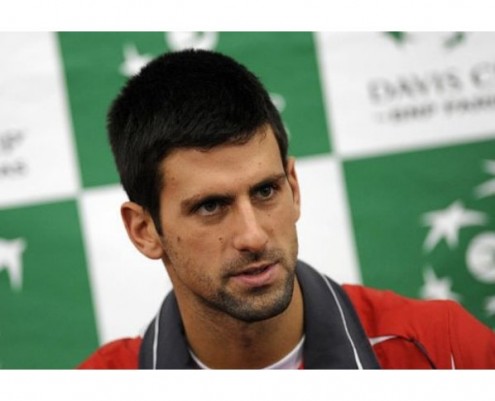
Do something.
Good luck here at the Open. I wish you the best. But then you gotta do something.
Get the fuck out of Monaco. Monaco is for Russian mafiosi. You’re not a Russian mafioso. Stop acting like a movie star and a super model. Put your pants back on. And start acting like an athlete again.
And a Serb.
Go home. I dunno: go to Chilandar for a while if you want. Then go up to Durmitor or somewhere and get a cabin by yourself – or better, a cave. Don’t play. Run on the trails up there. Your knees will be fine. What do you need high-tech oxygen low barometer chambers or whatever the fuck they are for? Run at high altitudes. Grow a beard, eat stale proja and raw meat.
When the snows melt come down at Easter and find a court. Does the one you first learned on still exist? Go play there. Do something for others; you’re a generous guy. Help Marko with his game. Or just give free lessons to anyone who wants them. “The giver’s glance gleams like gold,” Nietzsche says. “You have a golden child,” your first trainer told your parents. The problem isn’t your game or your body; it’s the spirit.
You let a couple of losses drag your ego down into a vicious cycle.
Be a Serb instead.
Your fans all love you like you don’t know.
NB

Durmitor (click)
Comment: nikobakos@gmail.com

Fresco of the Transfiguration at the Serbian Orthodox Monastery of Dečani in Kosovo. (click)
The Transfiguration – “today” all the title tracks of the Church’s feast days start with: today, here, the eternal now – is the moment when Christ revealed his divinity to John and Peter (yikes, I think, John and Peter…) on Mount Thabor, Moses and Elijah at his side. It’s a holiday that the Catholic West has largely ignored, probably because it’s too metaphysical and abstract and there are no Virgins or blood or cute babies involved, so it was of limited uses for the Counter-Reformation propaganda machine.
This isn’t like the Epiphany, which commemorates the moment Christ the Man and the Father and the Holy Spirit were all revealed at once, a holiday that the Catholic Church has also dumbed-down to the completely irrelevant “Three Kings Day,” because there they can cast a cute baby: though what the cute baby was doing freezing in a cave twelve days old waiting for the Kings to bring him gifts, when scripture says he had been taken away to Egypt way before, and why the Epiphany happens when He’s thirty and not a baby, is something that the Catholic Church, like much else, has never thought it needed to explain to its followers… Just the cheap marketing of Franciscan love for the Child — which is the distant root of the cheap marketing of Christmas.
The Transfiguration, the Metamorphosis, is Christ as God, a revelation of Divinity, a page straight out of the song book of any Indo-European or Semitic paganism, an Avatar or Incarnation — man, even animal – allowing a human to see the blinding glory of its Godhead. In this version John and Peter are just knocked to the ground, not incinerated, or impregnated or stricken with fatal love. But it’s clearly the same idea, and found its seed, like so much else, in the Semitic Christianity of the Near East.
In parts of rural Greece, it’s the day when the season’s first grapes are – or were — brought to church and blessed and distributed as prasad* to the congregation. I was moved to find this tradition oddly observed in most Greek parishes in Istanbul, by the most profoundly urban Greeks of all Greeks, with grapes from the manave.** I remember wondering what it was they needed to remember by doing this. I remember being given a handful at the Taxiarches in Arnavutkoy, munching on them as I strolled back to class in Bebek, saving a few for my best friend there.

This is the interior of the church of the Taxiarches (the Archangels, Michael and Gabriel) in Arnavutkoy. I went there a lot because it was the largest functioning church near Bogazici U, or at least the one that I knew wouldn’t be depressingly empty. The only church of the Transfiguration I know of in Istanbul is on Buyuk Ada (Prinkipo) and I couldn’t find a picture of it. Below is the Transfiguration of Corona, Queens, though, where I was baptized and raised. Under that is the Russian Orthodox Church of the Transfiguration in Williamsburg (“Preobrazhenie,” “obraz” being the Slavonic for “image,” like the Latin “figura” in Transfiguration or the Greek “morphe” in Metamorphosis) which you used to be able to see from the BQE against the Manhattan skyline before all the ugly condos for the hipsters with rich daddies went up. Below that are some grapes.


* prasad is a food offering to a Hindu deity which is blessed and then distrubuted to his devotees
** manave is a greengrocer
Comment: nikobakos@gmail.com

Novak Djokovic of Serbia scrambles back to his racket after falling while playing against Juan Martin del Potro of Argentina in the men’s singles bronze medal match at the All England Lawn Tennis Club at Wimbledon, in London, at the 2012 Summer Olympics, Sunday, Aug. 5, 2012. (AP Photo/Mark Humphrey)
WIMBLEDON, England (AP) — Juan Martin del Potro wept after losing to Roger Federer in the Olympic semifinals. He wept again Sunday, this time with joy after winning the bronze medal.
The Argentine beat Novak Djokovic 7-5, 6-4 in a rain-delayed match at Wimbledon and fell to the grass, covering his face with his hands.
“I don’t have the words to explain,” Del Potro said. “It’s similar to winning a Grand Slam (title) or maybe even bigger. It’s amazing.”
Del Potro had lost 3-6, 7-6 (5), 19-17 on Friday to Federer in the longest best-of-three set match in men’s tennis in the Open era – 4 hours, 26 minutes.
“I think I’m the most happy of the world at this moment,” Del Potro said. “After a really sad day two days ago, it’s not easy to recover and to play these kind of matches.”
Djokovic said he failed to capitalize on his chances, and that Del Potro deserved to win.
“Disappointing end, but I enjoyed it,” the second-seeded Serb said. “It was a pleasure playing for my country.”
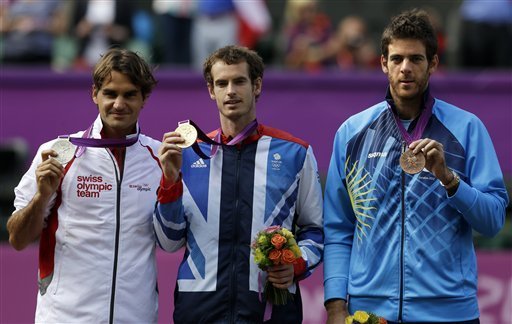
From left, silver medalist Switzerland’s Roger Federer, gold medalist Andy Murray of Great Britain, and bronze medalist Juan Martin del Potro of Argentina stand during the medal ceremony of the men’s singles event at the All England Lawn Tennis Club at Wimbledon, in London, at the 2012 Summer Olympics, Sunday, Aug. 5, 2012. (AP Photo/Elise Amendola)
Comment: nikobakos@gmail.com
 Jadde: from Bosnia to Bengal