Rezili, kai palin erw, REZILI: Attacks continue on Muslims in Greece

16 Aug

(hat tip to my buddy Aykut for this)

Kathikia.  And I don’t mean the Golden Dawn thugs either; I mean the millions of Greeks who passively support this shit, even individuals that I, personally, used to respect and love.  This, for me, is the definitive end — an end in total failure and shame — of the Neo-Greek project.  This is when you died.  Not when Paul and some other pesky Jews made you Christians and destroyed your supposed Classical purity.  Not in 1453.  Not in 1922.  This crisis, and the ugliness it’s unleashed in so many of the Statelet’s inhabitants is the definitive end.  Because it’s gonna be interment or starting from scratch now.  There’s no gluing this idea back together.

This is the end of your European fantasiwseis (delusions); this is the end of your Ancient Greek fantasiwseis, and how central to Europe you think they’re supposed to make you.  Of course, this is the end of the House-of-Cards economy you built on a folding table, which brought you the consumer culture of late capitalism which, for some reason, you felt entitled to, even though you had long stopped thinking of actually producing anything in order to support it.  It’s not the end of the politicians who kept pulling cards out from under the structure and thought nobody would notice, because you voted those kissers of Frango ass back into power again.  This is the end of all of the rest.  It’s the end of blaming Turkey or America for everything.  It’s the end.  Close the book.  Start looking for another one.

An Athenian fachito wrote me a couple of weeks ago and tried to justify these attacks to me.  “Wouldn’t the Ku Klux Klan,” he asked me rhetorically, “have been voted into office in the United States if it had been flooded by so many immigrants?”  No.  They wouldn’t have been.  I’m from a city where you stop being a stranger the second you arrive, maybe, as many say, because nobody can really be bothered to give you a second thought.  “We may not be very nice, or smile, or say ‘Good Morning’,” wrote Pete Hamill, “but there’s always room.”  But I don’t believe that New York is tolerant just because everybody’s too busy to be intolerant.  I believe there’s a sadness behind New York cynicism and irony and supposed “world-weary stoicism” that few people really understand, but if you feel the city in your gut and it’s not just a cool glamour-spot for you, then you know.  You can hear it in people’s voices, in the accent, in their body language and facial expressions, and in the kindness and blunt bursts of warmth you’ll suddenly get from where you least expect it.  It’s the sorrow of exile — and the wisdom it forces on you.  He may not know a word of whatever it was his great-grandparents spoke or seen even a picture of the land they came from, but every New Yorker carries a bit of that sense of loss in him and an innate knowledge of what drove him and his away and brought them here: the destitution of Ireland, the grinding poverty of Sicily, the fear of just being Jewish in Russia, the terror of being Black in Georgia, the violence of Colombia…  You think it’s romantic; it’s not.  (In fact, there’s lots of research out now suggesting that external experience can and does become genetic information that is then transmitted.)  Every New Yorker just knows it’s the human condition.  So when the next stranger comes along, he nods, says hi, and goes about his business.  Maybe takes a curious interest in where the new guy is from and learns a little something about the world; maybe helps him out if he can.  Of course, it’s now a cliche to say that New York isn’t America; but it’s just as true that it couldn’t exist in any other country.

How Greeks forgot the “sorrow of exile” is beyond me.  Mostly through suddenly thinking they were above and beyond that kinda Third-World thang.  You disdained or hated your neighbours for so long that you forgot who they were, no?  (The quickest way to forget who you are too.)  The Greek diaspora was no longer a motivated, highly creative and industrious group for you to be proud of, adventurers in the best Greek tradition, who went off and spun gold out of thin air while you sat around waiting for Providence to give you a cushy life.  They’re just an embarrassment and an object of condescension for you now, right?  Not for you Astoria and its tackiness — “My Big Fat Greek Wedding” — ha, ha…  You were Europeans now, right?  You didn’t emigrate anymore.  That was just for Cypriots.

Most of all, it’s the end of any sense of honour you might have still had left. You say these outsiders are destroying your “national identity”…pffff…and you declare it loudly without the slightest sense of irony…  You know “stranger” and “guest” have been the same word in Greek since classical times.  And strangers are a strain, of course.  It was a strain for that poor Greek family to feed you like you were a king and give you their beds while they took the floor.  It was a strain for that practically bed-ridden old woman to still get up and give you a lokum and a glass of water.  It was a strain to have a guest express admiration for an object in your house and to immediately make him a gift of it.  But you did it, and if not out of compassion for the poor and persecuted who came among you, you did it for your own sense of honour.

But you’ve now definitively failed that test like you’ve done all the others modernity presented you with.  I don’t know who replaced the Greeks I describe above.  I don’t know who you are any more.  I’ve groped around for decades trying to figure out what you’ve become exactly and mostly come out with a big handful of nothingness.  At best you seem like glib tourists in your own country to me, for whom Greek-ness is knowing the best beach in Melos or a cool baraki in Gazi you go to.  Is that the “national identity” these desperate people are threatening?  Other times you’re more and more starting to seem like mice in a cage who start biting pieces off of each other when there’s no food left.  And now you’re just shitty bullies, who beat up on the world’s most destitute, instead of providing them with pou ten kefalen kline and hoping that maybe you’ll save part of your souls that way — and your last scraps of honour.

And yet you still prattle on about philotimo and all the other ancient virtues you believe yourselves heirs to…  Even to having the unmitigated shamelessness of calling the police’s anti-immigrant round-up “Xenios Zeus”: Zeus Xenios, Philoxenon or Hospites: Zeus was the patron of hospitality and guests, ready to avenge any wrong done to a stranger.” [My empasis]

You were always envious, petty and malicious, the way the impotent usually are; Greece was the only country from where I got gloating “I’m so happy” emails after September 11th.  You were always whiney hysterics.  Flash floods would hit Athens, as they tend to do in deforested, arid-zone mountain basins all over the world; some mud would get on the plakakia of your house’s pylwte — which was built illegally on top of a dry gulley bed anyway — and you’d come out screeching on television like you’d just lived through the bombing of Dresden.  You just seemed ridiculous then.  Now you’ve crossed the line into the unforgivable.  Now you’ve sat Brownshirts and criminals in your Parliament and let them declare themselves your protectors.

I don’t know you any more.  And I’m not sure I want to.

Here is the article from “Demotix: News by You.”  I’m ripping off the whole text from them and a couple of pictures, and hope that they’ll understand why.  Read about fifty attack in six months, a rate that definitely outdoes any ten-million-inhabited section of the nineteenth-century Jim Crow South.

And see the rest of the excellent photos; with Eid approaching, the way they capture the beautiful military discipline of Muslim prayer couldn’t be more timely.

Muslims in Athens continue to attend services and pray despite continued attacks. By Christos Stamos

Over 500 foreigners have been attacked in the last 6 months in Greece.
A 19-year-old Iraqi died in an Athens hospital on Sunday after being attacked late on Saturday night in Athens center, (Anaxagora street), by five unknown persons riding motorcycles, police said.
A statement said the young Iraqi, “died in hospital of injuries sustained from a sharp object”.
The attack came after a huge police operation to clear cities of illegal immigrants.
For this Police operation under the code name “Xenios Zeus”, Jezerca Tigani, who is Europe and Central Asia Deputy Programme Director of Amnesty International, has said on Wednesday, 08/08/2012:
“While Greece has the right to control migration, it does not have the right to treat people in the street like criminals purely because of the colour of their skin.”

INTERVIEWS:

Pashtoon Mirues, aged 23, has come in Greece from Agfganistan some years ago, and now he is working on a restaurant.
He shows a stone with signs of blood, a few meters away from where the young Iraqi was murdered , on Sunday dawn, in Athens center.
An eyewitness told him that he saw someone hitting the young Iraqi on the head with this stone.
__________________________

Umar Vakas from Pakistan, aged 23 has come to pray for Ramadan in the private underground place they have rented for gathering and speaking about their culture in Piraeus area.
Athens is the only European capital that does not have a mosque yet.
Last Wednesday at 10:00 p.m. about 15-20 people, attacked the place and threw smoke canisters at the entrance. At that time Umar and four other Pakistanis were inside. Umar went up the stairs and one of the attackers hit him with his fist, throwing him down the stairs.
Umar shows the marks of the wounds caused by the attack.
__________________________

Shabaz Ahmad from Pakistan aged 26, was attacked by a group of about 25 young men two years ago in the street.
He remembers it was again the month of Ramadan .
He was beaten in the face with an iron object, a knuckle duster, while he was walking for his home, after the prayers at about 8pm.

He was taken to hospital with a fractured bone in the eye.
While speaking, he shows to the camera, where in his face he was beaten.

__________________________

Nazir aged 36, is from Pakistan and he is living in Greece for the last 14 years having all the legal documents.
He asks me: “Why do these attacks take place?”

“Now people are afraid of the attacks and do not gather here…
My family is in Pakistan.
I have two children 2 and 4 years old. I earn 720 euros every month from my job, where I work as a warehouseman. I cannot bring my family in Greece. I pay all my bills here, and any money left over, I send them to Pakistan to live my family.
Vast majority of Pakistan people, cannot afford having their families here, life is expensive and salaries are going down as Greece has economic crisis.
Many Pakistanis take the way back home because of the crisis.”

_____________________________________________

Javied Aslam is the President of the Pakistan Community in Greece and the President of Migrant Workers Union.
He is speaking to me in an appointment we have in Thiseio, a neighbourhood in downtown Athens, northwest of the Acropolis:
“Over 500 foreigners have been attacked in the last 6 months in Greece.
Migrant workers are transported to hospitals with broken bones.
Previously the attackers had bats and knuckle dusters.
Over the past two weeks the situation has evolved: the attacks are made with knives.

Police operation under the code name ‘Xenios Zeus’, is a racist operation.

Racists get power from this operation. Now on the streets many fascists hit us, they curse on us, they spit at us.
Greece must not become a jungle. Greece has to show respect for each every employee.

What we ask for, is the implementation of laws!
We believe that the police shows tolerance to the racist attacks.

Police do not care for immigrants who are under attack.
Quite the reverse, they do not want to hear that you will file a lawsuit.

If a migrant tries to sue a Greek, then police puts the immigrant in jail for two days at least, to make the migrant fear and force him not to file the lawsuit.
When we go to the police station and we say that we want to sue a Greek, policemen beat us.
This is fascism.
Police can beat you and commit crimes on you, while you are innocent and asking for justice and no one can protect you.

On June 23rd, about 45 Greeks attacked 3 immigrant houses in Marconi area in Athens, and the police have not arrested anyone of the perpetrators.
Quite the reverse, they arrested the victims of the attack, the Pakistani migrants.

Within the police departments, the followers of the far right party “Golden Dawn” have access, where they come and they curse on us, and they threaten us.

The attacks against places of prayer are very dangerous.
Because our culture imposes on us, that places of prayer, are more valuable than our lives.

We can not have bats.
For this reason we they beat us
Whoever can not beat us by himself, he sends the police to beat us.

We ask the Greek Government and Greek Police to implement justice and to protect us.”


Comment: nikobakos@gmail.com

August 15th

15 Aug

Let’s also take a moment today to remember one of history’s great crimes and its millions of victims.


Comment: nikobakos@gmail.com

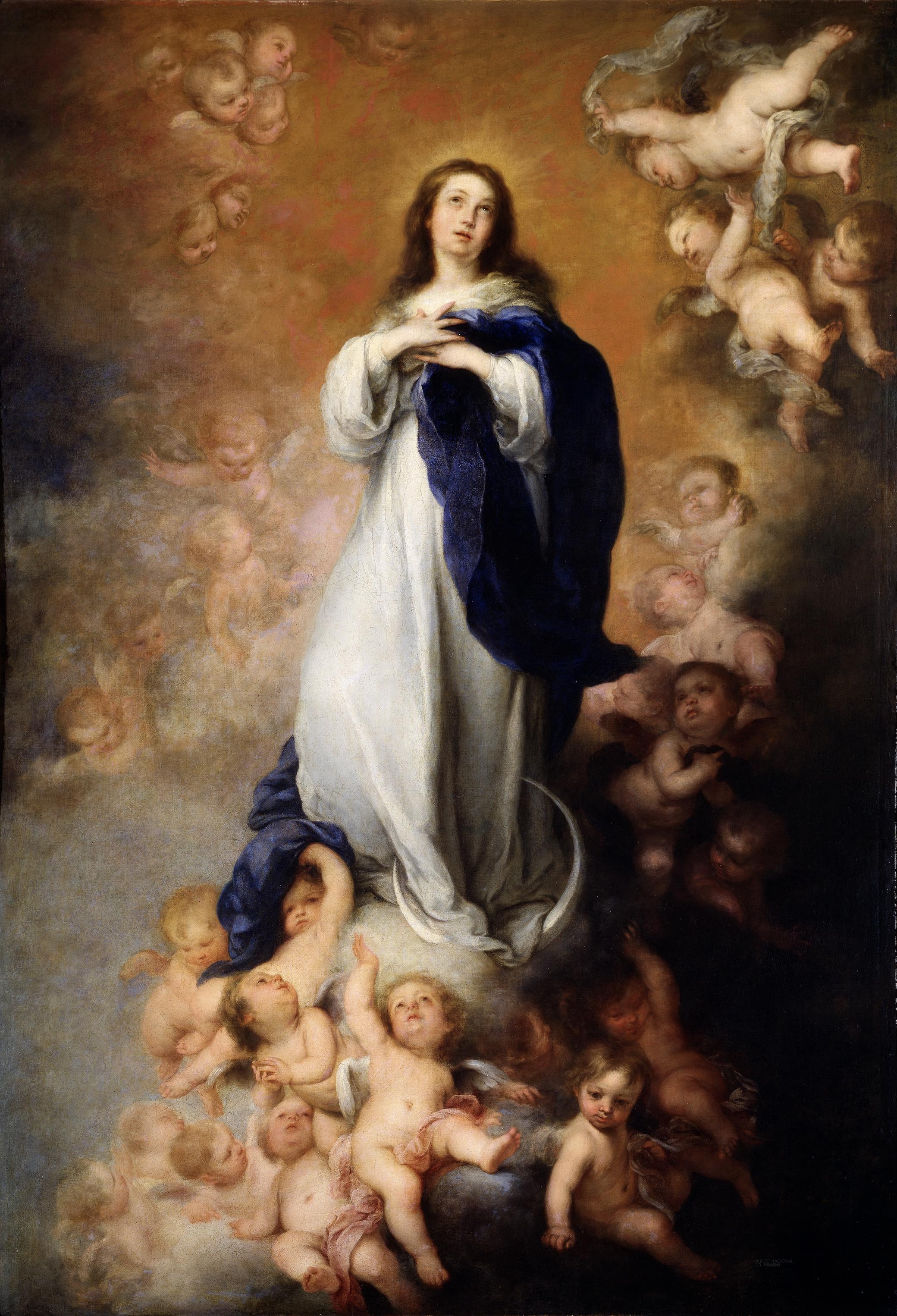
I love Murillo though

15 Aug

Murillo’s Virgin of the Immaculate Conception (click):


Comment: nikobakos@gmail.com

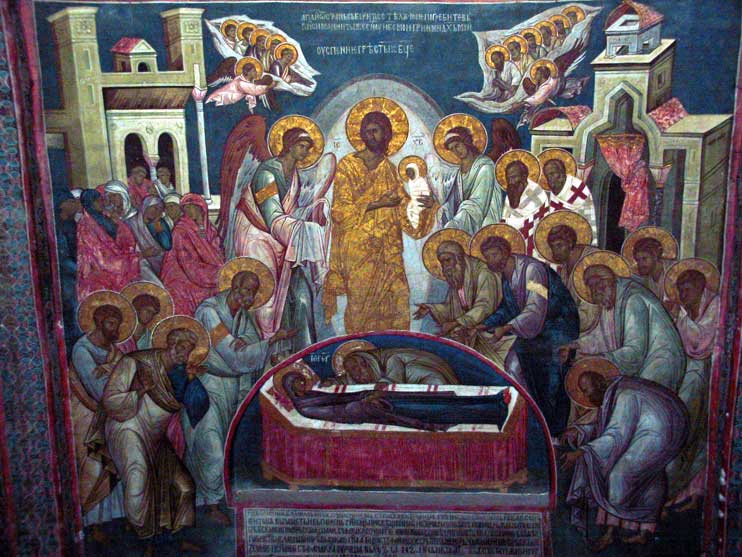
Rebecca West, on the fresco of the Dormition at Gračanica in Kosovo

15 Aug

From her magnificent Black Lamb and Grey Falcon: A Journey through Yugoslavia:

(click)

“Across one of the walls of Grachanitsa is shown the Falling Asleep of the Virgin Mary, the state which preceded her Assumption, a subject often treated by the Byzantines.  There is no man living today who, exploring his mind in the light of that idea, could draw out so much.

“In the foreground of the fresco is the Virgin lying on her bier.  By the lax yet immutable line is rendered the marvel of death, the death which is more than the mere perishing of consciousness, which can strike where there is no consciousness and annul a tree, a flower, an ear of corn.  Above her bier there shines a star of light; within it stands Christ, taking into his arms his mother’s soul in the likeness of a swaddled child.  Their haloes make a peaceful pattern, the stamp of a super-imperial power, within the angles of the star.  About them throngs a crowd of apostles and disciples, come hastily from the next world or from distant lands to attend the Virgin’s death, wearing their haloes as bubbling yet serene spheres.  On the edge of the crowd stand some bishops in their cross-covered mantles, rock-like with the endurance of the Church, which cannot be perturbed by the most lacerating grief, and still others, also in flowing garments but with bodies liquid with grief, and others, also in flowing garments but with bodies tautened by effort, low under the weight of the bier.  The background is full of angels as the Eastern Church loved to conceive them, ethereal messengers who are perpetually irradiated by the divine beauty and communicate its laws to flesh-bound man, a dream of perfect vision and unfrustrated will.

“The huge imaginative space occupied by this small fresco is washed by two swinging tides. There is a wave of such sincere and childish grief as children feel when their mothers die, that breaks and falls and ebbs; there is a rising sea of exaltation in the Son who can work all magic and cancel this death or any other, making glory and movement where stillness and the end seem to be ineluctable. The sides of the fresco are filled in with buildings, distorted with the most superb audacity in order to comply with the general pattern, yet solid and realistic in effect; we are amazed, as we all so often are during our lives, that our most prodigious experiences take place in the setting of the everyday world, that the same scenery should be used for the pantomine and the tragedy. Behind these buildings there is a firmament which evokes another recurrent amazement. It is the most astonishing of all the things which happen to us that anything should happen at all. It is incredible that there should be men and women, mothers and sons, biers and buildings, grief and joy; it would seem so much more probable that the universe should have as its sole packing empty nothingness. Existence in itself, taken at its least miraculous, is a miracle.”

Comment: nikobakos@gmail.com
Today is the Feast of the Dormition…

15 Aug

…the day that the Virgin Mary, a mortal woman, “fell alseep” — died.

Icon of the Dormition from one of the Churches of the Pecherskaya Lavra monastery complex in Kiev.

Marianism, which it would be absurd to argue doesn’t exist in the eastern Church (see “…απορώ και εξίσταμαι.”), has for many centuries been significantly more central to Catholicism than it has been to Orthodox beliefs.  The Orthodox Church either couldn’t (under Muslim rule) or didn’t need to (Russia) engage the challenges of Protestantism or modernity like the Catholic Church did.  That has led, in many Western eyes, to sterile ritualism and ossification.  It has led, in my eyes, to the freedom to remain a Church, and not a panel member at the Ethics Roundtable that most of Western Christianity has devolved into.

Catholicism met the first of the above challenges with the Inquisition and some of the most spectacular art in the entire human experience.  It met both challenges with a wave of renewed dogmatism.

In the case of the nineteenth century that meant dogmatism in the real sense of creating new dogmas (dogmas? dogmata?), all by itself, the way the Vatican has always done things.  One of those was Papal Infallibility.  And because, along with Phallus, Mother is perhaps the most exploitable symbol in the collective unconscious, the other two new dogmas were the Assumption of the Virgin and her Immaculate Conception.  Together with the miracle-ization of several Mary appearance locations in Europe, the new upgrade of these previously popular but unofficially held Catholic beliefs were intended to, and successfully did, provoke a hysterical wave of Marianism in the nineteenth century that I imagine the Vatican thought would keep its straying flock close to home.  (That’s why Concetta or Assunta or Fatima or Lourdes are more likely to be your grandmother’s or one of her friends’ names and not yours.)  The outcome of never correcting the hysteria created by that whole shameless propaganda strategy has manifested itself lately in a completely insane movement to have Mary declared Co-Salvatrix, or some such nonsense, with Jesus, which would just be heresy pure and simple to anyone concerned which such things.

The Orthodox Church has always assumed some kind of assumption of Mary into heaven — see above, there she is, already in her Son’s arms, in what are both swaddling clothes and a shroud, His mother and child at the same time — but has rejected officializing the belief.  It has vehemently rejected the entire idea of the Immaculate Conception, which refers to Mary’s conception, not Jesus’, as lots of people think.  The basis for that is that both ideas come dangerously close to deifying her — the Immaculate Conception especially because it pre-destines and pre-sacralizes her.  And that cancels out the essence of who Mary is: a brave and terrified Jewish girl who said “Yes” to God when He asked her to perform something unfathomable to any human mind, including her own.

So today is the day that girl died (there is no Greek or Slavic word for Assumption), which we commemorate happily because we know she’s in good hands (I know, that sounds a little glib…).  It’s the most important of the Virgin’s holidays in the Orthodox Church, probably because it’s in the middle of the summer and has long been associated with village festivals and, these days, with vacation time.  It’s a day when Athens is even emptier than it is at Easter, because practically the entire city is only one generation away from the villages they return to every year.

It’s also on the list-obsessed Catholic Church’s silly list of “Holy Days of Obligation,” which means you get a demerit if you didn’t go to church…because they just can’t let go of the idea that the way to “pack ’em in” is to obligate them.

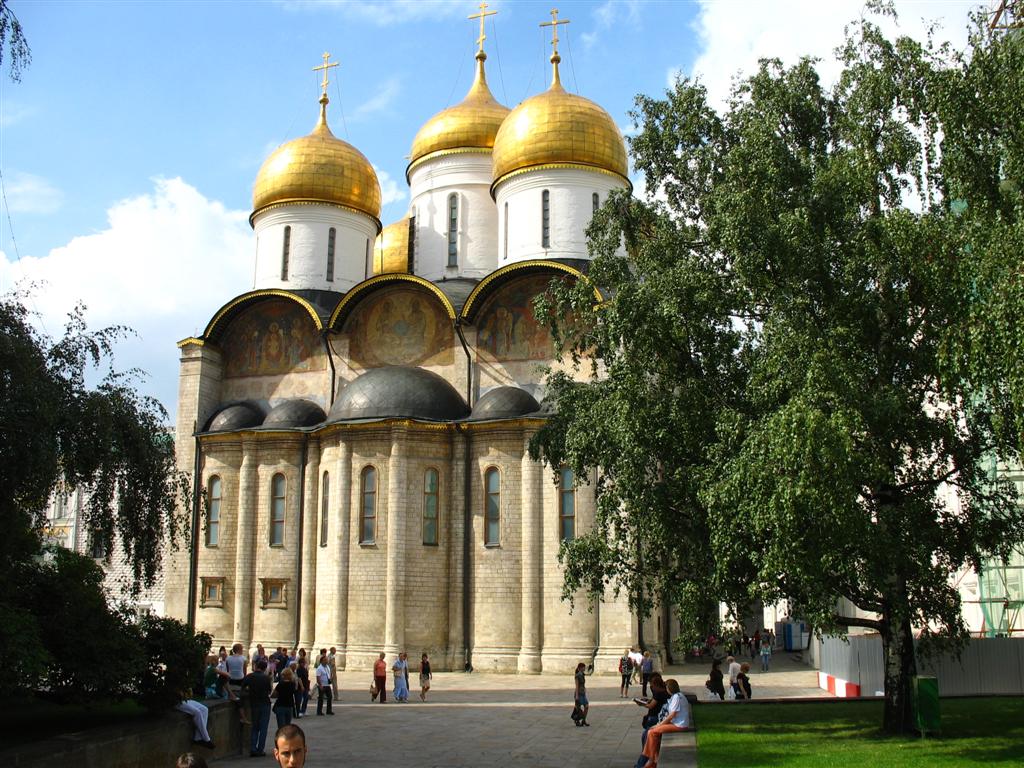
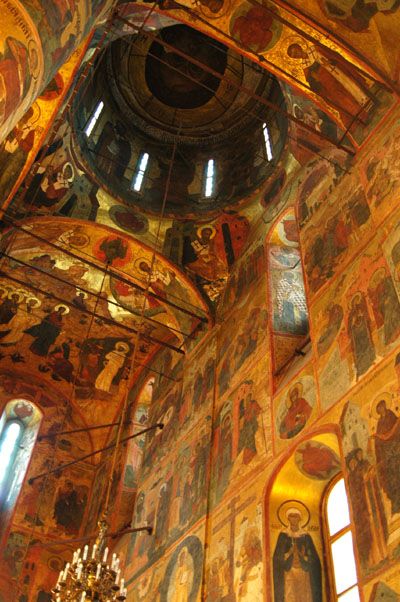
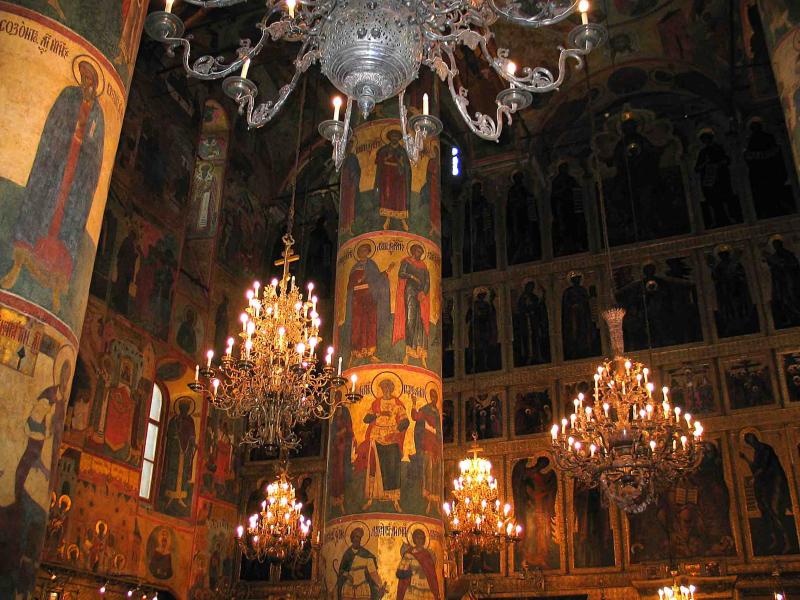
Below are some photos of the exterior and unbelievably beautiful interior (I’ve never been so overwhelmed by the magnificence of an Orthodox Church in my life: “For this we know, that God dwells there among men…”) of the Cathedral of the Dormition in the Kremlin, Russia’s Westminster, where Tsars from Ivan the Terrible in 1547 till Nicholas II in 1896 were crowned. (click)


Comment: nikobakos@gmail.com

“…απορώ και εξίσταμαι.”

14 Aug

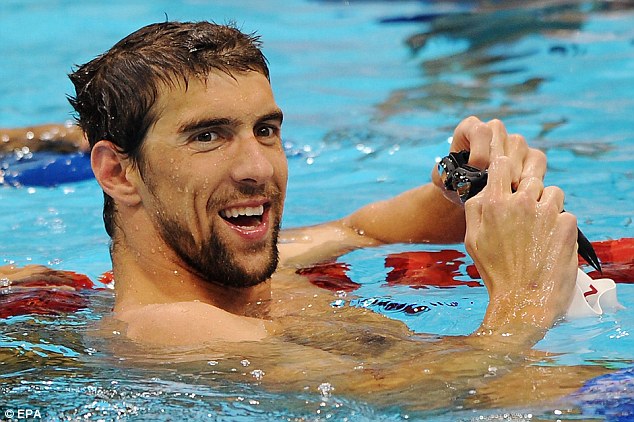
I was going to leave my boy Mikey alone for a while, because the games are over, obviously, and because he deserves some time without us intruding on his life all over the place.  But a couple of people want to know what the Greek heading on my last Phelps post meant so I’m back bothering him again.

It says:

Ποιόν σοι εγκώμιον προσαγάγω επάξιον, τι δε ονομάσω σε, απορώ και εξίσταμαι.

“What praise can I approach you with that would be worthy?  By what name address you?  I stand beside myself in wonder.”

It’s from the Orthodox service of the Salutations of the Virgin (Chairetismoi), which are a series of services sung on Friday nights during Lent — Saturday mornings for the Russians.  I have no idea why it’s sung during Lent; the subject matter is Lent-irrelevant; and I also have no idea whether it’s actually a Vespers or a Matins service, since Greeks have a habit of singing Matins the night before, “in anticipation,” which I like because I don’t like getting up in the mornings for church or anything, and because night-time seems more appropriate for what Rebecca West calls “the dark and mysterious Orthodox rite,” but the Russians are probably right to sing it in the mornings because they’re greater sticklers when it comes to issues of office accuracy (which means it must be Matins) and because Friday nights during Lent are really supposed to be when the Pre-Sanctified Liturgy, the most “dark and mysterious” of all “dark and mysterious” Orthodox rites, should be conducted anyway and now nobody knows what I’m talking about.

It’s also – I’m being serious now – called the Akathist hymn, the Un-sitting hymn, because it should be heard standing up, but all Orthodox services should be heard standing up; pews are an innovation of Greek-American churches, and Russian churches don’t even have the stalls for older people that Greek churches have always had.  It was supposedly first sung during an Avar siege of Constantinople in the 7th century, which was then miraculously lifted.

The lines above are addressed to the Virgin by the Archangel Gabriel.  It must’ve been truly wonderous to hear it set to an Ottoman-era composition, but it’s now sung to a banal nineteenth-century tune that ruins the poetry.  This was part of the halting but thankfully limited “modernization” of the music of the Greek Church that occurred in that and the early twentieth century; I wonder if the influence of Anatolian refugees and clerics put a stop to it.  But the more central a hymn was considered to a service’s meaning, the more likely it was to have been set, at some point, to a boring, semi-Western, “Mary-had-a-little-lamb” melody (like the hair-pullingly tedious Ainoi on Good Friday night, which seem to last for hours and which many — unbelievably — consider the highlight of Holy Week), in order to encourage, you know, congregational participation along Protestant and Neo-Catholic lines, as if it were more spiritually edifying to sing badly in a group (we’re not Black, you know) than to listen to the technically demanding music of the Church — essentially a branch of the Perso-Ottoman classical tradition — performed by highly trained cantors.  Maybe I’ll remember that next time I’m at the opera.

(There were a group of young – teenage – cantors here in Astoria in the nineties who were real prodigies and who used to dig up the older compositions for these hymns and ambush the congregation with them; I used to love to hear their clear tenors and baritones and technically perfect drone silence the bewildered aunties.)

The last clause, “απορώ και εξίσταμαι”  “I stand beside myself in wonder” is used sometimes as an ironic archaicism by Neo-Greeks to mean: “You’re shitting me…” or “Are you for real?” or like when a kvetching girlfriend says: “You know, I really can’t believe you…”  But I doubt most of them know where it’s from.

Anyway, it may be weird to choose a hymn to the Virgin with which to sing the praises of Michael Phelps, but the lyrics just hit the perfect tone of wonder and adoration due an athlete — and man — like him and Mikey’s a Cancer so he’ll get the Mother thing.

Another fresco from the Serbian Orthodox monastery of Decani in Kosovo (click), but I can’t for the life of me figure out what episode in either Christ or the Virgin’s life it’s supposed to represent, unless it’s the time Joseph and Mary went to Jerusalem and lost Jesus because he was at the Temple discussing the Torah with the elders, but he was twelve in that story…

Comment: nikobakos@gmail.com

Maybe Germans ARE scary

13 Aug

Don’t be fooled by all the guilt and Green-ness and the earnest, smart-looking glasses and the Birkenstocks.

Because the flip side of all that morality and righteousness is this kind of moralism and self-righteousness: “German Austerity’s Lutheran Core,” an expression of pure German arrogance that I can’t believe could be written in 2012 or by a professor at Harvard or published in a publication like The New York Times.

I just have a few questions for Herr Ozment.

Does he know that Frau Merkel was not just “a born-and-baptized daughter of an East German Lutheran pastor,” but also the daughter of a father who probably had a quite sweet and cozy little perk-filled relationship with the Communist Party of East Germany?  How does he reconcile Frau Merkel’s moral steadfastness with that kind of association with an institution that caused decades of untold and tragic suffering for millions of already suffering Germans who had just been through hell and back?  Or how does he think that Frau Merkel herself reconciles the two in her scrupulous Lutheran conscience?

Does he know of an obscure book called The Protestant Ethic and the Spirit of Capitalism by a certain Max Weber?  Does he know that soon after the ideal Lutheran German town created its common chest, it decided it should charge interest on the loans it gave to the poor from the chest, and that, instead of blowing it on one big juerga like Spanish aristocrats, or on great art, like Italian bankers did before them, leaving so much to posterity, they decided they should reinvest it to make more money?  And not for the town — but for the keeper’s of the chest?  (And speaking of art, how does he feel, btw, about Luther’s Taliban destroying so much of Europe’s artistic heritage?)

Does Herr Ozment really believe the grotesque lie that German austerity plans are putting the money back in the town chest and not giving it to the predatory chest-keepers?

And what was Luther’s answer to those poor, struck by life’s unforeseen misfortunes, who weren’t able to pay the loan back into the chest?  Was his answer the rhetorical question of Ebeneezer Scrooge in A Christmas Carol: “Are there no prisons?  Are there no workhouses?”  Because that certainly seems to be Frau Merkel’s and Germany’s answer to the unprecedented suffering they’re causing across much of Europe.  It’s one thing to try and help another help himself.  It’s another to try and squeeze blood from a stone.

Did Luther, or you, Herr Ozment, know that charity — caritas — means unconditional love and giving, and not the attempt to materially blackmail another man into your idea of moral rectitude?

But let’s go back to Germany itself and take a look at Ozment’s bloated claims for Lutheranism as the center of German culture.  Where does the vast Germanic South, with its deep Catholic traditions, fall in Herr Ozment’s vision?  Bavaria?  Austria?  Is it possible that traditional Catholicism’s emphasis on beauty and sensory experience can explain why so much of what inspires us in German culture comes from those lands — the music, the poetry, the architecture, the literature, the philosophy…from Dresden, from Munich, from Salzburg, from Vienna.  Just what Vienna has given us is enough to produce a whole man, in his moral and aesthetic entirety, who sees and tries to grapple with the complexity of the human condition and is not burdened in that search by trite judgmentalism.  (And perhaps much of that isn’t even German at all but Jewish.)

What have Berlin or Lubeck given us?  Prussian militarism and herring merchants counting their pfennigs.

In the end, whether Catholic or Protestant, it wasn’t the supposed wildness of German Romanticism that brought us Nazism, but a smug moralism’s sense of grievance, a little child’s “why should I?” when he’s asked to share.  (If you know Gerda in Rebecca West’s Black Lamb and Grey Falcon you know exactly what I mean.)  And that’s precisely the worldview Ozment espouses and Angela Merkel is imposing on an entire continent.

And beneath that ultimately is the great hypocrisy that lies beneath the whole phenomenon of the Protestant Reformation and — let’s just say it — Protestantism.  It wasn’t a new form of religion; it was the beginning of the end of religion.  That Weber guy would have explained to Herr Ozment that the Reformation was really the beginning of “disenchantment,” which is the end of seeing the world in a sacred way — and, thus, the first step to atheism — and the birth of a new way of seeing economic and material life and humanity.  Much of Protestantism, therefore, had to fall back onto moralism — a very different thing from morality — to fill the emptiness at its core and so that this new economic order could function the way it was supposed to.  And that’s why mainstream, white Protestantism was the last form of Christianity to be born and the first to die.

Some money quotes:

“And it is true that Lutheranism is hardly the only social force alive in Germany today. Yet it is of a piece with the country’s two millenniums of history, filled as it is with redemptive self-sacrifice and bootstrapping. In the fourth century A.D., German warriors controlled virtually every senior military post in the Roman army [not in the Eastern Empire they didn’t, Herr Ozment]. Later, Germans turned the wilds of northern Central Europe into a bountiful breadbasket — and, most recently, an industrial machine.”

Oh.  Well, what a bummer that the Allies didn’t let German warriors control every senior military post in twentieth-century Europe too.  And that they didn’t let them turn all of Eastern Europe “into a bountiful breadbasket — and, most recently, an industrial machine.” without pesky Slavs and Jews getting in the way.

And then this:

“With the steady advance of Islam into Europe over the last two decades and in the face of unrelenting economic pressure from their neighbors, it is no surprise that Germans of all backgrounds have now again quietly found “a mighty fortress” for themselves in their own Judeo-Christian heritage.”

…which I’m not even going to touch.

P.S.

When I first read Mann’s Doktor Faustus (perhaps my favorite writer; yes, I know, he was from Lubeck and he wrote a great book about it but he hated it and left and never went back again), I got to the point where the biographer/narrator is living through the Allied bombing of Munich late in the war, and he writes:

“Meanwhile the destruction of our venerable cities from the air continues, a sin that would cry up to the heavens, were the heavens not already deafened by the magnitude of our own crimes.”

…and I was shocked, had to put the book down.  I thought only the noblest, most honestly soul-searching people could have produced a sentence with that sense of moral clarity about themselves.  And I cried.  Because even though I had never felt even the slightest animosity towards Germans, I felt flooded with an overwhelming feeling of forgiveness.  And I thought that if even one German had produced that thought, had felt that in his soul, then no one in the rest of the world had any right to continue collectively villainizing them.  And now I’m not so sure.  And that’s troubling.

And maybe that was Mann’s Protestant conscience speaking, but it would be an act of obscenity for anyone to suggest that Merkel and Germany today are inspired by the same moral source.

You’ll excuse me now.  I just clicked on “Cosi Fan Tutte” on my ITunes and need to lie down and pick up some Rilke or Heine or something…immerse myself in what “German” has always meant to me.  Herr Ozment has turned my stomach.


Comment: nikobakos@gmail.com

Varesh-e-Bastani

13 Aug

Also from Andrew Sullivan:

When Sport Is Culture

GT_REZAEIIRANWRESTLER_20120810

by Chas Danner

Iran has cleaned up at the Olympics in weightlifting and wrestling, so far taking home 4 gold and 7 overall medals in the sports. Max Fisher takes a look at how Persian history has played into this success:

The surprisingly rich academic literature on Iran’s impressive records at wrestling, weightlifting, and tae kwon do consistently connects all three to an ancient Persian sport called Varzesh-e-Bastani [PDF], which literally translates to “ancient sport.” To Westerners, Varzesh-e-Bastani might look like an odd combination of wrestling, strength training, and meditation. Though there’s no known link between Varesh-e-Bastani and yoga, it might help to think of it as something like a Persian version of this athletic practice that’s also a method of personal and community development — and a symbol of cultural heritage.

Though Western cultures typically treat wrestling as an aggressive, individualistic, and deeply competitive sport, traditional Persian Varzesh-e-Bastani emphasizes it as a means of promoting inner strength through outer strength in a process meant to cultivate what we might call chivalry. The ideal practitioner is meant to embody such moral traits as kindness and humility and to defend the community against sinfulness and external threats. The connection of weightlifting with character development might sound odd, but it’s perhaps not so different from, for example, the yogic practice of Shavanasa, a meditative pose meant to bolster the spiritual and mental role of yoga’s stretches and poses.

Meanwhile, the Guardian‘s Saeed Kamali Dehghan looks at how the Olympics have played out back in Iran, including the reactions of ordinary Iranians:

The country’s success at the Olympics comes at a time of financial stringency and threats of war. But it is lifting the spirits of a nation gripped by sorrow and anxiety. “Despite all the pressure, there’s at least something positive out there to talk about and that’s the Olympics,” [a college student named] Reza said. His comments are echoed my many of his countrymen. “It’s so nice to see people discuss our success on public transport and share some joy,” said Ameneh, a 22-year-old Iranian student. “It’s also nice to see Iran’s name mentioned in some positive context. In the middle of all these financial difficulties, we have almost forgotten how to be happy,” she said.

(Photo: Yunior Estrada Falcon of Cuba (blue) wrestles against Ghasem Gholamreza Rezaei of Iran in the Men’s 96kg Greco-Roman Quarter-Final on Day 11 of the London 2012 Olympic Games at ExCeL on August 7, 2012 in London, England. Rezaei subsequently won the Gold for his weight class. By Mike Hewitt/Getty Images)


Comment: nikobakos@gmail.com

Tisha B’Av?

13 Aug

Sorry, but it’s pretty funny that Romney’s trip has made of Tisha B’Av such a central metaphor for contemporary Israeli politics and the problematics of Jewish conscience (see previous post).  In old Ashkenazi humour — at least as I know it from Brooklyn — Tisha B’Av, Ti-shabuv in Yiddish pronunciation, is used ironically because it’s such an obscure holiday that no one ever knows when it is.

“When is he gonna finally paint the kitchen?  Who knows?  At Tishabuv…”

“If you’re waiting for the perfect girl to come along, you’ll be waiting till Tishabuv…”

And the like…

But Beinart’s piece, Mitt Romney Misuses Judaism to Support Israel and Buttress His Own Campaign, is truly beautiful, expressing the best tradition of Jewish moral self-reflection, which time and again has saved them and saved us too, in ways too complex to get into here:

“Sorry, but that largely misses the point. Tisha B’Av is less about steeling Jewish resolve against our enemies than fostering self-reflection about the Jewish misdeeds that allowed those enemies to prevail. The Talmud says that God allowed the Babylonians to destroy the First Temple because the Jews committed idolatry, bloodshed, and sexual sins. Similarly, the Romans are bit players in the Talmud’s intricate explanation of the chain of Jewish sins that led to the Second Temple being destroyed. Among those sins—none of which easily lends itself to a GOP stump speech—are “baseless hatred” among Jews and a concern for ritual stringency so obsessive that it trumps concern for human life. [my emphases]”

What other people, even if they lapse so often and so often tragically, are so honest and clear-eyed about their faults?


Comment: nikobakos@gmail.com

Romney In Israel: How High To Jump?

13 Aug

It’s almost two weeks old already but I felt obliged to reproduce this sum-up of Romney’s Israel trip from Andrew Sullivan’s Dish because it’s such a thorough review from all quarters:

30 Jul 2012 12:54 PM

149487385

Haaretz’s Barak Ravid goes over the speech:

The speech itself sounded as if it could have been written by Netanyahu’s bureau. So it’s no surprise that when the two met later for dinner, Netanyahu thanked him for his “support for Israel and Jerusalem.” In general, Netanyahu embraced Romney as no Israeli prime minister has ever before embraced a candidate running against an incumbent U.S. president: Aside from their working meeting in the morning, Netanyahu also hosted Romney and his wife and sons for dinner at his official residence.

The crowd told you everything you need to know:

Religious American immigrants dominated the crowd; secular Jews and native-born Israelis were few and far between. Those present included Jewish-American millionaires, settler leaders like the former chairman of the Yesha Council of settlements Israel Harel, and former Netanyahu aides such as Dore Gold, Naftali Bennett, Ayelet Shaked and Yoaz Hendel.

Settlers and religious fanatics: it’s striking how the entire foreign policy position of the GOP in the Middle East has essentially been out-sourced to the Likud. The reasons for that, one senses, are multiple. The most powerful way that Romney can win over the religious right, given his past wobbliness on such issues as abortion and gay equality, is to back the Likud and its associated religious parties in their twin goals: permanent occupation of the West Bank and a war against Iran. That’s what the Christianists passionately believe in. Moreover, adopting wholesale the Israeli position – that Iran cannot enrich uranium even for peaceful and inspected purposes – is tantamount to declaring war, either by Israel or the US. In office, how will Romney not back Netanyahu in whatever he wants? And not because he has made an assessment of the realities of America’s interests in the region, but because any daylight between Romney and Netanyahu would produce a revolt among the pro-settler, end-times Christianist right that now runs the GOP. 

Notice how often Romney cited “providence” for Israel’s establishment and prosperity. Notice how for Romney, there is no more glowing characteristic of a nation than its economic wealth (a sign of its holiness). Note how the democratic revolutions in the Arab world, wished-for by Bush, encouraged by Obama, are now dark forces for Romney, because they might elevate Islamism in the Middle East in the short or medium term, and if you are Israel (but not necessarily America) that must be countered immediately.

I honestly don’t know whether Romney in office would follow the logic of this long campaign – he spoke platitudes about “a two-state solution” which his chief funder, billionaire fanatic Sheldon Adelson, has contempt for. But I do think his cartoonishly neocon posture in the Middle East is a huge liability and makes a return to Bush-Cheney global polarization more likely. Then there’s the tone-deaf issue:

Mitt Romney told Jewish donors Monday that their culture is part of what has allowed them to be more economically successful than the Palestinians, outraging Palestinian leaders who suggested his comments were racist and out of touch with the realities of the Middle East…

“It is a racist statement and this man doesn’t realize that the Palestinian economy cannot reach its potential because there is an Israeli occupation,” said Saeb Erekat, a senior aide to Palestinian President Mahmoud Abbas. “It seems to me this man lacks information, knowledge, vision and understanding of this region and its people,” Erekat added. “He also lacks knowledge about the Israelis themselves. I have not heard any Israeli official speak about cultural superiority.”

More pro-Israel than many Israelis; and too jejune to know you keep these sentiments quiet. Frum applauds the speech and says it helps Obama, because Romney was acting “as ‘bad cop’ to the administration’s ‘good cop,’ intensifying pressure on the Iranian regime to do a deal now—before the next administration offers yet tougher terms.” Oookaay. What strikes me as more significant is that Romney is the first presidential candidate not to endorse a two-state solution along 1967 lines with land-swaps. That’s a huge victory for the Israeli far right.

Shifting focus, Goldblog calls the timing of Romney’s photo-op at the Western Wall “vulgar”. Beinart elaborates:

In his Jerusalem speech, Romney went on to insist that “we cannot stand silent as those who seek to undermine Israel voice their criticisms. And we certainly should not join in that criticism.” But Tisha B’Av [the fast day that commemorates the destruction of the First and Second Temples] is all about the importance of criticizing Jewish behavior; that’s why, on the Sabbath before it, we read a portion of the Torah in which Moses rebukes the Jewish people before they enter the land of Israel. Obviously, some criticism truly is destructive and unfair. But to use Tisha B’Av to suggest that the country that most clearly wishes Israel well—the United States—should never publicly disagree with Israel’s actions isn’t just bad foreign policy. It’s bad Judaism.

Relatedly, Juan Cole lists the “Top Ten Most Distasteful things about Romney Trip to Israel.” One obvious one:

It is distasteful the Romney will not commit to a two-state solution within 1967 borders or demand Israel cease illegal squatting on and unilateral annexation of Palestinian land. If he is going to this Middle East hot spot, why doesn’t he visit a Palestinian refugee camp so as to understand the nub of the dispute, instead of hobnobbing with the uber-rich in Jerusalem.

Because understanding the nub of the dispute would mean empathizing with Muslim Arabs and getting outside his comfort zone. Romney, alas, can barely empathize with his own dog.

(Photo: US gaming tycoon Sheldon Adelson arrives to hear Republican presidential candidate, former Massachusetts Gov. Mitt Romney delivers foreign policy remarks on July 29, 2012 in Jerusalem, Israel. Romney is in Israel as part of a three-nation foreign diplomatic tour which also includes visits to Poland and Great Britain. By Lior Mizrahi/Getty Images.)


Comment: nikobakos@gmail.com