The Destruction of Delhi — Dalrymple

29 Jun

The following is reproduced by permission and with the generosity of the author from William Dalrymple’s The Last Mughal: The Fall of a Dynasty: Delhi, 1857.  I’ve mentioned this brilliant book in a previous post: Favorite Blogs: The Delhi Wallah.  These are from the gripping few pages where Dalrymple describes the irrational and totally vengeful destruction of much of Delhi by the British after the Uprising of 1857 had been suppressed.

The entrance to the Jama Masjid

*******************************************************************************************************************************************

Canning had already given orders to destroy the Delhi walls and defences, but Lawrence managed to get the orders rescinded, arguing that there was insufficient gunpowder in Delhi to blow up several miles of walls.  By the end of 1859, Canning had agreed to his plan only to demolish what was needed to make the fort and city more defensible.  By 1863, the planned demolition of the eastern half of Chandni Chowk down to the Dariba had also been stopped.  Even so, great swathes of the city – especially around the Red Fort – were still cleared away, as Ghalib recorded in a series of sad letters to his correspondents across Hindustan: “The area between Raj Ghat [on the city’s eastern edge, facing the Yamuna] and the Jama Masjid is without exaggeration a great mound of bricks.”

“The Raj Ghat Gate has been filled in.  Only the niched battlements of the walls is apparent.  The rest has been filled up with debris.  For the preparation of the metalled road, a wide open ground has been made between Calcutta Gate and the Kabul Gate.  Punjabi Katra, Dhobiwara, Ramji Ganj, Sadat Khan ka Katra, the Haveli [palace, mansion, konak] of Mubarak Begum [Ochterlony’s widow], the Haveli of Sahib Ram and his garden – all have been destroyed beyond recognition.”

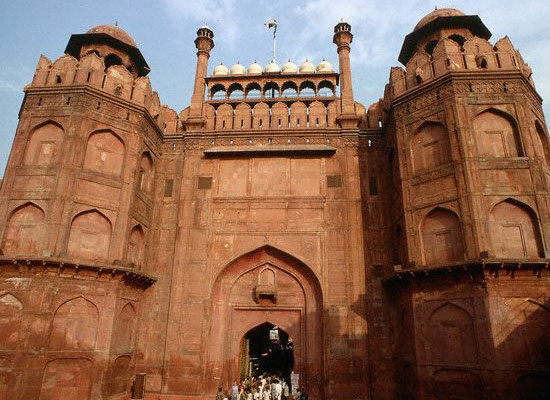
What had been the neighborhood around the Jama Masjid (above).  The Kashmiri Gate (below).

Other letters of Ghalib’s mourned the destruction of some of the city’s finest mosques, such as the Akbarabadi Masjid and the great Masjid Kashmiri Katra [I haven’t been able to find any photos of these, but the Akbarabadi Masjid was considered a sort of twin to the Jama Masjid — my comment]; great Sufi shrines such as that of Sheikh Kalimullah Jahanabadi;* the imambara+ built by Maulvi Muhannad Baqar; and the establishment of a cleared open space 70 yards wide around the Jama Masjid.  Four of Delhi’s most magnificent palaces were also completely destroyed; the havelis of the recently hanged nawabs of Jhajjar, Bahadurgarh and Farrucknagar, as well as that of the Raja of Ballabargh.  The great caravanserai of Shah Jahan’s daughter Jahanara was demolished and replaced by a new town hall.  Shalimar Bagh, where Aurangzeb had been crowned, was sold off for agricultural use.  Even where old Mughal structures were allowed to continue, they were often renamed: Begum Bagh, for example, became the Queen’s Gardens.

Tragically the Red Fort was another area where Lawrence intervened too late to stop the wholesale destruction.  He managed to save both the Jama Masjid and the Palace walls, but 80 per cent of the rest of the Fort was leveled.  Harriet Tyler, who was living in an apartment above the Diwan i-Am at this time, was horrified by the decision and decided to paint a panorama of the city before it disappeared.  It confirmed her in her disgust of the way the British had behaved in Delhi since the assault began on 14 September.  “Delhi was now truly a city of the dead,” she wrote in her memoirs.  “The death-like silence of that Delhi was appalling.  All you could see were empty houses… The utter stillness…[was] indescribably sad.  It seemed as if something had gone out of our lives.”

[These are some drawings I’ve been able to find of the palace and palace grounds but, though beautiful, they don’t give you much of a sense of what was destroyed — my comment]:

(the above appears in Dalrymple’s book)

The demolitions started at the Queen’s Baths in November 1857, and continued through most of the Palace, destroying an area “twice the area of the Escorial,” as the horrified historian James Ferguson pointed out twenty years later.  “The whole of the area between the central range of the buildings south and eastwards from the bazaar, measuring about 1000 feet each way, was occupied by the harem apartments – twice the area of any Palace in Europe.”

“According to the native plan I possess, which I see no reason for distrusting, it contained three garden courts, and some thirteen or fourteen other courts, arranged some for state, some for convenience; but what they were like we have no means of knowing.  Not one vestige of them now remains…  The whole of the harem courts of the palace were swept off the face of the earth to make way for a hideous British barrack, without those who carried out this fearful piece of vandalism, thinking it even worthwhile to make a plan of what they were destroying or preserving any record of the most splendid palace in the world.”

As late as March 1859 George Wagentrieber was please to record in the Delhi Gazette that “a good deal of blowing up” was still going on in the Palace.  Some of the finest buildings were the first to go, such as the Chhota Rang Mahal.  Even the Fort’s glorious gardens – notably Hayat Bakhsh Bagh and Mehtab Bagh – were swept away.  All that was left by the end of the year was about one-fifth of the original fabric – principally a few scattered, isolated marble buildings strung out along the Yamuna waterfront.  These were saved owing largely to the fact that they were in use as offices and messes by the British occupation troops, but their architectural logic was completely lost once they were shorn of the courtyards of which they were originally a part.


(click on this photo)

All the gilded domes and most of the detachable marble fittings were stripped and sold off by the Prize agents.  As Fergusson noted,

“when we took possession of the palace, everyone seems to have looted after the most independent fashion.  Among others, a Captain (afterwards Sir) John Jones [who had blown in the Lahore Gate during the capture of the Fort] tore up a great part, but had the happy idea to get his loot in marble as table tops.  Two of these he brought home and sold to the Government for 500 pounds, and were placed in the India Museum.”

These fragments included the rightly celebrated “Orpheus panel” of pietra dura inlay which Shah Jahan had placed behind his Peacock Throne.

Meanwhile, what remained of the Mughal’s Red Fort became a grey British barracks.  The Naqqar Khana, where drums and trumpets had once announced the arrival of ambassadors from Isfahan and Constantinople, became the quarters of a British staff sergeant.  The Diwan i-Am became a became a lounge for officers, the Emperor’s private entrance a canteen, and the Rang Mahal was turned into a military prison.  The magnificent Lahore Darwaza was renamed the Victoria Gate and became “a bazaar for the benefit of the Fort’s European soldiers.”  Zafar’s contribution to the Palace architecture – the Zafar Mahal, a delicate floating pavilion in a large red sandstone tank – became the centerpiece of a swimming pool for officers, while the surviving pavilions of Hayat Bakhsh Bagh were turned into urinals.

* A modest tomb of the saint is, however, still extant in the Pigeon-seller’s Bazaar in Old Delhi

+ Shia religious hall used to hold mourning ceremonies during Muharram

******************************************************************************************************************************************

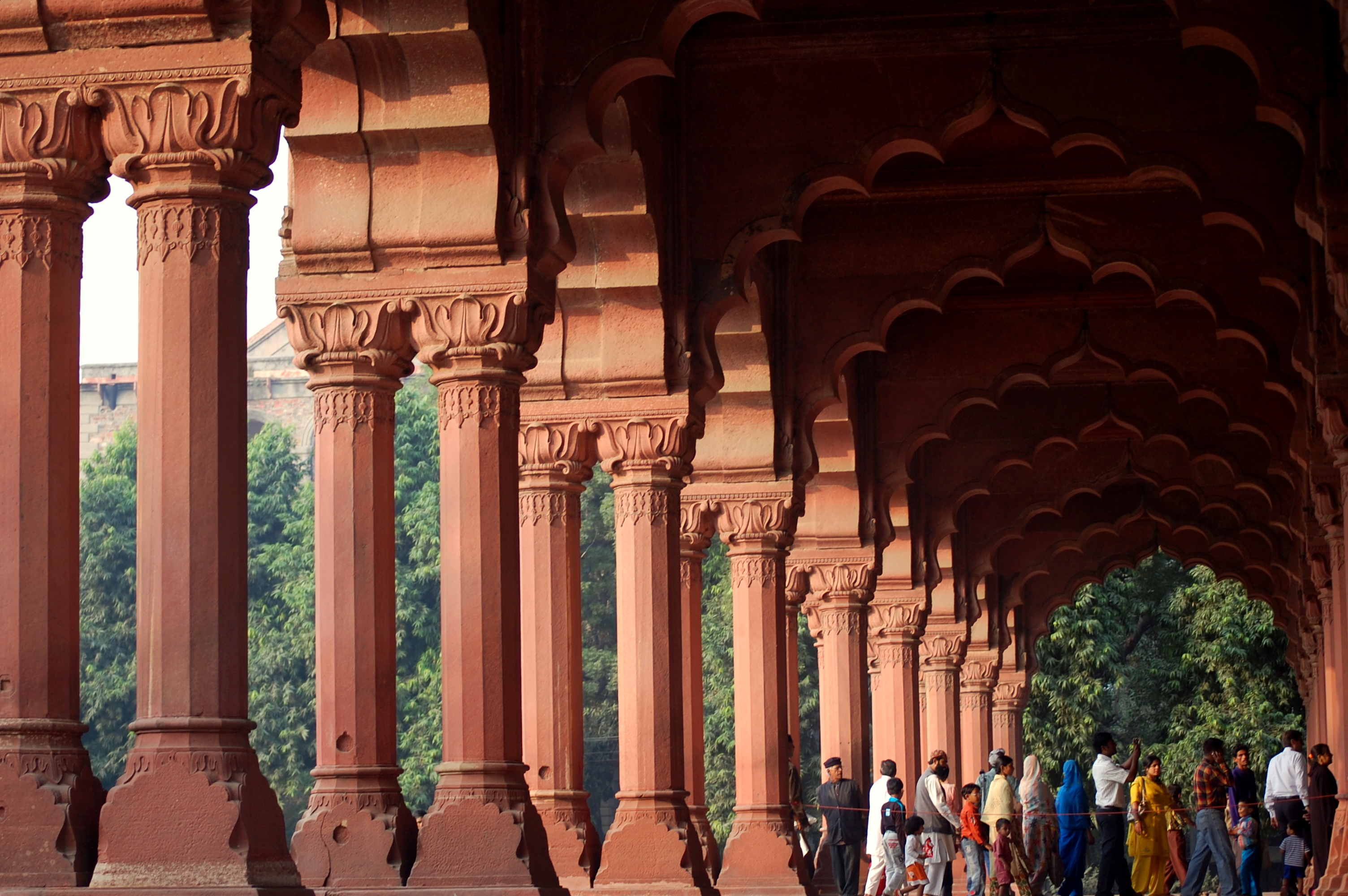
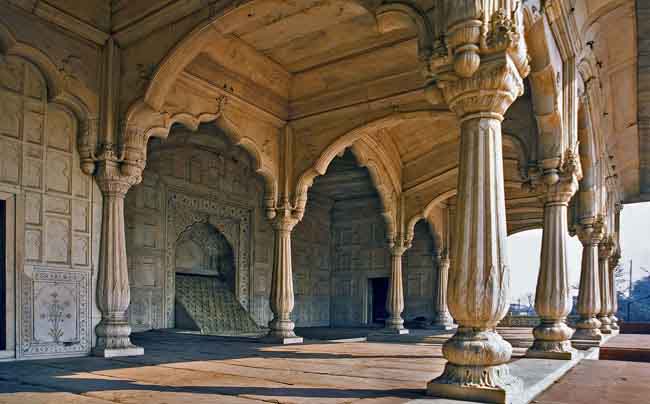
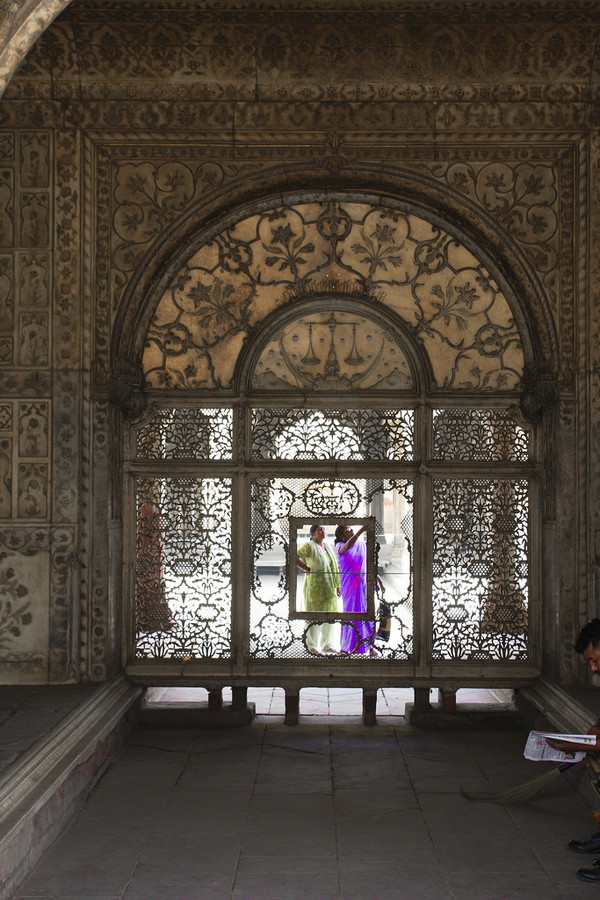
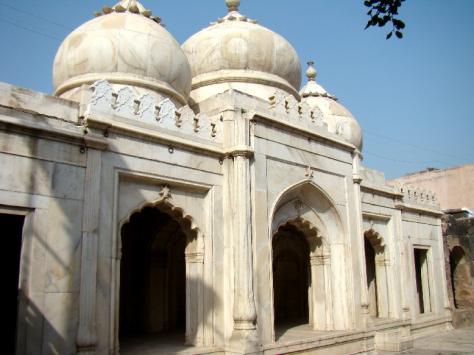
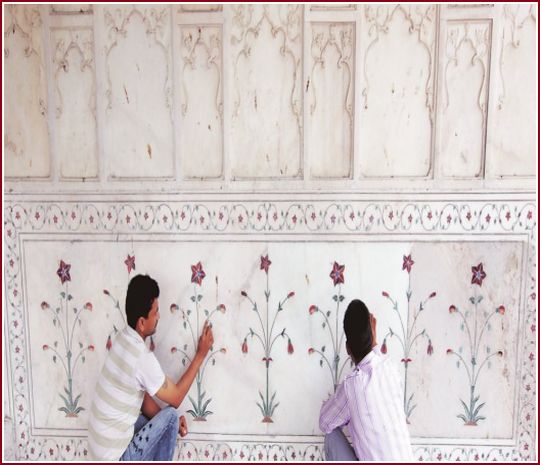
Below, I’m just posting whatever photos I can find of what’s left of the palace, without specific naming of each building, but hoping that readers constantly keep in mind that all this gorgeousness — and seen here damaged and stripped of its jewelled furnishings, gold, carpets, silken hangings, “Dacca gauzes,” running waters and the exquisitely dressed men and women of the court — is only the twenty percent of the original that survived Some photos may be clickable:

The famous Persian couplet by Amir Khosrow: “Agar Firdaus bar-ruhe-e-zamin ast, haminast o haminast o hamin ast.”  “If there is a heaven on earth, it is here, it is here, it is here.”

Snag…as we say in Queens.

28 Jun

2 -1 …. And the “1” was on a penalty…


Comment: nikobakos@gmail.com

The Cradle of Democracy

28 Jun

The new Greek Parliament was sworn in today, including the eighteen MP’s of the Nazi “Golden Dawn” party (down from the twenty-one seats they had won in the May elections).  Here they’re shown refusing to stand as the three Turkish MP’s from the the country’s Thracian Turkish minority are sworn in.  Actually, it’s illegal to call them “Turkish;” that’s why all media channels in the world fall in line with the the Greek government and you’ll only hear them referred to as the “Muslim” MP’s.

The official state line is that since some 30 to 40 percent of the minority consists of Bulgarian (Pomak)-speaking Muslims, it’s wrong to call them all Turkish, the Greek state being long known for its concern for minority identities and endangered languages.  As far as I know, it’s still illegal to call them Turks — just the ridiculous term “Greek Muslims,” which is something I don’t know how an EU member-state gets away with.  Till the early 2000’s it was illegal to refer to the Slavic language spoken in the country’s northwest as either Macedonian or Bulgarians as well; you had to refer to it as “ntopia” — “localish.”  Calling it either Macedonian or Bulgarian, if you happened to be a speaker of it, could land you in jail, and people there are still jittery about using it in public, will switch to Greek when a stranger comes around or wanders into one of their villages with its fake, new Greek name and don’t like to answer any questions concerning the issue.  This was probably once the numerically predominant language in Ottoman Macedonia, but most of its speakers were expelled from its central and eastern regions during the Balkan Wars and only a tiny island is left in the western Greek provinces of Emathia (Karaferia), Pella (Vodena), Kastoria (Kostur) and Florina (Lerin).  Again, it’s hard to know numbers with any accuracy, due to assimilation, shame or remnant fear.

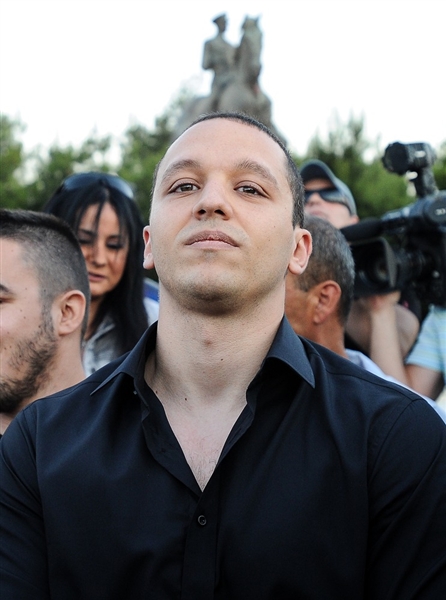
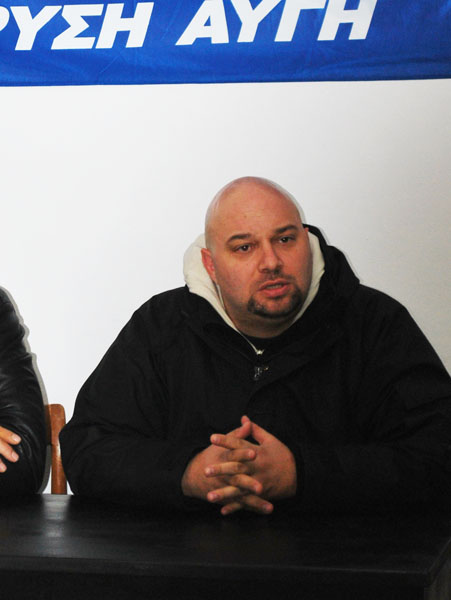
And this proud Hellenic pallikari, Ilias Kasidiaris (below), Golden Dawn’s spokesman, is now sitting free as an MP in the Greek Parliament despite the double assault immortalized by the video below (see also my previous post: Dateline Athens: From Bad to Worse)

An arrest warrant in Greece only lasts forty-eight hours, but Greek police knew where he was the whole time — even Greek police are not that incompetent — the whole country knew.  Apparently the statute of limitations on assault and battery is pretty short as well.  In any event, he now has parliamentary immunity, I think.  But he has other standing felony charges against him too; I don’t know the details.

And here’s some  pre-election cheer I had missed:

“A Far Right party has threatened to remove immigrants and their children from hospitals and nurseries in Greece if it gains power following Sunday’s general election.

Golden Dawn issued the warning at an election campaign rally in Athens, drawing loud applause from an audience.

According to the Guardian, Golden Dawn MP Ilias Panagiotaros said: ‘If Chrysi Avgi [Golden Dawn] gets into parliament, it will carry out raids on hospitals and kindergartens and it will throw immigrants and their children out on the street so that Greeks can take their place.'” [my emphases]

Panagiotaros is this stud here, who declared Kasidiaris’ assault on Dourou and Kanelle “an act of manliness.”

P.S.

According to Amnesty International’s 2007 report on Greece, there are problems in the following areas:

The US Department of State’s 2007 report on human rights in Greece identified the following issues:

  • Cases of abuse by security forces, particularly of illegal immigrants and Roma.
  • Overcrowding and harsh conditions in some prisons.
  • Detention of undocumented migrants in squalid conditions.
  • Restrictions and administrative obstacles faced by members of non‑Orthodox religions.
  • Detention and deportation of unaccompanied or separated immigrant minors, including asylum seekers.
  • Limits on the ability of ethnic minority groups to self-identify, [my emphasis] and discrimination against and social exclusion of ethnic minorities, particularly Roma.

Comment: nikobakos@gmail.com
“It’s Turkey’s Time” — NYT

28 Jun

May 23, 2012, 8:49 am 14 Comments

By ANDREW FINKEL
(Murad Sezer/Associated Press)

ISTANBUL — If patience is a virtue, then Turkey’s place among the angels is secure. The country’s efforts to become a member of the European Union has been dragging on for some 50 years, and while Ankara has not always been free from blame, since 2005 — when negotiations began in earnest — it has been trying hard to climb over the wall of Europe’s prejudices.

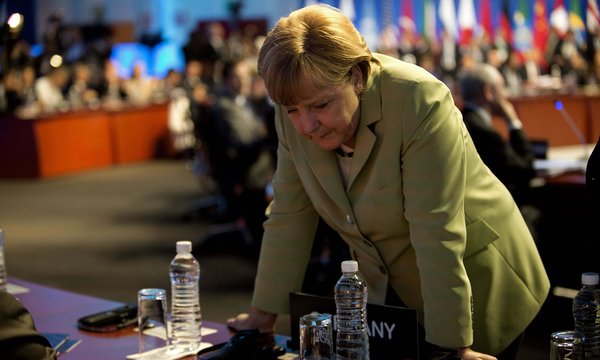
Yet now there is hope at last that the process may accelerate. Voter disenchantment in the euro zone recently claimed the head of President Nicolas Sarkozy of France, the leader of the die-hard Turko-skeptics. France had been refusing to even discuss with Turkey important provisions of the accession document known as the acquis communautaire, including those about budgetary affairs and agriculture. Along with his ally German Chancellor Angela Merkel — who has also been answering to constituencies that regard Turkey as not European enough to join the European club — Sarkozy favored granting Turkey a form of association that would stop well short of full membership.

News from the latest NATO summit in Chicago is that Sarkozy’s successor, François Hollande, is trying to turn the page. German attitudes may also be changing. Last week Merkel’s foreign minister, Guido Westerwelle, a member of the Liberal Democrats — partners of Merkel’s Christian Democratic Union in the governing coalition — delivered to Ankara a message very different from hers. “What is important is to seize the opportunity that emerged after the latest elections in Europe and restart E.U.-Turkey ties,” he said.

Turkey itself must seize the moment. Making the E.U. a priority again would quiet growing criticism that the government of Recep Tayyip Erdogan is becoming more autocratic as its traditional opponents (including the military) become weaker. But doing so will not be an easy matter. If Europeans may be said to suffer from enlargement fatigue, in the case of the Turks, it’s more like narcolepsy. The Turkish government is understandably tired of banging its head against a wall.

Turkey first approached Brussels in 1959. In 1963 it signed the Ankara Agreement, which set out a path for its joining what was then the European Communities. As Europe’s economic integration became political, too, sharing sovereignty with Turkey started to look like a more elaborate project. Still, in 2004, after an intense period of reform, Turkey was declared a full candidate for E.U. membership. Enthusiasm for joining Europe among Turks shot up, with 73 percent of respondents to a survey by the German Marshall Fund saying they thought accession would be a good thing.

But then Europe’s leaders slowed down negotiations, and the Turkish public started to look on the E.U. as a club that did not want them as members. By 2010, support for E.U. membership among Turks had dropped to 38 percent.

Europe wasn’t the only guilty party. My own jaundiced take is that Ankara was more interested in becoming a full candidate for E.U. membership than in becoming a full member of the E.U. Candidacy was an advertisement that Turkey was on a stable course, and it was instrumental in attracting much-needed foreign direct investment. Actual progress toward membership, on the other hand, would have meant implementing more reforms — environmental policies, greater transparency for government tenders — all at a steep economic and political cost. Turkey also refused to recognize the E.U. member Cyprus, or even open its ports to Cypriot vessels.

Turkish attitudes may change again, though. Over the past few years, Turks had begun to flirt with the notion that the Middle East was Ankara’s natural backyard. But they’ve started to realize that the Arab Spring has brought some stormy weather. Turkey’s relations with Iraq, Iran and Syria are at a low, and its export opportunities in Libya and Egypt have taken a hit. Despite the economic crisis in Europe, Turkey still carries out about 43 percent of its trade with the E.U.

Now is just the time when Turkey should want to join the union. With Europe more skeptical about itself these days, it may be less skeptical about admitting Turkey. While Europe staggers under austerity measures, Turkey is experiencing a boom. In the last two years its G.D.P. grew by 9.2 percent and 8.5 percent. The figure for this year will likely be lower, but Turkey can present itself as an engine of Europe’s recovery; it already is the E.U.’s fifth-largest export market. And though incorporating such a big country is still a major challenge, the task may seem less daunting if a “two-tier” Europe — with political integration occurring at different rates for different countries — emerges from the current crisis.

Turkey should spin Europe’s economic problems to its advantage and revive talks for E.U. membership. To its credit, the government has begun to speak about a “new era” and a “clean page.” At a time when Turkey is trying to adopt a more liberal constitution and better enforce the civil rights of the minorities like the Kurds, progress toward E.U. membership would strengthen democracy here. That would be good for Turkey, Europe and for Turkey’s neighborhood.


Andrew Finkel has been a foreign correspondent in Istanbul for over 20 years, as well as a columnist for Turkish-language newspapers. He is the author of the book “Turkey: What Everyone Needs to Know.”


Comment: nikobakos@gmail.com

“Morsy to appoint Copt, woman to vice presidency…”

27 Jun

Wow!  Either a cheap public relations move or a great, beautiful piece of good news.

(Photo: Virginie Nguyen)

A political adviser of President-elect Mohamed Morsy said a Copt and woman would be appointed as vice presidents.

Ahmed al-Deif told CNN that it would be the first time in Egypt’s history that a woman would be appointed to this position that will be granted powers.

“We didn’t call for establishing an Islamic republic in Egypt. Morsy was very clear on this. He assured [he is] seeking a civilian constitutional country, a civilized one based on respecting cultures, principles and religions,” he added.

Some enthusiastic, some skeptical comments at bottom


Comment: nikobakos@gmail.com
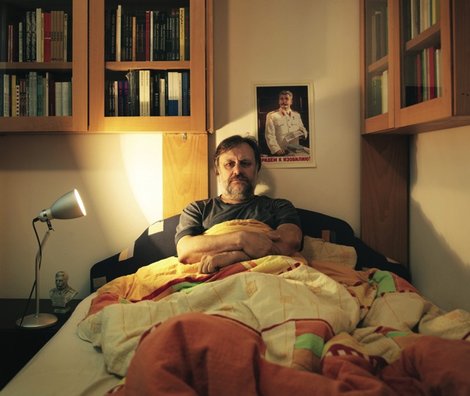
Zizek bash that sold me…

27 Jun

…and I was a slowly becoming a marginally dilettantish fan: The Violent Visions of Slavoj Zizek by John Gray, NYRB

Whether or not Marx’s vision of communism is “the inherent capitalist fantasy,” Žižek’s vision—which apart from rejecting earlier conceptions lacks any definite content—is well adapted to an economy based on the continuous production of novel commodities and experiences, each supposed to be different from any that has gone before. With the prevailing capitalist order aware that it is in trouble but unable to conceive of practicable alternatives, Žižek’s formless radicalism is ideally suited to a culture transfixed by the spectacle of its own fragility. That there should be this isomorphism between Žižek’s thinking and contemporary capitalism is not surprising. After all, it is only an economy of the kind that exists today that could produce a thinker such as Žižek. The role of global public intellectual Žižek performs has emerged along with a media apparatus and a culture of celebrity that are integral to the current model of capitalist expansion.

In a stupendous feat of intellectual overproduction Žižek has created a fantasmatic critique of the present order, a critique that claims to repudiate practically everything that currently exists and in some sense actually does, but that at the same time reproduces the compulsive, purposeless dynamism that he perceives in the operations of capitalism. Achieving a deceptive substance by endlessly reiterating an essentially empty vision, Žižek’s work—nicely illustrating the principles of paraconsistent logic—amounts in the end to less than nothing.


Comment: nikobakos@gmail.com
“Tal” Law exemption done…

27 Jun

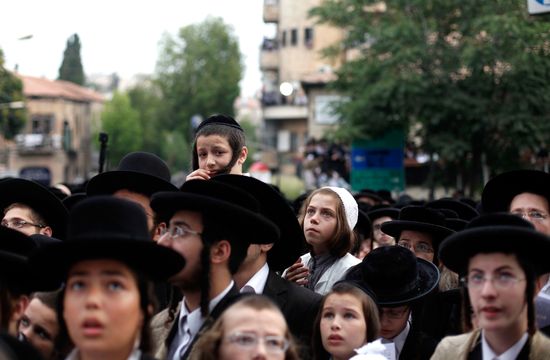
The question is: does Israel — or the rest of the world — want these guys as soldiers?  Seems to me it’s a toss-up as to whether they’ll be completely incompetent or the most vicious bunch yet.  Or, they’ll just move back to Borough Park and annoy us.

Ultra-Orthodox Jewish men and boys (some of them dressed in sacks as a sign of mourning) protest against Tal Law replacement on June 25, 2012 in Jerusalem, Israel. The Tal Law, which exempts ultra-Orthodox yeshiva students from mandatory military service, was declared unconstitutional by the High Court in February and is due to expire in August. (By Lior Mizrahi/Getty Images.)


Comment: nikobakos@gmail.com

Photo: Kashmir

26 Jun

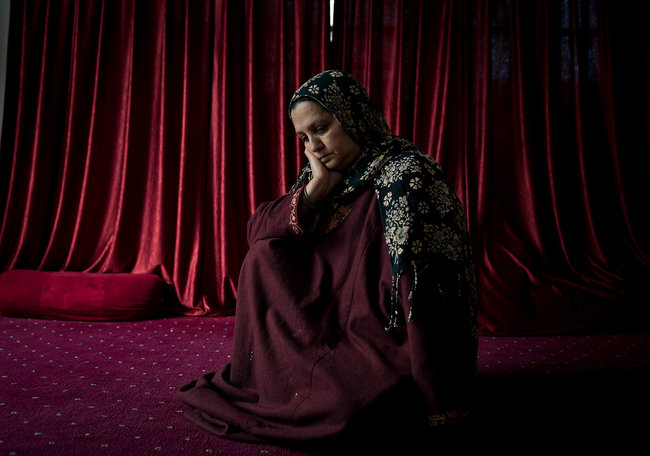
Grief. Red. Ruby. Blood. Velvet. Agha Shahid Ali. His mother. The Virgin. The clean, empty comfort of a Muslim home. The great disgrace of the “world’s largest democracy.”

Parveena Ahangar has not seen her son since three officers took him away in 1990, she said. The officers have not been punished.  (The New York Times)

“In Kashmir, Killing Ebbs, but Killers Roam Free”


Comment: nikobakos@gmail.com

Srinagar: Miraj-Ul-Alam

24 Jun

Kashmiri Muslims pray as an unseen custodian displays a holy relic, believed to be a hair from the Prophet Muhammad’s beard, at Kashmir’s main Hazratbal Shrine in Srinagar on June 22, 2012, during the last Friday of celebrations for Miraj-Ul-Alam (Ascension to Heaven).  (By Tauseef Mustafa/AFP/Getty Images.)

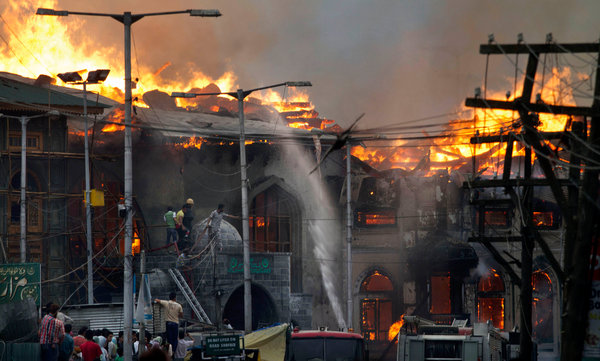
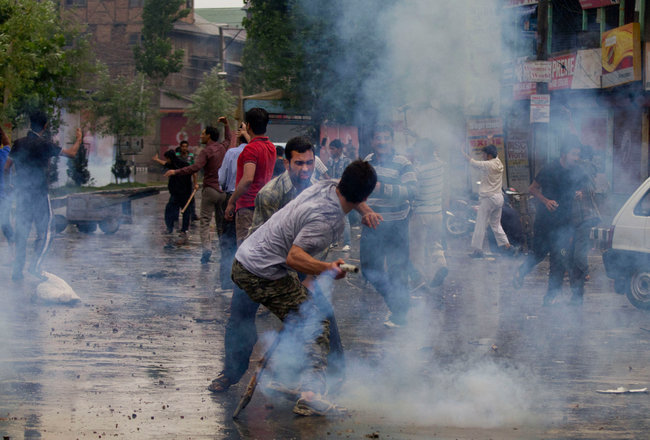
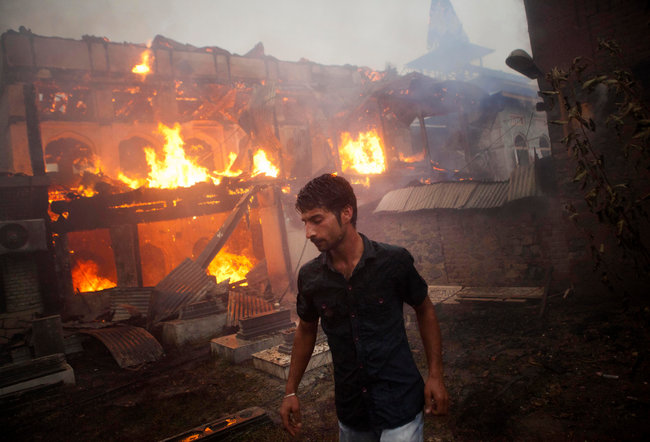
P.S.: Blaze at Sufi Shrine Triggers Violence in Indian Kashmir

Kashmiri residents helped firefighters extinguish the blaze at a Sufi shrine in Srinagar on Monday.  (Dar Yasin/Associated Press)

Protesters clashed with security forces in downtown Srinagar.  (Dar Yasin/Associated Press)

The cause of the fire at the shrine, which housed a relic of an 11th century Sufi saint, was not immediately known.  (Dar Yasin/Associated Press)

Residents pulled a water pipe to help battle the blaze.  (Danish Ismail/Reuters)

“Police sealed off roads leading to the shrine where hundreds of men and women had gathered, many of them wailing and crying.

“I feel like I’ve lost everything,” cried a 45-year-old woman, Shameema Akhtar, tears rolling down her cheeks.

Muslim militants spearheading the anti-India campaign in Kashmir have in the past tried to enforce a radical form of Islam, banning beauty parlors, cinemas and liquor shops, as well as asking women to wear the veil.

But they have had little success in a region where people mostly follow Sufiism, a gentle, mystic tradition of Islam.”

Tens of thousands of people have been killed in the years of strife in the region that both of the nuclear-armed rivals, India and Pakistan, claim. Pakistan controls part of Kashmir in the west.


Comment: nikobakos@gmail.com

Em….fate ta.

24 Jun

Greek Voting Past, Europe Returns to Fiscal Rescue,NY Times:

(Yuri Cortez/Agence France-Presse — Getty Images)
 

“But even though Brussels had been hoping for the victory by Antonis Samaras and his center-right New Democracy Party, the yearned-for result, paradoxically, may weaken Europe’s determination to take more radical steps to avert a meltdown.

German hard-liners were emboldened by the victory, viewing it as an endorsement of the drive for structural adjustment in Greece and elsewhere in Southern Europe through further austerity. As a result, the vote may delay concerted pro-growth steps by central banks and governments around the world, as well as the hard choices within Europe over deeper integration that are likely to prove necessary in the long run.”

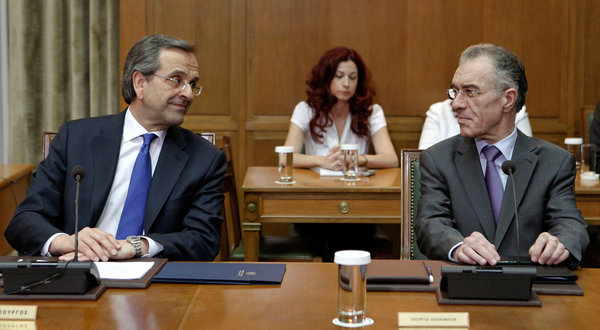
And, forgive the black humour, but this is what you get for voting for the same old farts that caused the problem to begin with: Greece’s New Leaders to Miss Crucial Meeting:”

Both Antonis Samaras, left, the newly installed prime minister, and Vassilis Rapanos, his finance minister, have been hospitalized since Friday.  The two men attended a cabinet meeting on Thursday. (Yorgos Karahalis/Reuters)


Comment: nikobakos@gmail.com