
…but this was a good speech, laying out some serious and intelligent policy intentions — especially tax break for Greek islanders.
Bre haydi git… : If I were from Kasımpaşa, I would hate a young, worldly, educated, eloquent, well-dressed, visionary, cute Frenchman too — especially with that tan he was sporting in Corsica.
12 SepP.S. But I’m not; I’m from Corona!


Balkan Insight: “Serbia, Kosovo Must Commit to Credible Missing Persons Investigations”
11 Sep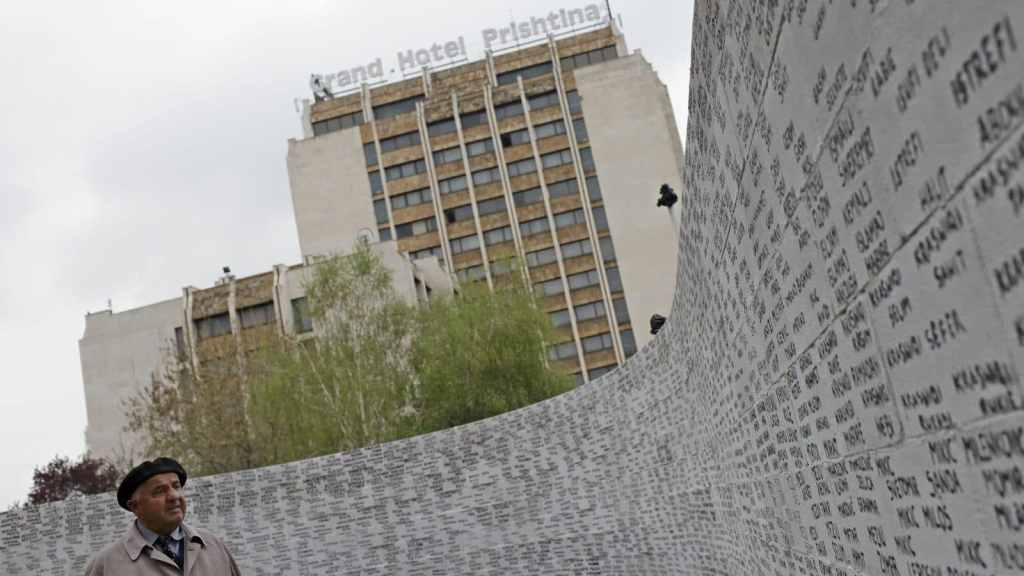
The Conversation: “Iran’s secular shift: new survey reveals huge changes in religious beliefs”
10 SepDon’t know anything about The Conversation or what its agenda might be in publishing this article (does anybody else know?) but, well, it’s good news.
And the photo is hot. “…σαν τα κρύα νερά.”
Article tweeted by @AlirezaNader

P.S. “‘68% agreed that religious prescriptions should be excluded from legislation, even if believers hold a parliamentary majority, and 72% opposed the law mandating all women wear the hijab, the Islamic veil.'”
************************************************************************
Write us: with comments or observations, or to be put on our mailing list or to be taken off our mailing list, contact us at nikobakos@gmail.com.
Gjeraqina – Γερακίνα – Gerakina – Αυτό το “Hellenic” θα μας φάει.
7 Sep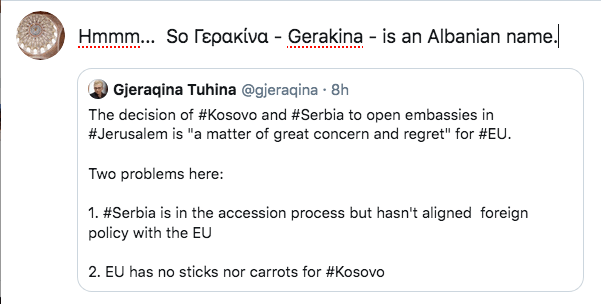
Or is it the other way around? Sorry if you thought this post was about Kosovo. Or…maybe it is!
From Youtube:
Μακεδονία γη Ελληνική! Macedonia Hellenic land! [Αυτό το Hellenic θα μας φάει.] Ελληνικό παραδοσιακό Μακεδονίας.
Γυναικείος χορός που χορεύεται στη Νιγρίτα Σερρών. Την ονομασία του οφείλει στα λόγια του τραγουδιού που αναφέρονται σε μια όμορφη νέα, τη Γερακίνα. Σύμφωνα με την παράδοση η Γερακίνα, προσπαθώντας να αντλήσει νερό από ένα πηγάδι, έπεσε μέσα και δεν κατάφερε να σωθεί παρά τις προσπάθειες του αγαπημένου της. Η ιστορία έγινε θρύλος και με τον καιρό εξελίχθηκε σε έναν από τους καλύτερους χορούς.
************************************************************************
Write us: with comments or observations, or to be put on our mailing list or to be taken off our mailing list, contact us at nikobakos@gmail.com.
“Constantinople’s Greeks, the deportations of 1964…” p.s.
7 SepIt’s truly remarkable how much a hold on the Western mind the ethnic nation-state has. You find it in all journalistic coverage of our lands over and over again: an inability to understand minority groups as a historical part of a particular city’s or region’s demographics, often, as in the case of Istanbul, with a presence in a given city even older than that of the majority’s, but rather to kind of sloppily categorize them through the American immigrant narrative. In this Times’ article it comes out in terms and references like: “Turks of Greek descent” or “many of these Greeks have been born in Turkey” and never been to Greece.
They weren’t Turks of Greek descent because there’s no such thing. They were the Greeks who already lived in Constantinople, many for centuries, when the Turkish republic was formed. Not many but all of them had been born in Turkey — they, and centuries of ancestors that are lost in their historical memory.
It’s çok irritating, as it denies the minority group’s status as a demographic constituent element of a certain locale, but makes them seem to be foreign in some way, so that, at least in this case, it deprives the Turkish government policy of the depth of its injustice.
In an old post of mine: “Tarlabaşı III: Kyra Smaro, the Kurdish taxi-driver and Orhan Pamuk“ I write about a Kyra Smaro I knew in C-Town:
“She was a consummate, almost clichéd, Politissa in every way: from her funky, old-fashioned name (“Smaragdo” – “Emerald”), to her learnedness, playfulness, awareness of the world, quick, ironic humour — down to what a great cook she was. She was a Greek school-teacher, constantly being shuffled across the city from school to school as they closed for lack of students, every reappointment taking longer and longer as the Turkish Ministry of Education engaged in deliberate bureaucratic foot-dragging with people like her.
…..
“But it would have been ridiculous to suggest she felt no bitterness at all. One particular form of it, that I heard from almost every Polite in a myriad different versions, was not just the pain of your community shrinking around you so much, or your city becoming unrecognizable around you, but of you becoming unrecognizable to your city. Armenians and Jews chose a path to greater assimilation after the twenties; they usually spoke Turkish without an accent. But a Greek of Kyra Smaro’s generation (she must’ve been in her fifties in the nineteen-nineties), still spoke Turkish with an accent, an accent Turkish İstanbullus recognized, and to which they would toss a greeting or a word of Greek when she was shopping or at the manave’s or at the butchers. But as the century wore on, those İstanbullus disappeared as surely as the Greeks did.
“She was in a cab once, and a young Kurdish driver, who, she remembers, couldn’t have been much more than twenty and who not only didn’t recognize her accent but probably didn’t even know that there used to be any Greeks in İstanbul, politely asked her: “Ma’am, where are you from?” And she snapped – she even felt bad afterwards: “Where am I from? I’m from here! Where are you from?!” I’m sure the poor kid was left mystified.”

************************************************************************
Write us: with comments or observations, or to be put on our mailing list or to be taken off our mailing list, contact us at nikobakos@gmail.com.
Salonica and Izmir are both giant graveyards for me: I dislike them equally.
7 SepIf it weren’t for St. Demetrios I would never go to Salonica, and I try to never have to be in Izmir except when passing through to go somewhere else.


Cool photo: Jewish wedding of Avramakis and Annetta Levis in Ioannina (c.1905)
7 SepSee Alex Sakalis@alexsakalis for a larger image.
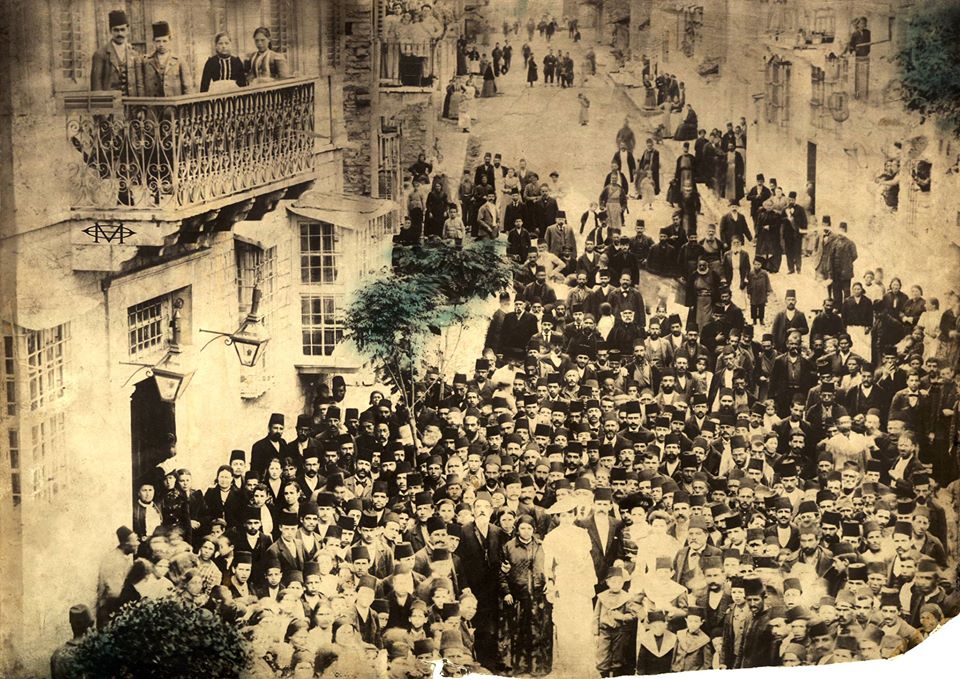
Constantinople’s Greeks, the deportations of 1964, the second huge blow after pogrom of 1955, New York Times
7 SepTURKS EXPELLING ISTANBUL GREEKS; Community’s Plight Worsens During Cyprus Crisis
Aug. 9, 1964
ISTANBUL, Turkey, Aug. 8 —Harassment and deportation of Greek nationals in Istanbul in retaliation for Turkish setbacks on Cyprus was declared today “an open policy” of the Government.
Unless a solution to the strife between Greek and Turkish Cypriotes is found soon, the Greeks here fear that their community, once numerous and prosperous, will be dispersed before winter.
“The pressure on the Istanbul Greeks will be gradual,” said a spokesman for the Foreign Ministry in Ankara.
Sources close to Premier Ismet Inonu said the Government believed “pressure on Greek nationals” was the only way left to Turkey to force Athens and the Greek‐dominated Cypriote Government to accept a satisfactory compromise.
Istanbul’s Greeks have many Turkish friends who believe the new tactic will prove as ineffective as it is harsh. The consensus among the Greeks themselves is that Turkey is using Cyprus as “an excuse to do what they have long wanted to do—get us out.”
This week 58 more Greeks were added to nearly 1,000 who had been deported on short notice since March.
New lists are expected within a few days, and the 9,000 remaining Greek nationals are sure their days here are numbered. Turkey has canceled, effective Sept. 15, a 1930 agreement under which Greeks have been privileged to live here.
There is fear now in the hearts of 60,000 Turks of Greek descent, They, too, complain of harassment, “tax persecution” and ostracism, although Premier Inonu has declared repeatedly that these minority nationals will not be discriminated against.
In the business districts of Istanbul, many Greek‐owned shops may be seen under padlock. They were closed on Government order or because the owners were summarily ordered from the country. Wives and other dependents are in many cases left destitute.
Every morning large numbers of Greeks crowd into the arcaded foyer of the Greek Consulate to ask help and advice. Some accept an emergency dole provided by the consulate; others are well dressed. Some are old and frail. In their anxiety they talk too loud and argue overheatedly. Some weep.
Most of those deported so far were born in Turkey, according to the consulate, and many had never been to Greece. They have no particular place in Greece to go, and they aay they have no idea what to do when they get there.
Greeks scan the Istanbul newspapers for published lists, fearing they will find their names. When they do, they go to the police to be fingerprinted, photographed and asked to sign deportation statements. They are given a week to leave the country, and police escorts see that they make the deadline.
Families of deportees protest that it is impossible to sell businesses or personal property in so short a time. “Few want to buy from us, and no one wants to pay a fair price,” one victim said. A deportee may take with him only his clothing, 200 Turkish lira (about $22) and his transportation ticket.
At first the Government denied that these deportations had anything to do with the dispute over Cyprus. AU the deportees were charged with “activities harmful to the Turkish state.”
The Greeks have found wry humor in this claim. According to a source close to the consulate, the deportation lists have included the names of six persons long dead. [my emphasis]
There have been 121 deportees more than 70 years old and 20 over the age of 80.
Many charges have been raised against the Greek aliens: smuggling money out of the country, for example, or evading taxes and military duty. The Turkish authorities say the Greeks have invested their wealth abroad and that this has damaged the Turkish economy.
Turkish estimates of Greek wealth here have gone as high as $500 million. But recently this figure has been reduced to $200 million. Greeks say the Turks “reduced their inflated estimates when they realized that someday they might have to settle for properties taken from us.”
They blame Turkey for not having offered better investment opportunities.
In addition to abrogating the 1930 agreement on residence, trade and shipping privileges, Ankara has suspended a 1955 agreement granting unrestricted travel facilities to nationals of both countries. A number of Greeks caught outside Turkey when this suspension took effect are reported to be unable to return.
More seriously, Ankara recently decided to enforce strictly a long‐overlooked law barring Greek nationals from 30 professions and occupations. They cannot, for example, be doctors, nurses, architects, shoemakers, tailors, plumbers, cabaret singers, ironsmiths, cooks or tourist guides.
************************************************************************
Write us: with comments or observations, or to be put on our mailing list or to be taken off our mailing list, contact us at nikobakos@gmail.com.
 Jadde: from Bosnia to Bengal