
These photos are fascinating in lots of ways, but perhaps the most moving is that, given the clothes and haircuts, many of them seem to be taken, not only after the pogrom of 1955 (“Tonight 65 years ago, the beginning of the end of Greek Istanbul“ and “1955: the Second Fall of Constantinople“) but even after the deportations of 1964. And yet so much of the spirit and good humor and fun of Politiko life still shines through.
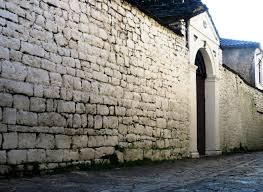
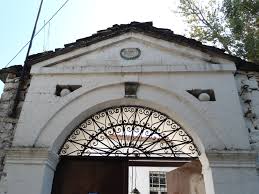
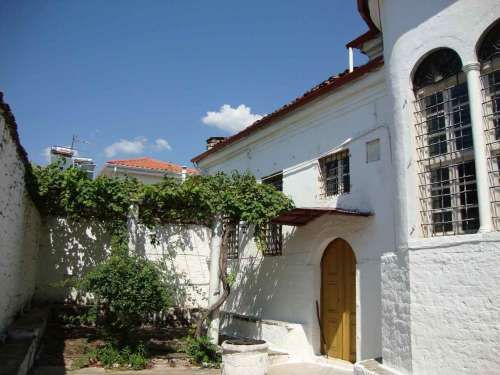
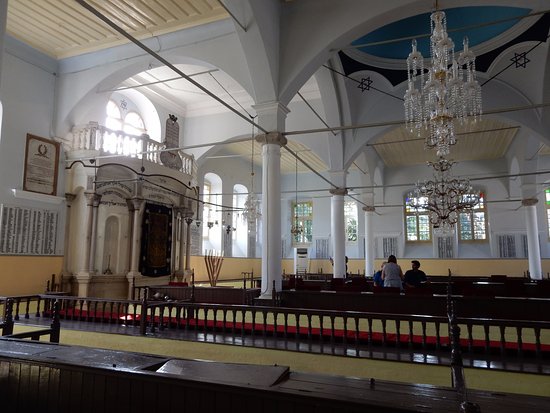
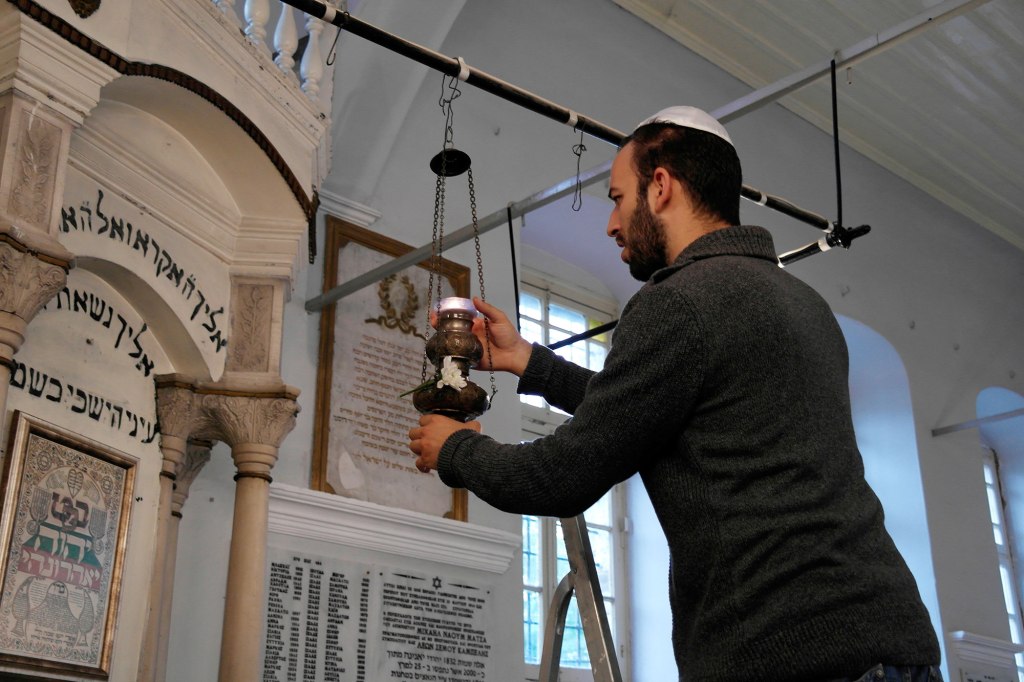
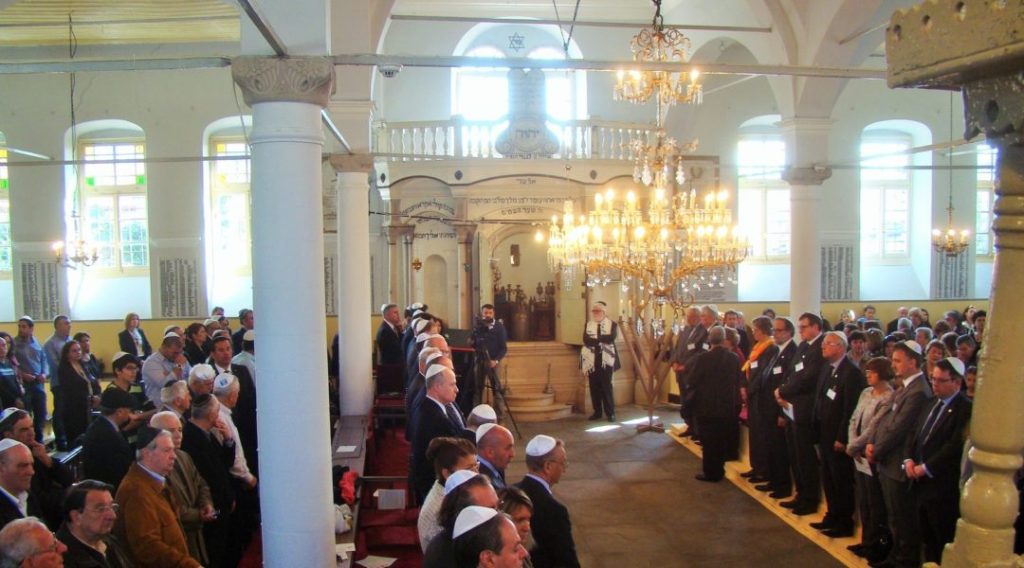
Photos: some extra photos of Jiannena synagogue
7 SepTo complement yesterday’s post: Photo: Iason Athanasiadis, Patrick Leigh Fermor, the Jews of Jiannena, me and my mother.

************************************************************************
Write us: with comments or observations, or to be put on our mailing list or to be taken off our mailing list, contact us at nikobakos@gmail.com.
Flamenco: I can’t get enough of this little girl right now…
7 SepYou won’t regret the two minutes you spent watching her, believe me.
Modern Catholicism’s self-inflicted malaise
6 Sep
“Orthodox church is very aesthetic” says tweeter @read_the_gita
That’s because the aesthetic is not separable from the sacred, but is its bearer. Beauty is not separable from the sacred, but is its bearer. Symbols and images are not separable from the sacred, but are its bearer. Music and theater are not separable from the sacred. Code and ritual are not separable from the sacred. A secret, not entirely intelligible, sacred language — one that you might have to devote some time and energy to in order to understand — is not separable from the sacred. Gilded and, yes, intimidating altar gates shutting on you so that you can’t see the anaphora or consecration, and then reopening only when the Spirit is ready to share itself, is a way of underlining the sacred.
Vatican II scrapped all of that yet kept the most retrograde and horrible prohibitions and humiliating forms of moralizing discrimination.
And they’re all scratching their heads trying to figure out why their churches just keep getting emptier. I mean, I don’t want to be mean, but the photo above is almost funny; you turn the altar around so that the “people” can feel like they’re “included” and “participating” and other kinds of cheap populist ideas like that; and there’s no people there!
I’ll tell you why. I’ll get up on a Sunday morning for a matinée production of Tristan. I won’t get up for a thirty-minute infomercial with a guitar. And an audience in sweatpants.
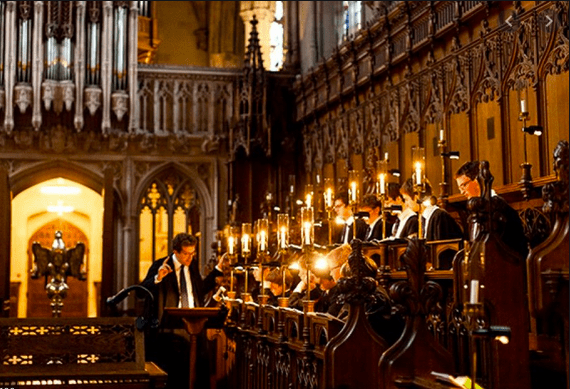
I remember stumbling onto evensong (vespers) in the Magdalen Chapel in Oxford on a rainy November night. And like Vladimir’s envoys, I felt that “God dwelled there among men.” And walking home to my friend’s room, I thought how ironic it was that High Church Anglicanism, born out of one of the first and most powerful rejections of Rome’s authority, had held onto more of the beauty of Christian ritual than modern Catholicism has.

Let’s scrap all of the above for the aesthetic and ethical equivalent of an AA meeting.
************************************************************************
Write us: with comments or observations, or to be put on our mailing list or to be taken off our mailing list, contact us at nikobakos@gmail.com.
Photo: Iason Athanasiadis, Patrick Leigh Fermor, the Jews of Jiannena, me and my mother.
6 SepIason’s original wide-angle of the remaining Old Synagogue in Jiannena (there was a larger new one outside the walls of the old city but the Germans blew it up, ’cause — I dunno — out of boredom and too much beer some afternoon.):
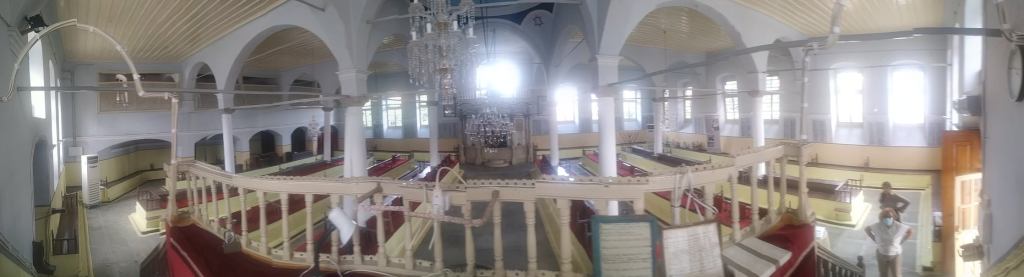
Iason attached Patrick Leigh Fermor‘s description of the shul, from A Time of Gifts :
“Wandering about northwestern Greece, I made friends with the Rabbi of Yannina, and he invited me to attend the Feast of Purim. The old, once crowded Sephardic Jewish quarter inside Ali Pasha’s tremendous walls was already falling to ruin. The rabbi had assembled the little group which was all that had survived the German occupation and come safe home. Cross-legged on the low-railed platform and slowly turning the two staves of the scroll, he intoned the book of Esther – describing the heroine’s intercession with King Ahasuerus and the deliverance of the Jews from the plot of Haman – to an almost empty synagogue.”
— A Time of Gifts, Patrick Leigh Fermor
Έσπευσα, of course, to correct Fermor and Athanasiadis, since we’re talking about Jews and Jiannena especially:
I dunno if this is interesting to you or not, but Fermor is wildly wrong — in a way he rarely is — in calling the Jews of Jiannena Sephardim. The Jews of Jiannena were totally “Romaniotes”, meaning Jews that had lived in Greek lands (Romania/Byzantium) way before the Ottoman conquest and the subsequent Sephardic influx that came with the Jew’ expulsion from Spain in 1492. In most Jewish communities in the empire, the flood of Spanish-speaking Jews soon swamped the old Romaniote, Greek-speaking communities, but in Jiannena, and in a couple of other towns (Volos, Halkida I think) the Romaniotes held out. (In Jewish Istanbul, the two communities lived side by side, though the Sephardim were the clear majority.)
Only pointing this out because survivors and descendants of Jewish Jiannena are ferociously proud of the fact that they still speak Greek. Their rites and cantorial traditions are unique, and they have a synagogue of their own in New York and two in Israel, where their traditions are carried on, and which I always went to for the Jewish High Holy Days in autumn: Kehila Kedosha Janina. In Jiannena itself, ironically and sadly, there is no longer a rabbi to serve the some thirty-member community of survivors. So a rabbi comes from Istanbul and only for Yom Kippur, and he’s Sephardic.
I should’ve known better than to think that Athanasiadis didn’t know that Fermor had made a mistake:
You’re absolutely right and I did a double-take when I read it too… exactly because the Jews of Yiannena are notorious for being the only Romaniot community to have (semi)-survived in Greece when most of the others were subsumed under the tide of Andalucian Jews. But I left it in as it’s a direct quote from the book. However, it would be great if you were to post your comment below, so that ppl know what’s going on.
Οπότε Μπάκε, what’s your story with Jiannena’s Jews or with Jews generally? Well, what my story with Jews is, is a long one. For now, let’s just say that I’m from New York, and that should suffice.
What my story with the Jews of Jiannena is…is pretty much explained in an old post of mine that I’m pasting below. Ironically — or through some sort of Jungian synchronicity — I wrote it just around Purim some years ago, the holiday on which Fermor stumbles upon the lone rabbi reading the Megillah of Esther. Check it — and the footnotes — out if you have the patience.
************************************************************************
It’s Purim tonight! — something like a letter to my mother…
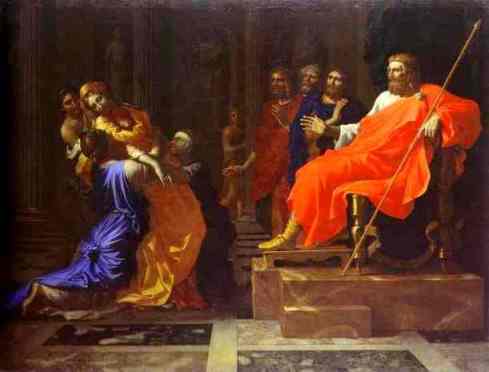
Esther before Assuereus, Nicolas Poussin, circa 1640 (click)
For Purim this year I’m posting this poem by Greek Jewish poet Joseph Eliya, who was from my mother’s hometown of Jiannena in the northwestern Greek region of Epiros. (See the tab box on the right for the hundred references to Jiannena and Epiros on the Jadde).
The Jews of Jiannena were Greek-speaking Romaniotes, descendants of the Jewish communities of Greece, the Balkans and Asia Minor that existed since Hellenistic times and that held out culturally against the flood of Spanish-speaking Sephardim that found refuge in the Ottoman Empire after their expulsion from Spain in 1492. They were called Romaniotes because Romania (the kingdom of the Romans) was what the Byzantines called their polity and what we too – till the early twentieth century – also called ourselves: “Romans” – which it always aggravates me to have to explain. But it is one of the rich ironies of history that the only inhabitants of Greek lands that stayed faithful to their true name for themselves were Jews, while we sold our souls to the West for the promises and prestige we thought the re-excavated neologism “Hellene” would curry us from the Frangoi.
So Eliya’s native language was Greek, and though he wrote some of the most beautiful translations of Jewish Biblical texts into Modern Greek, particularly one of the Song of Songs and a series of love poems to Rebecca, in a rich, florid, archaic idiom, he also wrote homelier poems in a folksier Jianniotiko style like this one, “something like a letter to his mother” on the occasion of the feast of Purim.
For those who don’t know, Purim is the day that Esther, the Queen Consort to the Persian King Ahasureus, and her uncle Mordechai, foiled the plans of the king’s evil minister Haman, to have the Jews of the kingdom massacred. It’s generally celebrated by listening to the book of Esther in synagogue, the Megilla, sending food and giving charity to the poor and dressing up in costume, an aspect of the celebration that may be an interborrowing due to the fact that it tends to fall around Christian Carnival.
Eliya was a poor schoolteacher who died at the young age of thirty, and I believe this poem was written when he was away from his beloved Jiannena, and his beloved mother, on a teaching post in the Macedonian city of Kolkush. It’s a sad, therefore — and very Epirotiko in that sense and in tone — poem, that’s in sharp contrast to the happiness of the holiday.
This poem also has an added emotional subtext for me. My mother’s best friend when she was in elementary school was a Jewish girl, Esther — Esther Cohen. “Astro” they called her, in the Epirotiko diminutive; “Tero” is also another form for the same name. And as a little girl from a peasant family recently moved to Jiannena from their village in the mountains just to the south, I could tell that her stories about her friendship with Astro were her first lessons in tolerance and difference, whether she would’ve called them that or not (we certainly wouldn’t in our day…I’ll leave them for another post). And she may have known it even less, but her friendship with Astro may have prepared her for life in New York in ways she was probably never conscious of. And what she may have been even less conscious of — though maybe I should give her some credit: I do know for sure that my mother’s stories of her friendship with Astro served as my first lessons in decency and openness to those different from you. Of that there’s no doubt. So this post is something like a letter to my mother too.
Always they ended in a kind of distracted silence, for she never knew what had happened to her friend during the war: “Τι νά’χει γίνει η Άστρω;” she would mumble. “What can have happened to Astro?” And what was strange was that she could’ve found out; there were surviving Jews in Jiannena that she knew and there were even Jewish Jianniotes in New York she could have asked. But it was like she didn’t want to know. Even odder, I’ve had several opportunities to find out as well; Kehila Kedosha Jiannena, the Jianniotiko shul in New York on Broome Street has records on the whole community. But it’s been almost as if I don’t want to know either.
Here is Eliya’s original Greek, with my free verse translation below.
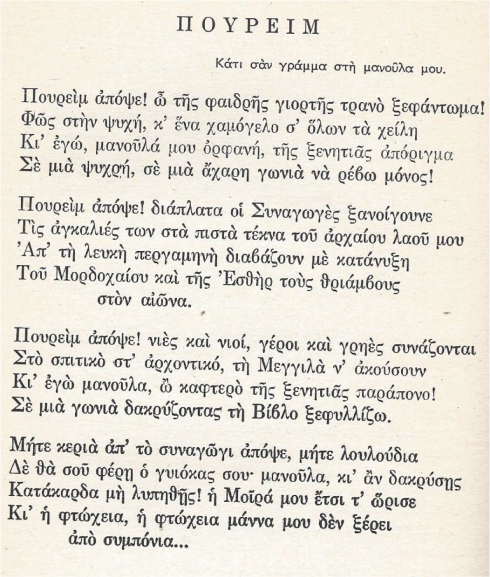
Purim
(Something like a letter to my mother)
It’s Purim tonight! The thrill and joy of the great feast!
Light in our souls, and a smile on the lips of all.
And I, my orphaned mother, the refuse of exile*
Waste away in a chill joyless corner.
It’s Purim tonight! And the synagogues open their arms wide to the faithful children of my ancient people.
And they read again with wonder, from the white parchment, the triumphs of Mordechai and Esther through the ages.
It’s Purim tonight! Young and old gather at home, at hearth, to hear the Megilla’s** tale.
And I mother – with the burning lament of exile – tearily thumb through my Bible in a lonely corner.
Your son won’t be bringing you candles or flowers from shul*** tonight, mother. And if your crying is bitter, don’t lament too deeply. My Fate has been decided, and poverty — poverty, mammele**** – has no feel for sympathy.
**********************************************************************************************************************************************************************************************
Notes on my translation:
*”Exile” here does not imply political banishment or anything of the sort. It’s the word “ξενητιά” as Eliya spells it, that’s so central to understanding the Greek and — it probably goes without saying — the Jewish soul, but is so devilishly difficult to translate precisely. It means absence — absence from the place where one should be, from one’s heart’s homeland. Through and because of emigration and poverty most often but not always; it’s often something one feels without having had to leave. The Turkish “kurbet” is the word closest in meaning that I know from another language.
**Not to be disrespectful, but the Megilla, the Book of Esther, is quite long, and is proverbial, in at least Ashkenazi humor, for being tedious and monotonous to listen to — but one bears it. It’s exactly the same as the Greek term “εξάψαλμος,” the Hexapsalm, a selection of six psalms that is always read at the beginning of Matins and I’m not sure if during other offices, and would be beautiful if correctly and carefully recited according to the rules of Orthodox recitation. Unfortunately, it’s usually read in an incomprehensible blur of mumbled boredom by the lector or cantor, which actually makes it even more tedious and irritating to sit through. It’s usually a good time to go out for a cigarette. I just always thought the similarity was funny. “Ωχ, τώρα θα’κούσουμε τον εξάψαλμο,” a Greek will say with dread when faced with a berating lecture or kvetch session or someone’s tiring complaint that’s so repetitive you just tune it out, just like a Jewish New Yorker will say: “I really can’t listen to his whole Megilla right now…”
***In the second verse, Eliya uses the Greek word for synagogues and I translated it as such. In this last verse, he uses a homier, Epirotiko form whose intimacy I felt was better conveyed by “shul.”
****And last but not least, we run into the painful translation issues that are generated by the fact that English is almost completely lacking in a system of diminutive terms of affection, especially compared with the highly elaborate diminutive terminologies of Slavic languages or Yiddish (or I assume Ladino) or even Greek. At no point in the poem does Eliya refer to his mother as “mother” but rather “my little mother” — “μανούλα’μ” — “manoula’m.” This is a term of affection used often by Greeks and especially Epirotes to refer to anyone, not just one’s mother, not even necessarily a female (Athenian idiots making fun will darken or double up the “l” to make it sound more northern and Slavic and hickish; for me it’s just more beautiful…); one will say to a young boy or even a friend: “Come here, manoula mou… What’s wrong, manoula mou?” Just like “mammele” is used in Yiddish. But I felt that using “mammele” throughout would have sounded too Yiddishy and cute, and so I saved it for that last, most intimate verse, and used mother elsewhere. After all, this is a poem that above all is an expression of the most Jewish kind of mother-son bond. But Yiddish and its many beauties is cursed now, by its sudden, dramatic extinction in Europe, and its shadow survival only in American entertainment, with the danger of always lapsing into a default comic tone. It’s sad. The translation from the Greek of the last line of the poem, for example: “poverty has no feel for sympathy…” would literally be: “…but poverty doesn’t know from sympathy.” But then I’d be writing Larry David dialogue.
**********************************************************************************************************************************************************************************************
FINALLY, I’d like to thank Marcia Haddad Ikonomopoulos for the scan of the Greek text of the poem. I’m in Athens now, away from my library and couldn’t find it anywhere online. I wrote to her and within five minutes she had written back to me with both “Purim” and “Esther,” another of Eliya’s poems about the biblical heroine. She suggested that “Esther” is a poem more appropriate to the happiness of Purim than the melancholy of “Purim.” Unfortunately, it’s written in a much more difficult, semi-biblical, archaic language that I didn’t have the time to translate. I promise her however, that as soon as I get a chance I will work on it and post it on the Jadde — out of gratitude to her helping me out for this, and out of gratitude to the one-woman pillar of the Kehila Kadosha Janina community that she is. I’d also like to thank the whole congregation there for always making me feel so welcome when I attend on Erev Simchas Torah; the rabbi and his stentorian voice, the three young men who lead prayer and are perhaps the community’s most precious resource — let’s see if I remember correctly: Seth, the rabbi’s son, and the brothers Andrew and Ethan, who though they’re from a Sephardic family from Berroia, devote their shabbes and yontif time to energizing this tiny community in need of outside help. The warmth of the community has always moved me and I’m grateful for both the odd need for Jewishness in my life and the link to my mother and her childhood that they unknowingly provide. Thank you.
–
Comment: nikobakos@gmail.com
–

Jiannena
Erdoğan’s almost ludicrous, repetitive attempts to hurt and insult us
6 Sep(The following is an edited compilation of a Twitter thread of mine.)

According to Hürriyet newspaper, Erdoğan stated that “a century ago we either buried them in the ground or threw them into the sea. I hope they do not pay the same price now.”
And I could shoot back with grizzly tails of the ethnic cleansing of Bulgarian Muslims by Bulgarian Christians and the Russians in the 1870s, or the almost complete extermination of Muslims/Turks (and Jews) in southern Greece during the Greek revolution with Kolokotronis bragging that he rode from the gates of the citadel of Tripolitsa to the main church of the city and his horse’s hoofs never stepped on ground because his whole way was carpetted by Muslim corpses, or how the Christian Greek/Albanian rebels roasted Muslim women on the spit. Or any other gruesome, inhumane episode of the the 300-year long contraction of the Ottoman Empire.

But I don’t! And the primary reason is not that bringing that stuff up will hurt Muslims or Turks. That comes second. Primarily I don’t because they hurt me. Because I’m revolted by those actions. I’m embarrassed by them. When I do touch on them, in writing or in personal interaction with Greeks or Serbs, it’s to make us face the complexity of the back-and-forth viciousness of our shared history and as a way to hopefully prompt people to think more critically about that.

Citing them with triumphalist glee — even if it’s to anger or hurt a jackass like Erdoğan — would be beneath my dignity and lessen me as a thoughtful and moral human being. But a self-important, grandiose, humorless, gigantic chip on the shoulder, overgrown barefoot street-kid, prole from Kasımpaşa like Tayyip Bey isn’t much of a human being. He’s a perfectly Turkish edition of Nietzsche’s man of resentment:
“For one thing is needful: that a human being attain his satisfaction with himself – whether it be by this or by that poetry and art; only then is a human being at all tolerable to behold. Whoever is dissatisfied with himself is always ready to revenge himself therefore; we others will be his victims, if only by always having to stand his ugly sight. For the sight of the ugly makes men bad and gloomy.”
I mean sometimes elaborate vocabulary or Nietzsche references aren’t necessary; the man’s just a dick — or “dek” as we say in Queens.
But…do tell him that the coast and river valleys of western Asia Minor from which they threw us “into the sea” had been put back to the plow, made productive again, reprospered and reurbanized by Greek settlement beginning in the 18th century.
Before us these valleys and coastlines, some of the richest and most prosperous and urbanized parts of the Roman Empire had lain fallow for centuries since the Turkic migrations into Anatolia, and had lain underutilized, winter pastures for nomadic Yörüklides…

************************************************************************
Write us: with comments or observations, or to be put on our mailing list or to be taken off our mailing list, contact us at nikobakos@gmail.com.
“1955: the Second Fall of Constantinople” — a more detailled analysis with extensive footnotes, from Henry Hopwood-Phillips and his blog and twitter thread: Byzantine Ambassador, @byzantinepower
6 SepI hope most readers know by now, that when HHP refers to Romans in the following text he means us!
1955: the Second Fall of Constantinople

Hagia Sophia’s conversion into a mosque this year was part of a pattern in which the Turkish state views its legitimacy as threatened by the symbols and peoples of its Roman predecessor. Instead of dwelling on Hagia Sophia’s conversion (2020), a tragedy well captured by the Philological Crocodile here, or prattling on the Population Exchange (1922-23), I’ve decided to shift the lens to 1955 because it reveals what the Turkish state will do to Romans (and other minorities) when it feels it can escape the consequences.
In 1955, the Istanbul pogrom, sometimes referred to as Septemvriana, was a government-instigated series of riots – a Kristallnacht – against the Romans of Constantinople. Indeed, the riots satisfy the criteria of the second article of the 1948 Convention of the Prevention and Punishment of the Crime of Genocide (UNCG) because the “intent to destroy in whole or part” of the Roman minority was present.

The events are best described by Speros Vryonis – a great scholar who died last year – in The Mechanism of Catastrophe (2005) which draws on a vast range of Turkish sources including the Yassiada trials and the report by Human Rights Watch (1992). Sadly, collecting disparate sources is necessary because there is still no official Turkish government or police report on the pogroms.
Here, I offer a quick summary of Vryonis’ 700-page indictment. In the weeks leading up to the pogrom, Turkish authorities repeatedly incited public opinion against the Romans, using Cyprus as a stick with which to beat them. A movement called “Cyprus is Turkish” was particularly active and created a hostile atmosphere in which the largest daily newspaper, Hurriyet, felt able to write that
“If the Romans dare to touch our brethren, then there are plenty in Istanbul upon whom we can deliver our revenge.”

Around midnight on 6th September an explosion occurred in the courtyard of the Turkish consulate in Thessaloniki. It was adjacent to the house where Kemal Ataturk was born and the press immediately blamed Romans, publishing photos that purported to show extensive damage.[1] Yet no Roman soul had been involved in the bombing. Instead (as demonstrated at the 1960/61 Yassiada trial) Turkish agents carried out the assault under orders from the Turkish government.[2]

Around 17:00 rioters were organised into groups – mostly recruited from the provinces by the Demokrat Parti – who successfully led mobs that devastated the Roman, Armenian and Jewish districts of Constantinople. They were armed with axes, crowbars, acetylene torches, petrol, dynamite and large numbers of rocks. Their mantra was
“Evvela mal, sonra can!”
(First your property, then your life!)

Meanwhile, though the Turkish militia and police were present, their function was not to keep the peace but to stop Turkish property coming under threat. As they stood by (in the enormous territorial triangle formed by the east tip of the Bosporus-Sariyar and Yeni Mahalle, as far as the Propontis-St. Stephan and the Isles) thirty-seven people died [3] – usually bludgeoned to death – two to three hundred Roman women were raped,[4] some boys too, many Greek men (including an Orthodox priest) were subjected to forced circumcision, and over five hundred million dollars of property was damaged (including the burning of over seventy churches, the desecration of the graves of the ecumenical patriarchs and smashing of the sacred vessels).[5] Leaders often carried portraits of Mehmet II and rejoiced in the pogrom as a natural (if violent) conclusion to the logic of the Valik Vergisi (1942-43), a Turkish confiscatory law which destroyed the economic bases of Romans and other minority communities. [My, NB’s, emphasis]

To top it all off, after the population exchange there were roughly one hundred and ten thousand Romans in Turkey, most of them in Constantinople, Tenedos and Imbros. The majority, however, understood the pogrom as a warning shot across the bow and fled. Today, the Roman community – heirs of Byzantium – numbers little more than two thousand in the imperial city and five hundred on the two islands. Worse, most of the Romans were Greeks; a people who who had created the city in 668 BC; a folk who had continuously occupied the city for two-thousand-six-hundred-and-twenty-three years (one hundred and four generations) before suffering an end to their existence in little more than seven hours (19:00-02:00) in 1955.

[1] On 6 September Turkish newspapers carried headlines such as ‘‘Greek terrorists defile Ataturk’s birthplace.’’ On 7 September 1955 Turkish State Radio carried a broadcast that stated in part, ‘‘The criminal attack undertaken against the house of our dear Ataturk and our consulate in Salonika, added to the deep emotion created over a period of months in public opinion by the developments in connection with the question of Cyprus … has provoked demonstrations on the part of large masses which have continued … in Istanbul until late last night.’’ S. Vryonis, Mechanism of Catastrophe (2005), 118, 193.
[2] The agent provocateur in Thessaloniki, the student Oktay Engin, was acquitted at the Yassiada trial, and lived to occupy high positions in the Turkish state after the Istanbul pogrom. Ibid., 530.
[3] Ibid., 581–82 (Appendix B, ‘‘List of the Dead in the Pogrom’’). Thirty victims were identified – including a priest named Chrysanthos of Balikli – three unidentified bodies were dug out of destroyed shops, and three burned bodies were found in a sack in Besiktas.
[4] Ibid., 222. The estimates go as high as two thousand rapes. One of the most frequently mentioned cases of rape involved the Working Girls’ Hostel on the island of Buyukada (Prinkipo). List of victims were established by the Ecumenical Patriarchate and by the Greek consul general and, if anything, these were underreported thanks to the shame attached to the victims at the time.
[5] The Greek Patriarchate in Istanbul, in dispatch 139 (to Washington DC), reported that sixty-one churches, four monasteries, two cemeteries, and thirty-six Greek schools had been devastated. Ibid., 268. Between chapters 3 and 4 of the same book appear, inter alia, photos of the destroyed churches of Saint Constantine and Helen, Saint George Kyparissas, Saint Menat in Samatya, and Saint Theodoroi in Langa; the Church of the Metamorphosis; and the Panagia in Belgratkapi, as well as cemeteries and the open and desecrated tombs of the ecumenical patriarachs. Ibid., facing p. 288. These photographs of the destructions were taken by D. Kaloumenos and smuggled out of Turkey by the journalist G. Karagiorgas.
[ All bold emphases in footnotes are mine.]
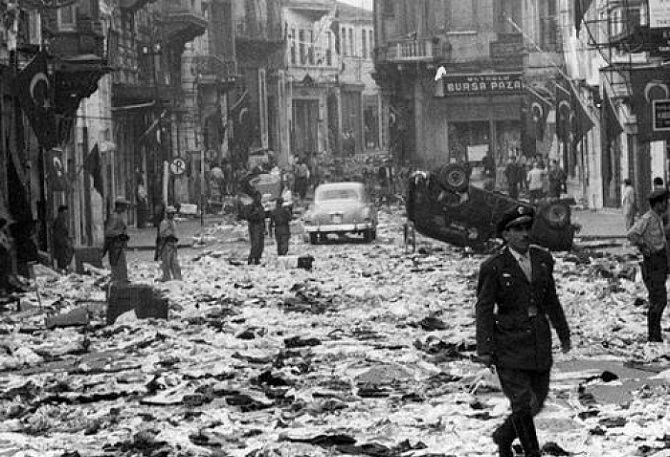
Tonight 65 years ago, the beginning of the end of Greek Istanbul
6 SepThere’s toooooons of other social media references out there today, but I couldn’t let it pass without my own contribution — especially this year and these days.
Below are what were originally footnotes to a post from 2014 which you might want to check out in its entirety: “Nobody really cares about Gezi Park: Greek thoughts on the protests of 2013“:
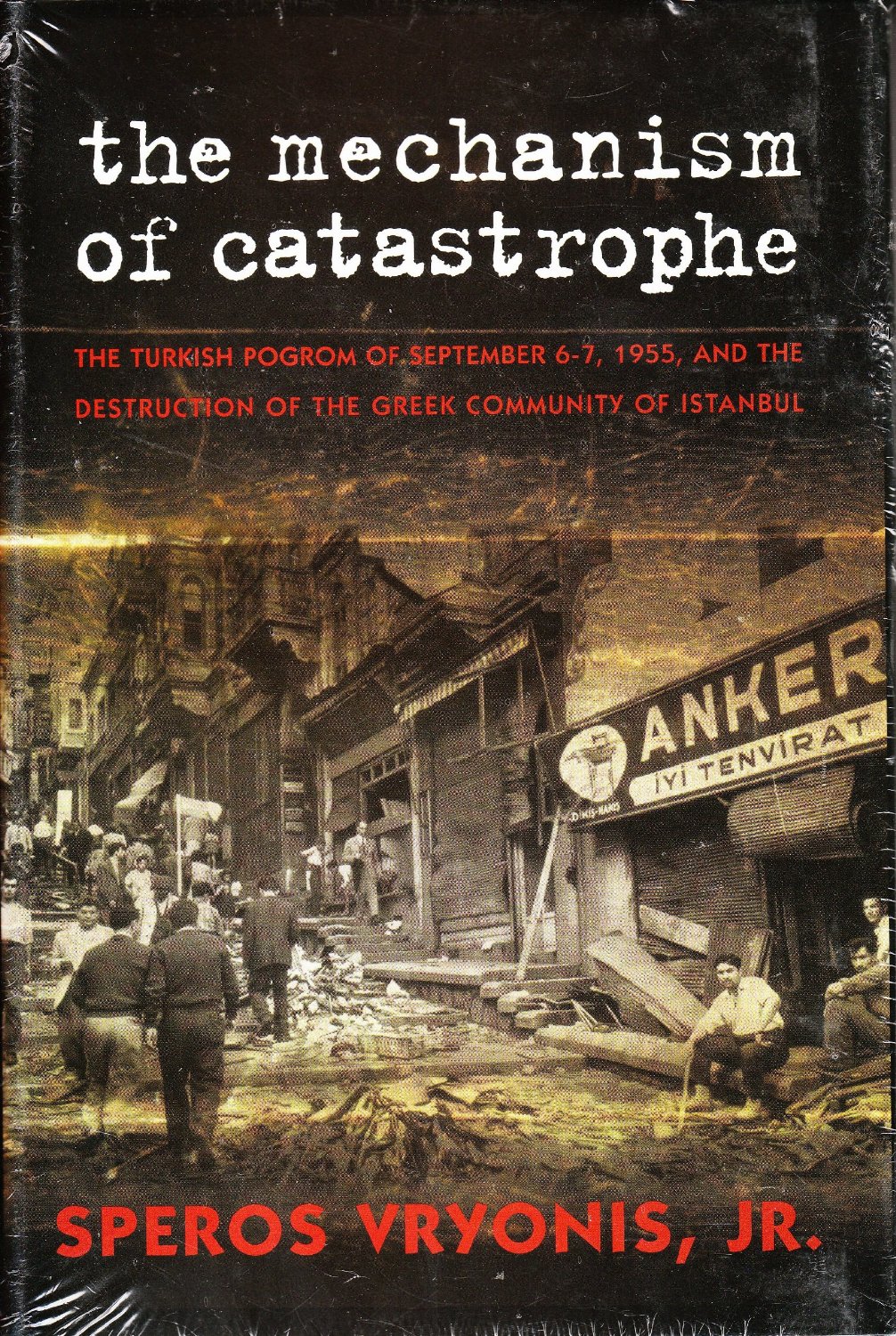
*** “Speros Vryonis The Mechanism of Catastrophe: The Turkish Pogrom Of September 6 – 7, 1955, And The Destruction Of The Greek Community Of Istanbul is a magisterial life’s work and piece of historical journalism that covers the one night of September 6-7, 1955 in which a pogrom organized by Adnan Menderes’ Demokrat Parti destroyed practically the entire commercial, financial, ecclesiastic, educational and domestic infrastructure of the City’s Greek community. I had put off reading it for quite a while — because the subject matter is upsetting and it’s long and detailled — but I was really impressed when I finally did. I hadn’t realized the exact extent of the damage: 4,500 Greek homes, 3,500 shops and businesses (nearly all), 90 churches and monasteries (nearly all), and 36 schools destroyed and 3 cemeteries desecrated. I hadn’t known that so many homes had been destroyed, leaving a large part of the community of then 80 or 90,000 or so homeless and destitute and that, as opposed to the traditional account of one old monk being burned alive, some 30 people were actually killed and many raped — others even circumcised.
“The Menderes government initially, and stupidly, tried to portray this as a spontaneous outbreak of nationalist fervor against Greeks over growing Cyprus tensions, but it was actually an extremely well-planned and executed military manoeuvre (every Turk, after all, is a soldier born) carried out and directed by local cadres of the Demokrat Parti who knew their neighborhoods and its Greek properties and institutions well and through the use of Anatolians brought in from the provinces; I guess they were afraid that local İstanbullus, who knew and lived with these Greeks, would not be as easily destructive, though the record of how the city’s Turks did act during the riots is hardly edifying. As all products of the nationalist-militarist mind, the plan was an extremely stupid move as well. It brought the economy of Turkey’s largest city to a virtual standstill, at a time when the country was in deep economic doldrums to begin with, by ripping out its retail heart, so much of it being in the hands of Greeks and other minority groups, and in the immediate aftermath there were chronic shortages of basic supplies in the city because distribution networks had been completely severed and even bread — so many bakeries being Greek and Epirote, especially, owned — was hard to find. It temporarily made Turkey an international pariah (though in that Cold War climate that didn’t last too long) and eventually played a role in bringing the Menderes government down and costing him his life — thought that all is well beyond the scope of this post, this blog and my knowledge. Vryonis’ analysis is brilliant if you’re interested.
“After the financial decimation of the community by the Varlık Vergisi, the “estate tax” of the 1940’s, when discriminatory taxation against minority groups had wiped out many, and sent many of those who couldn’t pay to forced labor camps, Greeks had bounced back to dominating the retail business of these central neighborhoods in less than a decade – only, of course, to have it all definitively trashed a few years later.
“It’s become axiomatic that the riots were the beginning of the end of Greek Constantinople; the community struggled and tried, but this time things were shattered — physically and psychologically — beyond repair.“
**** The Greek Daemon, “daemon” in the Roman sense of the word of animating genius — “To daimonio tes fyles” — is the idea that Greeks are resourceful enough to prosper anywhere and under any conditions — Patrick Leigh Fermor’s belief in their ability to “spin gold out of air” — and the repeated tragic setbacks and almost immediate comeback of the Greek community of İstanbul after nearly every catastrophe to befall it in the twentieth century tempts one to believe in its truth. Thus, one of the most poignant elements in the Constantinopolitan story is their almost masochistic refusal to leave — what it took to finally make the vast majority abandon the city they loved so much was just too overwhelming in the end however.”
Some photos:
Plebe resentment, with the sick glee of hatred, in action.


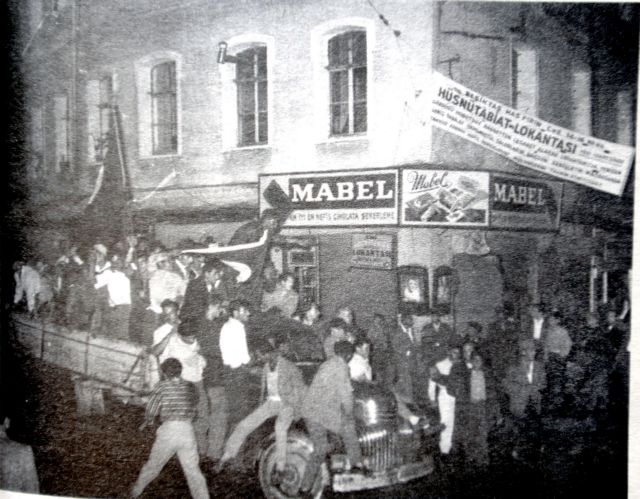
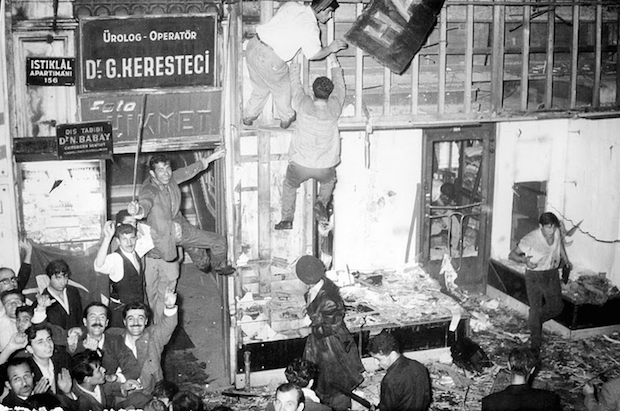

And Greeks come out of hiding the next day — stoic and classy and in heels — to pick up the pieces of a life’s work, or at least try.


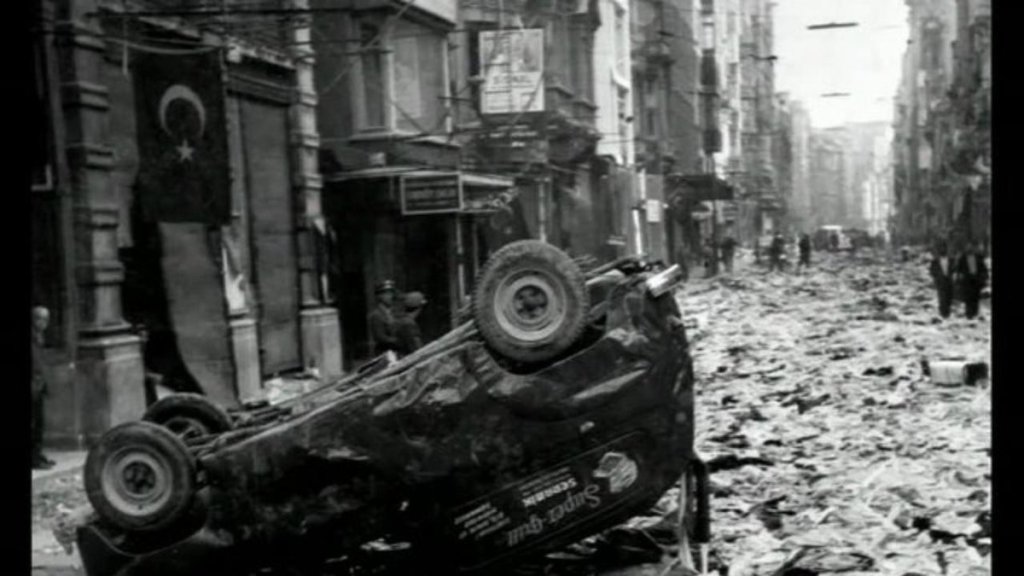
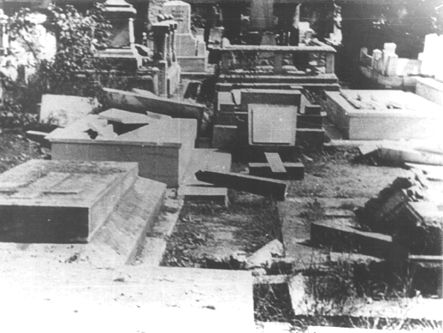



************************************************************************
Write us: with comments or observations, or to be put on our mailing list or to be taken off our mailing list, contact us at nikobakos@gmail.com.
Why Recep Tayyip Erdogan’s Love Affair with the Ottoman Empire Should Worry The World — Alan Mikhail
5 Sep
By Alan Mikhail September 3, 2020 7:00 AM EDT Mikhail is Professor of History and Chair of the Department of History at Yale University. His new book is GOD’S SHADOW: Sultan Selim, His Ottoman Empire, and the Making of the Modern World (Liveright/W.W. Norton & Co.)
At the end of August, Turkey’s president Recep Tayyip Erdogan celebrated the Islamic New Year with aplomb. Fresh off his conversion of the monumental Haghia Sophia to a mosque, he converted another former Byzantine church, the fourth-century Chora church, one of Istanbul’s oldest Byzantine structures. The day after that he announced the largest ever natural gas depository in the Black Sea. This followed another recent discovery of natural gas fields in the eastern Mediterranean. Both of these areas are hotly contested zones of international competition between the powers around these seas. Later that week he welcomed a delegation of Hamas to Ankara, where he expressed support for Palestinians in the wake of the recent announcement of an agreement between Israel and the UAE.
All of these moves project Erdogan’s vision of Islamist strength into the world. Standing up for Islam at home goes hand in hand with securing natural resources and imposing Turkey’s power abroad. It also goes hand in hand with domestic repression. The Islamic New Year saw Erdogan further tighten his grip on social media freedom and consider pulling Turkey out of what is known, now farcically, as the 2011 Istanbul Convention, a treaty of the Council of Europe that commits countries to protecting women from domestic violence. Democratic peoples in Turkey, the Middle East, and around the world should worry.
Much has been written about Erdogan’s attempts to “resurrect” the Ottoman Empire or to style himself a sultan. There is truth here. But to understand Erdogan’s political agenda and horizon we must be specific about which Ottoman sultan Erdogan strives to be. It is the empire’s ninth sultan, Selim I.
Selim died 500 years ago in 1520. It was during his lifetime that the Ottoman Empire grew from a strong regional power to a gargantuan global empire. For Erdogan, this sultan from half a millennium ago serves his contemporary needs. Selim in many ways functions as Erdogan’s Andrew Jackson, a figure from the past of symbolic use in the present. Selim offers a template for Turkey to become a global political and economic power, with influence from Washington to Beijing, crushing foreign and domestic challengers alike. He helps Erdogan too to make his case for Islam as a cultural and political reservoir of strength, a vital component of the glories of the Ottoman past, which he seeks to emulate in contemporary Turkey against the dominant elite secularism that has reigned since its founding.
We should be wary of Erdogan’s embrace of Selim’s exclusionary vision of Turkish political power. It represents a historical example of strongman politics that led to regional wars, the attempted annihilation of religious minorities, and the monopolization of global economic resources. In addition to his attempts to monopolize natural gas reserves around Turkey, today this takes the form of Erdogan’s foreign military ventures in Libya, Syria, and Yemen. At home, he has gone after Turkey’s Shiite community, Kurds, intellectuals, Christians, journalists, women, and leftists. Erdogan cultivates his own Sunni religiosity to position Islam at the center of Turkey’s domestic agenda, with the church conversions the most potent recent symbols of this. Erdogan’s represents a political logic of zero-sum competition that pits Turkey against Saudi Arabia and Iran for control of the region and over claims of global Islamic leadership.
Erdogan likes Selim because he made Turkish global political power possible. From 1517 through the end of World War I, the Ottoman Empire maintained the geographic shape Selim won for it, dominating the Middle East and the eastern Mediterranean. In 1517, the Ottomans defeated their major rival in the region, the Mamluk Empire based in Cairo, capturing all of its territory in the Middle East and North Africa. This more than doubled the empire’s size. This explosion of the Ottoman Empire into the Middle East turned it into the region’s foremost military and political power and one of the world’s largest states. The Ottomans now controlled the entire eastern half of the Mediterranean and thus dominated the globe’s most important trade routes overland between Europe and Asia and by sea through the Persian Gulf and Red Sea. The Turkish Republic inherited much of that power after the empire’s demise and the republic’s rise in 1923.
While every modern Turkish ruler has distanced himself from the legacy of the Ottoman Empire, and Islam, to attempt to project a more “western,” “secular,” and “modern” face for the republic, Erdogan is the first who has actively embraced the Ottoman past and the empire’s Islamic heritage. Here too Selim proves key to Erdogan’s image of his rule. Selim’s defeat of the Mamluks made the Ottoman Empire a majority Muslim state for the first time in its history, after over two hundred years of being a state whose population was mostly Greek Orthodox. [my emphasis] With this victory, Selim became the first Ottoman sultan to rule Mecca and Medina, Islam’s holiest cities, thus earning the title of caliph and cementing the empire’s global Islamic credentials. If Selim was the first Ottoman to be both sultan and caliph, Erdogan is the first republican leader to profess to possessing both titles.
Like President Donald Trump’s purposeful deployment of the symbols of Andrew Jackson—prominently displaying his portrait in the Oval Office and defending his statues—Erdogan has trafficked publicly and specifically in the symbolic politics of Selim in Turkey. His most striking act was to name the recently constructed third bridge over the famous Bosphorus Strait after Selim. Erdogan has also lavished enormous resources on Selim’s tomb and other memorials to his rule. After winning a 2017 constitutional referendum that greatly expanded his powers—a process marred by irregularities—Erdogan made his first public appearance at Selim’s tomb. Staged as a kind of pilgrimage, there Erdogan returned to the long-dead sovereign his kaftan and turban that had been stolen years before. This far-from-subtle first act after winning a referendum that gave him near-limitless power made clear who Erdogan’s role model is.
Erdogan and his Islamist party colleagues regularly describe themselves as the “grandchildren” of the Ottomans. In this very pointed genealogy, Erdogan purposefully skips a generation—that of Turkey’s republican fathers since 1923—to leapfrog back in time to when the Ottomans ruled the globe with their particular brand of Turkish Sunni politics, to Selim’s day when wars and domestic repression led to wealth and territorial power. Recreating a political program akin to Selim’s is a dangerous prospect for Turkey and the Middle East and indeed the world. To make Turkey Ottoman again requires the kind of violence, censorship, and vitriol that Erdogan has indeed shown himself ready to use. The universal lesson here is that calls for returns to perceived greatness, whether in Turkey or in United States, selectively embrace controversial historical figures, mangle their history, and elevate hatred and division.
************************************************************************
Write us: with comments or observations, or to be put on our mailing list or to be taken off our mailing list, contact us at nikobakos@gmail.com.
 Jadde: from Bosnia to Bengal

