Balkans, Anatolia, Caucasus, Levant and other Middle East, Iran, Afghanistan, South Asia, occasional forays into southern Italy, Spain or eastern Europe, minorities, the nation-state and nationalism — and whatever other quirks or obsessions lurk inside my head.
There’ve been lotsa times when I’ve felt like compiling a list of things that are annoying about living in Europe or Greece, but today let me just bitch about one.
When and how did it become so deeply ingrained in the subconscious of every European that EVERYONE had to go on vacation in August and EVERYTHING not related to August vacation had to close? F*cking EVERYTHING.
This makes beautiful vacation spots packed uncomfortably to the hilt and leaves the country’s cities and their economies dead for a month — so that you can’t go on vacation to, say, Paros, without being surrounded by drunk guiris*, and if you stay in Athens you can’t find aspirin or toilet paper, much less serious medical attention, anywhere for a month. This can’t be fun for vacationers, unless you’re 19 (do you like having nowhere to sit on even the deck of your ferry to Paros, or waiting at highway tolls for twenty minutes, or not being able to get a table at any restaurant in the resort you happen to be in?) and probably causes huge losses in the urban business sector.
It’s maddening. I mean there’s the logic of “ok, if the competition is going to close, I’ll close too” and then there’s the New York logic, I guess, of “if the competition is going to close, LET ME STAY OPEN AND MAKE SOME SERIOUS MONEY, make their clientele mine, and take my business to another level.” Why doesn’t logic #2 prevail? Doesn’t it make more sense to stagger people’s vacations and businesses’ and establishments’ closures into different shifts, including doctors and hospitals, than just to shutter everything at the same time.
–
* Guiri is an extremely unflattering, if not straight out nasty term used by Spaniards to refer to tourists, particularly northern European, particularly British, particularly female, tourists who come to Mediterranean countries in the summer, get drunk, act up and stumble about and fall and vomit in the streets. Don’t use it if you don’t know your audience. It’s kinna misogynistic and has the connotation of slutty too. The British guys, for example, who come to Spain in the summer, get trashed, trash your bar, and beat each other up for fun, are rarely referred to as guiris.
No words but silent respect necessary from me for the traditions of Polish heroism (see Battle of Warsaw and Polish resistance movement in World War II and watch Andrzej Wajda‘s Kanał and the rest of his wartime trilogy). Just to remember that 19 years later they fought off, as viciously as they could, a double invasion from both sides by perhaps the two biggest armies in Europe, and — in a wider context — that only Poles, Serbs and us, among all the peoples of eastern Europe, had an organized and effective resistance against the Germans. Every other of the currently sovereign states of central and eastern Europe collaborated, and gleefully, with the Nazis.
Twenty-four years later, the Vistula didn’t grant Poles the same victorious miracle, however, as the Red Army, supposedly chasing the retreating Germans, and from whom the Polish resistance was expecting help, sat and waited, in one of the slimiest acts of Bolshevik slime, on the eastern shore of the river until the Nazis had effectively crushed the Poles and had flattened Warsaw, to make their advance, thinking they could thus inherit a more supine, destroyed and what they thought would be a more pliant Poland. How pliant lasted until 1989, when Poles effectively set Western civilization free from the Red Plague.
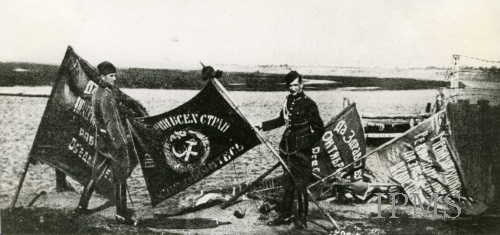
Polish soldiers displaying captured Soviet battle flags after the battle
And you don’t think I’m going to miss this opportunity to note once more one of the things that most make me what my friend E. calls “grouchy”, do you? the West’s reprehensible ignoring of the super-human efforts of Serbian resistance — both left and right — during the war, and the parallel ignoring of Croatian crimes during the entire twentieth century. I can’t right now produce more words here, describing the people with the most unexpiated moral baggage in Europe, yet who always get Europe and America’s support, so I’ll just quote myself:
But, for me, one basic fact is clear: that Croatians were always part of Yugoslavia in bad faith; that they wanted something out of the Serb efforts and Serbian blood that was decisive in defeating Austria in WWI, but that that something was independence, or greater autonomy within an Austria that they probably never expected to be dismembered the way it was – anything but what they felt was being subjected to Belgrade. And that became immediately clear upon the formation of the state when they – being, as Dame Rebecca calls them, good “lawyers” – began sabotaging the normal functioning of the Yugoslav government in any way they could, no matter how more democratic the Serbs tried to make an admittedly not perfect democracy, no matter how many concessions of autonomy Belgrade made to them. If there were any doubt as to the above, even when Radić and his Croatian People’s Peasant Party had turned the Skupština into a dysfunctional mirror image of today’s American Congress, even when a Macedonian IMRO activist working in tandem with Croatian fascists assassinated Serb King Aleksandr in Marseille in 1934, it was subsequently made brutally clear by the vicious death-spree Croatian, Nazi-collaborating fascism unleashed on Serbs during WWII, a true attempt at ethnic cleansing that dwarfs anything the Serbs may have done during the 90s — which is dwarfed again by what Croatians themselves did in the 90s again: the most heinous Nazi regime, “more royalist than the king,” as the French say — more Nazi than the Nazis — to appear in Eastern Europe during WWII. And they have not been even remotely, adequately, held to account by the world for any for any of the above; all this ignored, even as the West maintains a long list of mea-culpas it expects Serbs to keep reciting forever.
King Aleksandr of Yugoslavia (click)
And so, when they got their chance in the 90s, with the backing of a newly united, muscle-flexing Germany, Croatians abruptly and unilaterally and illegally declared their long-wished for (but never fought-for) independence. And so did Slovenia; but again, who cares about Slovenia? It was a prosperous northern republic that may have held the same Northern-League- or-Catalan-type resentments against a parasitic south that was draining its wealth, but it was ethnically homogeneous and its departure left no resentful, or rightfully fearful, minorities behind. But Croatia knew, when it declared its independence – as did, I’m sure, their German buddies – that they were pulling a string out of a much more complex tapestry. And did it anyway. And we all saw the results.
************************************************************************ Write us: with comments or observations, or to be put on our mailing list or to be taken off our mailing list, contact us at nikobakos@gmail.com.
The Greek national anthem was apparently sung inside the church of the Virgin on the island of Tenos, on this, the feast of the Dormition (the Assumption in the West), perhaps the most important of the several holidays dedicated to her.
UGH! How inappropriate…
************************************************************************ Write us: with comments or observations, or to be put on our mailing list or to be taken off our mailing list, contact us at nikobakos@gmail.com.
Readers and friends and acquaintances all know how irritated I can get by the romanticizing of Muslim Spain and its Moorish heritage — by the romanticizing of Islam’s tolerance and cosmopolitanism generally and its role in preserving classical Mediterranean culture* for the still adolescent West, blah, blah — but I’ll be damned if she doesn’t sound like a Quran recitation or a muezzin and especially a qawwali singer at certain moments. And this is “bulerías” too, considered one of the “lighter” palos or genres of flamenco
Yes, in Baghdad and Palermo and Córdoba…and in a dinky little provincial town called Constantinople.
Balkans, Anatolia, Caucasus, Levant and rest of ME, Iran, South Asia
Me, I'm Nicholas Bakos, a.k.a. "NikoBako." I'm Greek (Roman really, but when I say that in English some five people in the world today understand what I'm talking about, so I use "Greek" for shorthand). I'm from New York. I live all over the place these days. The rest should become obvious from the blog.






 Jadde: from Bosnia to Bengal