
Two videos — God give them strength.
Comment: nikobakos@gmail.com
Olympic year or not, London has always had it all over us in terms of theater — in variety, quality, daring and in its still central role in the city’s life:
“Perhaps the most logistically ambitious part of the festival was Globe to Globe, in which leaders of Shakespeare’s Globe Theater spent nearly two years lining up 37 international theater companies to mount one of the plays in their native languages at the Globe over six weeks this spring. The shows included a new “Balkan trilogy” with theaters from Serbia, Albania and Macedonia each performing one of the three parts of “Henry VI” — not coincidentally a play about civil war — as well as productions of “The Comedy of Errors” from the Afghan troupe Roy-e-Sabs and “The Merchant of Venice” from the Habima theater company of Israel (which drew protesters waving Palestinian flags).”
Give the guys a break, dudes, they’re doing “The Merchant of Venice.”
And Afghans doing “The Comedy of Errors” is too perfect.
London, 1666 (click)

Comment: nikobakos@gmail.com
Not the most brilliant thing I’ve read lately but one important, though really flawed, point:
“BY 1900, only two genuine multinational empires remained. One was the Ottoman, which was by then in the process of abandoning its traditional religious toleration for Turkish nationalism and even racism. [A completely, unfair, simplistic and un-historical assessment] The other was Austria-Hungary, home to 11 major national groups: a paradise in comparison with what it was to become. Its army had 11 official languages, and officers were obliged to address the men in up to four of them.
It wasn’t terribly efficient, but it secured an astonishing degree of loyalty. It also brought rapid economic and cultural progress to an area extending from the Swiss border to what is today western Ukraine. During World War I, Austria-Hungary fielded eight million soldiers commanded by, among others, some 25,000 Jewish reserve officers. Thirty years later, the nation-states that succeeded the empire sent most of the surviving Jewish officers to the gas chambers.”
Unfortunately, the poison of the ethnic-based nation-state ideal had gotten too far by then. Even the portrait of Austria-Hungary he gives us is completely idealized and existed in the form he describes for less than a century.

(Click above)
How sweet though, to have lived in a world that interesting instead of the stupefying monotony of the modern nation-state. But that idea is so powerful — no, not because it’s natural and inborn, but because the modern, bureaucratic state was the first with the technical apparatus to impose it on its population(s) — that it deletes all historical files dealing with plurality. Not a single European tourist who comes to New York fails to make the same comment: “Amazing…all these peoples living together…” and I want to explain that that’s how humanity lived for most of its civilized existence — or just pull my hair out — but I usually don’t bother.
But that reminds me: I do live in a world that “sweet” and “interesting:”
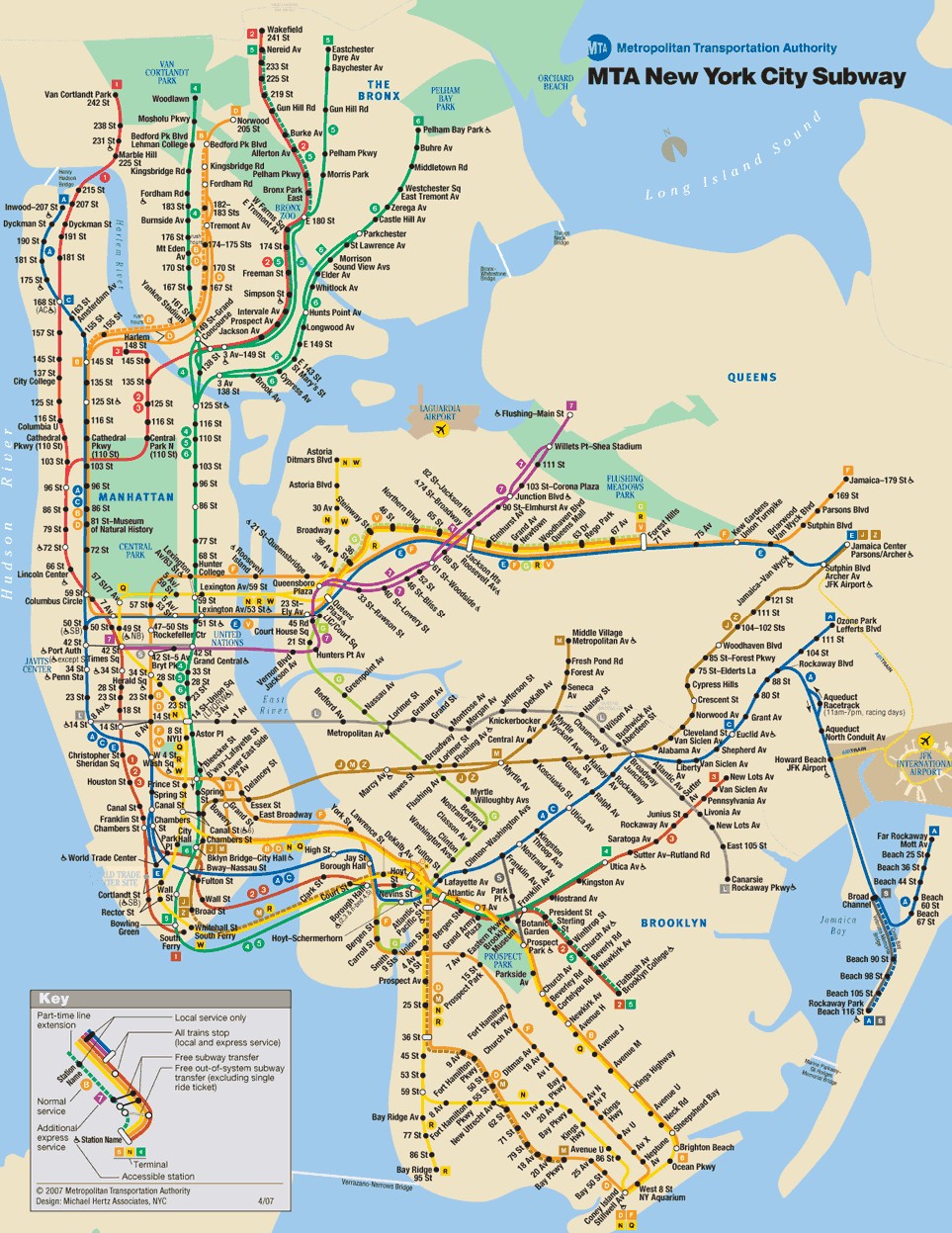
Mr. Deak (Hungarian?) is also wrong on an even more crucial point. The Ottoman and Austro-Hungarian empires were not the world’s last multi-ethnic states. There’s still China. Most of southeast Asia. And Russia. And most ex-Soviet republics. And certain Latin American countries. And almost all of Africa. And Syria and Lebanon and Iraq and Iran and Afghanistan and Pakistan and the world’s great wonder, India. Even Turkey. (And wherever ethnic nationalism is a problem in those countries it’s based on the Western intellectual model.) In fact, most of the world still lives in “plural” situations. Only Europe (and even in Europe there’s Spain and the U.K.), has an issue with this concept, but it seems to be fading even there. Its last bastion will probably be the growing number of viciously homogenized, ugly little states of Eastern Europe and the Balkans. Which brings us back to Michael Ignatieff:
“The misery of the Balkans stems in part from a pathetic longing to be good Europeans — that is, to import the West’s murderous ideological fashions. These fashions proved fatal in the Balkans because national unification could be realized only by ripping apart the plural fabric of Balkan village life in the name of the violent dream of ethnic purity.”
From Blood and Belonging: Journeys into the New Nationalism, Michael Ignatieff
Comment: nikobakos@gmail.com
— Rosanna Warren, The Art of Translation

Two Pashtun kids in Nangarhar, with that probing, no-shame, about-to-crack-a-smile inquisitiveness that all Afghans disarm you with.
Comment: nikobakos@gmail.com
Song from the great Ahmad Zahir: Footage from the documentary “Kabul Transit”
Comment: nikobakos@gmail.com

I’m nauseated by this tone of: “phhhheewwww….that was tough, but we put our Yank’ ingenuity to work and our men on the line, did what we could and now it’s time to say good-bye.”
Stop pretending. Stop pretending you or anybody else had a plan. Stop pretending that, except for the Turks, the rest of NATO wasn’t the bunch of non-committed pussies you knew they were. Stop pretending that all you did wasn’t to wage a pointless counterinsurgency with some brave and skilled but totally clueless kids who didn’t deserve to be sent on such a dumb mission if they weren’t going to be given full back-up. Stop pretending you tried to actually bring the Taliban into the political process in any serious, small-scale, on-the-ground way or that the United States even had people who could’ve negotiated such a tricky, labour-intensive manoeuvre (the Army only has 8,000 Civil Affairs troops, less than 1% of Army total) or that you gave even one Pashtun kid any incentive to not join the Taliban.
Stop pretending that you invested in any roads other than the one to the airport and Bagram, that you invested in any infrastructure at all, that you invested in schools or education for a smart, entrepreneurial-minded people that were starving for it. Stop pretending you didn’t just irresponsibly throw around a bunch of billions, and a bunch more millions as bakshish to line Karzai and his clan’s pockets, which won’t even be reinvested in Afghanistan but have already found their way to the Emirates by now and will pay for all their sons’ weddings for at least a generation.
STOP PRETENDING YOU DID EVEN THE SIMPLEST SHIT, like pave most of the streets of Kabul, give it a modern sewage system, that it didn’t take you until last year to even put up streetlights in at least the central arteries of Shehr-e-Nau, for fuck’s sake, so that people could see where they were going at night through the smog, and that you’re not probably now leaving that city to the mercy of a civil conflict and a destruction that may be worse than the nineties.’
Stop pretending you did any-thing. And that if Afghans now get it together somehow, insha’allah, that it won’t only be through their own strength and tenacity, which comes from, I swear, God only knows what mysterious and hidden source and that in the end it won’t be as if you had never been there at all.
Ask any Afghan. The Soviets did more. Rezili.
So stop. Please!

“And I think the reports we get are relatively accurate in the sense that there is real improvement. In those areas where we’ve had a significant presence, you can see the Taliban not having a foothold, that there is genuine improvement in the performance of Afghan national security forces.
But the Taliban is still a robust enemy. And the gains are still fragile, which leads me then to the second point that you’ve made in terms of a premature withdrawal. I don’t think that there is ever going to be an optimal point where we say, this is all done, this is perfect, this is just the way we wanted it and now we can wrap up all our equipment and go home. This is a process and it’s sometimes a messy process, just as it was in Iraq.
But think about it. We’ve been there now 10 years. We are now committing to a transition process that takes place next year, but the full transition to Afghan responsibility is almost two years away. And the Afghan Security Forces themselves will not ever be prepared if they don’t start taking that responsibility.
And, frankly, the large footprint that we have in Afghanistan over time can be counterproductive. We’ve been there 10 years, and I think no matter how much good we’re doing and how outstanding our troops and our civilians and diplomats are doing on the ground, 10 years in a country that’s very different, that’s a strain not only on our folks but also on that country, which at a point is going to be very sensitive about its own sovereignty.
So I think that the timetable that we’ve established is a sound one, it is a responsible one. Are there risks involved in it? Absolutely. Can I anticipate that over the next two years there are going to be some bad moments along with some good ones? Absolutely.
But I think it is the appropriate strategy whereby we can achieve a stable Afghanistan that won’t be perfect, we can pull back our troops in a responsible way and we can start rebuilding America and making some of the massive investments we’ve been making in Afghanistan here back home, putting people back to work, retraining workers, rebuilding our schools, investing in science and technology, developing our business climate.”
— Barack Obama
Comment: nikobakos@gmail.com
A British Dateline story from last year that deals with the plight of Afghan immigrants in Greece:
Comment: nikobakos@gmail.com
What are chitterlings, or chitterlins, or chit’lins? They’re pig intestines, which people eat all over the world wherever they eat pigs. (Where they don’t, they eat lamb intestines.) Unfortunately, in the United States, the only people with the sensory refinement to appreciate them are African-Americans. (And yes, girlfriend, the casing on that $25 a pound artisanal Calabrian soppressata you get at Whole Foods…pig gut.)
“Mageiritsa” is a Greek soup made of lamb offal that is made at – and only at – Easter. It’s an incredibly time-consuming and labor- intensive production, which is probably why. First comes the all-day or over-night simmering of the lamb’s heads and feet, to get the appropriately kelle paça type broth necessary. (Kaleh pacheh seems to be a Friday after-prayer tradition in Afghanistan, so starting Thursday morning in front of all the butcher shops in Kabul, usually collected on one street, and by shacks along roads leading out of the city that seem to open just for that purpose, one sees giant piles of recently severed, bloody heads next to piles of bloody feet, both still in their fur, swarming with flies. It’s a beautiful sight and one that, like so many other things in Afghanistan, I didn’t get a photo of while there because I thought I would embarrass people by taking pictures of things that I was afraid they would think I thought backwards.) 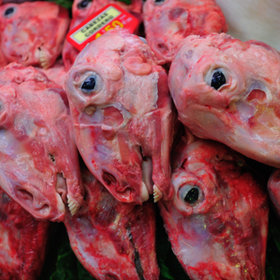 Then comes the cleaning out of faeces from about a football field’s length of lamb intestines (below), which is not that bad because they come from young animal
 s that only eat grass anyway so it’s kind of the texture of baby poop. (The European Union Daddy-State tried to ban the sale of intestines a few years ago and the Greeks to their credit, which I don’t grant them often, got into an uproar and Brussels backed down. I actually have a theory that the intestine issue was the behind-the-scenes deal-breaker between the EU and Turkey, and rightly so; make me bend over backwards about how I run my country, make me reorganize my economy to enrich you and impoverish myself, treat me like an unwanted guest because I’m Muslim, but I’ll be damned if you take away my kokoreç.*) Then you braise the intestines, and the sweetbreads (thymus glands) and hearts and kidneys in the broth (some people use liver or spleen and testicles too, but I don’t ‘cause the liver and spleen can get bitter and the testicles retain an unpleasant spongy texture when boiled which they don’t when grilled, or when sautéed with oil and a ton of garlic like they do with the bull’s balls in Spain after a bullfight — talk about sympathetic magic – and are quite yummy — see bottom.) Then they’re all minced up, browned in a healthy amount of butter, added to the broth with lots of scallions and dill, some rice, and, just before serving, terbiye-d** with eggs and lemon.
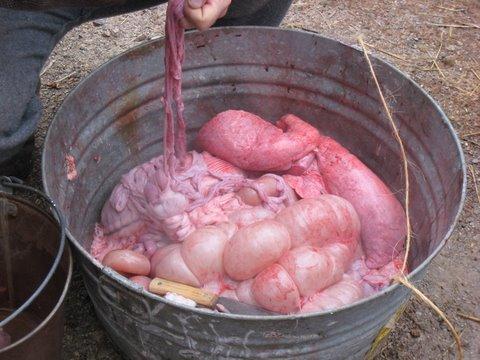
Intestines
It’s generally acknowledged that I make the best mageiritsa in the world. You can get pretty good mageiritsa lots of places, but mine is the best…in the world. When I serve it at Easter, some people can’t get enough of it and some people politely decline. Others, unfortunately – and tellingly, it’s usually younger Greek-American family – have always felt they have license to grimace and make faces of disgust and revulsion.
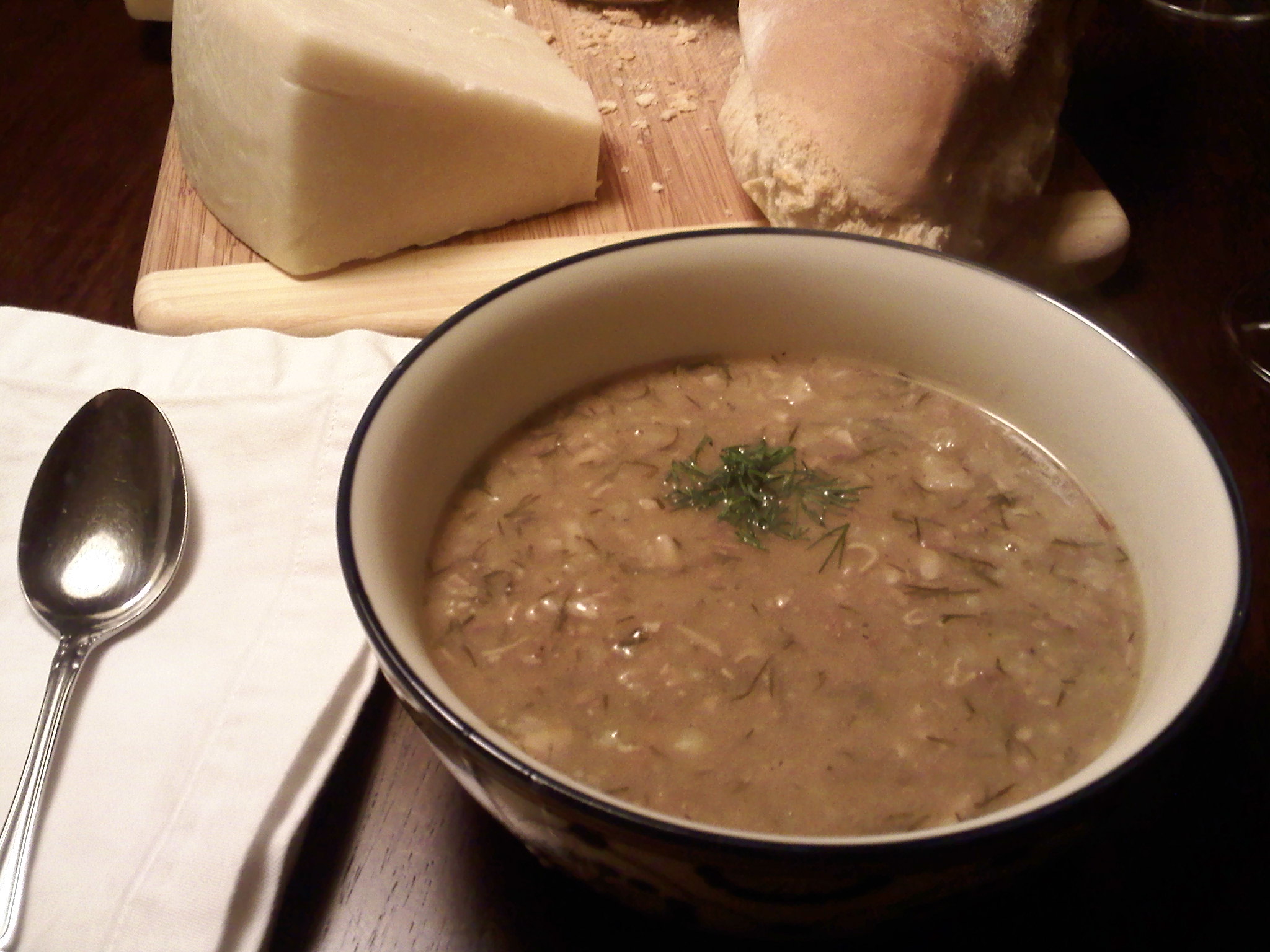
Mageiritsa — the finished product (click)
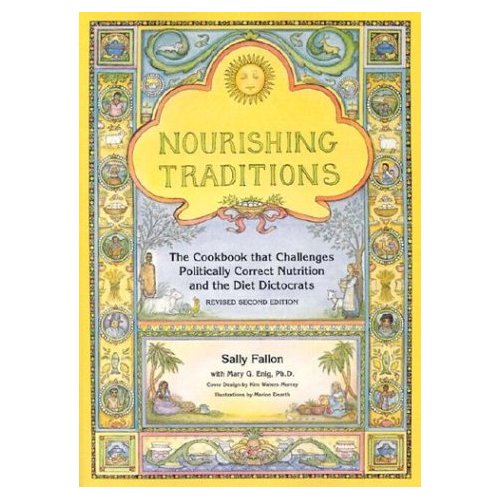
It’s bad enough that so much art and time and work on my part should be met with that kid of rudeness. Then I have to listen to the anthropology tes poutsas about how people only used to eat that stuff because they were poor and they had to eat everything available, like eating intestines were the equivalent of the dirt-eating that tragically occurs in third world countries under famine conditions. No they didn’t; they ate those things because they taste good. Organ meats perform more complex biochemical functions in our and other animals’ bodies than muscle does; joints: feet and hocks, are complexly interconnected with tendons and cartilage of various kinds. They therefore have more varied textures, mineral content and other elements, which gives them a richer and more varied taste than regular flesh has. As mentioned in this brilliant book Nourshing Traditions: The Cookbook that Challenges Politically Correct Nutrition and the Diet Dictocrats by Sally Fallon, when a carnivorous animal (which we are, by the way; ignore false, scientifically faulty Vegan and Buddhist propaganda) kills another animal in the wild, the first thing it goes for are the guts because it instinctively knows they’re the most nutritious part. Instead of teaching their kids the value and variety of our traditions or pointing out the beautiful economy with which our ancestors made use of every part of the animal, or their respect for and intimate knowledge of the world, the plants, and the animals which fed them, as opposed to our obscene wastefulness and complete alienation from any food which actually looks like food or reminds us of where it comes from, these people stupidly and condescendingly put it down to their poverty.
I never, ever heard anyone in older generations reminisce about the breast of any chicken or the dry, grey boti meat of a traditionally over-cooked Greek leg of lamb. My mother used to wax nostalgic about an aunt’s Sunday pacha or the street kokoretsi they sold down by the lake in Jiannena next to the Karagöz puppet box (you’d get slices of it on wax paper, that or a cone of pumpkin seeds or a stick-full of pişmaniye and sit and watch Karagöz and Hacivat’s brilliant antics; I can’t be grateful enough that all these survived until I myself was a child.) If a whole animal were roasted, the kids would fight over the head and its brains, tongue and the delicious, gelatinous cheek flesh. And pig feet and andouillete are enjoyed in the best Parisian bistros, not just in supposedly impoverished Balkan or South American villages.
It’s a growing ecological disaster – a cultural one – and that’s what depresses me most. We’re tangling ourselves (like most things modern, it starts in America but is spreading throughout the world) in such a neurotic, kosher-like web of food anxieties and hysteria that we’ll have soon lost access to half the things humanity used to enjoy at the table if we haven’t already. I truly believe that it’s a phenomenon connected to the disappearance of other forms of diversity:
“All these seemingly disconnected events are the symptoms, you could say, of a global epidemic of sameness. It has no precise parameters, but wherever its shadow falls, it leaves the landscape monochromatic, monocultural, and homogeneous. Even before we’ve been able to take stock of the enormous diversity that today exists — from undescribed microbes to undocumented tongues — this epidemic carries away an entire human language every two weeks, destroys a domesticated food-crop variety every six hours, and kills off an entire species every few minutes. The fallout isn’t merely an assault to our aesthetic or even ethical values: As cultures and languages vanish, along with them go vast and ancient storehouses of accumulated knowledge. And as species disappear, along with them go not just valuable genetic resources, but critical links in complex ecological webs.” — “In Defense of Differerence.”
“Oh, this is so salty. Oh, this is so fatty. Oh, this is so oily. Oh, this must have so much cholesterol; I can feel my arteries clogging. Eeew, this has liver in it. It’s what?! Made with blooood?!” (You can’t imagine how many people I’ve known who had heard of blood sausage but thought it was a metaphor.) “Ugh, this is so sweet – I can’t take a second bite.” We think we’re so sophisticated but are pretty much as incapable of thinking comparatively or relatively as an Amazonian tribe shooting arrows at airplanes. It never occurs to us that fattiness, or cloying sweetness, or fishiness or gumminess were and are qualities that people enjoy. One of the most interesting pieces of etymology that I’ve ever learned is that the word “funky” – one of the few African words to have passed into American English usage – actually means “stinky” in whatever West African language it comes from. But it’s telling that it’s come to mean what it means for us: weirdly, pleasantly off-beat. Cool — in a way you can’t put your finger on — ‘cause it’s off. Get it? Like certain French cheeses when they’re good and ripe and smell like your boyfriend’s unwashed underwear, or the obviously slimy texture and smell – the obviously slimy look even, with all its erotic overtones — of oysters or other raw seafood. Funky. Yum.
Even in foodie paradise New York — where curious Brooklyn Heights ladies are taking butchery classes and where you’ve started seeing more and more of the kind of tastes and smells I’m talking about on restaurant menus: tripe and boudin and fatback (and if that’s a good thing to you because you love good food, you’re indebted more than you know for that to one man: one of my best beloved heroes, Anthony Bourdain***, who wrote in his first best-seller, Kitchen Confidential: “My body is not a temple; it’s a playground.”) – try going out to dinner with a group of friends. It’ll take several hours of conference calling before everybody’s food concerns and quirks are taken into consideration and then, if the night’s not over, you’ve ended up at a least common denominator restaurant where one of your group is still bound to torment a busy waiter with a barrage of anxious questions, requests for substitutions, no peanut oil, “light on the butter” or the resounding, echoing sound of “sauce on the side.” This is most often a white girl who doesn’t cook (“sauce” is usually a fundamental component of a dish produced by the entire, holistic process of preparing it; you can’t put it on the “side;” it’s not the jarred tomato sauce you grew up eating, babe; you can’t make a blanquette de veau with the sauce on the ‘side,’ or a mole poblano with the mole on the side!) or it’s someone who has never worked in that business and has no idea what a tightly organized military operation a good New York restaurant is and what chaos that behavior throws both the floor and kitchen staff into, not to mention the offense to the chef himself and his line, who might not just be doing their jobs, but might actually be proud of the carefully conceived and prepared dishes they’re trying to put out.
I understand people have different tastes and that they even have different biochemical make-ups that might make certain tastes seriously unpleasant to them. I mean, even Tom Colicchio doesn’t like okra, which I love, but I don’t hold it against him. (I just know that he hasn’t eaten them properly prepared). But the preparation and sharing of food is such a fundamental part of most human socializing and it’s become almost impossible to conduct in any civilized form through this thicket of prohibitions and fears. Which brings me to my final point: the social aspect, which includes issues of hospitality, personal pride, and what Greeks call philotimo, all heavily weighted and codified issues in ‘our parts.’
But my intestines need cleaning, so I’ll have to tackle the rest of this issue in another post.
*Kokoreç (shown below) is basically the same ingredients as mageiritsa but spitted and roasted. The organ meats are spitted and the whole thing is wrapped around with the intestines like a giant andouillette. In Greece, they cut it in slices and serve it like that, which I prefer. In Turkey they usually mince it all up with red pepper after roasting and put it in a sandwich, which is delicious but doesn’t allow the texture of each constituent organ meat to be appreciated as much.

** Terbiye, what Greeks call augolemono, is supposed to be an egg-lemon liaison sauce used in many dishes or to thicken soups and is the greatest culinary hoax ever perpetrated on the peoples of the Near East. Very simply, the recipe, as usually given, does not work, and does not produce a thickened sauce but a watery, sour mess. When you make a béarnaise or a hollandaise you use minimal acid (vinegar or lemon respectively) only the egg yolks and pure butter, ideally clarified. It’s impossible to scramble some whole eggs with lemon, pour some watery liquid out of a pot of cabbage sarma into it and expect that it will produce something comparable. If you’ve ever seen a truly smooth, thick terbiye, some kind of extra binder (corn or regular flour) was added to it, and if the cook tells you otherwise she’s lying. Never underestimate the tactics a Turkish or Greek woman (especially one from Istanbul) will resort to in order to protect her recipes and ensure no one else’s version is as good; lying is the least of it.
***Anthony Bourdain
My man Bourdain — get all his books here.
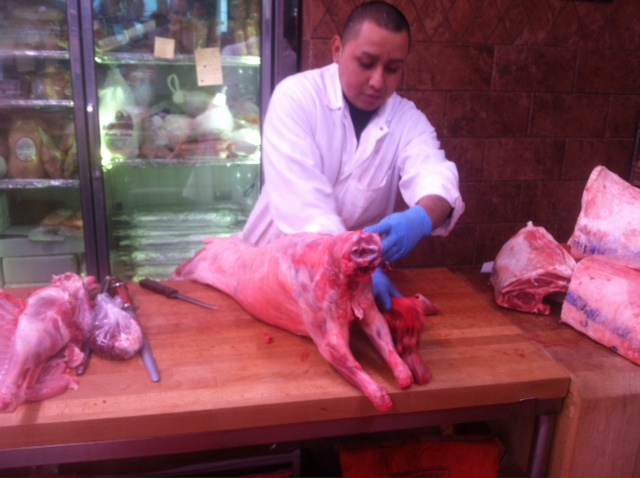
International Meats in Astoria, staffed almost entirely by Mexicans, who speak perfect Greek and know every detail of innards terminology in not only Greek, but Serbian and some Roumanian. A Queens insituton.

Bull balls at International, with liver to the left, kidneys on the right, spleen on bottom left, hearts on bottom right.
Comment: nikobakos@gmail.com

The Valley of Dropoli, the pass up to the Pogoni plateau near Libochovo, and in the distance, the snowcapped peaks of Nemerčka, from the Monastery of the Taxiarches in Derviçani, Easter 2014 (click)
When my father used to say “ta mere mas” (literally “our parts”) he was referring to the thirty or so Greek-speaking villages in the valley (shown above) and surrounding mountains of southern Albania where he grew up. It was a term that, before I had gotten too deep into my childhood, before I could even name those places, I had understood instinctively, almost oppressively. I knew who these people from our parts were, these landsmen, exotic even to me in certain ways. I knew how they comported themselves, knew their body postures; I knew how they spoke, how they treated a guest. I knew how they danced, how they sang; I knew their weird, haunting music before I could articulate why it stirred me so deeply. I knew how they prayed; I knew how they grieved. They didn’t laugh much. Or smile easily.
Later, in graduate school, students from Greece, the Balkans, Turkey, Iran, the Arab Middle East and even South Asia seemed to instinctively gravitate towards one another, and not just because they were all working in the history or the politics of the area but, well, mostly because we partied well together. I started using my father’s “our parts” semi-ironically, a little guiltily as well because it was without the Appalachian tone of mystery with which he used it, to indicate the region that all of us were somehow connected to – the region that, however vast and varied, and where, however viciously we treated each other in past and present — seemed to bring us together in an automatic comfort and feeling of ease. The term inevitably caught on and without irony. I guess it was bound to.
This blog is about “our parts.” It’s about that zone, from Bosnia to Bengal that, whatever its cultural complexity and variety, constitutes an undeniable unit for me. Now, I understand how the reader in Bihać, other than the resident Muslim fundamentalists, would be perplexed by someone asserting his connection to Bengal. I can also hear the offended screeching of the Neo-Greek in Athens, who, despite the experiences of the past few years, or the past two centuries, not only still feels he’s unproblematically a part of Europe, but still doesn’t understand why everyone else doesn’t see that he’s the gurgling fount of origin and center of Europe.
But set aside for one moment Freud’s “narcissism of petty differences,” if we have the generosity and strength to, and take this step by step. Granted there’s a dividing line running through the Balkans between the meze-and-rakia culture and the beer-and-sausage culture (hats off to S.B. for that one), but I think there’s no controversy in treating them as a unit for most purposes; outsiders certainly have and almost without exception negatively. And the Balkans, like it or not, include Greece. And Greece, even more inextricably, means Turkey, the two being, as they are, ‘veined with one another,’ to paraphrase the beautiful words of Patricia Storace. Heading south into the Levant and Egypt, we move into the Arab heartland that shares with us the same Greek, Roman-Byzantine, Ottoman experiences, and was always a part of the same cultural and commercial networks as the rest of us. East out of Anatolia or up out of Mesopotamia I challenge anyone to tell me where the exact dividing line between the Turkic and Iranian worlds are, from the Caucasus, clear across the Iranian Plateau into Afghanistan and Central Asia.
Granted, the descent into the suffocating Indo-Gangetic plain and its polytheism, from the suffocating monotheism of the highlands, is a cultural and most of all perhaps, a sensory rupture. But one has to know nothing about the “dazzlingly syncretic” civilization of north India to not know how much of it is Islamo-Persian in origin or was at least forged in an Islamic crucible, and if you do know that then the Khyber pass becomes what it always was, the Khyber link.
Are the borders of this zone kind of random? Maybe. But to step into Buddhist Burma is somehow truly a leap for me, which maybe I would take if I knew more. And in the other direction, I stop in Bosnia only because for the moment I’d like to leave Croatia to Europe – mit schlag – if only out of respect for the, er, vehemence with which it has always insisted that it belongs there. Yes, I guess this is Hodgson’s “Islamicate” world, since one unifying element is the experience of Islam in one form or another, but I think it’s most essential connections pre-date the advent of Islam. I’ll also probably be accused, among other things, of Huntingtonian border drawing, but I think those borders were always meant to be heuristic in function and not as hard-drawn as his critics used to accuse him of, and that’s the case here as well.
Ultimately what unites us more singularly than anything else, and more than any other one part of the world, is that the Western idea of the ethnic nation-state took a hold of our imaginations – or crushed them – when we all still lived in complex, multi-ethnic states. What binds us most tightly is the bloody stupidity of chilling words like Population Exchange, Partition, Ethnic Cleansing – the idea that political units cannot function till all their peoples are given a rigid identity first (a crucial reification process without which the operation can’t continue), then separated into little boxes like forks after Easter when you’ve had to use both sets – and the horrendous violence and destruction that idea caused, causes and may still do in “our parts” in the future.
What I hope this blog accomplishes, then, is to create even the tiniest amount of common consciousness among readers from the parts of the world in question. A very tall order, I understand, maybe even grandiose. Time will tell if it all ends up an unfocussed mess and I end up talking to myself; it’s very likely. But hopefully readers will respond and contribute material or comments even if they don’t feel the entire expanse of territory as their own. I hope it’ll be a place where one can learn something, including me; in fact, I expect most of my posts will end with “does anybody know anything more about…” or “can anyone explain…” I’ll be using vocabulary and making references from all over the place, sometimes footnoting them with an explanation, but if not hoping that readers will be interested enough to please, please ask when a word or topic is unfamiliar.
Clearly my intentions are more than just explicitly anti-nationalist, but please feel free to contribute even if you consider yourself ardently opposed to those intentions (just refrain from vulgarity please). Feel free to tell us how you’re the origins of civilization or how you saved it or how you restarted it or that you speak the first language that came from the Sun or that we don’t understand that you’re surrounded by enemies or that — in the language of a grammar school playground — you were here first and they started it, or how everything beautiful about your neighbors is ripped off from you and how everything ugly about you is the unfortunate result of your neighbor’s polluting influence. Feel free to express legitimate concerns and disagreements as well. Please.
I’m also sure that sooner than later the subject matter will spill over into neighboring areas (the rest of eastern Europe and southern Italy immediately come to mind), and that there’ll be occasional comments on American socio-political reality, which for better or worse affects us all. And there will probably be the more than occasional post on New York, because that’s where I live, that’s where I’m from, because it’s only from a vantage point that’s both heterogeneous and external that the phenomena I’ll be talking about can be apprehended in their fullness and because that’s where, more than any other single place or any single time in history, the cosmopolitan ideal that motivates me has manifested itself in one actual, throbbing, hopelessly chaotic and deeply sure of itself city.
I’ve been collecting material for this blog for a long time before actually sitting down to start it up, partly because life got in the way, as it tends to do, and partly cause I’m a technological spaz, so some stuff will be old (including some journal entries from a couple of years ago when I took a trip through the region), but my comments will be contemporary. If there’s any one out there in NYC who is inspired or interested enough to help me out with things like the blog’s design or things like Greek or Arabic fonts or Turkish letter markings (sorry, on a volunteer basis for now) please feel more than free to contact me at: nikobakos@gmail.com
 Jadde: from Bosnia to Bengal