Tag Archives: Easter

Philopomeon writes: “Easter in Derviçani”

30 May

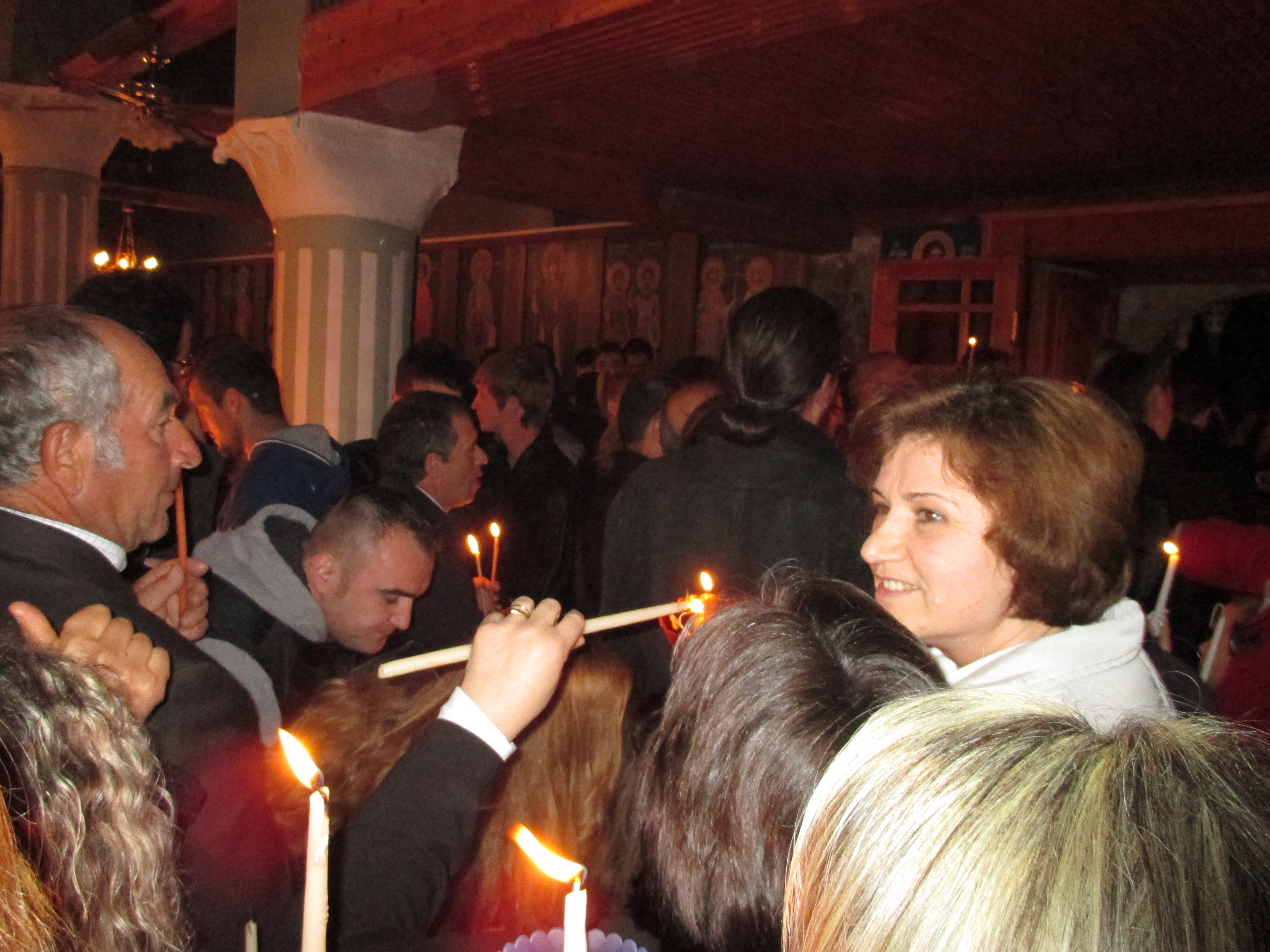
To this April 25th’s post on Easter in my village,  Easter in Derviçani,” Philopomeon writes:

“Beautiful. It’s rare that we get a look of what is going on among Greeks in Albania without having to hear about ‘Vorio Ipiros’ and ‘Chameria’ back and forth.”

Yeah P., except for a few real old die-hards, that stuff is pretty much over, and most people, young and old, have very maturely and intelligently, gone on with their lives and accepted things as are.  The most striking example of that is that there are youth associations from each of the Greek villages in the region, with members in Jiannena or Athens or all over the rest of Greece or Albania or the States or Australia, but the old pan-Voreio-Epirotiko associations like MABH, with their irredentist discourses have pretty much dissolved.  The hate is gone too, which was the most heartening thing to feel: the on-going, still often fatal feud with the neighboring Albanian Muslim village of Lezarates is mostly personal at this point and not an issue of religion or ethnicity.  I know more infantile little fascistakia in Athens, with no relation whatsoever to our villages, who are more preoccupied with those old causes — and feel like they have a right to shoot their mouths off about them as well — than anybody in Derviçani is today and who probably are greatly disheartened by our indifference to our “national issues.”  You’ve never wanted to lose it on someone so bad as I do when your family has been through what mine has (see: Easter Eggs…”) and then have some snot-nosed Kollegiopaido  think he can lecture you on how you don’t live up to them and lack their “national feelings” and other such bull-shit.

The young people of my village, particularly, are a marvel, a youth that any society would — or should — pray to have.  They are fanatically in love with their village; they return every chance they get — dozens come from Jiannena on just a regular weekend.  They’ve organized a new panegyri (village festival on the village saint’s day) on August 15th, when the village’s population is the highest.  This has happened all over Greece; since most people go on vacation in August, depopulated villages that only fill up with returnees at that time often organize a second “unofficial” panegyri in August, along with the traditional one which could be at any time of year, to take advantage of the greater presence of chorianoiDerviçani, however, has never really had this problem, because this is a village with such a gigantic ego that no mere saint would serve; its traditional panegyri was Easter itself! culminating on Easter Friday — της Ζωοδόχου Πηγής — and always packed, then and now…   But, what can I say, it’s a party town.  The youth association pays for this summer festival out of its own pocket; they’ve put a stop to the stupid drunken brawling that used to go on, even though they themselves can pack it away for sure.  They do tons of volunteer work for the village: roads, squares, little beautification projects, football fields and basketball courts.  Natally bilingual, interacting with the “other” and crossing borders both figurative and literal all their lives, they have that innate cosmopolitanism and perceptiveness of the wider world that can’t be learned in any school and that no Northern Suburb çoğlani could buy himself with all the millions in the world or a thousand trips to Europe or New York.  They’re strong, attractive, smart, open, friendly, generous and whether they’re busting their backs at the hardest manual work in Greece or other parts of Albania, or acing it at universities in Greece or in Europe, they’ve built active, productive lives for themselves out of nothing.  I’m not ashamed to say they put me to shame in almost every way.

The most satisfying feeling and identification I shared with them though was the sense that they knew who they were: Derviçiotes, Dropolites, Epirotes, and Greeks  — and that they have absolutely no need for the Neo-Greek nation-state as a reference point to bolster those identities.  Greece never did anything for them anyway except make their lives difficult when they got there in the nineties or provide leftist intellectuals to tell them that life in communist Albania wasn’t that bad or little Athenian pricks to mock them as “Albanians.”  (As opposed to the Church of Greece, however, which I’ve always found to be an abominably reactionary institution, but has really helped a lot of Greek kids from our parts find their way in life and adjust: learn trades, increase their Greek literacy skills, get them into universities, etc. — recognition should be granted when it’s due.)  They get tired of explaining to Neo-Greeks that they’re not Albanian, but ultimately they don’t give too much of a shit: one, because they don’t think being Albanian is an insult and, two, they know they’re Greek — in fact, they know they’re Greeker.  Their generational cohort in Greece would not want to hear their opinion of most of them.

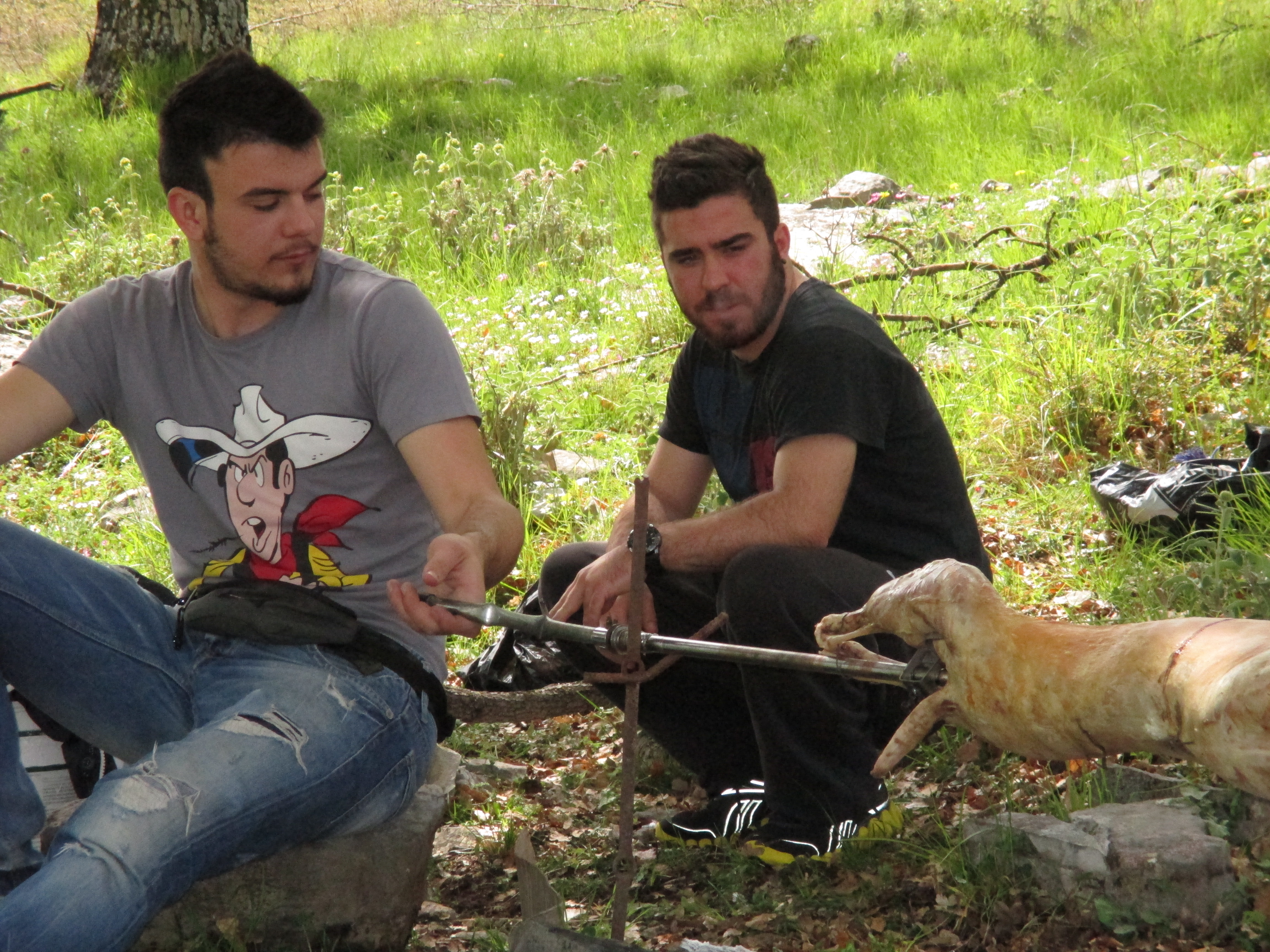
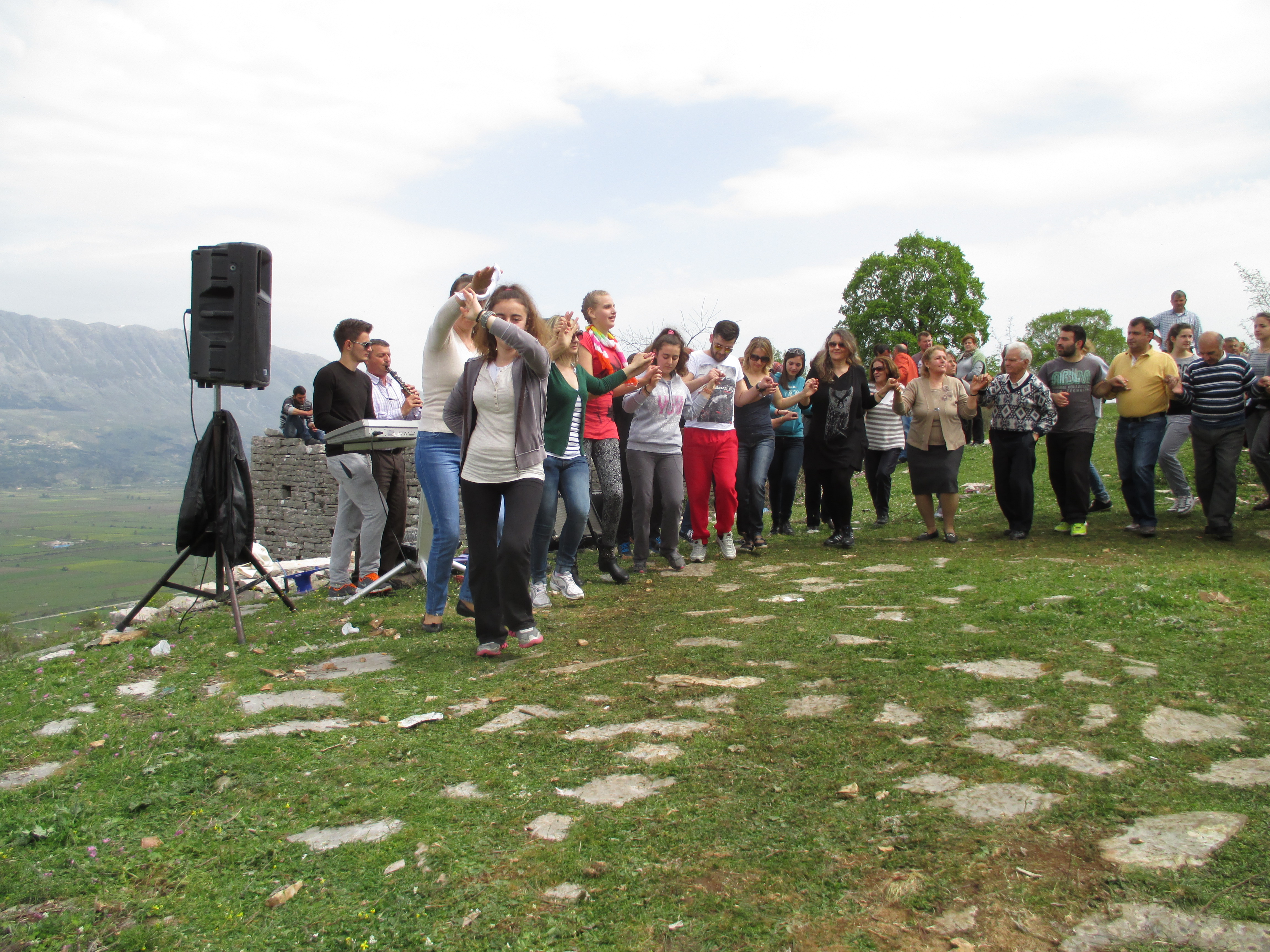
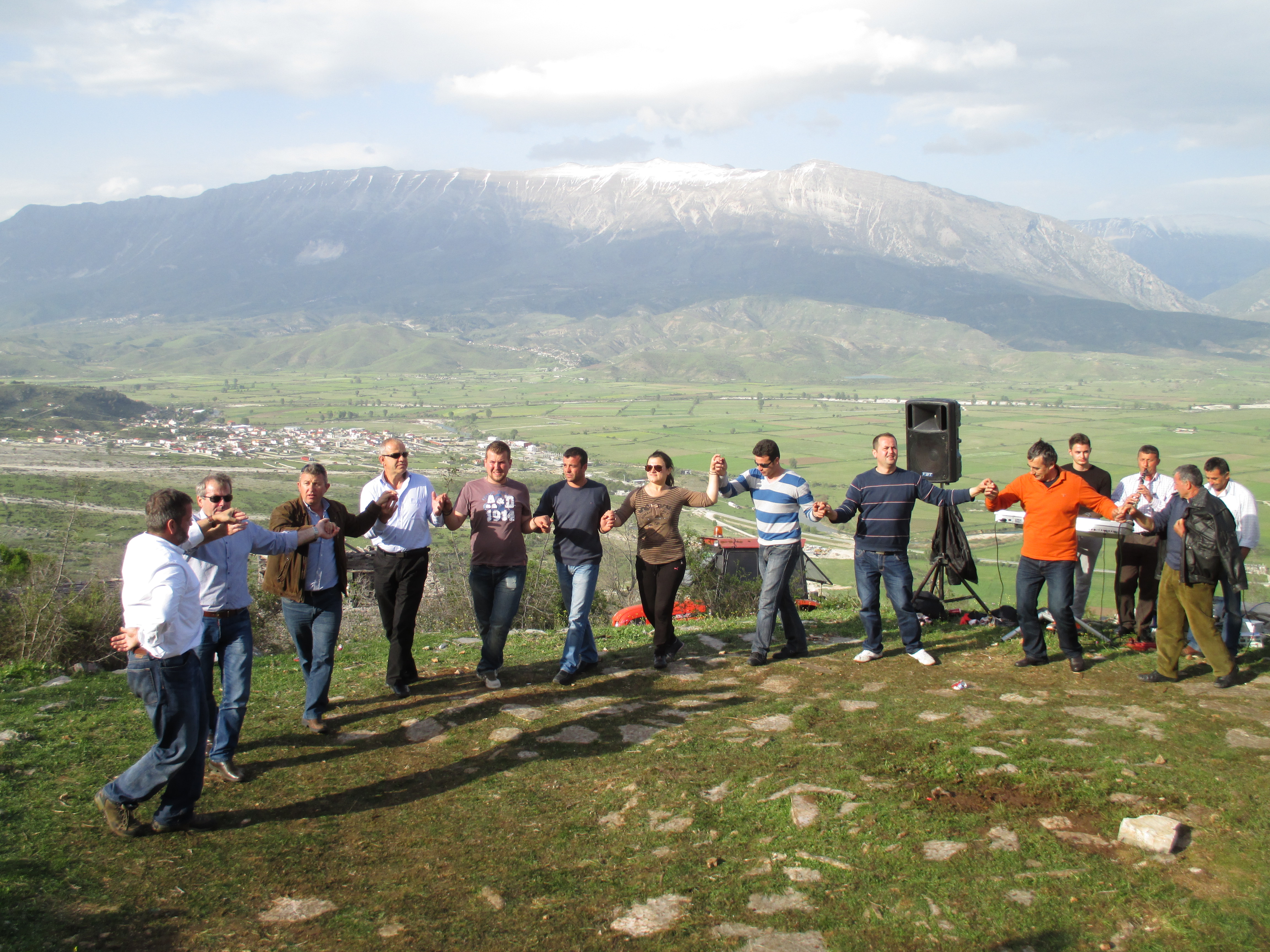
They love their Church, they love their music and they love their dancing.  Here are two videos of the early twenty-somethings, “Manastiri 1” and “Manastiri 2” (age groups and families take their turns) dancing up at the Monastery over the village on Easter Monday. My camera work on my brand-new little pocket Cannon is atrocious, but their spirit will come through.  I was astonished by how down-packed and completely internalized they had the traditional gestures and body language of the regional dance tradition — though I think dancing with open beer bottles is a new innovation and by the second video you can see they’re getting kind of sloppy.  There’s this one kid, FotoDretso, with the cartoon cowboy t-shirt, at the head of the line in the first video with the beautiful statuesque girl in the white sweater that no one can identify (“maybe she’s from another village…” the phantom beauty who showed up at our panegyri…), who is the son of GianneDretso, a village character out of Djilas’ Land Without Justice  with a fearsome reputation for leaping across borders and mountain tops like some cougar — a good rep to have around there.  Foto is also shown turning his spitted lamb in the Easter in Derviçani” post.  He seems to be something of a village youth leader, but the reason I couldn’t get enough video of him that day is, not just that he has my father’s name, but he dances exactly like my father did.  At times it was chilling.  Watch in that first video at around 1:35 when he takes lead of the dance.

IMG_0093FotoDretso, buddy and animal at the Monastery, Easter Monday 2014 (click)

In one of Misha Glenny’s books on Kosovo, Glenny asks a female Albanian politician in Tetovo, the unoffical capital of Macedonia’s some twenty to twenty-five percent Albanian minority: “Do you still dream of a Greater Albania? Where all Albanians can live in one state?”  And he got nearly the identical answer from her that I got from an Albanian guy I was talking to in the restaurant of our hotel in Tetovo: “Well…of course.  I guess we all do.  But those years are over.  The point now is not changing borders.  The point is making the borders not count.”

This is what most of my chorianoi — my “landsmen,” for New Yorkers, the rest of you can use your context clues, as we used to say in ESL — young and old seem to feel these days.  They live productive, happy as possible lives, where the border is practically a technicality and only promises to become more so as the years go on and the general integration of the region continues — a process that I see being halted only by those ideologues who get hard-ons at the thoughts of borders and nation-states and playing with little tin soldiers and tanks to defend them with.  But they’re a dying breed, unlikely to ever again reach a critical mass with which they could make a difference, whether they know or like it or not.  And the sooner the better.  So we can all get on with our lives.

Below are the kids dancing from my crappy footage.  But I have FINALLY found THE documentary video that captures the ethos of the whole music and dance tradition of Epiros as perfectly and deeply as possible but I’m thinking of the right way to set it up for readers.  In the meantime, enjoy.

This third video, ΔΕΡΒΙΤΣΑΝΗ 2013 ΧΟΡΟΣ Ι.ΜΠΑΡΟΥΤΑ,” is taken at the August dance, all generations participating.  The woman dancing at the head, Agathe Baruta — what relation to my Barutaioi I don’t know — is a stunning dancer (and a beautiful woman), and displays the precise, stylized seriousness that’s considered both beautiful dancing and proper elegant comportment for a woman.  (The kerchief is a remnant from a time when a man and a woman never touched publicly, even if related; the tall, handsome man she’s dancing with is her husband and is a member of the Greek Presidential Guard.  But some things are traditional formalities while the realities, obviously, change; one song from the new repertoire says: “Join the dance later and hand me a note with your cell number on it.”)  You’ll get a better sense of the communal joy this simple to-and-fro incites in people from this video because it’s more ordered than the kids’ dances above.  What you see here goes on, literally, for hours, till it induces an almost trance-like state; it starts at around eight in the evening and goes till dawn — for three nights in a row.  Unfortunately, I wasn’t able to capture in my videos above — nor is there a point here — a moment where the musicians slow down the tempo and the dancers get even more excited.  (At the end you get a fast number that really reminds you of how Balkan and Klezmer traditions are often connected.)  If you can, give it some time, because it needs time to build, time that we all have so little of; this whole tradition is the antithesis of the quick high and fake fun that characterizes our civilization: “Play it sweetly boys, sweet and slow, to heal the sickness I have in my heart”:

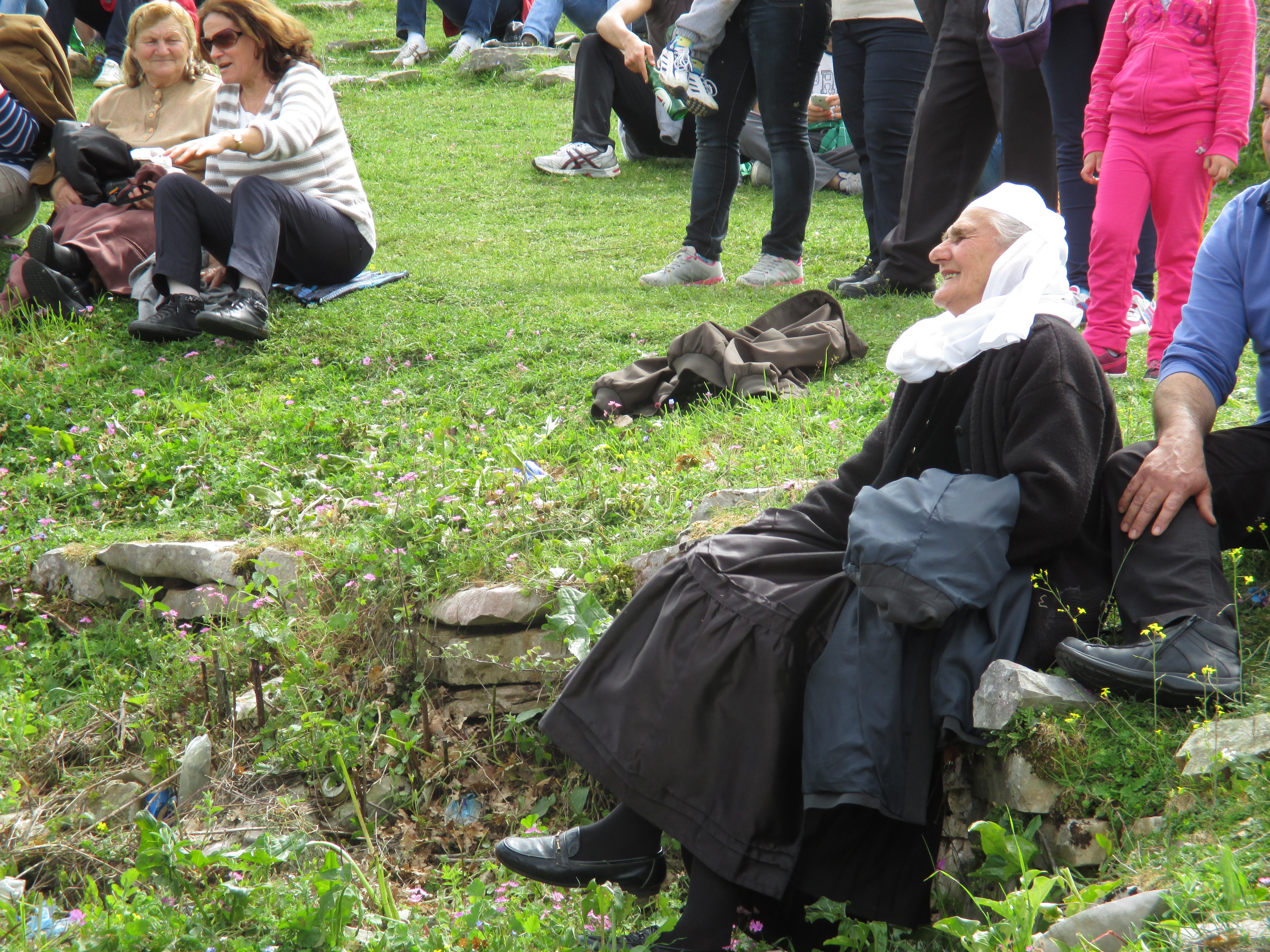
IMG_0182Meanwhile, back at Easter, some of the adolescents, watching the dance respectfully till it’s their turn.  (click)

IMG_0185The older guys, below, on dance break (click).

IMG_0196

IMG_0198

Some nephews of mine being bozos; every time I lifted the camera at them they would put their hunk of meat down and pose, so I asked them to be natural and this is what I got. (click)

IMG_0112

Comment: nikobakos@gmail.com

Easter eggs: a grandmother and a grandfather

17 May

Mana kai babas mikrosThe most recent picture of my grandmother to resurface, with my father as a baby, she in somewhat less then the full-out finery of the photo at bottom with my grandfather included, but with her good sash and her mecidiyia around her neck and forehead in any case.

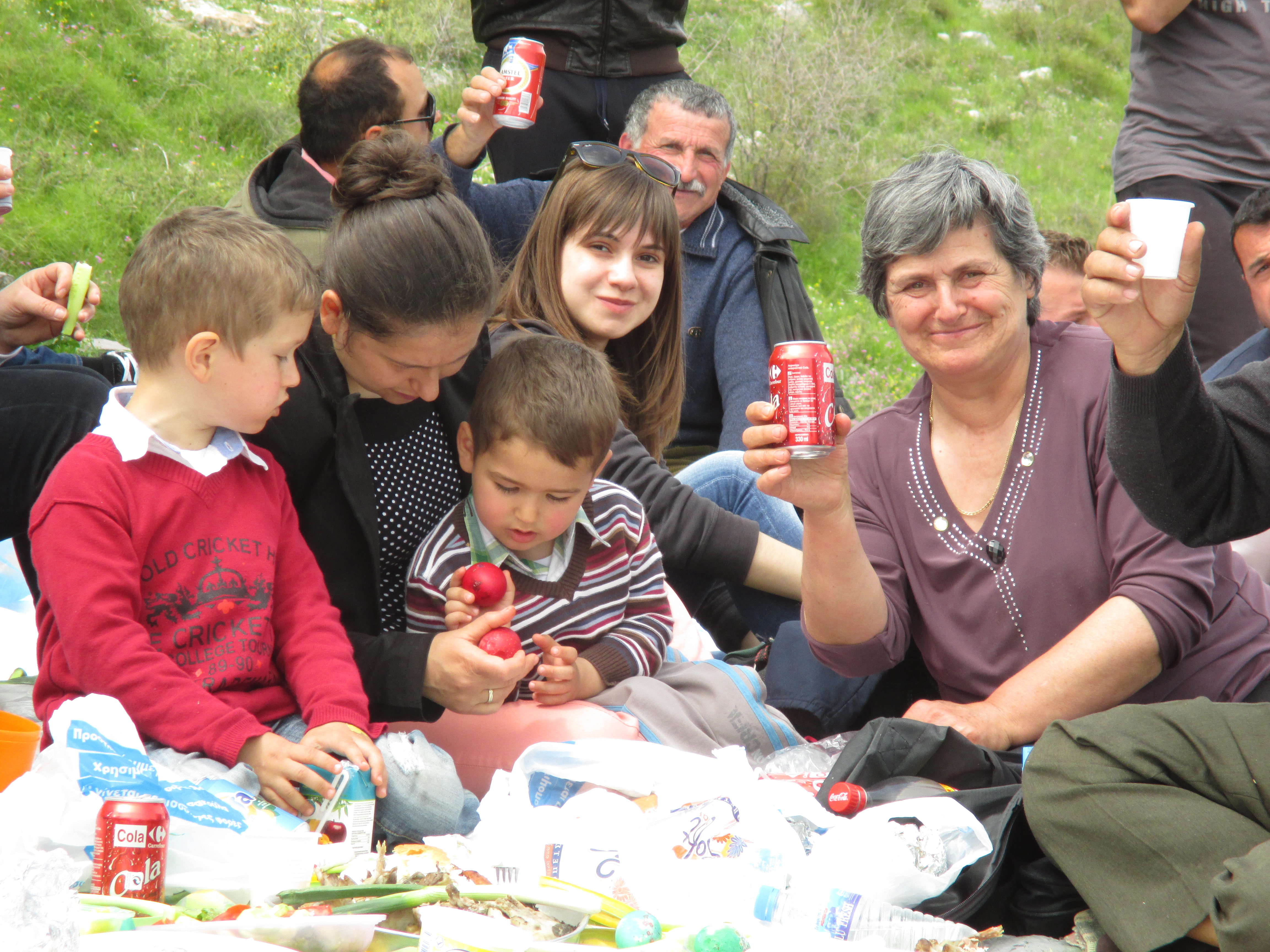
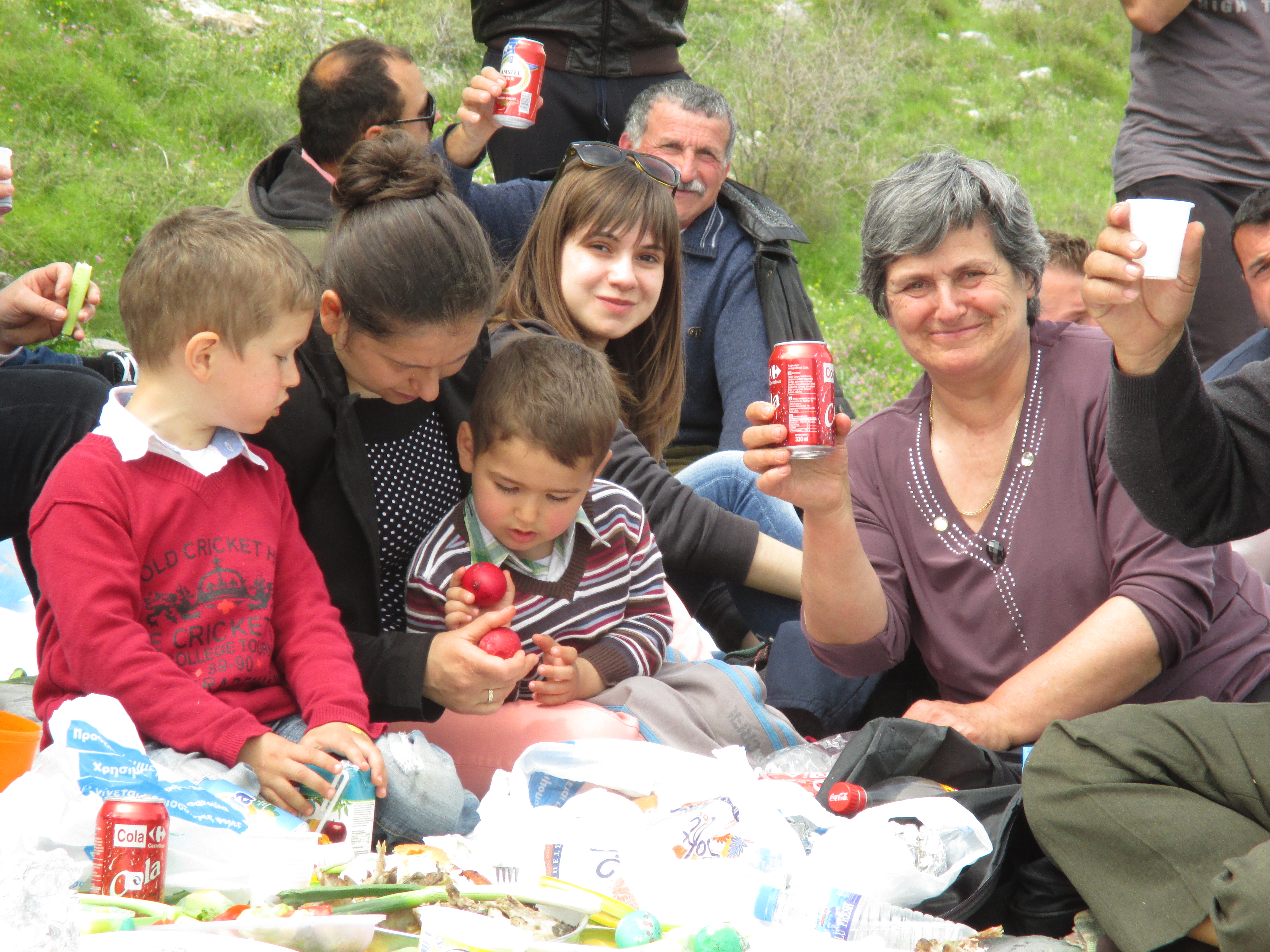
Probably the saddest of all the stories I got bombarded with while in Derviçani this time was one told to me by my cousin Chrysanthe, shown here in this picture with the Coke can (below) with her daughter Amalia and her two grandsons, cracking Easter eggs at the Monastery above the village on Easter Monday where the dancing takes place.  (See Easter in Derviçani” — the stunning young girl behind them is my niece Marina — click)  

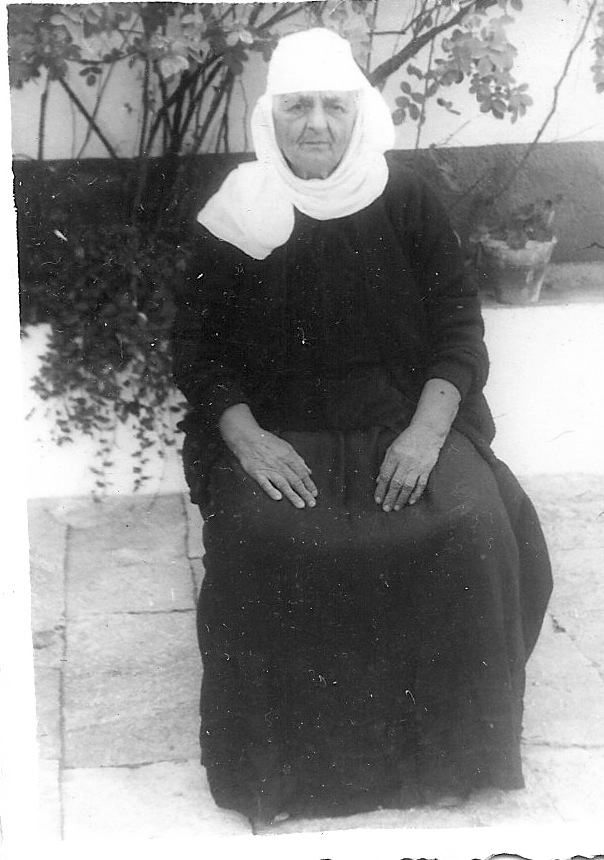
Augaimg_0102As our house was pretty much just off the village’s main square, most of the afternoons my grandmother could be found sitting on the stone bench in front of the house watching people. Try to imagine her about forty years after the above photo was taken, but not quite as old yet as this last one we have of her. (click)

giagoula

Spiti DervitsianiOur house today (click).  Built by my grandfather with blood and sweat shed in the slaughterhouses of Buenos Aires.  The village collective confiscated it and allowed my grandmother to live in only one room, keeping hay and seed and agricultural implements in the other three odas.  It’s lain abandoned since her death.  But someone always burns a cross on the top of the doorway at Easter.  This year I got to do it myself.

My grandfather dead in some prison camp in central Albania, my father, the only child, in America, letters getting through the censors only every so often, she was lonely, despite the hordes of family she had to take care of her. People say she would beg to hold any baby that someone brought by: “I just want a baby to wet me,” she would say, “and let it be someone else’s.”

But around Easter my cousin Chrysanthe says: “She would tell us quietly to come inside, and she would open up a little sentouki [chest] she had with a pile of bright red Easter eggs inside.” This was in the mid-sixties, when Albania, recently aligned with a China in the midst of its brilliant Cultural Revolution, had prohibited any form of religion whatsoever and dyeing Easter eggs could land you in jail, even the parents of the child, in this case, if they knew and hadn’t reported it. “And I would say, ‘oooooyyyyyy Kako [auntie]*, can I take one?’ and she’d say, ‘No canım, we’re just going to keep them here and you’ll come and we’ll look at them and we’ll play with them and have fun and then we’ll put them back in the sentouki and you won’t tell anyone, ok?’”

This is what those systems wasted their energies on, in case you’re wondering how it is that they collapsed like a house of cards from one day to the next after destroying the lives of millions: forcing old women to dye eggs in secret. No one ever knew where she got the dye from or how she even got so many eggs together at one time. She probably denied herself the product of the chickens she was allowed to keep to have enough eggs for Easter. Soon after, they prohibited private poultry and confiscated bostania too (kitchen gardens), even if they were part of your house’s immediate property, and all food items had to be gotten from the village collective, but I think some local Party member with half a soul let her and a few other old people keep theirs.

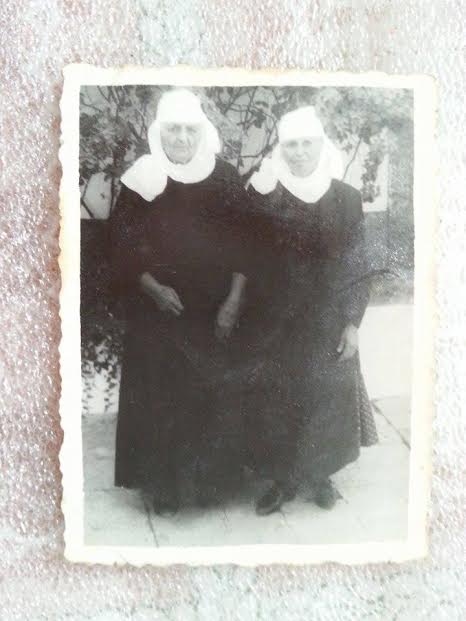
There’s a partly satisfying coda to this story though. Below is my grandmother, Martha (Mantho) with her favorite sister Alexandra (Leço).

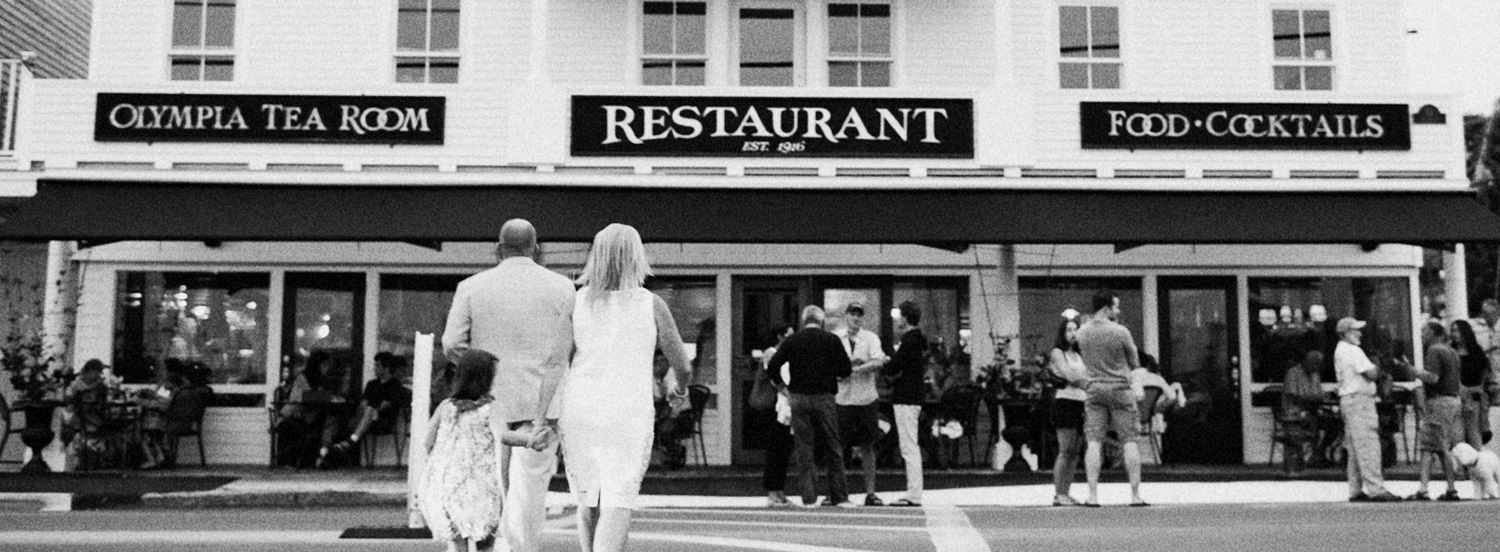
ManthaLechoTheir maiden name was Çames — and you can deduce for yourself what it might mean that Çam is also one of the major tribal sub-groups of southern Albanians, the ones who lived in what’s now Greek Epiros and who were violently driven out by Greek nationalist forces during WWII for supposedly collaborating with the Germans. Their father, my great-grandfather GianneÇames** came to the United States in 1895 and opened a fruit store in Mystic, Connecticut (the willingness of these men to just up and go off to places that must have been to them the equivalent of Zambia to us has always astounded me). A few years later, he brought three of his sons over, my grandmother’s brothers, and during the summers he used to send them down to Watch Hill, Rhode Island, a very understated, high-WASP resort on the far western shore of the state, to sell popcorn and cotton candy on the beach. But from these modest beginnings they eventually opened the Olympia Tea Room in 1916, which is still there and was quite the poshest place to eat in town for decades — and has suddenly become re-hip again. For better or worse, you know I’ve taken you seriously as a friend when I’ve dragged you down to Watch Hill to make you pay homage, as if it were my village; for my father, cut off from his own for most of his life, it was.  So the Çamedes ended up being people of some consequence in Derviçani; to have been given a Massios daughter as a bride, my great-grandmother Kostando (those who know will know what I mean), you have to have been, and their house was not just a prosperous one, but one always open to all, the “peliauri” – courtyard – where my father grew up, always swarming with women and children and guests and the whole mahalla coming in and out all day.

OlympiafrontThe Olympia Tea Room, “est. 1916,” Watch Hill, Rhode Island and general view of the town’s harbor below (click on both — I don’t know who took this Olympia photo but it’s great — thank you).

Watch_Hill_HarborYet my great-grandfather Gianne married off his two favorite daughters to two men without much wealth or property, my grandfather NikoBakos and my great-uncle MihoBarutas (Michales). And I think it was on their sheer reputation as outspoken men to be respected and feared – and in our parts, even today, you still have to be both – or, as men period, that he did so; my grandfather was tall and handsome but not to be messed with – “his word was law through all the villages of Dropoli” – I was told on this trip,*** and the Barutaioi are proverbially unafraid of anyone or anything.  Ex-Ottomans will know that the name itself means “gunpowder,” and that’s all you need to know.

KakoLechoLaloMihoBarutasMy great-aunt, Kako Leço (above) and my great-uncle Lalo Miho Barutas.  I wish we had a picture of them younger but no one can seem to locate one. (click)

Family(My grandparents and my father in what I suppose must have been around 1931 or ’32.  If you look carefully you can see that the photo is a Photoshop job of its day; my grandfather was photographed in Buenos Aires and the photograph later attached in Albania; it’s always been a metaphor of an inheritance of absent fathers for me.  My grandfather was known as Djoumerka, a high mountain range in southern Epiros because he was so tall (but see more on that below).  My grandmother’s outfit in this picture — all made possible by rich WASPs in Watch Hill, Rhode Island, early globalisation — was described to me once by a woman, my Theia Vantho, whose memory I would never dare to doubt: the vest and sash were a maroon-purplish velvet embroidered with gold thread, which would have looked most like this kind of work, but with a deepr, more puplish hue:

Screen Shot 2015-08-07 at 6.57.57 PM

(click)

The apron, green silk with heavy multi-coloured embroidery, the outer, mid-hip length vest, what was known as the “şita,” barely visible at the sides and mostly decorated to be seen from behind, was white woolen felt, trimmed in red and black.  The medallions embroidered on either side of the vest were not traditional and generally it was seen at the time as hubristically opulent, so much so that the kind of mean tongues that flourish in small communities like this attributed the misfortunes of her later life to her excessive pride as a young woman. Click, double if you wanna see the details.)

Of course these are not qualities that get you far in a totalitarian regime like Hoxha’s Albania, except blacklisted, sent to jail or into internal exile or killed. And that’s what happened to them. Both branches of the family and by association the whole network of related clans suffered greatly during communist rule and yet held together. The Çames gene is a strong one, and anyone who is from a big family knows how certain emotional “affinities” – in this case the love between the two sisters – end up being transmitted down specific threads through generational lines: my Kako Leço’s son, Vangeli, a first cousin of my father’s who my father barely knew, is my favorite uncle in the village: the Baruta patriarch now, he’s also a man to be respected and feared, who started from less than zero when the communist regime fell apart and is now a highly successful entrepreneur with a business that reaches Albania-wide markets. His daughters — especially one in Tirane, Calliope (she’s shown in the passing of the Light photo in “Easter in Derviçani,“) — are my favorite cousins, and one of Calliope’s sons, also Vangeli, named after his grandfather, and destined to be an equally formidable personality, is my favorite nephew.

My Uncle Vangeli spoke his mind as much as one could all during communist times and how he escaped harsher punishment during those decades is a miracle of sorts. But underneath the fear of the Party, older fears and structures of respect were still operating, I think, and that’s what saved them. One of the village informers, the usual squirrels in those systems who will tell on others for an extra ration of food — what in the Soviet Union was known as a stukach in Russian, a “knocker,” i.e., someone who comes and knocks at night to tell his superiors the information they want to know, or a sapo, a toad, in Latin America, another continent blessed with the necessary abundance of totalitarian experiences to develop such terminologies – had the misfortune of living next door to my uncle, and he would try to threaten them occasionally, but my uncle was unafraid of even getting into fistfights with him when necessary, so nothing ever came of it.

And back to Easter eggs. By ’88 or ’89 things had started, like all over Eastern Europe, not so much to relax, but to show such obvious signs of cracking apart that, as my relatives put it, “the fear started lifting.”  The Barutaioi started dyeing their own eggs during Holy Week, though there was still no functioning church or any open observation or acknowledgment of the holiday.  But on Easter night, after the Resurrection, when they had cracked and eaten their eggs, they would take the shells and throw them over the wall into the Party snitch’s front courtyard…  Forget empty tombs and angels in white and “Τι ζητείτε;”****  How’s that for some “good news” on Easter morning? And being a Jungian believer that no symbolism is accidental, I can see the cracked red shells in my mind, like splatters of the blood this guy had on his hands — though this is a person obviously too much of a hayvani to have been affected much I imagine. For to be a Christian in a village like Derviçani, and have people throw Easter egg shells at you on Easter Sunday, and not immediately find a bridge to jump off of, or a quiet corner to blow your brains out, you have to have a fairly huge hole where your conscience or any sense of shame should be. He’s still around. They’re still neighbors. And my Uncle Vangeli smiles and greets him courteously on the evening passegiata in the village square.

And my grandmother’s hidden eggs have been vindicated.

IMG_0069

*************************************************************************************************************************************************************************************************************

*”Kako”– aunt, and “Lalo” — uncle, are two of some of the Albanian words we use in our villages, though most people today just say “theia” or “theio” in Greek.  I’m the only one who still says Kako and Lalo and they all get a big kick out of it.  Ismail Kadare has a hilarious character named Kako Pino in his book about his native Gjirokaster, Chronicle in Stoneso I don’t know if it’s maybe a local usage only, or only a Tosk word (the southern ethnic/linguistic division of Albanians) because my nephew Vangeli in Tirane uses the Turkish “teyze” when he talks to his aunts.

** This is how we say (or again, said…) our names in the region: the first name, undeclined, attached as a prefix to the family name.  This is probably a left over from the day when there were no family names and only Muslim-type patronymics were used: your name and your father’s attached after.  So instead of “NikoBakos” I would have been “NikoFotos.”  Thus the oldest historical ancestor in my mother’s family, the Giotopoulos, was GioteStauros — his father Stauros is almost a sort of mythical character lost in time — and after GioteStauros, the family started calling themselves Giotopoulos, “son of Giotes.”  Women in this heavily gendered world were never known by their first names outside their immediate households, but by their husband’s name with a female suffix attached; thus my grandmother was “NikoBakaina” or even the more Slavic “NikoBakova.”

***My grandfather, it’s turned out, was quite the guy.  Absolutely fearless in a way hard for us to comprehend, he was a kind of village rowdy as a kid (the guys of Derviçani are known as such even today and their arrival in the cafés of neighboring villages in the evenings is said to be slightly unwelcome because it often means trouble; apparently they drink a hefty amount so they spend a lot of money and that’s good, but the local girls like them and that combination doesn’t always end well.)  And he would even engage in some occasional sheep rustling with a buddy of his — not for the material gain, but because it was a kind of male rite of passage in the region, as it was till recently in parts of Crete (see Michael Herzfeld’s The Poetics of Manhood: Contest and Identity in a Cretan Mountain Village” — below; let’s not mistake this with resistance to Ottoman or Muslim hegemony, as people love to do with the banditry traditions of the Balkans; it was pure thievery).  But if there were some lira to be made in the process, that was no problem either.  His nickname Djumerka, may not have come from just how tall he was, but from the fact that under the hire of a certian Ismail Ağa from Argyrocastro (Gjirokaster), he and a buddy of his (this buddy’s grandson remembered the ağa‘s name) went down to the Djumerka mountains when they were teens and stole the flocks of another rich Turk, an enemy of Ismail’s, from those parts and brought them back to Gjirokaster for him.  Given the chaos of late Ottoman times in the Balkans, this is not entirely the superhuman feat we may imagine it to be, not in terms of law enforcement at least, but we’re talking a great distance of extremely rough, high terrain and it was impressive enough to have entered the village’s legend canon.  Then he up and went to Buenos Aires in his early twenties and worked in the slaughterhouses there; Argentina is on my list of “to go” places partly or mainly because of that; I would give anything to find out even the tiniest detail of what his life there was like.  And then when he came back, with no more than an elementary school education, I think, and his pure charisma, he was important among the leaders of the the delegation from the Greek-speaking villages of Dropoli to the King, Zog, in Tirane, to protest the closing of their Greek-language schools.  The campaign was successful.  Elementary school education in Greek resumed and he soon after went to jail for the first of many times.

In the late 1950’s is when he went to jail for good and never came out and all we know is that he was buried in a mass grave somewhere in central Albania.  People in the village talk a lot about who snitched under custody on those occasions; neighbors and relatives were often taken together, so everyone would eventually find out.  If you could live with yourself afterwards, you could give false testimony about someone else and get off easier or be released or maybe just get the beatings to stop.  I turned it into a ritual questioning this time when I was there, of anyone I could, because I had to know: “Lalo, my grandfather never gave false witness against anybody to save his hide, did he? No.  Lalo, my grandfather never…? No.  Lalo…? No.”  When I got the third “No” from my Uncle Vangeli this time I was satisfied.

This is all hard stuff to live up to.  When they’re thrilled to have NikoBako come to Derviçani, I’m actually ashamed, because they really see him.  I’m just a cipher — a proud one, yes, but just a representative of someone I could never be.  Half of the time, with all my family on both sides, I’m living off of credit from my mother’s kindnesss and generosity and half the time off of my grandfather’s toughness and bravery and my father’s stoic bearing of the torch.  If you think it’s great to come from this kind of stock and have these kinds of tales to tell, think again.

**** “Τι ζητείται τον ζώντα μετά των νεκρών;  Τι θρηνείτε τον άφθαρτον ως εν φθορά;” — “Why do you seek the Living among the dead? Why do you lament the Incorruptible amidst the rot?” the angel asks the women who come to the grave on the day of the Resurrection, is my favorite verse of the Easter Canon.

Note: For those of you who made it this far with me on this post, thank you.  I hope it wasn’t boring or embarrassingly personal.  I thought a lot about whether I would ever get so deep into this stuff on this blog and decided to just go ahead.

Addendum: For the person who asked how my father can have been an only child and I can have all these hundreds of aunts and uncles and cousins and nieces and nephews, that’s because in Greek every indirect relative of an older generation is my aunt or uncle (even if he’s not my parent’s sibling but third or fourth cousin), and anyone of my generation laterally is a cousin and any children of those cousins, who may be third or fourth or fifth cousins, who are of a younger cohort, are my nieces and nephews.  My father was an only child; but my grandmother one of eight.  So out of those eight branches come this plethora of kin.

Herzfeld713qtIkpdbL

Comment: nikobakos@gmail.com

Easter in Derviçani

25 Apr

Dropoli

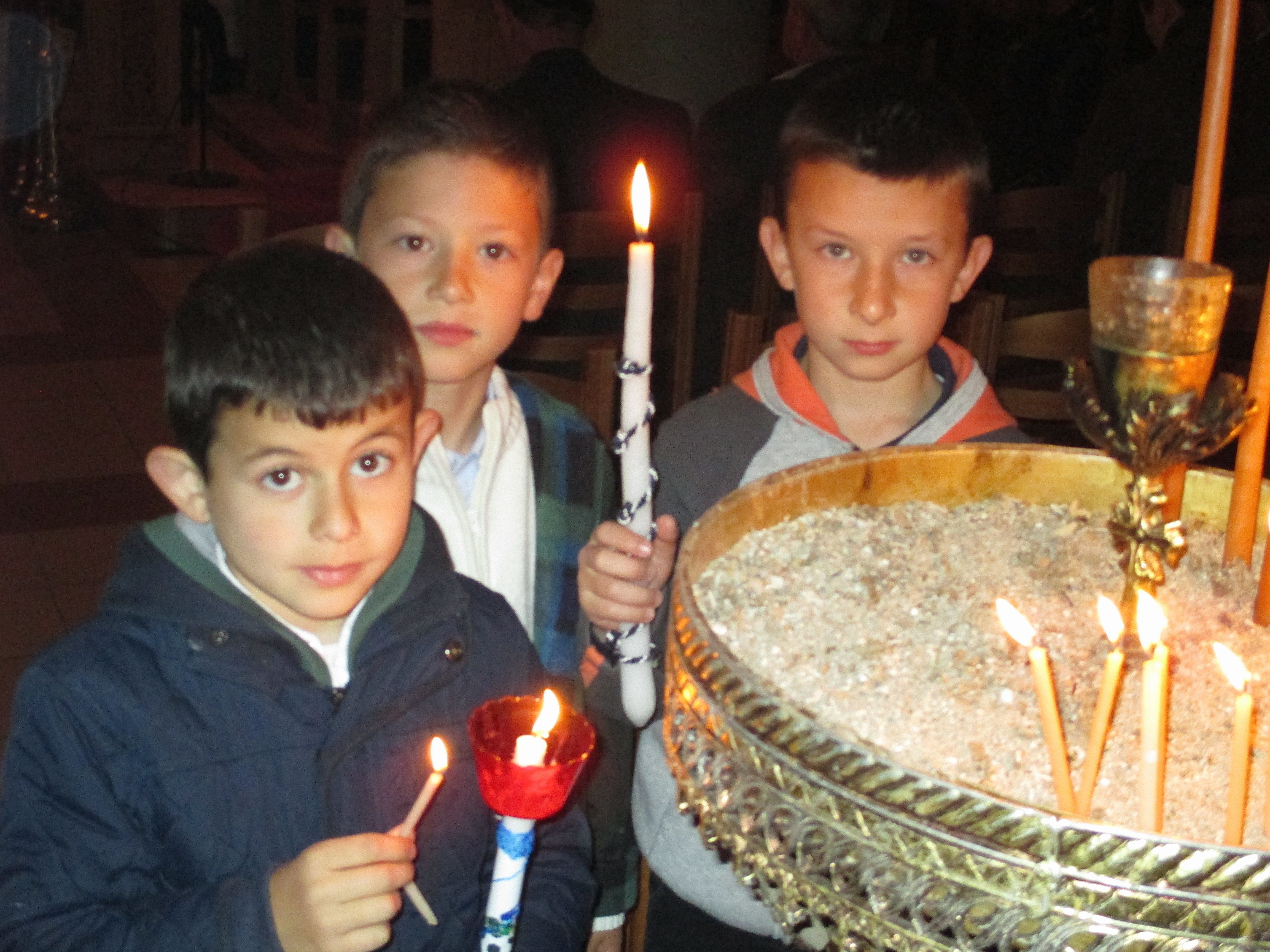
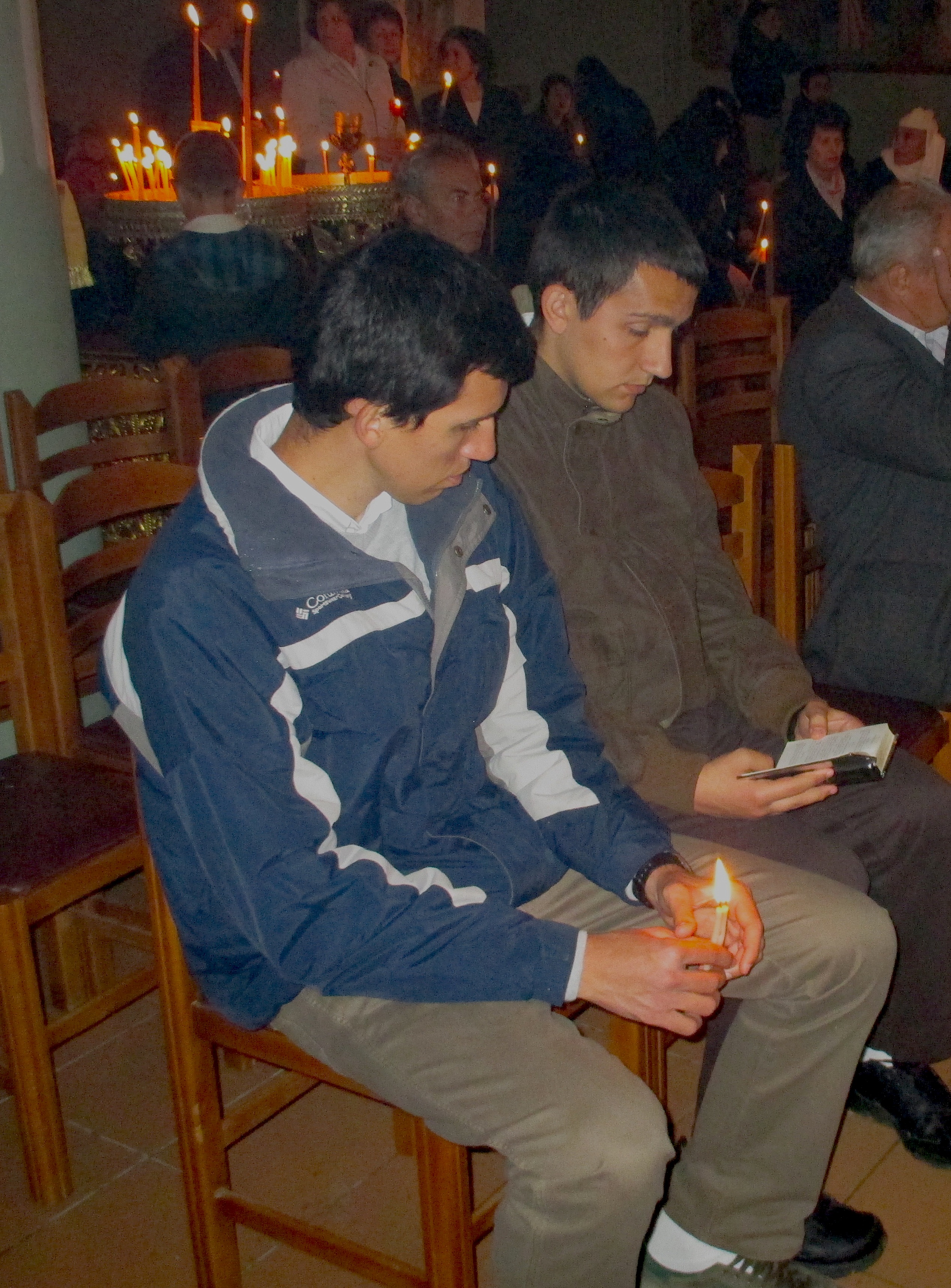
Easter in my fa… — in my — village has left behind such a mountain of tangled emotions and thoughts and joy and sadness that it’ll take me weeks, months…maybe never, to sort it all out and write anything coherent about it.  Almost feel like I don’t want to.  But here are some teaser pics in the meantime. (double-click on all)

IMG_0029 IMG_0058

IMG_0048

IMG_0094

IMG_0102

IMG_0129

IMG_0162

IMG_0146IMG_0125

IMG_0131

IMG_0149

IMG_0207

A Resurrection Song: “Orphan Girl” – Gillian Welch

20 Apr


http://www.youtube.com/watch?v=9qZOOb02u-4


I am an orphan on God’s highway
But I’ll share my troubles if you go my way

I have no mother, no father
No sister, no brother
I am an orphan girl

I have had friendships pure and golden
The ties of kinship have not known them

I know no mother, no father
No sister, no brother
I am an orphan girl

But when He calls me I will be able
To meet my family at God’s table

I’ll meet my mother, my father
My brother, oh my little, oh my big brother
No more an orphan girl

Blessed Savior make me willing
Walk beside me until I’m with them

Be my mother, my father
My sister, my brother
I am an orphan girl
I am an orphan girl


Christos Aneste

Σήμερον κρεμάται επί ξύλου…

17 Apr

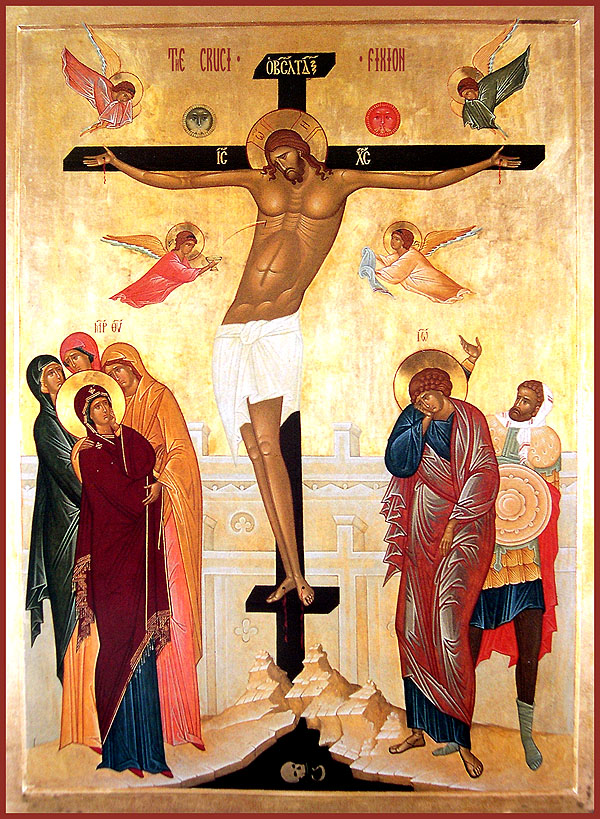
crucifixion2

(click)

“Today hangs suspended from a piece of wood, the One who suspended the earth amidst the waters…” begins the main hymn of tonight’s service in the Orthodox Church.  It’s matins for Good Friday, sung the night before; it corresponds to the Oficio de Tinieblas in the Catholic Church, or the Via Crucis, or Stations of the Cross.  Except it’s not the forty-five minutes Cliff notes version.  It’s a four — with Russians, five plus — hour, perfectly paced and structured, oratorio that uses twelve gospel selections (it’s colloquially known as the “Twelve Gospels” among both Greeks and Russians and I imagine other Orthodox peoples), and a surfeit of beautiful and psychologically astute poetry and music to tell the story of the Last Supper, and Christ’s arrest, judgement, crucifixion, death and burial.  It’s my favorite Holy Week service.  Because it’s a masterpiece.  It doesn’t draw any of its power from made-up, sadistic Mel Gibson details that aren’t even in the gospels: like how many times Christ fell, or where they whipped Him, or where and when they spat on Him, or where He scraped his knees, or any of the bloody kitsch and sensationalism and fabricated detail so physical that it’s disrespectful and that the Catholic Church allows and encourages; one speaks of the body of Christ with a certain laconic awe I would think, no matter what it was put through.  Its power comes from the perfection of its theater and its theology and — if anything — from the spareness of the story it tells.

Background to this post…  For years, whenever I heard that relatives or friends from Greece, especially under a certain age and especially from Athens, were coming to New York to visit for Easter, my guts would get twisted up in knots of anxiety in anticipation because I just could not endure having them around at that time of year.  Anticipation of what?  Well, there came a time, for me a crucial turning point in post-1974 Neo-Greek culture — it was around the early-eighties — when Greeks started asking each other: “Where are you going for Easter?”  And I couldn’t imagine what I would answer if asked.  Where am I going for Easter?  I dunno…  I’m going to be home.  I’m going to my village.  It’s Easter.  Where should I be going?  This is because there came a point, when, for the demographic I’m talking about, Holy Week and Easter had become the equivalent of Spring Break, some free days to go off on a vacation somewhere.

So I could anticipate their attitude.  I knew they wouldn’t appreciate the subtle shift in the pace of life that occurs in a Greek neighborhood like Astoria when Palm Sunday dawns.  The sobriety mixed with the rush of preparation and excitement.  I would anticipate instead the surprise, at best, but mostly the grinning condescension, with which they’d react to how seriously diaspora Greeks still took this time of the year, how backwards and un-hip and un-Euro it was of us.  I’d know they’d want to go out to a cool baraki on Good Friday night.  I’d know they’d ask to be taken shopping on Holy Saturday, in the middle of the cooking and cleaning: there were some shoes they had seen on sale at Macy’s.  I had two Turkish roommates for a while once: totally secular, modern Istanbullu girls; they just didn’t eat pork.  And out of respect, or just to prevent possible squeamishness on their part — they had never even said anything to me — I would keep salami and pancetta and other pork products in the basement refrigerator that they never used.  On the other hand, I once had to have a screeching match with a Athenian guest about not having meat in the house on Good Friday — I ended up feeling like a friggin’ Talib — because she needed her protein and fasting reminded her of how oppressive her mother was during her childhood.  Just a couple of years ago, a cousin saw me go off to the first Nymphio on Palm Sunday evening and said to me: “You mean…like…you’re going to go be going to church…like…every night this week?  In Greece nobody goes.  That’s something left over in the diaspora…” she had the archidia to say to me.  It was never something they had lost; it was always something “left over” among us.  I said nothing.  But, as you can imagine — as opposed to the sentiment of “Next year in Jerusalem” — the idea of being stuck in Greece for Easter had always been my nightmare.  I only came this year because it was going to be one of the rare years professionally when I could go to my father’s village in Albania for what I knew would be a traditional Easter that wouldn’t infuriate me.

And instead I’ve been amazingly and pleasantly surprised.  I don’t know what Greece it is that this cousin of mine lives in where nobody goes to church, but all through Lent and especially this week, every church I’ve been in has been packed.  Tonight was the most moving “Twelve Gospels” I’ve ever attended.  The massive (as massive as a pre-Tanzimat church could be) eighteenth-century, stone cathedral of Jiannena was filled to the rafters — literally; it has a two-floor gallery where the women used to traditionally stand and even both of them were full.  The cantors were perfect.  The procession of the Cross immaculately pulled off.  I felt like Vladimir’s envoys in Hagia Sophia.

But what most moved me most was the breadth of age and sex of the crowd.  If anything, there were even more young people than there would be in New York — young guys, parea — following the text from the little black book carefully, people with that relaxed reverence that the best Greek — knowing how to be respectful, but comfortable in his father’s house — displays when in church.  Almost everyone stayed to the very end.  I really felt in my heart and gut what Yosef Eliya felt in his Purim poem when he writes: “Tonight the synagogues open their arms wide to the faithful children of my ancient people…”

Tomorrow it’s off to Albania.

Kale Anastase and Happy Easter…my ancient people.

Comment: nikobakos@gmail.com

Tonight…

13 Apr

bridegroom-01

…the Bridegroom’s come, the barren fig tree cursed, the annoying Pharisees silenced.  And so begins the voyage to the “great feast of the Greeks”: our Eleusinian Mysteries, our Hajj, our Bayreuth; our Chaucer; our Shakespeare; our Mozart, our Beethoven and Wagner.  A seven-night and seven-day oratorio; the central narrative of Roman civilization.  “Come and see” if you can.

A reader writes: “Tishabuv?”

24 Sep

(Sorry…only now getting a chance to respond to some of these)

The Arch of Titus in Rome, built to commemorate the Roman suppression of the first Jewish revolt in 70 A.D. (click)

In reference to Jadde posts: “Romney in Israel: How High To Jump?“and “Tisha B’av?,”  “Jewish London” writes: 

“it seems appropriate that he should visit on Tisha B’Av, a day when great calamities befell the Jewish people”

Oooooofffff…  This is like teaching…when you’ve spent hours researching and preparing, and then another half hour conducting, a brilliantly detailed and structured, thrillingly executed lesson on participial phrases, only to have one student, while you’re catching your breath right after, ask a question that proves none of the class has understood shit the entire time you were lecturing.

My point was simply that there’s a genre of Ashkenazi jokes, among the many, based on “When is Tishabuv?”  Beinart’s point, “Mitt Romney Misuses Judaism…” is that in the long tradition of Rabbinic and Talmudic learning, Tishabuv has been a time to reflect on why a certain tragedy has struck Jews and not just commemorate that tragedy in a victimized and ad nauseum form.

Yes, brother, “terrible calamities befell the Jewish people” on Tishabuv.  The Second Temple, the One and Only House of God in the One and Only Holy City, was levelled.  Jews were slaughtered in unbelievable numbers.  In trying to figure out whether these events happened as part of the Roman response to the Jewish rebellion of 70 A.D. or that of 135 A.D. — which has never been clear to me — I learned that there’s a trend of Jewish mystical thought that fascinatingly believes all Jewish tragedies occurred, occur and will occur on Tishabuv: the selling of Joseph into slavery; Moses’ shattering of the first tablets at seeing the Jews revert to idolatry; the destruction of the First Temple and the Babylonian captivity; the destruction of the Second Temple; the first massacre of European Jews at the beginning of the Crusades; the issuing of the Edict of Expulsion from Spain in 1492; the day the first train left for Auschwitz – all become mystically assimilated into Tishabuv.  That’s a tragic and moving idea.  However, I do know that the Roman suppression of the revolt of 135 A.D. was so brutal in its massacre and expulsion of Jews that it’s easy to say that it officially marks the beginning of the Jewish Diaspora.

Tishabuv is also intimately related to Jewish messianic thought.  The revolts themselves were partly inspired by messianic expectations.  And the crushing of those hopes by the greatest cluster of disasters to befall Jews before the Holocaust made Rabbinic thought retreat into the sharpest of all cautions against any such expectations.  This, I suspect, is what marked the final rupture between Christian Jews and the rest of Jewry.  It’s not that Jews didn’t succumb to the temptation again.  Kabbalism is a mystic desire to correct the world that is a barely concealed messianic impulse.  And there was the great fever of messianic ecstasy that swept the Jewish world in the seventeenth century, when Sabbatai Zevi, a rabbi from Smyrna, started declaring himself the Messiah – one of the most fascinating and, in the end, sadly absurdist, episodes in Jewish history.  Zevi, either a con artist or a psychotic, had raised Jewish expectations to such a frenzied pitch, that when he ended up converting to Islam and becoming a ward of the Sultan, it sent shockwaves of psychological distress, not only through Ottoman Jewry, but throughout the entire Jewish world; in fact, due to renewed persecution and massacres at the time in Eastern Europe, the effects on Ashkenazi Jewry may have been even greater than on Sephardim.  The crisis sent the Eastern European Jewish universe careening into two different directions: on the one hand a trend that reemphasized Rabbinical textualism and that eventually responded to the Jewish Enlightenment, the Haskalah, the movement out of Germany that attempted to bring European Jewry into the modern world; and on the other, a retreat into the most introverted mysticism, out of which Hasidism, and an even greater immersion in Kabbalistic thought, grew.  To some extent, this split is one that old New York Jews still codedly refer to, whether they know it or not, as “Litvaks” and “Galizianers” (explanation in subsequent post).  See Michal Waszynski’s 1937 film version of S. Ansky’s Dybbuk.  I think there’s no greater primary text of Jewish spiritual impulses and its conflicts.

Lili Liana as Lea, the bride who becomes possessed by the spirit of her wronged beloved on her wedding day to another man, in Waszynski’s 1937 Yiddish film, the Dybbuk. (click)

(Two interesting notes that I’d like to make here.  One is that the Jewish revolts of the early first millennium were partially led by political groups whom we, today, wouldn’t hesitate to compare to, not only the first New England Puritans, but even the Taliban, and who engaged in certain tactics, like the surprise slaughter of masses of innocent civilians that we like to associate with Palestinian “terrorism” – or that of…errrr….Irgun, Haganah, the Stern Gang, Mssrs. Ben Gurion and Begin and all the rest.  The other is that maybe the real basis of Tishabuv jokes is still unconsciously based in messianic expectations, the way older Greek women who, say, have missed a bus, will mumble: “Oy, now we’ll be waiting till the Second Coming.”)

But if “Jewish London” is to understand my point, he needs to better understand the transformation that Tishabuv has undergone in Israel since its founding, because I suspect that, not living among the most vibrant Diaspora communities in the world, Israel is his model.  Obviously, Zionism didn’t need to worry about the Messiah, since it had solved the “Jewish Question,” as must be obvious to anyone who throws even a cursory glance at the Middle East today and sees the peace and happiness in which Jews there live can attest to, and no Messiahs need apply anymore.  Tishabuv had been forgotten by the Jewish Diaspora, reduced to such an obscure holiday that it was the object of humour; I’ve lived most of my life in a city, and worked for a great part of it in an environment, where, believe me, it was impossible to not know that a great, or even just important, Jewish feast was being celebrated or was coming up, and Tishabuv wasn’t one of them.  In Israel, however, the “secular” Jewish state raised Tishabuv to new, official status as a holiday-fast day.  But not as a day of introspection; but as a day to remember, as “Jewish London” puts it, “a day when great calamities befell the Jewish people.”  This is because “calamities” are Israel’s justification for being; it was Israel’s down-payment and it’s still how it pays its mortgage; it’s the currency in which it trades.  And the ignorant Romney’s visit to the Western Wall with Netanyahu or whoever on that day, was just another slimy exchange in that same currency — and, in fact, a dishonour to centuries of Jewish suffering.

But back to the Diaspora, and a time when Judaism hadn’t locked itself into a barricaded nation-state.  More than just self-reflection and introspection, the repeated, century-after-century dashing of Jewish hopes may have generated an even more important element in the Jewish psyche: doubt.  The great Christopher Hitchens, quotes the equally great Rebecca West in his introduction of her book, Black Lamb and Grey Falcon, and her own ruminations about the origins of anti-Semitism:

“West reflects on the virus of anti-Semitism, shrewdly locating one of its causes in the fact that ‘many primitive peoples must receive their first intimation of the toxic quality of thought from Jews.  They knew only the fortifying idea of religion; they see in Jews the effect of the tormenting and disintegrating ideas of skepticism.’”

That’s why on Easter night, the night of the Resurrection, I always remember to have one, only one, glass of wine that’s offered to the suspicion – the same one born out of the fact that Elijah never actually walks through that open door at Passover — that this whole idea is bullshit.

So what is Tishabuv for (when we know when it is)?  Introspection, moral responsibility, skepticism, doubt and the saving beauty of being eternally able to convert suffering into humour and irony – these last may be the most important — a pretty whole summation of what Jews have given us, given me, at least.

When “Jewish London” can tell me what Israel has given us, he should let us know.  These Days of Awe might be the perfect time to think about that.


Comment: nikobakos@gmail.com

“Deute labete fws…”

5 May

Come and receive the light…  Easter at my house.


Comment: nikobakos@gmail.com

Chrestos Aneste — Hristos Voskrese — Happy Easter

15 Apr

Il est l’affection et le présent, puisqu’il a fait la maison ouverte à l’hiver écumeux et à la rumeur de l’été, – lui qui a purifié les boissons et les aliments – lui qui est le charme des lieux fuyants et le délice surhumain des stations. Il est l’affection et l’avenir, la force et l’amour que nous, debout dans les rages et les ennuis, nous voyons passer dans le ciel de tempête et les drapeaux d’extase.

Il est l’amour, mesure parfaite et réinventée, raison merveilleuse et imprévue, et l’éternité : machine aimée des qualités fatales. Nous avons tous eu l’épouvante de sa concession et de la nôtre : ô jouissance de notre santé, élan de nos facultés, affection égoïste et passion pour lui, lui qui nous aime pour sa vie infinie…

Et nous nous le rappelons, et il voyage… Et si l’Adoration s’en va, sonne, sa promesse sonne : “Arrière ces superstitions, ces anciens corps, ces ménages et ces âges. C’est cette époque-ci qui a sombré !”

Il ne s’en ira pas, il ne redescendra pas d’un ciel, il n’accomplira pas la rédemption des colères de femmes et des gaîtés des hommes et de tout ce péché : car c’est fait, lui étant, et étant aimé.

O ses souffles, ses têtes, ses courses ; la terrible célérité de la perfection des formes et de l’action.

O fécondité de l’esprit et immensité de l’univers.

Son corps ! Le dégagement rêvé, le brisement de la grâce croisée de violence nouvelle !

Sa vue, sa vue ! tous les agenouillages anciens et les peines relevés à sa suite.

Son jour ! l’abolition de toutes souffrances sonores et mouvantes dans la musique plus intense…

O monde ! et le chant clair des malheurs nouveaux !

— Arthur Rimbaud

He is affection and the present because he has made the house which is open to the frothy winter and to the murmur of summer, he who has purified drink and food, he who is the charm of fugitive places and the superhuman delight of halts. He is the affection and the future, the strength and the love which we, standing in rage and boredom, see passing in the stormy sky among banners of ectasy.

He is love, the measure perfect and reinvented, marvellous and unexpected reason, and eternity: beloved machine of the fatal powers. We have all known the terror of his yielding and of our own: O delight in our health, impetus of our faculties, selfish affection and passion for him, him who loves us for his eternal life…

And we call him back to us and he travels on… And if Adoration goes away, ring, his promise rings: “Away with these superstitions, these old bodies, these couples and these ages. It is this epoch that has sunk!”

He will not go away, he will not descend from any heaven again, he will not achieve the redemption of women’s anger and men’s gaieties and all that sin: because it is done, because he exists and is loved.

O his breaths, his heads, his runnings; the terrible swiftness of the perfection of forms and of action.

O fruitfulness of the mind and immensity of the universe.

His body! The dreamed-of redemption, the shattering of grace meeting with new violence!

The sight of him, the sight of him! all the old kneelings and pains lifted at his passing.

His light! the abolition of all audible and moving suffering in more intense music…

O world! and the clear song of new misfortunes!

— Arthur Rimbaud


Comment: nikobakos@gmail.com

Chitterlings…and mageiritsa

12 Apr

What are chitterlings, or chitterlins, or chit’lins?  They’re pig intestines, which people eat all over the world wherever they eat pigs.  (Where they don’t, they eat lamb intestines.)  Unfortunately, in the United States, the only people with the sensory refinement to appreciate them are African-Americans.  (And yes, girlfriend, the casing on that $25 a pound artisanal Calabrian soppressata you get at Whole Foods…pig gut.)

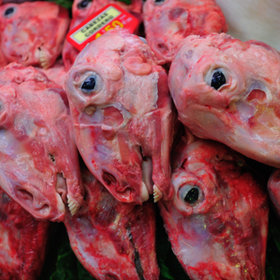
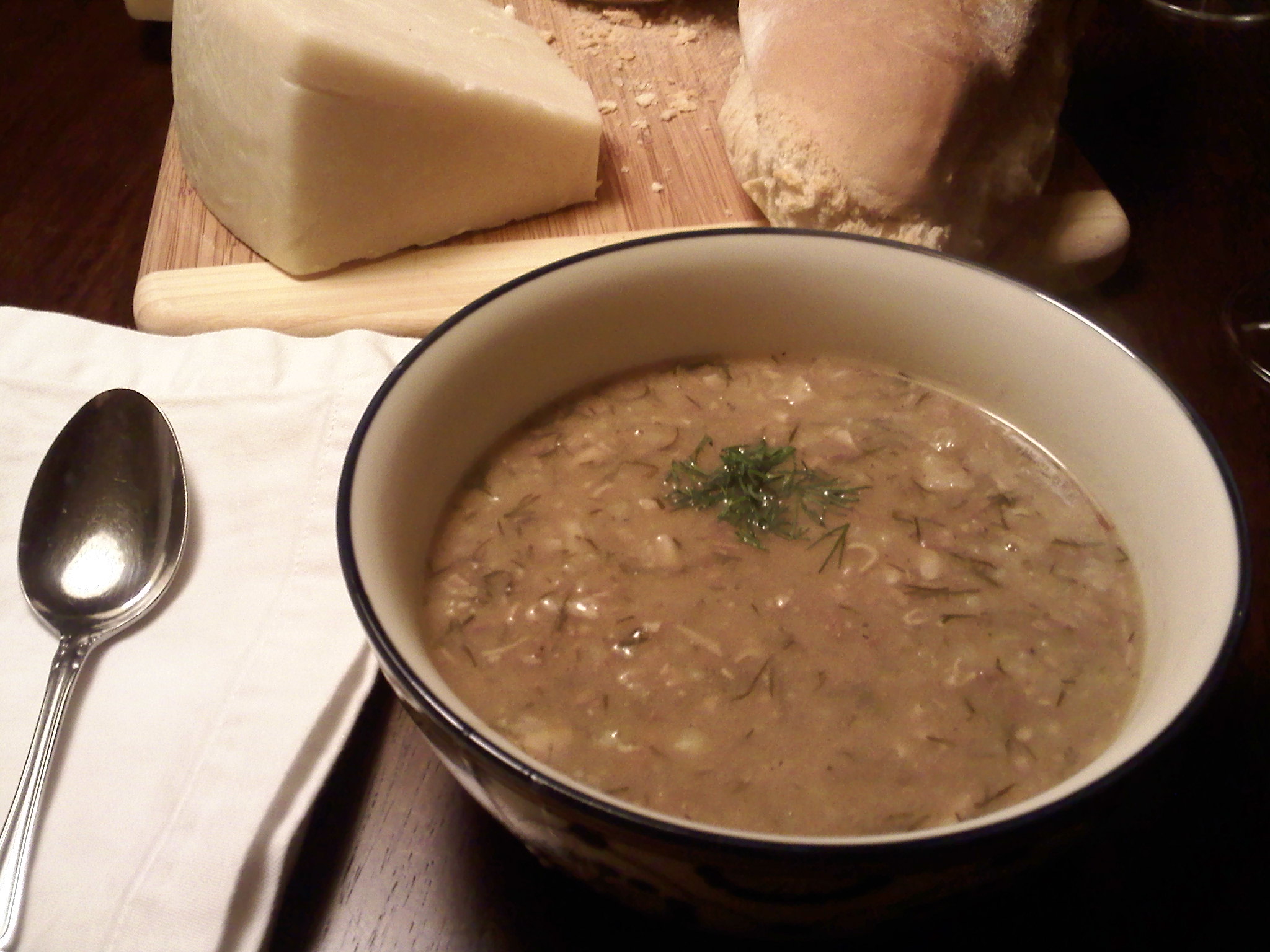
“Mageiritsa” is a Greek soup made of lamb offal that is made at – and only at – Easter.  It’s an incredibly time-consuming and labor- intensive production, which is probably why.  First comes the all-day or over-night simmering of the lamb’s heads and feet, to get the appropriately kelle paça type broth necessary.  (Kaleh pacheh seems to be a Friday after-prayer tradition in Afghanistan, so starting Thursday morning in front of all the butcher shops in Kabul, usually collected on one street, and by shacks along roads leading out of the city that seem to open just for that purpose, one sees giant piles of recently severed, bloody heads next to piles of bloody feet, both still in their fur, swarming with flies.  It’s a beautiful sight and one that, like so many other things in Afghanistan, I didn’t get a photo of while there because I thought I would embarrass people by taking pictures of things that I was afraid they would think I thought backwards.)  Then comes the cleaning out of faeces from about a football field’s length of lamb intestines (below), which is not that bad because they come from young animals that only eat grass anyway so it’s kind of the texture of baby poop.  (The European Union Daddy-State tried to ban the sale of intestines a few years ago and the Greeks to their credit, which I don’t grant them often, got into an uproar and Brussels backed down.  I actually have a theory that the intestine issue was the behind-the-scenes deal-breaker between the EU and Turkey, and rightly so; make me bend over backwards about how I run my country, make me reorganize my economy to enrich you and impoverish myself, treat me like an unwanted guest because I’m Muslim, but I’ll be damned if you take away my kokoreç.*)  Then you braise the intestines, and the sweetbreads (thymus glands) and hearts and kidneys in the broth (some people use liver or spleen and testicles too, but I don’t ‘cause the liver and spleen can get bitter and the testicles retain an unpleasant spongy texture when boiled which they don’t when grilled, or when sautéed with oil and a ton of garlic like they do with the bull’s balls in Spain after a bullfight — talk about sympathetic magic – and are quite yummy — see bottom.)  Then they’re all minced up, browned in a healthy amount of butter, added to the broth with lots of scallions and dill, some rice, and, just before serving, terbiye-d** with eggs and lemon.

Intestines

It’s generally acknowledged that I make the best mageiritsa in the world.  You can get pretty good mageiritsa lots of places, but mine is the best…in the world.  When I serve it at Easter, some people can’t get enough of it and some people politely decline.  Others, unfortunately – and tellingly, it’s usually younger Greek-American family – have always felt they have license to grimace and make faces of disgust and revulsion.

Mageiritsa — the finished product (click)

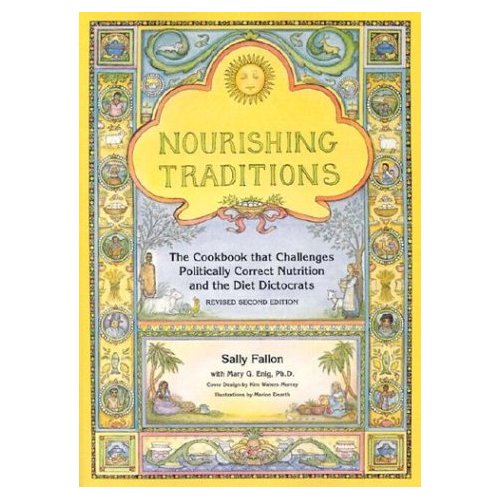
It’s bad enough that so much art and time and work on my part should be met with that kid of rudeness.  Then I have to listen to the anthropology tes poutsas about how people only used to eat that stuff because they were poor and they had to eat everything available, like eating intestines were the equivalent of the dirt-eating that tragically occurs in third world countries under famine conditions.  No they didn’t; they ate those things because they taste good.  Organ meats perform more complex biochemical functions in our and other animals’ bodies than muscle does; joints: feet and hocks, are complexly interconnected with tendons and cartilage of various kinds.  They therefore have more varied textures, mineral content and other elements, which gives them a richer and more varied taste than regular flesh has.  As mentioned in this brilliant book Nourshing Traditions: The Cookbook that Challenges Politically Correct Nutrition and the Diet Dictocrats by Sally Fallon, when a carnivorous animal (which we are, by the way; ignore false, scientifically faulty Vegan and Buddhist propaganda) kills another animal in the wild, the first thing it goes for are the guts because it instinctively knows they’re the most nutritious part.  Instead of teaching their kids the value and variety of our traditions or pointing out the beautiful economy with which our ancestors made use of every part of the animal, or their respect for and intimate knowledge of the world, the plants, and the animals which fed them, as opposed to our obscene wastefulness and complete alienation from any food which actually looks like food or reminds us of where it comes from, these people stupidly and condescendingly put it down to their poverty.

I never, ever heard anyone in older generations reminisce about the breast of any chicken or the dry, grey boti meat of a traditionally over-cooked Greek leg of lamb.  My mother used to wax nostalgic about an aunt’s Sunday pacha or the street kokoretsi they sold down by the lake in Jiannena next to the Karagöz puppet box (you’d get slices of it on wax paper, that or a cone of pumpkin seeds or a stick-full of pişmaniye and sit and watch Karagöz and Hacivat’s brilliant antics; I can’t be grateful enough that all these survived until I myself was a child.)  If a whole animal were roasted, the kids would fight over the head and its brains, tongue and the delicious, gelatinous cheek flesh.  And pig feet and andouillete are enjoyed in the best Parisian bistros, not just in supposedly impoverished Balkan or South American villages.

It’s a growing ecological disaster – a cultural one – and that’s what depresses me most.  We’re tangling ourselves (like most things modern, it starts in America but is spreading throughout the world) in such a neurotic, kosher-like web of food anxieties and hysteria that we’ll have soon lost access to half the things humanity used to enjoy at the table if we haven’t already.  I truly believe that it’s a phenomenon connected to the disappearance of other forms of diversity:

“All these seemingly disconnected events are the symptoms, you could say, of a global epidemic of sameness. It has no precise parameters, but wherever its shadow falls, it leaves the landscape monochromatic, monocultural, and homogeneous. Even before we’ve been able to take stock of the enormous diversity that today exists — from undescribed microbes to undocumented tongues — this epidemic carries away an entire human language every two weeks, destroys a domesticated food-crop variety every six hours, and kills off an entire species every few minutes. The fallout isn’t merely an assault to our aesthetic or even ethical values: As cultures and languages vanish, along with them go vast and ancient storehouses of accumulated knowledge. And as species disappear, along with them go not just valuable genetic resources, but critical links in complex ecological webs.”  — “In Defense of Differerence.”

“Oh, this is so salty.  Oh, this is so fatty.  Oh, this is so oily.  Oh, this must have so much cholesterol; I can feel my arteries clogging.  Eeew, this has liver in it.  It’s what?! Made with blooood?!”  (You can’t imagine how many people I’ve known who had heard of blood sausage but thought it was a metaphor.)  “Ugh, this is so sweet – I can’t take a second bite.”  We think we’re so sophisticated but are pretty much as incapable of thinking comparatively or relatively as an Amazonian tribe shooting arrows at airplanes.  It never occurs to us that fattiness, or cloying sweetness, or fishiness or gumminess were and are qualities that people enjoy.  One of the most interesting pieces of etymology that I’ve ever learned is that the word “funky” – one of the few African words to have passed into American English usage – actually means “stinky” in whatever West African language it comes from.  But it’s telling that it’s come to mean what it means for us: weirdly, pleasantly off-beat.  Cool — in a way you can’t put your finger on — ‘cause it’s off.  Get it?  Like certain French cheeses when they’re good and ripe and smell like your boyfriend’s unwashed underwear, or the obviously slimy texture and smell – the obviously slimy look even, with all its erotic overtones — of oysters or other raw seafood.  Funky.  Yum.

Even in foodie paradise New York — where curious Brooklyn Heights ladies are taking butchery classes and where you’ve started seeing more and more of the kind of tastes and smells I’m talking about on restaurant menus: tripe and boudin and fatback (and if that’s a good thing to you because you love good food, you’re indebted more than you know for that to one man: one of my best beloved heroes, Anthony Bourdain***, who wrote in his first best-seller, Kitchen Confidential: “My body is not a temple; it’s a playground.”) – try going out to dinner with a group of friends.  It’ll take several hours of conference calling before everybody’s food concerns and quirks are taken into consideration and then, if the night’s not over, you’ve ended up at a least common denominator restaurant where one of your group is still bound to torment a busy waiter with a barrage of anxious questions, requests for substitutions, no peanut oil, “light on the butter” or the resounding, echoing sound of “sauce on the side.”  This is most often a white girl who doesn’t cook (“sauce” is usually a fundamental component of a dish produced by the entire, holistic process of preparing it; you can’t put it on the “side;” it’s not the jarred tomato sauce you grew up eating, babe; you can’t make a blanquette de veau with the sauce on the ‘side,’ or a mole poblano with the mole on the side!) or it’s someone who has never worked in that business and has no idea what a tightly organized military operation a good New York restaurant is and what chaos that behavior throws both the floor and kitchen staff into, not to mention the offense to the chef himself and his line, who might not just be doing their jobs, but might actually be proud of the carefully conceived and prepared dishes they’re trying to put out.

I understand people have different tastes and that they even have different biochemical make-ups that might make certain tastes seriously unpleasant to them.  I mean, even Tom Colicchio doesn’t like okra, which I love, but I don’t hold it against him.  (I just know that he hasn’t eaten them properly prepared).  But the preparation and sharing of food is such a fundamental part of most human socializing and it’s become almost impossible to conduct in any civilized form through this thicket of prohibitions and fears. Which brings me to my final point: the social aspect, which includes issues of hospitality, personal pride, and what Greeks call philotimo, all heavily weighted and codified issues in ‘our parts.’

But my intestines need cleaning, so I’ll have to tackle the rest of this issue in another post.

*Kokoreç (shown below) is basically the same ingredients as mageiritsa but spitted and roasted.  The organ meats are spitted and the whole thing is wrapped around with the intestines like a giant andouillette.  In Greece, they cut it in slices and serve it like that, which I prefer.  In Turkey they usually mince it all up with red pepper after roasting and put it in a sandwich, which is delicious but doesn’t allow the texture of each constituent organ meat to be appreciated as much.

** Terbiye, what Greeks call augolemono, is supposed to be an egg-lemon liaison sauce used in many dishes or to thicken soups and is the greatest culinary hoax ever perpetrated on the peoples of the Near East.  Very simply, the recipe, as usually given, does not work, and does not produce a thickened sauce but a watery, sour mess.  When you make a béarnaise or a hollandaise you use minimal acid (vinegar or lemon respectively) only the egg yolks and pure butter, ideally clarified.  It’s impossible to scramble some whole eggs with lemon, pour some watery liquid out of a pot of cabbage sarma into it and expect that it will produce something comparable.  If you’ve ever seen a truly smooth, thick terbiye, some kind of extra binder (corn or regular flour) was added to it, and if the cook tells you otherwise she’s lying.  Never underestimate the tactics a Turkish or Greek woman (especially one from Istanbul) will resort to in order to protect her recipes and ensure no one else’s version is as good; lying is the least of it.

***Anthony Bourdain

My man Bourdain — get all his books here.

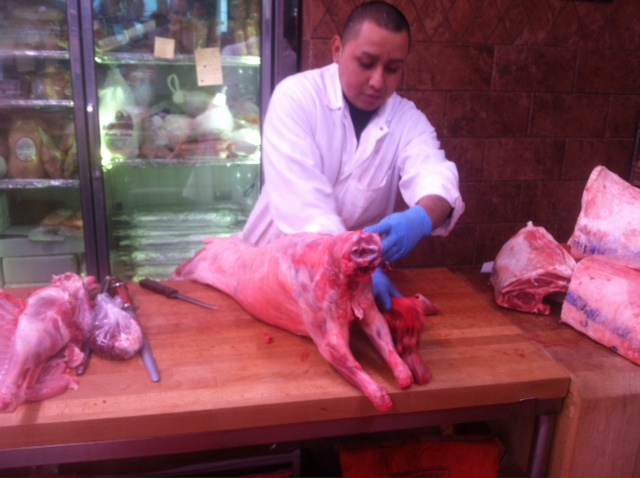
International Meats in Astoria, staffed almost entirely by Mexicans, who speak perfect Greek and know every detail of innards terminology in not only Greek, but Serbian and some Roumanian.  A Queens insituton.

Bull balls at International, with liver to the left, kidneys on the right, spleen on bottom left, hearts on bottom right.

Comment: nikobakos@gmail.com