

“Who ever lov’d who lov’d not at first sight?” Those who know that line know it’s Shakespeare from “As You Like It” – but actually it’s Shakespeare quoting Marlowe, a little homage to his more accomplished contemporary; interesting, particularly, because in my opinion Marlowe was a keener analyst of desire than Shakespeare, though I have only instinct and no textual support to back that up. The important thing is that it’s true. There’s now even science to support it; in “Narcissism Guides Mate Selection,” published in Evolutionary Psychology 2 (2004) Liliana Alvarez and Klaus Jaffe (?) write:
“Research has shown two bases for love at first sight. The first is that the attractiveness of a person can be very quickly determined, with the average time in one study being 0.13 seconds. The second is that the first few minutes of a relationship have shown to be predictive of the relationship’s future success, more so than what two people have in common or whether they like each other.”
And so it was with me and Toulouse. My first morning here I walked out onto the street at dawn, as the sun started coating the walls of the slightly pinkish brick that the whole city is built with and that was it. I think it actually took 0.9 seconds in my case. But I was finished. It was all over. I was lost, tumbling into that so familiar abyss. I had never fallen for a city so hard and so fast in my entire life.
Why? Well, “you can’t really say why you love somebody,” Stella says in Streetcar… but you try anyway, only because the temptations of let-me-count-the-ways and the attempt to grasp the ungraspable are so powerful.
To start with the most banal and obvious, it’s beautiful. Not a stunner, a Paris or a Florence or a Venice, but even more loveable because it’s not so perfect. Who wants every city to be Paris anyway? The medieval quarters are amazingly well-preserved and in the nineteenth-century neighborhoods it’s interesting to see the classic Haussmanian idiom of French cities translated into the local brick. But that’s not really it.
There’s the immediacy and availability of pleasure in all forms, somehow even slightly more than in the rest of France. Here, I’m reminded of Istanbul actually, because I think Turks might also have that same keen sense of “the brevity of time and the immediacy of pleasure” as the French do and even in Istanbul’s current hali, you feel, like in France, that you’re in the presence of a very ancient tradition of the production and consumption of luxury. New York tempts you at every turn as well, except New York makes you struggle so much to reach the promised gratification that it in the end it feels as if you’ve had it pulled through your nose, as the Greek expression has it.
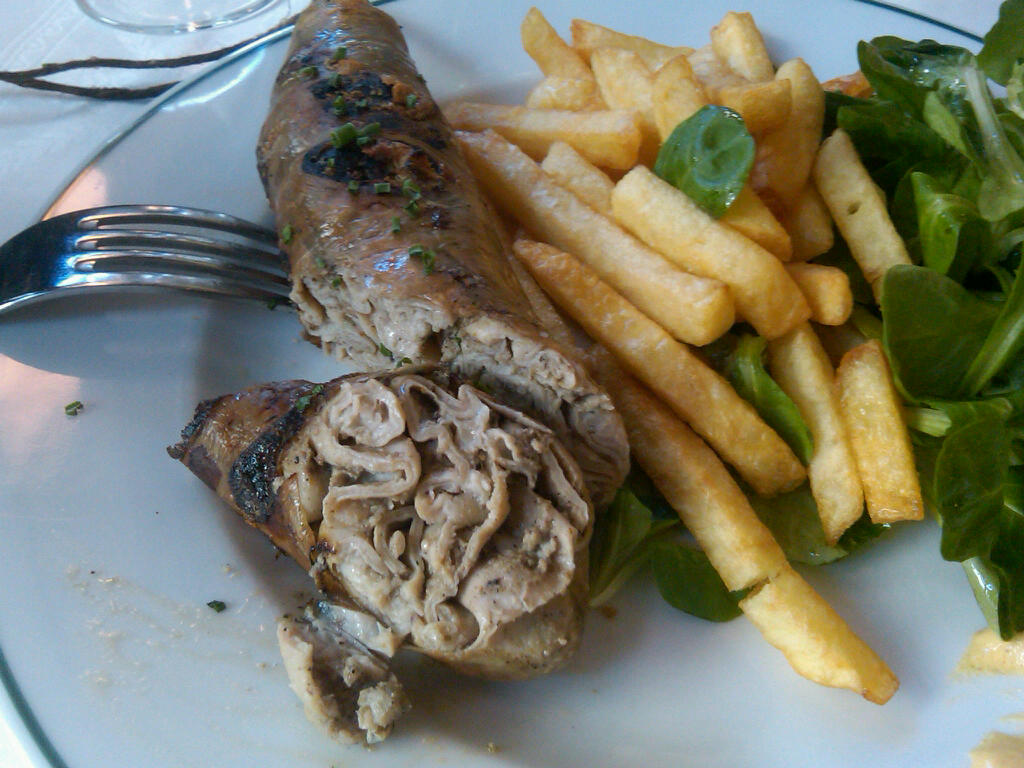
The food: though these things are eaten all over the country, this is the home turf of foie gras and pork belly and duck confit and restaurants that proudly assure their customers that their french fries are made in goose fat, the way McDonald’s promises you there are no trans-fats in anything. The wines are thick and rough and tannic and delicious; the only place where there’s no need to worry about ordering: whatever house red comes by the carafe is always perfect. The streets are filled with always-full bars and cafes and the disconcerting sound of talking, of discussion, I mean of people really conversing. Then it’s a university town, so it’s full of beautiful young people trying to fix all of their above oral fixations: talking and drinking and smoking and making out in public all over the place just like they should be. And it’s not just the young; that magical ability the French have to make it seem like they have more available leisure time than people in any other industrialized country is even more visible here than in Paris, to the point where even someone as anti-work as me sometimes wants to ask: “Does anybody here work?” And it’s not Italy, where everything is so homebound — all so tied to mamma’s apron strings — that most life happens domestically and out of view. Here, more like Spain, it’s out on the street, even in January; it’s public, like in the natural polis. It makes all the difference. You can feel people needing interaction hungrily, like Greece in better days, craving the stimulation of others.
(This is a characteristic of the French everywhere — this love, this need for language and the exchange of ideas, sometimes what seems like nothing but a deep gratifying pleasure taken in the sheer enunciating. It’s why — if you don’t speak any French at all and have no clue what people are talking about — every conversation you hear seems to have this tone of desperate urgency about it. That the French are rude or cold or unfriendly is patent bull-shit; they are absolutely none of those things — quite the opposite; but if interaction or closeness is sometimes a little difficult to achieve if your French isn’t at least very good, it’s the importance of language again that explains it. Sorry — I think they feel — but life is too short and there’s too much to talk about for me to help you with your halting French right now.)
And then there’s St. Sernin, the spectacular Romanesque basilica named after the patron saint of the city, which has become a major obsession of mine and in which I’m finding myself unable to keep from spending at least an hour every day. This may not be the most beautiful church in Europe but it’s certainly the most beautiful Romanesque church in Europe, and for me, therefore, the most beautiful, since I have what’s almost – no, what’s clearly — a powerful erotic attraction to the style. Knowing the renovation history of European ecclesiastic architecture, its interior is almost suspiciously austere, so I’m pretty sure it was re-Romanesqued or de-Baroqued, or however you want to see it, at some point. This happened a lot in the nineteenth century, when Romanticism made the mediaeval more attractive to people than anything that had to do with the seventeenth or eighteenth centuries: it generally involved stripping later decorative accretions from older churches and restoring their “purity.” Especially in southern Italy one finds this having been done fairly often, with mixed results: some before and after images I’ve seen of Sicily’s Byzantine churches seem successful; with the famous convent church of song and legend, Santa Chiara in Naples, they didn’t have a choice, since the Baroque church had been bombed by the Allies into a burnt shell and they rebuilt according to the original Gothic plan; others, like the practically made-up design of that silly Moorish cathedral in Amalfi, are clearly failures. But whatever distractions they removed from St. Sernin I’m all for: nothing should impede the soaring, muscled athleticism of this structure and the space it embraces so powerfully. It has to be seen — and felt, like flesh — to be believed.
St. Sernin is god-like; the building itself overwhelming the idea of whatever deity is supposed to be honored there. The city’s other churches are more human and all quirky in the extreme. There’s the Jacobins, named after some father monastery dedicated to St. Jacques and not those Jacobins; but still kind of jarring — like Our Lady of the Bolsheviks or something. Only in France. This church is described as having two naves, but only has one nave really, with a towering row of palm-like columns running right down the dead center (?) like the rope at a Hasidic wedding, so that the view of the apse and altar are obstructed from almost everywhere, so much so that mass is said at an altar set up against one of the side walls because if you’re further than even ten feet from the real altar you can only see it by peeking from around these, granted, beautiful columns. Then there’s the city’s cathedral church, St. Etienne. This was begun as an unusually low-arced and unusually wide Romanesque church, but that idea was apparently scrapped as not grand enough, so they continued the rest of the church in a higher Gothic style. The thing is it wasn’t continued on the same axis. So you enter the older Romanesque part, which now almost feels like an exonarthex in an Orthodox church, then the building’s axis makes a left turn, for about 50 feet, then a sharp right, then continues down the central nave. Later they pasted a Renaissance — but it being France, still slightly Gothicky — belfry onto the northwest corner of the façade, and at some point a shorter little clock tower in front of that, so that, as disconcerting as the interior is, the exterior looks like it was put together from leftover pieces of different Lego sets. And yet it works. Works the way that French girl in the bar can put on an orange sweater and purple scarf and make it work. And, like her, St. Etienne is quite elegant and well-loved by all, in fact. And almost every other church in the city is that kind of pastiche; they must’ve been some art historian, early post-modernist’s wet dream back in the eighties.
“History is a personal emotion for you” a good friend once told me, and all these buildings are obvious signs of a weighty, turbulent past. Is that why I fall in love? Because someone has a complicated past? What we used to call “baggage”? You don’t have to be too long immersed in Toulouse’s diffuse and slightly transgressive air of sexiness (a national poll apparently voted the local accent the hottest in France), or venture too far out into the surrounding countryside, which even in the dead of winter looks so lush and cultivatable that you half expect figs and quinces or roasted partridges from somewhere to fall into your lap, to believe that what we recognize as Europe’s first love poetry and, in fact, the West’s entire concept of Romantic love, as perverse and ridiculous as it seems to the rest of the world (and is: “Wait, you mean you’re supposed to not get what you want?” Yep. “And just pine and suffer forever?” Uh huh…) all come from this little corner of southwestern France.* In fact, so much of what’s considered quintessentially mediaeval in the popular mind took some consummate form in this region. And that includes the fact that so many of the skylofrangoi Crusaders that effed us over in 1204 came from around here. But that no longer matters, you see. Because while the Pope’s apology for the sack of Constantinople in 2004 left me cold, Toulouse and love have taught me to forgive.
That brings us to the crusade which brought an end to all that love and poetry. If they think you know no history, which the French automatically assume about anyone who speaks American English, people here will talk to you about the Albigensian Crusade like it happened last week. The ostensible purpose of this “crusade” was to eliminate a group of heretics that were probably never such a large percentage of the population of southern France; I think a popular Dan-Brown-type interest in “alternative” Christianities has perhaps exaggerated the importance of the Cathars, who were actually weirder than any mediaeval Mormons one could imagine. But it was the perfect excuse, with the blessing if not egging on of the Always and Eternally Holy See, for the kingdom of France and its northern dependents, to go on a conquering rampage throughout the independent duchies and counties of the south, decimating and depopulating whole swaths of the most urbanized, prosperous and sophisticated part of Europe and ending, as well, Europe’s first vernacular literature by destroying the court culture that supported it and reducing its language, Occitan or Provencal, to a despised folk dialect. This strikes all the chords in my personality that are peculiarly sensitive to the marginalized, the subjected, the memory abandoned, the tradition vanished, the lost, the forgotten — “all those things you know and tell me of, things that are long dead,” as the lyrics of a favorite Greek song testify.
(It’s why I love the Italian South as well. And it would maybe be why I’d love the American South too, if there weren’t so much else so ugly about it.)
So does that explain it? I don’t know. Who did you fall in love with Stella? Obviously someone completely in love with himself. That’s a powerful draw, isn’t it? Self-confidence. Probably goes for France as a whole. We think they’re all that because they’re so obviously convinced of it themselves, and that’s fine with me: “Great souls are always loyally submissive,” Carlyle said, “reverent to what is over them: only small mean souls are otherwise.” But even for France, I have never come across a city or a population so cocksure confident of their specialness than Toulouse and the Toulousains. Remember, we’re not far from D’Artagnan’s hometown here, and actually, if there’s any truth in the exaggerated cliché that Toulouse is a little bit of Spain in France (when it’s really Barcelona that delusionally thinks it’s a little bit of France in Spain), it’s that people’s comportment here has a definite element of swaggering, almost Spanish majeza** to it; and add that to the already elaborate culture of French flirtiness and you get a heady mix for sure. And it’s the only city in France where rugby is more wildly popular than soccer and that tells you something too. St. Sernin, come to think of it, is built like a rugby player.
So is that it? I dunno. A mix of all that? Self-confidence bordering on the sweetest kind of arrogance? Sophistication with a definite rough edge? A behind the scenes complexity you don’t see all of, not at first at least, if ever? Something quirky and slightly off: “There is no excellent beauty that hath not some strangeness in the proportion” as another Brit said? I don’t know. And probably don’t really care. I just know how it feels. And for those of you who have made it this far, sorry, I have no images of the Beloved to share — just the bricks. He’s all mine.
— For G., Toulouse, January 2014
–
Comment: nikobakos@gmail.com
–
**********************************************************************************************************************************************************************************************
* The most powerful, searing contemporary treatment of Romantic or Courtly love in all its cancerous beauty is Kaija Saariaho’s 2002 opera, L’amour de loin (Love from Afar) with a libretto by Lebanese writer Amin Maalouf. It’s based on the real, historical figure of Jaufre Rudel, a 12th century Aquitanian prince and poet who fell in love with a Toulousainne princess married to the Count of the Crusader state of Tripoli in Syria (makes Maalouf’s collaboration even more interesting) without having ever seen her. The music and poetry are beautiful and the opera’s psychological insights are razor-sharp — disturbingly so. The end leaves you in pieces on the floor — me at least. You’ll never come closer to the soul of Majnun in the desert than this.
It’s a shame only one aria is in Occitan; it would’ve been a real coup and homage if the whole libretto were. Get the DVD; Dawn Upshaw has to be seen and not just heard.
**Majeza,n., or majo, adj.: you can read the whole post where the meaning of this word appears previously: “Un Verano en Nueva York”, but if not, here’s the quote from it:
“Majeza is a very Spanish term that encompasses such a complex of qualities that it’s difficult to explain, especially in English, which is tragically lacking in a comparable term, as its speakers (aside from the Irish) are in most of its qualities. It means openness and frankness and humour and swagger; it means being hospitable without being in anyway servile; it means being able to put away copious amounts of wine and pig meat; being friendly and spirited and generous while always maintaining a kind of stylish dignity and flair; it partakes of some of the qualities of Greek and Turkish leventeia in that sense; in fact, it’s a word with a certain undoubtable Balkanness about it. Soon after the term appeared in, I think, the late eighteenth-century, working-class barrios of Madrid, it almost immediately became associated during the Napoleonic Wars with the city’s street kids, who terrified the French with their suicidal bravery, so it probably originally implied a quickness to pull a knife too and no squeamishness about seeing a little bit of your own blood shed as well. That doesn’t apply anymore, though the ferocity into which demonstrations in Madrid have descended these days makes you think twice about that; I’m proud of the angry tenacity of the Spanish protests; don’t know what they’ll accomplish but it’s good to know Spaniards can still be scary; that anger has become such a stigmatized, pathologized emotion in our civilization (“You know…I think you have a lot of anger…”) is partly what’s let banks and governments get away with what they have over the past few decades and generally has brought us to the civilizational crisis we find ourselves in. No, it’s not the other way around. In any event, courage is still certainly an implied element of being majo. There’s a great, chapter-long analysis of majeza in Timothy Mitchell’s Blood Sport: A Social History of Spanish Bullfighting, if you’re interested and can get your hands on it.”








 Jadde: from Bosnia to Bengal