

And still so indigestibly ugly.
Corfu is such a depressing rebuke to the ugliness of most other Greek οικίσμοι, urban or rural. Who would look at this photograph and not think Italy or southern France first? Or, who doesn’t go to Corfu and at some point ask himself: “Hmmm… What if all Greek lands had been Venetian colonies for four hundred years instead of Ottoman?”

************************************************************************
Write us: with comments or observations, or to be put on our mailing list or to be taken off our mailing list, contact us at nikobakos@gmail.com.
Anastasios Antoniou@AnastasiosAA
Turkey just renamed John Kennedy Avenue in Varosha to Semih Sancar Avenue. Semih Sancar was Turkey’s chief of armed forces in 1974, when Turkey invaded Cyprus. Mr Erdogan’s vulgarity has no limits.
8:33 AM · Nov 24, 2020·Twitter for iPhone

************************************************************************
Write us: with comments or observations, or to be put on our mailing list or to be taken off our mailing list, contact us at nikobakos@gmail.com.
I like that they dress the women up in a way that recognizes Constantinopolitan Greeks’ deep, deep bourgeoisness and αστισμό — perhaps the most precious thing we lost through that community’s destruction. But Polites didn’t talk with that weird accent and that thick Turkish “λ”. They spoke perfect, accentless Modern Greek.
Anyway, I guess it’s significant and positive that they remain an archetype Greeks are still conscious of.
************************************************************************
Write us: with comments or observations, or to be put on our mailing list or to be taken off our mailing list, contact us at nikobakos@gmail.com.
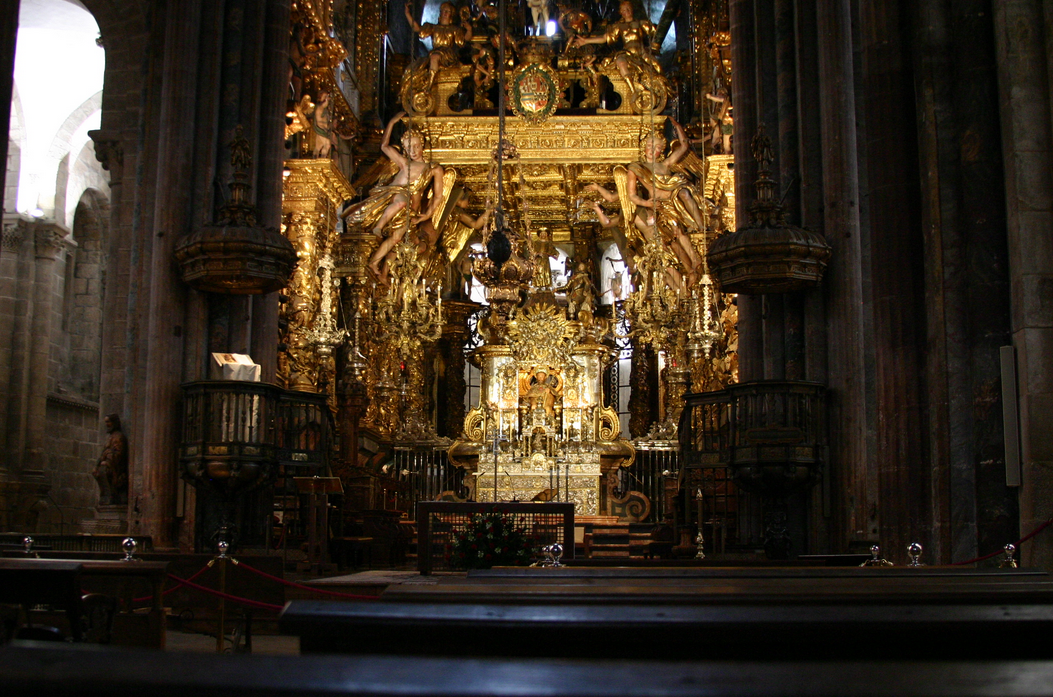
Byzantine Ambassador, in another informative piece, talks to us about the Spanish cult of Santiago.

Outside Rome the West lacked the relics of important apostles. This was rectified in Venice by the theft of St Mark the Evangelist from Muslim Alexandria in AD 828. Not to be outdone by the Adriatic pirates, however, the Spanish promptly discovered St James the Greater’s tomb at the Galician fishing town of Padron at some point between 818-42.
The interior and exterior (below) of the cathedral of Santiago in Santiago de Compostela, Galicia, Spain.

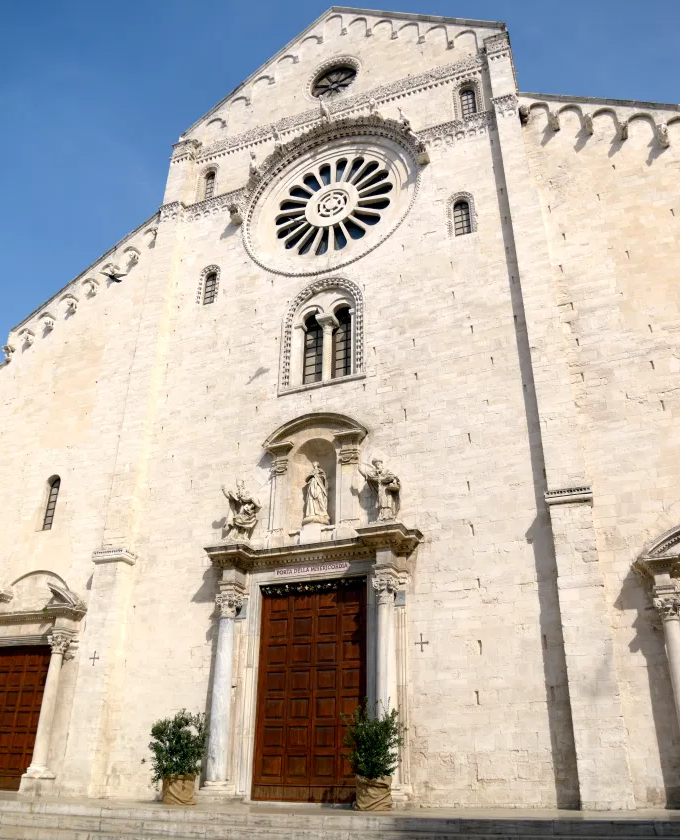
Just to add… Bari rectified a lack of relics by stealing the remains of St. Nicholas of Bari from the city where he had served as bishop, Myra in Asia Minor/Anatolia.
The Cathedral of St. Nicholas of Bari below; I love the combo-contrast between the austere Romanesque of Norman churches in southern Italy and later Baroque additions, like the ceiling here.

***********************************************************************
Write us: with comments or observations, or to be put on our mailing list or to be taken off our mailing list, contact us at nikobakos@gmail.com.
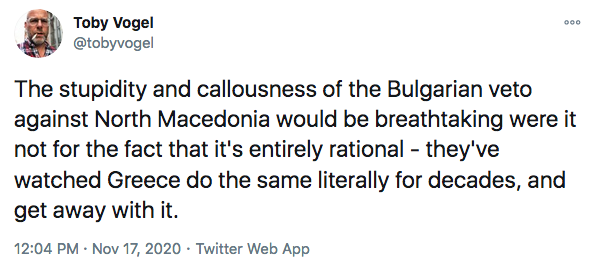
And here some serious shade gets thrown Greece’s way. :)

Check out whole thread here.
And see full story here on Balkan Insight:

***********************************************************************
Write us: with comments or observations, or to be put on our mailing list or to be taken off our mailing list, contact us at nikobakos@gmail.com.

Turkish president Recep Tayyip Erdoğan is scheduled to make an official visit to Turkish occupied northern Cyprus tomorrow. He has announced that he will “picnic” in the city of Famagusta/Amochostos/Αμμόχωστος, which has remained a unoccupied no man’s zone between Greeks and Turks since the 1974 invasion. Turkey has refrained from settling Turks from Anatolia in this part of Cyprus and it has — since the invasion — been seen as a sort of potential bargaining chip between the island’s two communities. Erdoğan’s visit is a clear symbolic statement that that will no longer be the case.
The protest is a sign of hope (though yes, the second video below contains a lot of Turkish gloating). It’s also an indication of the moderately nationalist and genuinely secular and modern identity of Turkish Cypriots. It was a real mistake on Greek Cypriots’ part to harass them as they did in the 50s and 60s, alienating and painting them into a corner.
************************************************************************
Write us: with comments or observations, or to be put on our mailing list or to be taken off our mailing list, contact us at nikobakos@gmail.com.
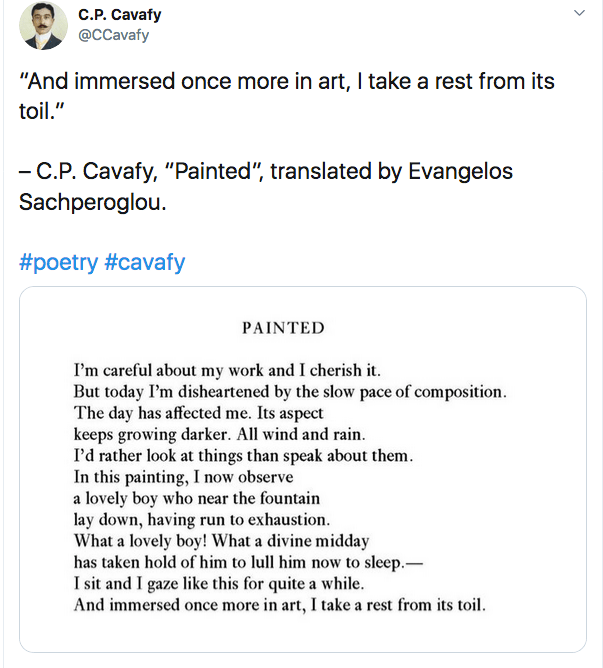
Την εργασία μου την προσέχω και την αγαπώ.
Μα της συνθέσεως μ’ αποθαρρύνει σήμερα η βραδύτης.
Η μέρα μ’ επηρέασε. Η μορφή της
όλο και σκοτεινιάζει. Όλο φυσά και βρέχει.
Πιότερο επιθυμώ να δω παρά να πω.
Στη ζωγραφιάν αυτή κυττάζω τώρα
ένα ωραίο αγόρι που σιμά στη βρύσι
επλάγιασεν, αφού θ’ απέκαμε να τρέχει.
Τι ωραίο παιδί· τι θείο μεσημέρι το έχει
παρμένο πια για να το αποκοιμίσει. —
Κάθομαι και κυττάζω έτσι πολλήν ώρα.
Και μες στην τέχνη πάλι, ξεκουράζομαι απ’ την δούλεψή της.
(translation comment: it’s a “spring” — βρύσι — not a “fountain”. Fountain sounds built and marble and urban, as in Trevi… Spring better suits the pastoral, Arcadian setting that I think Cavafy’s mind has wandered into in this poem.)
From: George Kessarios@GKesarios Check out GK for fuller-size image, since WordPress doesn’t let readers do that anymore.
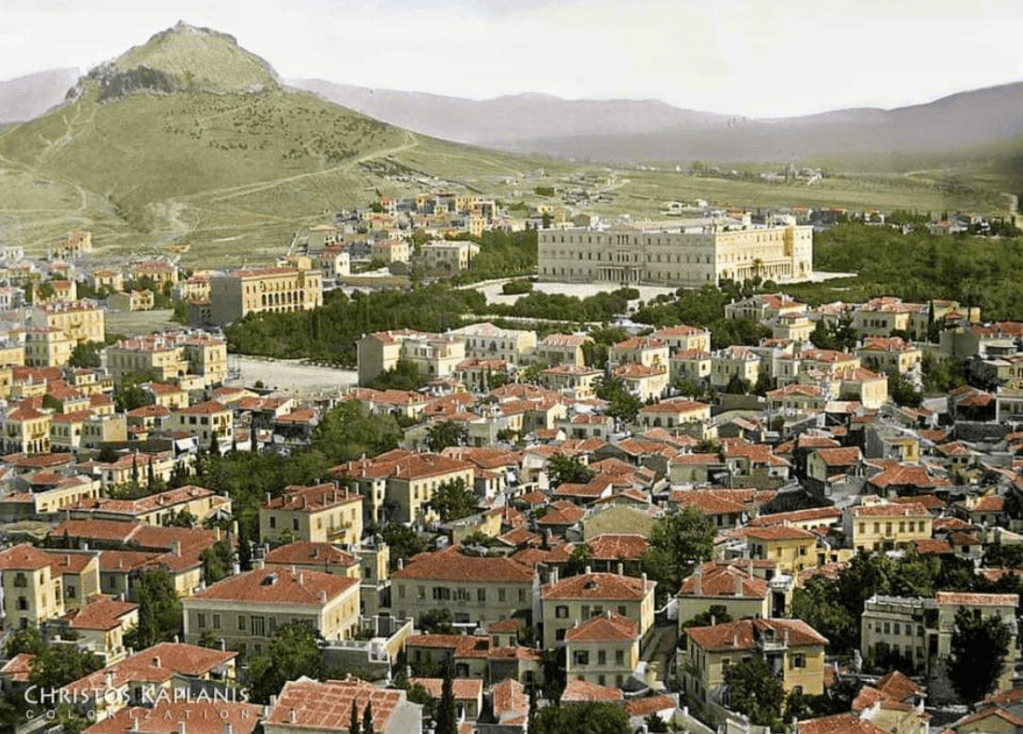
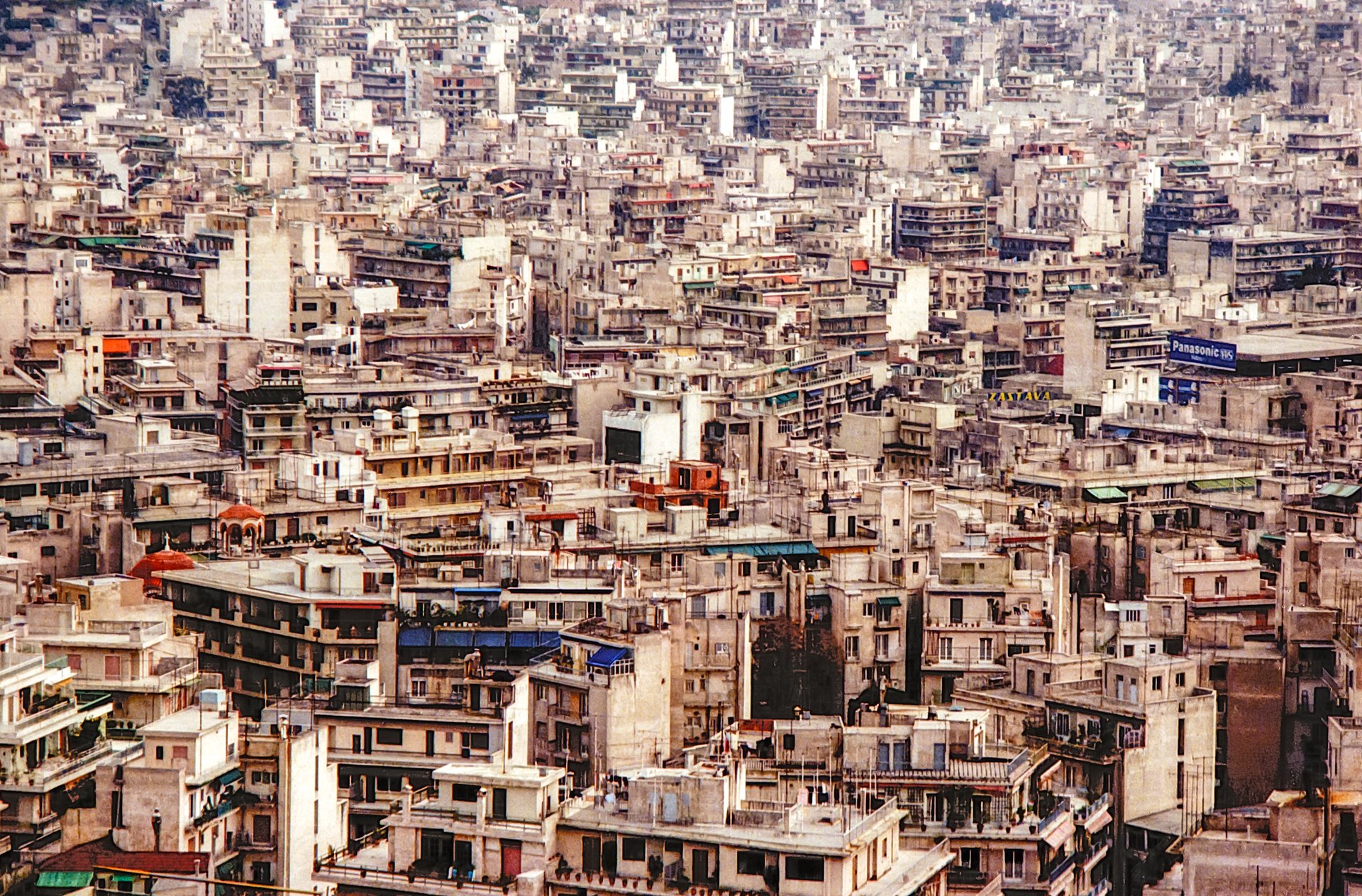
These photos are beautiful, but always also depressing, given what we’ve done to Athens, which was once one of the most beautiful cities in Europe/Mediterranean.* If you’ve been to Hermoupole/Syra on the island of Syros or to Nauplio in the northeast Peloponnese — think one of those two on a much grander, Bavarian Neo-Classical, large Haussmanian boulevards and public square scale, and that was Athens until the 1960s. No other city in Europe or the Med — that wasn’t bombed in the war or which wasn’t subjected to the psycho-whims of a Stalin-type dictator — was so wholly destroyed by its own inhabitants; 80% of Athens’ pre-WWII building stock is gone.

************************************************************************
* An exception in the Mediterranean might be Beirut. And by that I don’t mean the whole-scale destruction the city endured through the war/s of the 70s and 80s, but that even before that the city’s pre-concrete architecture had suffered large-scale destruction to be replaced by the Mediterranean beton apartment house whose only saving grace is their large balconies. I don’t have this on any source other than old photos I’ve seen and from the great Samir Kassir‘s magisterial Beirut. That said, in watching news and footage of last month’s beyond-belief destructive explosion, one of the things that surprised me was how much nineteenth and early twentieth-century architecture had survived…survived only to be trashed in 2020.

If you’re interested in a deep immersion in traditional Beiruti architecture, try and find (won’t be easy) Jennifer Fox‘ 1987 documentary: Beirut: The Last Home Movie, about the Greek Orthodox Bustros family in what I think is Achrafieh. It’s almost entirely shot in their family home and it’s a stunning look at the time-warp, physical, cultural and psychological ecosystem of the Levantine bourgeoisie. Yes, many of you will think it’s just a romanticizing of “elite minority supremacism” as my buddy X likes to say (IMBd says: “The movie shows how spoiled the Bustros family members really were, even during the horrors of the war.”) So I dunno — hold your nose, then, and watch it.


************************************************************************
P.S. Back to Athens and lead photograph — is there anyone else out there who thinks our much-mocked Parliament (at the time of photo above it was still the Wittelsbach Royal Palace) is actually a handsomely austere and Doric and impressive building? People seem to think it’s blocky and dreary and the quintessence of Neo-Greek, neo-classical, Hellenic-wannabe pretensions. But similar architecture in Munich isn’t as disliked; it may be thought creepily Teutonic, but nobody makes fun of it. And I think it’s gorgeous.

Below, von Klenze‘s (responsible for much of the construction, street plan and general idea behind modern Athens) Propylaea in Munich’s Königsplatz.

The whole panorama of the Königsplatz below.

And the reason it might make some people nervous:

************************************************************************
 Jadde: from Bosnia to Bengal