Tag Archives: Indian Islam

The Dark Lord

12 May

In a previous post, April 10th “A Dancing Girl,” I wrote about the ubiquity of Krishna-Radha imagery in Indian culture, from the obvious traditionally religious contexts to Bollywood cinema.  Sudhir Kakar, Indian psychologist and I guess all around cultural critic has a very interesting analysis of the Krishna archetype in Indian cinema.  He contrasts him, the playful phallic teaser, with the Majnun archetype, the distraught, longing lover (“majnun” means crazed in Arabic, the same Semitic root as “meshugeh” in Yiddish), setting up an interesting Hindu-Muslim interplay between the two:
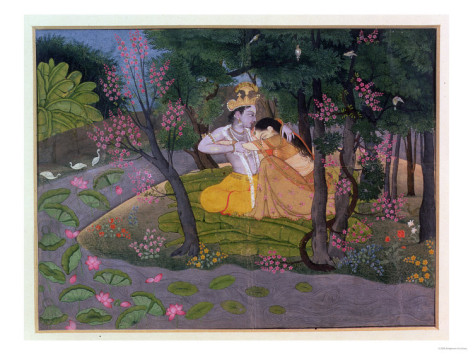
“The Krishna-lover is the second important hero of Indian films.  Distinct from Majnun,the two may, in a particular film, be sequential rather than separate.  The Krishna-lover is physically importunate, what Indian-English will perhaps call the “eve-teasing” hero, whose initial contact with women verges on that of sexual harrassment.  His cultural lineage goes back to the episode of the mischievous Krishna hiding the clothes of the gopis (cow-herdesses) while they bathe in the pond and his refusal to give them back in spite of the girls’ repeated entreaties.  From the 1950s Dev Anand movies to those (and especially) of Shammi Kapoor in the 1960s and of Jeetendra today, the Krishna-lover is all over and all around the heroine who is initially annoyed, recalcitrant, and quite unaware of the impact the hero’s phallic intrusiveness has on her.  The Krishna-lover has the endearing narcissism of the boy in the eve of the Oedipus stage, when the world is felt to be his “oyster.”  He tries to draw the heroine’s attention by all possible means – aggressive innuendoes and double entendres, suggestive song and dance routines, bobbing up in the most unexpected places to startle and tease her as she goes about her daily life.  The more the heroine dislikes the hero’s incursions, the greater his excitement.  As the hero of the film Aradhana remarks, “Love is only fun when the woman is angry.”

“For the Krishna-lover, it is vital that the woman be a sexual innocent and that in his forcing her to become aware of his desire she get in touch with her own.  He is phallus incarnate, with distinct elements of the “flasher” who needs constant reassurance by the woman of his power , intactness, and especially his magical qualities that can transform a cool Amazon into a hot, lusting female.  The fantasy is one of the phallus – Shammi Kapoor in his films used his whole body as one – humbling the pride of the unapproachable woman, melting her indifference and unconcern into submission and longing.  The spirited, androgynous virgin is awakened to her sexuality and thereafter reduced to a groveling being, full of a moral masochism wherein she revels in her “stickiness” to the hero.  Before she does so, however, she may go through a stage of playfulness where she presents the lover with a mocking version of himself.  This in Junglee, it is the girl from the hills – the magical fantasy-land of Indian cinema where the normal order of things is reversed – who throws snowballs at the hero, teases him, and sings to him in a good-natured reversal of the man’s phallicism, while it is now the hero’s turn to be provoked and play the recalcitrant beloved.”

—  Intimate Relations: Exploring Indian Sexuality, Sudhir Kakar

Bollywood classicists will probably object to my not using one of the above-mentioned actors as a movie clip example, but I’ve chosen to use recent meteor-hottie Imran Khan instead:

Not that Imran Khan…  No relation to Shahrukh Khan either or Salman Khan, but the nephew of Aamir Khan — just in case you doubted how nepotistic Bollywood is, how full of super-size Khan egos it is, or how disproportionately Muslim the industry is, a fact that usually remains unspoken.  Other than his still teenage swagger, which the other Khans are getting a little too old to pull off, I think Imran is so perfect in the role of this archetype because he has those exaggeratedly large, murti-like* eyes and eyebrows that so many Indians have and have such deep religious significance and symbolism.  “Darshan,” or the viewing of a deity, is usually centered on the eyes — on a visit to any temple one will usually find at least one devotee staring endlessly into the god’s eyes — and Hindus believe that the deity’s energy does not come to reside in an image until that very final moment when its pupils are painted in.

Anyway, here’s Imran with his Gopis, in the title number of the 2010 I Hate Luv Stories, playing the Dusky One to perfection (though as in Kakar’s classic trajectory, he’s later humbled into the Majnun lover):

And for those old-schoolers, here’s SRK, perhaps the central casting expert at the type, in the wedding scene from Kabhi Khushi Kabhi Gham, the wedding he’s impudent enough to crash because he’s smitten with the bride’s sister and shows up to hit on her.


*”Murti” is the image of a deity in Hinduism, any image: statue, painting, drawing, cheap print from the kiosk.  Obviously I don’t use the word “idol,” with its reek of monotheist condescension and demonization, as I generally consider monotheism — all of them — to be something of a plague and a great historical tragedy.  We’ll just have to do the best we can with what we have for now.

Comment: nikobakos@gmail.com

Begum Akhtar

11 May

Still the undisputed queen of the sung Urdu ghazal and a figure of great and deep love for Agha Shahid Ali:

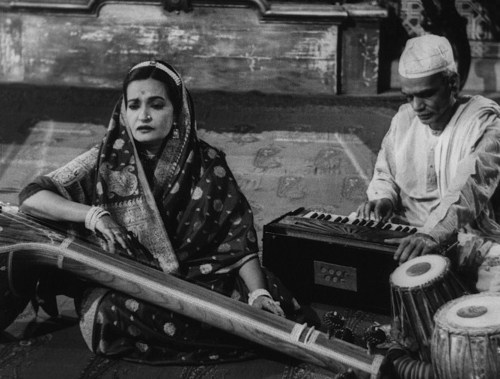
And below, in Satyajit Ray’s 1958 Jalsaghar (The Music Room), though here I need to own up to my ignorance and admit that I’m not sure if she’s singing a ghazal or thumri or some other genre.  It’s also extremely annoying and, to say the least, odd, that Ray would disrespect her performance so much by pasting most of it over by cutaways of the audience and especially the film’s idiot nouveau-riche neighbor who doesn’t even know what he’s listening to:

Begum Akhtar in Jalsaghar : (not allowed to embed it, logic of which I never understood…)

Here’s a photo anyway and more info: Begum Akhtar


Comment: nikobakos@gmail.com

Agha Shahid Ali

11 May

Talk of poetry, the Delhi Wallah and Kashmir (May 10, “Favorite Blogs: The Delhi Wallah”) made me think of one of my favorite poets of the past few years, the Kashmiri-American — I guess one would call him — Agha Shahid Ali, a prolific poet who wrote about the ghazal, edited a book of ghazals in English: Ravishing DisUnities: Real Ghazals in English and wrote a collection of his own ghazals in English: Call Me Ishmael Tonight a tiny volume that obsessed me for months the first time I got my hands on it.  That one of the most beautiful men I’ve ever known — a friend and the saqi at a bar in Astoria I used to go to — introduced me to it didn’t hurt either.  “Strange and beautiful” he called them, and I still do, and often think that the one must always by necessity partake of the other to some extent: in poetry, in religion, in the physical beauty of a man or woman, in an idea…

Here’s part of Ali’s description of the genre:

“The ghazal is made up of couplets, each autonomous, thematically and emotionally complete in itself… once a poet establishes the scheme—with total freedom, I might add—she or he becomes its slave. What results in the rest of the poem is the alluring tension of a slave trying to master the master.”

In Arabic

A language of loss? I have some business in Arabic.
Love letters: a calligraphy pitiless in Arabic.

At an exhibit of miniatures, what Kashmiri hairs!
Each paisley inked into a golden tress in Arabic.

This much fuss about a language I don’t know? So one day
perfume from a dress may let you digress in Arabic.

A “Guide for the Perplexed” was written–believe me–
by Cordoba’s Jew–Maimonides–in Arabic.

Majnoon, by stopped caravans, rips his collars, cries “Laila!”
Pain translated is O! much more–not less–in Arabic.

Writes Shammas: Memory, no longer confused, now is a homeland–
his two languages a Hebrew caress in Arabic.

When Lorca died, they left the balconies open and saw:
On the seat his qasidas stitched seamless in Arabic.

Ah, bisexual Heaven: wide-eyed houris and immortal youths!
To your each desire they say Yes! O Yes! in Arabic.

For that excess of sibilance, the last Apocalypse,
so pressing those three forms of S in Arabic.

I too, O Amichai, saw everything, just like you did–
In Death. In Hebrew. And (please let me stress) in Arabic.

They ask me to tell them what Shahid means: Listen, listen:
It means “The Beloved” in Persian, “witness” in Arabic.

Agha Shahid Ali (1949-2001)

More here: Poetry Foundation

Some more mundane info on the ghazal: Ghazal

“In Arabic” “Reprinted from The Veiled Suite: The Collected Poems by Agha Shahid Ali. English translation copyright © 2009 by Daniel Hall. With the permission of the publisher, W.W. Norton & Company, Inc.”


Comment: nikobakos@gmail.com

Favorite Blogs: The Delhi Wallah

10 May

The Delhi Wallah: Your gateway to alternate Delhi, the city of Hazrat Nizamuddin Auliya and Arundhati Roy is one of my favorite sub-continental blogs and even has the endorsement of the great historian and travel writer Walter Dalrymple: “The Delhi Walla is Delhi’s most idiosyncratic and eccentric website, and reflects a real love of this great but under-loved and underrated city.”  The work of the assumedly pseudonymed Mayank Austen Soofi, the blog really is written with the true tenderness that only a great city fallen on slightly hard times can inspire.  One thinks of Orhan Pamuk’s Istanbul, written about his youth in that city before it became the ISTANBUL! it’s become since the 1990’s.

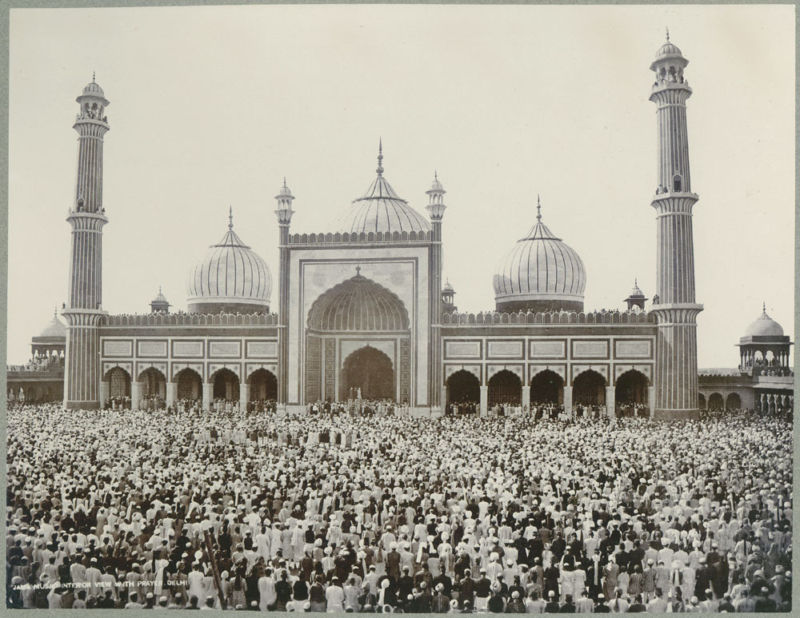
Delhi’s Jama Masjid in the 1890’s

Anyone who knows me, and some who don’t but might have already picked it out from this blog, know that I’m interested in all of India and even engage in certain Hindu practices and rites but that my true fascination is the Mughal culture of the northern Doab heartland.  This comes from — just among myriad things — the composite, deeply syncretic and super-elegant aesthetic of that culture and, more personally, from a deep affinity for lost worlds and for the dignity maintained in the face of the most tragic circumstances under which Indian Islam, much like the Byzantines, not only laboured but continued to flourish for so long.

Bahadur Shah, the last reigning member of the Mughal dynasty

When I read Dalrymple’s masterpiece, The Last Mughal, The Fall of A Dynasty 1857 I was left shell-shocked, not just by the sheer scale of the Indian Rebellion’s violence, but by the mindless, post-conflict destruction of the vindictive and obviously terrified Brits, determined to teach Indian Muslims a lesson for their “mutiny.”  Even the outer walls of the Red Fort and the Jama Masjid itself were saved at the eleventh hour by the orders of more intelligent superiors.  It makes my head spin to think that had the cooler heads that the British so pride themselves on prevailed, Delhi today would still be a showcase of Muslim art and architecture on a par with Isfahan and Cairo or even Istanbul.

The Red Fort in Delhi, once the largest palace complex in the world, eighty per cent of which was dynamited by the British after the Indian rebellion was crushed. (click)

One can read about how upper-class Muslim life in north India proudly soldiered on into the twentieth century in books like Ahmed Ali’s beautiful Twilight in Delhi or made it through the trauma of Partition and modernity in films like Garm Hawa and Sardari Begum.  (For a fairly insightful look — but one that doesn’t really tackle the most radical questions — at Indian Muslim life in the cinema seeIslamicate Cultures of Bombay Cinema by Ira Bhaskar and Richard Allen but all these can’t help but strike a certain elegiac tone.

But…what I love about the Delhi Wallah is what detailled coverage he brings you of how alive and well Muslim life and culture in Delhi still are: mushairas, qawwali gatherings, celebrations at sufi tombs — and not just Hazrat Nizamuddin Auliya’s — old ruins and mausoleums he’s constantly digging up among the chaos of the modern city — and the glorious food.  He has a four-volume guidebook to the city and he’s recently done a beautiful four-part photo op and piece of his trip to Kashmir.  Don’t miss this blog!


Comment: nikobakos@gmail.com

A Dancing Girl

10 Apr

A “dancing girl” giving us another vision of divine love…

Madhuri Dixit, maybe the most spectacular woman the gods have ever given us, playing the courtesan with the heart of gold, Chandramukhi, in perhaps the twentieth film version of Sarat Chandra Chattopadhyay’s 1917 Bengali novel Devdas, dancing a beautiful, if heavily Bollywood-ized, kathak — when she was four months pregnant…  They don’t make ’em like that anymore.  Kathak is a form of classical north Indian dance that always tells the story of the love between Krishna and Radha (Krishna an avatar of Vishnu, Radha often said to be an avatar of Lakshmi, in Hinduism’s dizzying, endlessly intelligent loops of shape-shifting.)  One of the reasons I love Kathak so much is that it’s a form developed primarily in the Muslim courts of North India, heavily Persian-derived in many of its elements, that tells a Hindu story.  One wishes that that kind of fecund inter-generosity characterized all of India’s history.  More on Kathak: http://en.wikipedia.org/wiki/Kathak  I’ll try and find more classic versions of it at some point soon.

Much to be said on Devdas.  Even more to be said on the erotic adventures — sweet, playful and tortured — of Krishna and Radha, which is the background music to, and occupies a huge space in, the collective unconscious of Indian sexuality; its imagery is ubiquitous; it turns up everywhere, sneaking up on you like Krishnaji himself on the banks of the Yamuna.  The breaking of Radha’s bangles by the adolescently phallic and annoying Krishna — “Why do you tease me so?” — who’s a god nonetheless, is one of the most powerful erotic images I know of.  When a religious culture understands that the soul in the presence of God is a flustered young woman being teased by a hot guy, there’s really nothing else to say.

Shahrukh Khan and Madhuri Dixit in Sanjay Leela Bansali’s 2002 Devdas (click)

Comment: nikobakos@gmail.com