Tag Archives: Israel

Jerusalem: “…if he cannot control her, he would rather see her dead.”

3 Jan


ISRAEL-superJumboJerusalem’s light rail trams, once a haven of normality, have come under attack in recent months. Rina Castelnuovo for The New York Times  (double click)

A line from an op=ed piece by

“Yet, with all their talk of Jerusalem’s indivisibility, neither side has a plan to enable everyone to live functional, productive lives here.

“Both sides profess their love for this city, but they love it as a violently jealous man loves a woman: If he cannot control her, he would rather see her dead.”

It says it all, and lends itself to a powerful explanation of why the fiercest nationalist is usually a male.  If I can’t have her, who cares.  Better yet, kill her, Stella-style.  This is what Venizelos was thinking when he embarked on his pipe-dream in 1919; this is what he though at Lausanne when agreeing to the Population Exchange — he had already run through several population exchange scenarios in his head with which he might seduce the Allies and bring himself glory; 1923 wasn’t the first time he had expressed such ideas.

This what Milošević was feeling when he abandoned Krajina’s Serbs to their fate and then again when he sealed the fate of Kosovar Serbs by thinking he would expel its 90% Albanian population.

This is what that other raging ego-maniac Jinnah was thinking when he convinced people to cut the heart out of Muslim India and create two dysfunctional wing statelets, one of which barely survives in horrible destitution, the other ruled by a series of some of the most hideous, corrupt, mendacious regimes in the world (see October 6: “It’s not even a country; it’s a fuckin’ acronym!”)

This is what the Messenger thinks when he starts shrieking from his Mussolini balcony: “And I don’t give a shit about Anatolian Hellenism or Politikes Kouzines or Loxandres!!! [.] I care about what’s good for Greece!!!”  Or when he stands ten kilometers from my father’s village “…where my ancestors held on tooth and nail to their land, their religion, their language, for centuries – as every other people have the right to — looks out over the valley of Dropoli and thinks out loud: “These borders could have been drawn to better advantage for us. All that was necessary would’ve been a few key population exchanges…”

The weird “contentlessness of nationalism” as I’ve said many times before.  It doesn’t matter what it is.  Or what it becomes.  It just has to be mine.  Or set a match to it.

Comment: nikobakos@gmail.com

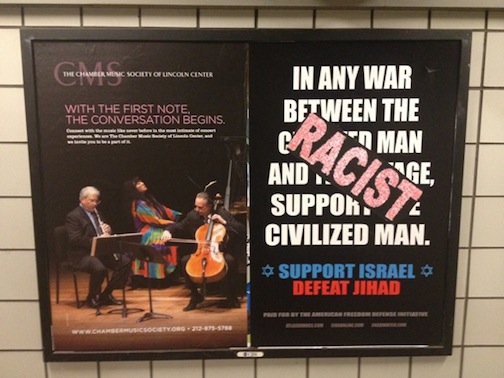
New Yorkers Plaster ‘Racist’ Stickers Over Islamophobic Subway Ads

28 Sep

From Thinkprogress.org:

By Ben Armbruster on Sep 25, 2012 at 9:15 am

After the anti-American protests erupted in the Middle East earlier this month, Pam Geller’s American Freedom Defense Initiative (AFDI) decided to re-up its anti-Muslim ad campaign in New York’s subway system. The ad, borrowing from an Ayn Rand quote, is meant to imply that Muslims are savages.

New York City transit authorities did not want to display the ads but a federal court said refusing the ads would violate AFDI’s First Amendment rights. But now that the ads are up, New Yorkers are taking matters into their own hands, writing “RACIST” and “HATE SPEECH” over the ads in certain subway stations […]

AFDI is trying to run a similar campaign in the Washington DC Metro but authorities there have so far been successful at blocking the campaign “out of a concern for public safety.” (HT: Mondoweiss)

Even Fox News, who has promoted Geller in the past, called her group’s ads “inflammatory” and “anti-Muslim.”


Comment: nikobakos@gmail.com

“Israel is the answer.”

24 Sep

From Andrew Sullivan’s The Dish, “Is Netanyahu Trying To Blow Up The Election?“:

“There is no just war theory on earth that can justify a pre-emptive strike against nuclear facilities which have not been used to produce a weapon in a country whose Supreme Leader has explicitly called a “sin” to deploy.

“As for a radical regime in terms of international relations, which country in the Middle East has launched more wars than any other since its creation, has occupied territory it has then sought to ethnically re-balance, has killed civilians outside its borders in the thousands, has developed a nuclear capacity outside of international non-proliferation treaties, has physically attacked both Iraq and Syria to destroy their nuclear programs, and is now threatening war against Iran, a war that could convulse the entire world into a new clash of civilizations?

“Israel is the answer. I have no doubt that this new incident of anti-American Salafist violence [response to anti-Muhammad video] in the Middle East is now being used by prime minister Netanyahu to concoct a casus belli with which to scramble global events and get rid of Obama – and his continuing threat to Israel’s illegal expansionism.”


Comment: nikobakos@gmail.com

A reader writes: “Tishabuv?”

24 Sep

(Sorry…only now getting a chance to respond to some of these)

The Arch of Titus in Rome, built to commemorate the Roman suppression of the first Jewish revolt in 70 A.D. (click)

In reference to Jadde posts: “Romney in Israel: How High To Jump?“and “Tisha B’av?,”  “Jewish London” writes: 

“it seems appropriate that he should visit on Tisha B’Av, a day when great calamities befell the Jewish people”

Oooooofffff…  This is like teaching…when you’ve spent hours researching and preparing, and then another half hour conducting, a brilliantly detailed and structured, thrillingly executed lesson on participial phrases, only to have one student, while you’re catching your breath right after, ask a question that proves none of the class has understood shit the entire time you were lecturing.

My point was simply that there’s a genre of Ashkenazi jokes, among the many, based on “When is Tishabuv?”  Beinart’s point, “Mitt Romney Misuses Judaism…” is that in the long tradition of Rabbinic and Talmudic learning, Tishabuv has been a time to reflect on why a certain tragedy has struck Jews and not just commemorate that tragedy in a victimized and ad nauseum form.

Yes, brother, “terrible calamities befell the Jewish people” on Tishabuv.  The Second Temple, the One and Only House of God in the One and Only Holy City, was levelled.  Jews were slaughtered in unbelievable numbers.  In trying to figure out whether these events happened as part of the Roman response to the Jewish rebellion of 70 A.D. or that of 135 A.D. — which has never been clear to me — I learned that there’s a trend of Jewish mystical thought that fascinatingly believes all Jewish tragedies occurred, occur and will occur on Tishabuv: the selling of Joseph into slavery; Moses’ shattering of the first tablets at seeing the Jews revert to idolatry; the destruction of the First Temple and the Babylonian captivity; the destruction of the Second Temple; the first massacre of European Jews at the beginning of the Crusades; the issuing of the Edict of Expulsion from Spain in 1492; the day the first train left for Auschwitz – all become mystically assimilated into Tishabuv.  That’s a tragic and moving idea.  However, I do know that the Roman suppression of the revolt of 135 A.D. was so brutal in its massacre and expulsion of Jews that it’s easy to say that it officially marks the beginning of the Jewish Diaspora.

Tishabuv is also intimately related to Jewish messianic thought.  The revolts themselves were partly inspired by messianic expectations.  And the crushing of those hopes by the greatest cluster of disasters to befall Jews before the Holocaust made Rabbinic thought retreat into the sharpest of all cautions against any such expectations.  This, I suspect, is what marked the final rupture between Christian Jews and the rest of Jewry.  It’s not that Jews didn’t succumb to the temptation again.  Kabbalism is a mystic desire to correct the world that is a barely concealed messianic impulse.  And there was the great fever of messianic ecstasy that swept the Jewish world in the seventeenth century, when Sabbatai Zevi, a rabbi from Smyrna, started declaring himself the Messiah – one of the most fascinating and, in the end, sadly absurdist, episodes in Jewish history.  Zevi, either a con artist or a psychotic, had raised Jewish expectations to such a frenzied pitch, that when he ended up converting to Islam and becoming a ward of the Sultan, it sent shockwaves of psychological distress, not only through Ottoman Jewry, but throughout the entire Jewish world; in fact, due to renewed persecution and massacres at the time in Eastern Europe, the effects on Ashkenazi Jewry may have been even greater than on Sephardim.  The crisis sent the Eastern European Jewish universe careening into two different directions: on the one hand a trend that reemphasized Rabbinical textualism and that eventually responded to the Jewish Enlightenment, the Haskalah, the movement out of Germany that attempted to bring European Jewry into the modern world; and on the other, a retreat into the most introverted mysticism, out of which Hasidism, and an even greater immersion in Kabbalistic thought, grew.  To some extent, this split is one that old New York Jews still codedly refer to, whether they know it or not, as “Litvaks” and “Galizianers” (explanation in subsequent post).  See Michal Waszynski’s 1937 film version of S. Ansky’s Dybbuk.  I think there’s no greater primary text of Jewish spiritual impulses and its conflicts.

Lili Liana as Lea, the bride who becomes possessed by the spirit of her wronged beloved on her wedding day to another man, in Waszynski’s 1937 Yiddish film, the Dybbuk. (click)

(Two interesting notes that I’d like to make here.  One is that the Jewish revolts of the early first millennium were partially led by political groups whom we, today, wouldn’t hesitate to compare to, not only the first New England Puritans, but even the Taliban, and who engaged in certain tactics, like the surprise slaughter of masses of innocent civilians that we like to associate with Palestinian “terrorism” – or that of…errrr….Irgun, Haganah, the Stern Gang, Mssrs. Ben Gurion and Begin and all the rest.  The other is that maybe the real basis of Tishabuv jokes is still unconsciously based in messianic expectations, the way older Greek women who, say, have missed a bus, will mumble: “Oy, now we’ll be waiting till the Second Coming.”)

But if “Jewish London” is to understand my point, he needs to better understand the transformation that Tishabuv has undergone in Israel since its founding, because I suspect that, not living among the most vibrant Diaspora communities in the world, Israel is his model.  Obviously, Zionism didn’t need to worry about the Messiah, since it had solved the “Jewish Question,” as must be obvious to anyone who throws even a cursory glance at the Middle East today and sees the peace and happiness in which Jews there live can attest to, and no Messiahs need apply anymore.  Tishabuv had been forgotten by the Jewish Diaspora, reduced to such an obscure holiday that it was the object of humour; I’ve lived most of my life in a city, and worked for a great part of it in an environment, where, believe me, it was impossible to not know that a great, or even just important, Jewish feast was being celebrated or was coming up, and Tishabuv wasn’t one of them.  In Israel, however, the “secular” Jewish state raised Tishabuv to new, official status as a holiday-fast day.  But not as a day of introspection; but as a day to remember, as “Jewish London” puts it, “a day when great calamities befell the Jewish people.”  This is because “calamities” are Israel’s justification for being; it was Israel’s down-payment and it’s still how it pays its mortgage; it’s the currency in which it trades.  And the ignorant Romney’s visit to the Western Wall with Netanyahu or whoever on that day, was just another slimy exchange in that same currency — and, in fact, a dishonour to centuries of Jewish suffering.

But back to the Diaspora, and a time when Judaism hadn’t locked itself into a barricaded nation-state.  More than just self-reflection and introspection, the repeated, century-after-century dashing of Jewish hopes may have generated an even more important element in the Jewish psyche: doubt.  The great Christopher Hitchens, quotes the equally great Rebecca West in his introduction of her book, Black Lamb and Grey Falcon, and her own ruminations about the origins of anti-Semitism:

“West reflects on the virus of anti-Semitism, shrewdly locating one of its causes in the fact that ‘many primitive peoples must receive their first intimation of the toxic quality of thought from Jews.  They knew only the fortifying idea of religion; they see in Jews the effect of the tormenting and disintegrating ideas of skepticism.’”

That’s why on Easter night, the night of the Resurrection, I always remember to have one, only one, glass of wine that’s offered to the suspicion – the same one born out of the fact that Elijah never actually walks through that open door at Passover — that this whole idea is bullshit.

So what is Tishabuv for (when we know when it is)?  Introspection, moral responsibility, skepticism, doubt and the saving beauty of being eternally able to convert suffering into humour and irony – these last may be the most important — a pretty whole summation of what Jews have given us, given me, at least.

When “Jewish London” can tell me what Israel has given us, he should let us know.  These Days of Awe might be the perfect time to think about that.


Comment: nikobakos@gmail.com

Tisha B’Av?

13 Aug

Sorry, but it’s pretty funny that Romney’s trip has made of Tisha B’Av such a central metaphor for contemporary Israeli politics and the problematics of Jewish conscience (see previous post).  In old Ashkenazi humour — at least as I know it from Brooklyn — Tisha B’Av, Ti-shabuv in Yiddish pronunciation, is used ironically because it’s such an obscure holiday that no one ever knows when it is.

“When is he gonna finally paint the kitchen?  Who knows?  At Tishabuv…”

“If you’re waiting for the perfect girl to come along, you’ll be waiting till Tishabuv…”

And the like…

But Beinart’s piece, Mitt Romney Misuses Judaism to Support Israel and Buttress His Own Campaign, is truly beautiful, expressing the best tradition of Jewish moral self-reflection, which time and again has saved them and saved us too, in ways too complex to get into here:

“Sorry, but that largely misses the point. Tisha B’Av is less about steeling Jewish resolve against our enemies than fostering self-reflection about the Jewish misdeeds that allowed those enemies to prevail. The Talmud says that God allowed the Babylonians to destroy the First Temple because the Jews committed idolatry, bloodshed, and sexual sins. Similarly, the Romans are bit players in the Talmud’s intricate explanation of the chain of Jewish sins that led to the Second Temple being destroyed. Among those sins—none of which easily lends itself to a GOP stump speech—are “baseless hatred” among Jews and a concern for ritual stringency so obsessive that it trumps concern for human life. [my emphases]”

What other people, even if they lapse so often and so often tragically, are so honest and clear-eyed about their faults?


Comment: nikobakos@gmail.com

Romney In Israel: How High To Jump?

13 Aug

It’s almost two weeks old already but I felt obliged to reproduce this sum-up of Romney’s Israel trip from Andrew Sullivan’s Dish because it’s such a thorough review from all quarters:

30 Jul 2012 12:54 PM

149487385

Haaretz’s Barak Ravid goes over the speech:

The speech itself sounded as if it could have been written by Netanyahu’s bureau. So it’s no surprise that when the two met later for dinner, Netanyahu thanked him for his “support for Israel and Jerusalem.” In general, Netanyahu embraced Romney as no Israeli prime minister has ever before embraced a candidate running against an incumbent U.S. president: Aside from their working meeting in the morning, Netanyahu also hosted Romney and his wife and sons for dinner at his official residence.

The crowd told you everything you need to know:

Religious American immigrants dominated the crowd; secular Jews and native-born Israelis were few and far between. Those present included Jewish-American millionaires, settler leaders like the former chairman of the Yesha Council of settlements Israel Harel, and former Netanyahu aides such as Dore Gold, Naftali Bennett, Ayelet Shaked and Yoaz Hendel.

Settlers and religious fanatics: it’s striking how the entire foreign policy position of the GOP in the Middle East has essentially been out-sourced to the Likud. The reasons for that, one senses, are multiple. The most powerful way that Romney can win over the religious right, given his past wobbliness on such issues as abortion and gay equality, is to back the Likud and its associated religious parties in their twin goals: permanent occupation of the West Bank and a war against Iran. That’s what the Christianists passionately believe in. Moreover, adopting wholesale the Israeli position – that Iran cannot enrich uranium even for peaceful and inspected purposes – is tantamount to declaring war, either by Israel or the US. In office, how will Romney not back Netanyahu in whatever he wants? And not because he has made an assessment of the realities of America’s interests in the region, but because any daylight between Romney and Netanyahu would produce a revolt among the pro-settler, end-times Christianist right that now runs the GOP. 

Notice how often Romney cited “providence” for Israel’s establishment and prosperity. Notice how for Romney, there is no more glowing characteristic of a nation than its economic wealth (a sign of its holiness). Note how the democratic revolutions in the Arab world, wished-for by Bush, encouraged by Obama, are now dark forces for Romney, because they might elevate Islamism in the Middle East in the short or medium term, and if you are Israel (but not necessarily America) that must be countered immediately.

I honestly don’t know whether Romney in office would follow the logic of this long campaign – he spoke platitudes about “a two-state solution” which his chief funder, billionaire fanatic Sheldon Adelson, has contempt for. But I do think his cartoonishly neocon posture in the Middle East is a huge liability and makes a return to Bush-Cheney global polarization more likely. Then there’s the tone-deaf issue:

Mitt Romney told Jewish donors Monday that their culture is part of what has allowed them to be more economically successful than the Palestinians, outraging Palestinian leaders who suggested his comments were racist and out of touch with the realities of the Middle East…

“It is a racist statement and this man doesn’t realize that the Palestinian economy cannot reach its potential because there is an Israeli occupation,” said Saeb Erekat, a senior aide to Palestinian President Mahmoud Abbas. “It seems to me this man lacks information, knowledge, vision and understanding of this region and its people,” Erekat added. “He also lacks knowledge about the Israelis themselves. I have not heard any Israeli official speak about cultural superiority.”

More pro-Israel than many Israelis; and too jejune to know you keep these sentiments quiet. Frum applauds the speech and says it helps Obama, because Romney was acting “as ‘bad cop’ to the administration’s ‘good cop,’ intensifying pressure on the Iranian regime to do a deal now—before the next administration offers yet tougher terms.” Oookaay. What strikes me as more significant is that Romney is the first presidential candidate not to endorse a two-state solution along 1967 lines with land-swaps. That’s a huge victory for the Israeli far right.

Shifting focus, Goldblog calls the timing of Romney’s photo-op at the Western Wall “vulgar”. Beinart elaborates:

In his Jerusalem speech, Romney went on to insist that “we cannot stand silent as those who seek to undermine Israel voice their criticisms. And we certainly should not join in that criticism.” But Tisha B’Av [the fast day that commemorates the destruction of the First and Second Temples] is all about the importance of criticizing Jewish behavior; that’s why, on the Sabbath before it, we read a portion of the Torah in which Moses rebukes the Jewish people before they enter the land of Israel. Obviously, some criticism truly is destructive and unfair. But to use Tisha B’Av to suggest that the country that most clearly wishes Israel well—the United States—should never publicly disagree with Israel’s actions isn’t just bad foreign policy. It’s bad Judaism.

Relatedly, Juan Cole lists the “Top Ten Most Distasteful things about Romney Trip to Israel.” One obvious one:

It is distasteful the Romney will not commit to a two-state solution within 1967 borders or demand Israel cease illegal squatting on and unilateral annexation of Palestinian land. If he is going to this Middle East hot spot, why doesn’t he visit a Palestinian refugee camp so as to understand the nub of the dispute, instead of hobnobbing with the uber-rich in Jerusalem.

Because understanding the nub of the dispute would mean empathizing with Muslim Arabs and getting outside his comfort zone. Romney, alas, can barely empathize with his own dog.

(Photo: US gaming tycoon Sheldon Adelson arrives to hear Republican presidential candidate, former Massachusetts Gov. Mitt Romney delivers foreign policy remarks on July 29, 2012 in Jerusalem, Israel. Romney is in Israel as part of a three-nation foreign diplomatic tour which also includes visits to Poland and Great Britain. By Lior Mizrahi/Getty Images.)


Comment: nikobakos@gmail.com

Moron…panderer, etc.

30 Jul

From The Washington Post: Romney faces Palestinian criticism for Jerusalem remarks

“As you come here and you see the [Gross Domestic Product] per capita, for instance, in Israel which is about $21,000 dollars, and compare that with the GDP per capita just across the areas managed by the Palestinian authority, which is more like $10,000 per capita, you notice such a dramatically stark difference in economic vitality,” Romney said, according to a pool report.

In fact, the difference is far more stark than that. According to the World Bank, Israel’s GDP per capita is actually $31,282. The same figure for the Palestinian areas is around $1,600.

Romney said he had studied a book called “The Wealth and Poverty of Nations,” searching for an answer about why two neighboring places–the U.S. and Mexico, for instance, or Israel and the Palestinian areas–could have such disparate prosperity.

“Culture makes all the difference. Culture makes all the difference,” Romney said, repeating the conclusion he drew from that book, by David Landes. “And as I come here and I look out over this city and consider the accomplishments of the people of this nation, I recognize the power of at least culture and a few other things.”

Romney also said he recognized “hand of providence in selecting this place [Israel].”

And Palestinian official Saeb Erekat responds:

“It is a racist statement and this man doesn’t realize that the Palestinian economy cannot reach its potential because there is an Israeli occupation,” Erekat said.

“It seems to me this man (Romney) lacks information, knowledge, vision and understanding of this region and its people,” he added.

To say the least…  Romney also stated that he would back Netanyahu on “anything” he chose to do on Iran.  Nice.


Comment: nikobakos@gmail.com

‘K guys, you can pull your pants up now.

29 Jul

Mitt in Israel…maybe the only foreign country that’s an obligatory campaign stop in an American presidential election,

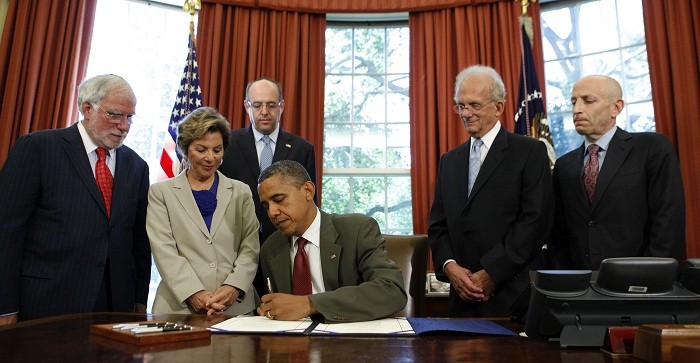
…as Obama signs away $70 million to them for their new “Iron Dome” rocket defense system, whatever that is, on the same day.


Comment: nikobakos@gmail.com


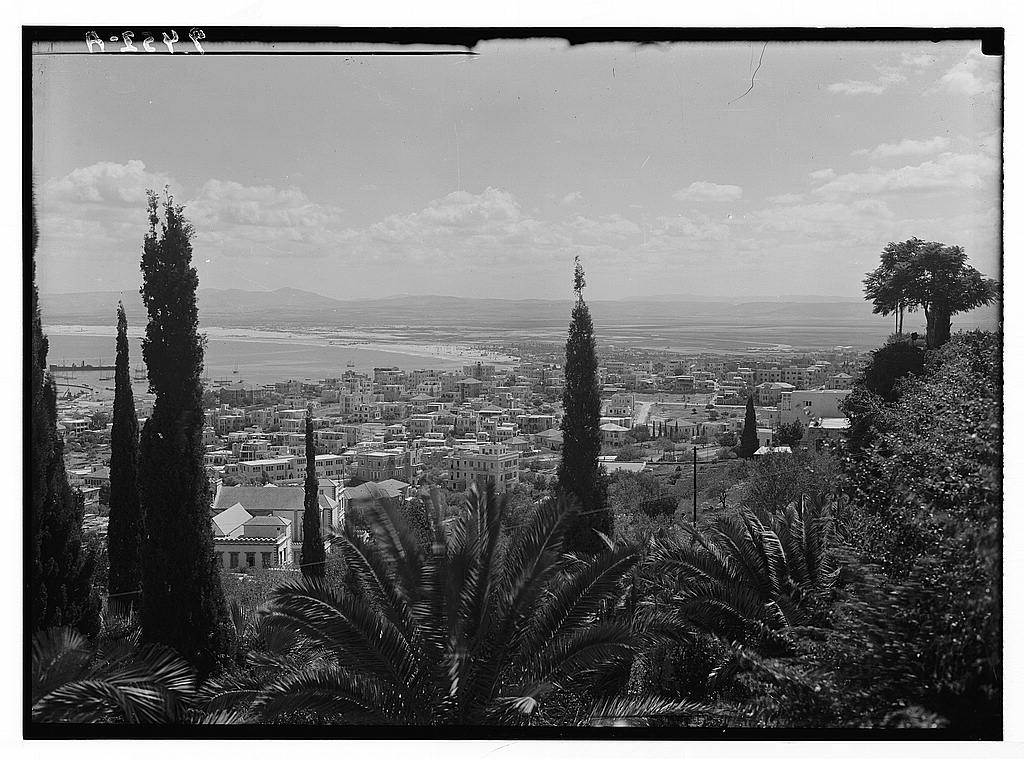
Turns out he’s the patron saint of Haifa

20 Jul

Duh…  Of course, Elijah on Mount Carmel…

An Arab icon of Elijah — and Haifa (click)


Comment: nikobakos@gmail.com

Balkan Trilogy

5 Jul

Olympic year or not, London has always had it all over us in terms of theater — in variety, quality, daring and in its still central role in the city’s life:

“Perhaps the most logistically ambitious part of the festival was Globe to Globe, in which leaders of Shakespeare’s Globe Theater spent nearly two years lining up 37 international theater companies to mount one of the plays in their native languages at the Globe over six weeks this spring. The shows included a new “Balkan trilogy” with theaters from Serbia, Albania and Macedonia each performing one of the three parts of “Henry VI” — not coincidentally a play about civil war — as well as productions of “The Comedy of Errors” from the Afghan troupe Roy-e-Sabs and “The Merchant of Venice” from the Habima theater company of Israel (which drew protesters waving Palestinian flags).”

Give the guys a break, dudes, they’re doing “The Merchant of Venice.”

And Afghans doing “The Comedy of Errors” is too perfect.

London, 1666 (click)